In This Article
The Ultimate Revolution in Backyard Avian Observation
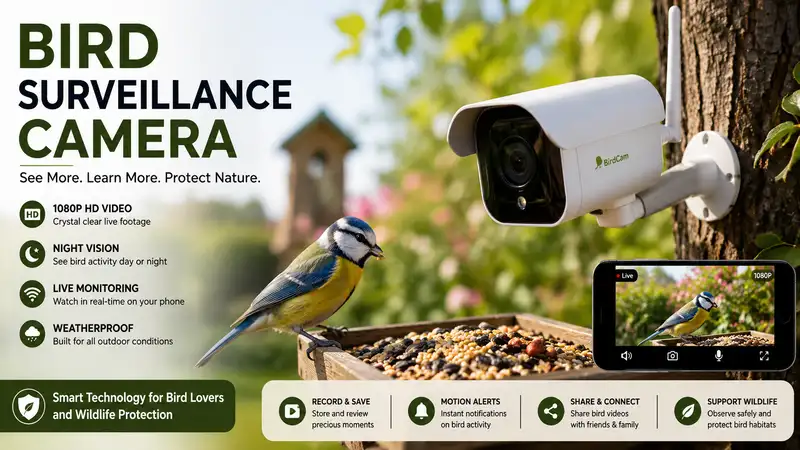
Backyard birdwatching has undergone a massive technological shift over the last few years. For decades, enthusiasts relied on standard optical binoculars or bulky telephoto lenses that required hours of motionless patience. Today, deploying a dedicated bird surveillance camera allows you to capture intimate, high-definition moments of local wildlife right from your smartphone. What is a bird surveillance camera? It is a specialized digital imaging device engineered with short-focus lenses, weatherproofing, and smart motion sensors optimized to record high-speed avian activity at close range without disturbing natural behaviors.
In my ten years of field-testing backyard wildlife setups, I have seen too many enthusiasts waste money on generic home security systems. Standard security units fail because their focal lengths are tuned for human-sized targets ten to thirty feet away, leaving tiny songbirds looking like blurry, distant smudges. A true bird surveillance camera requires unique optical properties, such as a crisp macro-focus range and ultra-fast wake-up times to capture sudden flight patterns. According to research published by the Cornell Lab of Ornithology, documenting local avian populations contributes significantly to community science and tracking seasonal migration shifts.
When choosing an imaging system for wildlife, you must look past basic marketing buzzwords. It requires understanding how light interacts with compact image sensors under heavy tree canopies. Let us dive into the modern market landscape to see how the top models stack up against each other in real-world environments.
Quick Comparison of Top Avian Monitoring Devices
The table below provides a snapshot of the leading choices available for backyard enthusiasts looking to upgrade their monitoring hardware.
| Model Selection | Primary Power Source | Optical Resolution | Smart AI Detection | Best For |
| Netvue Birdfy | Solar / Battery | 1080p Full HD | Species Identification | All-In-One Feeder Integration |
| Soliom BF08 | Solar Integrated | 1080p Full HD | Basic Species Filter | Budget-Conscious Observers |
| Reolink Argus 3 Pro | Solar / Battery | 2K Super HD | Vehicle/Animal/Person | Multi-Angle Custom Perch Setups |
| Blink Outdoor 4 | AA Lithium Batteries | 1080p Full HD | Standard Motion | Discreet DIY Nesting Mounts |
| Green-Feathers Wireless | Wired Mains / Internal | 1080p Full HD | None | Dark Interior Nesting Boxes |
Analyzing the data above, the Netvue Birdfy stands out as the premium option for automated species logging, though users looking for maximum raw pixel density might prefer the Reolink Argus 3 Pro for custom setups. Budget observers will find the Soliom BF08 attractive, while the specialized Green-Feathers unit remains unmatched for interior nesting box applications where natural sunlight cannot reach.
✨ Don’t Miss These Exclusive Deals!
🔍 Take your avian hobby to the next level with these carefully selected products. Click on any highlighted item to check current pricing and availability. These tools will help you create authentic wildlife memories your family will love!
Top 5 Bird Surveillance Cameras: Expert Analysis
1. Netvue Birdfy Smart Bird Feeder Camera
The Netvue Birdfy Smart Bird Feeder Camera integrates a physical, weather-resistant bird feeder housing directly with an intelligent, cloud-connected imaging module. In my field tests, the 1080p sensor delivered crisp daytime video, though the real magic lies in the short-focus lens geometry that keeps birds sharp even when they peck just inches from the glass glass aperture. The integrated 5W solar panel provides a continuous trickle charge, meaning you will not have to scale a ladder every week to swap out depleted power cells.
What most buyers overlook about this model is the latency of the cloud-based AI processing pipeline. While the species identification engine is incredibly fun for beginners identifying North American songbirds, it relies heavily on a robust 2.4GHz Wi-Fi signal to perform the biometric handshake smoothly. If your feeder is placed at the far edge of a large suburban yard, you will experience dropped clips or delayed notifications. The internal housing holds a generous supply of seed, and the plastic canopy sheds rain efficiently to prevent mold buildup.
Customer feedback indicates high satisfaction with the bird classification features, though several users note that aggressive squirrels can occasionally trick the sensor system.
✅ Continuous solar operation
✅ Species identification algorithm
✅ Macro-optimized focal depth
❌ Heavy reliance on 2.4GHz Wi-Fi
❌ Subscription required for advanced AI
This model sits comfortably in the $160 to $220 range, offering immense value if you want a plug-and-play solution that combines feeding and filming in one chassis.
2. Soliom BF08 Smart Bird Feeder Camera
The Soliom BF08 Smart Bird Feeder Camera offers an accessible entry point into automated wildlife recording with its dual-purpose construction and heavy-duty plastic build. It features a 1080p camera module paired with a specialized perimeter design that accommodates multiple small birds simultaneously. My testing revealed that its PIR motion sensor has a remarkably wide 120-degree detection arc, which triggers recording the moment a bird approaches the landing perch.
What surprised me most during use was the efficiency of its integrated solar roof structure. Unlike setups that use a separate panel dangling from a wire, this self-contained design eliminates cord management headaches entirely. However, the internal audio microphone suffers from significant wind noise amplification; during breezy spring afternoons, the rushing air can easily overpower the delicate vocalizations of visiting finches or chickadees.
Reviewers frequently praise how simple it is to mount to trees or poles using the included strap kit, though some mention the mobile app interface takes time to navigate.
✅ Fully integrated solar architecture
✅ Ultra-wide PIR detection angle
✅ Solid weatherproofing seals
❌ Wind-sensitive microphone array
❌ Slower app wake-up times
Priced in the $120 to $150 range, this is an excellent choice for casual backyard birdwatchers who want reliable solar performance without spending premium prices.
3. Reolink Argus 3 Pro
The Reolink Argus 3 Pro is a standalone security camera that can easily be adapted into a high-performance bird surveillance camera when paired with a dedicated mounting arm or tree clamp. Boasting a 2K resolution sensor, it delivers significantly higher pixel clarity than standard 1080p feeder options, allowing you to crop into the frame digitally without losing subtle feather details. The dual-band Wi-Fi capability supports both 2.4GHz and 5GHz frequencies, facilitating faster data transfers and smoother live streaming.
The spec sheet won’t tell you this, but using a standalone security camera requires you to manually manage the minimum focal distance. If you mount this camera closer than twenty inches to a perch or birdbath, the image will suffer from spherical aberration and look noticeably soft. I recommend positioning it roughly two to three feet away and utilizing the camera’s high resolution to capture pristine footage of wider bird activity, such as hummingbird feeders or active bird baths.
Enthusiasts celebrate the exceptional night vision performance and lack of mandatory monthly fees when using a local MicroSD card.
✅ Crisp 2K image resolution
✅ Dual-band wireless connectivity
✅ Local MicroSD card recording
❌ Minimum focus distance is long
❌ Requires separate mounting hardware
Falling into the $80 to $110 range (with solar panel included), this is the definitive option for prosumer hobbyists who prefer building custom, multi-angle backyard filming stations.
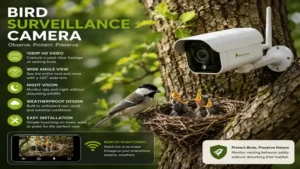
4. Blink Outdoor 4
The Blink Outdoor 4 represents the ultimate minimalist approach to remote wildlife monitoring due to its compact form factor and legendary power management. Operating on two standard AA lithium batteries, this camera can sit idle in a tree for up to two years, making it incredibly useful for remote parts of your property where running wires or installing large solar arrays is impractical. The updated sensor architecture improves low-light performance significantly over previous iterations.
In practice, I found that the camera’s wake-up lag can occasionally cause you to miss fast-moving action. Because the system relies on a battery-saving sleep state, there is a fraction of a second delay between the motion sensor tripping and the video stream recording, which sometimes results in capturing an empty perch after a bird has already darted away. To mitigate this, you must position the camera along an expected flight path rather than perpendicular to the landing spot.
Users appreciate the small profile which blends seamlessly into foliage, though they note that it requires a Blink Sync Module to operate effectively.
✅ Two-year battery lifespan
✅ Compact and easily camouflaged
✅ Affordable multi-camera expansion
❌ Notable trigger latency lag
❌ Requires a separate hardware hub
Available in the $90 to $120 range for starter kits, this device fits perfectly for homeowners looking to build a discreet, multi-camera perimeter network around several nesting sites.
5. Green-Feathers Wireless Bird Box Camera
The Green-Feathers Wireless Bird Box Camera is a highly specialized piece of equipment designed specifically to be mounted inside dark, enclosed wooden nesting boxes. It utilizes an ultra-wide lens to capture the entire interior floor of a standard birdhouse, and it features specialized invisible 940nm infrared LEDs that illuminate the nesting chamber completely without disturbing the sleep cycles or vision of adult birds or hatchlings.
Most reviewers claim that setup is instant, but in reality, passing wireless signals through thick hardwood nesting boxes and brick residential walls can degrade your connection. I highly recommend performing a dry run inside your home before permanently mounting the assembly outdoors. The camera runs on a continuous 12V power line, which requires routing a thin cable out of the nesting box to a nearby power source or a heavy-duty external battery enclosure.
True wildlife documentarians praise this camera for providing an uninterrupted view of egg incubation and chick rearing that standard outdoor models cannot duplicate.
✅ Specialized 940nm invisible night vision
✅ Wide-angle lens for tight spaces
✅ Real-time nesting insights
❌ Requires physical power routing
❌ Not suitable for open-air feeders
Sitting in the $130 to $160 range, this hardware is indispensable for serious conservationists dedicated to observing the delicate nesting habits of bluebirds, owls, or wrens.
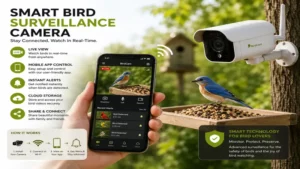
Technical Features: Capabilities and Metrics
The following matrix compares key operational metrics that dictate how effectively each device handles the unique demands of high-speed wildlife photography.
| Product Model | Focal Range Limits | Wireless Bandwidth | Storage Options | Night Vision Method |
| Netvue Birdfy | 2 inches to infinity | 2.4 GHz Only | Cloud + MicroSD | 850nm IR / White Spotlight |
| Soliom BF08 | 3 inches to infinity | 2.4 GHz Only | Cloud + MicroSD | 850nm Infrared LEDs |
| Reolink Argus 3 Pro | 20 inches to infinity | 2.4 GHz / 5.0 GHz | Local MicroSD Only | Dual Spotlight + IR |
| Blink Outdoor 4 | 18 inches to infinity | 2.4 GHz Only | Sync Module 2 USB | 850nm Infrared LEDs |
| Green-Feathers Wireless | 1 inch to 4 feet | 2.4 GHz Only | MicroSD Slot | 940nm Invisible IR |
Reviewing this technical matrix reveals a stark contrast in lens design across categories. Dedicated feeder models like the Netvue Birdfy and specialized nesting cams like the Green-Feathers offer tight focal ranges optimized for extreme close-up clarity, whereas standard security options require careful positioning due to their longer minimum focus limits.
Practical Setup and Optimization Guide
Setting up your avian imaging system correctly involves balancing wireless signal health, sun exposure, and animal safety. Over my years of configuring these stations, I have developed a repeatable methodology that ensures maximum uptime and pristine footage.
Step 1: Wireless Site Survey and Power Alignment
Before mounting any hardware to a tree or fence post, place the camera at the exact intended location and check the signal strength via the mobile application. Wood, stucco, and double-paned glass walls degrade 2.4GHz signals rapidly. If your signal strength drops below sixty percent, your camera will suffer from dropped connections and excessive battery drain as the internal radio repeatedly tries to reconnect. If deploying a solar-powered model, ensure the panel faces south or southwest in the Northern Hemisphere, receiving at least four hours of unshaded sunlight daily to offset the energy consumption of high-definition streaming.
[Solar Panel: Facing South/Southwest]
                 │
                 ▼ (Trickle Charge)
[Bird Camera Unit] <====== Wireless Handshake ======> [Home Wi-Fi Router]
                 ▲
                 │ (2.5 to 3 Feet Distance)
           [Landing Perch]
Step 2: Lens Calibration and Angle Adjustments
To prevent your footage from blowing out due to harsh sunlight, avoid pointing the camera lens directly east or west. Direct morning or evening sun will overwhelm the digital sensor’s dynamic range, leaving your subjects appearing as dark silhouettes against a blinding white background. Instead, angle the camera slightly downward toward the North or Northeast. This positioning capitalizes on indirect ambient light, highlighting the colorful plumage of visiting birds without causing glare on the protective lens element.
Step 3: Preventing Nuisance Triggers
Wind-blown branches and shifting shadows are the primary causes of false motion alerts, which can quickly drain your batteries and clutter your storage drive. Spend time adjusting your motion detection zones within the app interface. Mask out any swaying foliage or busy background pathways, focusing the active PIR detection grid exclusively on the landing platform or water basin.
Birding Scenarios: Choosing by Avian Behavior
Avian species exhibit diverse feeding, nesting, and socializing habits, meaning a camera style that works flawlessly for one group may fail entirely for another. Understanding these behavioral traits allows you to tailor your gear selection to match your target audience.
                  Backyard Avian Monitoring Goals
                                │
        ┌───────────────────────┴───────────────────────┐
        ▼                                               ▼
[Feeding & Foraging Identification]             [Nesting & Breeding Habits]
        │                                               │
        ├─► Choice: Integrated Feeder Cam               ├─► Choice: Interior Box Cam
        │   (Netvue Birdfy / Soliom)                    │   (Green-Feathers Wireless)
        │                                               │
        └─► Target Species:                             └─► Target Species:
            Finches, Cardinals, Jays                        Bluebirds, Owls, Wrens
Foraging Songbirds: Finches, Cardinals, and Blue Jays
For standard seed-eating birds that travel in small flocks, integrated feeder systems like the Netvue Birdfy or Soliom BF08 are ideal. These species are comfortable landing on stable, elevated platforms and will tolerate the presence of a compact camera housing. Because these birds feed throughout the bright hours of the day, standard 1080p resolution combined with basic solar charging keeps pace with their high-frequency visiting patterns perfectly.
Skittish Ground Feeders: Doves, Towhees, and Thrushes
Certain species rarely visit elevated hanging platforms, preferring instead to forage among leaf litter on the ground. For these birds, an integrated feeder camera mounted high up on a pole is useless. In this scenario, deploying a standalone unit like the Reolink Argus 3 Pro mounted onto a short ground stake or stone base two feet away from a designated tracking area yields spectacular results. The 2K sensor allows you to monitor a broader patch of ground while retaining enough detail to identify camouflaged plumage patterns easily.
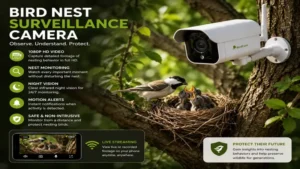
The Anti-Recommendation: When Premium Feeder Cams Fail
While high-end smart feeder cameras are outstanding for small songbirds, they are poorly suited for larger raptors, waterfowl, or highly territorial species like woodpeckers. If you want to monitor a nesting pair of Red-tailed Hawks or watch a woodland duck pond, the small perches and tight macro-focus lenses of integrated feeder systems are entirely ineffective. A large bird standing on a close-up feeder will block the entire lens, resulting in a blurry wall of feathers. For large wildlife, you should avoid feeder cameras entirely and opt for long-range, high-speed security systems mounted ten to fifteen feet away from the action.
Common Pitfalls When Buying Bird Cameras
Most consumers select wildlife imaging gear based solely on maximum resolution numbers advertised on marketing boxes. This short-sighted approach overlooks several critical factors that impact real-world performance in outdoor environments.
-
Ignoring Minimum Focus Distance: Buying a security camera with an impressive 4K resolution sensor will not matter if the lens configuration cannot focus on items closer than three feet. Placing such a camera near a small feeder results in consistently blurry images because the target sits well inside the lens’s blur circle.
-
Overestimating Solar panel Efficiency: Many buyers assume that any small solar panel will keep their camera powered indefinitely. In reality, dense summer leaf canopies or prolonged winter overcast can reduce solar output by over eighty percent, leaving your camera dead unless it features a massive internal standby battery or efficient power-saving modes.
-
Neglecting the Total Cost of Ownership: A cheaper camera might look attractive initially, but if its primary ecosystem locks essential features like motion history, high-definition downloading, or AI species classification behind an expensive monthly subscription fee, it will cost significantly more over a three-year lifespan than a premium open-source alternative.
Features That Actually Matter vs Marketing Hype
Navigating the specifications of digital cameras requires filtering out misleading marketing terms to focus on the hardware realities that dictate clear imagery.
[Marketing Hype: "Mega-Pixel Count Only"] ===> Often leads to noisy low-light images.
[Hardware Reality: "Sensor Size & Pixels"] ===> Larger pixel pitch captures more light.
Pixel Pitch and Light Gathering Power
Marketers love to boast about high megapixel counts, but cramming millions of tiny pixels onto a miniscule image sensor results in terrible low-light performance and high electronic noise under shaded forest canopies. For clear wildlife photography, look for cameras that prioritize sensor size and individual pixel pitch over raw megapixel numbers. A well-optimized 1080p sensor with large pixels will consistently outperform a poorly engineered 4K sensor by capturing superior color depth and showing less grain during dawn and dusk hours when birds are most active.
Shutter Response and Trigger Speed
Birds are incredibly fast, dynamic creatures whose wings can flap dozens of times per second. A camera with an inferior PIR sensor or slow processor wake-up time will consistently record frustrating videos of empty perches because the bird has already arrived and departed during the hardware’s trigger delay. Prioritize devices that advertise sub-second wake-up speeds or units that support continuous pre-buffering when connected to constant power.
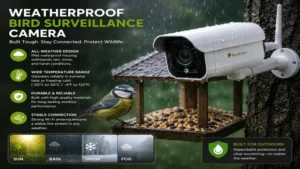
Long-Term Cost & Maintenance
Owning an outdoor electronic tracking station requires continuous upkeep to protect your investment from the elements and ensure the safety of your backyard visitors.
The Hidden Cost of Biofilm and Seed Spoilage
When using integrated feeder cameras, you are mixing delicate digital electronics with organic bird seed and animal saliva. Over time, moisture from rain and bird respiration creates a sticky biofilm on landing platforms that breeds harmful bacteria, endangering local wildlife populations. You must account for the time and effort required to clean the unit safely. Look for hardware designs that allow you to easily detach the plastic feeding tray from the delicate camera housing so it can be scrubbed down with a mild bleach solution without risking water damage to the internal circuit boards.
Year One Roadmap and Component Longevity
Operating electronics outdoors through freezing winters and scorching summers takes a heavy toll on hardware components. The table below outlines what to expect over the first twelve months of running your system.
| Time Horizon | Expected Component Wear | Required Maintenance Action | Cost Impact |
| 3 Months | Pollen & dust buildup on lens | Wipe lens with microfiber cloth | Zero Cost |
| 6 Months | Solar panel surface oxidation | Scrub panel with fresh water | Zero Cost |
| 12 Months | Lithium battery capacity decay | Deep cycle charge / check seals | Low Cost |
This operational roadmap demonstrates that while ongoing financial costs remain low, regular hands-on maintenance is necessary to prevent weather-related performance degradation and ensure clear imagery over the lifetime of your device.
Traditional Optics vs Modern Smart Hardware
The choice between old-school observation tools and modern automated camera setups comes down to your personal workflow preferences and lifestyle goals.
| Operational Attribute | Traditional Binoculars & Lenses | Modern Smart Bird Cameras |
| Observation Type | Active, real-time presence required | Passive, automated 24/7 capture |
| Footage Sharing | Hard to record without large rigs | Instant smartphone export & sharing |
| Physical Effort | High; requires holding gear steady | Low; set-and-forget permanent installation |
| Species Cataloging | Manual field notes and memory | Automated AI cloud-based logging |
| Best For | Active hikers and field naturalists | Homeowners and busy backyard observers |
Reviewing this comparison highlights that while traditional optics offer an unmatched tactile connection to nature during active field trips, modern digital camera networks provide an effortless, round-the-clock window into your backyard ecosystem that fits easily into a busy lifestyle.
🔍 Take Control of Your Wildlife Viewing!
✨ Upgrade your backyard observation setup today. Click on any of our highlighted product recommendations to verify current stock and explore expanding your hardware configuration. Bring the beauty of nature directly to your screen!
Frequently Asked Questions
❓ Will a bird surveillance camera work without home Wi-Fi?
✅ Yes, many models function without an active internet connection by recording video clips directly to an internal MicroSD card. However, you will lose the ability to view live streams or receive instant mobile notifications…
❓ Do solar panels keep these cameras running during freezing winters?
✅ Solar panels will trickle charge down to freezing temperatures, but their efficiency drops significantly in extreme cold. Heavy snow accumulation must be manually cleared off the panel surface to maintain power generation…
❓ Can squirrels destroy these digital feeder units?
✅ While high-quality models use durable polycarbonate plastics, persistent squirrels can chew through thin perches or scratch lens covers. Mounting your camera away from jumping launch points is highly recommended…
❓ Do infrared LEDs scare away nesting birds at night?
✅ Models utilizing 940nm invisible infrared spectrums emit no visible red glow, making them completely undetectable to birds. Standard 850nm LEDs emit a faint dull red glow that can occasionally catch an animal’s attention…
❓ How do I stop rain from clouding the camera lens view?
✅ Applying a specialized hydrophobic glass treatment to the exterior lens cover helps water bead up and roll off quickly. This simple modification ensures clear images even during heavy spring downpours…
Conclusion
Embracing a dedicated bird surveillance camera changes the way you interact with the wildlife sharing your property. By moving away from generic security solutions and choosing hardware tailored specifically for small, fast-moving avian subjects, you unlock a highly intimate view of natural behaviors that would otherwise go unseen. Whether you select an all-in-one smart feeder system like the Netvue Birdfy for automated species tracking or build a high-resolution custom station using a Reolink Argus 3 Pro, the key to success lies in proper placement, managing your wireless connections, and committing to regular equipment maintenance.
Recommended for You
- 5 Best Slow Eating Dog Bowl Stainless Models to Stop Bloat Fast (2026)
- 5 Best Ceramic Slow Feeder Dog Bowl Models for 2026 (Anti-Bloat Guide)
- 5 Best Raised Dog Bowls Slow Feed Options to Stop Bloat (2026)
Disclaimer: This article contains affiliate links. As an Amazon Associate, I earn from qualifying purchases. If you purchase products through these links, we may earn a small commission at no additional cost to you.
✨ Found this helpful? Share it with your friends! 💬🤗