
In This Article
Pet Lodge Feeder: Why a Farm-Store Classic Still Earns Its Spot in 2026
If you’ve ever wrestled a 40-pound bag of kibble into a leaky plastic bin while your dog supervises from the sidelines, you already understand the appeal of a pet lodge feeder. It’s a simple idea executed in steel: store the food and serve the food from the same box, and let gravity do the rest. No apps, no batteries, no Wi-Fi drama when the router hiccups.
Pet Lodge is a brand from Miller Manufacturing, a Minnesota-based company that has been serving farmers since 1941, and its feeders show that heritage. They’re built for barns, porches, garages, and mudrooms — places where a cute plastic smart feeder would dent, crack, or get chewed into modern art. The flagship is the Chow Hound line, a galvanized gravity dog feeder with a magnetized lid your dog nudges open with its nose.
But “simple” doesn’t mean “right for everyone.” A pet lodge feeder is a free-feeding tool, and free-feeding is a great fit for some dogs and a genuinely bad idea for others. Size matters, too: a 50-pound hopper is a gift for a farm with three working dogs and an expensive mistake for a single Beagle in an apartment.
In this guide, you’ll get an honest breakdown of seven real feeders — five from the Pet Lodge lineup and two alternatives worth knowing about — built from manufacturer spec sheets and aggregated customer review sentiment (not invented test drives). You’ll also find setup tips, a problem-solving section, cost-of-ownership math, and a decision framework, so you can pick the right pet lodge feeder the first time rather than the second.
Grab a coffee (and maybe a treat for the dog watching you read). Let’s dig in.
What Is a pet lodge feeder?
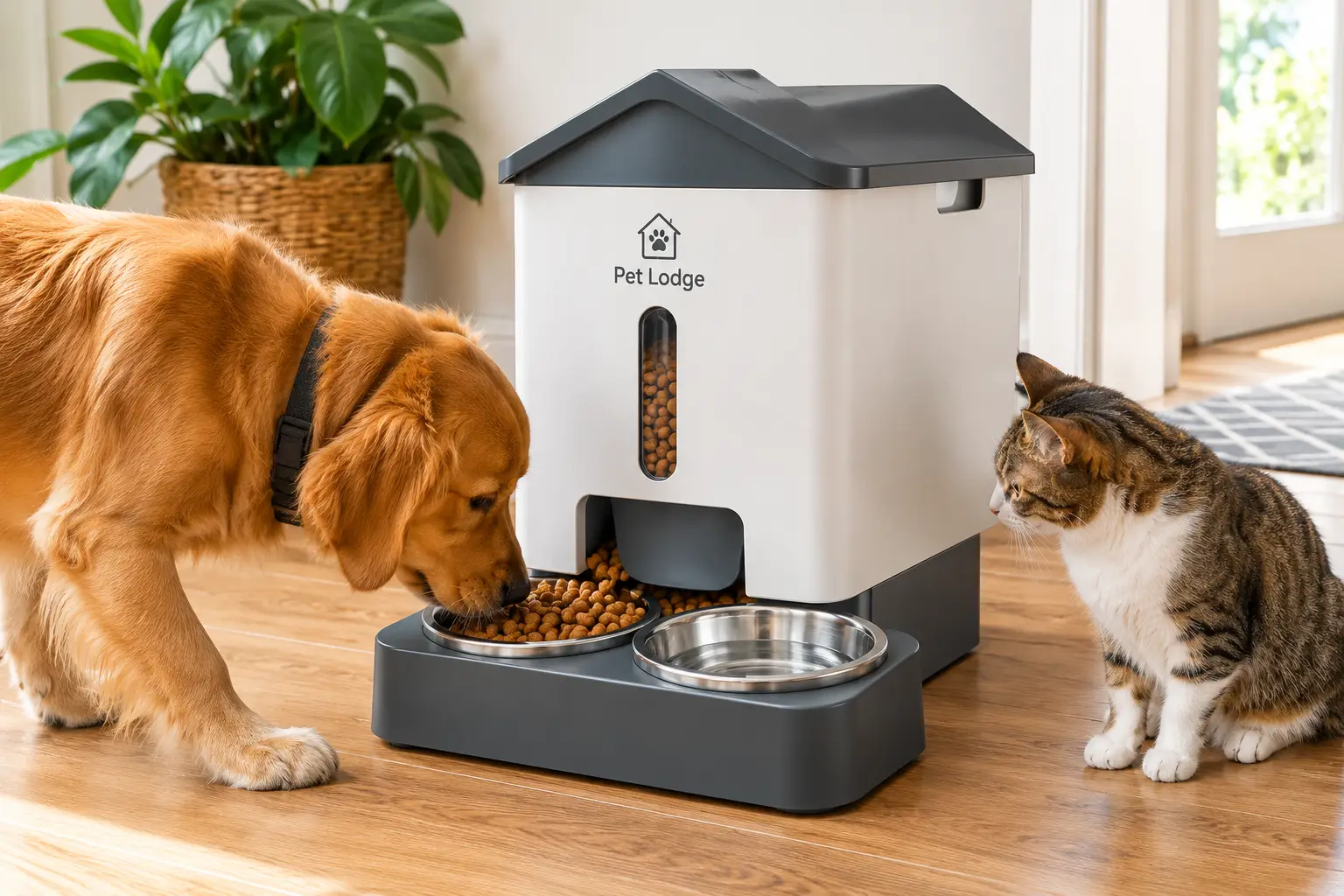
A pet lodge feeder is a gravity-fed pet food dispenser sold under Miller Manufacturing’s Pet Lodge brand. The best-known model, the Chow Hound, is a galvanized steel box that stores 12 to 50 pounds of dry kibble; food slides down an angled chute into a trough protected by a magnetized door your dog pushes open.
The concept deserves a slightly closer look, because the details are what separate a good self-feeder from a messy one.
How the gravity mechanism works
Inside, the hopper funnels kibble toward an angled chute. As your dog eats from the trough, the food level drops and more kibble slides down to replace it. There’s no motor and nothing to program — which is exactly why this style has been a farm-store staple for decades. The flip side is that gravity doesn’t count calories. It serves whatever your dog is willing to eat.
Why galvanized steel?
The Chow Hound’s body is galvanized steel — steel coated in zinc. As explained in this overview of how galvanization protects steel from corrosion, the zinc layer corrodes first and shields the steel underneath. For a feeder that might live on a damp porch or in an unheated barn, that matters far more than any “premium” plastic finish. Retailers list the Chow Hound as 24-gauge steel, which is sturdy but not armor plate — a detail we’ll come back to in the reviews.
Who makes it, and where is it sold?
Pet Lodge is one of Miller Manufacturing’s family brands, and its lineup now covers more than 160 feeding, watering, housing, and cleanup products. You’ll find the Chow Hound on amazon.com, as well as at farm-supply and big-box stores. The line is marketed as made in the USA, which appeals to buyers who want a domestic-built, no-electronics option.
Quick Comparison: 7 Feeders at a Glance
| Feeder | Capacity | Material | Best for | Price range* |
|---|---|---|---|---|
| Pet Lodge Chow Hound 25 lb | 25 lb dry food | Galvanized steel | Most single large dogs or two medium dogs | ~$70–$110 |
| Pet Lodge Chow Hound 50 lb | 50 lb dry food | Galvanized steel | Farms, kennels, multi-dog homes | ~$110–$180 |
| Pet Lodge Chow Hound 12 lb | 12 lb dry food | Galvanized steel | Small-to-medium dogs, tight spaces | ~$50–$85 |
| Pet Lodge Chow Tower Deluxe 16 lb | 16 lb dry food | Plastic tower + base | Visible food level, indoor/outdoor | ~$35–$55 |
| Pet Lodge Chow Tower Deluxe 3 lb | 3 lb dry food | Plastic tower + base | Cats and toy breeds | ~$15–$25 |
| Pet Lodge Metal Small Animal Feeder with Lid | Several days of pellets | Galvanized steel | Rabbits and hutch animals | ~$12–$20 |
| Petmate Pet Cafe Feeder 12 lb | 12 lb dry food | Plastic | Budget indoor free-feeding | ~$20–$35 |
*Approximate ranges at the time of writing; prices may vary — check the current price.
Looking at the table, the Pet Lodge Chow Hound 25 lb is the sweet spot for most households: enough capacity for a week or more with a large dog, without the footprint of the 50-pound model. The Pet Lodge Chow Tower Deluxe 16 lb is the value play if you want to see your food level at a glance, though you trade steel toughness for plastic convenience. Rabbit owners should skip the dog feeders entirely and go straight to the Pet Lodge Metal Small Animal Feeder with Lid.
💬 One click helps other shoppers make an informed choice too! 😊
Top 7 Pet Lodge Feeder Picks: Expert Analysis
Each pick below is evaluated on spec-sheet data, real aggregated review themes, and how the design choices play out day to day. Where reliable review data doesn’t exist, you’ll be told so plainly.
1. Pet Lodge Chow Hound 25 lb — the all-around sweet spot
The Pet Lodge Chow Hound 25 lb (model CH25) is the version most buyers should start with, because it balances capacity, footprint, and price better than its siblings.
It measures 11 x 12 inches at the base and stands about 22.6 inches tall, holding 25 pounds of dry dog food. In practice, that’s roughly a standard mid-size kibble bag, so you can pour in one bag and fold nothing. The magnetized door stays shut until your dog nudges it, which keeps rain, dust, and most bugs out of the trough. It arrives fully assembled and has backside keyholes for wall mounting — useful for keeping it from being pushed around a garage floor.
Based on comparing the specs, this is the right choice for a single Lab-sized dog or two medium dogs who get along at mealtimes. At about 10.5 pounds empty (per Walmart’s listing), it’s light enough to move but heavy enough to stay put once filled.
Customer reviews consistently praise the sturdiness, the capacity, and how quickly dogs learn to use the door; on Walmart, the 25-pound model carried a 4.5-star average from 176 ratings at the time of research. The recurring complaints are shipping dents and, occasionally, a door that sticks.
Pros:
- ✅ Holds a full standard kibble bag in one pour
- ✅ Chew-proof galvanized steel suits outdoor use
- ✅ Ships fully assembled with wall-mount keyholes
Cons:
- ❌ Thin sheet steel can arrive dented from shipping
- ❌ Door can occasionally stick and need adjustment
In the ~$70–$110 range (check the current price), it offers strong value for a feeder that should last years.
2. Pet Lodge Chow Hound 50 lb — built for farms and packs
The Pet Lodge Chow Hound 50 lb (model CH50) is the heavy hitter — the pet lodge feeder 50 lb option aimed at multi-dog properties.
It measures 12 x 16.25 inches and stands 28.25 inches tall, holding 50 pounds of dry food. That height is a real ergonomic win: you pour a big bag in without bending over like you’re tying shoelaces. It uses the same magnetized door, angled chute, and galvanized construction as its smaller siblings, and can be mounted to a wall or frame (hardware not included).
Here’s what to weigh: 50 pounds of kibble is a lot of food sitting in one place. If you have one small dog, the food could sit long enough for its fats to start going stale. This model shines on farms, in kennels, or in homes with three or more big dogs who empty it within a few weeks.
Retail review snippets for the Chow Hound line mirror the 25-pound feedback — sturdy and practical — with a few buyers reporting shipping damage or a loose door bar. Model-specific review volume for the 50-pound size is thinner, so treat that sentiment as line-wide rather than CH50-specific.
Pros:
- ✅ Largest capacity in the Pet Lodge dog lineup
- ✅ Tall hopper makes refilling easier on your back
- ✅ Weather-resistant steel handles barns and porches
Cons:
- ❌ Food can go stale if one small dog eats slowly
- ❌ Bulky footprint dominates small mudrooms
Expect roughly $110–$180 at the time of writing; for multi-dog homes, the cost per pound stored is hard to beat.
3. Pet Lodge Chow Hound 12 lb — compact steel for smaller dogs
The Pet Lodge Chow Hound 12 lb (model CH12) gives you the same tough build in a footprint that fits beside a laundry machine.
At 8 x 9 inches and about 19.25 inches tall, it holds 12 pounds of dry food. For a 25-pound dog eating around two cups a day, that’s likely a couple of weeks of supply — frequent enough that food stays fresh, infrequent enough that you’ll forget it’s even a chore. The same magnetized door means it works outdoors, too.
This is the pet lodge automatic dog feeder for owners of Beagles, Cocker Spaniels, or other small-to-medium breeds who still want steel durability. One nuance the spec sheet doesn’t spell out: the smaller trough opening suits smaller muzzles, but a very large dog may find it cramped.
Aggregated review sentiment for the Chow Hound line — sturdy, easy for pets to learn, occasional door and shipping issues — applies here. We couldn’t verify a large pool of reviews specific to the 12-pound size, so weigh that sentiment accordingly.
Pros:
- ✅ Small footprint fits tight indoor spaces
- ✅ Food turns over faster, so it stays fresher
- ✅ Same chew-proof steel as larger models
Cons:
- ❌ Trough may feel cramped for giant breeds
- ❌ Higher price per pound than the 25-pound model
Around $50–$85 (prices may vary), it’s a fair price for durable steel, though the 25-pound version is the better value per pound.
4. Pet Lodge Chow Tower Deluxe 16 lb — see your food level at a glance
The Pet Lodge Chow Tower Deluxe 16 lb trades steel for a translucent plastic tower, so you always know when a refill is coming.
It measures 18.5 x 10.125 inches and stands 18 inches tall, holding 16 pounds of dry food in a clear tower that dispenses into a sturdy plastic base. The removable cap on top makes refilling straightforward, and Pet Lodge rates it for indoor and outdoor use and for “dogs and many other animals.” In practice, the see-through tower is the headline feature: no lifting a lid to check the level.
Here’s the honest trade-off: an open trough doesn’t protect food from rain, ants, or wildlife the way the Chow Hound’s door does, and plastic is not chew-proof. It’s best for a covered porch or indoor corner with dogs who don’t treat plastic as a snack.
We couldn’t find a substantial, verifiable body of customer reviews for this specific size, so we can’t summarize buyer sentiment with confidence. The analysis above is based on the design and specs.
Pros:
- ✅ Translucent tower shows food level instantly
- ✅ Removable cap makes refills quick
- ✅ Much cheaper than steel for similar capacity
Cons:
- ❌ Open trough offers little pest or rain protection
- ❌ Plastic won’t survive a determined chewer
In the ~$35–$55 range, it’s good value for indoor or sheltered setups.
5. Pet Lodge Chow Tower Deluxe 3 lb — tiny tower for cats and toy breeds
The Pet Lodge Chow Tower Deluxe 3 lb is the smallest pet lodge feeder in this roundup and the one most suited to cats.
At 10.875 x 6.125 inches and 11 inches tall, it holds 3 pounds of dry food. For a 10-pound cat eating around a third of a cup a day, 3 pounds is roughly a few weeks of food — enough to cover a long weekend while keeping portions from sitting for months. The translucent tower and removable cap carry over from the larger model.
On paper, this suits cat owners and toy-breed households who want a no-electronics backup for busy days. But be clear-eyed: cats prone to overeating will overeat from any gravity feeder, and this one is no exception.
As with the 16-pound model, verifiable review data for this exact size is limited, so there’s no reliable aggregated sentiment to report. Farm-store listings do show it selling at a budget price point, which lines up with its role as an entry-level option.
Pros:
- ✅ Compact enough for a kitchen corner
- ✅ Low price makes it an easy experiment
- ✅ Clear tower makes refills predictable
Cons:
- ❌ Not ideal for cats that overeat
- ❌ Lightweight base can be nudged around
Around $15–$25 at the time of writing — about as low-risk as a feeder gets.
6. Pet Lodge Metal Small Animal Feeder with Lid — the rabbit hutch workhorse
The Pet Lodge Metal Small Animal Feeder with Lid is the pick for rabbit and small-animal keepers who are tired of flipped crocks.
It’s made from chew-proof, rust-resistant, heavy-gauge galvanized steel and comes in 3-, 5-, and 7-inch widths. Independent wire hooks let you attach it inside the hutch, or outside for easier filling (with some wire cutting). The gravity design dispenses several days’ worth of pellets a little at a time, and a hinged metal lid covers the feed. In practice, that means less spilled, soiled food on the hutch floor.
This is for rabbit owners, 4-H families, and small-scale breeders. Pick the width based on how many animals share a feeder — the 3-inch for a single rabbit, the 7-inch for a pair or a busier hutch.
We couldn’t verify a meaningful set of customer reviews for this item, so there’s no aggregated sentiment to share. The design itself is a long-established hutch-feeder style.
Pros:
- ✅ Galvanized steel resists gnawing teeth
- ✅ Hinged lid keeps pellets cleaner
- ✅ Three widths fit different hutch setups
Cons:
- ❌ Outside mounting may require cutting hutch wire
- ❌ Not suitable for dogs or cats
At roughly $12–$20, it’s an inexpensive upgrade over a bowl.
7. Petmate Pet Cafe Feeder 12 lb — the budget plastic alternative
The Petmate Pet Cafe Feeder 12 lb is the most common non-Pet Lodge alternative, and it’s worth knowing why.
It’s a gravity feeder with a wide-mouth hopper, a removable lid, and easy-grab handles on the base, sold in 3-, 6-, and 12-pound sizes and made in the USA. Petmate notes the base and bottle are not dishwasher safe; hand-washing with a bottle brush is recommended. Practically, the wide mouth makes pouring less messy than narrow-necked towers.
Based on comparing the designs, this is a solid indoor option for cats or small dogs on a tight budget. It lacks the Chow Hound’s weatherproof door and steel body, so it’s not an outdoor dog feeder.
Reviews generally describe it as good-looking and affordable, while a recurring complaint — noted by an independent reviewer of the 3-pound size — is that the narrow chute can jam with larger kibble, requiring a shake to get food flowing.
Pros:
- ✅ Very affordable way to try gravity feeding
- ✅ Wide-mouth hopper is easy to refill
- ✅ Three sizes cover cats to medium dogs
Cons:
- ❌ Chute may jam with large kibble
- ❌ Not dishwasher safe; hand-wash only
In the ~$20–$35 range for the 12-pound size, it’s good value for indoor use.
✨ Found your match? Don’t let dinnertime wait!
🔍 Take your dog’s feeding routine to the next level with this carefully curated lineup. Click a highlighted feeder to check current pricing and availability. The right pick means fewer refills, cleaner floors, and a happier pup at the trough!
Side-by-Side: The Top 7 Compared
| Feeder | Pest/rain protection | Chew resistance | Mounting | Best for |
|---|---|---|---|---|
| Pet Lodge Chow Hound 25 lb | Magnetized door | High (steel) | Wall keyholes | Pet Lodge Chow Hound 25 lb: one large dog |
| Pet Lodge Chow Hound 50 lb | Magnetized door | High (steel) | Wall or frame | Pet Lodge Chow Hound 50 lb: farms, 3+ dogs |
| Pet Lodge Chow Hound 12 lb | Magnetized door | High (steel) | Wall or frame | Pet Lodge Chow Hound 12 lb: small dogs |
| Pet Lodge Chow Tower Deluxe 16 lb | Minimal (open trough) | Low (plastic) | Freestanding | Pet Lodge Chow Tower Deluxe 16 lb: sheltered spots |
| Pet Lodge Chow Tower Deluxe 3 lb | Minimal (open trough) | Low (plastic) | Freestanding | Pet Lodge Chow Tower Deluxe 3 lb: cats |
| Pet Lodge Metal Small Animal Feeder with Lid | Hinged lid | High (steel) | Hutch hooks | Pet Lodge Metal Small Animal Feeder with Lid: rabbits |
| Petmate Pet Cafe Feeder 12 lb | Lid on hopper only | Low (plastic) | Freestanding | Petmate Pet Cafe Feeder 12 lb: indoor budget |
The pattern here is clear: the Chow Hound models are the only dog feeders in this group that protect the serving trough itself, which is why they dominate outdoor use. The plastic towers win on price and visibility but assume a sheltered, chew-free environment. If your feeder will live anywhere rain, raccoons, or a teething puppy can reach it, steel is worth the premium.
How to Set Up and Maintain Your Pet Lodge Feeder
A pet lodge feeder is nearly maintenance-free, but “nearly” is doing some work in that sentence. Here’s how to get the first 30 days right.
Day 1: Placement and mounting
- ✅ Choose a level, dry spot. Gravity feeders rely on an even base; a tilted feeder can cause uneven flow or jams.
- ✅ Keep it under a roof if possible. The Chow Hound’s door keeps most rain out, but a covered porch reduces moisture in the chute.
- ✅ Mount it. Use the backside keyholes with screws rated for your wall (hardware isn’t included). A mounted feeder can’t be pushed over by an enthusiastic eater.
- ✅ Raise it slightly if needed. For tall breeds, a sturdy wooden frame can lift the trough closer to a comfortable height.
Week 1: Teaching the door
Most dogs figure out the magnetized door fast, but you can help. Hold the door open with a finger while your dog eats for the first few meals, then let it rest on their nose. A few kibbles in the trough on day one make the “treasure chest” connection obvious.
Ongoing maintenance schedule
- Every refill: Let the hopper run nearly empty first, so old food doesn’t sit under new food indefinitely.
- Every 2–4 weeks: Empty completely, wipe out crumbs and oily residue, and dry thoroughly before refilling. Moisture is the enemy of both kibble and steel.
- Monthly: Check the door hinge bar and magnet. Some buyers report a loose bar; a quick tighten or gentle bend back into place usually fixes it.
- Seasonally: Inspect for scratches in the zinc coating. Small scuffs are normal; deep gouges on an outdoor unit are worth monitoring.
Common first-month mistakes
Overfilling a 50-pound hopper for one small dog, placing the feeder in direct sun (heat accelerates rancid fats), and forgetting to watch your dog’s waistline are the big three. Fix those, and the feeder mostly takes care of itself.
Real-World Scenarios: Matching the Feeder to the Household
Specs are useful, but the right pet lodge feeder depends on how you actually live. Here are three common profiles.
Scenario 1: The rural property with three working dogs
Budget: $110–$180 · Context: barn or covered shop, outdoor dogs · Refill frequency: every 1–2 weeks
Three active dogs can easily go through 50 pounds of kibble in two weeks, so food turnover isn’t a concern. The Pet Lodge Chow Hound 50 lb fits perfectly: the steel stands up to weather and curious livestock, and the magnetized door keeps most barn dust and birds out. Mount it to a post or frame so no one tips it during a squabble. If the dogs don’t share well, two Pet Lodge Chow Hound 25 lb units placed apart may reduce resource guarding.
Scenario 2: The suburban family with one Golden Retriever
Budget: $70–$110 · Context: garage or mudroom · Refill frequency: about every 1–2 weeks
A Golden eating around three to four cups a day will empty 25 pounds in roughly two weeks — ideal freshness. The Pet Lodge Chow Hound 25 lb is the obvious pick. The catch: Goldens are famously food-motivated, so free-feeding needs supervision (see the portion control section below). Many families use the feeder as smart storage and simply close off access between meal times.
Scenario 3: The apartment cat owner who travels on weekends
Budget: under $35 · Context: indoor kitchen corner · Refill frequency: every few weeks
The Pet Lodge Chow Tower Deluxe 3 lb or the Petmate Pet Cafe Feeder 12 lb (in its smaller sizes) covers a two-night absence without electronics. Pair it with a reliable water source and, ideally, a neighbor check-in. For cats that overeat, a timed electronic feeder may be the better tool — gravity can’t ration.
Problem → Solution: Fixing the Most Common Feeder Headaches
Even a well-built pet lodge chow hound feeder has quirks. Here are the problems buyers mention most, with practical fixes.
Problem 1: The door sticks or won’t close
Solution: Check whether the hinge bar has shifted or loosened; a few buyers report exactly this. Re-seat the bar, and make sure no kibble is lodged at the hinge or magnet contact point. A dented lid (often from shipping) can also cause misalignment — gently straighten it, or contact the seller promptly if it arrived damaged.
Problem 2: The feeder arrived dented
Solution: Photograph the damage on arrival and request a replacement. Several reviews mention shipping dents, and while some buyers straighten them by hand, a dent near the chute can affect food flow.
Problem 3: Food jams in the chute
Solution: Large or oddly shaped kibble can bridge in any gravity feeder, as reviewers note with the Petmate Pet Cafe Feeder 12 lb. Shake the unit, make sure it’s level, and consider a slightly smaller kibble. Never let moisture in; damp kibble clumps and jams quickly.
Problem 4: Wildlife or pests are getting in
Solution: The magnetized door deters most pests, but any door a dog can nudge is one a clever raccoon may learn too. Bring the feeder into a garage overnight, or mount it inside a shed with a dog door.
Problem 5: Your dog is gaining weight
Solution: Stop free-feeding. Use the feeder as storage and dispense measured meals, or restrict access to set times. Your vet can give you a daily calorie target.
How to Choose a pet lodge feeder
Picking the right model comes down to a handful of practical questions. Here’s a step-by-step framework.
- Count your dogs and their daily intake. Multiply daily cups by roughly 0.25 pounds per cup (it varies by kibble) to estimate pounds per week. You want a feeder you’ll empty in two to four weeks.
- Decide indoor vs outdoor. Outdoors, the magnetized door and galvanized steel of the Chow Hound line are almost essential. Indoors, plastic towers are fine.
- Match capacity to freshness, not convenience. A bigger hopper means fewer refills, but also older food at the bottom. The 25-pound model is the best compromise for most homes.
- Check your dog’s eating habits. If your dog self-regulates, a gravity feeder works well. If they inhale everything, you’ll need portion control.
- Measure your space. The 50-pound Chow Hound is about 28 inches tall and 16 inches wide; the 12-pound fits under a counter.
- Consider mounting. Wall mounting prevents tipping and keeps the trough stable. Confirm you have a suitable wall or post.
- Factor in the species. Rabbits need the dedicated small animal feeder; cats do best with small towers.
These steps sound simple, yet most returns stem from skipping step 1 or step 4 — buying for convenience instead of for how the dog actually eats.
Galvanized Gravity Dog Feeder vs Plastic Gravity Feeders
The biggest decision isn’t which size — it’s which material. A galvanized gravity dog feeder and a plastic gravity feeder look similar on paper but behave very differently over years of use.
Durability and chewing
Galvanized steel is chew-proof for practical purposes; a dog can scratch it but not destroy it. Plastic towers are fine for polite eaters, but puppies and anxious chewers can crack them. If you’ve lost a plastic bowl to your dog before, that’s your answer.
Weather and pests
The Chow Hound’s magnetized door is the real differentiator. Plastic towers generally dispense into an open tray, so rain, ants, and birds all get a turn. Outdoors, that open tray can mean soggy, moldy kibble after one storm.
Hygiene and cleaning
Plastic is lighter and easier to handle at the sink, but it scratches, and scratches can trap oily residue. Steel wipes clean and dries quickly, though its size makes it harder to wash in a sink.
| Factor | Galvanized steel (Chow Hound) | Plastic towers/cafés | Best for |
|---|---|---|---|
| Chew resistance | Excellent | Fair to poor | Steel: puppies, heavy chewers |
| Weather protection | Magnetized door | Open tray | Steel: outdoor dogs |
| Price | Higher | Lower | Plastic: tight budgets |
| Visibility of food level | Must lift lid | See-through | Plastic: busy households |
The table highlights a simple split: steel wins everywhere durability and weather are involved, while plastic wins on cost and convenience indoors. If you’re buying a single feeder to last many years outdoors, the Pet Lodge Chow Hound 25 lb is the more economical choice long term, even at a higher upfront price.
Free-Feeding and Portion Control: Is a Gravity Feeder Right for Your Dog?
This is the section most feeder guides skip, and it’s arguably the most important. A gravity feeder is a free-feeding device: it keeps the bowl full whether your dog needs more food or not.
Dogs that do well with free-feeding
Some dogs self-regulate naturally, eating a bit throughout the day and stopping when full. Working farm dogs with high energy needs, some adult herding breeds, and dogs with steady weights under veterinary supervision often fall into this group.
Dogs that don’t
Food-motivated breeds, less active seniors, and dogs already carrying extra weight tend to overeat when food is always available. Overweight pets face higher risks of joint problems, diabetes, and shortened lifespan, as summarized in this overview of obesity in pets. A convenient feeder shouldn’t come at that cost.
The smart compromise
You don’t have to choose between convenience and control. Many owners use their pet lodge feeder in one of three ways:
- ✅ As storage-plus-dispenser: Scoop measured portions from the trough at meal times.
- ✅ With restricted access: Place the feeder in a room or run your dog can access only at set times.
- ✅ For backup days only: Rely on measured meals normally, and let the feeder cover long workdays.
The honest bottom line: the feeder is a tool. Whether it helps or harms depends on how you use it and on your dog’s eating personality. When in doubt, ask your veterinarian for a daily target and weigh your dog monthly for the first couple of months.
Features That Actually Matter (and Ones That Don’t)
Marketing copy for pet feeders loves adjectives. Here’s how to separate the important from the fluff.
Features that matter
- A trough cover or door. For any outdoor dog feeder, this is the difference between fresh food and a raccoon buffet. The Chow Hound’s magnetized door is its best feature.
- Chew-proof construction. If a dog can reach it, it needs to survive teeth. Galvanized steel checks that box.
- Mounting options. Keyholes or frame compatibility prevent tipping and wandering feeders.
- Capacity matched to consumption. The right size preserves freshness; the wrong size wastes money on stale food.
- Easy cleaning access. A removable lid or cap makes the monthly clean-out painless.
Features that matter less than you think
- “Made in USA” as a quality proxy. It’s a legitimate plus for many buyers, but build quality still depends on the specific product; the Chow Hound’s reviews show occasional door and dent issues regardless of origin.
- Stylish colors. Nice for a kitchen, irrelevant in a barn.
- Enormous capacity for one small dog. More isn’t better if half of it goes stale.
A nuance on gauge
Retailers list the Chow Hound as 24-gauge steel. That’s thinner than some might assume, which explains why shipping dents appear in reviews. It’s still plenty tough for daily use; just handle it with a little care during setup.
Long-Term Cost and Maintenance
The sticker price is only part of the story. Here’s a simple total-cost-of-ownership view over five years, based on approximate price ranges at the time of writing.
| Feeder | Upfront cost (approx.) | Expected lifespan* | Rough cost per year | Best for |
|---|---|---|---|---|
| Pet Lodge Chow Hound 25 lb | $70–$110 | Many years with care | ~$15–$22 over 5 years | Long-term outdoor use |
| Pet Lodge Chow Hound 50 lb | $110–$180 | Many years with care | ~$22–$36 over 5 years | Multi-dog homes |
| Pet Lodge Chow Tower Deluxe 16 lb | $35–$55 | Shorter, depends on chewing | Varies | Indoor, polite eaters |
| Petmate Pet Cafe Feeder 12 lb | $20–$35 | Shorter, depends on care | Varies | Budget indoor setups |
*Lifespan estimates are reasoning based on materials, not manufacturer guarantees. Walmart’s listing notes a 1-year manufacturer warranty on the 25-pound Chow Hound.
The math favors steel for anyone planning to keep a feeder outdoors for years: spreading the upfront cost over a long service life puts the Pet Lodge Chow Hound 25 lb in a competitive range even against cheaper plastic units that may need replacing. For indoor cats or small dogs, the lower upfront price of the Petmate Pet Cafe Feeder 12 lb or Pet Lodge Chow Tower Deluxe 3 lb is hard to argue with.
Hidden costs to budget for
- Wasted food. A too-large hopper for a single small dog can mean tossing stale kibble — a quiet cost that can exceed the price difference between sizes.
- Mounting hardware. Screws and anchors aren’t included with the Chow Hound.
- Your time. Steel feeders need a monthly wipe-out; plastic ones need more frequent washing to handle scratched surfaces.
Common Mistakes to Avoid When Buying a Pet Lodge Feeder
Most regret with a pet lodge feeder comes from a handful of predictable mistakes.
Buying the biggest size “just in case”
It’s tempting to grab the 50-pound model to minimize refills. But unless you have multiple large dogs, the food at the bottom of the hopper may sit for a long time. Choose a size you’ll empty in two to four weeks.
Ignoring your dog’s appetite
A gravity feeder rewards dogs who eat moderately and punishes dogs who don’t. If your dog has ever eaten a whole bag of treats in one sitting, plan for portion control from day one.
Putting a plastic feeder outdoors
Plastic towers aren’t designed to keep rain and wildlife out of the tray. If the feeder lives outside, the Chow Hound’s steel and magnetized door are there for a reason.
Skipping the inspection on arrival
Several reviewers mention dents from shipping. Inspect the feeder immediately, test the door, and request a replacement promptly if something’s off — most return windows are short.
Forgetting about cleaning access
A feeder you can’t easily empty and wipe out will eventually collect oily residue and crumbs. Plan where you’ll do the monthly clean-out before you mount it permanently.
Buying a dog feeder for a rabbit
It happens more often than you’d think. Rabbits need a hutch-mounted feeder sized for pellets, like the Pet Lodge Metal Small Animal Feeder with Lid, not a dog-sized trough.
Safety, Storage, and Food-Handling Standards
A feeder is ultimately a food-storage container, which means food safety applies to it as much as to your pantry. The FDA’s tips for safe handling of pet food and treats recommend storing dry pet food in a cool, dry place, keeping it secure so pets can’t eat an entire supply at once, and washing bowls and scoops with soap and hot water. They also advise washing your hands for at least 20 seconds before and after handling pet food, since pet food can carry bacteria such as Salmonella.
Applying that guidance to a gravity feeder
- ✅ Cool and dry: Keep the feeder out of direct sun and away from damp corners. Heat speeds up fat oxidation; moisture invites mold.
- ✅ Secure location: A mounted Chow Hound with a magnetized door checks this box better than an open plastic tray.
- ✅ Regular cleaning: Empty and wipe the hopper between batches, so old crumbs don’t contaminate fresh food.
- ✅ Keep the lot number: Consider cutting the lot number and date from the kibble bag and taping it inside a cabinet. If there’s ever a recall, you’ll know whether your batch is affected.
Dry food only
The Chow Hound and Chow Tower are designed for dry food. Never put wet, raw, or moist food in a gravity feeder — it will spoil quickly at room temperature and can harbor bacteria.
Household safety
Mount large feeders securely, especially around children, so a full 50-pound unit can’t tip. Keep feeders where kids won’t use them as a snack station or step stool.
FAQs
❓ Is a pet lodge feeder worth buying for one dog?
❓ Where can I buy a pet lodge chow hound feeder?
❓ Can a pet lodge automatic dog feeder be used for cats?
❓ Does the pet lodge feeder 50 lb keep raccoons out?
❓ Can I mount an outdoor dog feeder on a fence post?
Conclusion: Choosing Your Pet Lodge Feeder with Confidence
A pet lodge feeder is one of those rare pet products that does exactly one job and does it without fuss. The Chow Hound line combines galvanized steel, a magnetized door, and a gravity-fed chute into a feeder that fits barns, porches, and garages better than most flashy alternatives.
For most homes, the Pet Lodge Chow Hound 25 lb is the sweet spot: enough capacity to cut refills, small enough to keep food fresh. Multi-dog farms will appreciate the Pet Lodge Chow Hound 50 lb, while owners of smaller dogs can save space with the Pet Lodge Chow Hound 12 lb. For indoor setups on a budget, the Pet Lodge Chow Tower Deluxe 16 lb, Pet Lodge Chow Tower Deluxe 3 lb, and Petmate Pet Cafe Feeder 12 lb make gravity feeding cheap and simple. And rabbit keepers should go straight to the Pet Lodge Metal Small Animal Feeder with Lid.
Whichever you choose, remember the two rules that matter most: buy a size you’ll empty in a few weeks, and know whether your dog can handle free-feeding. Get those right, and your feeder will quietly serve dinner for years.
🐾 Ready to simplify feeding time for good?
🔍 Click any highlighted feeder above to check current pricing and availability. Pick the one that fits your dog, your space, and your routine — and enjoy fewer refills, cleaner floors, and one very content pup!
Recommended for You
- Ceramic Dog Dishes: 7 Best Picks That Beat Plastic (2026 Guide)
- Refrigerated Automatic Cat Feeder: 7 Best Picks of 2026, Ranked
- Pet Dish Guide 2026: 7 Best Picks (and 5 Costly Mistakes)
Disclaimer: This post contains affiliate links. As an Amazon Associate, I earn from qualifying purchases made through these links, at no additional cost to you.
✨ Found this article helpful? Share it with someone who needs it! 💬🤗