In This Article
Why a Maze Bowl Might Be the Smartest Upgrade in Your Kitchen
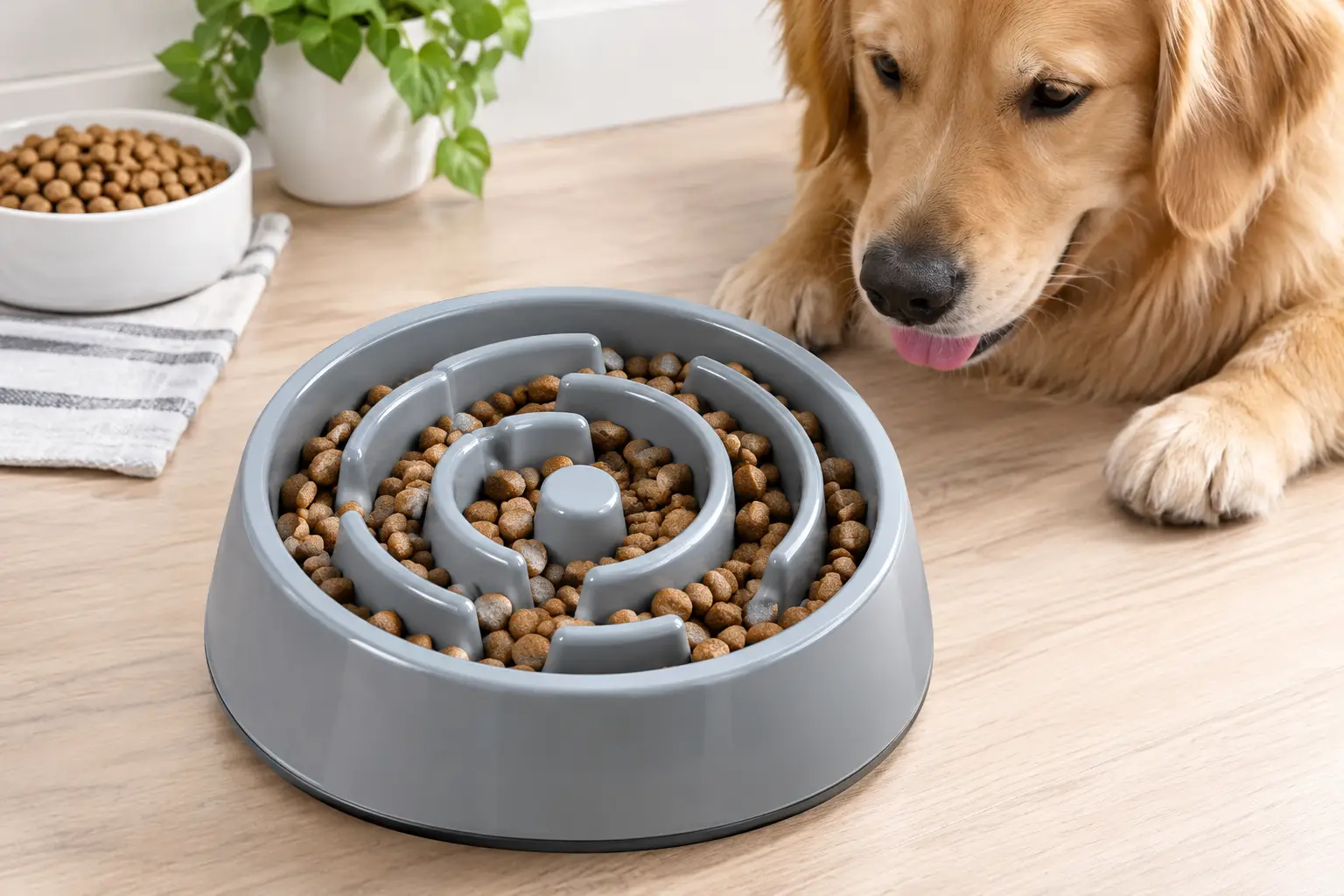
If your dog treats dinner like a timed eating contest, a maze bowl is the simplest fix you can buy. Instead of a flat, open dish, a maze bowl puts ridges, walls, and channels between your dog’s tongue and the kibble, so every bite takes a little work. The result is a meal that lasts minutes instead of seconds, less air swallowed along the way, and often fewer “scarf and barf” cleanups on the rug.
That sounds almost too easy, and in a way it is. The hard part isn’t deciding whether to try a maze bowl for dogs; it’s picking the right one. Pattern depth, material, footprint, and capacity all change how a bowl performs with a Labrador versus a Pug versus a cat who has discovered the joys of inhaling breakfast.
This guide cuts through that. We compared seven real slow feeder maze bowl options available on amazon.com, from budget plastic to heavy glazed ceramic and stainless steel, using manufacturer spec sheets and the aggregated sentiment of real customer reviews. No invented test results, no fake quotes — just honest analysis of what each design means for your dog.
What Is a Maze Bowl?
A maze bowl is a slow feeder dog or cat dish with raised ridges, channels, or obstacles molded into the eating surface. These barriers break food into small pockets, forcing a pet to nose and lick kibble out a few pieces at a time, which stretches mealtime and reduces gulping.
Fast eating matters because it has been implicated — alongside breed, age, and feeding habits — as a possible risk factor for gastric dilatation-volvulus (GDV), commonly called bloat, a life-threatening emergency in deep-chested dogs. A maze bowl is not a medical treatment, but it’s a low-cost way to change one behavior you can actually control. 🐕
Maze Bowl Quick Comparison: 7 Picks at a Glance
| Product | Type / Material | Capacity Range | Approx. Price Range | Best For |
|---|---|---|---|---|
| Outward Hound Fun Feeder Slo Bowl | Plastic maze, 3 difficulty levels | 3/4 cup to 4 cups | $10–$25 | Outward Hound Fun Feeder Slo Bowl: most dogs, best all-rounder |
| Outward Hound Fun Feeder Stainless Steel Slo Bowl | Steel bowl + removable maze insert | 2 cups | $20–$30 | Outward Hound Fun Feeder Stainless Steel Slo Bowl: owners who want steel |
| JASGOOD Slow Feeder Dog Bowl | Polypropylene maze | about 1.5–3 cups | $10–$18 | JASGOOD Slow Feeder Dog Bowl: tight budgets |
| Dogit Go Slow Anti-Gulping Dog Bowl | Plastic lobed design | about 1¼–5 cups | $8–$25 | Dogit Go Slow Anti-Gulping Dog Bowl: beginners, wet food |
| Company of Animals GREEN Slow Interactive Feeder | Grass-blade foraging tray | Large tray, one size | $30–$40 | Company of Animals GREEN Slow Interactive Feeder: extreme gulpers |
| LE TAUCI Ceramic Slow Feeder Dog Bowl | Glazed ceramic maze | 0.6–3 cups | $20–$40 | LE TAUCI Ceramic Slow Feeder Dog Bowl: bowl biters, style-conscious homes |
| Neater Pets Stainless Steel Non-Tip Slow Feed Bowl | Stainless steel, non-tip | 3/4 cup to 3 cups | $12–$25 | Neater Pets Stainless Steel Non-Tip Slow Feed Bowl: hygiene-first owners |
Prices are approximate ranges at the time of writing; check the current price on Amazon, as prices may vary.
Reading the table above, the price spread is narrow — almost every option lands under $40 — so the real decision is about design and material, not cost. If your dog is a moderate speed-eater, the Outward Hound Fun Feeder Slo Bowl or the Dogit Go Slow Anti-Gulping Dog Bowl covers most needs; if your dog bites or flips plastic, the weight of the LE TAUCI Ceramic Slow Feeder Dog Bowl or the steel of the Neater Pets Stainless Steel Non-Tip Slow Feed Bowl is worth a few extra dollars. The Company of Animals GREEN Slow Interactive Feeder sits in its own lane for dogs that have already “solved” ordinary mazes.
💬 One click helps other shoppers make an informed choice too! Tap a highlighted product name to check today’s price and reviews. 😊
Top 7 Maze Bowl Picks for 2026: Expert Analysis
Each pick below is broken down by what its features mean in practice, who it suits, what real buyers consistently report, and where it falls short.
1. Outward Hound Fun Feeder Slo Bowl — the benchmark maze bowl
The Outward Hound Fun Feeder Slo Bowl is the design most other slow feeders get compared to, and for good reason: it’s sold in multiple patterns ranked Slow, Slower, and Slowest, so you can match difficulty to your dog instead of guessing.
Sizes run from a small 3/4-cup bowl (about 5.8 inches) through a 2-cup medium to a large 3-to-4-cup version, and the brand markets the design as slowing eating up to 10x. In practice, that range means you can feed a full meal to a Beagle or a Lab without kibble spilling over the ridges. The non-slip base and top-rack dishwasher-safe, BPA-free plastic make it easy to live with day to day.
Based on comparing the lineup, this is the default choice for most medium and large dogs — especially first-time maze bowl buyers who want room to adjust difficulty later. Flat-faced breeds should look at the brand’s shallower patterns rather than the deepest “Slowest” mazes.
Reviews consistently report meals stretching from seconds to several minutes. The most common complaints are determined dogs flipping the bowl, small kibble wedging in narrow outer channels, and plastic not holding up to chewers.
Pros:
- ✅ Three difficulty levels let you fine-tune the challenge
- ✅ Wide size range fits toy breeds to large dogs
- ✅ Dishwasher-safe and light enough to wash daily
Cons:
- ❌ Food-driven dogs can learn to flip it
- ❌ Plastic isn’t a good match for chewers
At roughly $10–$25 depending on size, it delivers the best value-to-performance ratio in this lineup.
2. Outward Hound Fun Feeder Stainless Steel Slo Bowl — the maze, minus the plastic
If you love the Outward Hound pattern but want a steel bowl, the Outward Hound Fun Feeder Stainless Steel Slo Bowl pairs a stainless steel outer dish with a removable maze insert.
The insert uses the brand’s “Slowest” maze pattern and holds 2 cups of dry or wet food in an 8.3-inch bowl — enough for a full meal for a medium dog. Because the insert lifts out, you can scrub the steel bowl separately and even use it as a regular dish on days you don’t need the challenge. The manufacturer also notes it fits raised feeding stations, which matters if you already own one.
Here’s what to weigh: the steel exterior adds durability and a cleaner look, but the part your dog actually interacts with is still the maze insert, so chew-resistance doesn’t jump as much as “stainless” might suggest. It’s best for owners who want a two-in-one bowl and a more kitchen-friendly finish.
We couldn’t verify a large pool of reviews specific to this stainless version separate from the plastic line, so treat performance expectations as similar to the plastic “Slowest” pattern rather than proven better.
Pros:
- ✅ Removable insert doubles as a standard bowl
- ✅ Stainless exterior is easy to sanitize
- ✅ Fits many raised feeding stations
Cons:
- ❌ Only one size (2 cups) for most buyers
- ❌ Fewer independent reviews than the plastic version
Typically around $20–$30, it’s a fair premium if steel matters to you.
3. JASGOOD Slow Feeder Dog Bowl — best budget maze bowl
The JASGOOD Slow Feeder Dog Bowl proves you don’t need to spend much to get a functional maze, making it the go-to pick for multi-dog homes buying in bulk.
The large version measures about 9.6 inches across and 1.77 inches tall, holding roughly 3 cups of dry food. It’s made from food-safe polypropylene that the brand lists as BPA-, PVC-, and phthalate-free, and it ships with six rubber anti-skid pads you glue to the base. That low, wide profile means the bowl is hard to tip — but the shallow 1.77-inch height also means the pattern is less aggressive than deep mazes.
On paper, this is ideal for moderate gulpers, puppies moving up from a regular bowl, and anyone testing whether a maze bowl will work before spending more. JASGOOD itself flags that it’s not designed for chewers or cats.
The large JASGOOD listing showed thousands of ratings averaging around 4.7 stars at the time of research, with buyers frequently praising value and stability. One caveat: care instructions vary between listings (some say top-rack dishwasher safe, one says hand wash only), so check the exact listing you buy.
Pros:
- ✅ Very low cost for a full-size maze
- ✅ Wide base with anti-skid pads resists sliding
- ✅ Many color and size options
Cons:
- ❌ Shallow pattern may not stop extreme gulpers
- ❌ Not suitable for dogs that chew bowls
At roughly $10–$18, it’s the strongest pure-value option here.
4. Dogit Go Slow Anti-Gulping Dog Bowl — simplest learning curve
The Dogit Go Slow Anti-Gulping Dog Bowl skips the labyrinth entirely and uses smooth, raised lobes, which makes it the least intimidating “maze” for nervous or first-time dogs.
Retail listings put the sizes at about 1¼ cups (small, 6.9 inches), 2½ cups (medium, 8.7 inches), and 5 cups (large, 10.7 inches), with an extra-small also sold. It’s dishwasher safe and suitable for wet food, dry food, or water. That last point is underrated: the lobes slow down frantic drinkers too, which helps dogs that vomit after gulping water.
Based on the design, this suits small-to-medium dogs, wet-food eaters, and dogs that get frustrated by deep channels. It’s less suited to determined speed-eaters, who tend to learn the lobe pattern quickly.
Reviews consistently describe it as sturdy, nicely weighted, and stable on the floor thanks to its rubber base. A recurring complaint is sizing: some owners found their dog’s muzzle too wide to fit between the lobes of the smaller sizes.
Pros:
- ✅ Easy for anxious or first-time dogs to figure out
- ✅ Works well for water and wet food
- ✅ Solid, weighted feel for the price
Cons:
- ❌ Lobes can be too tight for wide muzzles
- ❌ Less challenging than true maze patterns
Usually around $8–$25 by size, it’s a low-risk entry point.
5. Company of Animals GREEN Slow Interactive Feeder — toughest challenge for gulpers
The Company of Animals GREEN Slow Interactive Feeder replaces maze walls with dozens of plastic “grass blades,” turning dinner into a foraging game for dogs that have already outsmarted standard bowls.
The tray measures roughly 16 by 11.25 by 4.5 inches and is made from phthalate-free polypropylene that the brand says is dishwasher safe. You scatter food across the blades, and your dog has to push each piece out with nose and tongue. That’s a fundamentally different task than following a channel, so dogs that “learn” a maze often slow down again on GREEN.
Our take: it’s the best pick here for extreme gulpers, large dogs, and dogs on calorie-controlled diets who benefit from meals that feel longer. The manufacturer notes it isn’t suitable for dogs with sensitive gums, and smaller dogs may do better with the separate GREEN Mini.
Reviews commonly mention a sturdy build that’s hard to flip, alongside a big footprint that needs floor space — some owners found it oversized for puppies.
Pros:
- ✅ Foraging design resists “maze fatigue”
- ✅ Heavy, wide tray is difficult to tip
- ✅ Works with dry and wet food
Cons:
- ❌ Large footprint won’t fit small corners
- ❌ More crevices to clean than a simple maze
Around $30–$40, it costs more but solves problems cheaper bowls can’t.
6. LE TAUCI Ceramic Slow Feeder Dog Bowl — heaviest, most bite-resistant
The LE TAUCI Ceramic Slow Feeder Dog Bowl is our pick if your dog shoves, chews, or flips lightweight plastic — sheer weight does the work.
LE TAUCI sells three sizes: 0.6 cups (small), 1.5 cups (8-inch medium), and 3 cups (9.5-inch large, listed at about 4 pounds). The glazed ceramic is microwave safe and dishwasher safe, and an optional wooden stand is sold separately. A heavy ceramic maze bowl simply doesn’t slide or tip the way an 8-ounce plastic bowl can, and there’s no plastic to gnaw off.
Based on comparing materials, this is ideal for bowl biters, owners who prefer non-plastic dishes, and homes where the bowl lives in plain sight. If you own a large, deep-chested breed, consider skipping the elevated stand (see our safety section below).
Reviews frequently praise durability and repeat purchases, with several owners of bloat-prone breeds citing it as their go-to. One honest complaint: filling to the full stated capacity piles kibble above the maze, which weakens the slow-down effect.
Pros:
- ✅ Heavy enough that most dogs can’t push it
- ✅ Glazed surface resists odors and scratches
- ✅ Attractive enough to leave on display
Cons:
- ❌ Can chip or shatter if dropped
- ❌ Full capacity reduces maze effectiveness
Generally in the $20–$40 range by size, it’s a strong buy for durability.
7. Neater Pets Stainless Steel Non-Tip Slow Feed Bowl — best hygiene-focused option
The Neater Pets Stainless Steel Non-Tip Slow Feed Bowl is for owners who want an all-metal bowl with no plastic insert at all.
It comes in sizes from 3/4 cup (about 7.5 inches wide, 1.4 inches high) up to 3 cups, with a flared non-tip base and a removable non-skid rubber ring. Because the slow-feed hump is stamped directly into the steel, there’s no separate insert to trap grime — wash the bowl and the ring separately, and you’re done. The flared shape means the bowl can’t be tipped the way a straight-walled dish can.
Here’s the trade-off: a single raised center is a simpler obstacle than a true maze, so expect a moderate slow-down rather than a dramatic one. It fits hygiene-minded owners, cats and small dogs (in the smaller sizes), and dogs with allergies to some plastics.
Verified buyer reviews on the brand’s site describe it as working as advertised for large and small dogs, though the review pool we could verify is smaller than for the Outward Hound or JASGOOD bowls.
Pros:
- ✅ All-steel construction with no insert to clean
- ✅ Flared non-tip base stays upright
- ✅ Removable rubber ring for easy washing
Cons:
- ❌ Simpler obstacle than a true maze
- ❌ Smaller independent review pool
Expect roughly $12–$25, a fair price for a bowl that should last years.
Side-by-Side Specs: How the 7 Maze Bowls Stack Up
| Product | Difficulty | Dishwasher Safe | Chew Resistance | Best For |
|---|---|---|---|---|
| Outward Hound Fun Feeder Slo Bowl | Adjustable (Slow–Slowest) | Top rack | Low | Outward Hound Fun Feeder Slo Bowl: most dogs |
| Outward Hound Fun Feeder Stainless Steel Slo Bowl | High (Slowest insert) | Check listing | Medium | Outward Hound Fun Feeder Stainless Steel Slo Bowl: steel lovers |
| JASGOOD Slow Feeder Dog Bowl | Low–medium | Varies by listing | Low | JASGOOD Slow Feeder Dog Bowl: budget buyers |
| Dogit Go Slow Anti-Gulping Dog Bowl | Low | Yes | Medium | Dogit Go Slow Anti-Gulping Dog Bowl: beginners |
| Company of Animals GREEN Slow Interactive Feeder | Very high | Yes | Medium | Company of Animals GREEN Slow Interactive Feeder: extreme gulpers |
| LE TAUCI Ceramic Slow Feeder Dog Bowl | Medium | Yes | High | LE TAUCI Ceramic Slow Feeder Dog Bowl: bowl biters |
| Neater Pets Stainless Steel Non-Tip Slow Feed Bowl | Low–medium | Yes | Very high | Neater Pets Stainless Steel Non-Tip Slow Feed Bowl: hygiene-first homes |
The pattern is clear: difficulty and chew resistance rarely come in the same package. The Company of Animals GREEN Slow Interactive Feeder wins on challenge, while the heavier LE TAUCI Ceramic Slow Feeder Dog Bowl and the all-steel Neater Pets Stainless Steel Non-Tip Slow Feed Bowl win on durability. Decide which problem — speed or destruction — is bigger for your dog, and buy for that.
✨ Don’t miss these top-rated picks!
🔍 Ready to turn dinner from a sprint into a stroll? Click any highlighted product name to check current pricing and availability. The right maze bowl can give you calmer mealtimes and a happier pup — starting tonight! 🐾
Getting Started: Your Dog’s First 30 Days With a Maze Bowl
Buying the bowl is step one. Getting your dog to use it without frustration is where most owners stumble. Here’s a practical rollout plan.
Days 1–3: Make it a win
Put a few high-value treats in the maze before you add kibble. You want your dog’s first experience to be “this thing has food” — not “this thing is blocking my food.” If your dog stares, barks, or walks away, that’s normal; just leave it down for a few minutes and try again.
Days 4–10: Transition the meals
Feed half the meal in the maze bowl and half in the old dish, then move to full meals once your dog eats from the maze without hesitation. Don’t overfill: keep kibble below the tops of the ridges, or the maze stops working.
Days 11–30: Watch and adjust
Time a few meals with your phone. If a meal that used to take 30 seconds now takes several minutes, you’re on track. If your dog has adapted and speeds back up, rotate patterns, switch to a harder bowl, or try freezing food with a little low-sodium broth inside the maze for a longer session.
Ongoing maintenance
✅ Wash daily — ridges trap residue, especially with wet food. ✅ Use a small bottle brush for narrow channels. ✅ Inspect plastic weekly for bite marks or cracks, and replace any bowl with rough, chewed edges. ✅ Check ceramic for chips before every wash.
A common first-month mistake is giving up after one rough meal. Most dogs need a few days, and some take a week or two, to stop treating the bowl as an obstacle and start treating it as a puzzle.
Real-World Scenarios: Matching the Right Maze Bowl to Your Dog
Specs only mean so much until you picture an actual dog. Here are three common profiles and the reasoning behind each match.
Profile 1: The 75-pound Lab who finishes 3 cups in 20 seconds
Budget: under $25. Use: twice daily, dry kibble. Start with the large Outward Hound Fun Feeder Slo Bowl in a “Slower” or “Slowest” pattern. It holds a full large-breed meal, and the adjustable difficulty gives you somewhere to go if he adapts. If he starts flipping it, upgrade to the Company of Animals GREEN Slow Interactive Feeder, whose wide, heavy tray is far harder to tip. Large, deep-chested dogs also benefit from staying on the floor rather than a raised feeder.
Profile 2: The apartment Frenchie on wet food
Budget: around $15. Use: two small meals daily. Flat-faced dogs struggle with deep, narrow mazes. The Dogit Go Slow Anti-Gulping Dog Bowl is a better fit — its smooth lobes slow eating without jamming a short muzzle into tight channels. Check the lobe spacing before buying, since reviews note smaller sizes can be too tight for wide faces.
Profile 3: The bowl-chewing rescue terrier
Budget: $20–$35. Use: twice daily, mixed food. Skip plastic entirely. The medium LE TAUCI Ceramic Slow Feeder Dog Bowl is too heavy to push around, and there’s nothing soft to gnaw. If you’d rather avoid breakable ceramic, the Neater Pets Stainless Steel Non-Tip Slow Feed Bowl is the near-indestructible alternative, with a gentler slow-down effect.
The thread connecting all three: match the bowl to your dog’s problem — speed, face shape, or destructiveness — not just to their weight.
Problem → Solution: Fixing the 5 Most Common Maze Bowl Headaches
Even a well-chosen maze bowl can cause friction. These are the issues that show up most often in owner reviews, with practical fixes.
1. “My dog just flips the bowl.” Lightweight plastic is easy to overturn. Place the bowl on a rubber feeding mat, or switch to a heavier option like the LE TAUCI Ceramic Slow Feeder Dog Bowl or the wide Company of Animals GREEN Slow Interactive Feeder.
2. “Kibble gets stuck in the outer channels.” Some deep patterns trap small pieces, which can frustrate dogs into giving up. Try a larger kibble size, a pattern with wider channels, or the simpler lobes of the Dogit Go Slow Anti-Gulping Dog Bowl.
3. “He figured it out and eats fast again.” Dogs learn. Rotate between two different patterns, step up to a harder level of the Outward Hound Fun Feeder Slo Bowl, or freeze wet food inside the maze to add a new challenge.
4. “She gets frustrated and won’t eat.” The maze may be too hard. Drop to a shallower bowl such as the JASGOOD Slow Feeder Dog Bowl, and reintroduce the challenge gradually with treats first.
5. “The bowl smells even after washing.” Scratched plastic can hold odors and residue. Move to glazed ceramic or the Neater Pets Stainless Steel Non-Tip Slow Feed Bowl, and wash after every wet meal. It’s also worth knowing that slowing eating is just one piece of the bloat puzzle: a Veterinary Evidence review on raised feeders and GDV is a useful reminder that bowl height deserves attention too.
How to Choose a Maze Bowl for Dogs: 7 Steps
Choosing a maze bowl for dogs is mostly about matching four variables — speed, size, muzzle shape, and habits. Follow these steps in order.
- Measure your dog’s current eating time. Time one meal. Under 30 seconds signals a serious gulper who needs a “Slowest”-level maze or a foraging tray.
- Match capacity to a full meal. Your dog’s portion should sit below the ridges. If a full meal piles over the top, size up.
- Check muzzle shape. Flat-faced breeds (Pugs, Bulldogs, Shih Tzus) need shallow, wide channels; long-nosed dogs can handle deep mazes.
- Factor in chewing and flipping. Destructive dogs belong with ceramic or steel; gentle eaters do fine with plastic.
- Pick a material you’ll actually wash. Dishwasher-safe is a big quality-of-life win for a bowl you’ll clean twice a day.
- Consider your dog’s bloat risk. Large, deep-chested breeds face higher GDV risk; VCA Animal Hospitals lists rapid eating and once-daily feeding among the factors that raise it. For these dogs, a slow feeder plus split meals is a sensible combination — and your vet’s advice comes first.
- Plan for adaptation. Choose a brand with multiple difficulty levels or budget for a second pattern to rotate.
This step-by-step approach usually narrows seven options to one or two, which is exactly where you want to be.
Maze Bowl vs Regular Bowl, Lick Mat, and Puzzle Feeder
A maze bowl isn’t the only way to slow a dog down, so it’s worth knowing when an alternative makes more sense.
| Option | Slows Eating | Holds a Full Meal | Ease of Cleaning | Best For |
|---|---|---|---|---|
| Maze bowl | High | Yes | Moderate | Everyday dry or wet meals |
| Regular bowl | None | Yes | Very easy | Calm, slow eaters |
| Lick mat | High (wet/spreadable only) | Rarely | Moderate | Calming, grooming distraction |
| Puzzle feeder / toy | Very high | Sometimes | Harder | Bored, high-energy dogs |
The takeaway: a maze bowl is the only option that slows eating and comfortably holds a full kibble meal every day, which is why it’s usually the right starting point. Lick mats shine for spreadable food and anxiety, while puzzle toys are better as enrichment than as a twice-daily feeding tool. The Company of Animals GREEN Slow Interactive Feeder bridges the gap, offering puzzle-like difficulty in a meal-sized format.
Think of it this way: the regular bowl is a highway, the lick mat is a slow scenic road, and the maze bowl is a well-designed city grid — still efficient, just with enough turns to stop anyone from speeding.
Plastic vs Stainless Steel vs Ceramic Maze Bowl: Which Material Wins?
Material affects hygiene, durability, weight, and price more than most buyers expect.
Plastic
Plastic slow feeder maze bowl designs — like the Outward Hound Fun Feeder Slo Bowl and JASGOOD Slow Feeder Dog Bowl — offer the most intricate patterns at the lowest prices, because plastic is easy to mold into deep channels. The downside is longevity: scratches from teeth and scrubbing can trap residue over time, and chewers can damage edges. Look for BPA-free labeling and replace bowls that look worn.
Stainless Steel
Steel bowls, such as the Neater Pets Stainless Steel Non-Tip Slow Feed Bowl, are nearly indestructible and easy to sanitize. The trade-off is pattern complexity — stamping metal can’t create a deep maze, so obstacles are simpler. Hybrid designs like the Outward Hound Fun Feeder Stainless Steel Slo Bowl get around this with a removable insert.
Ceramic
A ceramic maze bowl like the LE TAUCI Ceramic Slow Feeder Dog Bowl offers weight, a smooth glazed surface, and a good-looking finish. Ceramic is heavy enough that most dogs can’t push it around, but it can chip or break if dropped. Inspect it regularly; a chipped glaze creates rough spots that are harder to clean.
Bottom line: plastic for maximum challenge on a budget, steel for hygiene and durability, ceramic for weight and style. If your dog is a chewer, the choice narrows to the last two.
Maze Bowl for Large Dogs and Bloat-Prone Breeds
If you share your home with a Great Dane, German Shepherd, Standard Poodle, or another large, deep-chested breed, the case for a maze bowl for large dogs is stronger — but so are the details.
A veterinary review of GDV published on PubMed lists speed of eating, feeding frequency, food particle size, swallowed air, and an elevated food bowl among implicated dietary factors, and it reports that expected mortality even with surgery is 15–24%. That number is a reason to take prevention seriously, not to panic.
What a slow feeder can and can’t do
The honest picture: evidence on eating speed is mixed. Some studies flag fast eating as a risk factor, others find no clear effect — but no research we found suggests slowing a meal increases risk. That makes a maze bowl a low-downside habit, not a guarantee.
Watch the height
This is where many owners go wrong. Raised feeders were once recommended to “prevent” bloat, yet a widely cited 2000 Purdue study associated raised bowls with higher GDV risk in large and giant breeds; a later 2012 study did not find that association. Given the conflicting data, many vets advise floor feeding for deep-chested dogs. So if you buy the LE TAUCI Ceramic Slow Feeder Dog Bowl or a bowl that fits a raised station, consider keeping it on the floor unless your vet says otherwise.
Practical pairing
For a big dog, combine the large Outward Hound Fun Feeder Slo Bowl or the Company of Animals GREEN Slow Interactive Feeder with two or more smaller meals per day and quiet time after eating. And learn the warning signs: a swollen belly, unproductive retching, and restlessness mean an emergency vet visit, immediately.
Maze Bowls for Flat-Faced Breeds, Puppies, and Cats
Not every pet benefits from the deepest maze on the shelf. These three groups need tailored choices.
Flat-faced (brachycephalic) dogs
Pugs, French Bulldogs, Boston Terriers, and Shih Tzus have short muzzles that can’t reach into narrow, deep channels. A frustrating bowl can lead to skipped meals or more aggressive eating. Choose wide, shallow obstacles: the Dogit Go Slow Anti-Gulping Dog Bowl (check lobe spacing for your dog’s face) or a flat-faced-friendly pattern from the Outward Hound line.
Puppies
Puppies eat several small meals a day and are still learning. A small, shallow bowl like the 3/4-cup Outward Hound Fun Feeder Slo Bowl or the medium JASGOOD Slow Feeder Dog Bowl gives them a gentle challenge without overwhelming them. Avoid fragile ceramic with teething puppies who mouth everything.
Cats
Cats that gorge and vomit can benefit from a maze bowl too, but they need tiny pockets and shallow walls that won’t press their whiskers. The 0.6-cup LE TAUCI Ceramic Slow Feeder Dog Bowl and the smallest Neater Pets Stainless Steel Non-Tip Slow Feed Bowl are listed for small dogs and cats, while JASGOOD explicitly says some of its bowls are not meant for cats.
For all three groups, the rule is the same: start easier than you think, then increase difficulty once the pet is eating comfortably.
Long-Term Cost and Maintenance: What You’ll Really Spend
A maze bowl looks like a one-time $15 purchase, but replacement cycles change the math.
| Material | Typical Upfront Range | Realistic Lifespan* | Rough 3-Year Cost |
|---|---|---|---|
| Plastic maze | $10–$25 | 12–18 months with daily use | $20–$50 |
| Stainless steel | $12–$30 | Many years | $12–$30 |
| Ceramic | $20–$40 | Years, unless dropped | $20–$40 |
| Foraging tray (GREEN) | $30–$40 | Several years | $30–$40 |
Lifespan estimates are general guidance based on materials and owner reports (some Outward Hound buyers mention replacing a bowl every 12–18 months), not manufacturer guarantees.
Over three years, the “cheap” plastic bowl can cost as much as a ceramic or steel one, because worn or chewed plastic should be replaced. That doesn’t make plastic a bad choice — the Outward Hound Fun Feeder Slo Bowl still offers the best pattern variety for the money. It simply means durable materials like the Neater Pets Stainless Steel Non-Tip Slow Feed Bowl quietly win on total cost of ownership.
Maintenance costs are minimal: a bottle brush, dish soap, and maybe a rubber feeding mat. The real hidden cost is time — washing a maze bowl takes longer than a smooth dish, so dishwasher compatibility pays off every single day.
Common Mistakes to Avoid When Buying a Maze Bowl
Most disappointing maze bowl purchases come down to a handful of predictable errors.
❌ Buying by dog weight alone. A 60-pound Bulldog and a 60-pound Pointer need completely different bowls. Muzzle shape matters as much as size.
❌ Overfilling the bowl. Advertised capacity often means “filled to the brim,” which buries the maze. Reviews of the LE TAUCI Ceramic Slow Feeder Dog Bowl mention exactly this problem. Size up so the meal sits below the ridges.
❌ Choosing the hardest pattern first. Starting with the most challenging maze can frustrate your dog into refusing the bowl. Begin moderate and level up.
❌ Ignoring cleaning. A bowl you dread washing becomes a bowl that doesn’t get washed. Prioritize dishwasher-safe designs if you’re busy.
❌ Giving plastic to a chewer. Chewed plastic can create sharp edges and swallowed fragments. Chewers need ceramic or steel.
❌ Assuming a bowl replaces vet advice. A maze bowl for dogs is a helpful habit, not a treatment. For bloat-prone breeds, ask your vet about feeding frequency and whether preventive gastropexy makes sense.
Avoid these six, and almost any bowl in this guide will do its job well.
Maze Bowl FAQs
❓ Is a maze bowl worth it for a dog that eats normally?
❓ Can I use a maze bowl for water?
❓ Which maze bowl is best for a German Shepherd?
❓ How often should I replace a plastic maze bowl?
❓ Are ceramic maze bowls safe for puppies?
Conclusion: The Right Maze Bowl Is the One Your Dog Will Actually Use
A good maze bowl does one simple job — it turns a sprint into a stroll — but the “best” one depends entirely on your dog. Speed, muzzle shape, chewing habits, and how much washing you’re willing to do matter far more than brand hype.
For most dogs, the Outward Hound Fun Feeder Slo Bowl is the smartest starting point thanks to its three difficulty levels and wide size range. Budget-focused shoppers can test the waters with the JASGOOD Slow Feeder Dog Bowl, while nervous eaters and flat-faced breeds often do better with the gentle lobes of the Dogit Go Slow Anti-Gulping Dog Bowl. If your dog has already outsmarted ordinary mazes, the Company of Animals GREEN Slow Interactive Feeder brings back the challenge.
For chewers and flippers, invest in weight and durability: the LE TAUCI Ceramic Slow Feeder Dog Bowl for a heavy, stylish ceramic option, or the Neater Pets Stainless Steel Non-Tip Slow Feed Bowl for near-indestructible steel. And if you love the Outward Hound maze but want metal, the Outward Hound Fun Feeder Stainless Steel Slo Bowl splits the difference.
Whichever you choose, introduce it gradually, keep food below the ridges, feed large breeds at floor level, and keep your vet in the loop. Small changes at the food bowl can add up to calmer, healthier mealtimes for years.
🐾 Ready to slow down the chow-time chaos?
👉 Tap the highlighted product that fits your dog to check current pricing and availability on Amazon. Your floors — and your dog’s stomach — will thank you! ✨
Recommended for You
- Travel Dog Bowl Set: 7 Best Picks for Stress-Free Trips (2026)
- Christmas Bowls for Dogs: 7 Best Festive Picks to Avoid Regret (2026)
- Pet Lodge Dog Feeder: 7 Smart Picks & Honest Buying Guide (2026)
Disclaimer: This post contains affiliate links. As an Amazon Associate, I earn from qualifying purchases made through these links, at no additional cost to you.
✨ Found this article helpful? Share it with someone who needs it! 💬🤗