In This Article
Why a Dog Treat Ball Toy Belongs in Your Dog’s Toy Basket
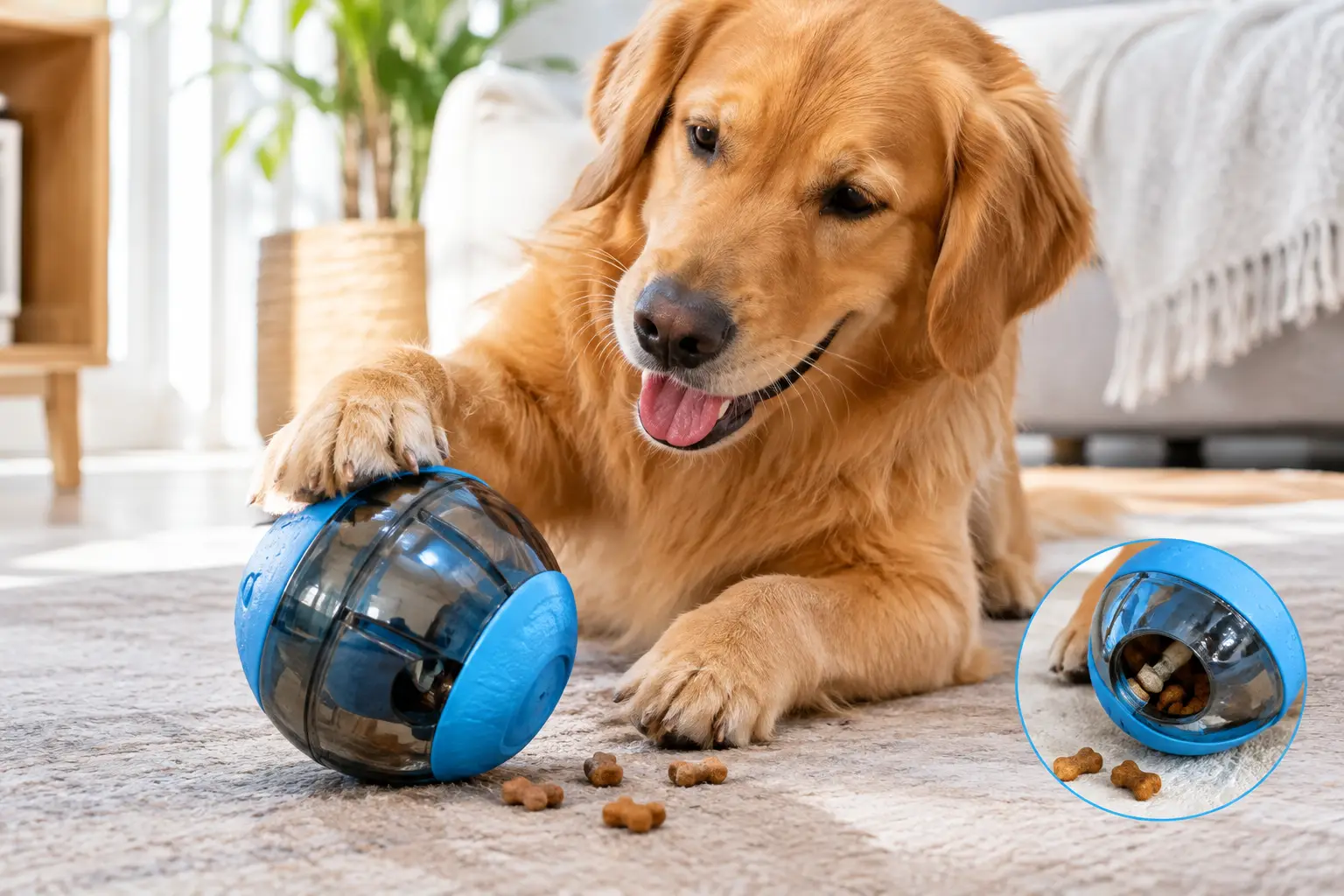
Your dog inhales dinner in about 40 seconds, licks the empty bowl twice, and then spends the next three hours following you from room to room like a furry parole officer. Sound familiar? A dog treat ball toy is one of the simplest fixes for that pattern. You fill it with kibble or small treats, your dog rolls and nudges it around the floor, and food drops out a few pieces at a time. Mealtime stretches from under a minute to fifteen or twenty, and your dog’s brain gets a workout along the way.
That second part matters more than most people realize. Dogs evolved to work for their food, sniffing, chasing, and figuring things out. A bowl skips all of that. The American Kennel Club points out that puzzle toys can improve a dog’s memory and teach them to focus on a task for a stretch of time, and a rolling treat ball is the most beginner-friendly way to start.
The catch? Not every dog treat ball toy suits every dog. A soft vinyl ball that delights a Cavapoo might last ten minutes with a Labrador who treats toys like jerky. Hard plastic balls rattle loudly across hardwood floors. Some holes are so wide the “puzzle” empties in two rolls. This guide sorts all of that out, using real specs and aggregated owner feedback, so you can pick once and pick right.
What Is a Dog Treat Ball Toy?
A dog treat ball toy is a hollow, ball-shaped toy you fill with kibble or small treats. As your dog rolls, paws, or bats it, food drops out through one or more openings at a pace set by the hole size and the ball’s internal design. It blends play, foraging, and slow feeding into a single object.
Quick Comparison: The 7 Best Dog Treat Ball Toys at a Glance
| Product | Material | Sizes | Challenge level | Best for |
|---|---|---|---|---|
| Starmark Treat Dispensing Chew Ball | Tough synthetic rubber-like compound | 2.5″, 3.25″, 4″ | Medium–hard | Starmark Treat Dispensing Chew Ball: power chewers |
| West Paw Zogoflex Rumbl | Zogoflex Echo (recyclable) | Small, Large | Easy–medium | West Paw Zogoflex Rumbl: fetch-plus-food players |
| Outward Hound Orbee-Tuff Snoop | Translucent TPE, mint-infused | Lil Snoop, Snoop (~5″) | Medium | Outward Hound Orbee-Tuff Snoop: quiet indoor play |
| OurPets IQ Treat Ball | Hard plastic, twist-apart | 3″, 4″ | Adjustable | OurPets IQ Treat Ball: meal feeding on carpet |
| KONG Rewards Ball | Durable molded plastic | Small, Large (4.75″) | Easy–medium | KONG Rewards Ball: dogs who love chasing |
| Omega Paw Tricky Treat Ball | Soft vinyl | S, M, L | Medium | Omega Paw Tricky Treat Ball: budget buyers |
| Outward Hound Nina Ottosson Treat Tumble | Food-safe plastic, one piece | Small, Large | Easy (Level 1) | Outward Hound Nina Ottosson Treat Tumble: first-timers |
Reading across the table, the biggest split isn’t brand, it’s material. Soft, chew-resistant balls like the Starmark Treat Dispensing Chew Ball and West Paw Zogoflex Rumbl forgive teeth, while hard plastic designs like the OurPets IQ Treat Ball and Outward Hound Nina Ottosson Treat Tumble offer smarter dispensing mechanics but need a gentler dog. If you only remember one rule, match the material to your dog’s jaw first and the puzzle design second.
💬 One click helps other shoppers make an informed choice too! 😊
Top 7 Dog Treat Ball Toys: Expert Analysis
Every pick below is a real product sold on amazon.com in the US market. The commentary is based on spec sheets, manufacturer data, and recurring themes in public customer reviews on major US retailers, not on invented testing.
1. Starmark Treat Dispensing Chew Ball — toughest pick for power chewers
If your dog has a graveyard of decapitated toys, the Starmark Treat Dispensing Chew Ball is the usual first stop. Starmark describes the material as stronger than rubber and free of latex, vinyl, and phthalates, and it comes in three sizes: Medium (2.5″, dogs under 15 lb), Medium/Large (3.25″, 15–40 lb, model SMFBML), and Large (4″, dogs over 40 lb). Clover-shaped openings with flexible “fingers” sit on each end, so treats only escape when your dog squeezes or bounces the ball just right. In practice, that means a slower, more deliberate challenge than a simple hole.
Based on comparing the specs, this is the dog treat ball toy to pick when durability outranks everything else. It’s squishy enough to carry comfortably, it floats, and it can go on the dishwasher’s top rack. It suits shepherds, pit mixes, and doodles who chew first and ask questions later.
Reviews consistently praise its survival rate; on Chewy, the Large size holds roughly 4.4 out of 5 stars across more than 2,500 reviews at the time of writing. The most common complaints are that newer batches feel firmer, and that some openings eventually tear or seams split under daily heavy chewing.
Pros:
- ✅ Outlasts most balls in this category with heavy chewers
- ✅ Three clearly weight-rated sizes reduce guesswork
- ✅ Floats and cleans in the dishwasher
Cons:
- ❌ Openings can loosen and get easier over time
- ❌ A light vanilla scent may put off some dogs
Typically between $10 and $20 depending on size, it’s strong value for chewers who destroy cheaper toys monthly.
2. West Paw Zogoflex Rumbl — bounciest made-in-USA option
The West Paw Zogoflex Rumbl is the pick for dogs who want a game of fetch that pays out. It’s molded from West Paw’s Zogoflex Echo material in Bozeman, Montana, and the brand states it contains no BPA, latex, phthalates, or silicone. The “fish trap” opening loads easily but holds dry food inside until your dog wobbles or bounces it. The Large holds about two cups of kibble and the Small about one cup, which means it can realistically replace a full meal bowl for many medium dogs.
Here’s what to weigh: West Paw rates the Rumbl for moderate chewers, not power chewers. That positioning is honest, and it matters. For a retriever who plays hard but doesn’t shred, it’s ideal. For a dedicated destroyer, the Starmark Treat Dispensing Chew Ball is the safer bet. It’s also top-rack dishwasher safe and freezer friendly, so you can soak kibble and freeze it for a longer session.
On West Paw’s own site, the Rumbl sits around 4.6 out of 5 across a couple hundred reviews. The recurring criticism is that the large opening makes it too easy for experienced puzzle dogs, and trainers note it isn’t damage-proof under power chewing.
Pros:
- ✅ Holds up to two cups for full-meal feeding
- ✅ Wild bounce makes fetch far more exciting
- ✅ Recyclable material backed by West Paw’s guarantee
Cons:
- ❌ Large opening can be too easy for puzzle pros
- ❌ Not designed for dedicated power chewers
Usually in the $15 to $25 range, it costs more upfront but replaces both a fetch ball and a slow feeder.
3. Outward Hound Orbee-Tuff Snoop — quietest pick for apartment living
The Outward Hound Orbee-Tuff Snoop (originally a Planet Dog design) stands out because it’s soft, translucent, and nearly silent on hard floors. Its non-toxic, BPA- and phthalate-free material is infused with mint oil, and treats hide inside a deep crevice that your dog has to squish, roll, and paw to empty. Because the toy is see-through, your dog can spot the food, which keeps beginners motivated instead of frustrated.
On paper, this is a medium-difficulty puzzle with a clever upgrade path: some owners insert a small Orbee ball inside to make treats harder to reach. That flexibility gives it a longer useful life as your dog gets smarter. It’s best for small to medium dogs in apartments or homes where a clattering plastic ball would drive the humans crazy.
On Chewy, the standard Snoop holds about 4.3 out of 5 across more than 1,300 reviews at the time of writing. Owners love the quiet and the mint scent, but focused chewers can destroy it quickly, and the rubbery surface collects dog hair. At least one owner reported a frightening incident with a dog getting stuck in the toy, so size up and supervise.
Pros:
- ✅ Nearly silent on hardwood and tile floors
- ✅ Translucent design keeps beginners engaged
- ✅ Mint infusion makes it smell pleasant
Cons:
- ❌ Not suitable for determined chewers
- ❌ Attracts hair and needs frequent rinsing
Generally between $10 and $15, it’s a fair price for a quiet, versatile puzzle.
4. OurPets IQ Treat Ball — best adjustable difficulty for meal feeding
The OurPets IQ Treat Ball is the engineer’s choice. The ball twists apart into two halves, and an internal disc sits between them. You rotate that disc to make the opening smaller or larger, which means you can start your dog on easy mode and dial up the challenge as they learn. Food has to pass through two openings before it drops out, so dispensing is noticeably slower than single-hole designs.
It comes in 3″ (for dogs 10 lb and up, not toy breeds) and 4″ sizes, and the larger ball holds roughly half a cup of kibble. That two-chamber design makes it a strong dog food dispensing ball for dogs who eat too fast. The trade-off is material: it’s hard plastic, so it’s loud on hardwood and not meant for dogs who can fit it in their mouths.
Reviews are mixed but informative. Owners of small and medium dogs report months or even years of use, and several mention it works best on carpet, where the ball rolls more slowly. The most common complaint is that strong or clever dogs learn to drop it from height and pop it apart.
Pros:
- ✅ Adjustable disc grows with your dog’s skill
- ✅ Two-stage dispensing slows fast eaters effectively
- ✅ Disassembles fully for thorough cleaning
Cons:
- ❌ Hard plastic is noisy on bare floors
- ❌ Determined dogs can split it apart
Typically in the $8 to $15 range, it’s excellent value for supervised meal feeding.
5. KONG Rewards Ball — most unpredictable bounce for chasers
The KONG Rewards Ball leans into chaos in the best way. Its lumpy, uneven shape sends it bouncing in random directions, so your dog never knows where it’s headed next. KONG markets it for quiet play and as a bowl replacement to help manage weight, and it comes in two sizes, with the Large measuring about 4.75″ for medium to large dogs.
What most buyers overlook with this model is that unpredictable movement is its own kind of mental challenge. A dog who has “solved” a predictable rolling ball has to re-engage every time this one veers off. That makes it a smart second treat ball for dogs who’ve gotten bored with the first. It’s fun for terriers, schnauzers, and other high-prey-drive dogs who love to pounce.
Review data for the Rewards Ball is thinner than for the other picks here, so treat this summary with some caution. The feedback that is available is positive about engagement and build quality, with the most common criticism being that treats come out a bit too quickly for experienced dogs.
Pros:
- ✅ Erratic bounce keeps chase-driven dogs engaged
- ✅ Trusted brand with a quiet-play focus
- ✅ Doubles as a portion-controlled feeder
Cons:
- ❌ Less public review data than rival picks
- ❌ Can be too easy for puzzle veterans
Usually around $8 to $15 at the time of writing, it’s a fair price for a fresh challenge.
6. Omega Paw Tricky Treat Ball — best budget pick for quiet homes
The Omega Paw Tricky Treat Ball has been around for years, and its staying power comes down to a clever detail: the fill hole connects to an internal tube, so food doesn’t simply pour out. Made of soft vinyl, it’s quiet on floors, and if it gets wedged in a corner, your dog can pick it up and reposition it instead of whining for help. The outer surface has dimples you can dab with peanut butter to coax hesitant dogs.
Here’s what to weigh: this is a budget dog treat ball toy, and it behaves like one. For gentle dogs, it’s a fantastic, low-risk introduction to food puzzles. For chewers, it isn’t appropriate at all. Sizing matters, too; owners repeatedly say the medium hole is too small for standard treats, so plan on kibble or tiny training bites.
On Chewy, the ball carries around 4 out of 5 stars across more than 1,200 reviews. Longtime fans love the quiet and the price, but a recurring complaint is that newer versions feel flimsier than older ones. Trainers also note you can’t open it fully, which makes deep cleaning difficult.
Pros:
- ✅ Very affordable entry point into food puzzles
- ✅ Soft and quiet on bare floors
- ✅ Internal tube slows down dispensing
Cons:
- ❌ Cannot open fully for deep cleaning
- ❌ Not safe for chewers of any intensity
Often under $10 depending on size, it’s the lowest-risk way to test whether your dog enjoys treat balls.
7. Outward Hound Nina Ottosson Treat Tumble — gentlest first puzzle for beginners
The Outward Hound Nina Ottosson Treat Tumble is labeled Level 1 in Nina Ottosson’s puzzle system, which tells you exactly who it’s for: dogs who have never solved anything harder than “where’s the bowl.” It’s made from food-safe plastic that the brand states is free of BPA, PVC, lead, and phthalates, and its one-piece build won’t twist apart during play or cleaning. Two sizes are offered; the small is listed at about 4.8″ on Amazon.
Based on comparing the specs, this is a confidence builder. The openings are generous and the ball rolls predictably, so dogs get rewarded quickly and learn that pushing equals payoff. That’s exactly what an anxious or under-confident dog needs. Once your dog empties it in minutes, graduate to the OurPets IQ Treat Ball or the Outward Hound Orbee-Tuff Snoop.
On Chewy, the large Treat Tumble holds about 4.2 out of 5 across more than 850 reviews at the time of writing. Fans love watching reluctant dogs finally play; critics, often owners of experienced puzzle dogs, call it too simple. The brand also stresses it’s not a chew toy.
Pros:
- ✅ Very easy for dogs new to puzzles
- ✅ One-piece design never pops apart
- ✅ Food-safe, BPA-free plastic construction
Cons:
- ❌ Too simple for puzzle-savvy dogs
- ❌ Hard plastic won’t survive chewing
Usually between $8 and $15, it’s a sensible starter purchase before investing in harder puzzles.
Side-by-Side: How the Top 7 Compare on What Matters
| Product | Capacity | Dishwasher safe | Chew resistance | Price range | Review sentiment | Best for |
|---|---|---|---|---|---|---|
| Starmark Treat Dispensing Chew Ball | Small treats/kibble | Yes (top rack) | High | $10–$20 | ~4.4/5 (Chewy) | Starmark Treat Dispensing Chew Ball: heavy chewers |
| West Paw Zogoflex Rumbl | Up to 2 cups (L) | Yes (top rack) | Moderate | $15–$25 | ~4.6/5 (West Paw) | West Paw Zogoflex Rumbl: full-meal fetch |
| Outward Hound Orbee-Tuff Snoop | Treats, kibble | Hand rinse | Low–moderate | $10–$15 | ~4.3/5 (Chewy) | Outward Hound Orbee-Tuff Snoop: quiet homes |
| OurPets IQ Treat Ball | ~½ cup (4″) | Hand wash | Low | $8–$15 | Mixed | OurPets IQ Treat Ball: adjustable meals |
| KONG Rewards Ball | Kibble, small treats | Hand wash | Moderate | $8–$15 | Limited data | KONG Rewards Ball: chasers |
| Omega Paw Tricky Treat Ball | ~1 cup (L) | Hard to clean | Low | Under $10 | ~4/5 (Chewy) | Omega Paw Tricky Treat Ball: budget starters |
| Outward Hound Nina Ottosson Treat Tumble | Kibble, small treats | Hand wash | Low | $8–$15 | ~4.2/5 (Chewy) | Outward Hound Nina Ottosson Treat Tumble: beginners |
The pattern is clear: chew resistance and puzzle sophistication rarely live in the same toy. The Starmark Treat Dispensing Chew Ball wins on toughness, the OurPets IQ Treat Ball wins on adjustable challenge, and the West Paw Zogoflex Rumbl is the best compromise for medium dogs who want both play and full meals. Ratings come from different retailers, so treat them as directional rather than directly comparable.
🐾 Ready to turn mealtime into playtime?
🔍 Upgrade your dog’s daily routine with this carefully curated lineup. Click a highlighted toy to check current pricing and availability. These picks will help you get a calmer, happier, better-exercised dog the whole family will enjoy!
How to Introduce a Dog Treat Ball Toy: Your First 30 Days
Most “my dog ignored it” reviews come down to setup, not the toy. Here’s a simple ramp that works for almost any interactive dog puzzle ball.
Days 1–3: Make it absurdly easy
Fill the ball with high-value treats, such as small pieces of cheese or chicken, and pick the easiest setting. On the OurPets IQ Treat Ball, open the disc all the way. Roll it gently toward your dog so a few treats spill out immediately. The goal is a single lesson: this object drops food.
Days 4–10: Let your dog do the work
Switch to a mix of treats and regular kibble, and stop rolling it for them. If your dog gets stuck, nudge the ball once, then step back. Short sessions of five to ten minutes beat long, frustrating ones.
Days 11–20: Replace part of a meal
Measure a portion of your dog’s daily kibble, around a quarter to a third, and serve it in the ball. Subtract that amount from the bowl so total calories stay the same. Tighten the difficulty slightly if your dog empties it in under three minutes.
Days 21–30: Add variety
Rotate between two toys so neither gets stale, for example a predictable roller and the erratic KONG Rewards Ball. The ASPCA also shares simple DIY food enrichment ideas like muffin-tin and paper-roll puzzles you can mix in on alternate days.
Common first-month mistakes
- ❌ Using treats too big to fit through the opening
- ❌ Leaving a new toy with an unsupervised dog
- ❌ Forgetting to subtract ball kibble from the bowl
Which Treat Ball Fits Your Dog? Three Real-World Scenarios
Specs only go so far. These profiles show how the decision changes with the dog in front of you.
Scenario 1: The apartment-dwelling Frenchie
Maya lives in a third-floor apartment with hardwood floors and a downstairs neighbor who notices everything. Her 24-lb French Bulldog eats fast and gets restless during her workday. Budget: about $15. Frequency: daily, 15 minutes before her first video call.
Best match: the Outward Hound Orbee-Tuff Snoop. It’s soft and nearly silent, and the translucent body keeps her dog motivated. Because Frenchies are flat-faced, the open crevice design is easier to work with than a deep hole. A hard plastic roller would be a noise complaint waiting to happen.
Scenario 2: The 70-lb Lab who eats everything, including toys
Derek’s Labrador has destroyed every “indestructible” ball he’s bought. He wants to slow down breakfast and keep the dog busy in the yard. Budget: up to $25. Frequency: twice daily.
Best match: the Large Starmark Treat Dispensing Chew Ball for daily use, with the Large West Paw Zogoflex Rumbl as a supervised fetch-and-feed option. The Starmark handles the jaw pressure, and the Rumbl’s two-cup capacity covers a full breakfast during monitored play.
Scenario 3: The anxious rescue who won’t play
Linda adopted a shy 30-lb terrier mix who ignores squeaky toys. She wants something low-pressure that builds confidence. Budget: under $15. Frequency: a few times a week, then daily.
Best match: the Outward Hound Nina Ottosson Treat Tumble, then a graduation to the OurPets IQ Treat Ball once the dog is solving it quickly. Early wins matter more than challenge for nervous dogs.
Problem → Solution: Fixing the 5 Most Common Treat Ball Frustrations
Even the best dog treat ball toy runs into snags. Here’s how to troubleshoot them.
1. “My dog empties it in 60 seconds.” Use larger or irregularly shaped treats mixed with small kibble, so pieces block the exit. On the OurPets IQ Treat Ball, narrow the disc. On the Outward Hound Orbee-Tuff Snoop, add a small Orbee ball inside as a blocker.
2. “My dog ignores it completely.” Go back to high-value treats and the easiest setting, and rub a dab of peanut butter on the outside of the Omega Paw Tricky Treat Ball or the Outward Hound Nina Ottosson Treat Tumble. Many dogs simply need to discover that the ball pays out.
3. “The ball keeps getting stuck under the couch.” Block off furniture gaps with pool noodles or cardboard, or use the toy in a hallway or bathroom. Softer balls like the Omega Paw Tricky Treat Ball are easier for dogs to pick up and reposition themselves.
4. “It smells funky after a week.” Food oils go rancid inside hollow toys. Choose dishwasher-safe options like the Starmark Treat Dispensing Chew Ball or the West Paw Zogoflex Rumbl, or twist apart the OurPets IQ Treat Ball and wash it in warm, soapy water after every few uses.
5. “My dog chews instead of rolls.” That’s a material mismatch, not a training failure. Swap to a chew-rated treat ball for aggressive chewers like the Starmark Treat Dispensing Chew Ball, and remove any toy as soon as pieces start coming off.
How to Choose a Dog Treat Ball Toy
Picking the right ball is mostly about matching the toy to your dog, not chasing the highest rating. Follow these steps in order:
- Assess chewing style first. A gentle mouther can use any ball here; a power chewer needs a chew-rated material, or every other feature is irrelevant.
- Size up, not down. The ball should be too big to fit fully in your dog’s mouth. If you share a home with several dogs, size for the largest one.
- Match the treat to the opening. Check whether your usual kibble fits. Owners often report medium-size holes that only accept small kibble.
- Pick a difficulty you can adjust. Adjustable designs like the OurPets IQ Treat Ball grow with your dog; fixed openings may become too easy within weeks.
- Consider your floors and neighbors. Hard plastic is loud on hardwood; soft rubber and TPE are much quieter.
- Prioritize cleanability. Dishwasher-safe or twist-apart designs prevent buildup of stale, greasy residue.
- Decide on treats vs. meals. If you want to replace a meal, look for capacity in cups, like the two-cup West Paw Zogoflex Rumbl.
That final step deserves more attention than it usually gets. The Association for Pet Obesity Prevention’s 2022 survey classified 59% of US dogs as overweight or having obesity, so a treat ball works best as a way to deliver food your dog was already going to eat, not as an extra snack.
Treat Dispensing Ball for Dogs vs. Other Enrichment Toys
A treat dispensing ball for dogs isn’t the only enrichment option, and it isn’t always the best one. Here’s how it stacks up.
| Toy type | Physical activity | Mental challenge | Mess level | Best for |
|---|---|---|---|---|
| Treat ball | High (rolling, chasing) | Medium | Low (dry food) | Active, food-motivated dogs |
| Stuffable rubber toy (e.g., KONG Stuff-A-Ball) | Low–medium | Medium | High (wet fillings) | Calm chewing sessions |
| Snuffle mat | Low | Medium (scent) | Low | Senior or low-mobility dogs |
| Slow-feeder bowl | Very low | Low | Low | Simple portion slowing |
The table shows why treat balls are unique: they’re the only option that combines meaningful movement with food. A snuffle mat engages the nose but keeps your dog stationary, which is ideal for seniors and recovering dogs, while stuffable rubber toys excel at long, frozen chewing sessions. Most dogs benefit from rotating two of these types rather than relying on one.
When a treat ball is the wrong choice
If your dog guards food aggressively around other pets, a ball that rolls into another dog’s space can spark conflict. In multi-dog homes, separate dogs during treat-ball time. And for dogs recovering from surgery or injury who need restricted movement, a lick mat or snuffle mat is a better pick until your vet clears activity.
Treat Ball for Aggressive Chewers: What Actually Holds Up
Here’s the uncomfortable truth: no dog treat ball toy is indestructible, and marketing claims of “virtually indestructible” should be read as “harder to destroy than average.” A treat ball for aggressive chewers has two jobs that work against each other. It needs openings for food, and every opening is a weak point teeth can work on.
What the spec sheets tell you
Solid, dense materials with flexible openings, like the Starmark Treat Dispensing Chew Ball, survive longest because the “fingers” around the opening flex instead of tearing. Zogoflex, used in the West Paw Zogoflex Rumbl, is tough and bouncy but is officially rated for moderate chewers. Hard plastic designs like the OurPets IQ Treat Ball and Outward Hound Nina Ottosson Treat Tumble are not chew toys at all and can crack into sharp pieces.
What reviews reveal that specs don’t
Across retailers, heavy-chewer owners report a predictable pattern: the opening deforms first, which makes the puzzle easier, and then the seam or wall eventually splits. Treat that first sign of easy dispensing as a warning that replacement is coming.
A practical rule
Inspect chew-rated balls weekly. Once you see cracks, missing chunks, or a stretched opening, retire the toy. For dogs who chew everything, the KONG brand also offers the KONG Stuff-A-Ball, a natural rubber ball available in multiple sizes, though owners report mixed durability results with the toughest chewers.
Dog Food Dispensing Ball Feeding for Fast Eaters
Using a dog food dispensing ball for part or all of a meal is one of the most practical upgrades you can make for a gulper. Dogs who eat too fast can swallow air and sometimes vomit shortly after eating. A ball physically limits how much food is available at once, so the pace drops naturally.
How much to put in
Capacity varies widely. The 4″ OurPets IQ Treat Ball holds roughly half a cup, the Large Omega Paw Tricky Treat Ball about one cup, and the Large West Paw Zogoflex Rumbl about two cups. For a 50-lb dog eating three cups a day, the Rumbl can cover an entire meal, while the IQ ball works better as a partial portion.
Picking the right food
Dry kibble works in every ball on this list. Freeze-dried or soft treats tend to crumble or stick, which can clog smaller openings and attract bacteria. If you want wet or frozen fillings, a stuffable rubber toy is a better tool than a rolling ball.
Watching the scale
Because treat balls make food feel like play, it’s easy to overdo it. Weigh or measure every portion, count ball kibble as part of the daily total, and check your dog’s body condition monthly. If your dog’s waist starts disappearing, cut the treats, not the playtime.
Safety, Materials, and Standards
Unlike children’s toys, pet toys in the US aren’t covered by a dedicated federal safety standard, so the burden falls on you to choose wisely. The good news: the core rules are simple and well established.
Material labels to look for
Every pick in this guide advertises BPA-free or phthalate-free construction, and several also exclude latex or PVC. Those claims come from manufacturers, so favor established brands that publish material details, such as West Paw, Starmark, KONG, and Outward Hound, over anonymous listings with vague descriptions.
Breakage and swallowing risks
The ASPCA’s position statement on dog chews notes that rubber or hard plastic toys should never break into pieces a dog can swallow, because intestinal blockage can require surgery. That’s why chew style and sizing matter so much. A ball that’s too small can lodge in the throat, and a ball that’s too brittle can splinter.
Supervision and inspection
- ✅ Supervise the first several sessions with any new toy
- ✅ Inspect for cracks, tears, and loose pieces weekly
- ✅ Replace damaged toys immediately, not “after this week”
- ✅ Separate dogs during food-based play in multi-dog homes
Long-Term Cost and Maintenance
A $7 ball that lasts three weeks costs more over a year than a $20 ball that lasts ten months. Thinking in cost per month gives you a clearer picture than sticker price alone.
| Product | Typical price range | Replacement pattern reported by owners | Rough yearly cost estimate | Best for |
|---|---|---|---|---|
| Starmark Treat Dispensing Chew Ball | $10–$20 | Months to over a year with heavy chewers | Low | Starmark Treat Dispensing Chew Ball: chewers |
| West Paw Zogoflex Rumbl | $15–$25 | Long life with moderate chewers; brand guarantee | Low–moderate | West Paw Zogoflex Rumbl: daily meals |
| Omega Paw Tricky Treat Ball | Under $10 | Varies widely; newer versions reported flimsier | Low if gentle, high if chewed | Omega Paw Tricky Treat Ball: gentle dogs |
These estimates depend heavily on your dog’s chewing style, but the takeaway holds: for a chewer, the Starmark Treat Dispensing Chew Ball is usually cheapest over time, while for a gentle dog, the Omega Paw Tricky Treat Ball may last long enough to be the best deal. The West Paw Zogoflex Rumbl adds the safety net of a manufacturer guarantee for moderate-chewer damage.
Maintenance schedule that keeps toys fresh
- After each use: shake out crumbs and rinse.
- Weekly: wash in warm, soapy water or run dishwasher-safe balls on the top rack.
- Monthly: inspect openings and seams, and replace anything cracked.
Common Mistakes to Avoid When Buying a Dog Treat Ball Toy
Plenty of treat balls end up in the donation bin for avoidable reasons.
Buying for the dog you wish you had
If your dog chews, a beautifully designed hard plastic puzzle won’t change that. Buy for your dog’s actual habits, even if that means a less clever toy.
Ignoring the opening size
Many returns happen because the household’s regular kibble or treats don’t fit. Check product photos and reviews for hole size before ordering, especially with medium balls.
Assuming bigger always means harder
A larger ball doesn’t automatically slow dispensing. The Outward Hound Nina Ottosson Treat Tumble is relatively large but intentionally easy, while the smaller Starmark Treat Dispensing Chew Ball can be much tougher to empty.
Skipping the rotation
Dogs habituate. A toy that fascinated your dog in week one can become background furniture by week six. Rotating two or three balls keeps the novelty alive without buying new toys constantly.
Forgetting about your floors
Hard plastic on tile at 6 a.m. is a sound your whole household will learn to dread. Quieter soft options, like the Outward Hound Orbee-Tuff Snoop, are worth considering if you live with light sleepers or downstairs neighbors.
FAQ: Dog Treat Ball Toy Questions Shoppers Ask Most
❓ Can I put my dog's whole meal in a treat ball?
❓ What size treat ball should I buy for a 50-lb dog?
❓ Are treat dispensing balls good for puppies?
❓ Can I leave my dog alone with a treat ball?
❓ Is it worth buying a more expensive treat ball?
Conclusion: The Right Dog Treat Ball Toy Is the One That Fits Your Dog
The best dog treat ball toy isn’t the one with the flashiest listing; it’s the one that matches your dog’s jaw, brain, and home. If your dog chews through everything, start with the Starmark Treat Dispensing Chew Ball. If you want a bouncy fetch toy that can also serve breakfast, the West Paw Zogoflex Rumbl earns its higher price. For quiet apartments, the Outward Hound Orbee-Tuff Snoop is hard to beat, and the OurPets IQ Treat Ball remains the most adjustable option for slowing down fast eaters.
Chase-loving dogs will get a kick out of the KONG Rewards Ball, budget shoppers can test the waters with the Omega Paw Tricky Treat Ball, and nervous beginners will find their footing with the Outward Hound Nina Ottosson Treat Tumble.
Whatever you choose, remember the fundamentals: size up, supervise early, count ball food as part of the daily total, and replace toys at the first sign of damage. Rotate two balls if you can, and you’ll keep the novelty alive for months. A few minutes of setup turns a boring bowl into the best part of your dog’s day, and gives you a calmer companion in return.
🎯 Give your dog the brain game they’ve been begging for!
🛒 Pick the treat ball that matches your dog’s chewing style and click a highlighted product to check current pricing and availability. Your dog’s next mealtime could be their favorite game of the day!
Recommended for You
- Travel Dog Bowl Set: 7 Best Picks for Stress-Free Trips (2026)
- Christmas Bowls for Dogs: 7 Best Festive Picks to Avoid Regret (2026)
- Pet Lodge Dog Feeder: 7 Smart Picks & Honest Buying Guide (2026)
Disclaimer: This post contains affiliate links. As an Amazon Associate, I earn from qualifying purchases made through these links, at no additional cost to you.
✨ Found this article helpful? Share it with someone who needs it! 💬🤗