
In This Article
As an Amazon Associate I earn from qualifying purchases. Links in this article may be affiliate links. How we choose gear
A custom dog bowl holder earns its place only when a dog has a medical or mobility reason to eat above floor level, and for every other dog the research still favors the floor. That split matters more than any stand design. Anyone shopping for a custom dog bowl holder in 2027 will run into engraved wooden feeders, bolt-adjustable frames and DIY plans that one popular blog prices under $5, and almost none of those listings mention the bloat data behind the veterinary caution.
Vet-reviewed articles, maker spec pages, build plans from woodworking blogs and owner write-ups supply the numbers below, and they point to one sequence: decide whether the dog needs height at all, measure that height, then choose between building and buying. The gear at the end is matched to those steps, not ranked.
Do dogs need elevated bowls? What the Purdue data says
Most healthy dogs do not. A Purdue University team followed about 1,600 large and giant breed dogs and published the results in the Journal of the American Veterinary Medical Association in 2000, and WebVet’s vet-reviewed summary reports that feeding from a raised bowl was associated with higher bloat risk in that group. The authors estimated that roughly 20% of bloat cases in large breeds and about 52% in giant breeds were attributable to raised feeders. The same summary stresses that the study was observational: it shows an association, not proven cause, and no follow-up trial has settled the question.
Bloat, formally gastric dilatation-volvulus, is a sudden emergency, which is why the caution carries weight even without proof of cause. Whole Dog Journal reaches the same practical position: most dogs should eat and drink from the floor, and owners of large dogs with arthritis have to weigh comfort against that risk with a veterinarian.
The dogs that do benefit are specific. WebVet lists megaesophagus (where feeding position is a medical matter and the dog’s vet sets the angle and hold time), arthritis, neck or back pain, and seniors who struggle with balance. Whole Dog Journal adds dogs recovering from neck injury or cervical-spine surgery. WebVet does not recommend raised feeding by default for healthy large deep-chested breeds, dogs with a bloat history, or healthy small dogs, who show no proven gain.
If your dog is on the first list, a holder is a comfort tool and worth the effort. If not, a custom holder works better as a bowl-sliding fix or a gift than as a health upgrade.
Bowl height: measure the withers, then subtract 4 to 6 inches
Height is where a homemade or custom stand most often goes wrong, because a good-looking stand at the wrong height is worse than a bowl on the floor. WebVet’s method is simple:
- Stand the dog square on a flat floor.
- Measure from the floor to the withers, the top of the shoulder blades, not the top of the head.
- Subtract about 4 to 6 inches to get the bowl-rim height.
- Watch the dog eat for about a week and adjust if it hesitates, strains, or splays its front legs.
The same page gives reference ranges: toy and small dogs (withers 6 to 12 inches) land at a 2 to 6 inch rim, medium dogs (13 to 18 inches) at 7 to 12, and large dogs (19 to 24 inches) at 13 to 18. Giant breeds (25 inches and up) fall at 19 to 27 inches, and WebVet says that only with veterinary clearance. A BestReviews buying guide frames it more loosely, as a height that lets the dog eat without stretching its neck or folding down. Both agree on the test that matters: watch the neck.
How to make a dog bowl holder in one afternoon
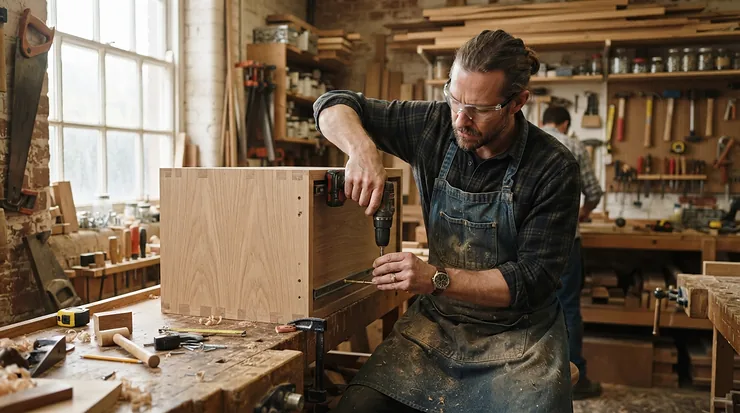
The build plans that circulate most (a pocket-hole 2×2 frame, a plywood cut-out, a single-plank version) share the same order of work. Anika’s DIY Life lists the 2×2 frame as a beginner project with about two hours of active time, so the order matters more than the skill.
- Buy the bowls before touching lumber. The author of the 2×2 plan on Anika’s DIY Life notes that readers report bowls coming out too big or too small for the cut list, since bowl sizes vary slightly.
- Fix the rim height from the measurement above, then work backward to leg length.
- Pick the build. The 2×2 frame uses mostly 2×2 boards, 2-1/2 inch pocket-hole screws, wood glue, a right-angle clamp, a miter saw, a drill and a sander. A plywood version from Houseful of Handmade cuts bowl openings into one sheet. Tonya Staab’s single-plank version needs a plank roughly 15 to 20 millimeters thick, a jigsaw, a drill and screws, and is billed as a 30-minute project.
- Rough-fit the bowls in the top before and after assembly. The 2×2 plan says to do both, and that a misfit top can be taken apart and adjusted.
- Join the pieces with glue as well as screws. Brittany Goldwyn’s raised feeder build reinforces every pocket-hole joint with wood glue.
- Finish with a pet-safe stain or paint and protect the wood from splashes, per the 2×2 plan. A plywood build adds sealer on the cut edges, and a Scout Life pet-bowl stand applies several coats of wood sealer after the legs go on.
- Add non-slip feet. One maker’s listing for a plywood stand includes gripping pads on the feet, which is cheap insurance on a smooth floor.
The same sequence answers how to make a dog bowl stand for a single bowl: leave one section off, as the plywood plan points out.
A YETI dog bowl holder has to be custom
A YETI dog bowl holder cannot come from YETI: Canine Journal’s review points out that the company sells no stand for its Boomer bowls, so every option comes from third-party makers or from a workshop. That makes sizing the first job. The same review lists the 4-cup Boomer at 6.8 inches wide and 3.1 inches tall, and the 8-cup at 8.0 inches wide and 3.5 inches tall.
Maker listings show how tight the fit can be. One adjustable wooden stand from Woodland Steelworks lists seven height settings set by four bolts and fits either bowl size at 6.75 or 8 inches. Another maker’s plywood stand comes in three heights, with the top of the bowl at 6.8, 9.2 or 13 inches, accepts bowls with an outer diameter up to 6.80 inches, and offers a custom height on request. Two listings giving the smaller bowl’s width as 6.75 and 6.8 inches is a reminder not to cut a hole to the exact figure with no slack.
Two cautions from owners and reviewers. Canine Journal notes that some owners report rust on the bowls and that the bowl is designed for flat ground, so a stand may cause some spillage. It also says the five-year warranty applies only when the bowl is bought directly from YETI, and that engraving is done only through the YETI site. A bowl bought on Amazon arrives plain, so “custom” here usually means a custom stand, not an engraved bowl.
Dog dish holder styles: what each one costs you in height, cleanup, and effort
Four routes cover almost every dog dish holder on the market:
| Style | Height control | Main trade-off |
|---|---|---|
| Homemade wood stand | Any height you cut | Bowls must be bought first; wood needs sealing against splashes |
| Maker-built custom stand | Custom sizes or heights on request from some makers | Made to order; marketplace listings run from the mid-$20s to above $180 |
| Bolt-adjustable wooden stand | Seven heights on one maker’s listing | Packs flat and needs assembly |
| Neater Feeder Deluxe | Fixed unless leg extensions are added | Plastic frame, built to contain spills |
Cost and height pull in opposite directions. A homemade stand is cheapest and fits exactly, but it asks for tools and a finish that survives water. A maker-built stand removes the build and keeps the exact bowl fit, and an adjustable one is the safer pick for a puppy that will grow or a senior whose needs change, since the height can move with the dog.
Where custom bowl holders go wrong
- Bowls bought last. Readers of the 2×2 plan report bowls that came out too big or too small, which is a lumber-wasting mistake that costs a weekend.
- Height set by looks. WebVet’s 4 to 6 inch rule exists because a bowl that sits level with the chest invites neck strain; giant breeds should not go high without a veterinarian’s approval.
- Bare wood near water. Water bowls splash, and the 2×2 plan specifically calls for a finish that protects against splashes.
- Spill-prone stands. Canine Journal flags spillage when a flat-ground bowl sits on a stand, so a lipped top or a tray earns its keep.
- Buying the bowl through the wrong channel. If engraving or the warranty matters, the YETI route runs through YETI’s site, not a marketplace listing.
Every one of these shows up at the first meal, and each is cheaper to catch before the glue dries.
Gear that goes with each step
Four products map to the steps above: the bowl a custom stand is cut around, the jig that makes a wood build easier, a ready-made holder for people who would rather not build, and a treat toy for dogs that should not be raised at all.
1. YETI Boomer 8 Dog Bowl — a tough bowl worth building around
Custom stands start with a bowl that does not change size, and this one is the bowl many third-party stands list by name. YETI’s own page describes 18/8 stainless steel, dishwasher-safe construction and BPA-free materials, with a non-slip ring on the base. The 8-cup size holds 64 ounces and weighs 1.9 pounds empty, according to Canine Journal, and the smaller YETI Boomer 4 Dog Bowl holds 32 ounces.
Durability reports are broadly positive. Gun Dog’s reviewer dropped the bowl on concrete and saw no dent, and ShopSavvy’s roundup of owner reviews calls it easy to clean while noting concerns about cost and a few reports of rust. YETI’s site lists the two sizes between $50 and $60. Check the current price on Amazon.com.
2. Kreg Jig K4 — pocket-hole joints for a wood build
This is the jig named in the 2×2 plan, which also says the Kreg 320 works. Pocket holes hide the screws, so a wood stand looks closer to a made-to-order one. Retailer pages describe the K4 as working with stock from half an inch to 1-1/2 inches thick, which covers 2×2 lumber.
It is the one item here that pays off only if the jig gets reused. Prices on Kreg’s own page and one tool retailer’s range from roughly $70 to $100, so a single dog stand does not justify it by itself. Someone who plans one stand and nothing else is better served by the plywood or single-plank build, which needs only a jigsaw and a drill.
3. Neater Feeder Deluxe — ready-made holder with spill walls
Buyers who want height and a cleaner floor without a build get both from this one. Patton Avenue Pet’s listing describes protective walls that contain splashes and kicks, three sizes (small for terriers and Chihuahuas, medium for Beagles and Cocker Spaniels, large for Golden Retrievers and Labradors), and an option to add leg extensions for taller dogs. The outer holder is made in the USA, and the stainless steel bowls are made in India.
Dogster’s review names it best overall, finds it easy to assemble and clean, and flags only that its scent may be too strong for some dogs. A separate BestReviews guide calls the lighter Neater Feeder Express fairly flimsy and limited in height, so the Deluxe is the one that fits a medium or large dog. Pet retailers list the Deluxe between about $40 and $57. Compare the exact size against your dog’s weight before ordering.
4. KONG Classic — a treat holder for slower meals
A dog treat holder toy fits the other half of this topic: the dog that should keep eating from the floor. KONG’s own pages say feeding from a stuffed KONG slows eating and adds a mental and physical challenge. Sources tie fast eating to bloat risk, though none claims a KONG prevents it.
Size by weight: the Classic runs Small for dogs up to 20 pounds, Medium for 15 to 35, Large for 30 to 65, and Extra Large for 60 to 90, with advice to size up for heavy chewers. It suits average chewers, and a power chewer is steered to the black Extreme line. Target and a trade supplier list sizes from about $9 up to around $26. Check the current price on Amazon.com.
Quick answers on bowl height, YETI stands, and homemade stands
Do dogs need elevated bowls?
How tall should a dog bowl stand be?
Does YETI sell a stand for its dog bowls?
What finish is safe for a homemade dog bowl stand?
Which size dog treat holder toy fits my dog?
Measure the dog, ask the vet, then pick the route
The right custom dog bowl holder depends on one question: does your dog have a neck, joint or esophagus reason to eat higher? If yes, ask the veterinarian for a height, measure the withers, subtract the 4 to 6 inches, and then choose by effort. A plywood or single-plank build fits someone who wants a custom size and owns a jigsaw. A bolt-adjustable maker stand suits a growing puppy or an aging dog. The Neater Feeder Deluxe suits a messy eater who needs a clean floor. If the dog has no such reason, keep the bowls on the floor and use a KONG Classic to slow the meal.
Whichever route you take, buy the bowls first, test the fit before gluing, and watch the dog eat for a week. Whole Dog Journal’s advice stands for most households: floor-level bowls carry none of the added bloat risk. Once the height is settled, take a closer look at the gear above.
Recommended for You
- Cute Dog Bowls With Stand: 7 Best Picks (2026)
- 7 Best Large Dog Slow Feeder Bowls in 2026
- 7 Best Ceramic Dog Bowls and Stand Sets (2026)
Measure your dog at the shoulder before you cut a board or add anything to the cart.