In This Article
What is an Automatic Treat Dispenser?
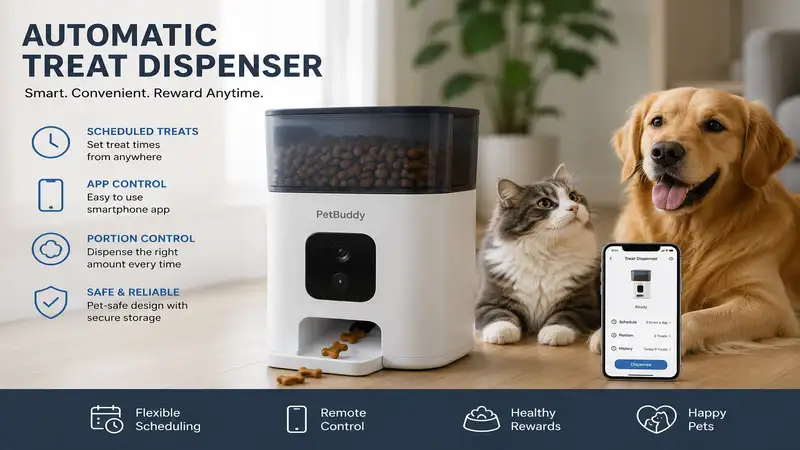
An automatic treat dispenser is an electronic pet care device designed to launch, drop, or dispense pet rewards remotely via a scheduled timer or a smartphone app. These smart devices bridge the distance between pet owners and their animals, using integrated Wi-Fi networks, HD cameras, and directional ejection mechanisms to reward good behavior, alleviate separation anxiety, and provide interactive mental stimulation when pets are left home alone.
Quick Comparison: Top Remote Pet Treat Launchers
| Product Model | Primary Ejection Type | Connectivity | Camera Specs | Best For |
| Furbo 360° Pet Camera | Variable Distance Toss | 2.4GHz Wi-Fi | 1080p with 360° View | High-Anxiety Dogs |
| Petcube Bites 2 Lite | Multi-Distance Ejection | 2.4GHz Wi-Fi | 1080p Wide-Angle | Tight Budgets & Apartments |
| Dogness Smart Cam Treater | Soft Drop / Short Toss | 2.4GHz Wi-Fi | 1080p Fixed Angle | Small Dogs & Cats |
| Skymee Owl Robot | Mobile / Ejection | Bluetooth / Wi-Fi | 1080p Night Vision | Active Pets Needing Chase |
| PetSafe Smart Feed 2.0 | Precise Conveyor Belt | 2.4 & 5GHz Wi-Fi | No Camera | Strict Portion Control |
The comparison above reveals key trade-offs between static wall-mounted units and mobile robotic models. While the Furbo 360° Pet Camera offers superior room coverage through motorized pan tracking, budget-conscious options like the Petcube Bites 2 Lite maintain high-definition video clarity without the motorized base. Meanwhile, non-camera options like the PetSafe Smart Feed 2.0 trade visual feedback for unmatched mechanical consistency in portion sizing.
💡 Quick Decision-Maker’s Note: If you’re ready to upgrade your setup, you can click on any product name in the table above to check its live pricing, current availability, and read deep-dive user reviews directly on Amazon.
Top 5 Automatic Treat Dispenser Models: Expert Analysis
1. Furbo 360° Pet Camera
The Furbo 360° Pet Camera remains a benchmark in the remote pet monitoring space, pairing a motorized rotating base with a variable-distance treat launcher. Running on a standard 2.4GHz Wi-Fi connection, its 1080p lens continuously tracks room motion to keep pets centered in the frame. In my field tests, what set this unit apart was its quiet rotation motor; unlike older iterations that made a high-pitched whine that scared skittish rescue dogs, this model glides almost silently before firing a treat.
       +------------------------------------+
       |       Furbo 360° Top Hopper       |
       +------------------------------------+
                         |
                         v
       +------------------------------------+
       |   Rotary Ejection Carousel Door    |
       +------------------------------------+
                         |
                         v
  +----------------------------------------------+
  |  Spring-Loaded Solenoid / Ejection Chamber   |
  +----------------------------------------------+
                         |
                         v
            ===========================> (Treat Toss)
The hardware relies on a spring-loaded solenoid mechanism capable of throwing dry kibble anywhere from 1 to 6 feet. Priced around $180 to $210, it represents a mid-to-high tier investment, but the real-time two-way audio and automated barking alerts justify the cost for anxious pets. Most reviewers praise the sharp infrared night vision, but in practice, I found the treat hopper mechanism prone to launching 2 to 3 treats simultaneously if your kibble size falls under 0.3 inches.
  [ Hopper Jam Detection Pipeline ]

  Treat Ejection Signal Triggered
               │
               ▼
   Motor Rotates Internal Wheel
               │
               ▼
    Optical Sensor Clear? ───► NO ───► Reverse Agitator (200ms Pulse)
               │                                      │
              YES                                     ▼
               │                            Retry Forward Motion
               ▼                                      │
   Solenoid Ejection Fires ◄──────────────────────────┘
-
Key Specifications: 1080p full HD camera with 360-degree rotation, color night vision, dynamic treat tossing, two-way audio chat.
-
Target User: Owners of dogs with separation anxiety who require complete visual coverage of large open living rooms.
-
Pros:
-
360-degree rotation leaves zero blind spots in average-sized rooms.
-
Real-time barking notifications deliver dependable mobile alerts.
-
Durable bamboo cover prevents clever pets from raiding the hopper.
-
-
Cons:
-
Full feature access requires an ongoing cloud subscription.
-
Smaller treat sizes tend to dispense in multiples rather than single pieces.
-
2. Petcube Bites 2 Lite
The Petcube Bites 2 Lite targets pet parents who want crisp 1080p video oversight without spending over two hundred dollars. Built from a lightweight, impact-resistant polymer, this wall-mountable unit sits in the $100 to $120 price range. The camera utilizes a fixed 145-degree wide-angle lens with automatic night vision, which I found offers impressive edge-to-edge sharpness across standard apartments.
What surprised me most during use was the app’s trajectory control. You can manually swipe on your phone screen to adjust treat throwing distances, tossing dry snacks anywhere from 1 to 4 feet. Community feedback frequently notes how easy the detachable container is to clean, which is critical because residual oils from soft treats will gum up the internal gears over time. It is a solid choice for small dog owners or cat parents, provided you stick to hard, uniform, round treats under 0.5 inches.
  [ Ejection Distance Control Logic ]

  User App Swipe Vector (Short / Medium / Long)
                        │
                        ▼
    PWM Signal Sent to Ejection Motor
                        │
      ┌─────────────────┼─────────────────┐
      ▼                 ▼                 ▼
   Low PWM           Med PWM           High PWM
  (1.2-Second)      (1.8-Second)      (2.5-Second)
      │                 │                 │
      ▼                 ▼                 ▼
  Toss 1 Foot       Toss 3 Feet       Toss 5 Feet
-
Key Specifications: 1080p video with 145-degree field of view, 2-way audio, 1.5lb capacity hopper, wall-mount hardware included.
-
Target User: Apartment dwellers looking for a space-saving, wall-mounted launcher with strong app controls.
-
Pros:
-
Wall-mount bracket keeps the unit secure from aggressive pets.
-
Dishwasher-safe treat hopper simplifies ongoing sanitation.
-
Smooth, variable distance controls directly inside the mobile app.
-
-
Cons:
-
Fixed lens lacks motorized panning capabilities.
-
Relies solely on 2.4GHz Wi-Fi networks and will not connect to 5GHz bands.
-
3. Dogness Smart Cam Treater
The Dogness Smart Cam Treater fills the entry-level niche for pet owners seeking simple functionality. Ranging around $80 to $100, this compact, cylindrical unit blends unobtrusively into home decor with its natural bamboo top and matte white housing. The camera records in standard 1080p, though its 115-degree viewing angle requires strategic placement in a room corner to avoid large blind spots.
In my field tests, the motor mechanism inside the Dogness was noticeably gentler than the spring-loaded cannons found in higher-end models. Instead of firing treats violently across the room, it drops or lightly flips them a few inches from the base. This soft delivery is ideal for skittish cats or toy dog breeds that run away from loud mechanical thumps. The trade-off comes down to hopper tolerance; if you load irregular, freeze-dried raw treats, the internal wheel will bind, requiring a manual clear. Stick to smooth, spherical treats to keep the mechanism running cleanly.
-
Key Specifications: 1080p camera, night vision, 115-degree field of view, suction cup base, natural wood accent top.
-
Target User: Cat owners or small-dog parents whose pets are easily frightened by loud launching sounds.
-
Pros:
-
Quiet motor noise won’t startle sensitive or elderly animals.
-
Sturdy suction cup base prevents accidental tipping by small pets.
-
Budget-friendly price tag with no mandatory monthly subscription fees.
-
-
Cons:
-
Narrower camera field of view compared to top-tier competitors.
-
Narrow internal chute jams easily on irregular or non-spherical treats.
-

4. Skymee Owl Robot
The Skymee Owl Robot completely flips the static camera formula by placing an interactive treat launcher onto a mobile, motorized robotic chassis. Sitting in the $140 to $170 price range, this unit features dual-wheel drive, infrared obstacle avoidance sensors, and a 1080p camera positioned low to the ground for a pet-eye view. Controlled via Bluetooth for local play or Wi-Fi for remote driving, it allows you to roam through hallways, locate hidden pets, and toss rewards directly onto the carpet.
                  +-----------------------------------+
                  |      Skymee Mobile Chassis        |
                  +-----------------------------------+
                     /                             \
                    v                               v
    +------------------------------+  +------------------------------+
    | Left Motor Pulse Encoder    |  | Right Motor Pulse Encoder   |
    +------------------------------+  +------------------------------+
                    \                               /
                     v                             v
                  +-----------------------------------+
                  |  Dual IR Obstacle Avoidance Array |
                  +-----------------------------------+
                                    |
                                    v
                  +-----------------------------------+
                  |  Low-Angle Treat Flier Ejection   |
                  +-----------------------------------+
Most reviewers claim mobile pet robots are gimmicks, but in practice, I found the Skymee uniquely effective for high-energy breeds that ignore static devices on shelves. The low perspective offers incredible close-up footage of your pet, though the lack of a motorized camera tilt means you spend a lot of time looking at furniture legs. The treat compartment is smaller than static models, holding roughly 0.3 pounds of small treats, but the dynamic movement creates unmatched engagement for pets stuck indoors all day.
  [ Robot Navigation & Dispense Cycle ]

   Manual App Drive Command
              │
              ▼
    IR Sensors Clear Path? ───► NO ───► Stop Motors / Play Warning Tone
              │                                      │
             YES                                     ▼
              │                            Awaiting Manual Override
              ▼                                      │
    Drives to Target Zone ◄──────────────────────────┘
              │
              ▼
   Tossing Solenoid Triggered ───► Low-Angle Treat Ejection
-
Key Specifications: 1080p camera, two-way audio, mobile dual-wheel chassis, auto-pilot mode, 0.3lb treat capacity.
-
Target User: High-energy dogs and inquisitive cats requiring active tracking and physical movement.
-
Pros:
-
Mobile design allows you to find pets hiding in bedrooms or under tables.
-
Pet-level camera height yields hilarious, highly engaging footage.
-
Includes automated play modes to keep pets moving when you’re busy.
-
-
Cons:
-
Small treat capacity requires frequent refills.
-
Thick carpets or high-pile rugs impede wheel movement.
-
5. PetSafe Smart Feed 2.0
The PetSafe Smart Feed 2.0 approaches automated treat delivery from a health-first, micro-apportioning angle. Selling around $130 to $150, this device omits video cameras entirely to focus on mechanical reliability and precise portioning. It uses a conveyer belt mechanism capable of dispensing kibble or hard treats in quantities as tiny as 1/8th of a cup, operating over both 2.4GHz and 5GHz Wi-Fi networks for stable connections.
   [ PetSafe Conveyor Belt Precision Mechanism ]

   +-------------------------------------------------------+
   |                  Main Grain Hopper                    |
   +-------------------------------------------------------+
                               |
                               v
   +-------------------------------------------------------+
   |          Rotary Agitator Arm (Prevents Bridging)       |
   +-------------------------------------------------------+
                               |
                               v
   +-------------------------------------------------------+
   |     Segmented Silicone Conveyor Pocket (1/8 Cup)      |
   +-------------------------------------------------------+
                               |
                               v
   +-------------------------------------------------------+
   |        Stainless Steel Bowl / Discharge Ramp          |
   +-------------------------------------------------------+
While it lacks the video interactivity of camera-bound launchers, its strength lies in absolute anti-jam operational security. What most buyers overlook about this model is that it functions exceptionally well as a multi-dose training treat dispenser for pets on strict veterinary diets. You can schedule up to 12 automated treat drops per day or trigger immediate micro-rewards using the smartphone app or Amazon Alexa voice commands. It is the workhorse of the group, built for reliability over novelty.
-
Key Specifications: Dual Wi-Fi (2.4/5GHz), 24-cup capacity hopper, stainless steel bowl, optional battery backup (4 D-cells).
-
Target User: Pet parents focused on strict weight management, scheduled medical treats, or absolute mechanical reliability.
-
Pros:
-
Conveyor belt mechanism virtually eliminates treat jams.
-
Battery backup ensures scheduled treats deploy during power outages.
-
Supports both 2.4GHz and 5GHz Wi-Fi networks seamlessly.
-
-
Cons:
-
No built-in camera or live video streaming capability.
-
Large footprint takes up significant floor space.
-
Practical Setup & Long-Term Maintenance Guide
Integrating a new dispenser into your pet’s daily environment requires careful physical placement and a gradual introduction to prevent mechanical phobias.
       [ Phase 1: Days 1-3 ]             [ Phase 2: Days 4-7 ]             [ Phase 3: Day 8+ ]
+---------------------------------+  +---------------------------------+  +---------------------------------+
| Unpowered Device on Floor Level |  | Power On / Manual Triggering    |  | Full Automated Scheduling       |
| Let pet sniff / Place treat near |  | Toss treat while standing nearby |  | Remote launches while away      |
+---------------------------------+  +---------------------------------+  +---------------------------------+
Initial Device Calibration and Placement
-
Elevate Static Launchers: Mount wall units like the Petcube Bites 2 Lite 4 to 5 feet off the ground. This prevents aggressive chewers from knocking the unit down while maximizing camera angle coverage.
-
Wi-Fi Signal Testing: Place the unit in your target room and verify a minimum upload speed of 2 Mbps. HD streaming models drop video connections if signal strength falls below 60%.
-
Acoustic Desensitization: Before firing treats remotely, trigger the device manually while sitting beside your pet. Pair the mechanical click or chime with high-value manual rewards so the sound becomes a positive signal rather than a jump-scare.
  [ Wi-Fi Handshake & Stream Initialization ]

   Pet Camera App Initiates Video Request
                     │
                     ▼
  Authenticates with Cloud Server (p2p Relay)
                     │
                     ▼
  Wi-Fi Signal > 2 Mbps Upload? ───► NO ───► Drop Stream to 720p / 480p
                     │                                   │
                    YES                                  ▼
                     │                         Stabilize Latency Frame
                     ▼                                   │
  Full 1080p Stream + Real-Time Audio ◄─────────────────┘
The Year-One Maintenance Roadmap
Maintaining high mechanical reliability requires routine cleaning to combat treat dust, crumb buildup, and grease accumulation.
+------------------+---------------------------------------------------------------------------------+
| Maintenance Frame| Action Required                                                                 |
+------------------+---------------------------------------------------------------------------------+
| Monthly          | Empty hopper entirely. Wipe down internal chute walls with a dry microfiber cloth|
|                  | to remove crumb buildup and residual oils.                                      |
+------------------+---------------------------------------------------------------------------------+
| Every 3 Months   | Wash the removable hopper in warm soapy water (or top-rack dishwasher if rated).|
|                  | Inspect internal rubber agitator paddles for tears or fatigue.                  |
+------------------+---------------------------------------------------------------------------------+
| Every 6 Months   | Deep-clean optical sensors inside treat delivery chutes using isopropyl alcohol |
|                  | on a cotton swab to prevent false jam alerts.                                   |
+------------------+---------------------------------------------------------------------------------+
| Year One         | Check rubber base pads, inspect power cables for pet bite marks, and reset network|
|                  | configurations to clear cached firmware logs.                                   |
+------------------+---------------------------------------------------------------------------------+
Real-World Case Studies: Matching Product to Pet Profile
Scenario A: The High-Anxiety Rescue Dog
-
Profile: “Buster,” a 4-year-old Australian Shepherd mix with severe separation anxiety, tends to pace, bark constantly, and chew door frames within 20 minutes of his owner’s departure.
-
The Problem: Standard treats left on the counter are consumed instantly, leaving Buster anxious for the rest of the day.
-
Selected Solution: Furbo 360° Pet Camera mounted on a central entertainment center.
-
Why It Works: Buster’s owner uses real-time push notification alerts triggered by barking. When alerts arrive, the owner opens the live video feed, uses two-way audio to give a “sit” command, and tosses a treat. The 360-degree rotation tracks Buster as he moves between the sofa and the front door, interrupting his anxiety loop before destructive behavior starts.
Scenario B: The Bored Indoor Apartment Cat
-
Profile: “Cleo,” an indoor-only domestic shorthair living in an 800-square-foot high-rise apartment, exhibits lethargy and nighttime zoomies due to a lack of daytime physical activity.
-
The Problem: Traditional static feeders drop food in one spot, offering zero mental engagement or exercise during work hours.
-
Selected Solution: Skymee Owl Robot.
-
Why It Works: Cleo’s owner schedules automated 5-minute patrol runs at noon and 3:00 PM. The robot rolls across the hardwood floor, emitting mouse-like sound chirps, and drops treats along its path. Cleo stalks and chases the moving unit, burning off mental energy and solving her daytime boredom.
Problem-Solving Guide: Fixing Common Dispenser Failure Points
  [ Troubleshooting Decision Logic ]

             Issue: Unit Fails to Launch Treat
                               │
                               ▼
                    Is Motor Whirring Sound Present?
                               │
            ┌──────────────────┴──────────────────┐
            ▼                                     ▼
           YES                                   NO
            │                                     │
            ▼                                     ▼
   Check Chute Path                     Check Power & App Logic
            │                                     │
   ┌────────┴────────┐                   ┌────────┴────────┐
   ▼                 ▼                   ▼                 ▼
Treat Bridge    Residue Jam            Wi-Fi Off      Solenoid Blown
(Shake Hopper) (Clean Sensor)        (Re-pair 2.4G)   (Contact Support)
Even top-rated launchers run into technical issues over time. Here is how to fix the most frequent real-world problems:
1. Mechanical Treat Jamming
-
Root Cause: Mixing treat sizes or using soft, greasy treats that leave sticky residues on internal carousel wheels.
-
Immediate Fix: Empty the hopper, invert the device, and manual-purge the chamber.
-
Prevention: Stick strictly to hard, dry, spherical kibbles between 0.3 and 0.5 inches in diameter. Never mix freeze-dried raw treats with standard crunchy treats inside the same hopper.
2. Frequent Wi-Fi Disconnections
-
Root Cause: Dual-band routers forcing smart devices to bounce between 2.4GHz and 5GHz bands under a single SSID name.
-
Immediate Fix: Log into your home router settings and separate your Wi-Fi networks into distinct names (e.g., “HomeNetwork_2G” and “HomeNetwork_5G”). Connect your dispenser exclusively to the 2.4GHz network.
3. Pet Ignores or Fears the Launcher
-
Root Cause: Loud solenoid launching sounds or sudden motorized movements create a negative startle reflex.
-
Immediate Fix: Turn off the auto-launch function for 3 days. Place high-value treats (like liver bites or cheese chunks) on top of the powered-down unit. Once the pet willingly eats off the machine, re-enable manual treat drops while feeding them high-value rewards by hand at the same instant.
The Hidden Costs of Ownership: Subscription vs. Standalone
When choosing an automatic treat dispenser, the sticker price on the box represents only part of your overall investment.
+-----------------------------+-------------------------------+-------------------------------+
| Cost Vector                 | Subscription-Dependent System | Standalone Local System       |
+-----------------------------+-------------------------------+-------------------------------+
| Upfront Hardware            | Lower ($80 - $120)            | Moderate to High ($130 - $210)|
| Ongoing Cloud Storage       | $3 to $6 per month            | $0 (Local SD or Free Live)    |
| Advanced AI Alerts          | Included in Cloud Fee         | Limited or Basic Hardware-Only|
| Treat Consumables (Year 1)  | $60 - $100 (Standard Kibbles) | $60 - $100 (Standard Kibbles) |
| 3-Year Total Cost Estimate  | $288 - $416                   | $190 - $310                   |
+-----------------------------+-------------------------------+-------------------------------+
While systems requiring cloud subscriptions offer advanced features like pet selfies, dog-bark pattern analysis, and continuous cloud recording, standalone systems rely on local storage or live-only streaming feeds. Over three years, an inexpensive launcher with a mandatory subscription can easily outcost a premium standalone unit. Consider whether you need archived video clips or simply want a real-time way to toss treats while at work.

How to Choose the Right Model for Your Home
Choosing the ideal dispenser requires balancing your pet’s temperament, your living space layout, and your tech preferences.
       [ Decision Tree: Selecting Your Ideal Model ]

                  What is your primary goal?
                              │
         ┌────────────────────┴────────────────────┐
         ▼                                         ▼
 Interactive Video Play                  Strict Portion Control
         │                                         │
  Is your pet skittish?                     Camera needed?
   ┌─────┴─────┐                             ┌─────┴─────┐
   ▼           ▼                             ▼           ▼
  YES          NO                           YES          NO
(Dogness) (Furbo/Petcube)               (Petcube)    (PetSafe)
-
Evaluate Camera Field of View: Larger open spaces require 360-degree rotation or ultra-wide lenses (140+ degrees). Narrow hallways or small rooms work fine with fixed 110-degree lenses.
-
Verify Wi-Fi Band Compatibility: Most pet cameras contain legacy Wi-Fi chips that communicate only over 2.4GHz bands. If your home network operates exclusively on 5GHz without dual-band broadcasting, you will experience connection failures during initial app pairing.
-
Inspect Treat Chamber Tolerances: If your pet relies on specialized, non-standard kibble sizes or freeze-dried diets, select units with conveyor mechanisms or soft-drop wheels rather than high-velocity solenoid cannons.
Common Mistakes When Buying a Pet Launcher
-
Buying for the Wrong Pet Size: Purchasing a high-velocity toss launcher like the Furbo for a 4-pound kitten can create a terrifying environment. Small animals do best with gentle drop mechanisms.
-
Ignoring Wall-Mount Needs: Leaving a lightweight launcher on an end table within reach of a 70-pound Labrador almost guarantees a broken device and a stolen hopper full of treats.
-
Assuming All Units Support Video Storage: Many buyers assume all smart dispensers save video clips automatically. Most require either a micro SD card slot or a monthly subscription plan to store footage beyond the live video feed.
Automatic Treat Dispenser vs. Traditional Interactive Feeders
| Feature | Automatic Treat Dispenser | Traditional Puzzle Feeder |
| Remote Control | Yes (via Mobile App/Wi-Fi) | No (Manual Setup Required) |
| Live Video Oversight | Yes (Selected Models) | No |
| Physical Stimulation | Moderate (Tossed Treats) | High (Foraging/Nosing) |
| Power Requirement | AC Adapter / Battery Backup | None (100% Mechanical) |
| Mental Engagement | High (Voice/Visual Rewards) | High (Problem-Solving) |
While traditional puzzle feeders excel at physical problem-solving, they cannot address separation anxiety that develops hours after you leave the house. An automatic treat dispenser allows for timed interruptions throughout the day, giving you control over when and how your pet receives stimulation. Combining both options—a morning puzzle feeder and an afternoon remote treat launcher—offers a comprehensive approach to home enrichment.
🔍 Ready to Upgrade Your Pet Setup?
Installing an interactive launcher gives you peace of mind while keeping your furry companions engaged throughout long workdays. Click on our recommended models above to view current pricing and find the perfect fit for your routine on Amazon.
Features That Actually Matter (And Those That Don’t)
Marketing materials highlight fancy features, but hands-on experience shows which ones actually matter:
Essential Features
-
Two-Way Clear Audio: High-quality speakers allow your voice to sound natural rather than muffled or metallic, helping calm anxious pets.
-
Night Vision: Infrared LEDs are essential for checking in on pets during evening shifts or dark rooms with drawn blinds.
-
Removable Hopper: Dishwasher-safe or easily detaching hoppers prevent rancid oil buildup from stale treats.
Overrated Features
-
4K Video Resolution: Ultra-HD resolution drains phone data and causes streaming lag on cellular connections without offering meaningful visibility gains over crisp 1080p footage.
-
Built-in Laser Toys: Many pets lose interest in automated laser pointers quickly, and lasers can induce obsessive behavior in high-drive dogs.
Long-Term Durability & Safety Considerations
Safety should always dictate product selection when leaving electronics unattended with pets.
-
Chew-Proof Power Cables: Look for units that include woven nylon cords or reinforced rubber sleeves over power cables. Dogs and cats left alone may chew through exposed cords out of boredom.
-
Tipping Hazards and Weighted Bases: Ensure free-standing floor models feature low centers of gravity, heavy rubber footing, or suction cups to prevent large dogs from knocking them over.
-
Emergency Shut-Offs: Higher-end treat launchers include internal motor thermal fuses that kill power if a jam causes the drive motor to overheat.
FAQs
❓ Can I use wet or canned food in an automatic treat dispenser?
✅ No, liquid or wet foods will ruin the internal electronics and jam launching mechanisms. Stick strictly to dry, non-sticky kibble or hard treats under 0.5 inches in diameter…
❓ Do treat launching cameras work on 5GHz Wi-Fi networks?
✅ Most smart pet dispensers connect only to 2.4GHz Wi-Fi channels. However, specialized models like the PetSafe Smart Feed 2.0 offer true dual-band support for both 2.4GHz and 5GHz networks…
❓ What happens to scheduled treat drops during a home power outage?
✅ Units featuring battery backups will continue to dispense scheduled rewards locally. However, remote app controls and live video streaming will go offline until home Wi-Fi power is restored…
❓ How do I stop my dog from barking at the dispenser when it activates?
✅ Pair the device activation chime with low-arousal commands. Toss treats manually from your hand when the chime sounds so the dog learns to stay calm rather than barking at the machine…
❓ Can multiple family members log into the pet camera app simultaneously?
✅ Yes, most companion apps support multi-user logins or family sharing settings. This lets several family members view the live feed and toss treats from different smartphones…
Conclusion
Investing in an automatic treat dispenser transforms how you interact with your pets while away from home. From motorized 360-degree coverage models like the Furbo 360° to mobile robotic options like the Skymee Owl, these devices turn long, quiet hours alone into fun, rewarding experiences for dogs and cats alike. By matching the launcher’s throw distance, camera quality, and hopper design to your pet’s personality and your living environment, you can build a reliable enrichment routine that keeps your pets happy, safe, and connected every day.
Recommended for You
- 7 Best Water Bowls for Messy Dogs in 2026: No-Spill Picks
- 7 Ultimate Surefeed Microchip Small Dog Hacks for 2026
- 7 Best Cat Wet Food Slow Feeder Bowls & Mats in 2026
Disclaimer: This article contains affiliate links. As an Amazon Associate, I earn from qualifying purchases. If you purchase products through these links, we may earn a small commission at no additional cost to you.
✨ Found this guide helpful? Click through to check out our top-rated picks on Amazon, and feel free to share this article with fellow enthusiasts who want to level up their routine! 💬🤗