
In This Article
Why a Metal Automatic Dog Feeder Beats Another Plastic Bowl
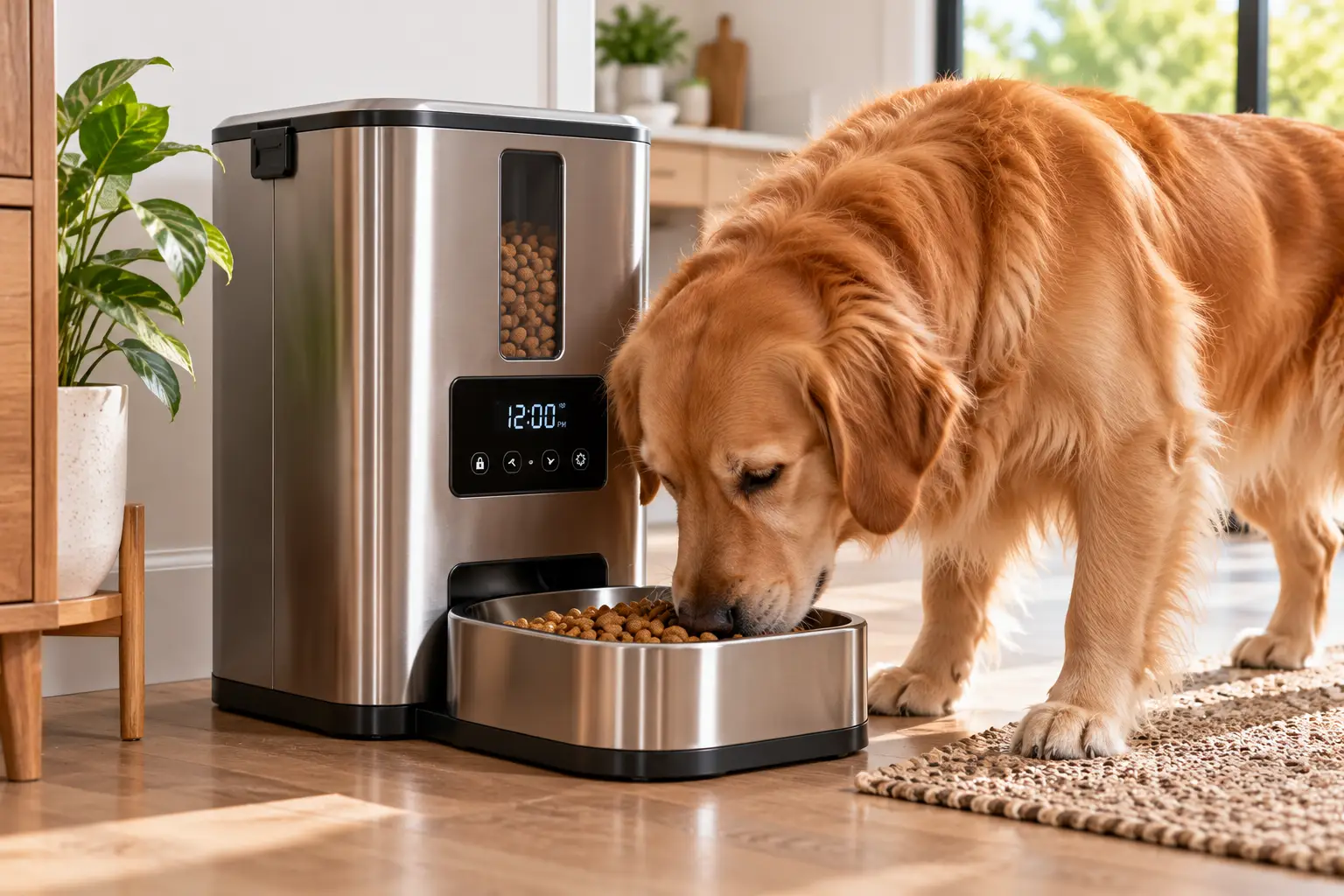
If your dog has ever turned a plastic feeder into confetti, you already understand the appeal of a metal automatic dog feeder. Plastic hoppers scratch, crack, and hold onto odors. A determined Lab can pry one open in an afternoon. Metal, on the other hand, shrugs off teeth, claws, and the occasional full-body tackle.
But here’s the catch most shoppers miss: “metal” on a product listing can mean three very different things. Some feeders are galvanized steel boxes with a gravity door and no electronics at all. Some are programmable timers wrapped in a stainless steel shell. And many popular “smart” feeders are actually plastic bodies with a stainless steel bowl, which is still a real hygiene upgrade, just not the armor you might be picturing.
That distinction matters more than any spec sheet number. A gravity-fed steel hopper is nearly indestructible but does nothing to control portions. A timed stainless model controls portions but has a motor and a power supply that can fail. A smart feeder gives you an app and a camera, yet its plastic shell won’t survive a crate-chewer.
This guide sorts all of that out. Below, you’ll find seven real feeders available on amazon.com, from rugged all-steel vaults to app-connected programmable units, analyzed on their actual specs and the aggregated sentiment in real customer reviews. You’ll also get a first-month setup routine, buyer scenarios, a fix-it guide for common problems, and a cost-of-ownership breakdown, so the feeder you pick is the one that still works two years from now.
Quick note: this guide contains affiliate links. If you buy through them, we may earn a commission at no extra cost to you.
What Is a Metal Automatic Dog Feeder?
A metal automatic dog feeder is a dispenser that stores dry kibble and releases it to your dog without you pouring each meal. It’s built with galvanized or stainless steel where it matters most: the hopper, the housing, or the bowl. Gravity models refill as the dog eats; timed models dispense set portions on a schedule.
The two metals behave differently. Galvanized steel is ordinary steel coated in zinc to slow rust, which is why it shows up on farm-style feeders built for barns, garages, and kennels. Stainless steel gets its corrosion resistance from chromium in the alloy itself, so there’s no coating to chip off. Food-grade bowls usually use 304 stainless, the same family of alloy found in kitchen sinks and cookware. If you want the metallurgy in plain English, the overview of stainless steel on Wikipedia explains why it resists corrosion and staining so well.
What does that mean for you in practice? A stainless steel automatic dog feeder bowl is non-porous, so it doesn’t trap bacteria in scratches the way a chewed-up plastic dish does. It also survives the dishwasher indefinitely. A galvanized body, meanwhile, is your best bet against physical destruction and pests, but you’ll want to keep it dry and avoid scrubbing through the zinc layer.
Most buyers end up in one of two camps: people who need armor (outdoor dogs, chewers, multi-dog yards) and people who need control (weight management, scheduled meals, long workdays). The products below cover both.
Quick Comparison: 7 Metal Feeders at a Glance
| Feeder | Type | Where the Metal Is | Capacity | Best For |
|---|---|---|---|---|
| Pet Lodge Chow Hound 50 lb | Gravity, no power | Full galvanized steel body | 50 lb kibble | Pet Lodge Chow Hound 50 lb: big dogs, barns, kennels |
| Pet Lodge Chow Hound 25 lb | Gravity, no power | Full galvanized steel body | 25 lb kibble | Pet Lodge Chow Hound 25 lb: garages, mudrooms, one large dog |
| Eastrexon Metal Automatic Dog Feeder 2-Pack | Gravity, no power | Powder-coated steel body | 25 lb per unit | Eastrexon Metal Automatic Dog Feeder 2-Pack: two-dog households on a budget |
| KHEARPSL 25 lb Steel Feeder | Gravity, no power | Galvanized steel hopper | 25 lb kibble | KHEARPSL 25 lb Steel Feeder: dogs learning to use a flap door |
| ChiPak 16L Stainless Steel Feeder | Timed, programmable | Stainless steel body | 16 L (about 20 lb) | ChiPak 16L Stainless Steel Feeder: outdoor scheduled feeding |
| MOLLY&CODY 14L Automatic Dog Feeder | Timed, programmable | 304 stainless bowl | 14 L (about 60 cups) | MOLLY&CODY 14L Automatic Dog Feeder: large breeds, long trips |
| PETLIBRO Granary WiFi 5L | Smart, app-controlled | 304 stainless bowl | 5 L | PETLIBRO Granary WiFi 5L: remote control, small to medium dogs |
Reading across the table, the split is obvious: the top four trade portion control for near-total durability, while the bottom three trade some ruggedness for scheduling. The ChiPak 16L Stainless Steel Feeder is the only pick that genuinely offers both a steel body and a timer, which is why it’s the one to look at first if your dog lives outdoors but needs measured meals. If you’re feeding a small or medium indoor dog and want app control, the PETLIBRO Granary WiFi 5L is the more practical choice, even though its “metal” is limited to the bowl.
💬 One click helps other shoppers make an informed choice too! 😊
Top 7 Metal Automatic Dog Feeders: Expert Analysis
1. Pet Lodge Chow Hound 50 lb — biggest all-steel kibble vault
If you want a feeder your dog physically cannot destroy, the Pet Lodge Chow Hound 50 lb (model CH50) is the benchmark. It’s a galvanized steel box that holds a full 50-pound bag of dry food and feeds from the same chew-proof container.
The key feature is a magnetized door that stays shut until your dog nudges it open with its nose. In practice, that keeps rain, birds, and rodents out of the kibble while letting the dog eat on demand. An angled internal chute feeds food steadily toward the opening, and keyholes on the back let you mount it on a wall or frame so it can’t be tipped.
Based on the specs, this is a tool for large, healthy-weight dogs with free-choice feeding, especially in barns, kennels, or covered porches. It is not “automatic” in the electronic sense; it’s automatic the way a gravity bird feeder is. Aggregated reviews on major retailers trend positive on toughness, but a recurring complaint comes from buyers who expected a timer and found a metal box. Know which one you’re buying.
Pros:
- ✅ Galvanized steel body resists chewing and rust
- ✅ Magnetic door keeps pests and weather out
- ✅ Wall-mountable, so it can’t be knocked over
Cons:
- ❌ No portion control whatsoever
- ❌ Some dogs need training to push the door
At the time of writing, it typically sells in the $75 to $130 range depending on the seller, which is strong value for a feeder that can outlast several plastic ones.
2. Pet Lodge Chow Hound 25 lb — same armor, smaller footprint
The Pet Lodge Chow Hound 25 lb (model CH25) is the same design in a size that actually fits inside a mudroom or garage corner. It measures roughly 11 x 12 x 22.6 inches and weighs about 10.5 pounds empty.
Like its bigger sibling, it uses galvanized steel construction, a magnetized nose-push door, and an angled chute that controls food flow. The smaller hopper is a quiet advantage: kibble cycles through faster, so food spends less time sitting in the container going stale. For a single 50- to 70-pound dog, a 25-pound fill lasts long enough to matter without becoming a month-old reservoir.
This is the pick for owners who like the Chow Hound concept but don’t need to store an entire 50-pound bag in one go. It also comes with a one-year manufacturer warranty per retailer listings. Reviews mirror the 50 lb version: buyers praise the sturdiness and pest resistance, while a minority report that timid dogs took days to learn the door.
Pros:
- ✅ Compact enough for indoor utility spaces
- ✅ Faster turnover keeps kibble fresher
- ✅ Backed by a one-year warranty
Cons:
- ❌ Free-choice only, not suited to overeaters
- ❌ Galvanized finish shouldn’t be scrubbed aggressively
Expect it to land in the $55 to $90 range (check the current price), making it the most affordable way into true all-steel construction.
3. Eastrexon Metal Automatic Dog Feeder 2-Pack — two-dog budget pair
The Eastrexon Metal Automatic Dog Feeder 2-Pack solves a problem single feeders can’t: two dogs, two stations, no fights at one door. Each unit holds 25 pounds of dry food.
Each feeder measures about 12.3 x 10.5 x 21.3 inches and uses a powder-coated steel body that the maker describes as waterproof and suitable for indoor and outdoor use. Powder coating is a baked-on finish, so in practice it’s smoother and easier to wipe than raw galvanized steel. The trade-off is that a deep chip exposes bare steel underneath, which can rust if it stays wet.
This is a smart buy for households where one dog bullies the other off a shared bowl. Placing two identical gravity feeders in separate spots removes the competition entirely. It’s a newer listing, so we couldn’t verify a meaningful volume of customer reviews at the time of writing. Judge it on construction and dimensions rather than on star ratings.
Pros:
- ✅ Two feeders reduce resource guarding between dogs
- ✅ Powder-coated finish wipes clean easily
- ✅ 25 lb capacity per unit
Cons:
- ❌ Limited review history to confirm long-term durability
- ❌ Chipped coating needs touch-up to prevent rust
Pricing for the pair fluctuates, so check the current listing; per unit, it typically works out cheaper than buying two premium single feeders.
4. KHEARPSL 25 lb Steel Feeder — see-through door for nervous eaters
The KHEARPSL 25 lb Steel Feeder takes the galvanized gravity concept and adds one genuinely useful twist: a transparent door that your dog can see food through.
The hopper is galvanized steel with a 25-pound capacity, and the unit can be wall-mounted or set on a floor stand. The standout is the knob that holds the door open. That sounds minor, but it’s the single best training aid in this category. Leave the door propped open for the first week so your dog learns that food lives there, then close it once the habit forms.
Based on comparing designs, this is the feeder to choose for shy, older, or first-time dogs who might never figure out an opaque push-door. The clear panel gives a visual cue the solid steel Chow Hound doors don’t. Review volume for this brand is modest, so we can’t point to a strong aggregated trend yet. The design logic, however, is sound.
Pros:
- ✅ Transparent door makes training much faster
- ✅ Hold-open knob eases the learning curve
- ✅ Floor or wall installation options
Cons:
- ❌ Less-established brand with fewer reviews
- ❌ Clear panel is likely less tough than steel
It sits in the budget-to-mid range for metal gravity feeders; check the current price, as third-party listings vary.
5. ChiPak 16L Stainless Steel Feeder — programmable meals in a steel shell
The ChiPak 16L Stainless Steel Feeder is the rare feeder that combines a stainless steel body with a real timer. That makes it the closest thing to an armored scheduled feeder you’ll find on Amazon.
It holds 16 liters, roughly 20 pounds of kibble, which the maker says supports a large dog for 10 to 15 days. You can program up to four feeding times, with dispensing set by motor run time (4 to 999 seconds) rather than by “portions.” What this means in practice: you’ll need to calibrate it once by running a cycle and measuring the output with a measuring cup. It mounts to a wall with included hardware or sits on the floor.
The maker claims stainless outlasts galvanized steel by three to four times. Treat that as marketing, but the underlying point is true: there’s no coating to wear through. This is the pick for outdoor dogs or kennels that need measured meals. Reviewers consistently praise the build and capacity, while the most common criticism is the lack of Wi-Fi or a camera at a mid-range price.
Pros:
- ✅ Stainless steel housing resists rust and chewing
- ✅ Four programmable meals per day
- ✅ Wall-mount option for kennels and patios
Cons:
- ❌ Seconds-based dispensing needs manual calibration
- ❌ No app, camera, or remote alerts
It typically sells in the mid-range for large-capacity feeders; check the current price, as the value is strongest if you specifically need steel plus scheduling.
6. MOLLY&CODY 14L Automatic Dog Feeder — month-long capacity for big breeds
The MOLLY&CODY 14L Automatic Dog Feeder is built for one job: keeping a big dog fed on schedule for weeks. Its 14-liter hopper holds roughly 60 cups of kibble.
You can program six meals a day with 1 to 60 portions per meal using simple buttons, with no app or Wi-Fi pairing required. The 304 stainless steel bowl sits on an elevated stand, which reduces how far a tall dog has to bend. A suction-cup base helps prevent tipping, and a four-AA battery backup is rated by the maker for up to 84 days, so a power outage doesn’t cancel dinner.
On paper, this is the best match for Great Danes, shepherds, and doodles whose owners travel or work long shifts. The 60-portion ceiling per meal is generous compared with many smaller feeders. Aggregated feedback is positive on capacity and stability, though total review volume is still small. A Wi-Fi version exists if you want app control, and remember that the body is plastic; only the bowl is metal.
Pros:
- ✅ 60-cup hopper covers multi-week trips
- ✅ Elevated 304 stainless steel bowl
- ✅ Long-lasting AA battery backup
Cons:
- ❌ Plastic housing isn’t chew-proof
- ❌ Base model lacks remote monitoring
It has typically been listed around $100 to $130, which is fair for its capacity class.
7. PETLIBRO Granary WiFi 5L — app control with a stainless bowl
The PETLIBRO Granary WiFi 5L is the smart-feeder pick for small and medium dogs. It’s included here because its 304 stainless steel bowl is the hygiene upgrade many “metal feeder” shoppers are actually after.
It connects to both 2.4 GHz and 5 GHz Wi-Fi, which matters more than it sounds: many feeders only pair with 2.4 GHz, a common setup headache on modern routers. You can schedule up to 10 meals a day, get low-food and jam alerts in the app, and record a 10-second voice call. It also runs on three D batteries as backup. A twist-lock lid and desiccant pack keep kibble crisp.
Here’s what to weigh: each portion is about 1/12 cup, which is great for precise weight-loss plans but means bigger dogs need many portions per meal. The body itself is plastic. Reviews consistently highlight reliable, jam-free dispensing and easy app setup; a recurring wish is finer control over portion amounts.
Pros:
- ✅ Dual-band Wi-Fi pairs easily
- ✅ Up to 10 scheduled meals daily
- ✅ Dishwasher-safe stainless steel bowl
Cons:
- ❌ Plastic body won’t stop a chewer
- ❌ 5 L hopper is small for giant breeds
It usually falls in the $80 to $100 range, solid value for a reliable smart feeder.
Head-to-Head: Specs, Price Ranges, and Review Sentiment
| Feeder | Portion Control | Power | Approx. Price Range | Review Sentiment | Best For |
|---|---|---|---|---|---|
| Pet Lodge Chow Hound 50 lb | None | None needed | $75–$130 | Positive on toughness | Pet Lodge Chow Hound 50 lb: maximum capacity |
| Pet Lodge Chow Hound 25 lb | None | None needed | $55–$90 | Positive on build | Pet Lodge Chow Hound 25 lb: compact durability |
| Eastrexon Metal Automatic Dog Feeder 2-Pack | None | None needed | Check current price | Limited reviews | Eastrexon Metal Automatic Dog Feeder 2-Pack: two dogs |
| KHEARPSL 25 lb Steel Feeder | None | None needed | Budget–mid | Limited reviews | KHEARPSL 25 lb Steel Feeder: easy training |
| ChiPak 16L Stainless Steel Feeder | 4 timed meals | Plug-in | Mid-range | Positive on build | ChiPak 16L Stainless Steel Feeder: outdoor schedules |
| MOLLY&CODY 14L Automatic Dog Feeder | 6 meals, 1–60 portions | Plug-in + AA backup | $100–$130 | Positive, small sample | MOLLY&CODY 14L Automatic Dog Feeder: big dogs, travel |
| PETLIBRO Granary WiFi 5L | 10 meals via app | Plug-in + D backup | $80–$100 | Strongly positive | PETLIBRO Granary WiFi 5L: remote control |
The table makes one pattern clear: price tracks electronics, not metal. The cheapest true steel feeders are the gravity models, while you pay a premium to add timers and apps, and those premium units are mostly plastic outside the bowl. If your dog is a chewer that also needs portion control, the ChiPak 16L Stainless Steel Feeder is the lone overlap, so it deserves a closer look than its modest spec sheet suggests.
✨ Don’t miss these sturdy upgrades!
🔍 Take your dog’s mealtime routine to the next level with this carefully curated lineup. Click a highlighted feeder to check current pricing and availability. These picks will help you get calmer, cleaner, on-time meals the whole family will enjoy!
Your First 30 Days With a Metal Automatic Dog Feeder
Most feeder “failures” happen in the first month, and nearly all of them are setup problems, not product defects. Here’s a routine that prevents them.
Days 1–3: Wash and dry everything. Hoppers ship with manufacturing dust and oils. Wash removable parts with warm, soapy water and let them dry completely; moisture plus kibble equals mold. The FDA’s guidance on proper storage of pet food and treats recommends washing and drying containers between bags, and that applies to hoppers too.
Days 1–7: Train, don’t force. For gravity feeders with push-doors, prop the door open (the KHEARPSL 25 lb Steel Feeder has a knob for this; on a Pet Lodge Chow Hound 50 lb you can wedge it gently). Let your dog eat from an open door for several days, then close it halfway, then fully.
Days 1–7: Calibrate timed feeders. Run one manual dispense into a measuring cup. On the ChiPak 16L Stainless Steel Feeder, adjust seconds until the output matches your dog’s meal size. On portion-based units, count how many portions equal one cup.
Week 2: Watch, then adjust. Keep your old bowl handy. If your dog finishes the meal and still acts hungry, check the calibration before increasing food.
Weeks 2–4: Set a cleaning rhythm. Wash the stainless bowl daily or every other day, and wipe the hopper weekly.
One easy-to-miss tip: before you pour kibble into a hopper, snap a photo of the bag’s lot number and best-by date. If there’s ever a recall, you’ll know instantly whether your food is affected.
Which Feeder Fits Your Dog? Three Real-World Scenarios
Specs only become useful when they’re matched to an actual life. Here are three common profiles and the reasoning behind each match.
Scenario 1: The farm dog. Picture a 75-pound working dog that sleeps in a barn and eats free-choice. The owner buys 50-pound bags, doesn’t want to refill more than twice a month, and has trouble with raccoons. The Pet Lodge Chow Hound 50 lb is the natural fit: it holds a full bag, the magnetized door frustrates pests, and wall-mounting stops a curious horse or dog from knocking it over. Budget sits in the low hundreds, and there’s nothing electronic to fail in the cold.
Scenario 2: The overweight Lab in a busy household. This dog is an indoor chewer, eats too fast, and needs strict portions after a weight warning from the vet. Both owners work 10-hour days. A gravity feeder would be a disaster here. The ChiPak 16L Stainless Steel Feeder delivers four measured meals in a steel shell that resists chewing. If the dog isn’t a chewer, the PETLIBRO Granary WiFi 5L is the alternative, since app alerts confirm each meal actually dispensed.
Scenario 3: The Great Dane owner who travels. A 140-pound dog, a pet sitter who visits once a day, and trips of a week or more. Capacity and reliability are the priorities. The MOLLY&CODY 14L Automatic Dog Feeder holds about 60 cups, programs six meals, and keeps working on battery during outages. Its elevated stainless bowl is a comfort bonus for a tall dog.
The common thread: pick the mechanism (gravity or timed) first, then the metal.
Problem → Solution: Fixing the 5 Most Common Feeder Headaches
Problem 1: “My dog won’t use the door.” This is the top complaint for gravity feeders like the Pet Lodge Chow Hound 25 lb. Solution: prop the door open for several days, smear a little wet food on the door edge, and close it gradually. The KHEARPSL 25 lb Steel Feeder shortens this phase because the dog can see the food.
Problem 2: “The feeder jams.” Jams on timed units usually come from oversized or oddly shaped kibble, or from moisture making the food sticky. Solution: confirm your kibble size matches the feeder’s range (the PETLIBRO Granary WiFi 5L double-bowl variant lists 2–15 mm), keep the desiccant fresh, and never top off a hopper with old crumbs sitting at the bottom.
Problem 3: “Kibble goes stale or smells off.” Large hoppers are tempting to overfill. Solution: fill only what your dog will eat in one to two weeks, especially in humid weather. This is where the Pet Lodge Chow Hound 25 lb beats the 50 lb version for a single dog.
Problem 4: “Rust spots appeared.” On galvanized or powder-coated feeders, rust starts where the coating is scratched. Solution: dry the unit after cleaning, avoid steel wool, and touch up chips on the Eastrexon Metal Automatic Dog Feeder 2-Pack with a pet-safe, food-contact-appropriate sealant away from the feeding area, or contact the seller.
Problem 5: “My dog empties the gravity feeder in a day.” That’s not a feeder fault; it’s a mismatch. Solution: switch to a timed model such as the MOLLY&CODY 14L Automatic Dog Feeder, and talk to your vet about daily calories.
How to Choose a Metal Automatic Dog Feeder
Choosing well comes down to seven decisions, in this order:
- Decide gravity or timed first. Gravity works only for dogs who self-regulate. That’s a smaller group than most owners think: the Association for Pet Obesity Prevention’s 2022 survey found 59% of US dogs were overweight or obese.
- Identify where the metal is. Read listings carefully: “stainless steel bowl” and “stainless steel body” are not the same. Chewers need a metal body.
- Size the hopper to one to two weeks of food. Bigger isn’t better if kibble sits for a month. Estimate daily cups, multiply by 10 to 14, and compare.
- Match kibble size to the dispenser. Timed feeders list a kibble range; large-breed kibble can exceed it.
- Check power backup. Battery backup (D or AA cells) keeps the schedule running during outages, which is essential if you travel.
- Plan the location. Outdoors favors galvanized or stainless bodies and wall mounts; indoors gives you more options.
- Consider cleaning access. A removable, dishwasher-safe stainless bowl saves real time over a year.
Work through these in order and you’ll usually land on one or two candidates before price even enters the picture.
Stainless Steel Automatic Dog Feeder vs Galvanized Steel Dog Feeder vs Plastic
Material choice drives durability, hygiene, and maintenance more than any feature list. Here’s how the three common options compare against each other.
| Material | Chew Resistance | Hygiene | Rust Risk | Typical Use | Best For |
|---|---|---|---|---|---|
| Stainless steel (body) | Excellent | Excellent, non-porous | Very low | Timed outdoor units like the ChiPak 16L Stainless Steel Feeder | ChiPak 16L Stainless Steel Feeder: chewers needing schedules |
| Galvanized steel | Excellent | Good, avoid scratching coating | Low if kept dry | Gravity units like the Pet Lodge Chow Hound 50 lb | Pet Lodge Chow Hound 50 lb: barns, kennels |
| Plastic body + stainless bowl | Poor (body) | Excellent at the bowl | None (body) | Smart units like the PETLIBRO Granary WiFi 5L | PETLIBRO Granary WiFi 5L: indoor smart feeding |
The takeaway is that you don’t need metal everywhere; you need it where your dog interacts with the feeder. A non-chewing indoor dog gets nearly all the hygiene benefit from a stainless bowl alone, while an outdoor or destructive dog needs a metal shell. Galvanized steel is the budget armor, and stainless steel is the premium armor with lower upkeep.
A galvanized steel dog feeder has one quirk worth knowing: its protection comes from a sacrificial zinc layer. Over the years, abrasive cleaning, standing water, and acidic residue wear that layer down. A stainless steel automatic dog feeder has no such layer to lose, which is why it costs more and asks less of you. Plastic, meanwhile, remains the lightest and cheapest, and it’s perfectly fine for dogs who treat their feeder politely.
Metal Gravity Dog Feeder vs Timed Feeder: Which Mechanism Wins?
A metal gravity dog feeder has almost nothing to break. Food falls toward the opening as the dog eats, and that’s the entire mechanism. No batteries, no motor, no app updates. That simplicity is why gravity steel feeders dominate barns and kennels, and why the Pet Lodge Chow Hound 50 lb has stayed in production for so long.
The weakness is just as simple: a gravity feeder trusts your dog to stop eating. For working dogs that burn serious calories, that’s often fine. For a typical suburban dog, it’s risky, given how common canine weight gain has become. Gravity also gives you no record of how much your dog ate, so changes in appetite, which can be an early health signal, go unnoticed.
Timed feeders flip the trade-off. The MOLLY&CODY 14L Automatic Dog Feeder and ChiPak 16L Stainless Steel Feeder release a set amount at set times, which supports weight control and builds a predictable routine. Smart models like the PETLIBRO Granary WiFi 5L go further, logging each meal and alerting you to jams. The cost is complexity: motors can jam, adapters can fail, and settings can reset.
So which wins? Use gravity for lean, active, self-regulating dogs, especially outdoors. Use timed for nearly every indoor pet, any dog with a weight issue, and any household that wants to know exactly what was eaten.
Automatic Dog Feeder for Large Dogs, Chewers, and Outdoor Kennels
Large and destructive dogs push feeders harder than any other group, and the requirements stack up quickly.
Capacity math for big dogs. A large breed eating around four cups a day burns through 28 cups a week. That rules out most 3–5 L smart feeders for multi-day trips. The MOLLY&CODY 14L Automatic Dog Feeder (about 60 cups) and the ChiPak 16L Stainless Steel Feeder (about 20 pounds) are the realistic timed options here.
Chewers need a metal body, not just a metal bowl. A chew proof automatic dog feeder must deny teeth any edge to grip. Gravity steel units like the Pet Lodge Chow Hound 25 lb are effectively immune; the ChiPak 16L Stainless Steel Feeder is the timed equivalent. Plastic-bodied smart feeders belong in rooms your chewer can’t access unsupervised.
Outdoor placement rules. The FDA advises storing dry pet food below 80°F, and a metal box in direct sun can get far hotter than that. Place outdoor feeders in shade, under a roof overhang, or inside a kennel shelter. Wall-mounting keeps the unit off wet ground, which protects both the kibble and the metal finish.
Pest pressure. Raccoons, rodents, and birds are a real problem for any outdoor dog feeder. Magnetized or weighted doors, like those on the Chow Hound line, are the first defense; bringing the feeder indoors overnight is the second.
Stability. Big dogs paw, push, and lean. Mount it, weigh it down, or choose a suction-cup base like the MOLLY&CODY design.
Long-Term Cost and Maintenance
Sticker price is only the start. Over two to three years, power, consumables, and replacements change the math considerably.
| Feeder | Upfront Cost | Ongoing Costs | Replacement Risk | Best For |
|---|---|---|---|---|
| Pet Lodge Chow Hound 50 lb | Mid | Essentially none | Very low | Pet Lodge Chow Hound 50 lb: lowest lifetime cost |
| ChiPak 16L Stainless Steel Feeder | Mid | Electricity, occasional cleaning | Low (body), moderate (motor) | ChiPak 16L Stainless Steel Feeder: durable scheduling |
| MOLLY&CODY 14L Automatic Dog Feeder | Mid–high | AA batteries for backup | Moderate | MOLLY&CODY 14L Automatic Dog Feeder: capacity per dollar |
| PETLIBRO Granary WiFi 5L | Mid | D batteries, desiccant packs | Moderate (chewing risk) | PETLIBRO Granary WiFi 5L: features per dollar |
The gravity steel feeders win the long game easily because nothing inside them wears out; a well-kept galvanized unit can last for many years. Timed and smart feeders add small recurring costs, such as backup batteries and desiccant packs, and carry the risk that a motor or adapter fails after the warranty ends. If you’re comparing a mid-priced smart feeder against a steel gravity unit, factor in that you may replace the smart unit at least once over the same lifespan.
Maintenance schedule that protects your investment:
- Daily or every other day: wash stainless bowls in hot, soapy water or the dishwasher.
- Weekly: wipe the hopper interior and check for crumbs packed into corners.
- Every refill: empty old kibble completely rather than topping off.
- Monthly: inspect galvanized or powder-coated surfaces for scratches and rust; replace desiccant packs per the maker’s schedule.
- Twice a year: test battery backup by unplugging the unit during a scheduled meal.
Safety, Regulations, and Standards
There’s no dedicated federal safety standard for pet feeders that we could verify, but several real rules and practical safeguards still apply.
Electrical components. For timed and smart feeders, the risk lives in the power adapter, not the steel. Look for adapters carrying a UL or ETL mark, which indicates testing by a nationally recognized lab. Keep cords out of chewing range or routed through a cord protector.
Wireless devices. Wi-Fi feeders like the PETLIBRO Granary WiFi 5L sold in the US must meet FCC rules for radio-frequency devices; you’ll usually find an FCC ID on the label or in the manual. Keep the app and firmware updated, and use a strong home network password.
Food safety. The FDA’s pet food handling guidance applies directly: store dry food cool and dry, wash bowls regularly, and keep lot information handy. Feeders don’t change those rules; they just make them easier to forget.
Metal-specific safety. Galvanized steel is coated with zinc, as explained in this overview of how galvanization works. In normal use as a dry-kibble container, that’s standard practice for farm feeders. The practical caution is to not let your dog gnaw on damaged, flaking areas, and not to use galvanized containers for wet, acidic, or moist foods. Zinc ingestion in quantity is a known veterinary concern, so call your vet if your dog has chewed off coating. Stainless steel bowls avoid this issue entirely.
Consumer complaints and recalls. If a feeder malfunctions in a way that injures a pet or person, you can report it to the Consumer Product Safety Commission through SaferProducts.gov.
FAQ: Metal Automatic Dog Feeder Questions
❓ Is a metal automatic dog feeder worth the extra cost?
❓ Can a galvanized steel dog feeder rust?
❓ Can I put wet food in a stainless steel automatic dog feeder?
❓ What size metal automatic dog feeder do I need for a large dog?
❓ Can two dogs share one automatic dog feeder?
Conclusion: The Right Metal Feeder Is the One That Fits Your Dog
The best metal automatic dog feeder isn’t the toughest or the smartest; it’s the one that matches how your dog actually eats. Start with the mechanism. If your dog is lean, active, and self-regulating, a gravity steel unit like the Pet Lodge Chow Hound 50 lb or the more compact Pet Lodge Chow Hound 25 lb gives you near-indestructible convenience with nothing to charge or program. For two dogs, the Eastrexon Metal Automatic Dog Feeder 2-Pack ends mealtime turf wars, and the KHEARPSL 25 lb Steel Feeder makes training painless.
If portions matter, and for most dogs they do, go timed. The ChiPak 16L Stainless Steel Feeder is the only true steel-plus-timer option and the clear pick for chewers and outdoor kennels. The MOLLY&CODY 14L Automatic Dog Feeder is the capacity champion for big breeds and long trips, while the PETLIBRO Granary WiFi 5L brings reliable app control and a stainless bowl to small and medium dogs.
Whatever you choose, the habits matter as much as the hardware: size the hopper to one or two weeks of food, keep it dry, wash the bowl often, and calibrate before you trust it. Do that, and your feeder becomes one less thing to worry about.
🐾 Ready to give your dog a feeder that lasts?
✨ Click any highlighted feeder above to check current pricing and availability on Amazon, and pick the one that matches your dog’s size, habits, and daily routine. Your future self (and your dog’s waistline) will thank you!
Recommended for You
- Automatic Animal Waterer: 7 Best Picks That Save Hours (2026)
- Automatic Feeder with Camera: 7 Best Smart Picks for 2026 (Ranked)
- Automatic feeders for horses: 7 Best Smart Picks for 2026
Disclaimer: This post contains affiliate links. As an Amazon Associate, I earn from qualifying purchases made through these links, at no additional cost to you.
✨ Found this article helpful? Share it with someone who needs it! 💬🤗