
In This Article
Why a Refrigerated Wet Cat Food Feeder Changes the Game
Your cat doesn’t care that you have a 7 a.m. flight or a late shift. Breakfast is at six, dinner is at six, and the complaints start at 5:45. If your cat eats wet food, a refrigerated wet cat food feeder is the only kind of automatic feeder that solves the real problem: keeping a perishable meal safe until it’s served.
What Is a Refrigerated Wet Cat Food Feeder?
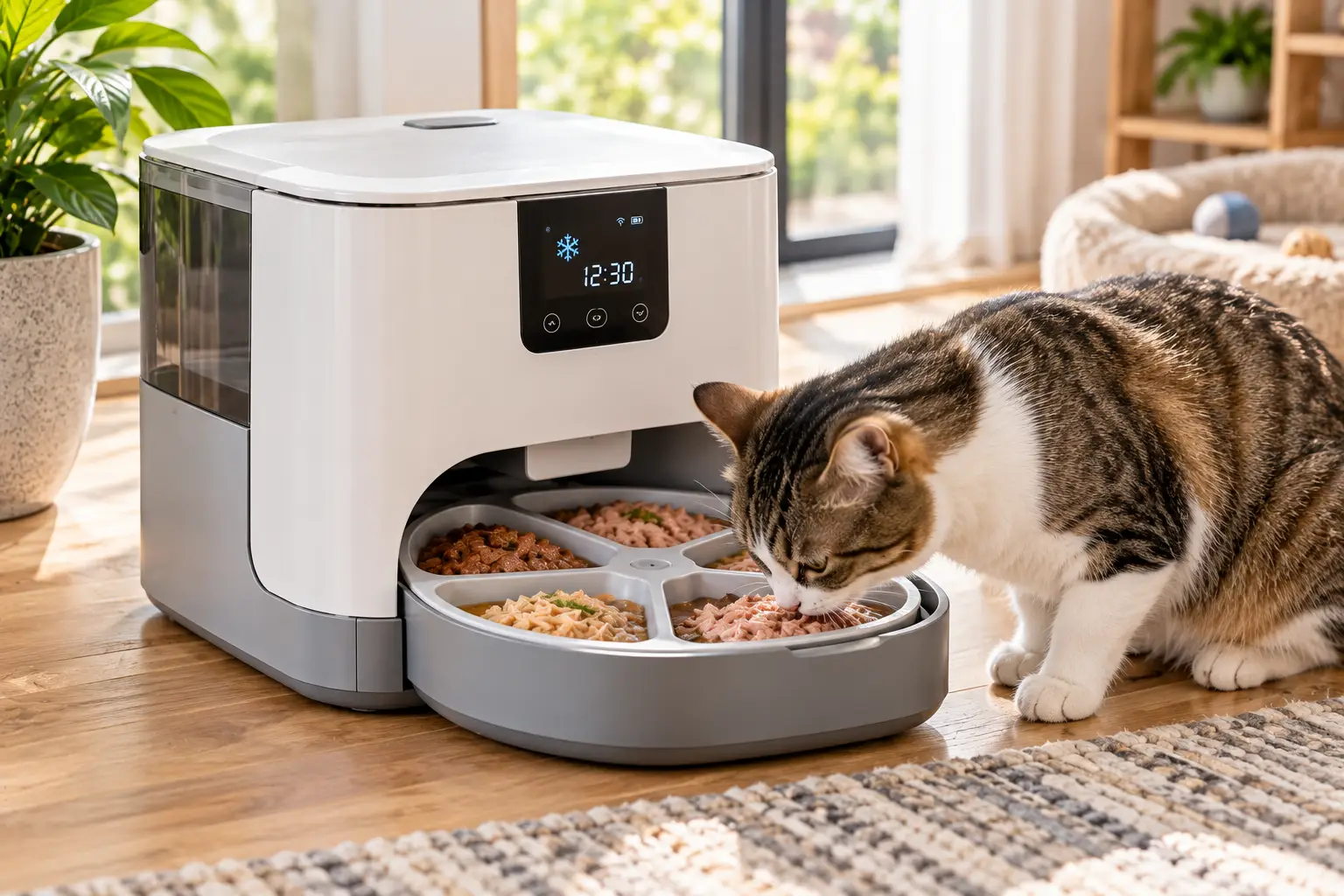
A refrigerated wet cat food feeder is an automatic, timer- or app-controlled dispenser that keeps pre-portioned wet food chilled until each scheduled mealtime. Premium models use built-in semiconductor (Peltier) cooling to hold food near 40°F for days; budget models use frozen ice packs that keep meals cool for several hours.
That distinction matters more than any other spec in this guide. Canned food is at least 75% water, which is great for hydration and also great for bacteria. The Cornell Feline Health Center’s feeding guidance notes that any opened portion of canned food should be refrigerated to keep its quality and prevent spoilage. A regular kibble feeder simply can’t do that.
Here’s the honest landscape in 2026. Only a handful of feeders on the US market actually refrigerate: the PetSafe FreshFeed Refrigerated Pet Feeder and the PETLIBRO Polar Wet Food Feeder lead that small group. Everything else, including the long-trusted Cat Mate line, relies on ice packs, which is perfectly fine for an overnight or a workday but not for a long weekend.
Below, you’ll find seven real feeders compared on cooling method, meal count, power source, and true cost of ownership. You’ll also get setup tips, problem-solving advice, and a decision framework, so you can pick the right automatic wet cat food feeder for your cat, your schedule, and your budget.
Quick Comparison: The 7 Best Refrigerated Wet Cat Food Feeder Options at a Glance
If you only have two minutes, start here. The table sorts all seven picks by cooling method first, because that single spec decides how long food stays safe.
| Feeder | Cooling method | Meals | Power | Approx. price range | Best for |
|---|---|---|---|---|---|
| PetSafe FreshFeed Refrigerated Pet Feeder | Dual semiconductor, targets 40°F | 6 | Plug-in | Around $250 | PetSafe FreshFeed — multi-day trips, fresh diets |
| PETLIBRO Polar Wet Food Feeder | Semiconductor, up to 72 hours | 3 | Plug-in + optional battery backup | $130–$180 | PETLIBRO Polar — weekend coverage on a mid budget |
| Geeni Smart Pet Feeder (5-Meal) | Ice packs | 5 trays | Plug-in + battery backup | $80–$100 | Geeni — app and voice-assistant fans |
| Casfuy Cordless 6-Meal Feeder | 4 ice packs (2 in use) | 6 | Rechargeable battery | $70–$90 | Casfuy — outlet-free placement |
| Cat Mate C500 | 2 ice packs | 5 | Batteries | $60–$90 | Cat Mate C500 — one cat, all-day grazing |
| Cat Mate C300 | 1 ice pack | 3 | Batteries | $50–$65 | Cat Mate C300 — workday coverage |
| Cat Mate C200 | 1 ice pack | 2 | 1 AA battery | $30–$50 | Cat Mate C200 — budget overnight meals |
Prices are approximate ranges at the time of writing and change often; check the current price before buying.
Looking at the table, the dividing line is obvious: only the PetSafe FreshFeed and the PETLIBRO Polar keep food cold for days rather than hours. The PETLIBRO Polar costs roughly $100 less but serves half as many meals, so the extra money for the PetSafe FreshFeed mainly buys capacity and a colder target temperature. Among the ice-pack models, the Casfuy and Geeni add modern conveniences, while the Cat Mate C200 remains the cheapest way to serve a cool meal while you sleep.
💬 One click helps other shoppers make an informed choice too! 😊
Top 7 Refrigerated Wet Cat Food Feeder Picks: Expert Analysis
Each pick below is a real model sold in the US. The commentary is based on comparing manufacturer spec sheets, published hands-on reviews, and the recurring themes in customer feedback, not on invented test results.
1. PetSafe FreshFeed Refrigerated Pet Feeder — coldest food, most meals
This is the closest thing to a mini fridge for your cat’s dinner, and it’s the pick when food safety over several days is non-negotiable.
The PetSafe FreshFeed uses dual semiconductor cooling and insulation to target a true 40°F, the same temperature the FDA recommends for refrigerated leftovers. In practice, that means a meal loaded on Friday morning should be just as safe on Sunday evening, which ice-pack feeders can’t promise. Its rotating tray holds six meals (about 4.5 cups total) in dishwasher-safe stainless steel inserts, and scheduling runs through PetSafe’s Pet Companion app.
On paper, this is the best fit for cats on fresh, gently cooked, or prescription wet diets, and for owners who travel for two or three days at a time. Six meals also covers two meals a day for three days, or three small meals a day for two. Adjustable-height legs are a thoughtful touch for older cats with stiff necks.
Because it’s newer, its review volume is still modest; early reviewers consistently highlight genuinely fridge-cold food and quiet operation, while the main hesitation is the price.
Pros:
- ✅ Targets a true 40°F refrigeration temperature
- ✅ Six meals per fill covers long weekends
- ✅ Dishwasher-safe stainless steel meal inserts
Cons:
- ❌ Most expensive feeder in this lineup
- ❌ Needs an outlet and generous counter space
💲 Typically around $250 (check the current price); worth it if you regularly leave for 48+ hours.
2. PETLIBRO Polar Wet Food Feeder — best value active cooling
The PETLIBRO Polar brought real refrigeration to the mainstream, and it remains the smartest buy for most wet-food households.
When it launched in April 2024, TechCrunch covered it as a first-of-its-kind refrigerated smart feeder. It uses semiconductor cooling to keep three meals fresh for up to 72 hours. PETLIBRO’s own lab figure is worth reading closely: at a 77°F room, it cools food to around 54°F. That’s far better than room temperature, but it isn’t fridge-cold, so treat three days as the ceiling, not a target.
A clever detail: the upcoming meal moves out of the chilled zone about 30 minutes before serving, so your cat doesn’t get a cold-from-the-fridge texture many cats reject. Note that setup and operation run entirely through the app (no physical feed button), it needs 2.4GHz Wi-Fi, and PETLIBRO advises against raw food.
Published reviews from cat-care sites and a feline diabetes community praise its punctuality for medically scheduled meals; a minority of customer complaints say it doesn’t get cold enough in warm rooms.
Pros:
- ✅ Real refrigeration at a mid-range price
- ✅ Warms the next meal before serving it
- ✅ Optional battery backup during outages
Cons:
- ❌ Only three meals per fill
- ❌ Cools to about 54°F, not 40°F
💲 Usually $130–$180 depending on bowl option; excellent value for one-cat, one-to-three-day coverage.
3. Geeni Smart Pet Feeder (5-Meal) — smart-home control on a budget
The Geeni Smart Pet Feeder is an ice-pack feeder with a brain, ideal if you want app and voice control without paying for refrigeration.
It offers five trays of about 380 ml each, ice packs to chill wet food, Wi-Fi scheduling, and compatibility with Alexa and Google Assistant. The practical upside is shared access: a partner or pet sitter can check or change the schedule from their own phone. Battery backup keeps the schedule running if the power blips.
This suits the tech-comfortable owner feeding wet food during the workday, not over multiple days. Ice packs are still ice packs; third-party reviewers estimate roughly 8 to 12 hours of useful cooling.
Customer feedback is mixed on ergonomics: the twist-lock lid is described as stiff, and reviewers note that only four of the five trays are programmable because one sits open at setup.
Pros:
- ✅ App plus Alexa and Google Assistant control
- ✅ Battery backup protects the feeding schedule
- ✅ Shareable access for sitters and family
Cons:
- ❌ Ice-pack cooling limits it to one day
- ❌ Lid can be hard to open
💲 Around $80–$100; good value if smart controls matter more than multi-day freshness.
4. Casfuy Cordless 6-Meal Feeder — freedom from outlets
The Casfuy Cordless is the pick when the best feeding spot in your home is nowhere near a plug.
It runs on a built-in rechargeable battery rated for up to 45 days per charge, serves up to six meals, and ships with four ice packs: two in use, two in the freezer. Casfuy says the packs stay frozen six to eight hours and keep wet food fresh for up to 24 hours. Interpreted honestly, that means a solid overnight-plus-workday window, with the spare packs making daily swaps painless.
It’s a natural fit for apartments, cats fed in a laundry room, or homes where a cord-chewing pet makes plug-in feeders risky. The bowls are about 1.9 inches deep, which is worth noting for flat-faced breeds.
On Chewy, the 6-meal version holds a 4.3-star average across 151 ratings; recurring praise covers reliability and easy programming, while some reviewers report swollen frozen packs jamming the rotating lid.
Pros:
- ✅ Cordless with roughly 45 days per charge
- ✅ Four ice packs allow easy rotation
- ✅ Six meals for frequent small portions
Cons:
- ❌ No app or remote monitoring
- ❌ Expanded ice packs can jam the lid
💲 Typically $70–$90; strong value for cord-free convenience.
5. Cat Mate C500 — the proven tamper-resistant classic
The Cat Mate C500 has fed cats for years, and its reputation for being nearly impossible to break into is well earned.
It has five sections of up to 330 g each, a digital timer, and two ice packs that slot beneath the food tray. A long-term owner writing for Reviewed described a cat who still hadn’t cracked the lid after a couple of years, which tells you something about build quality. Optional stainless steel inserts, sold separately, are worth buying because metal holds cold better and resists odors.
This is ideal for one cat who prefers several small meals while you’re out for the day. Third-party estimates put the ice packs at about 6 to 12 hours of cooling, so later meals in a five-meal rotation will be warmer than earlier ones.
Customer reviews repeatedly praise reliability and ease of programming; the common caveat is that it shines most for dry food, with wet food best kept to shorter windows.
Pros:
- ✅ Exceptionally tamper-resistant lid design
- ✅ Five meals for grazing-style feeding
- ✅ No app, no Wi-Fi to fail
Cons:
- ❌ Ice packs fade well before day’s end
- ❌ Stainless inserts cost extra
💲 Generally $60–$90; reliable value for daytime wet feeding.
6. Cat Mate C300 — simple workday coverage
The Cat Mate C300 is the middle child of the Cat Mate family: three meals, one ice pack, zero complications.
It uses a digital timer for up to three meals and a close-fitting lid with an ice pack underneath to keep food fresh. That combination covers breakfast, lunch, and an early dinner for a typical nine-to-five schedule. Replacement ice packs are sold separately, and owners who buy a spare can swap a frozen one in every morning.
On paper, it’s the best fit for owners who don’t travel much but want a predictable midday meal for a cat that begs or eats too fast. One customer comment about the replacement packs reports roughly nine hours of real cold, which matches the workday use case.
Reviews consistently describe it as sturdy and quick to set up, with the main frustration being the daily ice-pack swap.
Pros:
- ✅ Easy digital timer for three meals
- ✅ Sturdy, fly-resistant close-fitting lid
- ✅ Affordable spare ice packs available
Cons:
- ❌ Ice pack needs refreezing daily
- ❌ Not suitable for overnight trips
💲 Usually $50–$65; sensible value for daily routines.
7. Cat Mate C200 — cheapest cool breakfast
The Cat Mate C200 solves the single most common wet-food problem: the 5 a.m. wake-up call.
It has two bowls holding up to 400 g (about 14 oz) each, two independent 48-hour quartz timers, and a reusable ice pack nested underneath. One AA battery runs it for about a year. A lid-link clip lets both bowls open together, which makes it a two-cat feeder for a single meal.
This is the right buy for anyone who wants breakfast served on time without paying for app features they won’t use. Many owners buy two units to cover a weekend with two meals a day, but that still relies on ice packs, so be cautious in warm weather.
Customer reviews praise its quiet opening and simplicity; one reviewer advises not leaving wet food more than about four hours in warm weather, even with the ice pack.
Pros:
- ✅ Lowest price in this lineup
- ✅ Runs about a year on one AA
- ✅ Dishwasher-safe bowls and lids
Cons:
- ❌ Only two meals per unit
- ❌ Single ice pack limits hot-day use
💲 Around $30–$50; outstanding value for overnight and early-morning meals.
Getting Started: Your First 30 Days With an Automatic Wet Cat Food Feeder 🛠️
A great feeder can still fail if the first month goes wrong. Most “my cat won’t use it” stories trace back to setup, not hardware.
Week 1: Introduce it while you’re home
- Run it empty first. Let the lid open and close a few times so your cat hears the sound with no pressure attached.
- Serve one real meal from it while you watch. Pick the meal your cat is most excited about, usually breakfast.
- Pre-chill active models. Plug in the PETLIBRO Polar or PetSafe FreshFeed a few hours before loading so food goes into an already cold compartment.
Week 2: Fine-tune portions and timing
Weigh each portion on a kitchen scale for a week. Cats on wet food often need several small meals, and a feeder makes overfeeding easy because you stop seeing the can. If your cat leaves food behind, shrink the portion rather than leaving leftovers to sit.
Weeks 3–4: Build the cleaning and ice-pack rhythm
- ✅ Wash trays or inserts after every fill; dried wet food breeds bacteria fast.
- ✅ Keep a second set of ice packs frozen so the swap takes ten seconds.
- ✅ Test a full overnight cycle before you trust it for a trip.
Common mistakes in month one
❌ Loading room-temperature food into an ice-pack feeder hours before the first meal. Start the clock with fridge-cold food.
❌ Going away on the first weekend you own it. Do at least one dry run of the full schedule first.
Real-World Scenarios: Matching the Right Feeder to Your Life 🏡
Specs only matter in context. Here are three common households and the reasoning behind each match.
The weekend traveler (budget: $150–$250)
You leave Friday after work and return Sunday night, roughly 48–52 hours. Ice packs simply won’t last, so you need active cooling. The PETLIBRO Polar covers three meals in 72 hours, which works if your cat eats twice a day and you arrange a sitter visit or a backup dry feeder for one meal. If you’d rather cover every meal, the PetSafe FreshFeed and its six-meal tray handle three days of twice-daily feeding on its own.
The nine-to-five commuter (budget: $50–$100)
You’re gone about ten hours. A Cat Mate C300 serves a noon meal on a single ice pack. If your best feeding spot lacks an outlet, the Casfuy Cordless does the same job with more meals and no cord. Want to check the schedule from your desk? The Geeni adds app control.
The early-morning sleeper (budget: under $50)
Your cat starts yelling at 5 a.m. The Cat Mate C200 opens on a quartz timer while you sleep, chilled by an ice pack loaded before bed. It’s the cheapest fix for the most common wet-food complaint, and one AA battery runs it for about a year.
✨ Don’t miss these top-rated feeders!
🔍 Take your cat’s mealtime routine to the next level with this carefully curated lineup. Click a highlighted feeder to check current pricing and availability. These picks will help you serve fresher, safer meals that your cat will actually finish!
Problem → Solution: Fixing Common Wet Food Feeder Headaches 🔧
Even good feeders have quirks. Here are the problems owners report most often, and what actually fixes them.
Problem 1: Food comes out crusty or dried. Solution: Seal matters as much as cold. Add a teaspoon of water or a splash of the can’s gravy when loading, and choose models with close-fitting lids like the Cat Mate C500.
Problem 2: My cat ignores cold food. Solution: Cats often prefer food near room temperature. The PETLIBRO Polar warms the next meal before serving it. On ice-pack models, schedule meals at least an hour after the ice pack has softened, or ask your vet about warming strategies.
Problem 3: The lid jams. Solution: Frozen gel packs can swell. Reviewers of the Casfuy Cordless report this; let packs sit a minute before inserting, and never overfill trays.
Problem 4: Two cats fight over one bowl. Solution: Feed simultaneously from two units, or use the Cat Mate C200 lid-link clip to open both bowls at once.
Problem 5: The app lost connection. Solution: Smart feeders like the Geeni and PETLIBRO Polar need 2.4GHz Wi-Fi. Move your router closer or add an extender, and confirm battery backup is installed before traveling.
How to Choose a Refrigerated Wet Cat Food Feeder
Use these seven steps in order; each one narrows the field.
- Measure your longest absence. Under 12 hours, an ice-pack feeder works. Over 24 hours, you need active refrigeration.
- Pick the cooling method that matches. A refrigerated automatic cat feeder with semiconductor cooling buys days; a cat feeder with ice packs buys hours.
- Count meals, not days. Multiply meals per day by days away. Three meals covers 1.5 days of twice-daily feeding.
- Check the target temperature. “Keeps food fresh” is marketing; a stated number such as 40°F or 54°F is a spec you can compare.
- Decide on power. Plug-in models need an outlet and ideally battery backup; cordless models trade cooling for placement freedom.
- Inspect the bowls. Stainless steel, dishwasher-safe, and shallow enough to avoid whisker discomfort.
- Choose your control style. App control helps travelers; a simple timer has fewer failure points.
Refrigerated vs. Ice-Pack Feeders: What’s Really Different ❄️
The technology gap explains the price gap. Active models use a thermoelectric (Peltier) cooler, a solid-state heat pump with no compressor or refrigerant. It has no moving parts to wear out, but it’s less efficient than a kitchen fridge, so performance depends heavily on room temperature. That’s why the PETLIBRO Polar quotes about 54°F at a 77°F room, while the larger, dual-module PetSafe FreshFeed targets 40°F.
Ice packs work the opposite way: they start very cold and steadily lose ground. The first meal is chilly; the last one may be near room temperature.
| Factor | Active refrigeration | Ice packs | Best for |
|---|---|---|---|
| Safe holding time | 48–72+ hours | Roughly 6–24 hours | Active: PetSafe FreshFeed, PETLIBRO Polar |
| Temperature over time | Stable | Declines steadily | Active for trips |
| Daily effort | Load and go | Freeze and swap packs | Ice packs if you’re home daily |
| Power | Outlet required | Batteries or none | Ice packs: Casfuy Cordless, Cat Mate C200 |
| Upfront cost | $130–$250 | $30–$100 | Ice packs for tight budgets |
The table makes the trade clear: active cooling buys time, and ice packs buy flexibility and savings. If you are home every evening, an ice-pack feeder like the Cat Mate C300 delivers 90% of the benefit at a fraction of the cost. If you travel, the gap in holding time is the whole reason to spend more.
Food Safety, Standards, and What 40°F Really Means 🧪
The number 40°F isn’t arbitrary. The FDA’s tips for safe handling of pet food tell owners to promptly refrigerate or discard leftover canned and pouched pet food, keep it tightly covered, and set the refrigerator at 40°F or below. The same guidance recommends washing hands before and after handling pet food and cleaning bowls after use.
What does that mean for buyers? Only a feeder that holds near 40°F is mirroring the FDA’s storage advice. A feeder holding food in the 50s is better than a countertop, but it’s a compromise, so keep holding times short. Ice-pack feeders are fine for same-day meals, not multi-day storage.
Raw diets deserve extra caution. The FDA considers raw pet food a significant risk to pets and people, and PETLIBRO specifically advises against loading raw food into the PETLIBRO Polar. If your cat eats raw or gently cooked food, talk with your veterinarian before automating it.
On the electrical side, look for a recognized safety mark (such as UL or ETL) on plug-in power adapters, keep cords out of reach, and place feeders on a flat, dry surface away from heat sources like ovens and sunny windows.
Long-Term Cost and Maintenance 💰
Sticker price is only part of the story. Here’s how the total cost of ownership stacks up over a few years.
| Feeder | Upfront range | Ongoing costs | Value verdict | Best for |
|---|---|---|---|---|
| PetSafe FreshFeed | Around $250 | Electricity | Highest cost, lowest hassle | Frequent travelers |
| PETLIBRO Polar | $130–$180 | Electricity, optional backup batteries | Best cost per day of cold storage | Weekend trips |
| Casfuy Cordless | $70–$90 | Charging only | Strong mid-range value | No-outlet spots |
| Cat Mate C200 | $30–$50 | One AA per year, spare ice packs | Lowest cost per meal | Daily breakfast |
The pattern is simple: ice-pack models cost little to run but cost you time, while refrigerated models cost more upfront but replace a pet sitter’s visit. If one avoided sitter visit runs $25–$40, a PETLIBRO Polar can pay for itself within a handful of weekends. For maintenance, wash trays after every fill, wipe seals weekly, and replace ice packs if they crack or leak.
Features That Actually Matter (and Ones That Don’t)
Matter: a stated holding temperature, number of meals, stainless steel bowls, battery backup, and a lid that seals. These directly affect food safety and whether your cat will eat.
Matter less than you’d think: voice assistants, recorded voice messages, and companion apps packed with charts. They’re nice, but none keeps food colder.
Watch out for: listings that say “refrigerated” but actually mean ice packs. If a feeder lists frozen packs in the box, it’s an ice-pack feeder, whatever the title says.
Wet Food Dispenser for Cats With Special Needs 🩺
Senior cats, diabetic cats, and cats with kidney disease often need small, frequent, precisely timed wet meals. That’s where a wet food dispenser for cats earns its keep. A feline diabetes community review of the PETLIBRO Polar praised it for keeping meals consistent around insulin schedules. Raised feeders like the PetSafe FreshFeed, with adjustable legs, can help arthritic cats. Always build the schedule with your veterinarian, and never use an automatic feeder as a substitute for monitoring a cat that has stopped eating.
FAQ: Refrigerated Wet Cat Food Feeder Questions
❓ Is a refrigerated wet cat food feeder worth the money?
❓ What happens to a refrigerated feeder during a power outage?
❓ Can one automatic wet cat food feeder serve two cats?
❓ Are refrigerated cat feeders loud?
❓ Can I put pouch food in a cat feeder with ice packs?
Conclusion: Pick the Cold You Actually Need
The right refrigerated wet cat food feeder depends on one question: how long will the food sit before your cat eats it? Answer that honestly, and the choice almost makes itself.
For multi-day trips and fresh diets, the PetSafe FreshFeed is the most capable option, with a true 40°F target and six meals. For most single-cat households, the PETLIBRO Polar delivers real refrigeration for around $100 less, as long as you respect its three-meal, 72-hour limit.
If you’re home every evening, save your money. The Geeni adds smart control, the Casfuy Cordless frees you from outlets, the Cat Mate C500 and Cat Mate C300 handle the workday, and the Cat Mate C200 ends the 5 a.m. wake-up call for the price of a few cases of food.
Whichever you choose, pair it with good habits: fridge-cold food at loading, clean trays at every fill, spare ice packs in the freezer, and a dry run before any trip. Your cat gets fresher meals, and you get your mornings back.
🚀 Ready to upgrade your cat’s mealtime?
🛒 Click a highlighted feeder above to check today’s price and availability, and give your cat fresh, chilled meals on schedule, even when you’re not home!
Recommended for You
- Automatic Animal Waterer: 7 Best Picks That Save Hours (2026)
- Automatic Feeder with Camera: 7 Best Smart Picks for 2026 (Ranked)
- Automatic feeders for horses: 7 Best Smart Picks for 2026
Disclaimer: This post contains affiliate links. As an Amazon Associate, I earn from qualifying purchases made through these links, at no additional cost to you.
✨ Found this article helpful? Share it with someone who needs it! 💬🤗