In This Article
Why Ceramic Dog Bowls for Small Dogs Deserve a Second Look
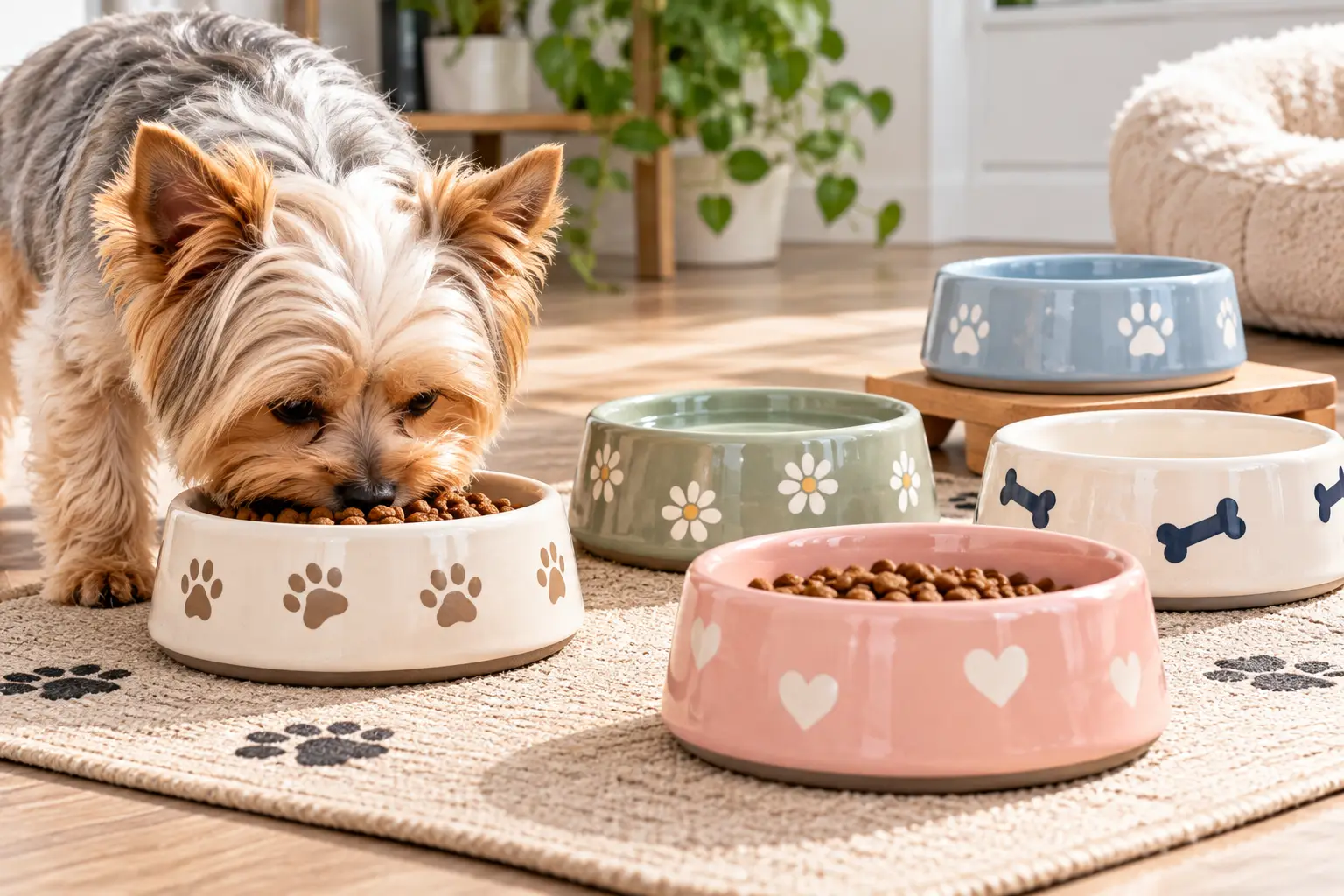
Small dogs eat small meals, but they can be surprisingly fussy about the dish. Picture a 6-pound Chihuahua nosing a featherweight plastic bowl across the kitchen, a Pug mashing its face into a deep crock, or a Yorkie whose water bowl has grown a slimy film by Wednesday. These are everyday problems, and the bowl itself is often the culprit. That’s exactly why ceramic dog bowls for small dogs have become a go-to upgrade for owners who want something heavier, easier to sanitize, and frankly nicer to look at than plastic.
However, “ceramic” covers a huge range of quality. The glaze is the surface your dog’s tongue touches several times a day, and not every glaze is made to the same standard. The FDA has long set limits on how much lead may leach from ceramic foodware (see the agency’s Compliance Policy Guide on lead in pottery), yet bowls sold for pets don’t always say whether they meet those human-food benchmarks. Size matters just as much: a bowl built for a Labrador is basically a moat for a 7-pound Maltese.
In this guide, you’ll find seven real ceramic options available to US shoppers on amazon.com, compared on capacity, depth, stability, and safety claims. Rather than inventing “lab tests,” we lean on manufacturer specs, retailer Q&As, and aggregated customer feedback — and we translate every spec into what it actually means at mealtime. You’ll also get a first-month care routine, fixes for common bowl headaches, and a buying framework built specifically for toy and flat-faced breeds.
What Is a Ceramic Dog Bowl for Small Dogs?
A ceramic dog bowl for small dogs is a glazed clay dish — usually stoneware or porcelain — sized for dogs under roughly 20 to 25 pounds and typically holding 0.5 to 2 cups. Its weight resists tipping and sliding, and an intact, food-safe glaze creates a smooth, non-porous surface that’s easy to sanitize.
Quick Comparison: 7 Ceramic Dog Bowls for Small Dogs at a Glance
Here’s the short version before we dig into each pick. Capacities and dimensions come from manufacturer listings; price ranges reflect what we saw at the time of writing, so always check the current price.
| Product | Capacity | Standout Feature | Price Range | Best For |
|---|---|---|---|---|
| Waggo Dipper (Small) | 2 cups | Heavyweight hand-dipped stoneware, 5.25″ wide | $20–$30 | Waggo Dipper: everyday food or water for 10–20 lb dogs |
| LE TAUCI Ceramic Slow Feeder (Small Breed) | 0.6 cup | Raised maze pattern | $15–$25 | LE TAUCI Slow Feeder: toy breeds that gulp |
| LE TAUCI Bowl Set with Acacia Wood Stand | 1.8 cups each | Two wide, shallow bowls on a wood stand | $25–$35 | LE TAUCI Acacia Set: a tidy food-and-water station |
| PetRageous Designs Metro Oval | 1 cup | Wide, shallow oval shape | Under $15 | PetRageous Metro Oval: Pugs, Frenchies, Shih Tzus |
| Bone Dry Lattice Non-Skid Bowl | 0.75 or 1.5 cups | Non-skid base, Prop 65 compliant | $10–$20 | Bone Dry Lattice: slick floors, tiny portions |
| Mora Ceramics Pet Bowl (Small) | 2 cups | Lead-free natural glaze, 5.1″ wide | $20–$35 | Mora Ceramics: safety-first buyers |
| PTOBER Raised Ceramic Bowl Set | 1.6 cups each | Stainless steel stand, lead- and cadmium-free claim | $12–$25 | PTOBER Raised Set: budget elevated feeding |
Reading the table, the biggest split isn’t price — it’s capacity. The LE TAUCI Slow Feeder and the 0.75-cup Bone Dry Lattice are sized for dogs under about 10 pounds, while the 2-cup Waggo Dipper and Mora Ceramics bowls double nicely as water bowls for dogs up to about 20 pounds. If your dog has a short muzzle, shape beats everything else, which pushes the PetRageous Metro Oval and the shallow LE TAUCI Acacia Set to the top of your list.
👉 Tap any highlighted bowl to check today’s price and availability — and share this table to help other small-dog owners choose smarter! 🐾
Top 7 Ceramic Dog Bowls for Small Dogs: Expert Analysis
Each pick below is a real product sold to US shoppers. For every bowl, we explain what the specs mean in daily use, who it suits, and what customer feedback reveals that the listing doesn’t.
1. Waggo Dipper Ceramic Dog Bowl (Small) — best all-around everyday bowl
The Waggo Dipper is the bowl to beat if you want one dish that handles food or water without drama. The Small size measures about 5.25 inches across and 2 inches tall and holds up to 2 cups. In practice, that’s enough water to get many 10- to 20-pound dogs through a workday, or a full kibble meal with enough headroom that pieces don’t spill over the rim when your dog shoves its nose in.
Waggo describes it as heavyweight, hand-dipped ceramic that’s dishwasher- and microwave-safe, and retailers list it as 100% ceramic meeting FDA standards. The weight is the real feature here: it does the anti-tip job that rubber feet do on lighter bowls. The dipped finish leaves a visible band near the base, which is part of the look but also the spot to inspect for chips over time.
Based on comparing the specs, the Waggo Dipper is ideal for owners who want one design for both food and water and care about matching their decor — it comes in about 11 colorways. Customer feedback on retailer sites consistently highlights how heavy and sturdy it feels, which is exactly what you want from a bowl a small dog can’t push around. The 2-inch depth suits most muzzles, though very flat-faced dogs may do better with pick #4.
Pros:
- ✅ Heavy enough to resist pushing and tipping
- ✅ Two-cup capacity works for food or water
- ✅ Dishwasher- and microwave-safe for easy sanitizing
Cons:
- ❌ Pricier than most single bowls on this list
- ❌ Too deep for some very flat-faced breeds
💲 Usually in the $20–$30 range at the time of writing — fair value for a bowl that can last for years if it isn’t dropped.
2. LE TAUCI Ceramic Slow Feeder (Small Breed, 0.6 Cup) — best for tiny speed-eaters
The LE TAUCI Slow Feeder is built for the toy dog that treats dinner like a race. It holds about 0.6 cup and uses a raised maze pattern molded into the ceramic, so your dog has to work kibble out of the channels instead of inhaling it.
Why that matters: a dog that gulps swallows air along with food, and small dogs that eat too fast often cough, gag, or bring the meal back up. Stretching a 15-second meal into a few minutes is the whole point. The listing says it’s microwave- and dishwasher-safe, and the ceramic is noticeably heavier than plastic slow feeders, which a determined Jack Russell can flip.
Here’s what to weigh: 0.6 cup is a meal-sized bowl, not a water bowl. It’s a great match for dogs in the 4- to 12-pound range whose portions are well under a cup. Reviews of this line on Amazon carry a high average rating across thousands of ratings at the time of research. Reviewers consistently report that it genuinely slows their dogs down, that the ceramic feels thick, and that the included adhesive grip dots help keep it in place. The most common caveat is that the maze grooves need a small brush to clean thoroughly.
Pros:
- ✅ Maze pattern measurably slows fast eaters
- ✅ Heavier and harder to flip than plastic puzzles
- ✅ Portion-sized for toy breeds
Cons:
- ❌ Grooves take extra effort to scrub clean
- ❌ Too small to double as a water bowl
💲 Typically $15–$25 — strong value if gulping is your dog’s main problem.
3. LE TAUCI Dog Bowl Set with Acacia Wood Stand — best matching food-and-water station
The LE TAUCI Acacia Set pairs two ceramic bowls with a slightly raised acacia wood stand, giving you a complete feeding station in one purchase. Each bowl measures about 5.6 inches across and 1.8 inches tall, holding roughly 1.8 cups of food or 14.5 ounces of water.
That ratio — wide and shallow — is the key spec. A shallow bowl lets short-muzzled dogs reach the bottom without pressing their whiskers and nose into the sides, and it keeps kibble visible and easy to grab. The stand keeps both bowls together, so your dog can’t scatter them across the floor, and the weight of ceramic plus wood adds stability.
On paper, this is the strongest choice for apartment dwellers and anyone who wants a tidy, decor-friendly setup. One detail worth knowing: the brand notes that the stand is assembled with nails, so handle it carefully, and wipe up water spills to keep the wood from staining or warping. We couldn’t verify a large, independent body of reviews for this exact set at the time of writing, so judge it mostly on its specs, which are solid for dogs under about 20 pounds.
Pros:
- ✅ Two bowls and a stand in one purchase
- ✅ Wide, shallow shape suits short muzzles
- ✅ Stand stops bowls from wandering
Cons:
- ❌ Wood needs drying after water spills
- ❌ Fewer verifiable reviews than single-bowl picks
💲 Around $25–$35 — good value considering you get two bowls plus a stand.
4. PetRageous Designs Metro Oval Ceramic Dish (1 Cup) — best for flat-faced breeds
The PetRageous Metro Oval solves a problem round bowls create for Pugs, French Bulldogs, and Shih Tzus. Its wide, shallow oval shape lets a short-snouted dog approach from the long side and reach every last kibble without jamming its face into a wall.
The brand describes it as hand-crafted, oven-fired ceramic that complies with FDA regulations for human use, and it’s microwave- and dishwasher-safe. In plain terms, oven firing hardens the glaze into a tougher, smoother surface, and “FDA compliant for human use” is the claim you actually want on a pet bowl. At 1 cup, it holds a full meal for most dogs under about 15 pounds — but, as editors at Cuteness have pointed out, it’s on the small side for water.
What the spec sheet doesn’t say, but a retailer Q&A for a decorated bowl from the same brand does: designs with decals could contain minute traces of lead that remain within FDA limits. If that concerns you, choose a solid-color interior. Independent editorial roundups recommend this model for flat-faced breeds, though we couldn’t verify a large pool of model-specific customer reviews.
Pros:
- ✅ Oval shape is ideal for short muzzles
- ✅ FDA-compliant for human use per the brand
- ✅ One of the most affordable picks here
Cons:
- ❌ Too small to serve as a water bowl
- ❌ Decal versions raise trace-lead questions
💲 Usually under $15 — excellent value for brachycephalic breeds.
5. Bone Dry Lattice Non-Skid Ceramic Bowl — best grip on slick floors
The Bone Dry Lattice bowl from DII adds a non-skid base to ceramic’s natural heft, which makes it the most planted option here on tile, vinyl plank, and polished wood. It comes in several sizes, including 0.75-cup and 1.5-cup versions that suit small dogs well.
The 0.75-cup size is a smart fit for toy breeds: less food sits out, which means less grazing and less stale kibble. The 1.5-cup size works better as a ceramic water bowl for dogs under about 15 pounds. The non-skid base matters more than you’d think, because a 5-pound dog pushing a bowl across a slick floor quickly learns that mealtime is a chase game.
What stands out is the brand’s transparency. In retailer Q&As, the company says these bowls pass California Proposition 65 and FDA compliance regarding lead, while noting that trace amounts may still be present due to the production facility. That’s a more honest answer than a vague “100% lead-free” badge. Editorial roundups such as Hepper have featured Bone Dry’s ceramic line, generally noting that its lower capacity suits small and medium dogs best.
Pros:
- ✅ Non-skid base grips smooth floors
- ✅ Right-sized options for toy breeds
- ✅ Clear, specific lead-compliance disclosure
Cons:
- ❌ Small sizes are too tiny for bigger dogs
- ❌ Trace lead possible, though within limits
💲 Generally $10–$20 — the best budget pick for slippery floors.
6. Mora Ceramics Pet Bowl (Small) — best for lead-free glaze transparency
The Mora Ceramics bowl is the pick for owners who put glaze safety first. The Small measures about 5.1 inches wide by 2 inches tall and holds 2 cups, so it works for food or water for most dogs under 20 pounds.
Mora says it uses what it calls Paladin clay — which the brand claims is 20% stronger than standard clay — along with a lead-free, all-natural glaze. Practically, a stronger clay body means better odds of surviving the occasional bump against a cabinet, while a lead-free glaze removes the biggest worry with ceramic. Notably, the brand itself points out that there’s no specific US regulation for lead in pet products. That’s an honest admission, and it’s exactly why choosing a brand that states its glaze is lead-free matters.
The natural glaze also shifts color depending on lighting, so your bowl may not look identical to the product photos. At the time of research, the Amazon listing showed an average around 4.7 out of 5 across roughly 480 reviews, a solid sample for a niche brand. Based on the specs and that feedback, it’s an easy recommendation for safety-conscious owners with dogs up to about 20 pounds.
Pros:
- ✅ Brand states a lead-free natural glaze
- ✅ Two-cup capacity covers food or water
- ✅ Strong average rating across hundreds of reviews
Cons:
- ❌ Glaze color can differ from photos
- ❌ Premium price for a single bowl
💲 Usually $20–$35 — worth it if glaze safety is your top priority.
7. PTOBER Raised Ceramic Dog Bowl Set — best budget elevated pair
The PTOBER Raised Set delivers two ceramic bowls on a stainless steel stand at a price that undercuts most single designer bowls. Each bowl holds about 1.6 cups (10.8 fluid ounces), and the listing (model QJ1115-B-S2) states the ceramic is food-grade and free of lead and cadmium.
The raised stand brings food a little closer to your dog’s mouth. For long-backed breeds like Dachshunds and for older small dogs, less stooping can mean a more comfortable meal. The stainless steel frame won’t rust, and because the bowls lift out, you can run them through the dishwasher separately from the stand.
Here’s what to weigh: the height is fixed, so it may be too tall for a Chihuahua and just right for a Cavalier. Also, the case for raised feeders is mostly about comfort and tidiness for small dogs, not a proven health benefit. At the time of research, the listing showed an average around 4.6 out of 5 from roughly 136 reviews — positive, but a smaller sample than bigger brands.
Pros:
- ✅ Two bowls plus a stand at a low price
- ✅ Lead- and cadmium-free claim on the listing
- ✅ Rust-proof stainless steel frame
Cons:
- ❌ Fixed height won’t suit every dog
- ❌ Smaller review pool than bigger brands
💲 Typically $12–$25 — the best value if you want an elevated setup.
✨ Ready to upgrade mealtime? 🐾
🔍 Match the bowl to your dog’s size and face shape, then click a highlighted name to check current pricing and availability. A heavier, cleaner, right-sized bowl makes every meal calmer — for your dog and for your floors!
Getting Started: Your First 30 Days With a New Ceramic Dog Food Bowl
A new ceramic dog food bowl is simple to use, but the first month sets the habits that keep it safe for years. Here’s a practical routine you won’t find on any product listing.
Day 1: Inspect before the first meal
Run a fingertip around the rim and the inside walls. You’re feeling for chips, rough spots, and hairline cracks. Also look for crazing — a fine spiderweb of lines in the glaze — because those micro-cracks can trap bacteria and, on poorly made ware, expose the clay body underneath. Then wash the bowl in hot, soapy water before it touches food.
Week 1: Make the switch gradually
Some dogs are wary of a new bowl, especially if it clinks against the floor. Set the new bowl next to the old one for a few meals, then swap. A thin silicone mat underneath softens the sound and catches splashes.
Every day: Wash food and water bowls
Veterinary experts at the FDA’s Center for Veterinary Medicine recommend cleaning your pet’s food bowl daily, as Consumer Affairs reported. Ideally, wash the food bowl after each meal with hot water and dish soap, and scrub the water bowl daily to break up biofilm before it turns slimy. Use a dedicated sponge that never touches your own dishes.
Common mistakes in the first 30 days
- ❌ Scrubbing with steel wool, which can dull or scratch the glaze
- ❌ Moving the bowl straight from a cold porch into hot water (thermal shock can crack ceramic)
- ❌ Overfilling food, which encourages grazing and stale leftovers
- ❌ Ignoring a small chip — once it appears, it’s time to plan a replacement
Real-World Scenarios: Which Bowl Fits Your Small Dog?
Specs only help when they’re matched to a real dog. These three profiles show how to translate the comparison into a decision.
Scenario 1: The apartment Chihuahua who inhales dinner
Picture a 5-pound Chihuahua in a one-bedroom apartment, eating about a quarter cup per meal and finishing in seconds. The owner’s budget is roughly $30 total. The best fit is the LE TAUCI Slow Feeder for meals, paired with a 1.5-cup Bone Dry Lattice as the water bowl. The maze slows the gulping, and the non-skid base keeps the water bowl from sliding on laminate. Total spend lands comfortably within budget.
Scenario 2: The flat-faced French Bulldog
Now imagine a 22-pound Frenchie who leaves half his kibble pushed against the bowl wall. Depth is the enemy here. The PetRageous Metro Oval handles meals, while the wide, shallow bowls of the LE TAUCI Acacia Set work well for water and keep everything in one tidy spot. Expect to spend about $40 to $50 for both.
Scenario 3: The senior Dachshund in a multi-pet home
Finally, consider a 14-pound senior Dachshund living with a cat. Comfort and hygiene come first. The PTOBER Raised Set brings food up slightly to reduce stooping, and the bowls lift out for the dishwasher. If the owner prioritizes glaze safety above all, a pair of Mora Ceramics bowls on a low mat is the premium alternative.
Problem → Solution: Fixing Common Ceramic Bowl Headaches
Even a great bowl can come with quirks. Here are the problems small-dog owners run into most often, with precise fixes.
- Problem: The bowl slides across the floor. Solution: Choose a model with a non-skid base, like the Bone Dry Lattice, or set any ceramic bowl on a silicone mat. Adhesive grip dots, like those included with the LE TAUCI Slow Feeder, also help.
- Problem: The ceramic dog water bowl turns slimy. Solution: That film is biofilm, a layer of bacteria. A quick rinse won’t remove it. Scrub daily with hot, soapy water and run the bowl through the dishwasher a few times a week.
- Problem: Your dog gulps and then vomits. Solution: Switch to a maze-style ceramic slow feeder and split the daily portion into smaller meals. If vomiting continues, talk to your vet.
- Problem: Kibble ends up on the floor. Solution: Your dog is probably chasing food up the walls of a deep bowl. A wide, shallow dish like the PetRageous Metro Oval usually stops the scatter.
- Problem: You find a chip or crack. Solution: Retire the bowl. Chips can have sharp edges, and cracks hold bacteria that daily washing can’t reach.
How to Choose Ceramic Dog Bowls for Small Dogs
Choosing the right small ceramic dog bowl comes down to six checks, in this order:
- Match capacity to the portion. Toy breeds usually need a food bowl in the 0.5- to 1-cup range, while a water bowl for a dog under 20 pounds works best at 1.5 to 2 cups. Too big, and food sits out and goes stale.
- Check depth against your dog’s muzzle. Flat-faced breeds do best with bowls under about 2 inches deep or with a wide oval shape. Longer snouts handle standard depths fine.
- Confirm a specific glaze-safety claim. Look for “meets FDA standards for human use,” “lead- and cadmium-free,” or Prop 65 compliance. Vague words like “non-toxic” alone aren’t enough.
- Favor weight and a stable base. Heavier bowls resist pushing, and a non-skid ring or mat matters on slick floors.
- Inspect the interior finish. The food-contact surface should be fully glazed, smooth, and free of decals. A rough or unglazed interior is harder to clean.
- Confirm dishwasher safety. A bowl you can sanitize easily is a bowl you’ll actually keep clean.
Style comes last — but with ceramic, you rarely have to sacrifice it.
Lead-Free Ceramic Dog Bowl Standards: What the Labels Really Mean
A lead-free ceramic dog bowl is the safest choice, but labels can be slippery. Here’s the regulatory reality, translated.
Why lead is a ceramic issue at all
Traditionally, lead was added to some glazes to help them melt smoothly and look glossy. If a glaze is poorly formulated or under-fired, lead can leach into food, especially acidic or wet food. That’s why the FDA sets action levels for extractable lead in ceramic foodware. Most small dog bowls — more than about an inch deep and under 1.1 liters — fall into the agency’s “small hollowware” category.
The pet-bowl gray zone
Those FDA limits were written for food dishes humans use. Pet bowls aren’t clearly covered by a separate federal standard, which is why the strongest claim a pet brand can make is that its bowl meets FDA standards for human foodware. The FDA has also warned that even products labeled “lead free” can be contaminated during manufacturing, as explained in its guidance on “Lead Free” labeling of pottery.
What to look for in practice
- ✅ A clear statement of FDA compliance for human use, or “lead- and cadmium-free”
- ✅ California Prop 65 compliance, which adds disclosure requirements
- ✅ Solid-color interiors without decals on the food-contact surface
- ❌ Avoid anything labeled “for decorative use only”
- ❌ Be wary of unbranded bowls with no safety claim at all
Home lead-test swabs can flag surface lead, but they don’t reliably measure leaching. For genuine peace of mind, buy from brands that disclose their testing.
Ceramic vs Stainless Steel vs Plastic for Small Dogs
Ceramic isn’t the only option, so here’s an honest comparison of the three common bowl materials.
| Material | Stability | Hygiene | Durability | Typical Price | Best For |
|---|---|---|---|---|---|
| Ceramic | Heavy; resists tipping | Excellent when glaze is intact | Chips or breaks if dropped | $10–$35 | Mora Ceramics or Waggo Dipper for style-conscious homes |
| Stainless steel | Light unless weighted | Excellent; non-porous | Nearly indestructible | $5–$25 | Travel, outdoor use, rough handlers |
| Plastic | Very light; easy to push | Scratches can trap bacteria | Chewable; wears over time | $3–$15 | Short-term use only |
The table shows why ceramic wins for most indoor small dogs: it’s the only material that combines weight with an easy-to-clean surface. Stainless steel matches ceramic on hygiene and beats it on durability, so it’s the smarter pick for camping trips or a dog who throws bowls around. Plastic trails both because scratches give bacteria places to hide, which veterinarians frequently cite as a reason to avoid it for daily use.
Ceramic Bowls for Toy and Flat-Faced Breeds
Small dogs aren’t one category. A 4-pound Yorkie and a 24-pound Pug need very different bowls.
Toy breeds (under 10 pounds)
Chihuahuas, Pomeranians, Maltese, and Yorkies eat tiny portions, so oversized bowls are the most common mistake. A 0.6- to 1-cup food bowl keeps portions visible and fresh. The LE TAUCI Slow Feeder and the 0.75-cup Bone Dry Lattice are built for exactly this size range. For puppies with sharp teeth, ceramic’s hard glaze is a plus because it can’t be chewed into fragments the way plastic can.
Flat-faced (brachycephalic) breeds
Pugs, French Bulldogs, Boston Terriers, and Shih Tzus have shortened muzzles. Deep, narrow bowls force them to press their noses and faces into the walls, which can make eating messy and frustrating. Wide, shallow designs like the PetRageous Metro Oval and the LE TAUCI Acacia Set let them eat comfortably. Some owners also report that whisker-sensitive dogs prefer shallower bowls, although “whisker fatigue” in dogs is less studied than in cats.
Long-backed and senior small dogs
Dachshunds, Corgis, and older small dogs may appreciate a slight lift. The PTOBER Raised Set offers a gentle rise without the extreme heights designed for large breeds.
Features That Actually Matter (and Ones That Don’t)
Pet-product marketing loves buzzwords. Here’s how to separate useful features from fluff.
Features that matter
- ✅ A specific glaze-safety claim — the single most important line on the listing
- ✅ Weight — a 1-pound ceramic bowl is far harder to push than a 3-ounce plastic one
- ✅ Correct capacity — matched to your dog’s actual portion
- ✅ Smooth, fully glazed interior — faster cleaning and less bacteria
- ✅ Dishwasher-safe rating — makes daily sanitizing realistic
Features that don’t matter as much as you’d think
- ❌ “Vet recommended” with no details — without a named source, it’s marketing
- ❌ “Antibacterial ceramic” — clean habits matter far more than surface claims
- ❌ Decorative interior decals — cute, but they add a potential trace-lead question
- ❌ Oversized “room to grow” bowls — a small dog doesn’t need a 4-cup bowl
In short, prioritize safety, weight, and size, and treat everything else as a bonus.
Long-Term Cost and Maintenance
Ceramic costs more upfront than plastic, but the math changes over time. The lifespans below are our estimates for bowls that are washed properly and never dropped.
| Product | Price Range | Estimated Lifespan | Approx. Cost per Year | Best For |
|---|---|---|---|---|
| Bone Dry Lattice | $10–$20 | 3–5 years | $3–$5 | Bone Dry Lattice: budget long-term value |
| PetRageous Metro Oval | Under $15 | 3–5 years | $3–$5 | PetRageous Metro Oval: low-cost flat-face fix |
| Waggo Dipper | $20–$30 | 4–6 years | $4–$6 | Waggo Dipper: durable daily bowl |
| Mora Ceramics | $20–$35 | 4–6 years | $4–$7 | Mora Ceramics: safety-first ownership |
The takeaway is that any well-made ceramic bowl costs only a few dollars a year when it lasts. In contrast, plastic bowls tend to scratch and need replacement much sooner, which erodes their low sticker price. The real cost risk with ceramic is breakage, so set bowls on a mat and away from busy foot traffic.
Maintenance is mostly about routine. The American Kennel Club offers vet-backed advice on how often to wash your dog’s bowl, and the consensus is clear: daily washing, plus a periodic deep clean in the dishwasher. Every few months, inspect for chips and crazing, and replace any damaged bowl promptly.
Common Mistakes to Avoid When Buying Ceramic Dog Bowls for Small Dogs
Even careful shoppers trip over these pitfalls:
- Buying by looks alone. A beautiful bowl with no glaze-safety claim isn’t worth the risk.
- Choosing a bowl that’s too big. Large bowls encourage overfeeding and let food go stale.
- Ignoring your dog’s face shape. A deep bowl frustrates flat-faced breeds every single meal.
- Assuming “ceramic” means “lead-free.” Cheap, unbranded ceramics can use lower-quality glazes.
- Forgetting the floor. On tile or vinyl, even heavy bowls can slide without a non-skid base or mat.
- Buying decorative ware. Anything marked “not for food use” belongs on a shelf, not on the floor.
FAQ: Ceramic Dog Bowls for Small Dogs
❓ What size ceramic bowl does a 10-pound dog need?
❓ Are ceramic dog bowls safe for teething puppies?
❓ Can ceramic dog bowls be used outdoors?
❓ Where can I buy a lead-free ceramic dog bowl in the US?
❓ Do ceramic bowls help with dog chin acne?
Conclusion: The Right Ceramic Bowl Makes Small Meals Better
The best ceramic dog bowls for small dogs aren’t simply the prettiest ones — they’re the ones sized to your dog’s portions, shaped for your dog’s face, and backed by a specific glaze-safety claim. Get those three things right, and ceramic delivers exactly what small-dog owners want: a heavy, stable bowl that won’t scoot across the floor, a smooth surface that’s easy to sanitize, and a look that fits your home.
To recap the standouts: the Waggo Dipper is the best all-around everyday bowl, while Mora Ceramics leads for lead-free transparency. Speed-eaters do best with the LE TAUCI Slow Feeder, and flat-faced breeds will thank you for the PetRageous Metro Oval. If you want a complete station, the LE TAUCI Acacia Set and the budget-friendly PTOBER Raised Set both deliver two bowls in one purchase. For slick floors on a tight budget, the Bone Dry Lattice is hard to beat.
Whichever you choose, the habits matter as much as the bowl. Wash it daily, inspect it for chips, and replace it when the glaze is damaged. A few minutes a day keeps your small dog’s meals safe, clean, and calm.
🛒 Find your small dog’s perfect bowl today! 🐶
✨ Compare the highlighted picks above, click the one that fits your dog’s size and face shape, and check current pricing and availability. A better bowl is one of the easiest upgrades you’ll ever make for your best friend!
Recommended for You
- Blitz Automatic Dog Feeder: 7 Best Picks Tested on Specs (2026)
- Metal Automatic Dog Feeder: 7 Best Chew-Proof Picks for 2026
- Automatic Animal Waterer: 7 Best Picks That Save Hours (2026)
Disclaimer: This post contains affiliate links. As an Amazon Associate, I earn from qualifying purchases made through these links, at no additional cost to you.
✨ Found this article helpful? Share it with someone who needs it! 💬🤗