
In This Article
As an Amazon Associate I earn from qualifying purchases. Links in this article may be affiliate links. How we choose gear
The Bergan Wall Mounted Dispenser 11732 releases kibble only when you pull its handle, while the Pet Lodge Chow Hound 25 lb Dog Feeder opens whenever the dog pushes a magnetized flap. That split decides most of what a wall hanging dog food dispenser will do for your routine: one hands out portions you control, the other leaves a standing supply. This 2027 guide covers the mounting, cleaning and do-it-yourself method first, then three units that fit it.
Maker and retailer listings, the FDA’s storage advice, veterinarian-reviewed articles, owner threads and buyer reviews supply the findings behind the method and the picks, and the method comes first because a unit mounted badly or washed rarely gives back the tidiness it promised.
From bag to wall: the steps that decide whether it works
- Choose how the food comes out. A lever unit gives you a portion each time; an auto-shut feeder leaves a standing supply that the dog opens itself. Tufts University’s veterinary nutrition team warns that a pet who overeats from its own food supply could get very sick, which makes the lever type the safer starting point for a dog that gulps.
- Match the hopper to your refill rhythm. Veterinarians quoted by Great Pet Care suggest a small container holding about a week of food, and they advise buying a bag size the dog finishes within a few months of opening. A 40-pound hopper only pays off if it empties on a schedule you can keep. Buyers of one 25-pound steel feeder describe a week or two per fill.
- Pick a wall that stays cool and dry. The FDA puts dry food in a cool, dry place below 80°F, and the vets quoted by Great Pet Care name garages as a spot where heat and moisture degrade oils and nutrients and let pests in. Outdoors brings its own problem: in a TractorByNet thread, one member’s unit on a light pole drew raccoons that climbed it and pushed off a concrete block set on top.
- Anchor it into studs. Forty pounds of kibble plus the unit is a lot to hang on drywall alone. The Bergan Wall Mounted Dispenser 11732 ships with mounting hardware and a template, according to its retailer listings, but the Pet Lodge Chow Hound 25 lb Dog Feeder lists keyholes on the back, or a frame that is not included, so you buy fasteners separately. A DIY builder who hung a homemade hopper on a french cleat located the studs with a sensor and used 3-inch screws.
- Set the height for how the food comes out. A lever unit works best when you can hold a bowl under the spout and still reach the handle, a routine the Bergan Wall Mounted Dispenser 11732 listing describes in exactly those terms. A free-feed door should sit where the dog can push it without crouching: one buyer wished their floor-level feeder sat slightly higher because the dog kept kicking bedding shavings into it.
- Label what goes in. A wall unit rarely takes a whole bag, and the FDA says that when you pour kibble loose you should use a clean, dry container with a snug lid and tape the product information to the outside, updating it with each new bag. Great Pet Care adds a simpler habit: photograph the barcode and best-by date before the bag is empty.
How to clean dog food container and chute between bags
Cleaning is where wall mounted dog food storage differs most from a floor bin, because the hopper is hard to reach and easy to forget. The FDA says to wash and dry the container after each bag to remove fat and crumbs. Great Pet Care quotes veterinarians who warn against topping off: fat and crumbs build up on the walls and eventually go bad, so the hopper should be emptied fully, washed, then refilled.
Chewy’s storage guide recommends hot, soapy water or white vinegar, followed by a thorough rinse and complete drying before the next fill. The same guide says stainless steel is easier to clean than plastic, and one veterinarian in the Great Pet Care piece points out that scratches in a container’s surface can hold bacteria. Both points argue for a smooth interior and a wide opening, and against a hopper with ridges or seams where crumbs collect.
The moving parts need the same attention. Every listing in this guide has a spout, flap or door where kibble dust gathers, and the Pet Lodge listing on one resale site carries a hand-wash-only care note. Because the FDA ties the wash to the bag rather than the calendar, a sensible rhythm is to let the hopper run empty, take it down or open it fully, wash, dry completely and refill. A hopper sized to your dog’s pace makes that rhythm possible; an oversized one invites topping off.
How to make dog food dispenser at home: a scrap-pine build
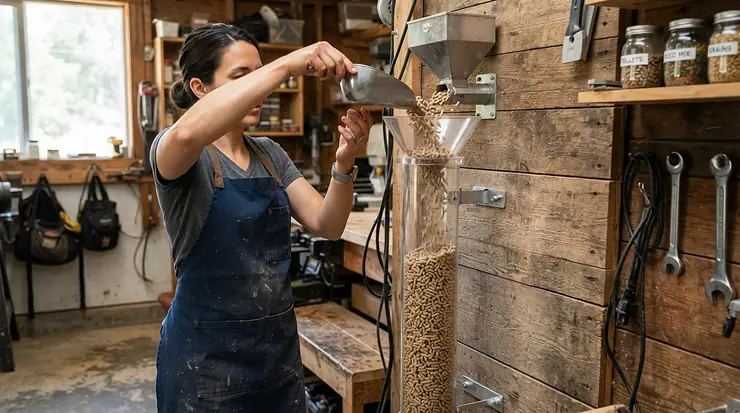
A homemade wall hanging dog food dispenser is realistic if you own basic woodworking tools. The woodworking blog Wilker Do’s documents a wall-hung dispenser built for a four-dog household that needed a weekly refill without lifting a 25-pound bag. The builder dumps the whole bag into the top, and a quarter-inch plywood slide in a routed track opens a chute at the bottom, so a container fills in seconds.
The materials were scrap pine for the sides, half-inch plywood for the back, quarter-inch plywood for the front and a leftover piano hinge for the lid. The sides are cut 6 1/2 inches wide with 60-degree bevels, joined with nails and screws. The cost was listed as zero because everything came from the scrap pile. The unit hangs on a french cleat screwed into studs, and the builder admits the result is not perfect. One design note carries over to any build: decide the chute opening size before cutting the back panel.
A Hepper roundup of eight DIY dog food storage projects rates this build easy and a freestanding version with a slide-out bowl advanced, so there is room to scale ambition. The food-safety angle deserves a pause before painting everything. Given the veterinary warning about scratches holding bacteria, a painted wood hopper with seams is harder to wash than a smooth poly or steel one, so a DIY version benefits from a removable food-safe liner or bin inside the cabinet. Treat the wooden box as a housing, and keep the food in something you can lift out and wash.
What shortens a wall unit’s life: heat, plastic fatigue and a nervous dog
Plastic ages. Members of a TractorByNet thread on wall-mounted dry pet food dispensers report that plastic units tend to crack after about five years, though one describes a plastic unit lasting around 20 years under cover, and two members have galvanized metal units roughly 10 years old that still look new. That is a handful of owner reports, not a test, but the pattern points toward metal for rough settings and plastic for sheltered indoor walls.
Free-feed doors carry a learning curve. A buyer on Do My Own’s page for the steel Pet Lodge feeders says the dog had trouble figuring out that the flap must be pushed open. A reviewer on a Desertcart listing reports that the dog barely ate during the first week and needed about two weeks to adapt, and another describes holding the flap open by hand until the dogs put their heads in. One reviewer calls the empty steel thin and flimsy but sturdy once full. Expect an adjustment period, and do not leave a dog without food while it learns.
Wet conditions are another limit. One reviewer says they would keep the steel feeder indoors rather than in wet conditions, while another reports it stays dry in rain on the side of a shed. The Walmart listing for the 50-pound version averages 4.3 stars across 50 ratings, which suggests broad but not universal satisfaction.
What about can dog food storage?
For can dog food storage, a hanging hopper is the wrong tool, because wet food follows different rules from kibble. Great Pet Care quotes veterinarians who say opened wet food should be covered tightly, refrigerated and used within three days, and the FDA says to refrigerate or discard leftovers at 40°F or below. None of the units below is built for that job, and a dry-kibble hopper should never hold wet food.
A lever dispenser and two auto-shut feeders worth hanging
We kept to units that mount on a wall, come from established makers and have buyer feedback across several retailers. Each is tied to a step above rather than ranked. Every wall mounted pet food dispenser here stores bulk dry food; what changes is who controls the flow.
| Unit | Holds | How food comes out | Main material | Mounting |
|---|---|---|---|---|
| Bergan Wall Mounted Dispenser 11732 | Up to 40 lb | You pull a handle | Plastic | Hardware and template included |
| Pet Lodge Chow Hound 25 lb Dog Feeder | 25 lb (12 and 50 lb versions exist) | Dog pushes a magnetized door | Galvanized steel | Keyholes on the back |
| Kane KDF Wall Mount Auto-Shut Dog Feeder | 25 lb | Dog pushes a weighted, self-closing door | High-density polyethylene and 304 stainless steel | Mounts to any wall or flat surface |
The first row suits households that want to measure meals, and the other two suit dogs that eat when they please. Capacity matters less than refill rhythm: 25 pounds covered a week or two for the buyers quoted above, while 40 pounds suits several dogs. Material appears to decide lifespan in the owner reports, so the metal feeders fit rough or exposed spots and the plastic dispenser fits a sheltered indoor wall.
1. Bergan Wall Mounted Dispenser 11732 — portions you control by hand
Portion control is the reason this unit exists. Its listings describe a lever handle that dispenses a measured amount into a bowl held beneath the spout, and a 40-pound capacity that keeps a whole bag’s worth of kibble up off the floor, which the retailer copy says also helps keep insects out. A Pets USA listing gives the footprint as about 15.75 by 11.25 inches and 26.13 inches tall, with BPA-free, FDA-compliant plastic and US manufacture. Hubers Animal Health positions it for pet food, bird seed, animal feed and cat litter, so a barn or utility room works as well as a kitchen wall.
The material is the trade-off. Plastic wall units in the TractorByNet thread cracked after about five years in some members’ experience, so a sheltered indoor wall is the sensible home for it. Retailer listings span roughly $65 to $150, based on Kwik Pets and Infinite Wags, so check the current price on Amazon.com. The maker sells lookalike dispensers such as the Aut-O-Dine and K-9 Cafe, so confirm the 11732 model number on the page you order from. Because the hopper takes loose kibble, the FDA’s tip about taping the lot number to the outside applies in full.
2. Pet Lodge Chow Hound 25 lb Dog Feeder — steel for dogs that eat on demand
Galvanized steel is what separates this feeder from most hanging dispensers. Do My Own describes 24-gauge galvanized steel that the maker calls chew-proof, with an angled chute that meters the flow and a magnetized door that opens when the dog nudges it and closes against pests. It arrives assembled, holds 25 pounds of dry food, and listings also carry it under the Little Giant name, with 12- and 50-pound versions.
Real-use feedback is mostly positive with clear caveats. The 50-pound version averages 4.3 stars across 50 ratings on Walmart, a Do My Own buyer calls the units perfect while noting the dog took time to learn the flap, and a Desertcart reviewer values the capacity as stand-in storage for a 25-pound bag. One buyer reports trouble with the magnets that keep the door shut, which is the part to inspect on arrival. Listings from Do My Own and Pawtail Supply put the 25-pound size at around $55 to $75. The door is a standing supply, so free-feeding is the real decision here.
3. Kane KDF Wall Mount Auto-Shut Dog Feeder — weatherproof, with mixed reviews
This is the priciest of the three in the listings cited here, at roughly $80 to $135 across QC Supply and Zoro, and it earns the premium with materials: high-density polyethylene and 304 stainless steel, a 25-pound capacity and an angled, weighted door that closes itself once the dog finishes. The maker lists it as weatherproof, made in the USA, shipped fully assembled and mountable on any flat surface. Its listing also pitches it as a pairing with Kane’s heated waterer.
Buyer feedback splits. One kennel owner on a Desertcart listing calls it tough and well built for two German Shepherd pups, and another with three large dogs who have torn up every feeder says it stays cleaner hanging than on the ground and has survived so far. A third reviewer returned it as poor for the price. When owners disagree this sharply, the return window matters more than the star average, and the self-closing door is the feature that carries the price.
Spotted a unit that suits your wall and your dog’s eating style? Take a closer look at its product page.
Pests, loose kibble and portions: quick answers on hanging feeders
Does a wall mounted pet food dispenser keep pests out?
How often should you clean a dog food container?
Can you pour dry kibble straight into a wall mounted dog food container?
How much food should a wall hanging dog food dispenser hold?
Is a free-feed dog feeder safe for a dog that overeats?
Which one to hang, and how
Start with how your dog eats. A dog that gulps does better with the lever-style Bergan Wall Mounted Dispenser 11732 on a sheltered indoor wall, while a steady eater that you want fed on demand fits the steel Pet Lodge Chow Hound 25 lb Dog Feeder. The Kane KDF Wall Mount Auto-Shut Dog Feeder is the weatherproof choice for a covered outdoor wall, with the caveat of mixed reviews and a higher price. Whichever you choose, the habits do more than the hardware: mount into studs, keep the spot cool and dry, label what you pour in, and wash the hopper between bags. A wall hanging dog food dispenser only pays back its footprint when it empties on a schedule you can keep.
Ready to compare sizes? Take a look at the current options for your dog’s bag size and your wall.
Recommended for You
- 7 Best Wall Mounted Dog Food Dispensers of 2026 (Pros & Cons)
- Dog Food Dispenser With Lever: 7 Best Picks for 2026
- 7 Best Dog Food Storage Feeder Picks for Kibble (2026)
Hanging weight and kibble size differ from home to home, so measure your wall and your dog’s food before you order.