
In This Article
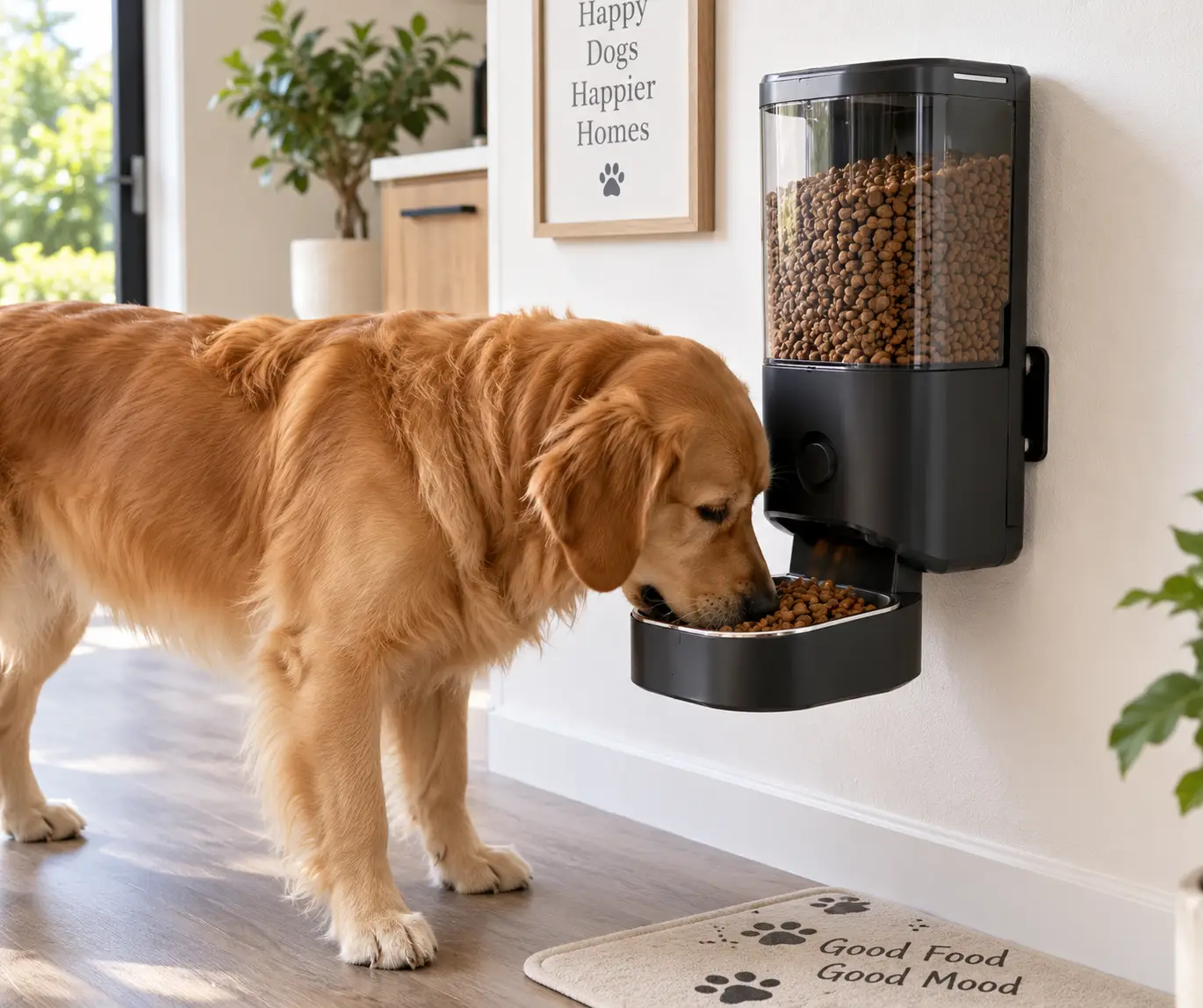
A wall mounted dog food dispenser is a feeding system that attaches directly to a wall instead of sitting on the floor, storing dry kibble in a sealed container and releasing it through a handle, chute, or gravity spout into a bowl below. If you’ve ever tripped over a 20-pound bag of kibble in the laundry room or watched ants find their way into an open food bin, you already understand the appeal. These units keep food up off the ground, out of reach of curious paws, and — in the case of the sturdier models — sealed tightly enough to slow down moisture, pests, and the slow staleness that comes from an open bag.
This guide walks through seven real, currently available options, from a simple $25 gravity dispenser to a Made-in-USA stainless-steel unit built for kennels and mudrooms. We looked at listed capacities, materials, mounting hardware, and the patterns that show up again and again in verified customer reviews, rather than just repeating manufacturer marketing copy. Along the way, you’ll also find a wall mounted dog feeder comparison table, a practical installation walkthrough, and answers to the buying questions that come up most often when people search for a dog food dispenser wall mount solution for a small apartment, a mudroom, or a backyard kennel.
Before we get into specific products: this article contains Amazon affiliate links, and as an Amazon Associate, purchases made through those links may earn a commission at no extra cost to you. Every price mentioned below is a general range, not an exact quote — always check the current listing for today’s price before buying.
Quick Comparison: Wall Mounted Dog Food Dispensers at a Glance
| Product | Capacity | Material | Best For | Price Range |
|---|---|---|---|---|
| Bergan Wall-Mounted Pet Food Dispenser | Up to 40 lbs | BPA-free plastic | Budget-friendly everyday use | Around $25–$35 |
| Pet Lodge Chow Hound Wall-Mount Feeder | Up to 25 lbs | Steel | Garages and kennels | Around $55–$70 |
| Kane KDF Wall Mount Auto-Shut Feeder | Up to 25 lbs | HDPE + 304 stainless steel | Outdoor/heavy-duty durability | Around $90–$115 |
| Hipidog Automatic Feeder & Water Set | 5 liters | Plastic + stainless bowls | Food-and-water combo | Around $20–$30 |
| Umigy Triple Wall-Mounted Dispenser | 39 oz (3-cup) | ABS plastic | Small breeds, portioned snacking | Around $15–$25 |
| Balacoo Elevated Wall-Mounted Bowl | Single bowl | Stainless steel | Cheapest way to elevate feeding | Around $10–$18 |
| Hamiledyi 2-Pack Elevated Wall Bowls | Dual bowl, adjustable | Stainless steel | Adjustable, foldable setups | Around $18–$28 |
Looking at the table, the split really comes down to two categories: sealed bulk dispensers (the Bergan, Pet Lodge Chow Hound, and Kane KDF) that store and dole out multiple days’ worth of kibble, versus elevated bowl brackets (the Balacoo and Hamiledyi) that simply lift an existing bowl off the floor without storing food at all. If your priority is reducing how often you refill, go with a bulk dispenser; if your dog’s main issue is neck strain or floor mess, an elevated bracket solves that more directly and costs less. The Hipidog and Umigy sit in the middle — smaller-capacity dispensers suited to apartments or small dogs that don’t need 25–40 lbs of standing reserve.
💬 One click helps other shoppers make an informed choice too! 😊
Top 7 Wall Mounted Dog Food Dispensers — Expert Analysis
1. Bergan Wall-Mounted Pet Food Dispenser — best budget all-in-one storage
The Bergan Wall-Mounted Pet Food Dispenser (model BER-11732) is the dispenser most people picture when they search for this category, and it earns that reputation by doing one job simply and cheaply. It holds up to 40 pounds of dry food inside a BPA-free plastic housing that mounts to the wall using an included template and hardware, and a pull-handle at the bottom controls how much food drops into a waiting bowl.
The wide-mouth top makes refilling straightforward — you can dump most of a large kibble bag straight in without a funnel — and the sealed lid is the feature that actually matters here: closing off the food from open air is what keeps insects and rodents from getting curious, not just the fact that it’s off the floor. Based on comparing the specs against pricier competitors, this is squarely an entry-level pick for anyone who wants food storage and portion dispensing combined into one wall-mounted unit without paying for stainless steel or a weatherproof shell.
Reviews consistently report satisfaction with the space savings and the pull-handle mechanism, though a recurring theme in customer feedback is that the plastic hinge and handle can feel less durable over years of daily use compared to metal alternatives, and a few buyers have noted the mounting screws work best driven into a stud rather than open drywall.
Pros:
- ✅ Holds a full 40 lbs, cutting down refill frequency
- ✅ Simple pull-handle portion control
- ✅ Budget-friendly compared to steel alternatives
Cons:
- ❌ Plastic handle feels less sturdy long-term
- ❌ Not weatherproof enough for uncovered outdoor use
At around $25–$35, the Bergan Wall-Mounted Pet Food Dispenser is one of the best values in this whole category for anyone feeding a single dog indoors or in a covered mudroom.
2. Pet Lodge Chow Hound Wall-Mount Feeder — best for kennels and garages
The Pet Lodge Chow Hound Wall-Mount Feeder trades plastic for a steel-bodied build with a specially angled chute designed to keep food flowing smoothly instead of clumping near the outlet. It’s rated to hold up to 25 pounds of dry chunk food and ships fully assembled, which matters if you’re mounting it in a kennel run or garage where you don’t want to fuss with parts.
What sets this one apart is the magnetic door closure over the dispensing opening — instead of relying purely on gravity or a hinge, the magnet keeps the access point shut between feedings, which does double duty keeping weather out and discouraging opportunistic pests. Here’s what to weigh: because it’s built from steel rather than food-grade plastic, it’s noticeably heavier to mount and generally better suited to a stud-anchored garage or kennel wall than a thin apartment partition.
Aggregated reviews describe it as genuinely built for outdoor and semi-outdoor use, with owners in colder climates reporting the magnetic door holds up through repeated opening and closing better than plastic flap designs. A smaller number of reviewers mention that the narrow chute can occasionally jam with larger kibble pieces, so it’s worth knowing your dog’s kibble size before buying.
Pros:
- ✅ Steel construction built for kennel and garage settings
- ✅ Magnetic door keeps weather and pests out
- ✅ Ships fully assembled, ready to mount
Cons:
- ❌ Heavier — needs a stronger wall anchor or stud
- ❌ Chute can jam with oversized kibble
Expect to pay somewhere in the $55–$70 range, positioning the Pet Lodge Chow Hound Wall-Mount Feeder as a solid mid-tier step up for anyone feeding outdoors or in a working kennel.
3. Kane KDF Wall Mount Auto-Shut Dog Feeder — toughest, Made-in-USA build
If durability is the deciding factor, the Kane KDF Wall Mount Auto-Shut Dog Feeder is the one to look at. It’s built from high-density polyethylene paired with 304 stainless steel components, manufactured in the USA, and designed around an angled, weighted door that auto-shuts once your dog steps away — a detail that matters more than it sounds, since it keeps rain, snow, and insects out between meals without you doing anything.
The 25-pound capacity is comparable to the Pet Lodge model, but the auto-shut mechanism and the stainless-steel guard around the trough are what justify the higher price. What most buyers overlook with this model is that it’s designed to pair with a matching heated water unit from the same manufacturer, making it a natural fit for anyone setting up a complete outdoor or kennel feeding station rather than a single stand-alone piece.
Reviews consistently point to the auto-shut door as the standout feature, with multiple owners specifically calling out that it held up through multiple winters of exposure without cracking or losing its seal — a common failure point on cheaper plastic dispensers. The trade-off, as reviewers note, is the price: this is not the dispenser to buy if you just need something for a dry mudroom.
Pros:
- ✅ Auto-shut weighted door blocks weather and pests
- ✅ Made in the USA from HDPE and stainless steel
- ✅ Proven durability across multiple review cycles
Cons:
- ❌ Highest price point in this roundup
- ❌ Overkill for simple indoor feeding needs
Priced around $90–$115, the Kane KDF Wall Mount Auto-Shut Dog Feeder earns its spot as the premium, buy-it-once option for anyone feeding dogs outdoors, in a barn, or in a multi-dog kennel setup.
4. Hipidog Automatic Dog and Cat Food Feeder and Water Dispenser Set — best 2-in-1 food-and-water combo
The Hipidog Automatic Dog and Cat Food Feeder and Water Dispenser Set takes a different approach: instead of a single large bulk dispenser, it pairs a 5-liter gravity food hopper with a matching gravity water dispenser and stainless-steel bowls, letting you mount (or simply mount the hopper and set the bowls beneath) both food and water in one coordinated station.
The stainless-steel bowls are the detail worth calling out — they’re dishwasher-safe and rust-resistant, which solves a common complaint with all-plastic dispensers where the bowl itself becomes the weak point over time. The gravity design means there’s no portion control here (it simply keeps the bowl topped off as your dog eats), so this is best suited to dogs that self-regulate rather than dogs prone to gobbling an entire hopper’s worth in one sitting.
A common theme in customer feedback is appreciation for the combined food-and-water setup saving counter and floor space in small kitchens and apartments, alongside praise for how easy the stainless bowls are to keep clean. Some reviewers note the plastic hopper seams can develop small cracks if repeatedly knocked or overfilled, so gentle handling extends its life.
Pros:
- ✅ Combines food and water in one coordinated set
- ✅ Dishwasher-safe stainless-steel bowls
- ✅ Compact footprint for small kitchens
Cons:
- ❌ No portion control — gravity feed only
- ❌ Plastic hopper seams can crack under rough handling
At roughly $20–$30, the Hipidog Automatic Dog and Cat Food Feeder and Water Dispenser Set is a strong entry-level pick for apartment dwellers who want both food and water handled at once.
5. Umigy Wall-Mounted Triple Dry Food Dispenser — best for small breeds and portioned snacking
The Umigy Wall-Mounted Triple Dry Food Dispenser was originally marketed for cereal and pantry snacks, but its three separate 39-ounce (about 1.15-liter) cups make it a genuinely useful option for anyone with a small dog, multiple small dogs, or a household that wants to keep dry treats and two different kibble varieties within easy reach without dedicating a full 25–40 lb tank to the wall.
Because each of the three compartments dispenses independently through its own small lever, you get built-in portion separation for free — one cup for breakfast kibble, one for training treats, one for a second pet’s different formula, for example. Based on comparing this against the single-chamber dispensers above, the trade-off is obvious: total capacity per cup is small, so this isn’t a set-it-and-forget-it solution for a large or food-motivated dog that would empty a cup in one sitting.
Reviews consistently describe the build as lightweight and easy to install with the included wall anchors, with several buyers specifically using it for small-breed dogs or as a treat station near the door. A recurring complaint is that the small levers can stick slightly if fine kibble dust builds up, so periodic wiping keeps it dispensing smoothly.
Pros:
- ✅ Three independent compartments for portion separation
- ✅ Compact size fits tight kitchen or hallway walls
- ✅ Easy do-it-yourself installation
Cons:
- ❌ Small per-cup capacity, not built for large dogs
- ❌ Levers can stick without occasional cleaning
Priced around $15–$25, the Umigy Wall-Mounted Triple Dry Food Dispenser is one of the more clever lesser-known picks in this category for small-breed households.
6. Balacoo Wall-Mounted Elevated Stainless Steel Dog Bowl — cheapest way to get bowls off the floor
Not every “wall mounted dog food dispenser” needs to store bulk food — sometimes the actual problem is a bowl sliding across the kitchen floor or a dog straining its neck to eat at ground level. The Balacoo Wall-Mounted Elevated Stainless Steel Dog Bowl solves that specific problem with a simple wall bracket that holds a single stainless-steel bowl at a fixed, elevated height.
The appeal here is honesty of purpose: this isn’t trying to be a storage solution, it’s a mounting bracket, and it does that one job at the lowest price point in this roundup. The rolled-edge stainless bowl resists chewing better than plastic alternatives, and because it’s a compact bracket rather than a full dispenser, installation takes only a couple of screws or, depending on the version, adhesive-backed mounting.
What most buyers overlook with brackets like this is that the bracket is sized specifically to the included bowl — reviews confirm that swapping in a different bowl size later is usually not a clean fit, so measure your dog’s typical bowl before assuming you can reuse existing dishes. Aggregated feedback is generally positive on ease of installation, with lower marks concentrated around the smaller resale-style listings that arrive with thinner mounting hardware.
Pros:
- ✅ Lowest price point in this comparison
- ✅ Rolled-edge stainless bowl resists chewing
- ✅ Minutes-long installation
Cons:
- ❌ Fixed to the included bowl size only
- ❌ No food storage — a companion, not a dispenser
At around $10–$18, the Balacoo Wall-Mounted Elevated Stainless Steel Dog Bowl is the cheapest entry point into wall-mounted feeding, best paired with a separate storage container.
7. Hamiledyi 2-Pack Wall-Mounted Elevated Dog Bowls — best adjustable, foldable design
Rounding out the list, the Hamiledyi 2-Pack Wall-Mounted Elevated Dog Bowls improve on the single-bracket concept above by offering two stainless-steel bowls with adjustable-height mounting brackets that fold flat against the wall when not in use — a genuinely clever detail for anyone trying to reclaim floor space in a small kitchen or mudroom.
Because the brackets are height-adjustable, this is one of the few products in this roundup that can grow with a puppy, moving the bowls higher as your dog grows into its adult size instead of forcing you to buy a new stand later. The fold-up design also means the bowls can be tucked away between meals, which matters for households running robot vacuums or simply trying to keep floors clear.
Reviews consistently highlight the adjustable height and fold-away function as the standout features, with multiple owners specifically recommending it for medium and large dogs that benefit from a more comfortable eating angle. A minority of reviews mention that the bracket hinges can loosen slightly over many months of daily folding, so a monthly tightness check is a reasonable maintenance habit.
Pros:
- ✅ Adjustable height grows with your dog
- ✅ Folds flat to reclaim floor space
- ✅ Dishwasher-safe stainless-steel bowls
Cons:
- ❌ Hinges can loosen with heavy daily folding
- ❌ Still requires a separate food storage solution
Priced around $18–$28, the Hamiledyi 2-Pack Wall-Mounted Elevated Dog Bowls is the most versatile elevated-bowl option here, especially for growing or multi-dog households.
How to Choose a Wall Mounted Dog Food Dispenser
Picking the right wall mounted dog food dispenser comes down to matching the mechanism to your actual routine, not just picking the biggest-capacity option on the shelf. Here’s the reasoning experienced buyers use:
- Start with capacity math, not marketing numbers. Divide your dog’s daily food amount into the dispenser’s listed capacity to estimate real refill frequency — a 40 lb tank sounds impressive, but if you’re feeding a Chihuahua, you may never need more than the Umigy‘s small compartments.
- Decide between gravity feed and portion-controlled dispensing. Gravity dispensers like the Bergan and Hipidog simply keep the bowl topped off; they’re wrong for dogs prone to overeating, where a measured scoop or a timed electronic feeder is the safer call.
- Match material to environment. Indoor, climate-controlled kitchens are fine with BPA-free plastic; anything exposed to rain, snow, or direct sun should lean toward the stainless-steel and HDPE builds like the Kane KDF or Pet Lodge Chow Hound.
- Check the mounting hardware against your wall type. Drywall alone typically cannot support 40 lbs of dry kibble safely without hitting a stud or using rated anchors — more on this in the installation section below.
- Consider multi-pet households separately. A single large dispenser feeding two dogs from one bowl invites resource guarding; separate, smaller units or the compartmentalized Umigy style avoid that entirely.
- Factor in cleaning access. Wide-mouth openings and removable bowls (like the stainless sets from Hipidog and Hamiledyi) are dramatically easier to keep sanitary than narrow-chute designs.
- Read reviews for the specific failure point that matters to you — hinge durability, chute jamming, or bracket fit — since these small mechanical details are what separate a five-year purchase from a five-month one.
Wall Mounted Dog Food Dispensers vs. Traditional Floor Bowls and Standing Feeders
The core argument for a wall mounted dog food dispenser over a standard floor bowl or a freestanding gravity feeder comes down to three things: floor space, pest exposure, and mess control. A standing gravity feeder still occupies square footage on the floor and can be tipped, chewed, or pushed around by an enthusiastic eater, while a properly anchored wall unit stays fixed in place regardless of how excited your dog gets at mealtime.
Pest exposure is the less obvious advantage. According to the FDA’s guidance on storing pet food, dry pet food should be kept in a cool, dry place in a container with a tightly fitting lid — precisely what the sealed dispensers in this roundup are built to do, compared with an open bag propped against a floor-level bin. Standing feeders with loose-fitting lids don’t offer the same seal, which is part of why insects and rodents are more commonly reported around floor-stored food than wall-sealed dispensers.
The trade-off runs the other way on flexibility: a floor bowl or standing feeder can be moved instantly if you rearrange a room or travel, while a wall mounted dog food dispenser is a semi-permanent fixture once it’s anchored. For most households with a fixed feeding spot, that permanence is a feature rather than a downside — but if you rent, move frequently, or foster dogs short-term, a standing feeder may still make more practical sense.
Common Mistakes to Avoid When Buying a Wall Mounted Dog Food Dispenser
Even a well-reviewed dispenser can be the wrong purchase if it doesn’t match your setup. The most common buying mistakes we see, based on comparing complaint patterns across review sections, include:
- Buying capacity you’ll never use. A 40 lb dispenser that only gets refilled every two months means stale kibble sitting at the bottom far longer than it should.
- Ignoring wall type before ordering. Plaster, tile backsplashes, and hollow-core doors all need different hardware than standard drywall or stud walls, and returns on mounted hardware are messier than returns on an unopened box.
- Overlooking cleaning access. A narrow-mouth dispenser looks sleek but becomes a chore to scrub out when kibble dust and oils build up along the interior walls.
- Assuming gravity feed equals portion control. These are different mechanisms; if your dog needs a measured amount per meal, a gravity dispenser alone won’t enforce that.
- Skipping the weight rating on mounting hardware. A dispenser rated for 25 lbs of food, plus its own body weight, needs anchors rated well above that combined figure — not just “any” wall anchor from the junk drawer.
Installing Your Wall Mounted Dog Food Dispenser the Right Way
Getting the mounting right is the single biggest factor in whether a wall mounted dog food dispenser lasts for years or ends up as a hole in the drywall six months in. Start by locating studs with a stud finder wherever possible — most manufacturers, including Bergan and Kane, include a paper or cardboard mounting template in the box specifically so you can trace screw positions accurately before drilling.
If a stud doesn’t line up with your ideal spot, don’t skip anchors altogether. The U.S. Consumer Product Safety Commission’s Anchor It! campaign exists primarily to address furniture and TV tip-overs, but the underlying principle applies directly here: any wall-mounted item carrying meaningful weight needs hardware rated for that load, not whatever anchor happens to be nearby. For a fully loaded 40 lb dispenser, that generally means metal toggle-style anchors rather than basic plastic drywall anchors, which typically top out well under that weight once you factor in the dispenser’s own housing.
Once mounted, do a 48-hour “shake test” — load it fully, and check for any shifting or loosening before you rely on it daily. A few other habits pay off long-term: wipe the interior walls dry before the first fill to avoid trapping moisture, keep the dispenser a few inches clear of direct sun exposure through a window (heat accelerates oil rancidity in kibble), and re-check screw tightness after the first month, since initial settling is normal even with a correct installation.
✨ Ready to stop wrestling with kibble bags every morning? Take a look at today’s pricing on our top picks above and get your dispenser mounted this weekend! 🐾
Real-World Scenarios: Matching a Dispenser to Your Household
The apartment dweller with one small dog: If you’re feeding a 10-pound terrier in a 600-square-foot apartment, a 40 lb bulk dispenser is overkill and eats visual space you don’t have. The Umigy Wall-Mounted Triple Dry Food Dispenser or the Hipidog Automatic Dog and Cat Food Feeder and Water Dispenser Set fit the footprint and the feeding volume far better, and either mounts easily on standard apartment drywall with light-duty anchors.
The multi-dog household with a mudroom feeding station: Feeding two or three medium dogs means refill frequency and mess control both matter. Pairing the Bergan Wall-Mounted Pet Food Dispenser for bulk storage with the Hamiledyi 2-Pack Wall-Mounted Elevated Dog Bowls underneath gives you both a large reserve and individual, adjustable-height eating stations that reduce the odds of food-guarding between dogs.
The kennel or garage setup for a working or outdoor dog: Exposure to weather changes the calculation entirely. Here, the Kane KDF Wall Mount Auto-Shut Dog Feeder or the Pet Lodge Chow Hound Wall-Mount Feeder are the only two in this roundup genuinely built for that environment, with sealed, weighted, or magnetic closures designed to keep moisture and pests out between visits.
Long-Term Cost and Maintenance of Wall Mounted Dog Food Dispensers
The upfront price of a wall mounted dog food dispenser is only part of the real cost picture. Cheaper plastic units like the Bergan and Hipidog typically need replacement hinges, seals, or full units every few years of daily use, based on the pattern of complaints in aggregated reviews about handle and hopper wear — so the $25 purchase price can effectively become a recurring $25 every three to five years.
By contrast, the steel-bodied Pet Lodge Chow Hound and the stainless-and-HDPE Kane KDF cost roughly two to four times as much upfront, but reviewers consistently report multi-year use without structural failure, particularly in outdoor conditions that would degrade plastic faster through UV exposure and temperature swings. If you’re feeding outdoors or in a kennel where replacement means climbing a ladder or dealing with a service call, that durability premium often pays for itself within a couple of replacement cycles.
Maintenance itself is low across the board — a wipe-down every one to two weeks and a full wash with warm, soapy water monthly is generally sufficient for any of these seven, though wide-mouth designs cut that cleaning time roughly in half compared to narrow-chute models.
Safety, Materials, and Regulations for Wall Mounted Dog Feeders
Food safety and mounting safety are two separate concerns worth addressing directly. On the food side, dry kibble is still a perishable product, and improper storage is a real risk: bacteria such as salmonella can develop in dry pet food that’s kept too warm or too humid, which is why every dispenser in this roundup benefits from being kept out of direct sunlight and away from heat sources like a stove or a sunny window. Look for BPA-free labeling on plastic components, and prioritize dishwasher-safe stainless-steel bowls where food actually contacts metal, since stainless resists the bacterial buildup that can occur in scratched plastic over time.
On the mounting side, there’s no federal weight-rating standard specific to pet feeders the way there is for cribs or car seats, so the responsibility for a secure mount falls on choosing appropriately rated hardware for your specific wall type and the dispenser’s fully loaded weight. As covered in the installation section above, this is a case where the general furniture-anchoring principles promoted by consumer safety agencies apply directly, even though they weren’t written with pet feeders specifically in mind.
Veterinary nutrition guidance also plays a role here: portion awareness matters more than the mounting mechanism itself. The VCA Animal Hospitals feeding guide for a healthy weight recommends measuring meals with a proper cup rather than estimating, which is worth keeping in mind if you choose a gravity-feed dispenser — the convenience of a self-topping bowl can quietly work against portion control unless you’re deliberate about how much goes in.
Wall Mounted Dog Food Dispensers for Small Breeds vs. Large Breeds
Small breeds and large breeds put genuinely different demands on a wall mounted dog food dispenser. For a small dog eating a half-cup to one cup per day, a large-capacity unit like the Bergan or Kane KDF is more house than you need — food can sit for weeks before it’s used, which works against freshness even inside a sealed container. The Umigy Wall-Mounted Triple Dry Food Dispenser‘s small, independent compartments are a genuinely better structural fit, letting you portion smaller amounts that turn over faster.
Large and giant breeds flip the calculation: a Labrador or Mastiff eating three to five cups daily will empty a small dispenser within a week, making frequent refills a real annoyance. Here, the 25–40 lb capacity dispensers make far more practical sense, and the elevated bowl height offered by the Hamiledyi 2-Pack Wall-Mounted Elevated Dog Bowls carries an added benefit — many large-breed owners specifically look for elevated feeding positions to reduce the neck-down angle during meals, though this should be discussed with a veterinarian for breeds prone to bloat, since elevated feeding is not universally recommended for every large dog.
Features That Actually Matter (and Ones That Don’t)
Marketing copy tends to lump every feature together as equally important, but a closer look at real-world use separates the genuinely useful details from the ones that sound better than they perform.
Actually matters: a tight-sealing lid (keeps out pests and moisture far more effectively than mounting height alone), wide-mouth refill openings (cuts cleaning and filling time dramatically), and mounting hardware rated for the fully loaded weight, not just the empty unit.
Doesn’t matter as much as it sounds: decorative color options rarely affect function; exact capacity numbers beyond what your dog actually eats in a reasonable window are more marketing than benefit; and “smart” branding on a purely gravity-fed dispenser (no app, no sensor) is often just a naming choice rather than an added capability.
Genuinely underrated: removable, dishwasher-safe bowl inserts. Several products in this roundup, including the Hipidog and Hamiledyi sets, include this detail, and it consistently shows up in positive reviews as the difference between a dispenser that stays sanitary and one that starts smelling within a few weeks.
Problem → Solution: Fixing Common Wall Feeder Issues
Problem: Food clumping or jamming near the dispensing chute. This is most common with narrow-outlet designs like the Pet Lodge Chow Hound when kibble size is on the larger end. Solution: empty and wipe the chute dry monthly, and if jamming persists with your specific kibble brand, a wider-mouth model like the Bergan will likely perform better.
Problem: Dispenser feels loose or wobbly after a few weeks. This typically signals under-rated anchors for the loaded weight. Solution: re-anchor into a stud if one is available within reach, or upgrade to toggle-style metal anchors rated well above the dispenser’s fully loaded weight.
Problem: Food smells stale or slightly off despite a sealed lid. Solution: check that the dispenser isn’t positioned near a heat source or direct sunlight, and confirm you’re not overfilling beyond a few weeks’ supply — even sealed containers benefit from turnover.
Problem: Multiple dogs guarding a single dispenser. Solution: split feeding into separate stations, using a compartmentalized option like the Umigy or simply mounting two smaller units at a distance from each other.
Problem: Bowl slides or tips during enthusiastic eating. Solution: pair a bulk dispenser with a bracket-mounted bowl like the Balacoo Wall-Mounted Elevated Stainless Steel Dog Bowl, which locks the bowl in place rather than leaving it loose on the floor.
Frequently Asked Questions
❓ Is a wall mounted dog food dispenser better than a floor feeder?
❓ How much weight can a wall mounted dog food dispenser hold?
❓ Can I mount a dog food dispenser on drywall?
❓ Do gravity dog feeders control portion sizes?
❓ How often should I clean a wall mounted dog food dispenser?
Conclusion
A wall mounted dog food dispenser solves a genuinely common household problem — kibble bags taking over floor space, spills near the pantry, and food left exposed to pests — but the right pick depends heavily on your dog’s size, your feeding routine, and where the unit will actually live. Budget-focused households feeding indoors will likely be happiest with the Bergan Wall-Mounted Pet Food Dispenser or the Hipidog Automatic Dog and Cat Food Feeder and Water Dispenser Set, while anyone feeding outdoors or in a kennel setting should look seriously at the Kane KDF Wall Mount Auto-Shut Dog Feeder or the Pet Lodge Chow Hound Wall-Mount Feeder for their weatherproofing and durability.
Small-breed owners and apartment dwellers get real, practical value from the compartmentalized Umigy Wall-Mounted Triple Dry Food Dispenser, and anyone whose main complaint is a sliding, floor-level bowl rather than bulk storage should look at the Balacoo or Hamiledyi elevated bracket options instead of a full dispenser. Whichever direction you go, the installation and safety guidance above applies across the board: mount into a stud or rated anchor, keep the unit out of direct heat and sun, and clean it on a regular schedule so the convenience doesn’t come at the cost of freshness.
✨ Don’t miss these exclusive deals! 🔍 Take your dog’s mealtime setup to the next level with this carefully curated lineup. Click a highlighted pick above to check current pricing and availability, and get your dog a feeding routine the whole family will enjoy!
Recommended for You
- Best Slow Feeder Water Bowl for Dogs: 7 Top Picks for 2026
- Slow Eating Dog Bowl Reviews: 7 Best Picks for Fast Eaters
- Slow Feed Dog Bowl Reviews: 7 Best Picks to Stop Bloat (2026)
Disclaimer: This post contains affiliate links. As an Amazon Associate, I earn from qualifying purchases made through these links, at no additional cost to you.
✨ Found this article helpful? Share it with someone who needs it! 💬🤗