
In This Article
As an Amazon Associate I earn from qualifying purchases. Links in this article may be affiliate links. How we choose gear
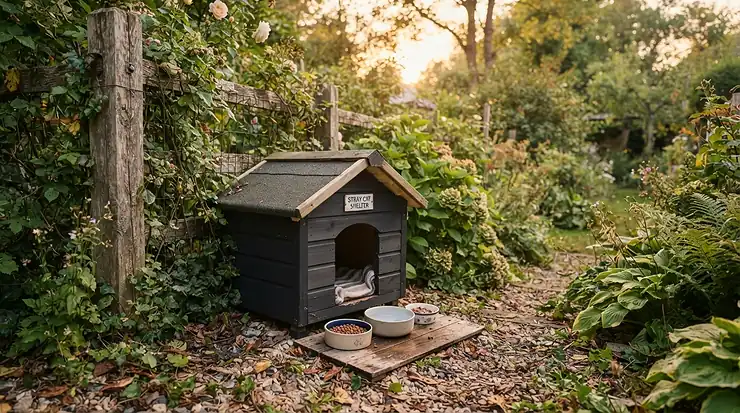
A roof over two bowls is the least demanding job an outdoor feral cat feeding station has to do. Humane World for Animals’ community cat feeding guidelines ask for far more: two entrances so cats can flee, a spot away from trees and structures, food out of reach of raccoons and opossums, and bowls that come up within half an hour. Most stations on the market solve the rain and little else, so the useful question for 2027 is which one fits the problem at your site.
This guide sorts five options (three shelters, one heated bowl set and one raised, critter-proof design) by what each handles and where each falls short. The findings rest on maker spec pages, retailer listings with their buyer reviews, and the feeding advice published by Humane World for Animals, Alley Cat Allies and Neighborhood Cats, which together describe what a station has to survive.
Roof, exits, height and power: what the guidelines ask of a station
Community-cat groups agree on the basics. Neighborhood Cats says a station protects food and water and keeps the site tidy, and its feeding page favors a private spot where food never sits on bare ground. Alley Cat Allies’ feeding station gallery boils the designs down to four themes: a roof or tunnel, a raised food surface, drainage, and a lid that opens for cleaning and refilling.
Humane World for Animals adds the wildlife layer. Its guidelines want the station at least 6 feet from trees and other structures, with two exits, and they pair the raccoon problem with height, which comes up again below.
That leaves four tests for any product: does it keep rain and snow off the bowls, does it hold in wind, does it fit more than one bowl, and can power reach it for a heated bowl in winter. Wildlife is the fifth, and it is the one most fabric shelters cannot answer. Each pick here answers at least one test with a documented feature (a cord hole, an escape door, a raised build, a heated base), which is why the list mixes shelters with a heated bowl set: a roof does nothing for frozen water.
Footprint, shelter and power: how the five differ
| Product | Type | Listed size | Strongest at | Main limit |
|---|---|---|---|---|
| Dreyoo Outdoor Cat Feeding Station | Fold-flat fabric and board shelter | 17 x 17 x 15.5 in on one listing | Low cost, easy to move | Several buyers call it flimsy |
| K&H Pet Products Outdoor Cat Dining Room | Nylon shelter, hook-and-loop closures | 16.5 x 20 x 14 in | Pairs with heated bowls | Light in wind |
| K&H Pet Products Thermo-Kitty Cafe | Heated bowl set, 30 W | 14.9 x 9.25 x 3 in | Unfrozen food and water | Needs an outlet and a roof |
| Petsfit Expanded Feeding Station Wooden Outdoor Cat House | Wooden station for 1 to 2 cats | Sized for 1 to 2 cats | Second, one-way exit | Small for a colony |
| GDLF Outdoor Feral Cat Feeding Station | Raised, critter-proof station | 24.5 x 24.5 x 61 in | Built around height | Few details on how it works |
Shoppers hunting for the best models for outdoor stray cat feeding stations will find the differences are less about looks than about anchoring, size and power. The two K&H products are made to work together, and K&H’s own store suggests its dining room as the shelter for the heated bowls. Only the GDLF is built around height, and only the Petsfit lists a second exit. Every shelter in the table is sized for one or two cats, a limit the multi-cat section returns to.
Compare each listing’s dimensions with the patch of ground you have in mind before you order.
Picks that cover wind, frost and wildlife
1. Dreyoo Outdoor Cat Feeding Station — fold-flat shelter for tight budgets
Price is the reason this one gets a long look. Dreyoo’s listing describes waterproof Oxford fabric over density board, a slanted roof, two ground stakes, a rear hole for a heated-bowl cord and tool-free assembly, in a body of about 2.5 pounds. One listing gives the footprint as 17 by 17 inches and 15.5 inches tall, while the title on other listings says 13 by 17 by 15.5, so the dimension line on the page you order from is the one to trust. Check the current price on Amazon.com.
Reviewers on Desertcart’s copies of the listing split in a useful way. One copy shows 4.0 out of 5 from 151 reviews and another 4.2 from 103. Buyers praise how it keeps bowls dry in rain and snow, and one reports it holds two well-fed ferals with heated bowls weighing it down on a concrete step. Several others call it flimsy, and one says it fits only two small bowls because they feed from dog-sized dishes. One reviewer calls it a summer-only product while others praise its winter performance, which suggests results depend on wind exposure and anchoring.
Pros:
- Folds down, so it moves easily when a spot stops working
- Rear cord hole for a heated bowl
- Stakes included for wind
Cons:
- Several buyers describe the build as flimsy
- Tight for dog-sized bowls
2. K&H Pet Products Outdoor Cat Dining Room — pairs with K&H heated bowls
Wind is the recurring complaint. The listing gives 16.5 inches deep, 20 wide and 14 high, about 2.8 pounds, in vinyl-backed nylon that closes with hook-and-loop fasteners and needs no tools. Several reviewers on Desertcart report needing bricks or weights to stop it blowing away, and one wishes it had loops for ground stakes. Space is tighter than the footprint suggests: one reviewer says only a single food bowl fits and the water bowl does not.
Other reviewers describe it as sturdy through winter, quick to set up, and good at keeping food dry and water clean. Several say it kept birds away from the food, and cats readily used it, with two eating side by side. One buyer notes the cats seemed uneasy because the walls have no windows, a reminder that nervous ferals choose a spot by sightlines as well as shelter.
K&H’s own store points to this dining room as the shelter for its heated bowls, and the listing mentions a rear opening for the cord. Where a second bowl or a heated bowl matters, this is the roomier of the two fabric shelters here, though the weighted-down fix is worth planning for.
3. K&H Pet Products Thermo-Kitty Cafe — heated bowl set for hard freezes
A shelter cannot stop water from freezing; this can. The set is a 30-watt, thermostatically controlled base with a 24-ounce and a 12-ounce stainless bowl, and either side can hold food or water. K&H lists a 5.5-foot steel-wrapped cord with the electronics sealed in the base, a one-year warranty, and removable bowls that go in the dishwasher. PetSmart’s listing says the set was tested and certified by MET Labs. Chewy’s answer to a buyer question notes both bowls heat together, with no way to warm just one.
Real-world reports point both ways. A reviewer in Canada on a Desertcart listing describes a night that fell to minus 28 Celsius (minus 18 Fahrenheit), with the food still soft and the water unfrozen. A Chewy reviewer, though, says her feral cats avoided the set because the bowls are small and deep. That detail matters in winter, since Humane World for Animals notes cats eat about 15 percent more in cold weather, and a 12-ounce bowl empties fast at a multi-cat site.
Expect to pay between about $50 and $65, going by K&H’s own store and Petco. It needs a roof and an outdoor-ready power source nearby, so it belongs inside a shelter with a cord hole, such as entries 1 and 2.
4. Petsfit Expanded Feeding Station Wooden Outdoor Cat House — wooden station with a one-way escape door
The two-exit rule is what makes this one interesting. Chewy’s page describes a wooden outdoor house sized for one or two cats, with a waterproof curtain door and a one-way escape door; either opening can hold a heating pad, sold separately. A cat cornered at a single entrance is the scenario Humane World for Animals’ two-entrance guidance is meant to prevent, and a second exit addresses it directly. Petsfit gives a one-year warranty, and Chewy’s price sits under $100.
Wood suits a permanent spot better than a fabric shelter, and it will not flutter in wind. The trade-off is flexibility. A wooden house is harder to move when a site changes, and Alley Cat Allies’ gallery notes that stations with a top-opening lid are easier to clean and refill, a feature this listing does not describe. Treat it as a shelter-and-feeding spot for a pair of cats, not as a colony solution.
5. GDLF Outdoor Feral Cat Feeding Station — raised design aimed at raccoons
Height is the whole idea here. The seller’s storefront page lists 24.5 by 24.5 by 61 inches, a lid and barriers meant to keep raccoons, squirrels and other critters from the food, an all-weather build and a design that comes apart for cleaning, at roughly $140 to $150. The page does not say how the barriers work, what the unit is made of beyond “plastic or metal,” or how many bowls it holds, so those answers sit on the Amazon listing, if anywhere.
The number to chase is the height of the food platform, not the overall height. Catster’s raccoon guide and Animal Path both put a workable platform at about 40 inches, because cats clear that jump and raccoons do not, and Humane World for Animals goes further with a 6-foot smooth post and an aluminum flashing skirt. A 61-inch unit may or may not meet either bar depending on where the bowls sit. If the platform lands near 40 inches and the post is smooth, it fits the guidance. If it does not, the unit still shelters food, but wildlife protection becomes a claim to verify rather than a feature to rely on.
Raccoon height, flashing and feeding times
Fabric and wooden shelters sit on the ground, so they depend on timing and cleanup rather than on any barrier. Humane World for Animals recommends feeding in daylight to avoid nocturnal visitors such as raccoons, opossums and skunks, and picking up leftovers and bowls after 30 minutes. Alley Cat Allies’ best-practice list gives the same 30-minute rule and warns that overnight food attracts insects and wildlife.
One source disagrees on timing. Neighborhood Cats suggests feeding at dusk or at night to cut down flies, and warns against leaving wet food out for long. Both are defensible: a site with raccoons should lean toward daylight, while a fly-heavy summer site may do better with cooler hours and mostly dry food. A motion-activated trail camera, which Humane World recommends checking periodically, shows who actually visits when no one is watching.
For a raised build, the sources agree on two details. Smooth metal or plastic around the base removes a raccoon’s grip, and a platform of at least 40 inches clears the jump. That is the standard to hold the GDLF listing against, and the reason a fabric shelter alone will not stop a determined raccoon.
Multi cat feeding stations: when one small box stops being enough
Every shelter above is sized for one or two cats, and a colony outgrows that quickly. Alley Cat Allies describes its own do-it-yourself station, built from plastic storage containers, as easy and inexpensive but able to feed only a few cats at a time. A multi cat feeding station for a real colony usually means several small stations spaced apart, or a larger custom build.
Custom cedar is the other route. Two small makers, Cats Play and Cozy Cat Furniture, sell double-sided cedar stations that hold up to eight bowls at around $355 to $370, with smaller cedar sizes starting nearer $240. Those makers build to order, so expect a wait of days, and the price puts them well above the shelters in this guide.
Sample calculation: at the Humane World for Animals figure of half to three-quarters of a cup of kibble per cat per day, four cats need about two to three cups daily, or roughly 2.3 to 3.5 cups once the cold-weather increase of about 15 percent applies. That total decides how many bowls the station needs and how often the bowls will be empty before the next meal.
A round multi cat feeding station is a layout rather than a weather answer. Curved triple-bowl racks sold at pet retailers such as Chewy are listed as stainless bowls on a raised iron stand shaped for round corners, with no roof mentioned, so a rack like that belongs under a porch or an existing shelter. For a colony, the two-exit rule matters more than the outline of the box, since a cat at one end needs a way out that does not run past another cat.
How do you stop feeding feral cats without leaving them stranded?
Stopping is harder than starting. The ASPCA’s position statement on community cats says a feeding ban can be inhumane for cats that have come to depend on a caregiver’s food, since they are often left to subsist on too little. For decisions about reducing or stopping, Humane World for Animals points caregivers to the local animal care and control agency.
When a caregiver can no longer continue, the sources lean toward handing the routine to someone else. Alley Cat Allies’ substitute-care guidance starts with gathering the cats’ records, confirming the cats are neutered and vaccinated, and finding a trustworthy person to take over. Its relocation page describes moving cats as a last resort and suggests asking neighbors to take on feeding first. Neighborhood Cats adds that if a site becomes unsafe, the first move to try is shifting the feeding area and shelter gradually down the block before relocating the colony.
A sturdy, portable station helps in each case, because the same shelter, bowls and schedule can move or hand over with the cats’ routine intact.
Placement, birds, portions and rules: feeding-station questions answered
How far should the feeding station sit from where the cats sleep?
How do you keep birds and ants out of the feeding station?
How much food does each cat need per day?
Is it legal to feed feral cats where you live?
How do you stop feeding feral cats without harming them?
Which feeding station to buy for your site
For a sheltered spot in a cold climate, the pairing of the K&H Pet Products Outdoor Cat Dining Room and the K&H Pet Products Thermo-Kitty Cafe covers shelter, a cord path and unfrozen water in one system, as long as the shelter is weighted down. For a mild climate and a tight budget, the Dreyoo Outdoor Cat Feeding Station is the cheaper starting point, with the caveat that several buyers call it flimsy. The Petsfit Expanded Feeding Station Wooden Outdoor Cat House suits one or two cats and adds a second exit, and the GDLF Outdoor Feral Cat Feeding Station is worth a look only if the platform height clears the 40-inch raccoon mark.
Whichever one you choose, the outdoor feral cat feeding station is only part of the routine: feed at a set time, pick up leftovers after 30 minutes, and keep water out year-round. Compare the exact model number before buying, since sizes and cord details differ between versions.
Recommended for You
- 5 Best Stray Cat Feeding Station Options for 2026 (Safe & Smart)
- 5 Best 2 in 1 cat feeder Choices to Streamline Feeding in 2026
- Multiple Cat Feeding Station: 5 Best Multi-Cat Setups (2026)
Check the listing’s dimensions and cord details against your site before you order.