
In This Article
As an Amazon Associate I earn from qualifying purchases. Links in this article may be affiliate links. How we choose gear
A dog that gulps dinner, a cat that noses wet food out of a deep dish, and a steel bowl that skates across the tile at every meal are three separate problems, yet all three get sold under one name: dog feeder mat. In 2027 that name covers two different kinds of product. Textured lick mats make a meal last longer, while flat silicone or fabric mats sit under a bowl and catch the mess.
Picking the wrong kind costs little money but plenty of annoyance, because a lick mat under a water bowl does nothing and a flat placemat will not slow a gulper. The sections below sort out which mat fits which job, what to spread on it, how to make a dog bowl mat at home, where vets draw the line, and how to wash a mat without bending it. Maker care pages, Chewy listings and their review summaries, veterinarian quotes in Rover’s lick mat explainer and Reader’s Digest, and an FDA consumer update supply the facts, with owner reports named wherever they appear.
Lick mat or bowl mat: decide the job first
Start with the symptom. A dog that finishes a meal in a flash or needs a distraction during nail trims wants a textured lick or slow-feed mat. A bowl that slides, or a water dish that leaves a puddle, wants a flat mat underneath. Some homes need both, and the two never substitute for each other.
Rover’s roundup of cat mats puts the lick-mat idea simply: the mat spreads food thinly, which slows eating and adds enrichment. Chewy’s guide to under-bowl mats lists a different checklist, covering material, non-slip design, size and shape, and water resistance. Keep those two lists apart and the shopping gets easier.
From unboxing to the first meal: five moves
- Name the job. Gulping or stress calls for a lick or slow-feed mat. Sliding and splashing call for a placemat. Dr. Krista Sirois, the veterinarian quoted by Rover, does not call licking inherently soothing; she describes the texture as a distraction during triggers such as vet visits or storms.
- Size it to the dog. Dr. Tara Hansen, a Chewy veterinarian quoted by Reader’s Digest, advises against giving big dogs small or thin lick mats, since they can pick them up and swallow them whole or chew them apart. Chewy reviewers of the small LickiMat Classic Soother describe it as fine for small servings and not for a full meal for a large dog.
- Check the label of what goes on it. The FDA warns that some peanut and nut butters contain xylitol, so the ingredient list comes first, and a dog that may have eaten it needs a vet, an emergency clinic or animal poison control right away. Rover’s explainer lists dog-safe peanut butter, canned dog food and yogurt as spreads, with pumpkin and applesauce for everyday use, because every spread adds calories.
- Stay in the room. Hansen says lick mats should not be left unattended, and Sirois says to always give them under supervision. A recurring complaint in Chewy reviews of the LickiMat Classic Soother is dogs chewing off the small center nubs when nobody is watching. A spread frozen onto a freezer-safe mat, such as the Hyper Pet IQ Calm Slow Feeder Treat Mat that Dogster lists as freezer friendly, stretches a session without extra effort.
- Wash it the same day. Grooves hold residue, and the cleaning section below shows the routine.
A stainless steel bowl mat that keeps the bowl put
A steel bowl on bare tile moves whenever a dog noses it, and a mat with a grippy top is the usual remedy. Dogtime’s roundup says the Reopet Silicone Dog Bowl Mat discourages bowl nudging and stays in place on hard floors, while the DogBuddy Dog Food Mat has a rubbery texture that keeps bowls from sliding and raised edges that guard the floor. Dogtime also notes that the DogBuddy readily picks up dirty paw prints and that the printed Navy Knot Pet Mat, which has no raised edges, leaves large splashes uncontained.
Size matters in both directions. Chewy’s guide says a mat that is too small gives little coverage and one that is too large wastes space, so measure the bowl or bowls and add a splash zone. Walmart’s listing gives the small DogBuddy as 19 by 12 inches.
Mats resist nudging, not lifting. A dog that picks up its bowl and carries it off needs a heavier or fixed bowl instead.
How to make a dog bowl mat at home
A homemade mat works under a bowl, and two free projects show how. Heather Handmade’s free sewing pattern cuts cotton canvas, a waterproof fabric, fusible interfacing and fusible fleece, so the top catches crumbs and water while the waterproof layer keeps moisture off the floor. Lia Griffith’s version pairs a cotton fabric top with cotton toweling underneath and says to prewash both so the mat does not shrink later.
Grip is the usual weak point. A reader tip on Dollar Store Crafts says to glue non-slip kitchen drawer liner to the underside of a homemade placemat so it stops sliding.
Stop there. A sewn mat belongs under a bowl and is not a lick mat. Finished lick mats name their materials, whether food-grade rubber, TPR, FDA-grade silicone or TPE, and that label is exactly what a homemade surface cannot offer.
Are mats bad for dogs? Where vets draw the line
Used as directed, lick mats are widely recommended, but vets name specific dogs and habits that call for caution. Sirois lists super chewers and destructive dogs, dogs easily frustrated by food puzzles, puppies, and dogs that are not food motivated as poor matches. Ask A Vet’s guide, written by Dr. Duncan Houston, adds food guarders and dogs that destroy chew toys, and flags unsupervised use, high-fat spreads every day and mat chewing as common mistakes.
Even the heavy-duty option gets a caveat. Rover’s roundup says of the LickiMat Tuff: “No lick mat will hold up to a truly determined power chewer.”
Calories deserve a line of their own. Sirois says fillers add to the daily total, so rich spreads suit special occasions and lighter ones suit routine use. She also says mats offer only some friction on the front teeth, so brushing stays on the to-do list. A dog that refuses a lick mat loaded with very high-value treats may be highly stressed, in her words, which is a reason to call a vet and not to push the mat.
A mat is a pacing and distraction tool. A dog that vomits after meals or eats in a panic needs a veterinarian before a shopping cart.
Cat wet food on a mat or in a bowl, and what keeps it safe
Rover’s cat roundup describes the trade-off in plain terms. Mats spread wet food thinly, which slows eating, while bowls with sloped sides or borders hold chunkier food and reduce mess. The same roundup notes that the wobble of one bowl design deters some cats and that raised trays may suit older cats.
Whisker fatigue is the usual argument for flat dishes, and the evidence is soft. Feliway’s blog calls it plausible but not firmly proven and cites a 2020 study in which a whisker-friendly dish did not significantly change how much or how fast cats ate, though some individual cats seemed to prefer it. The same blog describes a lick mat as a flat surface that avoids the issue.
Owner reports are mixed. Chewy reviewers of the LickiMat Felix Non-Skid Thermoplastic Rubber Cat Bowl (4.5 out of 5 from 28 ratings on that page) say it slows gulping and, for some cats, cut down on vomiting. Others find the thin, shallow shape lets food slide off, the small grooves trap food the cat cannot reach, and very fast eaters slow only a little. The Chewy Q&A says the Felix is meant to be hand washed.
Safety for wet food comes down to time. Dr. Amy Fox, a small animal veterinarian writing for Adopt a Pet, says wet cat food generally should not sit out longer than four hours and that a shorter window can be better, especially in heat. She advises discarding opened cans after three days even in the fridge, offering small frequent meals, removing leftovers, and washing the bowl before the next feeding. A mat follows the same clock, so a long grazing session on a wet-food mat runs against that guidance.
For cats that vomit, The Cat in the Box blog says eating too fast is only one potential cause of chronic regurgitation and advises calling a veterinarian when it keeps happening despite slower feeding.
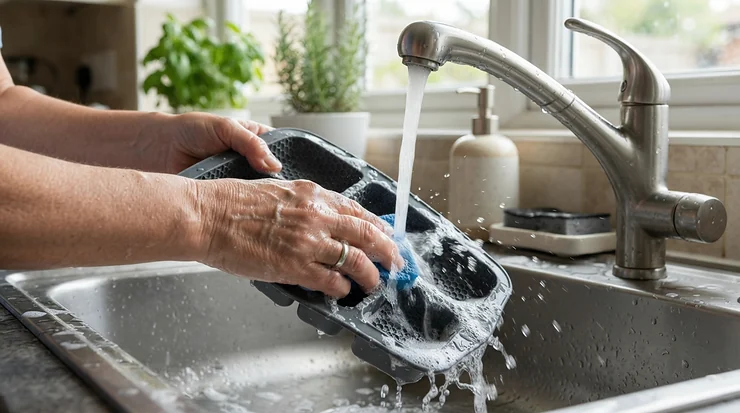
How to clean a dog food mat without warping it
Fast cleaning keeps spreads from drying into the grooves. The routine below follows LickiMat’s own care page, with owner and roundup notes added.
- Rinse or scrape the mat right after the meal.
- Run warm water over it with a few drops of dish liquid and soak for about 15 minutes, per LickiMat’s care post. Loobani’s guide suggests longer soaks for stubborn residue.
- Scrub with a washing-up brush of medium to soft bristles. LickiMat’s post says a hard brush can damage the mat and found that each mat took about two minutes to clean, with a silicone bottle brush working for some patterns and a nylon brush for others.
- Rinse well, shake off the water and lay the mat flat, face up, to dry.
- Use the dishwasher only if the label allows it, on the top rack, and with lower heat.
Sources split on the dishwasher. Chewy’s Q&A says the LickiMat Classic Soother is dishwasher safe, while LickiMat’s care post says a classic-line mat will warp unless it lies perfectly flat and recommends hand washing. Reader’s Digest calls the LickiMat Classic hard to clean and not dishwasher safe. Read the label on the mat itself. LickiMat’s post names its rigid-base LickiMat Tuff line as the fully dishwasher-safe choice.
Under-bowl mats are simpler. Dogtime says the Reopet Silicone Dog Bowl Mat wipes clean or goes in the dishwasher, and warns that food and water roll off when the mat is carried to the sink, so fold it lengthwise first. Dogtime also says a microfiber mat is machine washable but wrinkles if it dries folded.
Four mats that match those moves
| Mat | Job | Surface per the sources | Washing per the sources | Watch for |
|---|---|---|---|---|
| Reopet Silicone Dog Bowl Mat | Under a steel or any other bowl | Silicone, raised border, recessed shape | Wipe clean or dishwasher, per Dogtime | Contents can roll off when carried |
| LickiMat Classic Soother | Low-cost lick mat | Food-grade TPR rubber, close-set nubs | Hand wash per LickiMat, dishwasher per Chewy Q&A | Chewed nubs without supervision |
| Hyper Pet IQ Calm Slow Feeder Treat Mat | Lick mat for freezing and wet food | Listed as plastic, rubber and TPE across sources | Dishwasher and microwave safe, per Dogster and Rover | Size differs between sources |
| LickiMat Tuff Buddy | Sturdier lick mat | Rubber bonded to a rigid polypropylene base | Dishwasher safe, per LickiMat and Petful | Not chew-proof |
The first mat solves a floor problem and the other three solve a mealtime problem, so many homes will buy one from each group. Washing method is where the three lick mats really differ. Choose by the cleaning label if the dishwasher is part of your routine.
1. Reopet Silicone Dog Bowl Mat — rim and grip under any bowl
A feeding corner with a sliding steel bowl and a wet floor is the use case here. Dogtime ranks this silicone mat its best overall under-bowl pick, citing a raised border, a recessed shape, corners that stay flat so debris does not get trapped, and an affordable price. Bustle’s roundup calls it a best-seller for medium and large dogs and quotes a reviewer who ordered it because a Lab turns the floor into a pool at every drink.
The drawback is minor but real: Dogtime notes that food and water can roll off while the mat is carried to the sink. Fold it lengthwise first. Silicone also shrugs off wet food better than fabric. Check the current price on Amazon.com.
2. LickiMat Classic Soother — budget licking surface for spreads
Under $10 is where this one sits on Chewy, which lists 4.3 out of 5 from 223 ratings and describes food-grade rubber that is BPA free. Chewy reviewers say it holds wet food and spreads well, lasts a long time, calms dogs during grooming, medication or crate time, and cleans in the dishwasher or by hand with a brush. Vetstreet picks the Classic Soother as its overall best lick mat.
The negatives are consistent, too. The same reviews report dogs chewing off the center nubs, some dogs licking it clean quickly, and a mat too small for a big dog’s meal. Rover’s cat roundup also lists it for wetter foods and spreadable treats, with close-set nubs.
Pros:
- Low price tier
- Works with wet food and spreads
- Freezer-friendly per Rover
Cons:
- Small size
- Nubs can be chewed off
- Washing advice conflicts between sources
3. Hyper Pet IQ Calm Slow Feeder Treat Mat — freezer-ready and fine for cats
Sources disagree on the basics, so the listing deserves a close read. Dogster gives it as plastic at 11 by 11 by 0.4 inches, while Rover’s dog roundup calls it food-grade rubber at 8 inches square with a tighter pattern, and Rover’s cat roundup describes the sibling two-pack, the Hyper Pet IQ Treat Mat, as FDA-grade TPE made in the USA.
Dogster names it best overall for dogs, freezer friendly, optionally slow feeding, and microwave and dishwasher safe, with the downside that the texture may be too small. Rover says it has no suction cups and suggests pairing it with a floor-gripping mat for energetic lickers. The cat set includes one mat with rounded nubs for spreads and one with X-shaped ridges for chunkier wet food, and Rover says the material holds up to sharp little cat teeth. Check the current price on Amazon.com.
4. LickiMat Tuff Buddy — rigid base for dishwasher cleaning
Some dogs mouth every mat they meet, and this version was built for them, up to a point. Rover describes soft TPR rubber bonded to human-grade polypropylene with non-slip rubber feet, and Petful points to the rigid base and dishwasher cleaning as the reason to choose it over the classic, citing a price in the mid-teens in dollars. LickiMat’s own care post says the rigid base keeps it from warping in the dishwasher.
The chewing caveat from Rover quoted earlier still applies. A determined chewer can defeat any lick mat, so supervision stays the rule.
Pros:
- Rigid base that resists warping
- Dishwasher safe per the maker’s care post
- Non-slip feet
Cons:
- Costs more than the Classic line
- Not chew-proof
Spotted a mat that fits your pet’s mealtime? Take a closer look at the care label before ordering.
Lick mats, bowl mats and wet food: short answers
Are mats bad for dogs?
Is a mat or a bowl better for cat wet food?
How do you clean a dog food mat?
How do you make a dog bowl mat?
Do slow feed mats for dogs really slow eating?
Match the mat to the mess before the meal
Start with the job. For a bowl that slides or splashes, a silicone placemat such as the Reopet Silicone Dog Bowl Mat does the work. For a dog that gulps and tolerates supervision, the LickiMat Classic Soother is the low-cost start, the Hyper Pet IQ Calm Slow Feeder Treat Mat suits homes that also feed wet food to a cat, and the LickiMat Tuff Buddy adds a rigid base for dishwasher cleaning, although no lick mat survives a determined chewer. Whichever dog feeder mat goes on the floor, plan on three habits from the sources: check spread labels for xylitol, stay in the room, and wash the mat the same day. Before ordering, compare the size and care label of the mat you like against the dog’s mealtime.
Recommended for You
- 5 Best dog bowls and mat Combos for Messy Eaters (2026 Reviews)
- Wooden Dog Feeder: 7 Best Picks for 2026
- 7 Best Dog Food Storage Feeder Picks for Kibble (2026)
Sizes and care labels vary by model, so match the mat to your pet’s mealtime before you order.