In This Article
Why an Auto Horse Feeder Belongs in Your Barn in 2026
Affiliate disclosure: This post contains affiliate links. As an Amazon Associate, I earn from qualifying purchases, at no additional cost to you.
It’s 5:40 a.m., it’s sleeting sideways, and somewhere in the barn a gelding is drumming on his stall door like he’s auditioning for a marching band. If that scene feels familiar, an auto horse feeder might be the most practical upgrade you make this year. The right auto horse feeder doesn’t just buy you a slower morning — it lets you split your horse’s concentrate into the small, frequent meals that equine nutritionists have recommended for decades.
Here’s the catch: this is a niche category. Amazon carries only a handful of genuinely horse-ready units, several of the best-engineered feeders are sold direct by small US and Irish makers, and plenty of “automatic feeders” in search results are actually deer spinners in disguise. This guide sorts all of that out honestly, using real spec sheets, maker documentation, and aggregated owner feedback — no invented test drives, no made-up star ratings.
What Is an Auto Horse Feeder?
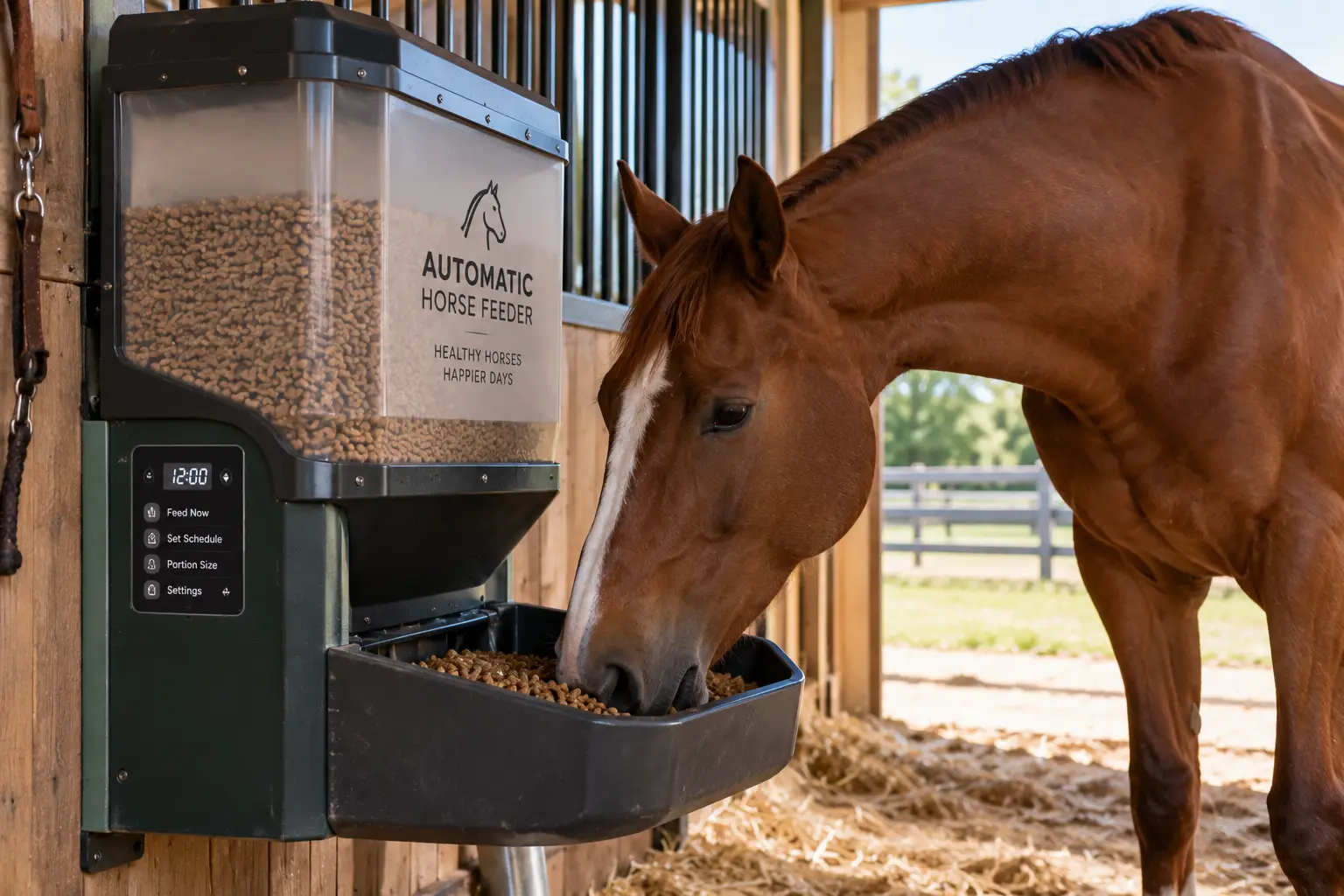
An auto horse feeder is a programmable dispenser that stores grain, pellets, or cubes in a sealed hopper and releases a measured portion at preset times, usually through a motorized auger or rotating drum. It lets you deliver several small meals a day without being in the barn, which supports digestive health and a steady routine.
Why does meal frequency matter so much? A horse’s stomach is small — only about 10 percent of the total digestive tract, according to the University of Nebraska–Lincoln’s NebGuide on feeding horses — so big grain meals rush through before the small intestine can handle all that starch. The overflow lands in the hindgut, where it can ferment and set the stage for colic or laminitis. An automatic horse feeder turns “feed little and often” from a nice idea into something that actually happens, even on the days you’re stuck at work until 7 p.m.
Auto Horse Feeder Quick Comparison (2026)
| Product | Type | Hopper Capacity | Max Feedings/Day | Power | Best For |
|---|---|---|---|---|---|
| Quick Feed QFS Automatic Horse Feeder | Wall/fence-mount dispenser | 50 lb pellets or grain | 12 | 110V plug-in + AA memory backup | Quick Feed QFS: one stalled horse |
| Quick Feed Double Automatic Feeder | Twin-outlet mount | 50 lb | 12 | 110V plug-in + AA memory backup | Quick Feed Double: two neighbors |
| Quick Feed Solar Automatic Feeder | Wall/fence mount | 50 lb | 12 | Solar + extended-life battery | Quick Feed Solar: paddocks without power |
| American Hunter RD-Pro Digital Feeder Kit | DIY timer/motor kit | Whatever container you pair it with | Up to 16 (some listings say 24) | 6V battery, solar-ready | American Hunter RD-Pro: budget DIY builds |
| SimpleFeeder Standard Dry Feeder | Stall-bar mount, auger | 34–106 lb across the range | 8 | Transformer or battery | SimpleFeeder: show and boarding barns |
| Equine Automation X5-CD | 5-compartment drum | Up to 30 lb grain / 20 lb cubes | 5 prefilled (16 with refills) | Rechargeable 12V, solar option | X5-CD: metabolic horses, soaked feed |
| Feed Smart Sr. | Freestanding pasture unit | 500–550 lb | 6 | Solar + 12V sealed battery | Feed Smart Sr.: small herds on pasture |
Looking at the table above, the three Quick Feed models cover the widest middle ground: they’re the most established option available through amazon.com, they’re easy to program, and they fit most stall fronts or fence lines. If your horse needs soaked feed or a different ration at each meal, however, the Equine Automation X5-CD is in a category of its own, while the Feed Smart Sr. is the only pick designed from the ground up to feed several horses at once on open pasture.
Budget-minded owners should read the American Hunter RD-Pro Digital Feeder Kit entry carefully before buying. It’s the cheapest way into timed feeding, but it’s a hunting product that needs real modification before it’s horse-appropriate. Notice, too, how feeding frequency climbs as you move from pasture units (six meals) to stall units (up to twelve): pasture feeders prioritize capacity and toughness, while stall feeders prioritize precision.
💬 Spotted your match? Click a highlighted feeder to check current pricing and availability — one click helps other shoppers make an informed choice too! 😊
Top 7 Auto Horse Feeder Picks: Expert Analysis
1. Quick Feed QFS Automatic Horse Feeder — proven plug-and-play workhorse
If you want the auto horse feeder that the most US owners have actually lived with, this is it — Quick Feed has been building these units since 1997.
The Quick Feed QFS holds 50 pounds of pellets or grain and dispenses 1 to 12 times per day, from 1 to 5 cups per feeding. In practice, five cups of a typical pelleted feed works out to very roughly 1.5 to 2 pounds, so weigh a sample of your own feed to know what each setting really delivers. A 12-volt transformer plugs into a standard 110-volt outlet, and two AA batteries preserve your program during short outages — the difference between a missed breakfast and a non-event when a storm flickers the power.
Based on comparing the specs, this is the natural pick for one horse in a stall or run-in shed within reach of an outlet, especially if you feed pellets, senior feed, or hay-replacer pellets. It’s less suited to sticky sweet feeds.
Owner reviews on the maker’s site are overwhelmingly positive, particularly from owners of senior and colic-prone horses, and customer service gets repeated praise. The recurring complaints: the sight window can stay coated with fines, cold-weather warnings are easy to miss, and damp pellets cause jams. The Amazon listing also carries at least one strongly negative review about a refund dispute, so buy from a seller whose return policy you understand.
Pros:
- ✅ Up to 12 measured feedings every 24 hours
- ✅ Battery-backed memory survives short power outages
- ✅ Nearly three decades of real-world track record
Cons:
- ❌ Maxes out at five cups per drop
- ❌ Sight window can mislead once fines stick
Expect it in the $300–$400 range at the time of writing, which is strong value for one horse near an outlet.
2. Quick Feed Double Automatic Feeder — one hopper, two horses fed together
The Quick Feed Double Automatic Feeder solves a problem single units create: the horse next door watching his neighbor eat.
It shares the Quick Feed QFS mechanics — a 50-pound hopper, 1 to 12 feedings a day, 1 to 5 cups per feeding, a 12-volt transformer, and AA memory backup — in a 28 x 16 x 10-inch, 10-pound housing that ships with PVC pipes and fittings for routing feed. That routing is the whole point. Research on stabled horses has found that dividing concentrate into more meals can reduce oral stereotypies in the horses being fed, but it may increase stereotypic behavior in unfed horses that can see them. Feeding two neighbors at the same moment sidesteps that tension. Confirm with the maker exactly how portions split between outlets before you order, since your two horses may not need identical rations.
What most buyers overlook is that one double unit means one outlet, one timer to program, and one hopper to fill — genuinely less daily friction than managing two separate singles.
Horse-specific reviews for the double model are thin. One reviewer on the maker’s site praised how tightly it seals against mice but wished for half-cup increments and reported that the clear window fell out; otherwise, the aggregated sentiment for the shared mechanism mirrors the single’s.
Pros:
- ✅ Feeds two neighbors at the same moment
- ✅ Uses the proven Quick Feed timer and auger
- ✅ One outlet and one hopper to manage
Cons:
- ❌ Both horses follow the same schedule
- ❌ Few horse-specific reviews to date
It typically runs roughly $350–$450 — usually less than buying two singles.
3. Quick Feed Solar Automatic Feeder — off-grid feeding for back paddocks
The Quick Feed Solar Automatic Feeder (sold with an extended-life battery) brings the same programmable feeding to paddocks where running an extension cord would be dangerous or impractical.
You get the familiar 50-pound hopper and 12-meal timer, but power comes from a solar panel charging a battery, so there’s no cord for a horse to chew or a mower to shred. The feeder’s power demand appears to be modest: one owner review describes running a Quick Feed on a small 15-watt solar setup feeding an old car battery. What the spec sheet doesn’t say, but experience with any solar gear confirms, is that winter matters — short days and low sun angles mean you should face the panel south, keep it clear of snow, and check battery voltage during long cloudy stretches.
This is the right call if your horses live on a dry lot or pasture more than a hundred feet or so from reliable power, and you’d rather not pay an electrician to trench a line. Build or buy a simple weather hood as well, because dry pellets are the single biggest factor in jam-free operation.
Owners on the maker’s site report solar-with-battery units running reliably for years alongside plug-in versions, though independent review volume for this configuration is limited.
Pros:
- ✅ No extension cords crossing your paddock
- ✅ Same twelve-meal programming as the plug-in
- ✅ Battery bridges short cloudy spells
Cons:
- ❌ Costs noticeably more than the plug-in model
- ❌ Panel placement needs planning for winter
Expect it in the $425–$525 range — worth it whenever trenching power would cost more.
4. American Hunter RD-Pro Digital Feeder Kit — cheapest route for DIY builders
Let’s be upfront: the American Hunter RD-Pro Digital Feeder Kit is a deer-feeder conversion kit, not a horse product — but it’s the lowest-cost path to timed feeding if you’re handy.
The kit bolts under a container you supply and uses a digital timer that feeds 1 to 16 times per day (some retailer listings say 24, so confirm on the product page), with a motor run time adjustable from 1 to 30 seconds. It runs on a 6-volt battery (not included) and comes pre-wired for an optional solar panel. Here’s the practical meaning of “run time”: the kit measures seconds, not cups, so you must calibrate by weighing what actually drops in, say, a 3-second cycle. Its “No-Blo” slinger is designed to broadcast feed in a circle for wildlife, which is exactly what you don’t want in a stall — you’ll need to shroud it so feed falls into a trough.
This suits hobby farmers feeding minis, donkeys, or easy keepers a small ration, and owners comfortable with DIY. It is not the pick for a colic-prone or metabolic horse where portion accuracy is critical.
Reviews come almost entirely from hunters, who generally describe easy installation; I found no verified horse-owner review pool for it.
Pros:
- ✅ Very low entry cost for timed feeding
- ✅ Digital schedule with day-of-week options
- ✅ Pre-wired for solar charging
Cons:
- ❌ Broadcast slinger must be modified for horses
- ❌ Accuracy depends entirely on your calibration
The kit alone usually sits around $50–$100; budget extra for a hopper, battery, and enclosure.
5. SimpleFeeder Standard Dry Feeder — tidy bar-mount for busy stall rows
The SimpleFeeder Standard Dry Feeder mounts on the outside of the stall bars, so the horse never touches the machine — only the feed.
An auger dispenses measured portions through an aluminum chute directly into your existing trough or manger, up to eight times every 24 hours. It runs on 12 volts via a supplied transformer (110V/230V) or on battery, and the unit protrudes only about 6 to 12 inches from the wall. Across the SimpleFeeder range, hopper capacity runs from about 34 to 106 pounds, and an extension adds roughly 23 pounds more — meaning fewer refills in a busy barn. The maker also sells a moist-feed version with a modified internal setup for stickier mixes, which is rare in this category.
Based on the design, this is built for boarding, show, and racing barns with stall bars, where a neat, uniform installation down the aisle matters as much as the feeding schedule. Eight meals a day is plenty for most concentrate programs.
SimpleFeeder is an Irish company with US customers; the testimonials it publishes come largely from racing and show yards, and independent US review volume is limited. I couldn’t confirm an amazon.com listing at the time of writing.
Pros:
- ✅ Mounts outside the stall, beyond reach
- ✅ Moist-feed version handles stickier mixes
- ✅ Optional hopper extension adds capacity
Cons:
- ❌ Tops out at eight feedings daily
- ❌ Pricing and shipping require a direct quote
Pricing sits in the premium tier and varies by model and shipping, so request a current USD quote before deciding.
6. Equine Automation X5-CD — the only pick built for soaked feed
The Equine Automation X5-CD was designed by owners of a horse with insulin resistance and Cushing’s disease, and it shows.
Instead of one hopper, it uses five separate compartments, each prefilled with its own meal. The maker rates it for up to 30 pounds of grain, 20 pounds of hay cubes, or 10 pounds of chopped forage, plus supplements — and, crucially, soaked feed, which auger feeders can’t handle. Practically, that means a laminitis-prone pony could get soaked hay cubes at 10 p.m. and a small ration balancer at 2 a.m. You can schedule up to 16 feedings if you refill compartments. A 12-volt rechargeable battery reportedly runs 3 to 5 weeks per charge, and a solar add-on is available. The unit measures 20 x 20 x 20 inches, weighs about 50 pounds, and mounts outside the stall or paddock.
This is the specialist’s pick for insulin-resistant, EMS, dentally compromised, or rehab horses whose diets change from meal to meal.
The maker publishes a testimonial from a Connecticut farm praising its battery life and its role in rehabilitating thin rescue mares; beyond that, independent review volume is small.
Pros:
- ✅ Handles soaked feed, cubes, and chopped forage
- ✅ Different ration in each compartment
- ✅ Weeks of runtime per battery charge
Cons:
- ❌ Only five prefilled meals per load
- ❌ Heavy, bulky, and costly to ship
Direct pricing lands roughly in the $1,000–$1,250 range, plus a shipping quote — steep, but uniquely capable.
7. Feed Smart Sr. — herd-scale feeding on open pasture
The Feed Smart Sr. is what happens when you design an auto horse feeder for Oklahoma pastures instead of show-barn aisles.
It’s a freestanding, all-galvanized-steel unit with a 500- to 550-pound hopper, a solar panel, a 12-volt sealed battery, and a digital timer that feeds up to six times a day. Each feeding can drop as little as 2 cups or as much as 20 pounds into a 4.5-foot round trough, so it scales from a couple of horses to a small herd. The maker recommends 6-foot legs for most full-size horses and notes the unit weighs 225 to 235 pounds empty, with a base about 5 feet wide — that stability matters when a 1,200-pound horse leans on it. Optional divider panels, paired with your own corral panels, create up to four separate feeding stations to cut down on bullying.
It’s ideal for owners with several pasture-kept horses and no power in the field. The limit: it only dispenses dry, loose feed — no molasses-coated pellets.
The maker’s testimonials highlight owners who don’t live on-site and value independence from barn power; independent review volume is limited.
Pros:
- ✅ Holds hundreds of pounds between refills
- ✅ Made in the USA from galvanized steel
- ✅ Divider panels reduce feed-time aggression
Cons:
- ❌ Won’t dispense sticky sweet feeds
- ❌ Large, heavy, and freight-shipped
Direct pricing sits in the $2,000–$2,300 range (the smaller Jr. costs a bit less) — excellent value per horse fed.
Side-by-Side: How the 7 Picks Really Differ
| Feeder | Portion Control | Feed Types | Warranty (per maker) | Price Range | Review Evidence | Best For |
|---|---|---|---|---|---|---|
| Quick Feed QFS | 1–5 cups per drop | Dry pellets, grain | 1-year guarantee | $300–$400 | Maker site + Amazon | Quick Feed QFS: best all-rounder |
| Quick Feed Double | 1–5 cups per drop | Dry pellets, grain | 1-year guarantee | $350–$450 | Maker site (limited) | Quick Feed Double: stall pairs |
| Quick Feed Solar | 1–5 cups per drop | Dry pellets, grain | Check with maker | $425–$525 | Maker site (limited) | Quick Feed Solar: no-power paddocks |
| American Hunter RD-Pro | 1–30 sec run time | Dry, free-flowing | Check listing | $50–$100 (kit) | Hunters only | American Hunter RD-Pro: DIY minis |
| SimpleFeeder | Timed auger | Dry; moist model available | Check with maker | Premium (quote) | Maker testimonials | SimpleFeeder: barn aisles |
| Equine Automation X5-CD | Per-compartment | Grain, cubes, forage, soaked | 1 year; battery 1 year | $1,000–$1,250 | Maker testimonials | X5-CD: special diets |
| Feed Smart Sr. | 2 cups–20 lb | Dry, loose only | 3 yr frame, 1 yr motor/solar, 6 mo battery/timer | $2,000–$2,300 | Maker testimonials | Feed Smart Sr.: herds |
The key pattern here is that portion control and feed flexibility rise with price, while review transparency actually falls — the Quick Feed units have the deepest public review record, whereas the premium feeders rely mostly on maker-published testimonials. The Feed Smart Sr. also stands out for having the most detailed written warranty. If you’re choosing between the X5-CD and a Quick Feed QFS, the deciding question is simple: does your horse need soaked or varied meals? If not, the Quick Feed QFS does the core job for about a third of the cost.
✨ Don’t let breakfast depend on your commute!
🔍 Take your horse’s feeding routine to the next level with this carefully researched lineup. Click a highlighted feeder to check current pricing and availability — these picks will help you deliver the steady, small meals that keep horses calmer and healthier all year long! 🐴
How to Set Up an Auto Horse Feeder: Your First 30 Days
Unboxing is the easy part; the first month is where good habits (or bad jams) form. Here’s a practical rollout plan.
Days 1–3: Mount and calibrate. Install the auto horse feeder outside the stall wherever possible, with the chute ending over a trough the horse can’t flip. Before involving the horse, run the test cycle three times and weigh each drop on a kitchen scale. Write the real weight per setting on masking tape inside the lid — cups are volume, and your horse’s ration is by weight.
Days 4–7: Introduce the sound. Horses are wary of new mechanical noises. Trigger a cycle while you stand nearby, and let the first few drops land alongside a familiar handful of feed. Most horses connect the whir with food quickly.
Days 8–14: Shift one meal. Move only the midday or late-night concentrate to the feeder while you keep feeding morning and evening by hand. Watch manure, appetite, and attitude. Any diet or schedule change should be gradual, so don’t flip to eight automated meals overnight.
Days 15–30: Build the full schedule. Spread the day’s concentrate across 4–6 drops. Check the feeder once daily, empty and wipe the chute weekly, and keep a spare set of lithium AA or backup batteries in the tack room.
Common first-month mistakes: overfilling a hopper with feed that sits for a week in humid weather, forgetting daylight saving time on older timers, and assuming the sight window is accurate instead of lifting the lid.
Real-World Scenarios: Which Automatic Horse Feeder Fits Your Barn?
Specs make more sense when you attach them to real situations. Here are three common profiles and the reasoning behind each match.
The commuting owner with one senior horse
Budget: around $300–$400. Barn with power. Feeding: 4–6 small meals daily. You work 45 minutes from the boarding barn, and your 24-year-old gelding does best on soaked-free senior pellets in small portions. The Quick Feed QFS Automatic Horse Feeder fits perfectly: plug it in, program midday and late-night meals, and hand-feed morning and evening. Its 50-pound hopper covers several days, so you only top it up on weekends and one midweek visit.
The metabolic pony on a strict, varied diet
Budget: $1,000+. Owner at home but away overnight. Feeding: soaked hay cubes plus a ration balancer. A laminitis-prone pony needs low-sugar, soaked meals spread through the night. Only the Equine Automation X5-CD can dispense soaked feed and different rations per compartment, which makes it the honest choice despite the cost. Talk the schedule through with your vet first.
The small-acreage herd with no power in the field
Budget: $2,000+. Four horses on pasture. Feeding: pellets 2–4 times daily. Here, stall units don’t make sense. The Feed Smart Sr. holds enough feed for days, runs on solar, and — paired with divider and corral panels — gives each horse its own station so the boss mare can’t hog the trough.
If your situation sits between these, such as one horse in a remote paddock, the Quick Feed Solar Automatic Feeder usually bridges the gap.
Troubleshooting Guide: 5 Common Auto Horse Feeder Problems and Fixes
Even the best auto horse feeder is a small machine living in a dusty, humid, rodent-friendly building. These are the issues owners report most often, with practical fixes.
- Feed jams or “bridges” in the hopper. Moisture is almost always the culprit. Pellets absorb humidity, swell, and lock together. Fill the hopper with only 3–5 days of feed in humid months, add a weather hood on outdoor units, and never top up over old feed without stirring.
- Portions seem inconsistent. Fines (pellet dust) settle at the bottom and change how much feed a cup-sized cycle moves. Sift dusty feed, and re-weigh a test drop whenever you open a new bag or switch brands. On the American Hunter RD-Pro, recalibrate seconds-to-weight after any battery change, since a weaker battery can slow the motor.
- The timer lost its program. On the Quick Feed units, replace the backup AAs every season and consider lithium cells in cold climates — one Montana owner reported keeping programming through subzero temperatures that way.
- Sticky feed won’t flow. Most auger and drum feeders dislike molasses-heavy sweet feeds. Switch to pellets or extruded feed, or choose the SimpleFeeder moist-feed model or the compartment-based Equine Automation X5-CD.
- Horses bang or chew the unit. Mount on the aisle side of stall bars or outside the paddock fence, and route any low-voltage wiring through metal conduit. On pasture, the Feed Smart Sr. trough guard and T-post-anchored panels stop horses from shoving the feeder around.
How to Choose an Auto Horse Feeder (7 Steps)
Choosing well comes down to matching the machine to your horse’s diet first and your convenience second. Work through these steps in order.
- Start with the diet, not the gadget. Dry pellets suit almost every model; soaked feed narrows your choice to the Equine Automation X5-CD, and sticky mixes favor the SimpleFeeder moist version.
- Decide how many meals you actually need. Alabama Cooperative Extension’s rules for feeding horses advise splitting concentrate into at least two meals once it exceeds 0.75 percent of body weight per day; more frequent, smaller meals are gentler still. Six to eight daily drops cover most programs.
- Check the maximum portion per drop. A five-cup ceiling is fine for concentrate, but a big working horse may need two back-to-back drops ten minutes apart.
- Map your power. An outlet within easy reach favors plug-in units; a distant paddock favors solar.
- Match mounting to your setup. Stall bars, wooden fence lines, and open pasture each call for different hardware.
- Weigh capacity against freshness. Bigger hoppers mean fewer refills but more time for feed to absorb moisture.
- Read the warranty and return terms. Know who pays freight on a 50-pound or 230-pound unit before you order.
Automatic Horse Feeder With Timer: What the Programming Really Controls
Every automatic horse feeder with timer controls two variables: when feed drops and how much drops. How each model defines “how much” is where buyers get tripped up.
The Quick Feed family measures by cup settings (1–5 cups per feeding), which is intuitive but volumetric. The American Hunter RD-Pro measures by motor run time (1–30 seconds), so its output shifts with feed density and battery strength. The SimpleFeeder uses a timed auger, and the Equine Automation X5-CD sidesteps the issue entirely: each compartment holds a pre-weighed meal, so accuracy depends on your kitchen scale, not the machine.
Timer resolution matters too. Twelve programmable events (Quick Feed) let you split a large ration into many small drops; eight (SimpleFeeder) is still plenty for most programs; six (Feed Smart Sr.) reflects pasture reality, where herd dynamics matter more than hourly precision.
Look closely at memory protection as well. Battery-backed memory, like the AA backup in Quick Feed units, keeps your schedule intact through brief outages — something to prioritize in rural areas where power blips are routine. Finally, check whether you can skip days or pause feeding. The Feed Smart optional toggle switch, for example, lets you stop dispensing for up to two days while horses are away at a show — without wiping your settings.
Timed Horse Feeder vs Slow Hay Feeder: Which Problem Are You Solving?
A timed horse feeder and a slow hay feeder often get lumped together, but they solve different problems. Understanding the difference saves you from buying the wrong tool.
Slow hay feeders — small-hole nets, hay boxes, and grazing mats — stretch out forage intake. According to University of Minnesota Extension research on slow-feed hay nets, horses evolved to spend more than 14.5 hours a day grazing, and small- and medium-hole nets slow the rate at which they eat hay. A timed horse feeder, by contrast, controls concentrate timing and portion size. Most grain-style units cannot dispense long-stem hay at all.
| Feature | Timed Auto Feeder | Slow Hay Net or Box | Hand-Feeding Twice Daily |
|---|---|---|---|
| Controls meal timing | ✅ Yes, programmable | ❌ No | ⚠️ Only when you’re present |
| Controls concentrate portions | ✅ Yes | ❌ No | ✅ Yes, if you weigh it |
| Handles long-stem hay | ❌ Rarely | ✅ Yes | ✅ Yes |
| Works when you’re away | ✅ Yes | ✅ Partly | ❌ No |
| Best for | Quick Feed QFS, X5-CD users | Easy keepers, stalled horses | Low-concentrate diets |
The takeaway: these tools complement each other rather than compete. The most horse-friendly setup for a stalled horse is often a slow hay net for steady forage plus an auto horse feeder like the Quick Feed QFS to split the concentrate. Hand-feeding still works fine if your horse eats mostly forage and only a small ration balancer.
Solar Automatic Horse Feeder vs Plug-In: Choosing Your Power Source
Power is the least glamorous decision you’ll make, and the one most likely to decide whether your feeder runs reliably for years.
Plug-in units (Quick Feed QFS, Quick Feed Double, SimpleFeeder on its transformer) are the simplest when an outlet is nearby. The low-voltage design — a transformer stepping 110V down to 12V at the feeder — reduces shock risk at the horse end. The weak point is the cord: route it high, protect it in conduit, and keep it out of reach of curious lips.
A solar automatic horse feeder (Quick Feed Solar Automatic Feeder, Feed Smart Sr., or the Equine Automation X5-CD with its solar add-on) frees you from wiring entirely. The trade-offs are higher upfront cost, battery replacement down the line, and seasonal sun. Face panels south, tilt them steeper in winter so snow slides off, and check battery health before the first cold snap.
Rechargeable battery-only setups, like the standard X5-CD, sit in the middle: no cords and no panel, but you’ll carry the battery to a charger every few weeks.
As a rule of thumb, if running power would require trenching or crossing a gate, solar almost always wins on total cost and safety. If an outlet sits on the same wall, a plug-in unit is cheaper and has fewer parts to fail.
Automatic Grain Feeder for Horses: Seniors, Metabolic Cases, and Hard Keepers
An automatic grain feeder for horses delivers its biggest payoff for three groups of horses whose needs clash with a twice-a-day schedule.
Seniors with worn teeth. Many older horses can’t manage long-stem hay and live on complete senior pellets. Those rations are large by volume, and dumping them in two big meals is hard on an aging gut. Owners on the Quick Feed site repeatedly describe using the Quick Feed QFS to spread pelleted senior feed across the day, including for a pony reported to be 46 years old.
Metabolic horses (IR, EMS, PPID). These horses benefit from smaller, low-starch meals that blunt blood sugar spikes. University of Kentucky guidance collected on the eXtension horse site notes that numerous small feedings beat one large one, and that three or four daily feedings are better than two. For metabolic cases needing soaked feed, the Equine Automation X5-CD is the tailored choice.
Hard keepers and performance horses. Horses needing high calorie intake often eat more concentrate than is safe in two sittings. An automated schedule of 5–8 smaller drops lets you raise total intake without overwhelming the small intestine.
Whatever the category, involve your veterinarian or an equine nutritionist before automating a medical diet. The feeder delivers precision; the professional decides what precision should look like.
Long-Term Cost and Maintenance
The sticker price is only the opening bid. Here’s how ownership costs really stack up over roughly five years.
| Feeder | Upfront Range | Likely Ongoing Costs | Horses Served | Best For |
|---|---|---|---|---|
| American Hunter RD-Pro | $50–$100 + DIY parts | 6V batteries, DIY repairs | 1 small horse | American Hunter RD-Pro: tight budgets |
| Quick Feed QFS | $300–$400 | AA backup cells, occasional parts | 1 | Quick Feed QFS: best value per stall |
| Quick Feed Double | $350–$450 | AA backup cells | 2 | Quick Feed Double: lowest cost per stalled horse |
| Quick Feed Solar | $425–$525 | Battery replacement every few years | 1 | Quick Feed Solar: no electrician needed |
| Equine Automation X5-CD | $1,000–$1,250 + shipping | Battery (1-year warranty), charging | 1 | X5-CD: special diets |
| Feed Smart Sr. | $2,000–$2,300 + freight | Battery, timer, eventual motor | Several | Feed Smart Sr.: lowest cost per pastured horse |
Reading the table, the Quick Feed Double delivers the lowest cost per stalled horse, while the Feed Smart Sr. looks expensive until you divide it across a herd — feeding four horses brings its per-horse cost close to a single Quick Feed Solar. The American Hunter RD-Pro is cheapest upfront, but your time spent building and calibrating is a real cost too.
Maintenance is mostly habit: empty and wipe hoppers monthly, clear fines from chutes weekly, and swap backup batteries seasonally. Feed Smart states a useful life of ten years or more for its units, and several Quick Feed reviewers describe running units for a decade — so buying well once genuinely pays off.
Common Mistakes to Avoid When Buying an Auto Horse Feeder
A few predictable missteps account for most buyer regret in this category.
Buying a wildlife feeder by accident. Search “automatic horse feeder” on Amazon and you’ll see tripod deer feeders and hanging spinners. These broadcast feed across the ground — wasteful and unsanitary for horses. If you go the DIY route with a kit like the American Hunter RD-Pro, plan the modifications before you buy.
Ignoring your feed type. Owners discover too late that their molasses-coated sweet feed gums up an auger. Check the feed-type rules first: the Feed Smart Sr. explicitly excludes sticky feeds, for instance.
Trusting cups instead of pounds. A five-cup setting of oats weighs differently from five cups of dense pellets. Weigh, label, repeat.
Forgetting the neighbors. Automating one horse’s meals in a row of stalls can stir up frustration in the horses that don’t get fed. A double unit or synchronized schedules help.
Skipping the return policy. Freight on heavy units is expensive, and some makers charge restocking fees (Feed Smart lists 25 percent on assembled feeders). Know the terms before you click buy.
Treating it as a babysitter. An auto horse feeder doesn’t check water, notice a limp, or spot early colic. Someone still needs eyes on your horse every day.
Safety, Regulations, and Standards
There’s no single federal certification for livestock feeders in the US, so safety comes down to smart component choices and good barn practice.
Electrical components. For any plug-in auto horse feeder, look for a UL or ETL mark on the transformer or power adapter, which indicates the component was tested by a nationally recognized testing laboratory. Low-voltage designs that step household current down to 12 volts at the feeder — like the Quick Feed and SimpleFeeder units — keep higher voltage away from the horse end of the system.
Barn wiring. Barns combine dust, hay, moisture, and chewing animals, which is why NFPA 150 (the fire and life safety code for animal housing facilities) exists. Use outdoor-rated, GFCI-protected outlets, run cords through metal conduit, and never daisy-chain extension cords to a feeder. When in doubt, hire a licensed electrician familiar with agricultural buildings.
Feed safety. Moldy feed is a genuine health hazard for horses. Keep hopper contents to a few days’ supply in humid weather, clean out old feed completely between refills, and store bags off the floor.
Physical safety. Mount feeders outside stalls or beyond fence lines where possible, anchor pasture units on rubber mats with T-posts, and check for sharp edges or loose fasteners after installation.
Dietary safety. Any change in schedule or ration should be gradual, and medical diets should be set with your veterinarian.
FAQ: Auto Horse Feeder Questions Buyers Ask Most
❓ Can an auto horse feeder dispense hay?
❓ Is an auto horse feeder worth it for just one horse?
❓ Where can I buy an auto horse feeder in the US?
❓ Do automatic horse feeders work with sweet feed?
❓ How long do auto horse feeder batteries last?
Conclusion: Pick the Auto Horse Feeder That Matches Your Horse, Not the Hype
The best auto horse feeder isn’t the priciest or the most high-tech one — it’s the one that fits your horse’s diet, your power situation, and your barn layout. For most owners feeding pellets to one stalled horse, the Quick Feed QFS Automatic Horse Feeder remains the practical, proven default, and the Quick Feed Double Automatic Feeder is a smart upgrade when two neighbors need to eat together. Paddock horses far from an outlet are better served by the Quick Feed Solar Automatic Feeder.
If your horse’s needs are medical — insulin resistance, dental issues, soaked-feed requirements — the Equine Automation X5-CD earns its premium. Barns with stall bars and a polished aisle will appreciate the SimpleFeeder Standard Dry Feeder, herds on open pasture belong with the Feed Smart Sr., and confident DIYers can start small with the American Hunter RD-Pro Digital Feeder Kit.
Whichever you choose, weigh every setting, keep feed dry, roll the schedule out gradually, and loop in your vet for special diets. An automated schedule of small, steady meals is one of the kindest things you can do for a horse’s gut — and one of the best things you can do for your mornings.
🐴 Ready to reclaim your mornings?
✨ Click any highlighted feeder above to check current pricing and availability, and give your horse the small, steady meals nature designed them for — rain, sleet, or late meeting! 🚀
Recommended for You
- Outdoor Water Dispenser for Dogs: 7 Best Picks That Work (2026)
- Outdoor Automatic Dog Water: 7 Best Picks That Never Run Dry (2026)
- 7 Best Remote Control Treat Dispensers for Dogs in 2026
Disclaimer: This post contains affiliate links. As an Amazon Associate, I earn from qualifying purchases made through these links, at no additional cost to you.
✨ Found this article helpful? Share it with someone who needs it! 💬🤗