In This Article
Why Automatic Feeders for Horses Deserve a Serious Look in 2026
It’s 9:45 p.m., it’s sleeting, and your gelding is staring at you over the stall door like you personally invented hunger. Every horse owner knows the feeling: the schedule your horse’s gut wants and the schedule your life allows rarely match. That gap is exactly where automatic feeders for horses earn their keep.
Here’s the core problem. A horse’s stomach is small, and it evolved for near-constant grazing, not two big “slug” meals at 7 a.m. and 6 p.m. Equine extension specialists have long recommended splitting concentrate into equal, evenly spaced feedings—the University of Kentucky’s feeding-frequency guidance on horses.extension.org explains that frequent smaller meals let the small intestine digest more starch, so less of it spills into the hindgut where it can trigger colic. Most of us, however, can’t be in the barn four times a day.
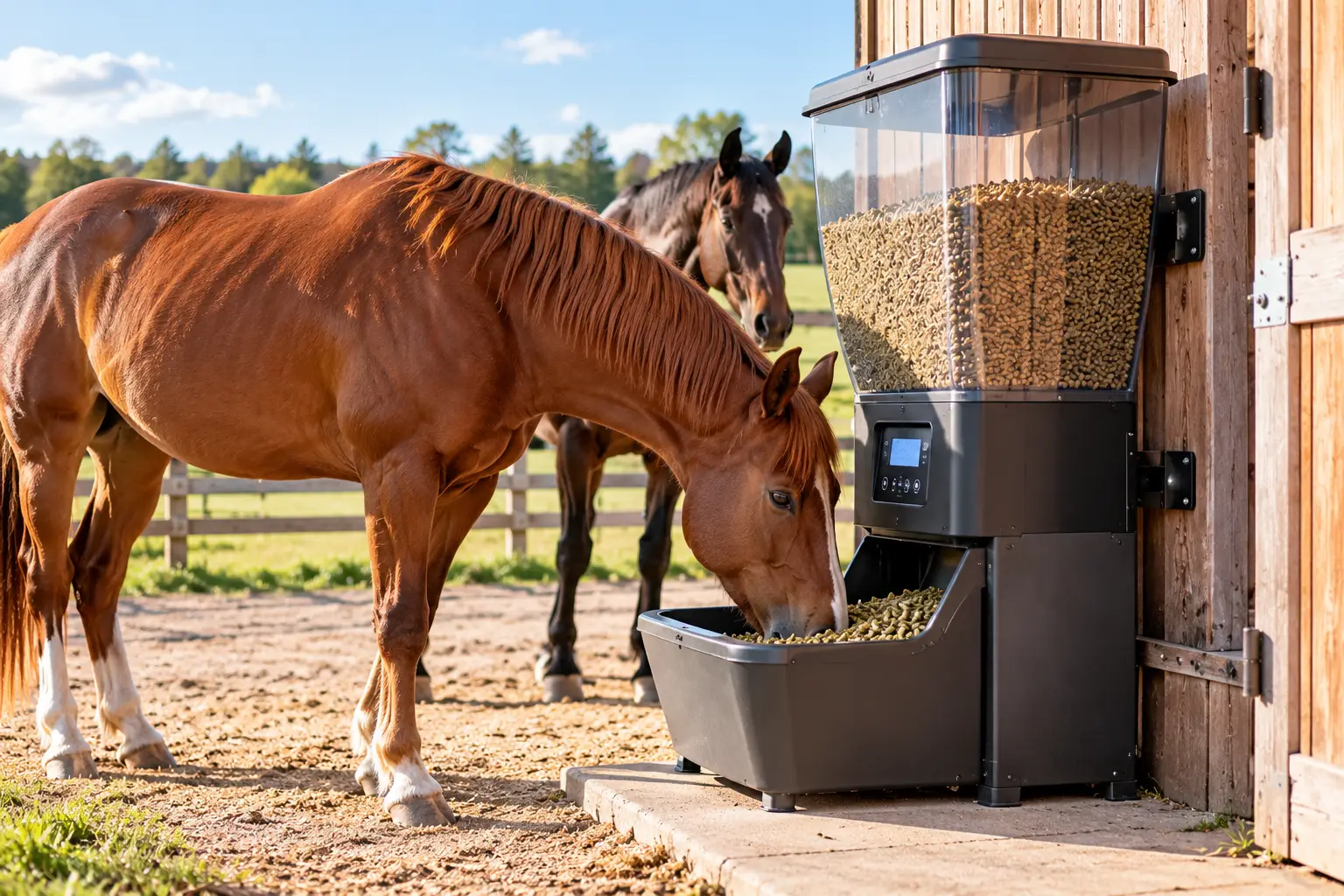
Automatic feeders for horses solve that timing problem mechanically. A programmable timer drops a measured portion of grain, pellets, hay cubes, or even flakes of hay at the times you choose—whether you’re at work, stuck in traffic, or finally asleep.
That said, not every unit fits every barn. Some are indoor-only plastic hoppers; others are galvanized steel built for open paddocks; a few handle actual long-stem hay, which is the hardest feed to automate. In this guide, you’ll find seven real options across entry-level, mid-range, and premium budgets, compared on what actually matters: feed type, power, weatherproofing, and how much babysitting each one needs. We’ll also cover setup, troubleshooting, and the long-term cost math, so you can buy once and buy right.
What Is an Automatic Feeder for Horses?
An automatic feeder for horses is a programmable device that stores feed and releases pre-set portions at scheduled times, usually via a digital timer driving a motorized dispenser, drop door, or timed lock. It lets owners deliver smaller, more frequent meals without being present for each feeding.
In practice, the category splits into three families:
- ⚙️ Grain and pellet dispensers — a hopper above a rotating cylinder or auger that meters out cups of dry feed.
- 🌾 Hay dispensers — shelves, compartments, or timed doors that release flakes or open access to forage on schedule.
- 🔧 DIY timer conversions — universal game-feeder timers repurposed to drive a horse-safe gravity or drop-style hopper.
Each family solves a different problem, which is why the comparison below matters more than any single “best” badge.
Quick Comparison: 7 Automatic Feeders for Horses at a Glance
| Product | Feed Type | Power | Indoor/Outdoor | Approx. Price Range | Best for |
|---|---|---|---|---|---|
| Quick Feed Single Feeder | Grain, pellets | 12V transformer (110V outlet) + AA memory backup | Indoor or covered | $300–$400 | Quick Feed Single Feeder: one stalled horse on a pellet diet |
| Amouu Equine FeedPilot | Hay (timed bag) | Battery timer lock | Stall/barn | Check current price | Amouu Equine FeedPilot: skipping the late-night hay trip |
| Equine Automation X5-CD | Grain, cubes, chopped forage, soaked feed | 12V rechargeable, solar option | Indoor/outdoor | Around $1,100 | Equine Automation X5-CD: metabolic horses needing soaked meals |
| AgPro ProFeeder | Pellets, dry feed | 120V AC or 12V DC | Indoor/outdoor | Around $1,200 | AgPro ProFeeder: pastures and commercial barns |
| Stable Grazer Automatic Feeder Kit | Hay + grain | Battery, programmable | Stall wall mount | $2,600–$2,700 | Stable Grazer Automatic Feeder Kit: true flake-hay automation |
| Haygain StableGraze | Hay (3 timed releases) | 12V battery | Stall | Premium; varies by dealer | Haygain StableGraze: ground-level forage for laminitis-prone horses |
| Highwild 6V/12V Universal Digital Timer | Any (DIY build) | 6V/12V battery | Depends on build | Under $30 | Highwild 6V/12V Universal Digital Timer: handy owners on a tight budget |
Looking at the table, the split is clear: if you feed mostly pellets, the Quick Feed Single Feeder and AgPro ProFeeder cover indoor and outdoor needs respectively at a fraction of hay-automation prices. True long-stem hay automation—the Stable Grazer Automatic Feeder Kit and Haygain StableGraze—costs several times more because handling flakes mechanically is genuinely harder. The Highwild 6V/12V Universal Digital Timer is the wildcard: cheapest by far, but only as good as the hopper you build around it.
💬 One click helps other shoppers make an informed choice too! Tap a highlighted feeder to check today’s price and availability. 😊
Top 7 Automatic Feeders for Horses: Expert Analysis
A quick honesty note before we dive in: the automatic-horse-feeder market is small and specialized. Several of these units are sold primarily direct from the manufacturer or through tack dealers, and availability on amazon.com changes. Where public customer feedback is thin, we say so rather than pad it.
1. Quick Feed Single Feeder — the proven grain workhorse
Nolan Engineering’s Quick Feed has been dispensing horse feed since the late 1990s, and its appeal is simplicity. The hopper holds roughly 50 pounds of grain or pellets, and a rotating cylinder drops 1 to 5 cups per feeding, up to 12 times a day. In practice, that means you can split a 10-cup daily ration into four or five evenly spaced meals—exactly what extension nutritionists recommend.
It runs on a 12-volt transformer plugged into a standard outlet, with AA batteries preserving your program during outages. The manufacturer is upfront about limits: the hopper isn’t fully sealed, so it needs a covered location outdoors, and sticky molasses-heavy sweet feeds tend to “bridge” above the dispenser. Pellets work best.
This is the pick for an owner with one or two stalled horses on pelleted feed who wants reliability over bells and whistles. Customer reviews on the maker’s site consistently describe multi-year service, including one owner running a solar-and-battery setup; the most common gripe is a small viewing window that makes hopper levels hard to check.
Pros:
- ✅ Up to 12 feedings daily for real small-meal schedules
- ✅ Large 50-pound hopper means fewer refills
- ✅ Long track record with horse owners since 1997
Cons:
- ❌ Not weather-sealed or rodent-proof without a cover
- ❌ Struggles with molasses-heavy sweet feeds
💵 Price & value: typically between $300 and $400—excellent value if your horse eats pellets indoors.
2. Amouu Equine FeedPilot — the easiest overnight hay fix
The FeedPilot takes a refreshingly low-tech approach to automated forage: instead of a motorized dispenser, it’s a 30-liter hanging hay bag in 500D PVC with a digital timer lock. You fill it during your evening chores, and it stays closed until the timer opens access later. Translation: your horse gets a second forage meal at 2 a.m. without you getting out of bed.
Thirty liters is a modest volume—loose hay compresses differently by type, so expect a light flake or two rather than a full night’s ration. Weigh what actually fits before you build a feeding plan around it, since feeding by weight (not volume) is a core extension rule.
Who is it for? Boarders and backyard owners who already feed hay twice a day and just want to break up the longest overnight gap. It’s not a replacement for a full automatic hay system. Because this is a recent Amazon release, verified long-term customer feedback was very limited at the time of writing, so durability against a determined chewer is still unproven.
Pros:
- ✅ Simple concept with almost nothing mechanical to fail
- ✅ Targets the long overnight forage gap directly
- ✅ Portable for stalls, barns, and paddock shelters
Cons:
- ❌ Small capacity limits it to a supplemental meal
- ❌ Little verified long-term review data yet
💵 Price & value: check the current listing price—pricing wasn’t stable enough at the time of writing to quote a range; value hinges on how well the timer lock survives your horse.
3. Equine Automation X5-CD — the specialist for special diets
The X5-CD’s standout trick is five pre-loadable feed bins, each of which can hold a different portion or even a different feed. That means Tuesday’s 6 a.m. meal can be soaked beet pulp while the noon slot is a supplement-only snack. The manufacturer states it can handle grain (up to about 30 pounds), hay cubes, chopped forage, supplements, and pre-soaked feed—the last of which almost no competitor attempts.
Power comes from a rechargeable 12-volt battery rated for roughly four to six weeks between charges, with a factory solar option. It’s built for indoor or outdoor mounting.
On paper, this is the strongest choice for insulin-resistant or metabolic-syndrome horses, where small, frequent, carefully controlled meals matter most. It’s also useful for senior horses on soaked mashes. The trade-off: with five bins, you’re refilling more often than with a big hopper if you run many meals a day (it supports up to 16 programmed times). Public review volume is limited—the maker’s own page lists only a single review—so weigh brand responsiveness when buying.
Pros:
- ✅ Dispenses soaked feed, a rare capability
- ✅ Different portions or feeds per meal
- ✅ Battery and solar power for barns without outlets
Cons:
- ❌ Five bins mean frequent refills on busy schedules
- ❌ Very few independent customer reviews available
💵 Price & value: around $1,100—pricey, but justified if your horse’s diet is medically complex.
4. AgPro ProFeeder — commercial-grade toughness
Built by AgPro in Paris, Texas, the ProFeeder is the tank of this list. Its galvanized-steel, airtight hopper resists weather and rodents, which matters outdoors: one mouse family in a plastic hopper can ruin a 50-pound load. Capacity starts at 50 pounds, and a separately sold hopper extension roughly doubles it.
You choose between a 120V AC model for barns with power and a 12V DC model for remote pastures, with an optional solar charger. A positive feed shut-off is designed to stop dispensing cleanly rather than dribbling feed between meals.
Equine trade press reviewers have named it their first look for a commercial-grade outdoor feeder, and that matches the spec sheet. It’s ideal for boarding operations, pasture-kept horses, or anyone tired of replacing plastic units. The catch is cost and size—it’s overkill for one stalled pony. Note that the price figure most commonly cited comes from an older listing, so confirm current pricing with a dealer.
Pros:
- ✅ Galvanized, airtight build shrugs off weather and rodents
- ✅ AC or 12V DC versions for any location
- ✅ Expandable capacity with a hopper extension
Cons:
- ❌ Heavy and bulky for small stalls
- ❌ Dry feeds and pellets only, no hay
💵 Price & value: around $1,200 historically—strong long-term value for outdoor or multi-horse use.
5. Stable Grazer Automatic Feeder Kit — real flakes, real automation
Most “automatic” feeders dodge long-stem hay; the Stable Grazer embraces it. The kit mounts on a stall wall and uses six timed feed shelves behind a patented drop-down door, releasing hay, grain, or both at programmed intervals. It’s made by Carter2 Systems in Hillsboro, Oregon, and the kit ships with everything needed for installation.
Why does that matter? Forage, not grain, should be the backbone of most horses’ diets. Six timed drops let you turn two big hay meals into six smaller ones, which narrows the empty-stomach windows linked to ulcers and stall vices.
This is a premium tool for owners whose horse is stalled long hours, or for laid-up horses on restricted turnout. Battery power keeps cords out of chewing range. Aggregated public reviews are sparse; owner forum chatter mostly flags the cost as the main hurdle rather than performance problems.
Pros:
- ✅ Automates long-stem hay, not just pellets
- ✅ Six timed drops for genuine small-meal forage
- ✅ Complete kit with battery-powered controller
Cons:
- ❌ Highest price on this list
- ❌ Requires solid wall mounting and careful setup
💵 Price & value: roughly $2,600–$2,700—expensive, but the most complete hay solution here.
6. Haygain StableGraze — ground-level forage, done gently
Haygain, best known for hay steamers, built the StableGraze to release hay at three scheduled intervals at ground level. That posture detail isn’t marketing fluff: eating head-down supports natural drainage of the airways, more even dental wear, and a relaxed topline.
It runs on a dedicated 12-volt battery and charger, and Haygain positions it especially for horses recovering from laminitis, where steadier forage intake supports more stable glucose levels. Three releases is fewer than the Stable Grazer’s six, but paired with your own morning and evening feeds, it can stretch forage across five meals.
Choose it if respiratory health or laminitis management is your priority. The honest caveat: it’s a UK-origin product, so US availability, dealer support, and pricing vary—confirm warranty service before buying. US-based aggregated reviews were limited at the time of writing.
Pros:
- ✅ Ground-level feeding supports airway and dental health
- ✅ Positioned for laminitis and recovery cases
- ✅ Backed by an established equine brand
Cons:
- ❌ Only three timed releases per cycle
- ❌ US availability and support can be patchy
💵 Price & value: premium pricing that varies by dealer—worth it mainly for medically driven forage plans.
7. Highwild 6V/12V Universal Digital Timer — the DIY budget route
This one comes from the hunting world, and that’s both its strength and its warning label. The Highwild timer is a universal game-feeder controller that runs on 6V or 12V, supports up to 8 feed times daily, and sets each run from 1 to 30 seconds, with memory retention and an in-line fuse.
For a handy owner, it can drive a homemade horse feeder at a tiny fraction of commercial prices. But here’s what the spec sheet won’t tell you: deer feeders use spinner plates that broadcast feed in a wide circle. For horses, you need a drop-style or chute design delivering into a trough, mounted outside the stall so it can’t be kicked, chewed, or knocked down.
It suits budget-conscious tinkerers with a protected spot outside the stall. Reviews from hunters are broadly positive about reliability and easy programming; the main complaint is the basic display. Remember those reviews reflect wildlife use, not horses.
Pros:
- ✅ Lowest cost of entry by a wide margin
- ✅ Up to 8 daily feed times with adjustable run
- ✅ Settings memory and in-line fuse protection
Cons:
- ❌ Requires building a safe, horse-proof hopper yourself
- ❌ Run-time dosing is less precise than cup metering
💵 Price & value: usually under $30—unbeatable value if, and only if, your build is safe.
Head-to-Head: Capacity, Feed Flexibility, and Power
| Product | Max Feedings/Day | Capacity | Handles Long-Stem Hay? | Weather/Rodent Resistance | Best for |
|---|---|---|---|---|---|
| Quick Feed Single Feeder | 12 | ~50 lb grain/pellets | No | Low (needs cover) | Quick Feed Single Feeder: indoor pellet feeding |
| Amouu Equine FeedPilot | 1 timed release per fill | 30 L bag | Yes (small volume) | Moderate | Amouu Equine FeedPilot: one extra overnight hay meal |
| Equine Automation X5-CD | Up to 16 (5 preloaded) | ~1 cu ft | No (cubes/chopped only) | High | Equine Automation X5-CD: soaked and mixed meals |
| AgPro ProFeeder | Multiple, programmable | 50 lb (expandable) | No | High (galvanized, airtight) | AgPro ProFeeder: outdoor and multi-horse |
| Stable Grazer Automatic Feeder Kit | 6 shelves | 6 portions | Yes | Moderate (indoor wall mount) | Stable Grazer Automatic Feeder Kit: all-day hay |
| Haygain StableGraze | 3 | 3 portions | Yes | Moderate | Haygain StableGraze: ground-level forage |
| Highwild 6V/12V Universal Digital Timer | 8 | Depends on build | Depends on build | Depends on build | Highwild 6V/12V Universal Digital Timer: DIY projects |
The pattern worth noticing: feeding frequency and hay capability rarely come together cheaply. The Quick Feed Single Feeder offers the most daily feedings for the money, but only for dry concentrates. If forage is your priority, you’re choosing between the volume of the Stable Grazer Automatic Feeder Kit and the posture benefits of the Haygain StableGraze—or pairing a grain dispenser with a slow-feed hay net, a combination we break down below.
✨ Don’t miss the right fit for your barn!
🔍 Take your horse’s feeding routine to the next level with this carefully curated lineup. Click a highlighted feeder to check current pricing and availability. These picks help you deliver steadier, smaller meals your horse’s gut will thank you for!
Getting Started: Your First 30 Days With an Automatic Feeder
Buying the feeder is the easy part. The first month decides whether it becomes a trusted tool or an expensive coat rack.
Week 1: Install and calibrate
- ✅ Mount the unit outside the horse’s reach where possible, or in a corner the horse can’t kick or chew. Feeders inside the stall take abuse—horses quickly learn where food comes from.
- ✅ Run the dispenser into a bucket and weigh each portion on a kitchen scale. A “cup” of pellets and a “cup” of textured feed weigh very different amounts.
- ✅ Program meal times that bracket your own presence at first, so you can watch the first few drops.
Week 2: Introduce the horse
Some horses startle at motor noise or a dropping door. Stay nearby for the first several cycles, and pair the sound with a familiar feed. Most horses connect the noise to food within days.
Weeks 2–4: Transition the diet slowly
If you’re switching from two meals to five, keep the total daily amount the same and simply redistribute it. If you’re also changing feeds, follow the standard extension rule of shifting gradually over at least two weeks.
Ongoing: Build a maintenance rhythm
- 🔋 Check battery level or charge status weekly.
- 🧹 Empty and wipe the hopper every refill cycle to prevent caked, moldy residue.
- 👀 Do a daily “eyes-on” check. Automation replaces the trip, not your judgment. Missed drops, leftover feed, or a horse acting off are all signals no timer can read.
The most common first-month mistake? Trusting the machine before verifying it. Spend two weeks proving it right, and you’ll sleep better for the next two years.
Real-World Scenarios: Which Feeder Fits Your Barn?
Specs only make sense in context. Here are three typical owner profiles and the reasoning behind each match.
🏠 Profile 1: The commuting boarder
Sarah keeps one Quarter Horse in a self-care barn 25 minutes from her office. She can reliably do mornings and evenings but not midday. Her horse eats a ration-balancer pellet plus hay. Best match: the Quick Feed Single Feeder for a noon pellet drop, plus the Amouu Equine FeedPilot to split the evening hay. Total spend stays modest, and both tools target her exact gaps.
🩺 Profile 2: The metabolic senior
Tom’s 22-year-old pony has insulin resistance and needs soaked, low-sugar meals spread across the day. His vet wants no meal larger than a set weight. Best match: the Equine Automation X5-CD. Its ability to dispense pre-soaked feed in different portions per bin is the deciding factor—a pellet-only dispenser can’t do this.
🐴 Profile 3: The small boarding operation
A four-horse facility with outdoor pens and limited power wants to cut a midday labor shift. Best match: two AgPro ProFeeder units on 12V with solar charging for pens, keeping concentrate dry and rodent-free outdoors. For a stall-bound rehab horse in the same barn, the Stable Grazer Automatic Feeder Kit handles forage.
The takeaway: start with your horse’s diet and your biggest scheduling gap, then pick the feeder. Working backward from a feature list is how people overspend.
Troubleshooting: 5 Common Problems and How to Fix Them
Even well-built automatic feeders for horses hit snags. Here’s how to solve the usual suspects.
1. Feed “bridges” and won’t drop. Molasses-coated sweet feeds clump above the dispenser, especially in humid weather. Switch to pellets or a lower-molasses textured feed, and tap-test the hopper weekly. This is the classic issue with the Quick Feed Single Feeder.
2. Portions are inconsistent. Run-time timers like the Highwild 6V/12V Universal Digital Timer dispense by seconds, so a draining battery means slower motors and smaller portions. Recalibrate monthly and keep batteries fully charged.
3. The horse attacks the feeder. Horses that associate a box with food will paw, chew, or bang it. Move the unit outside the stall and use a chute, or add a protective steel enclosure.
4. Rodents or moisture in the hopper. Plastic hoppers in open barns invite trouble. Relocate under cover, or upgrade to an airtight steel unit like the AgPro ProFeeder.
5. The timer resets after an outage. Confirm your memory backup batteries are fresh. If the barn loses power often, a battery or solar-powered unit such as the Equine Automation X5-CD removes the dependency entirely.
How to Choose an Automatic Horse Feeder With Timer
Use these seven steps to narrow the field quickly:
- Start with feed type. Pellets, textured grain, cubes, soaked feed, and long-stem hay need different mechanisms. This single question eliminates half the market.
- Count the meals you actually need. Two extra drops per day is a different product than eight.
- Match power to location. No outlet nearby? Prioritize 12V battery or solar models.
- Assess the environment. Outdoor, dusty, or rodent-prone barns demand sealed steel; a clean indoor aisle tolerates plastic.
- Check portion precision. Cup-metering cylinders are more consistent than run-time spinners for horses with strict rations.
- Plan for safety. Can it be mounted outside kicking and chewing range? Are cords protected?
- Verify support. Spare parts, warranty service, and a responsive manufacturer matter more than a slick display.
As the Alabama Cooperative Extension System’s 10 rules for feeding horses emphasizes, feeding on a regular schedule and dividing larger concentrate rations into multiple meals reduces colic risk. A feeder that delivers your schedule reliably beats one with more features you’ll never use.
Automatic Hay Feeder for Horses vs. Slow-Feed Hay Nets
This is the comparison most buyers skip, and it can save you thousands. A slow-feed hay net isn’t automatic, but it attacks the same problem—long gaps without forage—by stretching how long a meal lasts.
University of Minnesota researchers found that small- and medium-holed hay nets substantially slowed intake; horses took roughly 5 to 6.5 hours to finish a meal that took about 3.2 hours off the stall floor. Their extension summary on hay net design suggests twice-daily feeding with these nets can extend foraging to 10–13 hours a day.
| Factor | Automatic Hay Feeder | Slow-Feed Hay Net |
|---|---|---|
| Upfront cost | High (often $1,000+) | Low (usually under $50) |
| Meal timing control | Precise, scheduled | None—horse sets pace |
| Overnight coverage | Excellent | Good if net is large |
| Maintenance | Batteries, mechanics | Inspect for holes, wear |
| Best for | Stable Grazer Automatic Feeder Kit users with long stall hours | Budget owners with predictable schedules |
Reading this table, nets win on cost and simplicity, while automatic hay feeders win when you need distinct meals at exact times—say, a laminitic horse whose intake must be capped per feeding. Many owners land on a hybrid: a slow-feed net for forage plus a grain dispenser like the Quick Feed Single Feeder for concentrates. That combo often delivers 80% of the benefit at a fraction of the cost.
Automatic Grain Feeder for Horses: Portion Control for Special Diets
For certain horses, smaller meals aren’t a nicety—they’re a management requirement.
🩺 Insulin-resistant and EMS horses. Large starch loads spike blood glucose. Splitting the daily ration into four or five portions flattens those spikes. The Equine Automation X5-CD was explicitly designed for this group.
⚡ Performance horses on high concentrate. Alabama Extension notes that a horse needing more than 1.5% of body weight in concentrate should have it divided over three or four meals. For an 1,100-pound horse, that’s every ounce over 16 pounds per day split into at least three feedings. A cup-metering unit like the Quick Feed Single Feeder or AgPro ProFeeder makes this practical.
🐢 Grain bolters and choke-prone horses. Smaller portions physically limit how much a fast eater can gulp at once. Add a few large, smooth stones to the feed pan to slow eating further.
👴 Seniors with dental issues. Soaked mashes are often the safest option, which again points to the Equine Automation X5-CD.
One rule applies to all four groups: the feeder delivers the plan, but your veterinarian or a qualified equine nutritionist should set it. Automation makes a good ration consistent—it can’t fix a poorly designed one.
Long-Term Cost and Maintenance: What Ownership Really Costs
Sticker price is only part of the story. Here’s a realistic ownership view.
| Product | Upfront Range | Recurring Costs | Typical Labor Saved | Best for |
|---|---|---|---|---|
| Highwild 6V/12V Universal Digital Timer | Under $30 + build materials | Batteries, hopper repairs | 1 trip/day | Highwild 6V/12V Universal Digital Timer: tight budgets |
| Quick Feed Single Feeder | $300–$400 | Minimal (transformer, AA backup) | 1–2 trips/day | Quick Feed Single Feeder: single-horse value |
| Equine Automation X5-CD | Around $1,100 | Battery charging, optional solar | 1–3 trips/day | Equine Automation X5-CD: diet-driven ROI |
| AgPro ProFeeder | Around $1,200 | Low (durable steel) | 1–2 trips/day per pen | AgPro ProFeeder: multi-horse payback |
| Stable Grazer Automatic Feeder Kit | $2,600–$2,700 | Battery, parts | 2–4 trips/day | Stable Grazer Automatic Feeder Kit: maximum labor savings |
Consider the math. If you’d otherwise pay a barn hand or neighbor even a modest fee for a midday feeding, a mid-range feeder can plausibly pay for itself within a year. Fuel saved on extra drives adds up too.
Hidden costs deserve equal attention: replacement batteries, a protective enclosure, and feed lost to a single malfunction. Budget roughly 10% of the purchase price per year for upkeep on electronic units. The AgPro ProFeeder tends to have the lowest long-term cost per year simply because galvanized steel outlives plastic in rough conditions.
Features That Actually Matter (and Ones That Don’t)
Marketing pages love long feature lists. Here’s what deserves your money.
✅ Matters a lot:
- Memory backup. A timer that forgets its program during an outage is worse than no timer.
- Portion precision. Cup-metering cylinders beat run-time dosing for strict rations.
- Sealed construction if the feeder lives anywhere near dust, rain, or rodents.
- Malfunction alerts. The Quick Feed’s alarm feature, for example, flags problems before your horse goes hungry.
- Off-grid power for pastures and older barns with limited outlets.
❌ Matters less than you think:
- Huge feeding counts. Twelve or sixteen slots look impressive, but most horses do great on four to six meals.
- App connectivity. Nice for monitoring, but a reliable mechanical design matters far more than a phone notification.
- Massive hopper sizes for single horses. Feed sitting for weeks loses freshness and invites pests.
The smartest buyers pay for reliability and the right feed mechanism, then skip the extras.
Safety, Placement, and Standards
An automatic feeder adds electricity and moving parts to a space shared with a 1,000-pound animal that chews things. Plan accordingly.
⚡ Electrical safety. For plug-in units, use a properly grounded outlet protected by a GFCI, and route cords through conduit out of reach. Look for chargers and transformers carrying a recognized safety listing (such as UL or ETL). Battery-powered 12V units like the Equine Automation X5-CD and the Stable Grazer Automatic Feeder Kit reduce shock and cord-chewing risks.
🛡️ Physical placement. Patent filings for automatic horse feeders repeatedly note that horses strike, chew, and bump at feeders once they learn they hold food. Mounting outside the stall with a chute is the gold standard.
🔥 Fire risk. Keep electronics away from hay storage and clear dust buildup regularly. A barn fire is the worst-case scenario for any electrical device.
👀 Human oversight. No feeder replaces daily checks. Equine trade press has stressed that automation shouldn’t become a reason to leave horses unattended for extended periods. Water, injuries, and colic signs still need human eyes every day.
Common Mistakes to Avoid When Buying Automatic Feeders for Horses
- ❌ Buying for features instead of feed type. A pellet dispenser won’t handle long-stem hay, no matter how many timer slots it has.
- ❌ Assuming “weatherproof” means rodent-proof. Plastic lids keep rain out but not mice.
- ❌ Skipping calibration. Volume isn’t weight. Always weigh portions.
- ❌ Repurposing a deer spinner as-is. Broadcast plates scatter feed on the ground; horses need trough delivery.
- ❌ Changing schedule and diet at the same time. Make one change, then the other.
- ❌ Ignoring support. A great feeder with no available parts becomes useless after one broken motor.
- ❌ Treating automation as permission to visit less. It saves trips; it doesn’t replace care.
FAQ: Automatic Feeders for Horses
❓ Are automatic feeders for horses worth the money?
❓ Can an automatic horse feeder dispense hay?
❓ How many times a day should an automatic feeder feed my horse?
❓ Do automatic horse feeders work during a power outage?
❓ Can I use a deer feeder timer for horses?
Conclusion: Choosing Among the Best Automatic Feeders for Horses
The best automatic feeders for horses don’t replace you—they extend you. They deliver the small, frequent meals your horse’s digestive system was built for, at the times your schedule can’t cover.
Here’s the short version. If you feed pellets indoors, the Quick Feed Single Feeder offers the best value. If you simply need to break up the long overnight hay gap, the Amouu Equine FeedPilot is the most affordable test. For metabolic horses on soaked feed, the Equine Automation X5-CD is the specialist. For outdoor durability and multi-horse barns, the AgPro ProFeeder is built to last. If automating long-stem hay is the goal, the Stable Grazer Automatic Feeder Kit and Haygain StableGraze lead the field. And if you’re handy and budget-bound, the Highwild 6V/12V Universal Digital Timer can power a safe DIY solution.
Whatever you choose, calibrate by weight, install out of kicking range, transition gradually, and keep up your daily checks. Get those basics right, and a well-chosen feeder becomes one of the most valuable tools in your barn.
🐎 Ready to give your horse a steadier routine?
✨ Click any highlighted feeder above to check current pricing and availability, and pick the setup that fits your barn, your budget, and your horse’s diet. Smaller, smarter meals start today!
Recommended for You
- Dog Treat Machine Guide 2026: 7 Best Picks That Actually Work
- Auto Dog Treat Dispenser: 7 Best Picks That Actually Work (2026)
- Dog Treat Dispenser Training: 7 Best Tools That Work (2026)
Disclaimer: This post contains affiliate links. As an Amazon Associate, I earn from qualifying purchases made through these links, at no additional cost to you.
✨ Found this article helpful? Share it with someone who needs it! 💬🤗