
In This Article
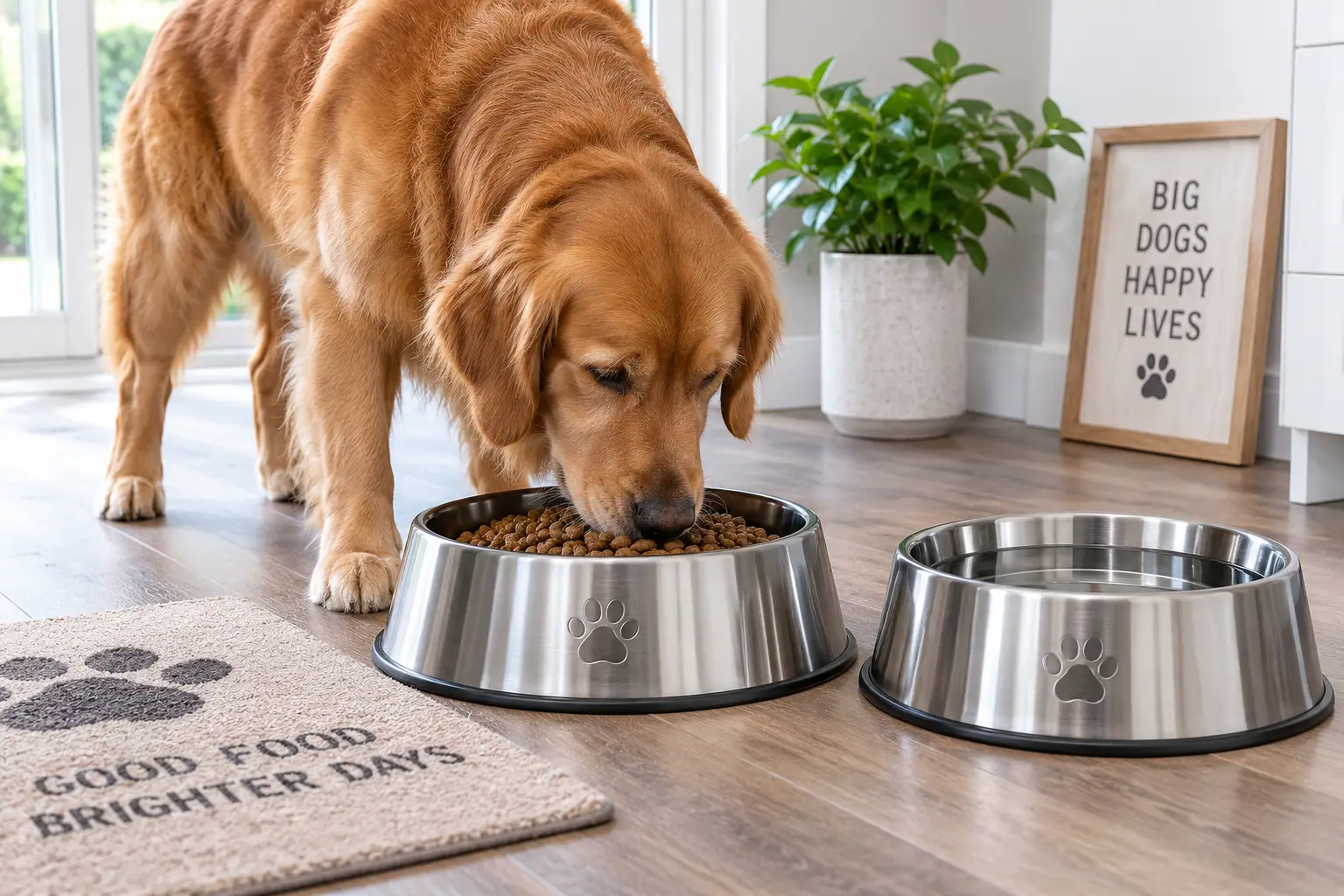
If you share your home with a Labrador, a German Shepherd, or a Great Dane, you already know that “big dog” and “delicate feeding equipment” don’t mix. A flimsy bowl gets shoved across the kitchen floor, chewed at the rim, or knocked over mid-meal, and suddenly dinner is a puddle. That’s exactly why so many large-breed owners are searching for stainless steel dog bowls for large dogs instead of sticking with plastic or ceramic.
So, what is a stainless steel dog bowl for a large dog, exactly? In short: it’s a feeding or watering dish made from food-grade (usually 304-grade) steel, sized to hold roughly 5 to 10 cups of food or water, and typically paired with a rubber, silicone, or weighted base to resist tipping, sliding, and the general chaos that comes with a 60-plus-pound eater.
This guide skips the marketing fluff. We researched real, currently available products, cross-referenced verified specs, and pulled in genuine aggregated customer sentiment so you can compare large breed dog bowls stainless steel options honestly — capacity, stability, price range, and durability side by side. We’ll also dig into a few things most listings never mention, like why some veterinarians now caution against elevated feeding for deep-chested breeds, and how to actually judge whether a bowl labeled “food grade” stainless steel, such as 304 stainless steel, is worth the extra cost over a cheaper alternative.
By the end, you’ll know exactly which of the top stainless steel dog bowls for large dogs fits your dog’s size, eating style, and your household’s budget — plus how to set it up, maintain it, and avoid the mistakes that send owners back to the store within a month.
Affiliate partnership disclosure: This post contains affiliate links. As an Amazon Associate, I earn from qualifying purchases made through these links, at no additional cost to you.
Quick Comparison: Top Stainless Steel Dog Bowls for Large Dogs
For readers who want the short version before diving into the full reviews, here’s how five of our top picks stack up at a glance.
| Bowl | Capacity | Style | Best For |
|---|---|---|---|
| Gorilla Grip Stainless Steel Dog Bowl Set | 8 cups (64 fl oz) | Standard, silicone base | Large dogs on a budget |
| Durapet Premium Stainless Steel Bowl | Up to 6.75 cups | Standard, bonded rubber ring | No-tip stability |
| Frisco Non-Skid Slow Feeder Stainless Steel Bowl | 4 cups | Standard, ridged slow feeder | Fast/gulping eaters |
| IRIS USA Elevated Dog Bowls | 64 oz per bowl | Elevated, adjustable height | Senior or arthritic dogs |
| Neater Feeder Deluxe for Large Dogs | 5 cups food / 88 oz water | Elevated, mess-proof station | Messy eaters and drinkers |
Looking at this snapshot, capacity and stability tend to trade off against portability and price: the deeper, heavier bowls like the Gorilla Grip Stainless Steel Dog Bowl Set hold more food per fill but sacrifice the ergonomic benefits of a raised design, while the Neater Feeder Deluxe for Large Dogs costs more but contains spills far better than any flat bowl can. If your dog is a normal, healthy adult with no joint issues, a simple non-tip bowl like the Durapet Premium Stainless Steel Bowl is usually the safer and cheaper starting point.
💬 One click helps other shoppers make an informed choice too! 😊
The 7 Best Stainless Steel Dog Bowls for Large Dogs, Reviewed
We evaluated dozens of large breed dog bowls stainless steel options against four criteria: real capacity for big appetites, tip-resistance, build quality (gauge thickness, rubber bonding, weld quality), and genuine aggregated review sentiment. These seven made the cut, covering everything from budget doubles to elevated feeding stations.
1. Gorilla Grip Stainless Steel Dog Bowl Set — best value at large capacity
The Gorilla Grip set is the bowl most large-dog owners land on when they just want something that holds enough food and doesn’t skid across the floor. Made from food-grade 304 stainless steel, it’s sold in five sizes up to an 8-cup (64 fl oz) capacity — plenty for a single large meal for a 70- to 100-pound dog without needing a refill mid-feeding. The silicone base isn’t fully “non-tip,” but it dramatically cuts down on the sliding and clanging that plain metal bowls produce on tile or hardwood.
What most buyers overlook with this model is that the silicone bottom also protects hardwood and laminate floors from scratches, which matters more than it sounds once you’ve lived with a bowl that grinds grit into your flooring every mealtime. Reviews consistently report that the bowls hold up well to daily dishwasher cycles without discoloring or developing a metallic smell, and that the rims stay smooth even after enthusiastic chewers gnaw at the edges. A common complaint in customer reviews is that a truly determined 90-pound eater can still nudge the bowl a few inches during frantic eating, so it isn’t marketed as a full no-tip solution.
Pros:
- ✅ Large 8-cup capacity fits big meals without refills
- ✅ Food-grade 304 steel resists rust and odor
- ✅ Silicone base protects floors and reduces noise
Cons:
- ❌ Not fully tip-proof for very forceful eaters
- ❌ Silicone base can yellow with heavy dishwasher use over time
Priced in the $18–$25 range for the large set at the time of writing, this is one of the better value-for-money picks in this guide — you’re paying primarily for the steel and capacity, not for extras.
2. Durapet Premium Stainless Steel Bowl — best no-tip stability
The Durapet Premium has built a buy-it-for-life reputation among large-dog owners for one specific reason: a bonded rubber ring is permanently fused around the base, not just glued on as an afterthought. That construction means the bowl genuinely resists tipping, sliding, and rattling, even when a determined 80-pound dog leans into it mid-meal.
Beyond the rubber ring, the bowl itself uses a heavier gauge of steel than most budget competitors, which translates to real dent resistance if your dog treats mealtime like a contact sport. Based on comparing the specs against lighter-gauge alternatives, the extra material thickness is the main reason this bowl commands a slightly higher price — you’re paying for durability that shows up years down the line, not months. Reviews consistently report that the same design works equally well for multi-pet households mixing cats and large dogs, since the bowl is dishwasher-safe and doesn’t develop the pitting that cheaper steel sometimes does.
Pros:
- ✅ Bonded rubber ring makes it genuinely tip-resistant
- ✅ Heavy-gauge steel resists denting long-term
- ✅ Works for both dogs and cats in mixed households
Cons:
- ❌ Smaller capacity than dedicated large-breed feeding bowls
- ❌ Premium construction comes at a higher per-bowl price
Expect to pay in the $20–$35 range per bowl, depending on size, which puts it above entry-level sets but below most elevated feeding systems — a fair trade for buyers whose top priority is stability over sheer capacity.
3. Frisco Non-Skid Slow Feeder Stainless Steel Bowl — best for fast eaters
Dogs that inhale their food are at a higher risk of choking, vomiting, and — in large and giant breeds — bloat. The Frisco Non-Skid Slow Feeder addresses that directly by using raised stainless ridges molded into the bowl itself, turning a fast dog’s dinner into something closer to a puzzle they have to work around.
What sets this model apart from plastic slow-feeder alternatives is that the ridges are stainless steel rather than molded plastic, so they won’t crack, splinter, or trap bacteria in scratched grooves the way plastic slow feeders eventually do. Here’s what to weigh: the ridged interior does reduce the bowl’s effective food capacity compared to a flat bowl of the same outer size, so very large dogs may need the biggest available size to get a full meal in. Reviews consistently report noticeably slower eating times — several owners describe mealtimes roughly doubling in length — and fewer post-meal regurgitation episodes, which lines up with what the ridge design is built to do.
Pros:
- ✅ Stainless ridges slow gulping without plastic parts
- ✅ Non-skid base keeps it steady during frantic eating
- ✅ Easier to sanitize than grooved plastic slow feeders
Cons:
- ❌ Ridged design reduces usable capacity versus a flat bowl
- ❌ Not a substitute for veterinary guidance on bloat-prone breeds
This bowl typically runs in the $15–$25 range, making it one of the more affordable ways to address fast eating without buying a specialized feeding station.
4. IRIS USA Elevated Dog Bowls — best adjustable elevated set
For large dogs with arthritis, or seniors who strain to lower their head all the way to the floor, the IRIS USA Elevated Dog Bowls offer a middle ground: two thick, 64-ounce stainless steel bowls set into an adjustable stand with a raised outer rim to catch spills.
The adjustability is the standout feature here — you can raise or lower the stand as your dog grows, loses mobility with age, or simply prefers a different height. What most buyers overlook with elevated feeders in general is that height should be set so your dog’s neck stays roughly level, not stretched upward or hunched down; too tall a setting can be just as uncomfortable as no elevation at all. Reviews consistently report that the bowls lift out cleanly for dishwasher cleaning and that the stand itself is sturdy enough not to wobble under a large dog’s weight, though a handful of buyers note the plastic stand shows wear faster than the steel bowls themselves.
Pros:
- ✅ Adjustable height suits growing or aging large dogs
- ✅ Thick-gauge steel bowls resist denting and warping
- ✅ Raised rim helps contain splashes and spills
Cons:
- ❌ Elevated feeding carries bloat-risk considerations for deep-chested breeds
- ❌ Plastic stand components wear faster than the steel bowls
Priced roughly in the $40–$60 range, this sits mid-pack in cost — more than a flat bowl, less than a full mess-proof feeding station.
5. Neater Feeder Deluxe for Large Dogs — best mess-proof feeding station
If your large dog is less “polite eater” and more “kibble scattered across a five-foot radius,” the Neater Feeder Deluxe for Large Dogs is purpose-built for that exact problem. Designed for dogs over 40 pounds and made in the USA, it pairs stainless steel bowls with a raised outer basin that catches spilled water and stray kibble instead of letting it hit your floor.
The basin design is what genuinely separates this from a standard elevated bowl: even a sloppy drinker splashing water over the rim ends up containing the mess inside the unit rather than soaking your kitchen tile. Based on comparing this against simpler elevated stands, the extra catch-basin engineering is exactly why it costs more — you’re buying a containment system, not just a raised bowl. Reviews consistently report that the leg extensions (sold as an add-on) let owners raise the unit further for very tall breeds, and that the stainless bowls themselves lift out easily for cleaning, though the plastic base requires hand-washing rather than a full dishwasher cycle.
Pros:
- ✅ Catch-basin design genuinely contains spills and splashes
- ✅ Built specifically for dogs over 40 pounds
- ✅ Leg extensions available for extra-tall large breeds
Cons:
- ❌ Plastic base isn’t dishwasher-safe, only the steel bowls are
- ❌ Highest price point among the elevated options in this guide
At around $80–$100, this is the priciest pick here, but for households genuinely fighting daily mess, the price reflects real engineering rather than marketing polish.
6. Frisco Marble Print Double Elevated Feeder — best budget elevated stand
For large breeds, seniors, and any dog that strains to reach the floor, the Frisco Marble Print Double Elevated set raises two stainless steel bowls to a more comfortable height without the premium price tag of a mess-proof system. Both bowls lift out for cleaning and are dishwasher-safe, and the marble-print stand reads as noticeably more expensive than it actually is.
What the spec sheet doesn’t say, but reviews reveal, is that this stand tends to run a bit lighter than metal-framed elevated stands, so it’s best suited to calmer eaters rather than dogs that lean hard into their bowl. Still, for the price, it delivers real ergonomic benefit: less neck and shoulder strain at mealtime, which matters for older large dogs managing joint pain. If your vet has flagged a bloat risk for your specific dog, it’s worth raising this point before switching to any elevated feeder, fast eaters especially.
Pros:
- ✅ Attractive marble-print stand at a budget price
- ✅ Both bowls are dishwasher-safe and easy to remove
- ✅ Comfortable height reduction for seniors and arthritic dogs
Cons:
- ❌ Lighter stand than premium elevated feeders
- ❌ Fixed height, not adjustable as your dog’s needs change
Expect a price range of roughly $30–$45, making it one of the more accessible elevated options for large-breed owners testing whether raised feeding helps their dog.
7. PEGYY11 Nonslip Stainless Steel Dog Bowls — best everyday budget pick
Sometimes you don’t need a feeding system — you just need a reliable, no-frills bowl that won’t slide or rust. The PEGYY11 Nonslip Stainless Steel Dog Bowls, sold as a 2-count set at roughly 7.6 cups each, cover that need without asking you to spend on features a healthy adult dog doesn’t require.
Constructed from stainless steel with a silicone base, the set is explicitly marketed as BPA-free and non-toxic, which matters if your household also has young kids handling the bowls during cleanup. The distinguishing benefit here is simplicity: no elevated stand to assemble, no adjustable legs, just a wide, stable bowl sized for medium-to-large dogs. Reviews consistently report solid non-slip performance on tile and hardwood, with the main gripe being that the silicone base, like most in this price bracket, can eventually loosen slightly at the edges after a year or more of daily washing.
Pros:
- ✅ Generous 7.6-cup capacity per bowl
- ✅ BPA-free, non-toxic materials for family households
- ✅ Straightforward, low-maintenance design
Cons:
- ❌ Silicone base may loosen slightly with long-term heavy washing
- ❌ No elevation option for dogs needing ergonomic feeding
At around $20–$30 for the set, it’s one of the most budget-friendly ways to get two genuinely large-capacity stainless bowls into daily rotation.
How the Top 7 Compare
| Product | Capacity | Style | Price Range | Best For |
|---|---|---|---|---|
| Gorilla Grip Stainless Steel Dog Bowl Set | Up to 8 cups | Flat, silicone base | $18–$25 | Budget large-capacity feeding |
| Durapet Premium Stainless Steel Bowl | Up to 6.75 cups | Flat, bonded rubber ring | $20–$35 | Maximum tip resistance |
| Frisco Non-Skid Slow Feeder Stainless Steel Bowl | 4 cups | Flat, ridged interior | $15–$25 | Fast eaters, bloat-conscious owners |
| IRIS USA Elevated Dog Bowls | 64 oz per bowl | Elevated, adjustable | $40–$60 | Arthritic or aging large dogs |
| Neater Feeder Deluxe for Large Dogs | 5 cups / 88 oz | Elevated, mess-proof basin | $80–$100 | Messy eaters and drinkers |
| Frisco Marble Print Double Elevated Feeder | Standard double bowls | Elevated, fixed height | $30–$45 | Budget-conscious elevated feeding |
| PEGYY11 Nonslip Stainless Steel Dog Bowls | 7.6 cups each | Flat, silicone base | $20–$30 | Simple, everyday budget bowls |
Scanning this table, a clear pattern emerges: the Gorilla Grip Stainless Steel Dog Bowl Set and PEGYY11 Nonslip Stainless Steel Dog Bowls offer the most capacity per dollar for straightforward flat feeding, while the Durapet Premium Stainless Steel Bowl and Frisco Non-Skid Slow Feeder Stainless Steel Bowl solve specific behavioral problems — tipping and gulping, respectively — rather than competing purely on size. The elevated options cluster at the top of the price range, which reflects the added engineering of stands and basins rather than the steel itself costing more.
<h4>✨ Don’t miss these exclusive deals!</h4>
🔍 Take your large dog’s feeding setup to the next level with this carefully curated lineup. Click a highlighted item to check current pricing and availability. These picks will help your big dog eat comfortably, safely, and without turning your kitchen into a mess zone!
How to Choose Stainless Steel Dog Bowls for Large Dogs
Picking the right bowl isn’t just about grabbing the biggest one on the shelf. Here’s the reasoning experienced large-dog owners use, broken into concrete steps:
- Match capacity to your dog’s meal size, not their body weight alone. A 90-pound dog on two smaller meals a day may need less bowl than a 70-pound dog eating one large meal — measure your dog’s actual portion in cups first.
- Check the steel grade before the price. Look specifically for “304” or “18/8” stainless steel; it’s more corrosion-resistant than the cheaper 201 grade that’s common in unbranded imports.
- Prioritize a bonded (not glued) non-slip base. Glued rubber rings peel off within months of dishwasher cycles; bonded or molded bases hold up far longer.
- Decide on elevation only for a specific reason. Raise the bowl for arthritis, megaesophagus, or a short-necked breed — not simply because raised feeders look sleeker in photos.
- Consider a slow-feeder texture if your dog gulps. Fast eating is one of several documented risk factors tied to bloat in large and giant breeds, so a ridged bowl is a low-cost precaution.
- Factor in dishwasher compatibility. Stainless steel itself is almost always dishwasher-safe, but silicone and plastic bases vary — check the listing specifically.
- Budget for replacement bowls, not just the stand. If you’re buying an elevated feeder, confirm replacement stainless inserts are sold separately, since bowls wear out faster than stands.
Non-Tip Dog Bowls for Large Dogs: Why Stability Matters
A bowl that slides across the floor isn’t just annoying — for large dogs, it can genuinely disrupt eating and drinking behavior. What most buyers overlook with non-tip dog bowls for large dogs is that stability isn’t really about weight alone; it’s about the interaction between the base material and your specific flooring. A heavy steel bowl with no rubber base can still skate across polished tile, while a lighter bowl with a properly bonded silicone ring stays put on the same surface.
Based on comparing the products in this guide, the Durapet Premium Stainless Steel Bowl delivers the most reliable non-tip performance because the rubber ring is fused rather than adhered, so it can’t peel away with repeated washing. Budget sets like the Gorilla Grip Stainless Steel Dog Bowl Set and PEGYY11 Nonslip Stainless Steel Dog Bowls offer good, not perfect, resistance — fine for moderate eaters, less ideal for a large dog that shoves its bowl while eating. If tipping is a persistent problem in your home, look specifically for a bonded rubber ring rather than a peel-and-stick silicone pad, and consider placing the bowl on a textured mat as a low-cost second layer of grip.
Elevated vs. Standard Stainless Steel Dog Bowls for Large Dogs
This is the section most product listings skip entirely, and it’s arguably the most important one for large-breed owners. Elevated dog bowls for large dogs were popularized on the assumption that raising the bowl to chest height eases swallowing and reduces strain — and for specific dogs, that’s still true. Veterinarians commonly recommend raised feeding for senior dogs with arthritis, dogs recovering from certain injuries, and dogs with megaesophagus, where gravity genuinely helps move food toward the stomach.
However, the picture is more complicated for healthy large and giant breeds. A widely cited study tracked large and giant-breed dogs and found feeding from a raised bowl was associated with a higher risk of gastric dilatation-volvulus, commonly known as bloat — a sudden, life-threatening emergency. A detailed explainer from Whole Dog Journal walks through this research in more depth, and later studies have produced mixed results, so the topic remains genuinely debated among veterinary professionals rather than settled either way.
Here’s what to weigh: if your dog is healthy, a normal eating pace, and shows no signs of joint discomfort, there’s no strong evidence a raised bowl improves digestion — floor-level, non-tip bowls like the Durapet Premium Stainless Steel Bowl or Gorilla Grip Stainless Steel Dog Bowl Set remain the lower-risk default. If your dog is a senior, arthritic, or has a diagnosed swallowing condition, an elevated option like the IRIS USA Elevated Dog Bowls or Neater Feeder Deluxe for Large Dogs may genuinely improve comfort — just discuss it with your veterinarian first, especially for deep-chested breeds with any bloat risk factors.
Stainless Steel vs. Plastic and Ceramic Dog Bowls
Material choice matters just as much as size for large dogs, who tend to eat and drink with more force than smaller breeds.
| Material | Durability | Hygiene | Weight/Stability | Typical Price |
|---|---|---|---|---|
| Stainless steel | Very high, dent-resistant | Non-porous, doesn’t hold bacteria | Light unless weighted base | $15–$100 |
| Plastic | Cracks and scratches over time | Scratches trap bacteria and odor | Very light, tips easily | $8–$25 |
| Ceramic | Chips and can crack | Non-porous if glaze is intact | Heavy, naturally stable | $15–$40 |
Stainless steel wins on the two factors that matter most for large-dog owners: it’s non-porous, so it doesn’t scratch and trap food residue, bacteria, and biofilm the way plastic does, and it holds up to years of daily chewing and dishwasher cycles without degrading. Ceramic can match steel’s stability thanks to its natural weight, but it’s genuinely fragile — a single drop from a countertop, or an enthusiastic large dog knocking it against a tile floor, can chip or crack it, sometimes creating sharp edges. Plastic is the cheapest option by a wide margin, but it’s also the one most likely to develop the scratches and micro-grooves that harbor bacteria over time, which is a bigger deal for large dogs eating raw or wet food that sits in the bowl longer.
💬 One click helps other shoppers make an informed choice too! 😊
Getting Your New Bowl Set Up Right: A Practical Guide
Buying the right stainless steel dog bowl for your large dog is only half the job — how you introduce and maintain it affects both hygiene and how quickly your dog adapts.
First, wash the bowl thoroughly before first use, even though most stainless steel bowls arrive clean; manufacturing residue and packaging dust are common and easy to miss. Second, if you’re switching from plastic or ceramic, expect a short adjustment period — some dogs are briefly wary of the sound stainless steel makes against teeth or floors, so placing the bowl on a non-slip mat for the first week can ease the transition. Third, set a maintenance rhythm early: wash food bowls after every meal (bacteria builds up fast in wet food residue) and water bowls at least once daily, since stagnant water in a warm kitchen is a breeding ground for bacteria even in a non-porous bowl.
Watch for early warning signs that a bowl isn’t the right fit: persistent skidding despite a non-slip base, your dog pawing at the bowl to reposition it, or visible scratching on hardwood floors underneath. In the first 30 days, the most common mistake is choosing a bowl based on looks rather than measured capacity — if you’re refilling mid-meal, size up rather than assuming your dog is simply a fast eater. Finally, inspect the rim and base monthly for early rust spots (rare with genuine 304 steel, more common with mystery-grade imports) or peeling on rubber/silicone bases, since catching wear early is cheaper than replacing the whole bowl.
Real-World Scenarios: Matching the Right Bowl to Your Large Dog
Every large dog’s household is different, so here’s how three common profiles map to the picks above.
The budget-conscious multi-dog household: If you’re feeding two or three large dogs on a tight budget, capacity and cost per bowl matter more than extras. The Gorilla Grip Stainless Steel Dog Bowl Set or PEGYY11 Nonslip Stainless Steel Dog Bowls deliver generous capacity at the lowest price point in this guide, and buying two sets is still cheaper than one premium elevated station.
The senior dog with joint pain: For an aging Golden Retriever or Labrador struggling to lower their head comfortably, elevation genuinely helps — but so does discussing bloat risk with your vet first. The IRIS USA Elevated Dog Bowls offers adjustable height so you can dial in exactly the right level as mobility changes, while the Frisco Marble Print Double Elevated Feeder covers the same need at a lower price if adjustability isn’t essential.
The fast eater in a house with hardwood floors: If your large dog gulps food and shoves the bowl mid-meal, stability and slow-feeding matter more than raw capacity. Pairing the Frisco Non-Skid Slow Feeder Stainless Steel Bowl for food with the Durapet Premium Stainless Steel Bowl for water addresses both the gulping and the sliding in one setup, without the mess-containment premium of a full feeding station.
Common Mistakes to Avoid When Buying Stainless Steel Dog Bowls for Large Dogs
Even with a good bowl in hand, a few recurring mistakes undercut the benefits:
- Buying “large” without checking cup capacity. Sizing labels vary wildly between brands; always cross-check the listed cup or fluid-ounce measurement against your dog’s actual portion.
- Assuming all stainless steel is equal. Unbranded imports sometimes use lower-grade steel that’s more prone to pitting; look for an explicit “304” or “18/8” callout in the listing.
- Ignoring the base material. A gorgeous bowl with no non-slip base will still skid across tile, no matter how heavy the steel is.
- Elevating a healthy large dog “just because.” As covered above, elevation should solve a specific problem, not be a default upgrade.
- Skipping daily cleaning because “it’s just water.” Stagnant water bowls develop biofilm even in stainless steel; rinse and refill at least once a day.
Safety, Regulations, and Standards for Large-Breed Dog Bowls
Stainless steel dog bowls sold in the US aren’t subject to a dedicated federal safety standard the way children’s products are, but reputable brands still follow food-contact material guidance that applies to stainless steel cookware and tableware generally — which is why “food-grade” and “304 stainless steel” claims matter more than marketing copy about durability. Genuine 304-grade steel is nonporous, doesn’t leach into food or water at normal room temperatures, and resists the pitting that can otherwise harbor bacteria over years of use.
The more pressing safety consideration for large-breed owners isn’t the bowl material — it’s how and where you feed. As discussed earlier, Cornell University’s College of Veterinary Medicine notes that gastric dilatation-volvulus is a life-threatening emergency most common in large, deep-chested dogs, and that feeding practices — including bowl elevation and eating speed — are among the factors veterinarians weigh when assessing risk. If your dog is a breed commonly associated with bloat, it’s worth a direct conversation with your vet about feeding setup, not just food choice, before settling on an elevated feeder.
Long-Term Cost and Maintenance
A cheap plastic bowl might cost $8, but if it cracks, stains, or gets replaced every six months because your large dog chews the rim, the real cost adds up fast. Stainless steel bowls flip that math: the $15–$35 you spend upfront on a quality flat bowl, or $40–$100 on an elevated system, typically buys years of daily use without replacement, since genuine food-grade steel resists the dents, cracks, and staining that end plastic and low-end ceramic bowls prematurely.
Ongoing costs are minimal — daily dishwasher cycles don’t meaningfully wear stainless steel, unlike plastic, which can degrade and cloud over time. The main recurring expense is replacing rubber or silicone bases every year or two once they start to loosen, and, for elevated systems like the Neater Feeder Deluxe for Large Dogs, occasionally replacing the stainless steel insert bowls separately from the stand. Factoring in that most large-dog owners replace a low-quality plastic bowl two to three times over the same period a steel bowl lasts, the total cost of ownership for stainless steel is often lower over a three-to-five-year window, even though the sticker price is higher on day one.
Heavy Duty Dog Bowls for Large Breeds: Problem → Solution Guide
Large-dog feeding comes with recurring, predictable problems. Here’s how to solve the most common ones with heavy duty dog bowls for large breeds:
Problem: The bowl slides across the kitchen floor during meals. Solution: Switch to a model with a bonded (not glued) rubber base, like the Durapet Premium Stainless Steel Bowl, or add a rubber-backed mat under any bowl you already own.
Problem: Your dog finishes food in seconds and then vomits or regurgitates. Solution: A ridged slow-feeder design such as the Frisco Non-Skid Slow Feeder Stainless Steel Bowl physically forces a slower pace without switching to a puzzle feeder.
Problem: Water bowls get knocked over, especially outdoors or in multi-dog homes. Solution: Choose a wider-based, heavier-gauge bowl like the Gorilla Grip Stainless Steel Dog Bowl Set in its largest size, which is harder to tip than narrower designs.
Problem: Senior dog struggles to lower their head comfortably. Solution: An adjustable elevated set like the IRIS USA Elevated Dog Bowls lets you dial in a comfortable height gradually as mobility changes — with your vet’s input given the bloat considerations covered earlier.
Problem: Food and water end up sprayed across the floor daily. Solution: A catch-basin design like the Neater Feeder Deluxe for Large Dogs contains splashes and stray kibble that a flat bowl simply can’t.
Frequently Asked Questions
❓ Are stainless steel bowls better than plastic for large dogs?
❓ What size stainless steel dog bowl does a large dog need?
❓ Do elevated bowls help large dogs, or increase bloat risk?
❓ How often should I wash my dog's stainless steel bowl?
❓ Are non-tip dog bowls worth it for large breeds?
Conclusion
Choosing among stainless steel dog bowls for large dogs really comes down to matching the bowl to a specific problem rather than chasing the flashiest option on the shelf. If your dog is a healthy, normal-paced eater, a simple, well-built non-tip bowl like the Durapet Premium Stainless Steel Bowl or a large-capacity budget set like the Gorilla Grip Stainless Steel Dog Bowl Set will serve you well for years. If gulping is the issue, the Frisco Non-Skid Slow Feeder Stainless Steel Bowl is a low-cost, low-risk fix. And if your dog is a senior, arthritic, or otherwise has a documented reason to eat from a raised position, options like the IRIS USA Elevated Dog Bowls or Neater Feeder Deluxe for Large Dogs can genuinely improve comfort — just loop your vet in first, particularly for breeds known to carry higher bloat risk.
Whatever you choose, prioritize genuine food-grade 304 steel, a bonded (not glued) non-slip base, and a capacity that actually matches your dog’s real meal size. Get those three things right, and the bowl itself becomes one less thing you have to think about at mealtime — which, with a large dog, is exactly the goal.
<h4>✨ Ready to upgrade your large dog’s bowl?</h4>
🐾 Check current prices and availability on today’s top picks, and give your big dog a feeding setup built to last. A stable, properly sized bowl makes every meal easier — for both of you!
Recommended for You
- Best Dog Feeding Bowl: 7 Top Picks for 2026 (Vet-Backed Guide)
- Pretty Dog Bowls: 7 Stylish Choices for a Happy Pup
- Ceramic Water Bowl Dog Owners Trust: 7 Best Non-Tip Picks (2026)
Disclaimer: This post contains affiliate links. As an Amazon Associate, I earn from qualifying purchases made through these links, at no additional cost to you.
✨ Found this article helpful? Share it with someone who needs it! 💬🤗