In This Article
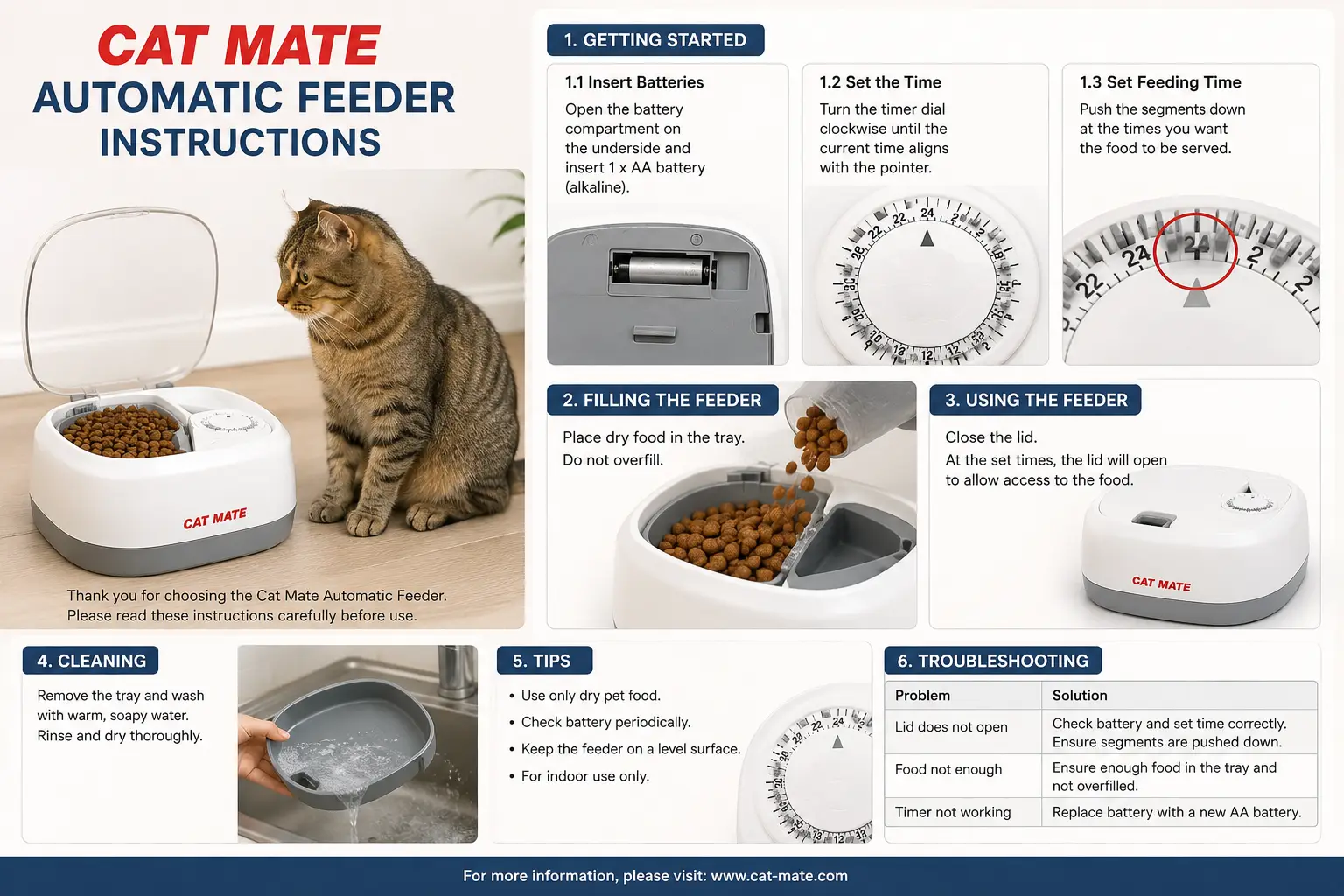
If you’ve just pulled a Cat Mate feeder out of the box and you’re staring at a set of buttons wondering which one sets the clock, you’re in good company. Cat mate automatic feeder instructions look simple on paper — insert batteries, set the time, program the meals — but the actual button sequence trips up a lot of first-time owners, especially on the digital models where a mistimed press resets the whole schedule. This guide walks through exactly how the major Cat Mate models work, then digs into seven real automatic feeders (Cat Mate and a couple of worthy competitors) so you can decide which one actually fits your cat’s routine, not just which one looked good in a five-star review.
What is a Cat Mate automatic feeder? It’s a battery-operated pet feeder that opens a lid, rotates a tray, or unlocks a compartment at pre-set times, so your cat gets fed on schedule even when you’re at work, asleep, or traveling — no smart-home hub or subscription required.
We’ll cover setup, common troubleshooting, how to pick between analog and digital models, and how Cat Mate stacks up against app-controlled competitors, based on real spec sheets, manufacturer manuals, and aggregated customer feedback — not guesswork.
Quick Comparison: Cat Mate Automatic Feeders at a Glance
| Feeder | Meals/Day | Timer Type | Best For |
|---|---|---|---|
| Cat Mate C20 | 2 | Analog dial | Single cat, weekend trips |
| Cat Mate C50 | 5 | Analog dial | Multi-day, low-tech setup |
| Cat Mate C300 | 3 | Digital LCD | Everyday wet/dry feeding |
| Cat Mate C500 | 5 | Digital LCD | Multiple daily meals |
| Cat Mate C3000 | 3 | Digital LCD | Dry food, diabetic cats |
| PetSafe 5-Meal | 5 | Digital dial-tray | Dry food, simple reliability |
| PETLIBRO WiFi Feeder | Up to 10 | App-controlled | Remote scheduling, tech-savvy owners |
Looking at the table above, the analog Cat Mate C20 and Cat Mate C50 win on simplicity and battery life, but they trade away precision — the dials can’t be set to the exact minute, which matters if you’re managing a diabetic cat’s medication schedule. The digital models, led by the Cat Mate C500 and Cat Mate C3000, close that gap with minute-level programming, while the PETLIBRO WiFi Feeder goes a step further with remote scheduling from your phone. Budget-focused shoppers should note that reliability, not just meal count, is what separates a good feeder from a frustrating one — a theme we’ll come back to throughout this guide.
💬 Bookmark this guide before your trip — set your feeder up the right way the first time! 😊
Top 7 Automatic Cat Feeders (Cat Mate and Beyond)
1. Cat Mate C20 — simplest analog setup for one cat
If you want an automatic feeder with zero learning curve, the Cat Mate C20 is about as close as it gets. Setting cat mate automatic feeder instructions to work on this model means turning two dials to the number of hours until the next feed — no digital menu, no clock to set. The two-bowl design lets you feed one cat twice or split a single meal between two cats, and each bowl sits over an ice pack to keep wet food from spoiling for up to 48 hours. A single AA battery is rated for roughly a year of use, which is a genuine advantage over the digital models that eat through batteries faster. This feeder is best suited to single-cat households or owners who only need coverage for a weekend, not extended trips. Reviews consistently report that the dial mechanism is reliable for basic scheduling but not perfectly synchronized between the two lids, so in multi-cat homes a dominant eater can sometimes reach both bowls at once. A common complaint in customer reviews is that the battery compartment lacks a secure retention clip, so some owners tape it shut as a precaution. Given its low price and dead-simple operation, the Cat Mate C20 is one of the best values in the category for anyone who just needs a no-frills backup feeder.
Pros:
- ✅ Extremely simple dial-based setup, no clock required
- ✅ Single AA battery lasts up to a year
- ✅ Ice pack keeps wet food fresh up to 48 hours
Cons:
- ❌ Two lids don’t always open in perfect sync
- ❌ No digital display or minute-level precision
Priced in the under-$25 range, the Cat Mate C20 delivers strong value for anyone who wants automation without complexity.
2. Cat Mate C50 — five meals without a digital learning curve
The Cat Mate C50 scales up the same analog philosophy to five feeding compartments, making it a solid middle ground between the bare-bones C20 and the digital C-series models. Setup uses red pegs on a rotating timer dial: you push down a peg at each desired meal time, and the lid rotates to reveal the next compartment automatically, covering up to 90 hours before a refill is needed. That means a long weekend away is realistic without asking a neighbor to check in. The twin ice packs underneath the compartments help wet food stay appetizing longer than a single-pack design, which matters if your cat won’t touch food that’s started to dry out. This feeder is best for owners who want more meals than the C20 offers but are wary of programming a digital timer under time pressure before a trip. What most buyers overlook with this model is that the first meal peg needs to be set at least four hours out and subsequent pegs at least six hours apart — skip that spacing and the timing gets thrown off. Reviews consistently report accurate rotation once the pegs are set correctly, with occasional complaints about the mechanism’s reliability after several years of daily use.
Pros:
- ✅ Up to five meals over a 90-hour cycle
- ✅ No digital programming — set and walk away
- ✅ Twin ice packs extend wet food freshness
Cons:
- ❌ Peg spacing rules are easy to get wrong the first time
- ❌ Long-term reviewers note the mechanism can wear with heavy use
At around $25 to $35, the Cat Mate C50 is a smart pick for owners who want more coverage than a two-meal feeder without committing to a digital interface.
3. Cat Mate C300 — the everyday digital feeder for wet and dry food
The Cat Mate C300 is the model most owners land on when they’ve outgrown analog dials but don’t need five daily meals. It programs up to three feeds — one available immediately, two on a digital timer — and each of its three compartments holds up to three-quarters of a pound of food, generous enough for a full canned-food serving. The LCD screen displays upcoming meal times at a glance and flags a low battery before it becomes a problem, which is a meaningful upgrade in practice: no more guessing why the feeder suddenly stopped opening on schedule. Based on comparing the specs against the C500, the C300 makes the most sense for owners feeding one to two meals a day who still want a visible readout, rather than five daily servings. Reviews consistently report that the feeder is easy to program and holds its schedule reliably, though a recurring theme in customer feedback is that the bowl’s depth can make some cats hesitant to put their whole face into the compartment — something worth testing with your specific cat before relying on it for an extended trip.
Pros:
- ✅ Digital LCD shows upcoming meal times clearly
- ✅ Generous three-quarter-pound compartments for wet food
- ✅ Low-battery warning prevents missed meals
Cons:
- ❌ Deep bowl shape isn’t ideal for every cat
- ❌ Only three meals max, fewer than the C500
Expect the Cat Mate C300 to fall in the $35 to $55 range, offering strong value for everyday two-to-three-meal routines.
4. Cat Mate C500 — five digital meals with the most flexible scheduling
The Cat Mate C500 is the flagship of the Cat Mate lineup and the model most cat mate automatic feeder instructions searches are actually about, since its LCD menu has the most steps to walk through. It programs up to four scheduled meals plus one that’s open from the start, each capped around 330 grams, which comfortably covers a full day of wet or dry food for most cats. What most buyers overlook with the digital models is that meal times can only be set in 10-minute increments — not exact-minute precision — which is a minor limitation worth knowing before you assume perfect timing. The dual ice packs and dishwasher-safe lid and bowl make daily cleanup manageable, and the three-year manufacturer guarantee signals real confidence in the mechanism’s longevity. This model is best for multi-meal households, cats on medically supervised feeding schedules, or owners who travel for a few days and need more than two servings covered. Reviews consistently report that the digital menu, while more capable than the analog models, has a real learning curve on first setup — expect to reference the manual for the first attempt at programming all four meal slots. The tamper-resistant lid design also earns consistent praise from owners of food-motivated cats who’ve defeated simpler feeders.
Pros:
- ✅ Up to five meals with 10-minute scheduling precision
- ✅ Dual ice packs keep wet food fresher longer
- ✅ Three-year manufacturer guarantee
Cons:
- ❌ Digital menu has a real learning curve at first
- ❌ Meal times can’t be set to the exact minute
Positioned in the $55 to $85 range, the Cat Mate C500 is the go-to pick for owners who need genuine flexibility across multiple daily meals.
5. Cat Mate C3000 — dry food precision for diabetic or weight-managed cats
Unlike the wet-food-friendly C300 and C500, the Cat Mate C3000 is built specifically for dry kibble, dispensing portions as small as two teaspoons with a 6.5-pound hopper that reduces how often you need to refill. Four feeding modes — a regular automatic schedule, an extra snack, an early feed override, and a frequent-feed mode — give it more flexibility for cats with specific dietary needs than any other Cat Mate model. That frequent-feed setting is particularly useful for cats managing diabetes or a vet-recommended weight plan, since it can break a day’s ration into many small portions rather than a few large ones. Based on comparing the specs sheet against similar dry-food dispensers, the anti-jam hopper design is a meaningful advantage over cheaper gravity feeders that can clog with irregularly shaped kibble. Aggregated ratings across major retailers put the C3000 in a solid but not spectacular range — roughly 3.7 to 4.3 stars depending on the platform — with reviewers consistently citing accurate portioning as the standout feature and occasional complaints about the price relative to simpler dry-food dispensers.
Pros:
- ✅ Four feeding modes, including a frequent-feed option
- ✅ 6.5-pound hopper reduces refill frequency
- ✅ Portion accuracy down to two teaspoons
Cons:
- ❌ Dry food only — no wet food compartment
- ❌ Priced higher than comparable dry-food dispensers
The Cat Mate C3000 typically lands in the $60 to $100 range, and buyers managing a cat’s diet closely tend to find it worth the premium.
6. PetSafe 5-Meal Automatic Pet Feeder — the reliable dry-food workhorse
Stepping outside the Cat Mate lineup, the PetSafe 5-Meal Automatic Pet Feeder is one of the most consistently recommended dry-food feeders on the market, having earned a spot among Wirecutter’s top picks in independent testing (see the Wirecutter automatic pet feeder guide for their full testing methodology). It uses a rotating five-compartment tray, each holding one cup of dry or semi-moist food, with one meal ready immediately and four more scheduled on a digital timer down to the minute — a genuine edge over Cat Mate’s 10-minute increments. Here’s what to weigh: the motor makes an audible rotating noise at each feed, which some owners find reassuring as an “it’s working” signal and others find startling for a skittish cat. Reviews consistently report strong reliability for straightforward dry-food scheduling, with an aggregated rating hovering around 4 out of 5 stars across thousands of Amazon reviews and roughly six in ten of those reviews landing at five stars. This feeder is best for households that want a dependable, no-frills dry-food solution and don’t need wet food or app connectivity.
Pros:
- ✅ Minute-level scheduling precision
- ✅ Widely reviewed with a strong reliability track record
- ✅ Simple one-cup compartments, easy to portion
Cons:
- ❌ Audible motor noise may startle skittish cats
- ❌ Dry and semi-moist food only, no ice pack for wet food
Expect to pay in the $50 to $70 range for the PetSafe 5-Meal Automatic Pet Feeder, a fair trade for its testing pedigree and consistent performance.
7. PETLIBRO WiFi Automatic Cat Feeder — app control for remote scheduling
For owners who want to adjust a feeding schedule from a phone rather than a physical dial, the PETLIBRO WiFi Automatic Cat Feeder represents the high end of this lineup. It connects over 2.4GHz or 5GHz WiFi to a companion app, letting you schedule up to ten meals a day, review a feeding log, and even record a short voice message that plays at mealtime — genuinely useful for cats who respond to a familiar voice cue. What the spec sheet doesn’t say, but reviews reveal, is that the voice-recording feature can be more novelty than necessity; several reviewers mention disabling it because the motor sound alone is enough to call their cat over. The sealed rotor design helps keep kibble fresh longer than an open hopper, and the app’s feeding history is genuinely useful for tracking whether a multi-cat household’s feeder is dispensing on schedule while you’re away. This model is best for tech-comfortable owners who travel frequently and want remote visibility rather than a “set it and forget it” analog approach. Aggregated third-party testing has placed PETLIBRO’s app-connected models among the more accurate performers for portion consistency in independent lab comparisons.
Pros:
- ✅ Remote scheduling and monitoring via smartphone app
- ✅ Feeding history log for peace of mind while traveling
- ✅ Sealed rotor helps preserve kibble freshness
Cons:
- ❌ Requires a stable WiFi connection to function remotely
- ❌ More moving parts than a manual model, more to troubleshoot
The PETLIBRO WiFi Automatic Cat Feeder generally runs in the $50 to $100 range depending on capacity and camera features, positioning it as a premium but justifiable option for connected households.
Comparing the Top 7: Features, Price Range, and Best Use
| Feeder | Food Type | Price Range | Best For |
|---|---|---|---|
| Cat Mate C20 | Wet/Dry | Under $25 | Single cat, weekends |
| Cat Mate C50 | Wet/Dry | $25–$35 | Long weekends, low-tech |
| Cat Mate C300 | Wet/Dry | $35–$55 | Daily 2–3 meal routines |
| Cat Mate C500 | Wet/Dry | $55–$85 | Multiple daily meals |
| Cat Mate C3000 | Dry only | $60–$100 | Diabetic/weight management |
| PetSafe 5-Meal | Dry/Semi-moist | $50–$70 | Reliable dry-food scheduling |
| PETLIBRO WiFi | Dry | $50–$100 | Remote app-based control |
This table makes the trade-off clear: the Cat Mate C3000 and PETLIBRO WiFi Automatic Cat Feeder justify their higher price ranges with real functional advantages — precision dry-food portioning and remote app control, respectively — while the Cat Mate C20 and Cat Mate C50 win on affordability for owners who don’t need those extras. If wet food freshness is your priority, the ice-pack-equipped Cat Mate C500 and Cat Mate C300 outperform the dry-food-only options in this lineup.
Advantages Over Traditional Feeding Methods
| Method | Portion Control | Works While You’re Away | Freshness for Wet Food |
|---|---|---|---|
| Free-feeding bowl | None | Yes, but overeating risk | Poor |
| Manual scheduled feeding | High | No, requires a person present | Good |
| Automatic timed feeder | High | Yes | Good, with ice pack models |
Free-feeding — just leaving a full bowl out — offers no portion control at all, and veterinary guidance consistently warns that unrestricted access encourages overeating and weight gain. An automatic timed feeder like the Cat Mate C500 or PetSafe 5-Meal Automatic Pet Feeder closes that gap by combining the portion control of manual feeding with the reliability of a device that doesn’t forget or oversleep. According to the Cornell Feline Health Center, the right feeding frequency depends heavily on a cat’s age and health, which is exactly the kind of nuance a programmable feeder handles better than a static bowl.
How to Program and Set Up Your Cat Mate Automatic Feeder
Getting cat mate automatic feeder instructions right the first time saves a lot of frustration later. Here’s the general process that applies across the digital C-series models, with brand-specific quirks noted where they matter.
- Insert fresh alkaline batteries in the correct orientation. Most digital Cat Mate models use 3 x AA batteries, while the analog C20 uses just one. Rechargeable and lithium batteries will run the unit, but the low-battery indicator is calibrated for standard alkaline cells and may not read accurately with other types.
- Let the unit complete its self-test. After power-up, the LCD will briefly cycle through a display test before settling on a flashing 12:00 clock — don’t press any buttons during this stage.
- Set the current time first. Skipping this step is the single most common setup mistake; every meal time you program afterward is calculated relative to the clock, so an incorrect clock throws off the whole schedule.
- Program each meal one at a time. Hold the ADJ/SET button until the hour digits flash, adjust with the up/down arrows, confirm, then repeat for minutes. On the C500 and C300, meal times can only be set in 10-minute increments.
- Test the feeder empty before loading real food. Run through one full cycle without food in the bowl to confirm the lid opens on schedule — this catches battery or mechanical issues before your cat’s meal is on the line.
- Load food and ice packs, then double-check the lid seals fully. A partially closed lid is the most common cause of a feeder opening between compartments rather than on a clean schedule.
- Do a dry run over 24 hours while you’re home. Confirm each meal dispenses at the intended time before relying on the feeder unsupervised over a weekend or longer trip.
Following these steps in order eliminates the vast majority of “why isn’t my feeder working” support calls that Cat Mate’s own troubleshooting documentation addresses.
Real-World Scenarios: Matching a Feeder to Your Household
Every household’s feeding needs look a little different, so here’s how three common situations map to the lineup above.
The single-cat apartment dweller who travels occasionally. If you’re gone for a weekend once a month and just need basic coverage, the Cat Mate C20 or Cat Mate C50 covers the essentials without the complexity of a digital menu. Budget for the C20 if it’s truly occasional use; step up to the C50 if those trips regularly stretch past two days.
The two-cat household with a diabetic cat on a strict schedule. Precision matters here more than meal count. The Cat Mate C3000‘s frequent-feed mode, paired with its accurate small-portion dispensing, is purpose-built for exactly this situation, and its dry-food focus works well if your vet has recommended a specific kibble diet. Pair it with a second, separate feeder if your other cat needs a different schedule.
The frequent business traveler who wants remote visibility. If a week-long trip is a regular occurrence and you want to confirm from your phone that meals are actually being dispensed, the PETLIBRO WiFi Automatic Cat Feeder is worth the premium over a Cat Mate analog or digital model. The feeding log alone can be the difference between anxious guessing and genuine peace of mind.
Common Cat Mate Feeder Problems and How to Fix Them
Even reliable feeders run into occasional hiccups. Here are the five issues that show up most often in aggregated customer feedback and manufacturer support documentation.
Problem: The lid opens between two compartments instead of cleanly on one. This usually means the food flap wasn’t fully closed before the last cycle. Solution: check that the lid clicks fully shut after each refill, and avoid overfilling compartments to the point where food props the flap open.
Problem: The drive wheel gets stuck at an odd angle. On digital models like the C500, manually forcing the wheel can make things worse. Solution: power off the unit, remove the batteries for a few minutes, then reinsert them — the wheel should self-correct to the proper position on restart.
Problem: The low-battery indicator flashes unexpectedly early. This is common with rechargeable or lithium batteries, since the indicator is calibrated for standard alkaline cells. Solution: switch to fresh alkaline batteries if accurate low-battery warnings matter to your routine.
Problem: Wet food dries out before the scheduled meal. The ice pack keeps food cool, not frozen, and its effectiveness drops after six to eight hours in a warm room. Solution: pre-freeze the food itself in the compartment when planning a longer gap between meals, and keep the feeder out of direct sunlight.
Problem: A cat learns to pry open compartments early. This shows up most with the tray-style feeders. Solution: mounting the unit to a wall or heavy board, as several manufacturers recommend for their C3000 and C500 models, removes the leverage a determined cat needs to tip or pry the unit open.
How to Choose the Right Automatic Cat Feeder
- Start with food type. Wet food needs an ice pack compartment like the Cat Mate C500 or C300; dry food opens up dispenser-style options like the Cat Mate C3000 or PetSafe 5-Meal Automatic Pet Feeder.
- Match meal count to your actual schedule, not the maximum the feeder offers. A cat eating twice a day doesn’t need a five-meal unit sitting mostly idle.
- Decide how much precision you actually need. Medically managed cats benefit from digital, minute-accurate scheduling; most healthy adult cats do fine with an analog dial.
- Factor in battery type and reliability. Analog models sip power for months at a time; digital and WiFi models need more frequent battery checks.
- Consider tamper resistance if your cat is food-motivated. Reviews consistently flag which models hold up against a persistent, hungry cat and which ones get pried open.
- Weigh app connectivity against simplicity. Remote control is genuinely useful for frequent travelers, but it’s one more thing that can fail if your WiFi drops.
- Check the cleaning requirements. Dishwasher-safe lids and bowls, standard on most Cat Mate models, save real time over units that require hand-washing every component.
Common Mistakes to Avoid When Buying an Automatic Feeder
Buyers often over-index on meal count and under-index on the details that actually determine day-to-day satisfaction. A common mistake is choosing a five-meal feeder for a cat that only eats twice a day, which just adds unused complexity. Another frequent misstep is ignoring compartment depth — a bowl that’s too deep can discourage a short-muzzled cat from eating fully, a pattern that shows up repeatedly in customer feedback on deeper-bowl models like the C300. Buyers also commonly skip the empty test-run step, only discovering a mechanical issue after the cat has already missed a meal. Finally, some shoppers assume all automatic feeders handle wet food equally well; in reality, only ice-pack-equipped models like the Cat Mate C500 are built for it, and using wet food in a dry-food dispenser like the Cat Mate C3000 or PetSafe 5-Meal Automatic Pet Feeder can clog the mechanism.
Cat Mate Feeders vs WiFi App-Controlled Feeders
The core trade-off between Cat Mate’s analog and digital lineup and app-controlled options like the PETLIBRO WiFi Automatic Cat Feeder comes down to control versus simplicity. Cat Mate feeders are entirely self-contained: once programmed, they need no internet connection and can’t be hacked or disrupted by a WiFi outage, which is a real advantage for owners who value reliability over flexibility. App-controlled feeders, by contrast, let you adjust a schedule on the fly from anywhere, review a feeding history, and in some models watch a live camera feed — genuinely valuable for anyone whose travel schedule shifts unpredictably. The trade-off is more points of potential failure: a dead WiFi router, an app update gone wrong, or a dead phone battery can all interfere with remote control in ways a purely mechanical Cat Mate timer never will. For most everyday households, a digital Cat Mate model like the C500 or C300 hits the sweet spot of precision without added complexity; frequent travelers who want visibility into whether meals actually happened are the clearest use case for stepping up to a connected feeder.
What to Expect: Everyday Performance
On paper, spec sheets make every feeder sound flawless, but daily use tells a more textured story. The analog Cat Mate C20 and C50 operate almost silently, which is a genuine plus for cats sensitive to mechanical noise, but that same silence means you won’t get an audible confirmation that a meal actually dispensed. Digital models like the Cat Mate C500 and PetSafe 5-Meal Automatic Pet Feeder make a distinct motor sound at each cycle — some cats learn to associate that sound with mealtime and come running, which functions as a built-in dinner bell. Portion accuracy varies more than most spec sheets admit: independent testing organizations that have run repeated dispensing trials on similar mechanisms have found that even top-performing feeders can vary by a meaningful percentage from their stated portion size, which is worth knowing if you’re managing a cat’s weight closely rather than just avoiding an empty bowl.
Long-Term Cost and Maintenance
Beyond the sticker price, ongoing costs matter. Digital and WiFi models go through AA batteries faster than analog dials — expect to replace them every few months on the Cat Mate C500 versus close to a year on the Cat Mate C20. Replacement ice packs and bowls are available for most Cat Mate models if the originals crack or go missing, typically at a modest cost compared to replacing the whole unit. WiFi-connected feeders like the PETLIBRO WiFi Automatic Cat Feeder may carry an optional paid app subscription for extended feeding history or premium features, though the core scheduling functions typically remain free. Factoring in a three-year manufacturer guarantee, as offered on the Cat Mate C500, the total cost of ownership skews favorably toward Cat Mate’s mid-range models when you weigh purchase price against expected lifespan and warranty coverage.
Safety, Regulations, and Standards
Automatic pet feeders fall under general consumer product safety oversight in the United States, and the Consumer Product Safety Commission maintains a public database where you can check whether any specific model has an active recall before or after purchase — a quick habit worth building for any electronic device that handles your pet’s food unsupervised. Look for feeders constructed from BPA-free plastic, as most current Cat Mate models are labeled, and keep battery compartments secured, since loose batteries pose a genuine ingestion hazard if a curious cat or small child gets access. If you buy a feeder through an affiliate link in an article like this one, transparency matters: publishers are required to follow the FTC’s endorsement guidelines for disclosing paid or commissioned relationships, which is why you’ll see a disclosure at the end of this article.
✨ Ready to stop guessing at feeding times? Check today’s availability and pick the feeder that fits your routine! 🔍
Automatic Feeders for Multi-Cat Households
Feeding multiple cats automatically introduces its own set of considerations. A dominant cat can and will eat from a second bowl if a two-compartment feeder like the Cat Mate C20 doesn’t open both lids in perfect sync, which several reviewers confirm happens even when both dials are set identically. For genuinely separate feeding stations, running two single-cat feeders in different rooms is more reliable than expecting one multi-bowl unit to manage food-motivated competition. Microchip or RFID-gated feeders exist for households where resource guarding is a serious issue, though none of the Cat Mate models in this lineup include that feature — worth flagging if you have a cat on a prescription diet that another cat shouldn’t access.
Frequently Asked Questions
❓ How do I set the clock on a Cat Mate C500 feeder?
❓ Why does my Cat Mate feeder open between two bowls?
❓ Can I use rechargeable batteries in a Cat Mate feeder?
❓ How long does wet food stay fresh in an automatic feeder?
❓ What's the difference between the Cat Mate C300 and C500?
Conclusion
Cat mate automatic feeder instructions aren’t complicated once you understand the pattern: set the clock first, program meals in the correct sequence, and always run an empty test cycle before trusting the feeder with a real meal. Beyond the instructions themselves, the right feeder depends less on how many meals it can technically hold and more on how well it matches your cat’s actual eating habits — a single cat on a simple schedule is well served by the affordable Cat Mate C20, while a diabetic cat on a tightly managed diet benefits far more from the precision of the Cat Mate C3000. Multi-meal households land well with the Cat Mate C500 or Cat Mate C300, dry-food purists have a dependable option in the PetSafe 5-Meal Automatic Pet Feeder, and frequent travelers who want remote visibility should look seriously at the PETLIBRO WiFi Automatic Cat Feeder. Whichever model you choose, a short test run while you’re still home is the single best way to avoid a surprise on the first day you actually rely on it.
Recommended for You
- Best Refrigerated Cat Feeder: 7 Top Picks for 2026 (Ranked)
- Cat Feeder With Collar Sensor: 7 Best Picks for 2026 (Tested)
- Dog Bowls for Flat Faced Dogs: 7 Best Options for Easier Feeding in 2026
Disclaimer: This post contains affiliate links. As an Amazon Associate, I earn from qualifying purchases made through these links, at no additional cost to you.
✨ Found this article helpful? Share it with someone who needs it! 💬🤗