
In This Article
As an Amazon Associate I earn from qualifying purchases. Links in this article may be affiliate links. How we choose gear
A traveling dog feeder is not the same thing as a collapsible bowl, and treating the two as one is why so many road-trip meals end in a tipped dish or a bag of stale kibble. A bowl holds dinner for ten minutes. A working setup also carries the food, delivers water at a rest stop, and stays put on a hotel floor or a tailgate. Maker pages, specialist-press roundups, owner reviews on retailer listings and AKC travel guidance shape the advice below, which covers the method first and then the four pieces of 2027 gear that each solve one step of it. Building a travel dog feeder kit that works comes down to matching each piece to a job instead of buying the cutest bowl.
Setting up a mobile dog feeder in six steps
The routine below is the part that decides whether the gear helps. Each step names the evidence behind it.
- Start the trial run a week out. AKC’s travel guide recommends collapsible bowls over bulky ones and says to get the dog used to them about a week before leaving. A dog that has never eaten from a silicone dish or drunk from a squeeze bottle may refuse it on the first day of a trip, when everything else is already unfamiliar.
- Pack the regular food, pre-measured. The same AKC guide says to bring a supply of the dog’s usual food, which avoids one more change on a trip that changes plenty. Measure each meal into a zip bag or a marked section of an airtight container so portions match the home routine.
- Plan meals around the drive, not inside it. AKC advises letting a dog ride on an empty stomach to limit carsickness while keeping water available. Hepper’s vet-reviewed car-travel tips go a step further and suggest holding dinner until the destination, offering only chewable snacks in transit. An AKC column carried by the Dayton Daily News adds that short practice drives show whether a given dog does better fasted or with a small meal beforehand.
- Offer water at every stop. Hepper’s tips point out that a dog is unlikely to drink freely while the car is moving, so every gas station or rest area is a chance to refill. AKC suggests asking a veterinarian about bottled water only, and WebMD says unfamiliar water sources may upset a dog’s stomach, so a jug from home is the safer starting point.
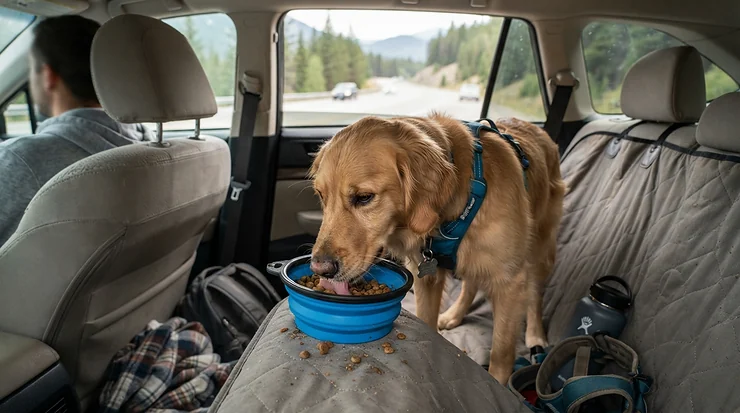
- Feed on level ground with a grip. Put the bowl on a flat patch of pavement, a tailgate or a hotel floor, never on a car seat. Stability is the quality reviewers punish most when it is missing, as the mistakes section below shows.
- Rinse, dry and reset. Reviewed’s roundup of travel bowls prioritizes quick-drying, odor-resistant materials, and most silicone options are dishwasher safe, so a quick rinse at the stop and a proper wash at night keeps the kit usable for the next leg.
Travel dog water feeder or bowl: keeping a moving dog hydrated
Water is the one item AKC says a traveling dog should never be without, so it deserves its own plan. There are two formats. A collapsible bowl is light and cheap but needs a separate jug to fill it, and it sloshes when carried full. A bottle with an attached drinking cup, the style sold as a travel dog water feeder, keeps water and bowl in one hand and fits a car cup holder, but it holds less.
Reviewed’s roundup split the use cases clearly. Soft or collapsible vessels suit hiking, while the 3-quart Lixit Water Boy Water Tank, roughly the size of a gas can, suited long car and plane trips because it can be turned upside down without leaking. The reviewers also called it too bulky for basic walks. The Highwave AutoDogMug, covered below, sits in the middle: bigger than a pocket bowl, smaller than a tank.
Travel elevated dog feeder: when raising the bowl helps and when it hurts
A raised stand is the most debated item in this category, and the debate has a health edge. Whole Dog Journal’s piece by emergency veterinarian Dr. Jennifer Bailey reports that large and giant breeds eating from raised feeders face a higher risk of gastric dilatation-volvulus (bloat), a life-threatening emergency, and that eating from floor-level bowls does not raise the risk in dogs of any size. The cause is unknown; some speculate that a higher head position makes dogs swallow more air. A WebVet summary of the key study, Glickman and colleagues in JAVMA in 2000, reaches the same association for large, deep-chested breeds and also notes that owners of high-risk dogs may have been more likely to buy raised feeders to begin with.
The same article says raised bowls may help dogs with arthritis in the neck or forelimbs, or dogs recovering from neck injuries or cervical-spine surgery, and tells owners to weigh comfort against bloat risk with a veterinarian. Warning signs it lists include restlessness, pacing, drooling, a swollen belly and unproductive retching, all of which call for veterinary care right away.
Real-use reports show how much height varies between models. A reviewer on Chewy’s listing for the Frisco Elevated Collapsible Travel Bowl says they bought it for a tall dog and found the bowl sits only a few inches off the floor once set up, while another Chewy reviewer says the height suited an older dog that struggles to bend. The Dexas Popware Elevated Feeder stands about 5 inches high, according to Reviewed, a modest lift. No source in this research says what height is safe for a given breed, so the decision belongs with your veterinarian, especially for a large or deep-chested dog.
Travel dog slow feeder: useful on some dogs, wasted on others
Collapsible silicone bowls with ridges or wells are sold as a way to slow a dog that gulps. The makers and sellers make that pitch; the owner reviews are mixed. Two reviewers on Chewy’s listing for the Pounce + Fetch Slow Feeder Collapsible Bowl disagree: one calls it a compact option for traveling but says their dog empties it in about a minute, while the other gave three stars because it did not work for their dog.
That spread is the useful signal. A slow feeder suits a dog that gulps and has patience for the puzzle, and it is a wasted slot in the bag for a dog that solves it at once. Ridges and wells also give kibble dust more places to sit, so rinse soon after the meal.
Five ways traveling dog bowls fail on the road
Floppy walls. Reviewed’s testers found the Bonza Large Collapsible Dog Bowl neither sturdy nor stable: it buckled when carried full of water and skidded on the ground while a dog drank. The Outward Hound Port-A-Bowl weighs 0.8 ounces and packs into a pocket, yet its thin walls topple and sag unless it is full, and the Kurgo Collaps A Bowl is durable but a bit wobbly when unfolded. The fix is a wide base, legs or a suction bottom, plus pouring water in with the bowl already on the ground.
Sizing for the bag instead of the dog. Retailer buyers split on the bowls built into the Gamma2 Vittles Vault Travel-Tainer: one calls them a little small for their dog, another calls them sturdy and well sized for medium to large breeds. A 20-ounce water bottle, the size Dogster lists for the Highwave AutoDogMug, is also pitched at small to medium dogs. Read the capacity against the dog before checkout.
Carrying a tank to a trail. Reviewed describes the Gamma2 canister and the Lixit Water Boy Water Tank as bulky, and the Gamma2 as overkill for a trail. They shine in a car or camper and drag on a hike.
Feeding a full meal just before or during the drive. AKC and Hepper both point toward an empty stomach or a late dinner, which is why meal timing sits in the method above instead of in the gear.
Leaving kibble in the open bag. A sealed container keeps food fresh and pests out. One retailer reviewer of a larger Gamma2 storage container warns that moisture still got in when it sat outdoors, so a container is no substitute for shelter.
The gear that solves each step
Four pieces cover the jobs above: storing food, handing over water, slowing a meal and raising a bowl. Hold off on ordering until the dog’s size, the cup holder and the cargo space are measured, because three of the four pieces come in more than one size.
| Product | Step it solves | Capacity | Cleaning | Main trade-off |
|---|---|---|---|---|
| Gamma2 Vittles Vault Travel-Tainer | Pack and store food | 6 cups of food per retailer titles; up to 4 quarts per Reviewed | Bowls dishwasher safe, canister hand wash | Bulky |
| Highwave AutoDogMug | Water at every stop | 20 ounces (22-ounce version also listed) | Dishwasher safe | Small for large dogs |
| Puppington Slow-Feeder Non-Skid Travel Dog Bowl | Slower, steadier meals | 2.25 cups | Top-rack dishwasher | Slow-feeder results vary by dog |
| Dexas Popware Elevated Feeder | Raised, steady serving | 12-ounce bowl (larger versions exist) | Dishwasher safe | Raising a bowl is not right for every dog |
The table sorts the four by job, which is how they should be bought. The Gamma2 Vittles Vault Travel-Tainer and the Highwave AutoDogMug are the two most dogs need on a car trip, while the other two depend on how the dog eats and whether a vet approves a raised bowl.
1. Gamma2 Vittles Vault Travel-Tainer — sealed kibble storage with bowls
Bulk is the first thing reviewers mention. Reviewed calls the Gamma2 Vittles Vault Travel-Tainer an all-in-one storage, drinking and feeding system that clips to a bag, yet too large to be worth carrying on a trail. In a car, camper or hotel room the size stops mattering. The twist-lock canister holds the kibble and two bowls attach to its sides. Capacity figures conflict, with Reviewed describing up to 4 quarts and retailer titles listing 6 cups of food, so the size on the listing is the one to trust. One retailer buyer says it held more than enough kibble for a dog’s first long trip. The bowls are dishwasher safe, while the canister is hand wash only, according to a retailer listing. Check the current price on Amazon.com.
2. Highwave AutoDogMug — one-handed squeeze water refills
Rest stops are where the Highwave AutoDogMug earns its place. According to the maker’s description on retailer pages, squeezing the bottle fills the bowl on top, and releasing it draws the leftover water back in. It fits a standard car cup holder, and the maker calls it virtually leak-free. Dogster named it best overall among dog water bottles, listing 20 ounces and small to medium breeds as the target. Listings also show a 22-ounce bottle and a Springer-branded version described as the same bottle under a new name, so the size matters more than the label. Expect to pay around $20 to $28, depending on the seller and branding, going by Chewy and independent pet-store listings. A large dog will need more than one fill from a 20-ounce bottle.
3. Puppington Slow-Feeder Non-Skid Travel Dog Bowl — silicone bowl with suction base
Retail listings put the Puppington Slow-Feeder Non-Skid Travel Dog Bowl at roughly $16 to $20, with Macy’s among the sellers. The Chewy listing gives the capacity as 2.25 cups and describes a non-slip suction base meant to grip floors, even smooth ones. Macy’s lists food-grade, BPA-free silicone and a built-in clip for a bag or leash. Chewy’s care notes say to rinse after each use, use the top rack of the dishwasher and store the bowl flat once dry. The textured interior is designed to slow eating, though as the slow-feeder section showed, owner experiences with collapsible slow feeders vary from dog to dog.
4. Dexas Popware Elevated Feeder — folds flat, stands on legs
Folded, the Dexas Popware Elevated Feeder measures 1.5 inches thick, according to Reviewed, which named it best overall in its travel-bowl roundup. Unfolded, the legs lift a silicone bowl about 5 inches, and Reviewed says the setup keeps the bowl from slipping and sloshing and keeps debris out of the food and water. The Popware line includes single and double stands in several sizes; Reviewed describes a 12-ounce bowl on the single version, with a 4-cup version also available, while Ace Hardware lists double stands with 2.5-cup bowls. Retail listings run around $15 to $21 for the single stands, based on Reviewed and independent pet-store pages. Because of the bloat association covered above, a veterinarian’s approval comes before the purchase for any large or deep-chested dog.
Kibble, water, and bowls on the road: quick answers
What is the best way to feed a dog while traveling?
Should you bring water from home for a dog on the road?
Are collapsible dog bowls good for travel?
Is an elevated dog bowl safe for travel?
How do you keep kibble fresh on a camping or road trip?
Packing a traveling dog feeder that fits your dog
For most car trips, the evidence favors a two-piece core: a sealed food container such as the Gamma2 Vittles Vault Travel-Tainer and a squeeze-style water bottle such as the Highwave AutoDogMug, with a stable, grippy bowl to serve meals. Add the Puppington Slow-Feeder Non-Skid Travel Dog Bowl only for a dog that gulps, and bring the Dexas Popware Elevated Feeder only after a veterinarian agrees a raised bowl suits that dog. Everything else in a good traveling dog feeder setup is routine: pre-measured meals, water at every stop, and a week of practice before departure. Compare the exact model number and bowl size on each listing before ordering.
Recommended for You
- Frenchie food bowl: Mess Fixes, Mistakes, and Bowls
- Automatic dog watering system: Mistakes and Easy Fixes
- Pet Dish Guide 2026: 7 Best Picks (and 5 Costly Mistakes)
Run the whole setup through one short drive at home before the real trip, and adjust whatever tips, skids or goes unused.