In This Article
What Is a Treat Dispensing Ball, and Why Do So Many Trainers Recommend One?
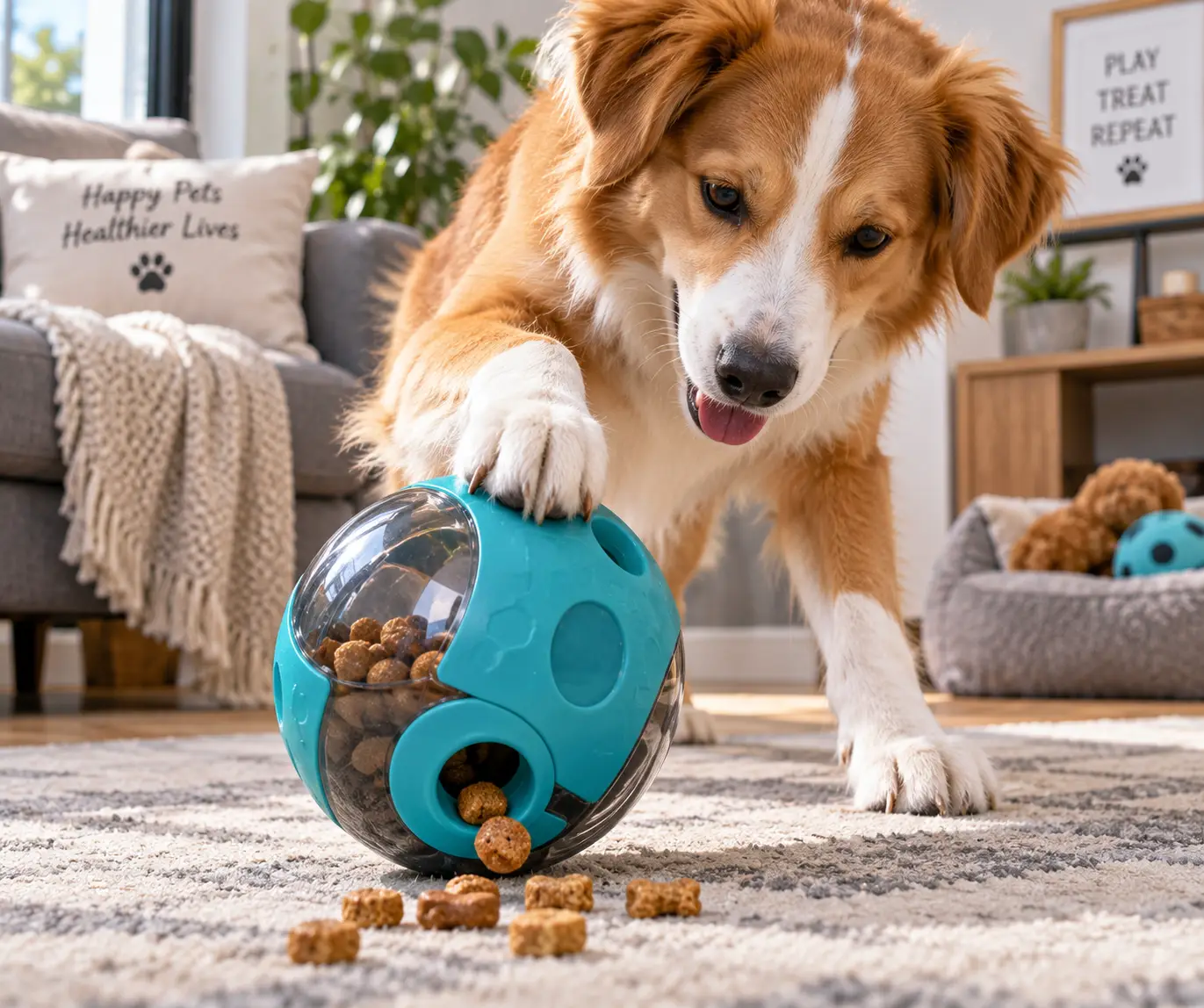
A treat dispensing ball is a hollow toy, usually rubber or hard plastic, that releases kibble or small treats as a dog noses, paws, or rolls it across the floor. Instead of a bowl doing all the work, the ball makes the dog “earn” each bite, which slows down fast eaters and gives an otherwise idle brain something to chew on — literally and figuratively.
If you’ve landed here, you’re probably scrolling through Amazon listings that all sound the same: “durable,” “interactive,” “fun for hours.” What those pages skip is the part that actually matters — which treat dispensing ball fits your dog’s size, chew strength, and attention span, and which ones tend to crack, jam, or get abandoned in a closet after week two. We dug into real spec sheets, real owner reviews, and veterinary guidance on food-related enrichment to put together a guide that goes past the marketing copy.
You’ll find seven genuinely different options below — from a $6 rubber ball to a $35 wobbling feeder — organized by budget, dog size, and how much of a puzzle-solver your particular pup happens to be. According to the ASPCA’s guidance on canine enrichment, food puzzles like these tap into a dog’s natural foraging instinct, which is a big part of why they work better than a plain bowl for so many dogs. Let’s get into it.
Quick Comparison: 7 Treat Dispensing Ball Options at a Glance
| Product | Best For | Price Range | Material | Difficulty Adjustable? |
|---|---|---|---|---|
| KONG Wobbler | Meal replacement, medium-large dogs | $25–$35 | Hard polymer | No (fixed hole) |
| Starmark Bob-A-Lot | Heavy chewers, large breeds | $10–$20 | Hard plastic | Yes (top + bottom openings) |
| PetSafe Busy Buddy Kibble Nibble | Fast eaters, all sizes | $10–$20 | Rubber-capped plastic | Yes (trimmable prongs) |
| Omega Paw Tricky Treat Ball | Small/gentle chewers, puppies | $8–$18 | Soft pliable rubber-like plastic | No |
| JW Pet Hol-ee Roller | Aggressive chewers, fetch + treats | $6–$15 | Natural rubber | No |
| Pet Zone (OurPets) IQ Treat Ball | Budget shoppers, light chewers | $5–$12 | Hard plastic | Yes (interior disc) |
| Outward Hound Nina Ottosson Dog Tornado | Smart breeds, mental workouts | $25–$40 | Food-grade plastic | Yes (bone covers) |
Looking at this table, the split comes down to durability versus difficulty. The JW Pet Hol-ee Roller and Omega Paw Tricky Treat Ball win on toughness and simplicity but don’t let you dial in a challenge level, while the Starmark Bob-A-Lot, PetSafe Busy Buddy Kibble Nibble, Pet Zone IQ Treat Ball, and Outward Hound Nina Ottosson Dog Tornado all offer some kind of adjustable difficulty for dogs who get bored fast. If your dog is a power chewer, prioritize the rubber options near the top of this table over the hard-plastic ones near the bottom — reviewers consistently flag plastic treat balls as the first to crack under determined jaws.
💬 Found a match already? Tap through to check today’s price and current stock before it changes!
The 7 Best Treat Dispensing Balls: Full Breakdown
1. KONG Wobbler — best for turning mealtime into exercise
The KONG Wobbler looks like an oversized KONG toy balanced on a rounded base, and that shape is the whole point: it stays upright until a dog’s paw or nose knocks it over, then rights itself unpredictably as treats spill out. Fill capacity runs about 1/2 cup in the small size and up to 1 cup in the large, so it can genuinely stand in for a meal rather than just a snack toy. The hard polymer shell unscrews in the middle for filling, and the whole thing is dishwasher-safe, which matters more than it sounds once kibble dust starts caking inside the dispensing hole.
What most buyers overlook with this model is that the dispensing hole size is fixed — there’s no dial to slow things down further, so if your dog empties it in ninety seconds, you’re stuck feeding smaller kibble or switching toys rather than adjusting this one. On the plus side, that same fixed hole is what makes the wobble motion so reliably erratic; dogs can’t “solve” it the way they eventually crack some puzzle toys, which is why owners report it staying interesting for years rather than weeks. It’s the strongest fit for medium to large dogs that gulp their food, and for owners specifically trying to slow down fast eaters as a digestive-health measure rather than just an entertainment purchase.
Reviews consistently report that the KONG Wobbler holds up impressively well even with aggressive nudging and the occasional drop down a staircase, though a handful of owners note the wobble action can be noisy on hardwood or tile — something to factor in if you’re in an apartment. The 1/2- to 1-cup capacity and near-indestructible reputation are the two things reviewers mention most often, alongside genuine surprise at how long the novelty lasts compared to cheaper alternatives.
Pros:
- ✅ Made in the USA from a food-grade, high-strength polymer
- ✅ Dishwasher-safe and unscrews easily for refilling
- ✅ Holds a full meal’s worth of kibble in the large size
Cons:
- ❌ Fixed dispensing hole with no difficulty adjustment
- ❌ Wobbling motion can be loud on hard flooring
At a price in the $25–$35 range depending on size, the KONG Wobbler sits at the premium end of this list, but the durability track record and USA manufacturing make it a reasonable long-term value for a dog that will use it daily rather than occasionally.
2. Starmark Bob-A-Lot — biggest capacity for large-breed mealtimes
The Starmark Bob-A-Lot is built around a weighted, anti-slip base that keeps it wobbling erratically rather than rolling away entirely, and a large bottom chamber that holds up to 3 cups of food — enough for a full meal for many medium and large dogs. Both the top and bottom openings are adjustable, which is the feature that separates it from simpler treat balls: you can widen the openings for a puppy still learning the game, then tighten them as your dog gets faster at emptying it.
That adjustability is genuinely useful in practice, not just a marketing bullet point. Reviewers who’ve had the toy for years describe deliberately narrowing the openings as their dog’s confidence with the puzzle grew, essentially leveling up the challenge the same way you’d increase resistance on exercise equipment. Based on comparing the specs against the rest of this list, the Starmark Bob-A-Lot is the only entry that pairs “holds a full 3-cup meal” with “adjustable on two separate openings,” which is why it shows up so often in vet-recommended slow-feeder lists rather than purely as a toy.
Aggregated reviews put this toy in the 4.3–4.5 star range across tens of thousands of ratings, with owners repeatedly describing it as their dog’s longest-lasting enrichment toy — several mention replacing a well-worn unit after five or more years of daily use rather than because it broke. The most common complaint centers on determined chewers eventually gnawing through the plastic edges around the openings, so it’s a better fit for dogs that nose and paw at toys rather than ones that treat every toy as a chew project.
Pros:
- ✅ Adjustable top and bottom openings for tunable difficulty
- ✅ Large chamber holds up to 3 cups — a full meal for many dogs
- ✅ Weighted anti-slip base keeps it wobbling in place
Cons:
- ❌ Heavy chewers can eventually wear down the opening edges
- ❌ Hand-wash only, which is less convenient than dishwasher-safe options
Priced roughly $10–$20 depending on size and any current promotion, the Starmark Bob-A-Lot delivers one of the best capacity-to-price ratios on this list, especially for households with a larger dog that needs a genuinely full-size feeder.
3. PetSafe Busy Buddy Kibble Nibble — most customizable release speed
The PetSafe Busy Buddy Kibble Nibble holds up to 3.5 cups (about 828 mL) of dry food and uses a patented Treat Meter — a set of flexible rubber prongs inside the dispensing opening — to control how fast kibble falls out. The trick is that those prongs are trimmable: snip a little off with scissors and the flow speeds up permanently, which lets owners fine-tune the toy to a specific dog’s patience level in a way most treat balls simply can’t match.
What the spec sheet doesn’t say, but reviews reveal, is that this trimming feature is a one-way adjustment — once you cut the prongs, there’s no putting them back — so the sensible approach is trimming a little at a time and testing rather than committing to a big cut on day one. That’s a smart design for owners willing to experiment, but it does mean the toy arrives at its slowest, most challenging setting out of the box, which can frustrate an impatient dog before you’ve had the chance to adjust it. It twists apart for filling and is dishwasher-safe on the top rack, both practical wins for anyone tired of hand-washing sticky kibble dust off a treat toy.
Aggregate ratings hover in the high 3s to low 4s out of 5 across major retailers, with a recurring theme in customer summaries: dogs stay engaged for 20 to 30 minutes or longer per session, which is genuinely long for this toy category. The main knock in negative reviews is that some dogs figure out how to chew directly through the softer rubber prongs, effectively bypassing the puzzle — something to watch for with strong-jawed breeds.
Pros:
- ✅ Trimmable Treat Meter prongs let you permanently tune dispensing speed
- ✅ Holds up to 3.5 cups — enough for a full meal
- ✅ Dishwasher-safe on the top rack for easy cleanup
Cons:
- ❌ Prong trimming is irreversible, so early adjustments require caution
- ❌ Strong chewers can sometimes bite through the rubber prongs
Available in small and medium/large sizes for roughly $10–$20, the PetSafe Busy Buddy Kibble Nibble is the pick for owners who want a dial-in feature rather than a one-size-fits-all difficulty.
4. Omega Paw Tricky Treat Ball — gentlest option for puppies and small dogs
The Omega Paw Tricky Treat Ball trades hard plastic for a softer, pliable material with a cratered, textured surface designed to be easy to grip and pick up — a detail that matters more than it sounds for small dogs or puppies whose jaws aren’t strong enough to manage a rigid ball. It comes in three sizes: small for dogs up to about 30 pounds, medium for 30–65 pounds, and large for dogs over 65 pounds, and the manufacturer explicitly recommends sizing up for enthusiastic chewers regardless of weight.
Here’s what most listings don’t spell out: this toy has no adjustable difficulty and a fixed opening, so the challenge level is baked in at manufacture. That’s a feature, not a flaw, for the audience it’s built for — new puppies and older or smaller dogs benefit from a predictable, low-frustration toy rather than one with a learning curve. Reviews consistently report that this ball’s soft material is genuinely gentler on teeth and gums than the hard-plastic alternatives on this list, which is exactly why it shows up so often in “first treat ball” recommendations for young dogs.
With over 1,200 verified reviews on major retail sites and a consistent 4-out-of-5-star average, the Omega Paw Tricky Treat Ball has one of the longest track records of any toy in this category — some reviewers mention units that lasted a decade with a previous dog before finally needing replacement for a new one. The most common complaint is that larger, more powerful dogs can eventually puncture or deform the softer material, reinforcing that this is a small-to-medium dog pick rather than a heavy-duty option.
Pros:
- ✅ Soft, pliable material is gentler on puppy and senior teeth
- ✅ Easy-grip textured surface designed for smaller mouths
- ✅ Long track record — some owners report a decade of use
Cons:
- ❌ No adjustable difficulty setting
- ❌ Larger or more determined chewers can eventually puncture it
At $8–$18 depending on size, the Omega Paw Tricky Treat Ball is one of the most budget-friendly entries here, and arguably the best value for anyone shopping specifically for a puppy or a small breed.
5. JW Pet Hol-ee Roller — toughest build for power chewers
The JW Pet Hol-ee Roller is a honeycomb-patterned rubber ball with large open holes that double as both a treat dispenser and a standard fetch toy. Made from double-molded natural rubber, it’s built to be stretched, tugged, and gnawed on without falling apart the way hard plastic treat balls sometimes do, and it comes in a wide range of sizes from small (roughly 4 inches) up through an XXL suitable for the largest breeds, plus an “X Extreme” variant with a reinforced structure for especially determined chewers.
The honest trade-off here is that the open honeycomb design means treats fall out almost immediately with barely any rolling required — there’s no built-in difficulty curve like the puzzle-style toys on this list. What the spec sheet doesn’t say, but owner feedback reveals, is that this is actually the appeal for a lot of buyers: the JW Pet Hol-ee Roller functions as a genuinely versatile toy first (fetch, tug, chew) and a treat dispenser second, rather than a dedicated slow-feeder. If your goal is specifically slowing down a fast eater, this isn’t the strongest match on this list; if your goal is a nearly indestructible multi-purpose toy that can also hold treats, it’s hard to beat.
Aggregated Chewy reviews across roughly 4,000+ ratings put this at a 4.2 out of 5, with customer-sentiment summaries showing especially strong marks for durability and interactive value. The most consistent negative theme involves smaller dogs managing to chew small rubber fragments off the honeycomb edges over extended use, which is a reasonable prompt to size up and supervise rather than leave the toy out unattended for hours.
Pros:
- ✅ Double-molded natural rubber stands up to serious chewing
- ✅ Doubles as a fetch and tug toy, not just a treat dispenser
- ✅ Wide size range from small dogs up through XXL breeds
Cons:
- ❌ Open honeycomb design offers minimal dispensing challenge
- ❌ Small fragments can chip off at the edges over heavy long-term use
At roughly $6–$15 depending on size, the JW Pet Hol-ee Roller is one of the most affordable and multi-functional picks on this list, especially for owners who want one toy that covers several bases.
6. Pet Zone (OurPets) IQ Treat Ball — most budget-friendly adjustable option
The Pet Zone IQ Treat Ball, sometimes labeled under the OurPets brand, uses a removable interior disc to change how quickly treats fall out, and it comes apart into pieces for a genuinely thorough cleaning — something plenty of one-piece treat balls can’t offer. It’s sold in 3-inch and 4-inch sizes, with the smaller size aimed at dogs from about 10 pounds and up, and the treat capacity is modest compared to the mealtime-sized options higher on this list, positioning it more as a snack-and-play toy than a full feeder replacement.
Here’s where honesty matters most: this is the toy on our list with the most mixed review record, sitting in the mid-3-star range across thousands of ratings rather than the 4-plus scores seen elsewhere. Reviews consistently report that the twist-together halves can separate unexpectedly during rough play, sometimes scattering the interior disc across the floor — a legitimate concern for dogs over roughly 20–25 pounds playing with real enthusiasm. What most buyers overlook is that this toy’s strength is genuinely its price and its adjustability, not its long-term ruggedness, so it earns its spot on this list specifically as a low-cost way to test whether your dog enjoys treat-ball-style enrichment before committing to a pricier option.
For small, gentle dogs, or as a secondary toy in a rotation rather than an everyday workhorse, the reported durability issues matter far less, and several reviewers specifically praise how quickly puppies pick up the mechanics. If your dog is a determined chewer or over 25 pounds and plays hard, the tougher rubber options on this list (the JW Pet Hol-ee Roller or Starmark Bob-A-Lot) are the safer bet.
Pros:
- ✅ Adjustable interior disc lets you set the difficulty level
- ✅ Fully disassembles for a genuinely deep clean
- ✅ One of the most affordable treat balls available
Cons:
- ❌ Reviews report the halves can separate under rough play
- ❌ Smaller treat capacity than mealtime-focused competitors
At around $5–$12, the Pet Zone IQ Treat Ball is the lowest-cost entry on this list — a reasonable low-stakes starting point, with the caveat that it’s better suited to gentler or smaller dogs than to heavy-duty daily use with a large breed.
7. Outward Hound Nina Ottosson Dog Tornado — best for mentally sharp, food-motivated dogs
The Outward Hound Nina Ottosson Dog Tornado breaks from the “ball” format entirely in favor of a multi-tiered spinning puzzle with up to twelve compartments across three or four layers, plus bone-shaped covers that add an extra step of difficulty by blocking treats until a dog physically removes them. It’s made of food-grade plastic that’s free of BPA, PVC, and phthalates, holds roughly a cup of kibble or small treats across its compartments, and is explicitly rated as a Level 2 (intermediate) puzzle by the manufacturer.
This is the most mentally demanding option on this list, and that’s exactly the point. Based on comparing the mechanics against every other product here, the Outward Hound Nina Ottosson Dog Tornado requires a dog to combine multiple actions — spinning a layer, then removing a cover, then repeating — rather than a single rolling or nosing motion. That makes it a poor first toy for a dog with zero puzzle experience, but an excellent next step for a dog that’s mastered simpler treat balls and needs more of a challenge to stay engaged. Reviews consistently report that food-motivated, intelligent breeds (herding and working breeds especially) pick up the multi-step mechanic quickly and stay engaged noticeably longer than with single-action toys.
Owner feedback across multiple retailers skews strongly positive, frequently mentioning its usefulness for managing separation anxiety and stress during events like thunderstorms, since the multi-step puzzle demands sustained focus in a way a simple rolling ball doesn’t. The primary drawback flagged by reviewers is that it’s a stationary tabletop-style puzzle rather than something a dog can chase and carry around the yard, so it doesn’t double as a fetch or outdoor toy the way several entries above do.
Pros:
- ✅ Multi-step puzzle mechanic provides a genuine mental workout
- ✅ BPA, PVC, and phthalate-free food-grade plastic construction
- ✅ Frequently praised for easing boredom-driven stress and anxiety
Cons:
- ❌ Not portable or chase-friendly like a true rolling ball
- ❌ Too advanced as a first puzzle toy for beginners
Priced around $25–$40, the Outward Hound Nina Ottosson Dog Tornado is the most expensive item on this list, but it earns that price with a genuinely different, more advanced mechanic than any of the true treat balls above it.
Getting Started: Your Dog’s First 30 Days With a Treat Dispensing Ball
Bringing home any new enrichment toy — including a treat dispensing ball — goes more smoothly with a little structure in the first month, rather than just tossing it on the floor and hoping for the best. Start with the easiest possible setting: widen adjustable openings all the way, or choose a fixed-hole toy that dispenses generously, so your dog experiences an early, easy win. A frustrated dog that gets nothing out of a toy in the first few tries often abandons it permanently, so the goal early on is confidence, not challenge.
For the first several sessions, stay in the room and demonstrate the mechanic yourself — nudge the ball with your hand or foot so your dog sees treats fall out, then let them take over. This single step dramatically shortens the learning curve, especially for toys like the Outward Hound Nina Ottosson Dog Tornado or Starmark Bob-A-Lot that require a specific motion rather than random rolling. Once your dog understands the game, gradually tighten adjustable settings or switch to a smaller dispensing hole every few days, rather than jumping straight to the hardest setting.
By week two or three, most dogs settle into a predictable relationship with the toy, and this is the point to start watching for wear. Check dispensing holes, seams, and any chewable edges weekly for the first month — this is when you’ll first notice if a particular dog is a candidate for the more durable rubber options (JW Pet Hol-ee Roller, KONG Wobbler) versus the lighter hard-plastic ones. A common mistake in this window is leaving a treat ball out unsupervised around the clock; most manufacturers, and most trainers, recommend supervised sessions rather than 24/7 access, both for safety and because novelty (and therefore engagement) fades faster when a toy is always available.
Real-World Scenarios: Matching Dogs to the Right Treat Dispensing Ball
Every dog’s relationship with a treat dispensing ball depends on three variables that rarely make it into a product listing: chew strength, patience, and how much of a meal you want the toy to replace. Here’s how that plays out with a few common situations.
Consider a household with a 9-week-old Labrador puppy just starting solid food, still building confidence with new objects and unable to generate much bite force. The Omega Paw Tricky Treat Ball is a strong fit here — its soft material forgives clumsy early attempts, and the fixed, generous opening means the puppy gets consistent, easy wins that build a positive association with the toy rather than frustration.
Now picture a 65-pound German Shepherd that inhales an entire bowl of kibble in under a minute, a classic candidate for a slow-feeder rather than a pure toy. The Starmark Bob-A-Lot or KONG Wobbler both make sense here, since either can hold a full meal’s worth of food and force genuinely slower eating — a health-motivated purchase more than an entertainment one, and one worth discussing with your veterinarian if your dog has a history of digestive issues.
Finally, think about a food-driven, high-energy Border Collie mix that’s already mastered every simple treat ball in the house and needs something with more cognitive demand to stay satisfied. The Outward Hound Nina Ottosson Dog Tornado‘s multi-step mechanic is built precisely for this profile — a dog smart enough to get bored quickly and food-motivated enough to stay committed to solving something harder.
How to Choose a Treat Dispensing Ball: 6 Criteria That Actually Matter
- Match the size to your dog’s weight and mouth, not just the product photo. Most treat balls come in at least two sizes, and manufacturers generally list weight ranges for a reason — a ball sized for a 15-pound dog can become a choking risk if a 60-pound dog manages to compress or break it.
- Weigh chew strength honestly. If your dog has ever destroyed a “indestructible” toy in under a week, prioritize double-molded rubber (JW Pet Hol-ee Roller) or thick hard polymer (KONG Wobbler) over lighter hard plastic.
- Decide whether you want a toy or a meal replacement. Products holding 3+ cups (Starmark Bob-A-Lot, PetSafe Busy Buddy Kibble Nibble) can substitute for a bowl; smaller-capacity options (Pet Zone IQ Treat Ball) work better as a supplemental snack toy.
- Check for adjustable difficulty if your dog gets bored quickly. A fixed-hole toy is simpler but can’t grow with your dog’s skill level the way an adjustable one can.
- Factor in cleaning method. Dishwasher-safe designs (KONG Wobbler, PetSafe Busy Buddy Kibble Nibble) save real time over hand-wash-only toys, especially with oily or wet treats.
- Read the aggregated review sentiment for durability complaints specific to your dog’s size class, since a toy that holds up fine for a 20-pound dog may not survive a 70-pound one, and vice versa for toys that are simply too large for small mouths to manipulate.
Common Mistakes to Avoid When Buying a Treat Dispensing Ball
The single most common mistake is buying based on price or aesthetics alone without checking the weight/size guidance, which leads directly to the safety and durability complaints that dominate negative reviews across every product on this list. A close second is assuming every treat ball works the same way: a rolling ball (Omega Paw Tricky Treat Ball, JW Pet Hol-ee Roller) requires a completely different play style than a multi-step puzzle (Outward Hound Nina Ottosson Dog Tornado), and buying the wrong style for your dog’s patience level often ends with an abandoned toy in a drawer.
Another frequent misstep is skipping the adjustment period — expecting a dog to instantly understand a brand-new mechanic and giving up on the product after one unsuccessful session. Reviews across nearly every product in this category mention a short learning curve as completely normal, not a sign of a defective toy. Finally, several buyers report leaving treat balls filled with wet or perishable treats for extended periods, which can encourage bacterial growth inside hard-to-clean crevices; dry kibble or hard treats are the safer default for anything you plan to leave out for a while.
Treat Dispensing Balls vs. Traditional Food Bowls
A standard food bowl delivers a dog’s entire meal in seconds with essentially zero physical or mental effort required, which is exactly the problem treat dispensing balls are designed to solve. Where a bowl offers convenience and speed, a treat ball trades some of that convenience for measurable benefits: slower eating, sustained mental engagement, and a built-in outlet for the kind of natural foraging behavior dogs rarely get to exercise indoors. According to the American Veterinary Society of Animal Behavior’s guide to food puzzle toys, this shift from passive eating to active problem-solving gives dogs positive experiences tied directly to acquiring food, which is a meaningfully different emotional experience than simply being handed a full bowl.
| Factor | Standard Food Bowl | Treat Dispensing Ball |
|---|---|---|
| Feeding time | Under 1–2 minutes typically | 10–45+ minutes depending on toy |
| Mental stimulation | Minimal | Significant, varies by puzzle complexity |
| Best for fast eaters | Not recommended alone | Purpose-built for this use case |
| Cleanup | Simple, single piece | Varies — some disassemble, some don’t |
| Portability | Stationary | Most models are portable/chase-friendly |
The trade-off isn’t absolute — a treat ball shouldn’t fully replace a bowl for every meal in every household, especially for dogs with certain medical conditions where consistent, complete intake matters more than pacing. But for the average healthy adult dog, especially one prone to gulping food or showing signs of boredom-driven behavior problems, rotating in a treat dispensing ball for some or all meals offers a genuine upgrade over a bowl with essentially no downside beyond the up-front cost.
✨ Ready to slow down mealtime and give your dog’s brain a workout? Check today’s price on your top pick above!
Long-Term Cost and Maintenance
Treat dispensing balls are a low-maintenance category compared to most dog gear, but the total cost of ownership still varies more than the sticker price alone suggests. A $6 JW Pet Hol-ee Roller with a multi-year lifespan against determined chewing can end up cheaper over three years than a $12 toy that gets destroyed every few months, so it’s worth weighing durability against upfront price rather than shopping on price alone.
Cleaning cadence matters for long-term cost too. Dishwasher-safe toys like the KONG Wobbler and PetSafe Busy Buddy Kibble Nibble cost nothing extra to maintain since they piggyback on a cycle you’re already running, while hand-wash-only designs demand a few minutes of dedicated owner time weekly — not a dollar cost, but a real one if you’re managing multiple dogs or multiple toys in rotation. Replacement parts are essentially nonexistent in this category; when a treat ball cracks or a chewer breaches the shell, the standard advice from every manufacturer is full replacement rather than repair, both for cost-effectiveness and, more importantly, for safety, since a cracked edge can turn into a choking hazard.
Budgeting roughly $10–$35 per toy and expecting a one- to three-year lifespan for a moderately active chewer is a reasonable baseline across the products on this list, with the caveat that a genuinely determined power-chewer can shorten that window regardless of which toy you choose — which is precisely why matching chew strength to material (Criterion #2 above) does more for your long-term cost than brand loyalty ever will.
Safety, Supervision, and What the Research Says About Slow Feeding
Treat dispensing balls sit at an interesting intersection of “toy” and “feeding equipment,” which means the usual toy-safety rules apply alongside some feeding-specific considerations. No toy in this category is marketed as indestructible, and every manufacturer represented here recommends supervised play — a good habit generally, and an especially important one for the first several weeks with a new toy while you’re still learning how your specific dog interacts with it.
There’s also a genuine health angle worth understanding, not just a marketing one. Fast eating is a recognized risk factor connected to gastric dilatation-volvulus (GDV), commonly called bloat — a sudden, life-threatening emergency in which the stomach fills with gas and twists on itself, cutting off blood flow. According to Cornell University’s Riney Canine Health Center, feeding adjustments — including offering smaller, more frequent meals and slowing down how quickly a dog eats — are among the practical steps owners can take to help reduce risk, alongside avoiding heavy exercise right after meals. Large, deep-chested breeds are considered most at risk, which is worth keeping in mind if you’re specifically shopping for a Great Dane, Standard Poodle, or similar build — a treat dispensing ball used for full meals (like the Starmark Bob-A-Lot or KONG Wobbler) can be a genuinely useful tool in that broader prevention strategy, though it’s never a substitute for veterinary guidance if your dog has known risk factors.
On the toy-safety side specifically, inspect any treat dispensing ball regularly for cracks, chewed-through edges, or pieces small enough to swallow, and retire the toy immediately if you spot damage rather than waiting for it to fail completely. This applies to every product on this list regardless of price point or brand reputation — durability claims describe typical use, not a guarantee against a determined enough chewer.
Features That Actually Matter (and Ones That Don’t)
Marketing copy across this category loves to lean on words like “indestructible” and “genius,” so it’s worth separating what genuinely affects a dog’s experience from what’s mostly packaging language. Dishwasher-safety, adjustable openings, and disassembly for cleaning are all features that show up repeatedly in positive long-term reviews — they solve real, recurring friction points rather than just sounding impressive on a box.
On the other hand, color options, novelty shapes, and “IQ-boosting” claims tend to matter far less than owners expect going in. A dog’s engagement with a treat ball comes down almost entirely to whether the mechanic matches their patience level and whether the treats smell appealing enough to chase — cosmetic differences rarely move the needle either way. Similarly, claims about specific “difficulty levels” printed on packaging (like the Level 2 rating on the Outward Hound Nina Ottosson Dog Tornado) are a useful rough guide but shouldn’t be treated as gospel, since a highly food-motivated dog will often “solve” a Level 2 toy faster than a less-motivated dog manages a Level 1.
Frequently Asked Questions About Treat Dispensing Balls
❓ What size treat dispensing ball should I buy for my dog?
❓ Are treat dispensing balls safe to leave with dogs unsupervised?
❓ Can a treat dispensing ball replace my dog's food bowl entirely?
❓ How do I clean a treat dispensing ball?
❓ Why won't my dog play with their new treat dispensing ball?
Conclusion: Finding the Right Treat Dispensing Ball for Your Dog
There’s no single “best” treat dispensing ball, because the right pick depends on exactly the variables this guide walked through — your dog’s size, chew strength, patience for a puzzle, and whether you want the toy to replace a full meal or just add some enrichment to the day. For puppies and gentle chewers, the Omega Paw Tricky Treat Ball offers a forgiving entry point; for fast eaters who need a full slow-feeder, the Starmark Bob-A-Lot and KONG Wobbler both bring genuine mealtime capacity; for power chewers who need something closer to bombproof, the JW Pet Hol-ee Roller earns its reputation; and for a smart, food-driven dog craving a bigger mental challenge, the Outward Hound Nina Ottosson Dog Tornado is the clear step up.
Whichever option fits your household, the underlying idea is the same one veterinarians and behaviorists keep coming back to: mealtime doesn’t have to be passive. A few extra minutes of nose work and problem-solving, even a handful of times a week, adds up to a noticeably more engaged, better-exercised dog — no walk required.
✨ Don’t miss these exclusive deals! 🐾 Take your dog’s next mealtime to the next level with this carefully curated lineup. Click a highlighted pick above to check current pricing and availability, and give your best friend a challenge they’ll actually look forward to.
Recommended for You
- Best Slow Feeder Water Bowl for Dogs: 7 Top Picks for 2026
- Slow Eating Dog Bowl Reviews: 7 Best Picks for Fast Eaters
- Slow Feed Dog Bowl Reviews: 7 Best Picks to Stop Bloat (2026)
Disclaimer: This post contains affiliate links. As an Amazon Associate, I earn from qualifying purchases made through these links, at no additional cost to you.
✨ Found this article helpful? Share it with someone who needs it! 💬🤗