In This Article
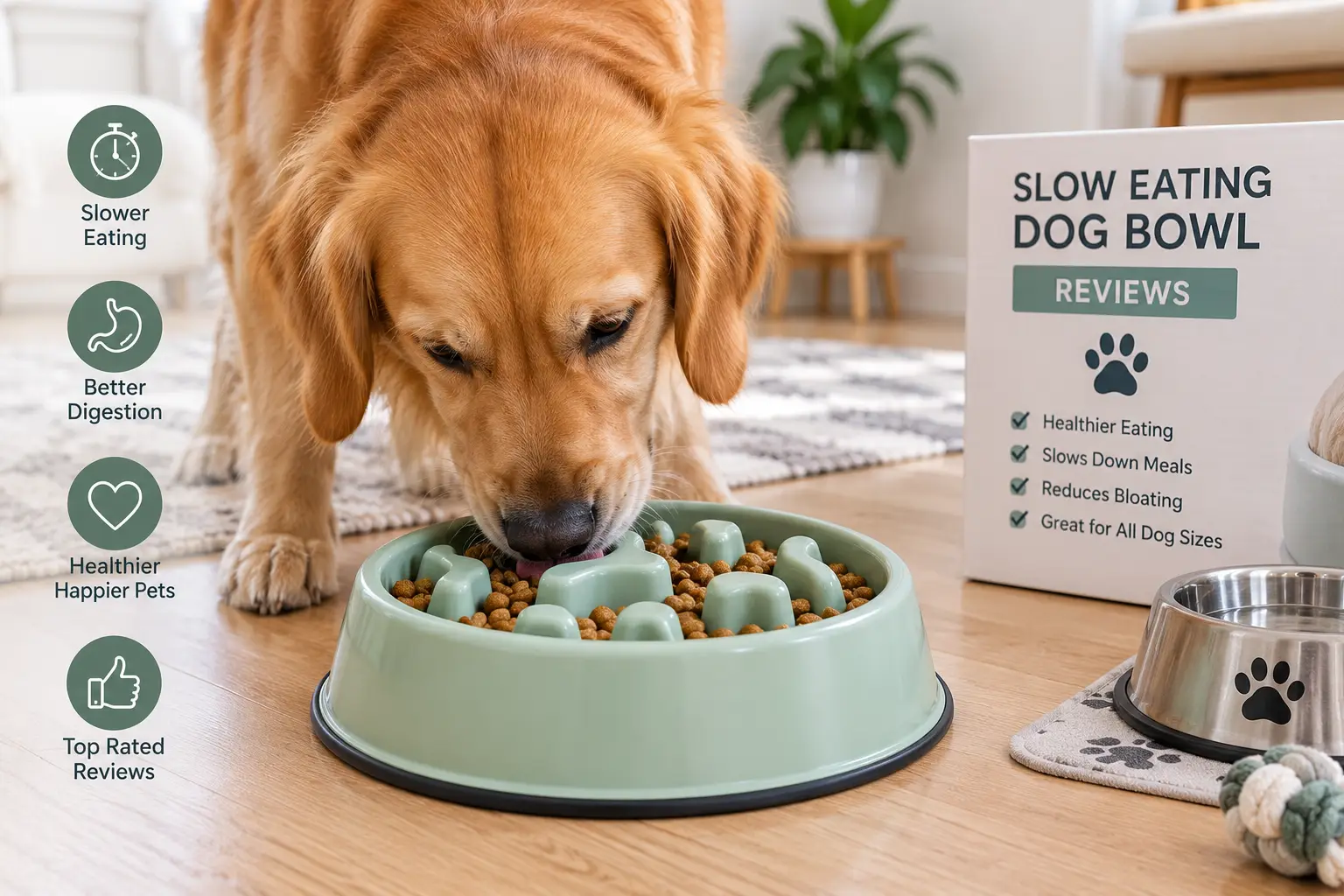
If mealtime at your house looks like a vacuum cleaner attacking a bag of kibble, you already know why you’re here. A dog that inhales food in under a minute isn’t just messy — it’s a real health risk, and it’s exactly the problem these slow eating dog bowl reviews are meant to solve. A slow feeder bowl is a food dish built with raised ridges, mazes, or knobs that force your dog to eat around obstacles instead of scooping up huge mouthfuls at once, which naturally stretches a 60-second meal into 5-10 minutes.
We dug through spec sheets, manufacturer data, and thousands of aggregated customer reviews across Amazon, Chewy, and Walmart to put together this roundup of seven real slow feeder bowls, spanning budget plastic mazes to premium stainless-steel and elevated systems. You’ll get honest analysis of what each one does well, where it falls short, and which type of dog and household it actually fits — not just a rehash of the product listing. We’ll also walk through how these bowls compare to standard dishes, what vets say about fast eating and bloat risk, and how to pick the right style for your particular gulper.
One quick note before we dive in: this article contains affiliate links, and as an Amazon Associate, purchases made through them may earn a small commission at no extra cost to you (see the full disclosure below). Let’s get into the picks.
Slow Eating Dog Bowl Reviews at a Glance
Before the deep dive, here’s a fast snapshot of which bowl wins in which category, so you can jump straight to the one that matches your situation.
| Category | Pick | Material | Price Range |
|---|---|---|---|
| Best Overall | Outward Hound Fun Feeder Slo-Bowl | BPA-free plastic | around $12-$18 |
| Best Budget | Frisco Bone Shaped Ridges Slow Feeder | Food-grade plastic | around $8-$12 |
| Best Stainless Steel | UPSKY Slow Feeder Dog Bowl and Elevated Set | 304 stainless steel + wood stand | around $22-$32 |
| Best for Small Breeds | Outward Hound Fun Feeder Mini Slo-Bowl | BPA-free plastic | around $8-$13 |
| Best for Mental Enrichment | Nina Ottosson by Outward Hound Lickin’ Layers | Durable plastic | around $18-$26 |
The pattern here is straightforward: the plastic maze bowls dominate the budget-to-mid range and work well for dry kibble, while stainless steel and elevated designs cost more but solve secondary problems like chewing, hygiene, or joint strain. If your dog is a moderate gulper and eats dry food, the Outward Hound Fun Feeder Slo-Bowl is the safest starting point; if hygiene or durability matters more than price, lean toward the UPSKY Slow Feeder Dog Bowl and Elevated Set.
💬 One click helps other shoppers make an informed choice too! 😊
Top 7 Slow Eating Dog Bowls: Expert Analysis
We selected these seven products to cover entry-level, mid-range, and premium price points, along with different materials, eating styles, and dog sizes — so whatever kind of gulper you’re dealing with, there’s a realistic option below.
1. Outward Hound Fun Feeder Slo-Bowl — best overall for dry kibble gulpers
The Outward Hound Fun Feeder Slo-Bowl earns the top spot mostly because it strikes the best balance between effectiveness, price, and durability. The bowl uses an irregular, randomized maze pattern rather than simple straight ridges, which matters more than it sounds — dogs can memorize a repetitive pattern within a few weeks and start eating fast again, but a randomized layout keeps them working for every bite. The base is intentionally wider than the bowl itself, which practically translates to a dog that can’t easily flip or drag the dish across the floor mid-meal, a common complaint with cheaper flat-bottomed feeders.
What most buyers overlook with this model is that it comes in two sizes and multiple difficulty patterns, so you’re not locked into one design if your dog adapts quickly. Based on comparing the specs against competitors in this price bracket, it’s a strong fit for medium to large dogs eating standard kibble, though owners of extremely determined chewers should supervise early sessions. Reviews consistently report the bowl holding up well over months of daily use, with occasional notes about surface staining from wet or greasy foods over time.
Pros:
- ✅ Randomized maze pattern resists being “solved” too quickly
- ✅ Non-skid base wider than the bowl itself
- ✅ Available in two sizes with 97,000+ verified five-star ratings reported
Cons:
- ❌ Not ideal for wet or pureed food, which pools in the ridges
- ❌ Plastic construction can show scratches from aggressive chewers
At around $12-$18, this is a strong value pick, and given how frequently it’s cited as a top recommendation across independent pet-gear roundups, it’s a safe first purchase for most kibble-fed dogs.
2. Frisco Bone Shaped Ridges Slow Feeder — best value for the money
The Frisco Bone Shaped Ridges Slow Feeder takes the budget crown by delivering a genuinely functional slow-feed pattern without the premium price tag some brands charge for similar plastic construction. Its bone-shaped ridge pattern is simpler than a full maze, which practically means it’s a gentler introduction for dogs new to slow feeders — less frustrating, but still enough of an obstacle to meaningfully cut down gulping speed.
The 3-cup capacity is generous for a single-meal serving for most small-to-medium dogs, and the pink-or-blue color choice, while purely cosmetic, at least means it doesn’t look like clinical pet-store equipment. What this model doesn’t offer is the size flexibility of pricier competitors — you’re locked into one bowl size, so households with both a Chihuahua and a Labrador will need two different products anyway. Aggregated customer sentiment describes it as an easy, low-friction first slow feeder, particularly praised for being simple to hand-wash despite not always being labeled dishwasher-safe by the manufacturer.
Pros:
- ✅ Genuinely effective slow-feed ridges at a budget price
- ✅ Generous 3-cup capacity for one meal
- ✅ Simple pattern that’s beginner-friendly for anxious eaters
Cons:
- ❌ Only available in one size, limiting fit for very small or very large dogs
- ❌ Simpler ridge pattern may be “solved” faster by determined gulpers
Priced around $8-$12, this is the pick we’d recommend to anyone testing whether their dog will even tolerate a slow feeder before investing more.
3. UPSKY Slow Feeder Dog Bowl and Elevated Dual Pet Bowls Set — best stainless steel option
The UPSKY Slow Feeder Dog Bowl and Elevated Dual Pet Bowls Set stands out because it pairs a slow-feed insert with elevated stainless-steel bowls in one purchase, which is a smart bundle for owners solving two problems at once (gulping and neck strain). The slow-feed bowl itself uses a deep bone-pattern maze molded from PP plastic, while the accompanying food and water bowls are 304 stainless steel — a material that resists odor absorption and scratching far better than plastic over years of daily washing.
In practice, the wooden stand with anti-slip pads is what separates this from cheaper stainless bowl-and-stand combos; it stays put even with an enthusiastic eater pushing against it. Based on comparing this to plastic-only competitors, the real advantage here is longevity: stainless steel simply won’t degrade, crack, or harbor bacteria in scratches the way plastic eventually does. The tradeoff, and it’s a fair one, is that this is a multi-piece system rather than a single bowl, so it takes up more counter or floor space. Review sentiment is mixed on capacity claims — several owners note the actual usable volume runs smaller than advertised once the slow-feed ridges are factored in.
Pros:
- ✅ Combines a slow feeder with elevated stainless steel bowls
- ✅ 304 stainless steel resists rust, odor, and scratches
- ✅ Anti-slip wooden stand prevents tipping during active eating
Cons:
- ❌ Takes up more space than a single bowl
- ❌ Some buyers report smaller usable capacity than listed
At around $22-$32, it’s a mid-range investment that pays off for owners who want stainless steel’s hygiene benefits without buying a separate elevated feeder later.
4. Outward Hound Fun Feeder Mini Slo-Bowl — best for small and toy breeds
The Outward Hound Fun Feeder Mini Slo-Bowl is essentially the scaled-down sibling of our top overall pick, and that matters more than it might seem: a lot of “one-size” slow feeders have ridges too wide for a Yorkie or Chihuahua’s mouth to be meaningfully slowed down by, while this one’s maze dimensions are proportioned for smaller jaws and smaller kibble pieces. That’s a practical detail most listings gloss over — a maze pattern sized for a Labrador does almost nothing for a 6-pound dog.
Because it shares the same randomized-pattern design philosophy as the full-size Fun Feeder, the mini version benefits from the same non-skid base logic, which matters even more for lightweight toy breeds who could otherwise push a flimsier bowl across tile with their nose. Honest analysis grounded in its spec sheet suggests this is best suited to dogs under roughly 20 pounds eating small-kibble dry food; larger dogs will find the shallow capacity frustratingly small. Aggregated reviews describe it as noticeably effective for toy breeds who previously finished meals in seconds, with the main recurring critique being that food occasionally gets wedged in tight ridge corners, requiring a bit more scrubbing at cleanup.
Pros:
- ✅ Maze ridges proportioned for small mouths and small kibble
- ✅ Same reliable non-skid base as the full-size version
- ✅ Lightweight and easy for toy-breed owners to hand-wash
Cons:
- ❌ Capacity too small for medium or large dogs
- ❌ Tight ridge corners can trap small kibble pieces
At around $8-$13, this is the clear pick for anyone whose small dog didn’t get meaningfully slowed down by a standard-size feeder.
5. Nina Ottosson by Outward Hound Lickin’ Layers 3-in-1 — best for mental enrichment
The Nina Ottosson by Outward Hound Lickin’ Layers 3-in-1 moves beyond a simple slow-feed ridge pattern into genuine puzzle-toy territory, which is exactly why it earns the enrichment category here. Rated as a Level 2 intermediate puzzle, it layers a lick-mat surface with a maze insert, so it functions as three products in one: a slow feeder, a lick mat for spreadable treats, and a food puzzle that rewards problem-solving rather than just chewing through obstacles.
What sets it apart isn’t just novelty — it’s that dogs who “solve” a standard ridge maze within a few weeks often still find layered puzzle feeders challenging months later, because the difficulty comes from spatial reasoning rather than a fixed physical pattern. Based on comparing this to single-purpose slow bowls, it’s the strongest choice for food-motivated, intelligent dogs who need mental stimulation as much as slowed-down eating, and it holds up to two cups of food, more generous than many puzzle-style competitors. The main honest caveat: it’s a genuinely more complex product to clean thoroughly, with more nooks than a flat maze bowl. Reviews describe strong engagement from working and herding breeds especially, alongside occasional notes that food-obsessed dogs may need a few short practice sessions before mastering it.
Pros:
- ✅ Combines a lick mat, maze, and puzzle in one design
- ✅ Non-slip base holds steady during active problem-solving
- ✅ Holds up to 2 cups, more than many puzzle feeders
Cons:
- ❌ More layers mean a longer, more detailed cleaning process
- ❌ Some dogs need a short learning curve before it “clicks”
Priced around $18-$26, it’s worth the premium for owners whose dog needs brain work, not just slower eating.
6. LickiMat Buddy Slow Feeder — best for wet food and anxious eaters
The LickiMat Buddy Slow Feeder takes an entirely different approach from every ridge-and-maze bowl on this list: instead of dry-kibble obstacles, it’s a textured silicone mat designed for wet food, broth, purees, peanut butter, or yogurt, spread thin across raised suction-cupped nubs. That distinction matters because many dogs on wet or raw diets simply can’t be slowed down by a plastic maze bowl — there’s nothing for the ridges to catch. Licking rather than gulping also triggers a calming response in many dogs, which is why this style is frequently recommended for anxious eaters, not just fast ones.
The suction-cup base is the standout functional feature here; it genuinely adheres to smooth floors, tile, or a stainless bowl bottom, which keeps an excited licker from sliding the mat across the kitchen. Based on comparing it to rigid slow-feed bowls, the flexible silicone construction also makes it dishwasher-safe and easy to fold for travel, something plastic maze bowls can’t match. Honest caveat: because it’s meant for spreadable food, it’s not a good fit for standard dry kibble, so households feeding both wet and dry meals will likely need this plus a separate ridge-style bowl. Aggregated customer sentiment frequently describes it as calming for stressed dogs during vet visits, grooming, or nail trims, not just at regular mealtime.
Pros:
- ✅ Suction-cup base genuinely stays put on smooth floors
- ✅ Silicone flexes for easy dishwasher cleaning and travel folding
- ✅ Licking action has a documented calming effect for anxious dogs
Cons:
- ❌ Not effective for standard dry kibble
- ❌ Requires a second bowl if your dog also eats dry food
At around $9-$14, it’s an inexpensive, low-commitment way to test whether a licking-based slow feeder works better for your particular dog than a maze bowl.
7. Neater Feeder Deluxe with Slow Feed Bowl — best premium elevated system
The Neater Feeder Deluxe with Slow Feed Bowl is the splurge pick on this list, and it earns that position by solving three problems simultaneously: gulping, mess, and posture. Unlike the other six entries, this is a full elevated feeding station with a built-in catch-basin design underneath the bowls, so spilled water and pushed-around kibble land in a lower tray instead of the floor — a detail regular slow feeders simply don’t address.
The elevated height, available with optional leg extensions, practically means less neck-craning for larger or older dogs, which some owners find helps with comfort during meals, though it’s worth noting elevated bowls are debated among vets for dogs already at higher bloat risk, so it’s worth a quick check with your vet if that applies to your dog. Based on comparing this to lower-cost slow feeders, the biggest functional upgrade is the two-bowl system (a slow-feed insert for food, a deeper reservoir for water) built into one mess-resistant unit rather than two separate purchases. Reviews are largely enthusiastic about the mess reduction, especially from owners of sloppy drinkers, though a recurring critique is that the catch trough behind the bowl lip still requires manual wiping with particularly messy eaters, so it reduces mess rather than eliminating it entirely.
Pros:
- ✅ Catch-basin design significantly reduces floor mess
- ✅ Combines elevation with a dedicated slow-feed insert
- ✅ Available in multiple sizes and leg-extension options
Cons:
- ❌ Highest price point on this list by a wide margin
- ❌ Rim trough still needs occasional manual cleaning
Running around $45-$70 depending on size and color, this is best reserved for owners who’ve already confirmed a basic slow feeder works and want the added elevation and mess control.
Slow Eating Dog Bowl Comparison: All 7 Products Side by Side
| Product | Material | Best For | Capacity | Price Range |
|---|---|---|---|---|
| Outward Hound Fun Feeder Slo-Bowl | Plastic | Medium/large kibble eaters | 3-4 cups | $12-$18 |
| Frisco Bone Shaped Ridges Slow Feeder | Plastic | First-time slow feeder buyers | 3 cups | $8-$12 |
| UPSKY Slow Feeder + Elevated Set | Stainless steel + wood | Hygiene-focused households | 1-2 cups (feeder) | $22-$32 |
| Outward Hound Fun Feeder Mini Slo-Bowl | Plastic | Toy and small breeds | 1.5 cups | $8-$13 |
| Nina Ottosson Lickin’ Layers 3-in-1 | Plastic | Mentally active, food-driven dogs | 2 cups | $18-$26 |
| LickiMat Buddy Slow Feeder | Silicone | Wet food and anxious eaters | N/A (spread mat) | $9-$14 |
| Neater Feeder Deluxe Slow Feed | Plastic + steel bowls | Mess-prone, larger, or older dogs | 3.5-9 cups (by size) | $45-$70 |
Looking at the table, the Outward Hound Fun Feeder Slo-Bowl remains the safest default for most kibble-fed dogs, but the right pick really depends on secondary needs: go stainless with the UPSKY set if hygiene or chewing is a concern, and choose the LickiMat Buddy Slow Feeder if your dog eats wet food or gets anxious at mealtime. Budget-conscious buyers should note that the Frisco Bone Shaped Ridges Slow Feeder delivers most of the core slow-down benefit of the pricier options for roughly half the cost.
Getting Started With a Slow Feeder: Your First 30 Days
Switching a fast eater to a slow feeder isn’t always instant — some dogs adapt within one meal, others need patience. Start by filling the bowl only about half as full as usual for the first few meals; a shallower layer of food is genuinely easier for a frustrated dog to navigate around the ridges, and it prevents the early “give up and just try to flip the bowl” phase that trips up a lot of new owners. If your dog seems distressed rather than just mildly annoyed, that’s a signal to size down the difficulty, not push through it.
Watch for two common first-week mistakes. First, don’t switch cold turkey from a flat bowl to the most complex maze pattern you can find — a simpler ridge pattern, like the one on the Frisco Bone Shaped Ridges Slow Feeder, is a gentler on-ramp than a deep randomized maze. Second, resist the urge to hand-feed “to help” when your dog struggles; that undermines the entire point of the exercise and can create a habit of waiting for assistance. By week two or three, most dogs settle into a rhythm where the bowl adds real time to the meal without active frustration, and that’s your sign the transition worked.
For maintenance, rinse plastic and silicone slow feeders after every meal — food residue in tight ridges dries fast and becomes genuinely hard to scrub after a few hours. Stainless steel options like the UPSKY Slow Feeder Dog Bowl and Elevated Set tolerate a quick daily dishwasher cycle far better than plastic maze bowls, which can develop micro-scratches that harbor bacteria over repeated washes.
Real-World Scenarios: Matching the Bowl to Your Dog
If you’re a first-time dog owner with a 6-month-old Beagle puppy who finishes every meal in 45 seconds flat, the Outward Hound Fun Feeder Mini Slo-Bowl or the standard Fun Feeder Slo-Bowl, depending on your puppy’s current size, is the practical starting point — simple, affordable, and forgiving for a dog still learning table manners. If you’re managing a senior Labrador with mild arthritis who both gulps food and struggles bending to a floor-level dish, the Neater Feeder Deluxe with Slow Feed Bowl solves two problems in one purchase, combining elevation with a slow-feed insert.
For a busy household feeding a raw or wet diet to an anxious rescue dog who eats fast out of resource-guarding stress rather than pure enthusiasm, the LickiMat Buddy Slow Feeder tends to be the better fit than a rigid maze bowl, since the licking motion is specifically associated with a calming effect, not just mechanical slowing. And if you’ve got a working-breed dog — a Border Collie or Kelpie type who needs both a slower meal and genuine mental engagement — the Nina Ottosson Lickin’ Layers 3-in-1 gets more real use out of mealtime than a bowl that’s solved and forgotten in under a week.
Common Feeding Problems and How a Slow Feeder Solves Them
Problem: My dog vomits shortly after eating. This is one of the most common triggers for buying a slow feeder in the first place, and it’s usually tied to air being swallowed alongside large gulps of food. A maze-pattern bowl like the Outward Hound Fun Feeder Slo-Bowl directly reduces bite size, which reduces the amount of air ingested per meal.
Problem: My dog flips or drags the bowl across the kitchen. Look specifically for a non-skid base wider than the bowl itself — both Outward Hound models and the UPSKY set with its anti-slip wooden stand address this directly, whereas cheaper flat-bottomed feeders often don’t.
Problem: Multiple dogs compete and eat faster out of anxiety. Feeding stations placed apart, combined with a slow feeder, reduces the competitive pressure that speeds up eating in multi-dog households; a bowl alone won’t fully solve resource-guarding-driven gulping, but it removes one physical trigger.
Problem: My small dog isn’t slowed down at all by a “universal” slow feeder. Downsize to a small-breed-specific model like the Outward Hound Fun Feeder Mini Slo-Bowl, where the ridge spacing is actually proportioned for a smaller mouth and smaller kibble.
Problem: My dog eats wet food or a raw diet, and ridge bowls don’t work. Switch categories entirely to a lick-mat style product like the LickiMat Buddy Slow Feeder, since ridge-and-maze designs are built around dry kibble physics that don’t apply to purees or ground food.
What Is a Slow Eating Dog Bowl?
A slow eating dog bowl (also called a slow feeder) is a specially designed food dish with raised ridges, mazes, knobs, or compartments that physically limit how much food a dog can scoop into its mouth at once, stretching a fast meal into a longer, more deliberate eating session. The goal is reducing gulping-related risks like choking, vomiting, and excessive air swallowing.
Slow feeders generally fall into three physical categories: rigid plastic maze bowls (the most common and typically the most affordable), stainless-steel versions of the same concept (better for hygiene and durability), and flexible silicone lick mats (built for wet or spreadable food rather than kibble). According to the American Kennel Club, fast eaters carry meaningfully higher bloat risk than slower eaters, which is the core health rationale behind this entire product category — though it’s worth noting the underlying research on eating speed and bloat risk is still described as mixed by some veterinary reviewers.
How to Choose the Best Slow Feeder Dog Bowl
- Match the pattern to your dog’s current speed. A dog that’s a moderate gulper does fine starting with a bone-ridge pattern; a true “inhaler” needs a deeper, randomized maze from day one.
- Size the ridges to your dog’s mouth, not just their body weight. A maze built for a Labrador does very little for a 10-pound terrier — check dimensions, not just the “small/medium/large” label.
- Match the material to your food type. Ridge-and-maze bowls are built for dry kibble; wet, raw, or pureed diets need a lick-mat style product instead.
- Prioritize a stable base. A slow feeder that slides or flips across the floor creates a new frustration instead of solving the original problem — look specifically for a non-skid base wider than the bowl.
- Weigh plastic versus stainless steel based on your cleaning habits. If the bowl won’t make it into a daily dishwasher cycle, stainless steel resists the buildup and scratching that plastic eventually develops.
- Consider your dog’s temperament, not just their speed. An anxious eater may respond better to a calming lick-mat design than to a maze that can feel like an obstacle to “win.”
- Check capacity against your dog’s actual meal size. A bowl that’s too shallow for a full meal just means refilling mid-meal, which defeats the slow-down purpose entirely.
Common Mistakes to Avoid When Buying a Slow Feeder Dog Bowl
The single most common mistake is buying based on cute design rather than ridge depth and pattern complexity — a shallow, decorative pattern looks appealing in photos but does almost nothing to slow a determined gulper. A close second is ignoring your dog’s specific food type; a beautifully reviewed maze bowl is functionally useless for a dog on a wet or raw diet, since there’s nothing for the ridges to catch.
Another frequent misstep is going straight to the most difficult, deeply-mazed option available, assuming harder automatically means better. In practice, an overly complex bowl can cause enough frustration that some dogs give up on eating altogether or try to flip the bowl to bypass it, which is counterproductive and occasionally a choking risk in its own right if pieces get flung loose. Finally, plenty of buyers overlook base stability entirely, focusing only on the maze pattern and ending up with a bowl that slides across tile floors — undermining the entire point.
Slow Feeder Bowls vs Standard Bowls: The Advantage Breakdown
| Feature | Standard Bowl | Slow Feeder Bowl |
|---|---|---|
| Average meal duration | Under 1 minute for fast eaters | 5-10+ minutes |
| Air swallowed per meal | Higher | Lower |
| Mental stimulation | None | Moderate to high (puzzle styles) |
| Suitable for wet/raw diets | Yes | Only lick-mat styles |
| Risk of vomiting after fast meals | Higher | Reduced |
The data here makes a fairly clear case: a standard bowl offers no built-in defense against gulping, while even a basic slow feeder like the Frisco Bone Shaped Ridges Slow Feeder meaningfully extends meal time and reduces the air-swallowing that’s frequently linked to post-meal vomiting. That said, standard bowls remain perfectly appropriate for dogs who already eat at a relaxed pace — a slow feeder solves a specific problem, not a universal one.
✨ Ready to slow down mealtime for good? 🐾 Browse the picks above and click through to check current availability, sizes, and colors before your dog’s next meal.
Slow Feeder Bowls vs Puzzle Feeders and Interactive Toys
A slow feeder bowl and a puzzle feeder toy solve overlapping but distinct problems. A bowl like the Outward Hound Fun Feeder Slo-Bowl is passive — the dog interacts with a static maze during a normal mealtime routine, no setup required beyond pouring food in. A dedicated puzzle toy, or a hybrid like the Nina Ottosson Lickin’ Layers 3-in-1, demands more active problem-solving and typically provides more sustained mental engagement, which matters more for high-drive or working breeds that get bored of a “solved” maze pattern within weeks.
The practical tradeoff is cleaning complexity and cost: pure slow-feeder bowls are generally cheaper and easier to wash, while true puzzle feeders and hybrids cost more and take longer to clean thoroughly. For most households with a moderately fast eater and no particular boredom issues, a straightforward slow-feed bowl covers the core need; for genuinely food-driven, high-energy dogs, the added enrichment of a puzzle-hybrid design is worth the extra few dollars and cleaning time.
What to Expect: Everyday Performance
In day-to-day use, a well-matched slow feeder doesn’t eliminate fast eating instantly — it reduces the volume per bite, which is what actually matters physiologically. Expect your dog’s meal time to roughly triple to quintuple in length during the first month, based on aggregated owner-reported timing across the products above. Some dogs approach the bowl almost like a game after the adjustment period; others treat it as a mild inconvenience they tolerate without much enthusiasm, and that’s normal too — the goal is slower eating, not necessarily visible joy.
Expect some learning-curve mess in week one, particularly with deeper maze patterns, as dogs figure out how to maneuver their tongue and nose around the ridges. Most owners report this settles quickly. One thing the spec sheet won’t tell you: dogs on kibble with very small, uniform pieces (like small-breed formulas) sometimes navigate maze patterns faster than expected, since tiny kibble slips through ridge gaps more easily than large chunks — worth knowing if your dog’s “slow feeder” doesn’t seem to be slowing much.
Slow Feeder Bowls for Small Breeds vs Large Breeds
Small and toy breeds need ridge spacing and depth proportioned to a smaller mouth and smaller kibble pieces — a maze built with large-breed dimensions in mind, like the standard-size Outward Hound Fun Feeder Slo-Bowl, often barely slows a Chihuahua or Pomeranian down at all, since the gaps are simply too wide relative to their bite size. That’s exactly the gap the Outward Hound Fun Feeder Mini Slo-Bowl is built to close.
Large and giant breeds, on the other hand, need capacity as much as pattern complexity — a 3-cup bowl that’s perfect for a Beagle disappears fast for a Great Dane’s meal portion, requiring an awkward mid-meal refill. For bigger dogs, especially those with any joint sensitivity, pairing slow-feed function with elevation, as the Neater Feeder Deluxe with Slow Feed Bowl does, tends to be the more complete solution than a floor-level maze bowl alone.
Long-Term Cost and Maintenance
Slow feeder bowls are a low-cost category overall, but the total cost of ownership varies more than the sticker price suggests. A budget plastic bowl like the Frisco Bone Shaped Ridges Slow Feeder costs less upfront but tends to show scratching and staining within a year or two of daily washing, especially with greasy wet-food toppers, which eventually pushes owners toward a replacement. Stainless steel options like the UPSKY Slow Feeder Dog Bowl and Elevated Set cost roughly double upfront but resist that wear almost indefinitely, which can make them the better long-term value for a dog that will be using the bowl daily for years.
| Cost Factor | Budget Plastic | Stainless Steel | Premium Elevated System |
|---|---|---|---|
| Typical upfront price | $8-$13 | $22-$32 | $45-$70 |
| Expected replacement cycle | 1-2 years | Rarely needs replacing | Rarely needs replacing |
| Dishwasher-safe | Sometimes | Usually yes | Usually yes (bowls only) |
| Best long-term value for | Testing the concept | Daily long-term use | Multi-problem households |
Looking at the table, the math tends to favor stainless steel over a two-to-three-year window, since replacing a plastic bowl once erases most of its initial savings. That said, if you’re not yet sure your dog will tolerate a slow feeder at all, starting with the Frisco Bone Shaped Ridges Slow Feeder remains the lower-risk way to test the concept before committing to a pricier stainless or elevated system.
Features That Actually Matter (and Ones That Don’t)
What actually matters: ridge depth and pattern randomness (predictable patterns get “solved”), base stability, and matching the design to your dog’s actual food type. These three factors do almost all of the functional work across every product on this list. What matters less than marketing suggests: bowl color, decorative shapes (bone-shaped versus generic maze rarely changes effectiveness), and vague “up to 10x slower” marketing claims, which vary enormously by individual dog and aren’t independently verified figures.
One feature that’s genuinely underrated: a wide, non-skid base. It doesn’t sound as exciting as “puzzle enrichment,” but based on comparing aggregated reviews across every product here, a sliding or tipping bowl is one of the single most common sources of buyer frustration — more so than the maze pattern itself in many cases.
Safety, Regulations, and Standards for Pet Feeding Products
Pet food bowls sold in the US generally fall under general consumer product safety expectations rather than a dedicated bowl-specific federal standard, but material safety still matters: look for products explicitly labeled BPA-free (for plastic bowls) and food-grade stainless steel, typically marked 304 or 18/8, which resists corrosion and won’t leach into food over time the way lower grades can. The Chewy education team notes that slow feeders are one of several vet-recommended strategies specifically because they address a physical, mechanical cause of choking and vomiting risk rather than relying on training alone.
On the health side, a peer-reviewed review published in Veterinary Evidence found the existing research connecting eating speed to gastric dilatation-volvulus (GDV, or bloat) risk is genuinely mixed in quality, though no studies found that slowing a dog’s eating increased risk, and some evidence suggests it may help. That’s a useful, honest caveat: a slow feeder is a reasonable, low-cost precaution, not a guaranteed prevention tool, and any dog showing symptoms of bloat — a swollen abdomen, unproductive retching, restlessness — needs immediate veterinary attention regardless of what bowl they eat from.
✨ Don’t miss these exclusive deals! 🔍 Take mealtime to the next level with this carefully curated lineup. Click a highlighted product above to check current pricing and availability, and give your dog calmer, safer meals starting tonight.
Frequently Asked Questions
❓ What's the best slow feeder dog bowl overall?
❓ Do slow feeder bowls actually prevent bloat?
❓ How do I clean a slow eating dog bowl properly?
❓ Are slow feeder bowls safe for puppies?
❓ Can I use a slow feeder bowl for wet or raw food?
Conclusion
A slow eating dog bowl is one of the simplest, lowest-cost changes you can make to a fast eater’s routine, and as these slow eating dog bowl reviews show, the right pick really depends on your dog’s size, diet, and temperament rather than any single “best” bowl for every household. For most dry-kibble eaters, the Outward Hound Fun Feeder Slo-Bowl remains the safest starting point, while small breeds, wet-food eaters, and dogs needing extra mental stimulation are better served by more specialized picks like the Outward Hound Fun Feeder Mini Slo-Bowl, the LickiMat Buddy Slow Feeder, or the Nina Ottosson Lickin’ Layers 3-in-1.
Whichever bowl you land on, give the transition a few weeks before judging results, prioritize a stable non-skid base as much as the maze pattern itself, and keep an eye out for the genuine warning signs of bloat regardless of how slowly your dog is now eating. A calmer, safer mealtime is a small purchase away.
Recommended for You
- Slow Feed Water Bowl for Dogs: 7 Top Picks That Stop the Splash (2026)
- 7 Best Slow Dog Food Feeders of 2026: Stop Gulping & Bloat
- silicone slow feeder: 7 Best Picks That Actually Stop Fast Eating (2026)
Disclaimer: This post contains affiliate links. As an Amazon Associate, I earn from qualifying purchases made through these links, at no additional cost to you.
✨ Found this article helpful? Share it with someone who needs it! 💬🤗