In This Article
If you’ve ever come home late, gotten stuck in traffic, or just wanted one less thing to worry about before your morning coffee, you’ve probably typed “cat mate feeder” into a search bar at least once. It’s a smart instinct. A cat mate feeder takes the guesswork — and the guilt — out of feeding your cat on schedule, whether you’re pulling a 10-hour shift, traveling for a long weekend, or simply trying to keep a food-obsessed cat from waking you up at 5 a.m.
Consistent feeding isn’t just a convenience issue, either — cats are far less tolerant of skipped or irregular meals than dogs, and veterinary guidance on feline liver health points out that even a couple of days without adequate food can put a cat at risk. A reliable feeder is a small investment against a genuinely serious problem.
What most first-time buyers don’t realize is that “cat mate feeder” covers a surprisingly wide range of devices, from a simple analog dial with a rotating tray to a WiFi-connected hopper with a built-in camera. Each one solves a slightly different problem, and picking the wrong one can mean a feeder that jams, a cat that figures out how to break in early, or wet food that spoils before the next scheduled meal. That’s exactly what this guide is here to prevent.
Below, we’ll walk through seven real, currently available feeders — including the core Cat Mate lineup and a few worthwhile alternatives — with honest analysis pulled from real spec sheets and aggregated customer feedback, not marketing copy. We’ll also cover setup, common troubleshooting headaches, and how to think about long-term cost before you commit. By the end, you should know exactly which cat mate feeder fits your cat, your schedule, and your budget.
Disclosure: This post contains Amazon affiliate links. As an Amazon Associate, we may earn from qualifying purchases at no additional cost to you.
What Is a Cat Mate Feeder?
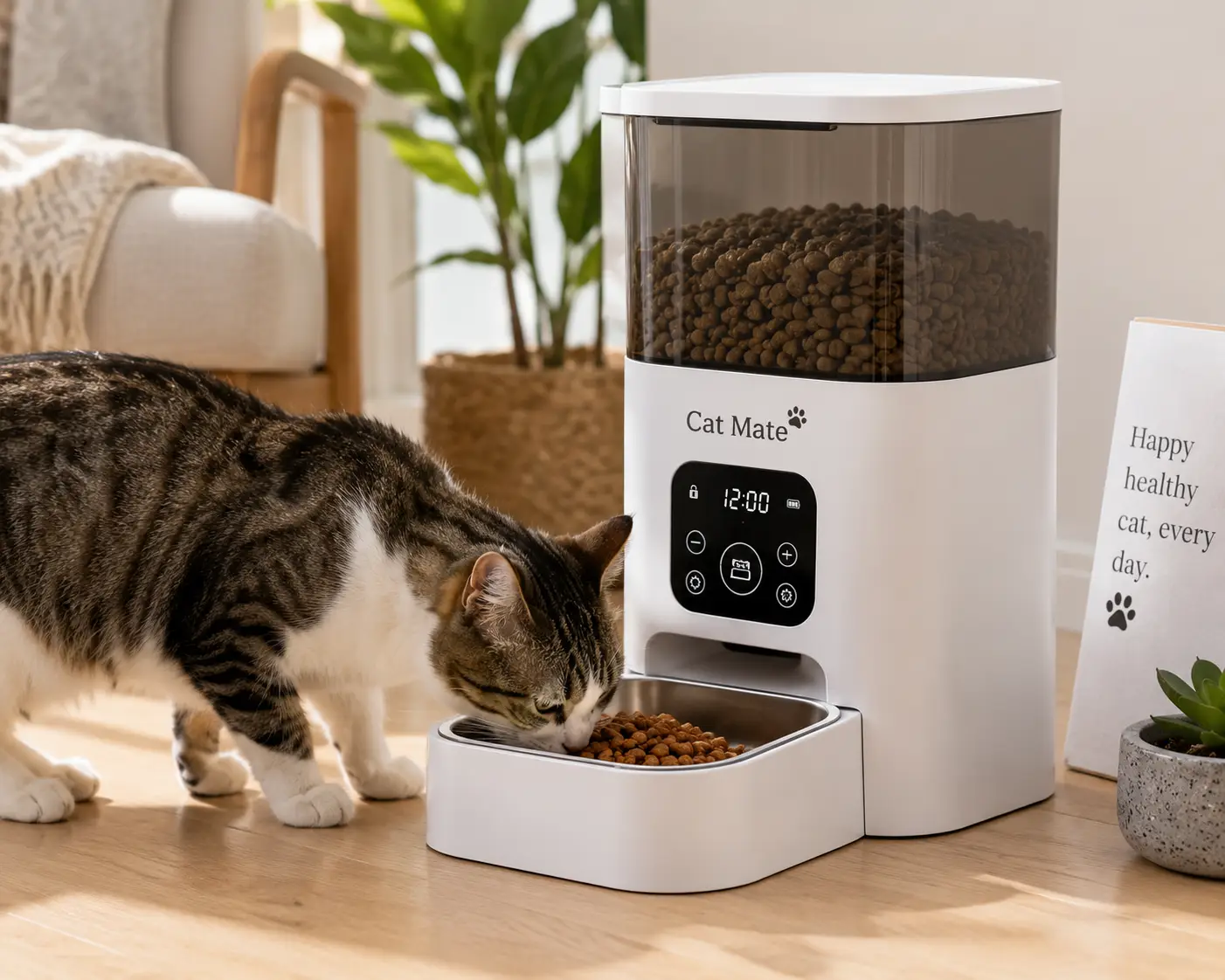
A cat mate feeder is an automatic pet feeding device, originally made by the UK brand Cat Mate (now produced under the Closer Pets/Petmate umbrella), that dispenses pre-portioned meals on a programmed schedule using either an analog dial or a digital timer. Most models use a rotating tray or hopper mechanism to release wet or dry food at set intervals, so cats are fed consistently even when their owner isn’t home.
The category has since expanded well beyond the original Cat Mate brand — plenty of shoppers now use “cat mate feeder” as a catch-all term for any automatic cat feeder, including WiFi-enabled and app-controlled models from competing brands. We’ll cover both the true Cat Mate lineup and a few of the strongest alternatives so you can compare like for like.
Quick Comparison: Cat Mate Feeder Options at a Glance
| Feeder | Type | Meals | Food Type | Best For |
|---|---|---|---|---|
| Cat Mate C50 | Analog dial | Up to 5 | Wet/Dry | Budget-conscious, no-frills scheduling |
| Cat Mate C300 | Digital timer | Up to 3 | Wet/Dry | Small households, short trips |
| Cat Mate C500 | Digital timer | Up to 5 | Wet/Dry | Most buyers, wet food reliability |
| Cat Mate C3000 | Digital timer | Up to 3 | Dry only | Long unattended stretches |
| PetSafe Healthy Pet Simply Feed | Digital timer | Up to 12 | Dry/Semi-moist | Multi-meal, larger cats |
| WOPET 6L WiFi Feeder | App + timer | Up to 15 | Dry only | Budget smart-feeder shoppers |
| PETLIBRO Granary Camera Feeder | App + camera | Up to 10 | Dry only | Remote monitoring, tech-forward owners |
Looking at the table above, notice the split between wet-food-capable feeders (which use ice packs and a rotating tray) and dry-food-only hoppers (which use a screw or drum mechanism and hold far more food). If your cat eats canned or raw food even occasionally, that distinction should drive your decision more than price. The Cat Mate C500 and Cat Mate C300 remain the only two feeders here truly built for wet food, while the rest are dry-food specialists that trade wet-food compatibility for much larger capacity.
💬 Found a feeder that looks like a fit already? Check current pricing and availability before it changes.
Top 7 Cat Mate Feeders and Alternatives: Expert Analysis
We researched real spec sheets, verified availability on Amazon, and pulled aggregated customer sentiment for each of these seven feeders. Prices below are shown as ranges, since Amazon pricing shifts frequently — always check the current price at checkout.
1. Cat Mate C50 — simplest analog option
The C50 strips automatic feeding down to its essentials, and that simplicity is exactly its distinguishing benefit.
It uses a mechanical dial timer rather than a digital display: you physically set red tabs to the times you want each of the five compartments to open, then twist the lid to align it with the base. In practice, this means no batteries drain a display, no software to update, and no LCD to misread in a dark kitchen — just a dial you set once and can visually check at a glance. The five-compartment rotating tray is refrigerated by twin ice packs, so it works for wet or dry food, and the whole unit is dishwasher safe apart from the electronic base.
Based on comparing this model against its digital siblings, the C50 is best suited to owners who want a “set it and forget it” feeder for short trips and don’t need the precision of 10-minute-interval digital scheduling. It’s a poor match for anyone who travels frequently and needs to reprogram feeding times often, since the dial reset process is more fiddly than pressing a button.
Reviews consistently report that the analog dial is intuitive once you’ve set it the first time, though several buyers note that misjudging the “twist to align” step at setup causes an immediate accidental feeding. That’s a one-time learning curve rather than a recurring flaw.
Pros:
- ✅ No digital display to malfunction or reset
- ✅ Straightforward analog dial once you learn it
- ✅ Refrigerated compartments handle wet food
Cons:
- ❌ Less precise than digital 10-minute scheduling
- ❌ Reprogramming for a new schedule is more tedious
At around $30 to $40, the Cat Mate C50 is the most affordable way into the wet-food-capable Cat Mate lineup, and it delivers solid value if you’re feeding on a fixed daily routine rather than a shifting one.
2. Cat Mate C300 — compact 3-meal option
The C300 is essentially a smaller, three-compartment sibling to the C500, and its distinguishing benefit is a lower footprint for single-cat households that don’t need five separate meals.
Its digital timer allows delayed opening of each of the three 330-gram sections, and a single cool pack (rather than the C500’s twin packs) keeps wet or dry food fresh under the spinning cover. The battery-operated design runs on three AA batteries, and every removable part — cover, bowl, cool pack tray — is dishwasher safe. Because it only holds three meals, the C300 is inherently limited to shorter absences than its five-meal counterparts.
What most buyers overlook with this model is that “3 meals” doesn’t mean “3 days” — it typically covers a single day of feeding for cats that eat two to three times daily, making it a weekend-trip feeder rather than a week-away solution. For anyone with a strict multi-meal daily routine and a single cat, though, it’s a tidier, less bulky option than stepping up to the five-bowl models.
Aggregated reviews frequently mention the compact size as a selling point for smaller kitchens and counters, alongside praise for the digital timer’s simplicity compared to older analog Cat Mate models. A recurring complaint is that the single cool pack doesn’t keep wet food as cold, as long as the C500’s twin-pack system.
Pros:
- ✅ Compact footprint fits smaller kitchens
- ✅ Digital timer with delayed-opening compartments
- ✅ Dishwasher-safe cover, bowl, and tray
Cons:
- ❌ Only one cool pack, shorter wet-food freshness window
- ❌ Three meals cap it at roughly a single day away
Priced in the $30 to $45 range, the Cat Mate C300 is a reasonable pick if you want digital precision without paying for compartments you won’t use.
3. Cat Mate C500 — most popular all-rounder
The C500’s distinguishing benefit is balance: five meals, wet-or-dry compatibility, and a digital timer, all in the Cat Mate lineup’s most reviewed model.
The unit programs up to four timed servings plus one immediately available meal, each of the five 11.5-ounce compartments sealed under a rotating lid that only exposes one bowl at a time. Twin ice packs sit beneath the tray to keep wet or mixed food cold, and Cat Mate states they can maintain freshness for roughly half a day to a full day depending on ambient temperature — worth noting since a hot kitchen will shorten that window. The LCD control panel supports both 12-hour and 24-hour formats and can be pre-set up to 90 hours in advance, and Cat Mate backs the unit with a 3-year limited warranty.
Based on comparing the specs against competing 5-meal dispensers, the C500’s biggest advantage is genuine wet-food capability at this price point — most rivals in the same range are dry-food-only hoppers. That makes it the clear pick for anyone feeding canned or raw food on a schedule, though its 11.5-ounce compartments may run small for larger cats or multi-cat households sharing one bowl.
Reviews consistently report strong satisfaction with portion control for cats with digestive issues or a tendency to gulp food too fast, and several long-term owners mention buying multiple units for multi-cat homes rather than relying on a single feeder to split meals. A recurring complaint involves the rotating tray occasionally misaligning, which Cat Mate’s support documentation addresses with a straightforward battery and alignment check.
Pros:
- ✅ Handles wet, dry, or mixed food reliably
- ✅ Digital timer with up to 90-hour pre-set window
- ✅ Backed by a 3-year manufacturer warranty
Cons:
- ❌ 11.5-ounce compartments run small for large cats
- ❌ Rotating tray can occasionally misalign
Expect to pay somewhere between $45 and $60 for the Cat Mate C500, and given the warranty and wet-food handling, it’s genuinely solid value for the price — which is exactly why it’s the best-known feeder in the lineup.
4. Cat Mate C3000 — largest dry-food hopper
The C3000 trades wet-food compatibility for sheer capacity, holding roughly 105 ounces (about 3 kilograms) of dry food — its clear distinguishing benefit.
Rather than a rotating tray, it uses a screw-feed mechanism that dispenses individually sized dry-food portions through a spout, controlled by a digital timer that supports up to three meals a day. The large hopper is rated to last approximately one month for a single average-sized cat, and the unit runs on four C-cell batteries rated for up to 12 months of use. Cat Mate also includes a frequent-feed mode intended for pets with specific dietary needs, such as diabetic cats who benefit from smaller, more frequent portions.
Here’s what to weigh: because this model is dry-food only, it won’t work for anyone feeding wet or raw diets, and its plastic construction is noticeably lighter than the wet-food models, which several reviewers and hands-on testers note makes it easier for a determined cat to tip over unless it’s anchored. On the other hand, the sheer capacity makes it the strongest choice here for genuinely long unattended stretches, like a week-long trip, rather than a single overnight.
Aggregated customer sentiment is mixed but leans positive: the large capacity and simple screw mechanism earn consistent praise, while the lightweight base and occasional kibble jams with irregularly shaped pellets are the most common complaints. Cat Mate specifies the unit works best with kibble between roughly a quarter-inch and just under an inch in diameter, so oddly shaped treats or very large kibble can cause dispensing issues.
Pros:
- ✅ Massive hopper lasts about a month per cat
- ✅ Frequent-feed mode for special dietary needs
- ✅ Digital timer with straightforward programming
Cons:
- ❌ Dry food only, no wet-food option
- ❌ Lightweight base tips easily unless anchored
You’ll typically find the Cat Mate C3000 priced between $40 and $55, and for the capacity alone, it’s a strong value if long trips (not wet food) are your priority.
5. PetSafe Healthy Pet Simply Feed — highest meal frequency
The Simply Feed’s standout benefit is scheduling flexibility: up to 12 meals a day in portions as small as an eighth of a cup, which no other feeder on this list matches.
Its 24-cup hopper is translucent, doubling as a built-in low-food indicator, and the digital control panel lets you dial in portions from 1/8 cup up to 4 cups per meal. A “Feed Now” button lets you dispense an early meal on demand, and a separate “Pause Feed” function stops scheduled dispensing without erasing your programmed schedule — handy if you’re temporarily switching to hand-feeding. It runs on four D-cell batteries rated for roughly nine months, with an optional AC power adapter sold separately for owners who’d rather not manage batteries at all.
What the spec sheet doesn’t say, but reviews reveal, is that the interface takes longer to learn than Cat Mate’s simpler dial or button systems, and the unit’s internal clock has been reported to drift over time, requiring periodic resets to stay accurate. On the upside, this is the feeder best suited to multi-cat households or larger cats needing bigger portions more often throughout the day, since none of the Cat Mate models offer 12 daily feeding windows or 4-cup portions.
Reviews consistently mention that the “Feed Now” and “Pause Feed” features are genuinely useful day-to-day conveniences, while the recurring criticism centers on the programming process feeling more complex than it needs to be, especially compared to PetSafe’s own newer app-connected models.
Pros:
- ✅ Up to 12 meals daily in 1/8-cup increments
- ✅ Feed Now and Pause Feed convenience buttons
- ✅ Large 24-cup hopper with visible low-food warning
Cons:
- ❌ Programming interface has a steeper learning curve
- ❌ Internal clock reportedly drifts and needs resets
Pricing generally falls between $60 and $90, which is a fair trade if you specifically need high-frequency, small-portion feeding that the Cat Mate lineup doesn’t offer.
6. WOPET 6L WiFi Feeder — budget smart feeder
The WOPET’s distinguishing benefit is bringing app control and a voice-recording feature into a genuinely budget-friendly price bracket.
The 6-liter hopper holds several days of dry food for a medium-sized cat, and the companion app lets you schedule, adjust, or trigger feedings remotely over WiFi from a smartphone. A standout feature is the 10-second voice recorder, which lets you record your own voice calling your cat to the bowl — genuinely useful for pets who respond to a familiar voice more than a mechanical dispensing sound. Portions are adjustable in small increments up to four meals a day, and the large LCD screen is generally easier to read and program than some pricier competitors.
On paper, this means WOPET undercuts PetSafe’s WiFi-enabled Smart Feed on price while still delivering the core smart-feeder experience: remote scheduling, portion control, and app alerts. The trade-off is build quality and long-term reliability — this is a budget smart feeder, not a premium one, and its plastic components and WiFi module are the most common points of failure reported by long-term owners.
Aggregated reviews frequently highlight the voice-recording feature and straightforward app setup as strengths, while a recurring complaint involves WiFi connectivity drops that occasionally require the app to be reset or the feeder to be power-cycled.
Pros:
- ✅ App-based remote scheduling and feed-now control
- ✅ 10-second personalized voice recorder
- ✅ Large, easy-to-read LCD programming screen
Cons:
- ❌ WiFi connectivity occasionally drops or lags
- ❌ Build quality trails pricier smart feeders
At roughly $60 to $80, the WOPET 6L WiFi Feeder is the most accessible way to try app-controlled feeding without committing to a premium price tag.
7. PETLIBRO Granary WiFi Camera Feeder — most feature-rich option
The Granary Camera model’s clear distinguishing benefit is the built-in 1080p camera, turning a feeder into a full remote pet-monitoring station.
Beyond app-based scheduling for up to 10 meals a day with adjustable portions, the feeder streams live 1080p video with night vision and a 145-degree wide viewing angle, plus two-way audio so you can talk to your cat and hear them back through your phone. Motion and sound alerts notify you when your cat approaches the feeder, and video can be saved locally to a supported memory card for playback later. Some versions in the current lineup add a built-in smart scale that logs exactly how much food is consumed at each visit, which is a genuinely useful data point for cats on a monitored diet.
Here’s what to weigh: this is by far the most expensive and feature-dense option here, and none of that camera or scale technology matters if you just need reliable scheduled dispensing — in that case, you’re paying for capability you won’t use. But for owners managing a cat with a medical condition, multiple pets with different dietary needs, or simply significant separation anxiety about leaving their cat alone, the live monitoring genuinely changes the experience compared to a “dumb” dispenser.
Reviews consistently praise the video and audio quality as excellent for the price category, and the food-intake tracking data is frequently cited as valuable by owners managing a cat’s weight or a chronic condition. The most common complaint involves the WiFi setup process being finicky on certain router configurations, plus recurring subscription prompts for extended cloud video storage beyond the free tier.
Pros:
- ✅ 1080p camera with night vision and two-way audio
- ✅ Smart scale option tracks precise food intake
- ✅ Motion and sound alerts sent to your phone
Cons:
- ❌ Priciest option here by a meaningful margin
- ❌ WiFi setup can be finicky depending on router
Expect to pay in the $90 to $150 range depending on which Granary variant you choose, and if remote monitoring matters as much as feeding schedules do, the PETLIBRO Granary WiFi Camera Feeder is worth the premium.
Comparing the Top 7 Cat Mate Feeder Options
| Feeder | Power Source | Capacity | Price Range | Best For |
|---|---|---|---|---|
| Cat Mate C50 | 2 AAA batteries | 5 × meal trays | $30–$40 | Simple fixed routines |
| Cat Mate C300 | 3 AA batteries | 3 × 330g trays | $30–$45 | Single-cat short trips |
| Cat Mate C500 | 3 AA batteries | 5 × 11.5oz trays | $45–$60 | Wet food, most households |
| Cat Mate C3000 | 4 C batteries | ~105oz hopper | $40–$55 | Long dry-food stretches |
| PetSafe Simply Feed | 4 D batteries / AC | 24-cup hopper | $60–$90 | High meal frequency |
| WOPET 6L WiFi | AC + battery backup | 6L hopper | $60–$80 | Budget app control |
| PETLIBRO Granary Camera | AC + battery backup | 5L hopper | $90–$150 | Remote monitoring |
The pattern here is fairly clear once you line the products up side by side: capacity and meal frequency climb as you move away from the classic wet-food-capable Cat Mate trays and toward dry-food hoppers, while price climbs sharply once WiFi and camera hardware enter the picture. If budget is the deciding factor, the Cat Mate C50 and Cat Mate C3000 offer the best value in their respective categories (wet-capable and high-capacity dry, respectively). If features matter more than price, the PETLIBRO Granary WiFi Camera Feeder justifies its premium with genuine monitoring capability the others simply don’t offer.
🔍 Take your cat’s feeding routine to the next level
Click through on any of the highlighted picks above to check current pricing and availability — these seven options cover budget, wet-food, and smart-feeder needs so your cat (and your sleep schedule) can finally get on a reliable routine.
How to Set Up and Program Your Cat Mate Feeder
Getting a new feeder running correctly in the first week matters more than most buyers expect — a surprising number of one-star reviews trace back to setup mistakes rather than actual product defects.
Start by installing fresh, high-quality alkaline batteries before you do anything else; Cat Mate’s own customer support repeatedly flags weak or mismatched batteries as the number-one cause of feeders that stop rotating or lose their programmed schedule. Once powered on, set the current time first, since every Cat Mate digital model calculates meal times relative to that clock rather than a fixed daily schedule. For digital models, program your first meal at least four hours ahead of the current time, and space subsequent meals at least six hours apart — setting meals too close together is a common reason the display shows an error instead of confirming the schedule.
For the rotating-tray models (C50, C300, C500), double-check that the lid is seated flush and twisted fully into its locking position before walking away; a lid that isn’t fully engaged is the single most common reason a “programmed” feeder never actually opens on schedule. If you’re using wet or mixed food, freeze the included ice packs for a full 24 hours beforehand — a partially frozen pack won’t hold temperature long enough for an all-day absence. For the hopper-style dry feeders (C3000, PetSafe, WOPET, PETLIBRO), run one manual test dispense before your first scheduled meal to confirm the kibble size you’re using doesn’t jam the mechanism; Cat Mate specifies the C3000 works best with kibble roughly a quarter-inch to just under an inch in diameter.
In the first 30 days, keep an eye out for two easy-to-miss maintenance habits: wipe down the base unit (not the removable tray) with a damp cloth weekly, since the base typically isn’t dishwasher safe, and replace ice packs on wet-food models every use rather than reusing a partially thawed pack. Skipping either step is a leading cause of the “why is my feeder jammed” and “why does the food smell off” complaints that show up in long-term reviews.
Real-World Scenarios: Matching the Feeder to Your Household
Different households need genuinely different feeders, and matching your situation to the right model up front saves a return-and-reorder cycle.
The commuter with one cat and a strict 9-to-5 schedule: A single cat eating twice daily on a predictable routine doesn’t need 12 meal slots or a camera — the Cat Mate C300 or Cat Mate C500 covers a standard workday comfortably, and the wet-food compatibility matters if the cat eats canned food for breakfast and dinner.
The frequent weekend traveler with two cats: Two cats sharing a feeding schedule benefit from either two separate Cat Mate C500 units (one per cat, to avoid food-guarding conflicts) or a single higher-capacity hopper like the PetSafe Healthy Pet Simply Feed, which can be portioned generously enough to satisfy two eaters across a long weekend away.
The owner managing a diabetic or overweight cat: Precise, frequent small portions matter more than capacity here. The Cat Mate C3000‘s frequent-feed mode or the PetSafe Healthy Pet Simply Feed‘s 1/8-cup increments and 12-meal-a-day ceiling both support the kind of tightly controlled feeding schedule a veterinarian might recommend for weight management or blood sugar stability.
The anxious pet parent who travels for work: If peace of mind matters as much as the mechanics of feeding, the PETLIBRO Granary WiFi Camera Feeder solves a different problem entirely — it lets you confirm, in real time, that your cat actually ate, rather than just trusting that the timer worked.
Common Feeding Problems and How to Solve Them
Problem: The feeder dispensed early or didn’t open on schedule. This is almost always a clock-and-battery issue rather than a mechanical failure. Reset the current time, replace batteries with fresh alkaline cells (not rechargeables, which run at a lower voltage many Cat Mate units aren’t calibrated for), and reprogram the meal times from scratch rather than trying to edit an existing schedule.
Problem: Wet food smells off by the scheduled mealtime. This points to an ice pack that wasn’t fully frozen, an ambient kitchen temperature that’s too warm, or a feeding window that’s simply too long for perishable food. Freeze ice packs a full day ahead, and if you’re routinely away more than about 8 to 10 hours with wet food loaded, consider switching that slot to dry food or upgrading to a feeder with stronger cooling.
Problem: My cat learned how to pry the lid open early. Tamper-resistant lids help, but a food-motivated cat can be surprisingly persistent. Cat Mate models can typically be screwed to a small board for added stability, which also makes the lid harder to lever open, and placing the unit against a wall removes one angle of attack entirely.
Problem: Dry food jams in the dispensing mechanism. Screw-feed and drum-style dispensers (C3000, PetSafe, WOPET, PETLIBRO) are sensitive to kibble size and shape. Check the manufacturer’s specified pellet-size range before buying food, and avoid mixing in oddly shaped treats or very large kibble pieces that can wedge in the feed channel.
Problem: My multi-cat household has one cat stealing another’s portions. A single feeder rarely solves a multi-cat food-guarding dynamic. The more reliable fix is one feeder per cat, placed in separate rooms, or a model with RFID/collar-tag recognition designed specifically to restrict access to the intended cat.
How to Choose a Cat Mate Feeder
- Start with your cat’s diet. If your cat eats any wet or raw food, you need a feeder with active cooling (ice packs), which narrows you immediately to the C300 or C500 style. Dry-food-only cats open up every hopper-style option on this list.
- Match capacity to how long you’re actually away. A weekend trip needs far less capacity than a week-long absence — don’t overpay for a 105-ounce hopper if you never leave for more than a day.
- Decide whether you need WiFi. App control and remote monitoring are genuinely useful for frequent travelers, but they add cost, a setup step, and one more thing that can lose connection. If you’re rarely away, a simple digital or analog timer is often more reliable.
- Check the power source and backup. Battery-only feeders keep working through a power outage; AC-powered smart feeders usually include battery backup, but confirm that before buying if outages are common where you live.
- Consider your cat’s temperament. Cats who are pushy or food-motivated do better with tamper-resistant lids and board-mounting options; more relaxed cats may never test the lid at all.
- Factor in cleanup. Dishwasher-safe trays and bowls save real time over weeks and months of use — check this before buying rather than after the first messy cleanup.
- Read the warranty terms. A 3-year warranty, like Cat Mate offers on several models, is a meaningful signal of manufacturer confidence compared to feeders with only a 90-day or 1-year window.
Common Mistakes to Avoid When Buying a Cat Mate Feeder
The most frequent mistake is buying based on price alone and ending up with a dry-food-only hopper when your cat actually eats wet food — an easy mix-up given how similar these feeders look in thumbnail photos. Read the food-type compatibility line in the listing carefully before adding to cart.
A second common mistake is underestimating portion size needs for larger or multiple cats. The 11.5-ounce compartments on the Cat Mate C500, for example, are generous for one average cat but tight if you’re trying to split a single tray between two. Buyers assuming rated capacity will match their specific cat’s appetite anonymous of body size are frequently surprised by mid-sized or larger cats needing top-ups sooner than expected.
A third mistake is skipping the battery-quality detail in the fine print. Multiple models specifically call for fresh, name-brand alkaline batteries, and using older or rechargeable batteries is a leading cause of feeders that reset their programming unexpectedly. Buying “on sale” batteries at the same time you order the feeder is a small step that prevents a frustrating first week.
Finally, don’t assume every feeder is cat-proof out of the box. Reviews across every model in this guide mention at least some owners whose cats learned to defeat the lid mechanism eventually — board-mounting and lid-locking accessories exist for a reason, and it’s worth budgeting for them if your cat has a track record of getting into things it shouldn’t. According to a widely cited 2015 industry survey referenced by the American Veterinary Medical Association, well over half of American cats are already overweight, which makes portion-locking features less of a luxury and more of a genuine health safeguard.
Cat Mate Feeders vs Smart WiFi Feeders
The core trade-off between the classic Cat Mate lineup and app-connected smart feeders like the WOPET and PETLIBRO models comes down to reliability versus visibility.
Battery-only Cat Mate feeders don’t depend on your home WiFi network, a smartphone app staying updated, or a cloud server staying online — the schedule you set is stored locally and runs regardless of internet connectivity. That makes them notably more resilient during a router outage or a travel destination with spotty connectivity, since a smart feeder that loses its WiFi connection can, depending on the model, still dispense on its last saved schedule but won’t accept new instructions or send alerts until it reconnects.
WiFi feeders win decisively on flexibility and peace of mind, though. Being able to trigger an early or extra feeding from your phone, adjust a schedule mid-trip, or simply glance at a live camera feed solves problems that a fixed analog or digital timer physically cannot. For cats with irregular schedules, changing routines, or owners who travel unpredictably rather than on a fixed weekly pattern, that remote flexibility is worth real money.
In practice, the right choice often isn’t “Cat Mate or smart feeder” but “which specific problem am I solving.” If reliability without dependency on your home network is the priority, the traditional Cat Mate C500 remains hard to beat. If remote control and monitoring are the priority, the PETLIBRO Granary WiFi Camera Feeder delivers capability no analog Cat Mate model can match.
What to Expect: Everyday Performance
Spec sheets rarely capture what living with one of these feeders actually feels like day to day, so here’s the translation from technical detail to lived experience.
The rotating-tray Cat Mate models make an audible mechanical sound when the lid turns to reveal the next meal — several long-term owners report their cats actually learn to associate that noise with mealtime, which can be a helpful behavioral cue rather than a drawback, though it may startle particularly skittish or elderly cats with hearing sensitivity. Digital timer displays are readable in normal room lighting but can be hard to see in a dark kitchen at night, so placing the unit somewhere with at least some ambient light helps with troubleshooting.
Hopper-style dry feeders run quieter overall, since there’s no rotating lid mechanism, but the screw-feed motor does produce a brief whirring sound during dispensing. Battery life claims (up to 12 months for the C3000, roughly 9 months for the PetSafe unit) generally hold up under normal single-cat use, but multiple daily feedings across a multi-cat household will draw batteries down meaningfully faster than the rated estimate.
WiFi-enabled feeders add a genuinely different day-to-day rhythm: instead of setting a schedule once and largely ignoring the unit, most owners check the companion app periodically, especially in the first few weeks, to confirm feedings are firing correctly and to review any low-food or motion alerts. That extra engagement is either a comfort or a minor chore depending on your personality — worth being honest with yourself about before paying the premium for app connectivity you might not actually use after the novelty wears off.
Long-Term Cost and Maintenance
The sticker price is only part of the real cost of owning a cat mate feeder over a year or more. Battery-powered models require an ongoing, if modest, battery budget — a single Cat Mate C500 running on three AA batteries for up to a year works out to a few dollars annually in battery replacement, which is close to negligible. Higher-drain models, especially WiFi feeders that stay connected to your network continuously, tend to burn through batteries or rely more heavily on their AC adapter, shifting the ongoing cost toward electricity rather than batteries.
Replacement parts are the next consideration. Ice packs for the wet-food-capable models occasionally need replacing if they crack or stop holding a seal, and replacement bowls or trays are sold separately for most models in this lineup — budget a small annual allowance if you have a particularly rough-on-equipment cat. Smart feeders add one more line item some buyers overlook: several camera-equipped models, including higher-end PETLIBRO configurations, offer optional cloud video storage subscriptions beyond a limited free tier, which is a genuine recurring cost if extended video history matters to you.
Weighed against the alternative — a missed feeding leading to a vet visit, or a cat’s diet-related health issue going unmanaged — the total cost of ownership on any of these seven feeders remains modest. Consistent, portion-controlled feeding is also one of the more effective tools against feline weight gain, a condition veterinary researchers at the University of Illinois have linked to a heightened risk of a serious liver condition in cats that stop eating regularly, which is exactly the kind of scenario reliable automatic feeding is designed to prevent.
Safety, Regulations, and Standards
Automatic pet feeders sold in the U.S. fall under general consumer product safety oversight, and a few practical safety points are worth knowing before you buy.
Battery compartments matter more than most buyers assume, especially in households with young children. The Consumer Product Safety Commission maintains detailed safety guidance on battery-powered household products, and it’s worth confirming that any feeder’s battery compartment uses a secure screw closure, particularly for models using coin or button-style cells rather than standard AA or C batteries — all seven feeders in this guide use standard cylindrical batteries rather than button cells, which is a meaningful safety plus if there are kids in the house.
Look for BPA-free plastic construction, which most reputable pet feeder brands, including Cat Mate, explicitly call out in their product specifications — this matters for food-contact surfaces that hold your cat’s meals for hours at a time. If you’re using a wet-food-capable feeder, food safety is really a food-storage-time issue rather than a regulatory one: don’t load perishable wet food into a feeder for a window longer than the ice packs are rated to keep it cold, generally somewhere in the range of half a day to a full day depending on the model and ambient temperature.
For WiFi-connected feeders, it’s also worth a quick check of the manufacturer’s data privacy policy, particularly for camera-equipped models that store video, since that’s a newer category of consideration that didn’t exist for the original analog Cat Mate feeders.
Frequently Asked Questions
❓ What is a cat mate feeder used for?
❓ How many meals can a Cat Mate C500 hold?
❓ Can a cat mate feeder be used for wet food?
❓ Do cat mate feeders work without WiFi?
❓ How long can a cat mate feeder run without power or refill?
Conclusion
There’s no single “best” cat mate feeder — there’s a best one for your specific cat, schedule, and food type. If you’re feeding wet food and want a proven, no-nonsense option, the Cat Mate C500 remains the strongest all-around pick in this guide, backed by a 3-year warranty and genuine wet-food cooling that most competitors in its price range simply don’t offer. If your cat eats dry food exclusively and you need to cover longer absences, the Cat Mate C3000‘s large hopper is hard to beat on capacity alone.
For households that want more control or peace of mind while traveling, stepping up to the WOPET 6L WiFi Feeder or the PETLIBRO Granary WiFi Camera Feeder adds real functionality, at a real cost, that the analog and digital Cat Mate models can’t match. And if your household has unusual scheduling needs — a diabetic cat, a multi-cat food-guarding situation, or a genuinely unpredictable travel pattern — the PetSafe Healthy Pet Simply Feed‘s high meal frequency fills a gap none of the others cover.
Whichever you choose, the setup habits matter as much as the hardware: fresh batteries, a fully seated lid, correctly frozen ice packs for wet food, and a quick test dispense before you actually rely on it for a real absence. Get those right, and any of these seven feeders should earn its keep for years.
Recommended for You
- Best Refrigerated Cat Feeder: 7 Top Picks for 2026 (Ranked)
- Cat Feeder With Collar Sensor: 7 Best Picks for 2026 (Tested)
- Dog Bowls for Flat Faced Dogs: 7 Best Options for Easier Feeding in 2026
Disclaimer: This post contains affiliate links. As an Amazon Associate, I earn from qualifying purchases made through these links, at no additional cost to you.
✨ Found this article helpful? Share it with someone who needs it! 💬🤗