In This Article
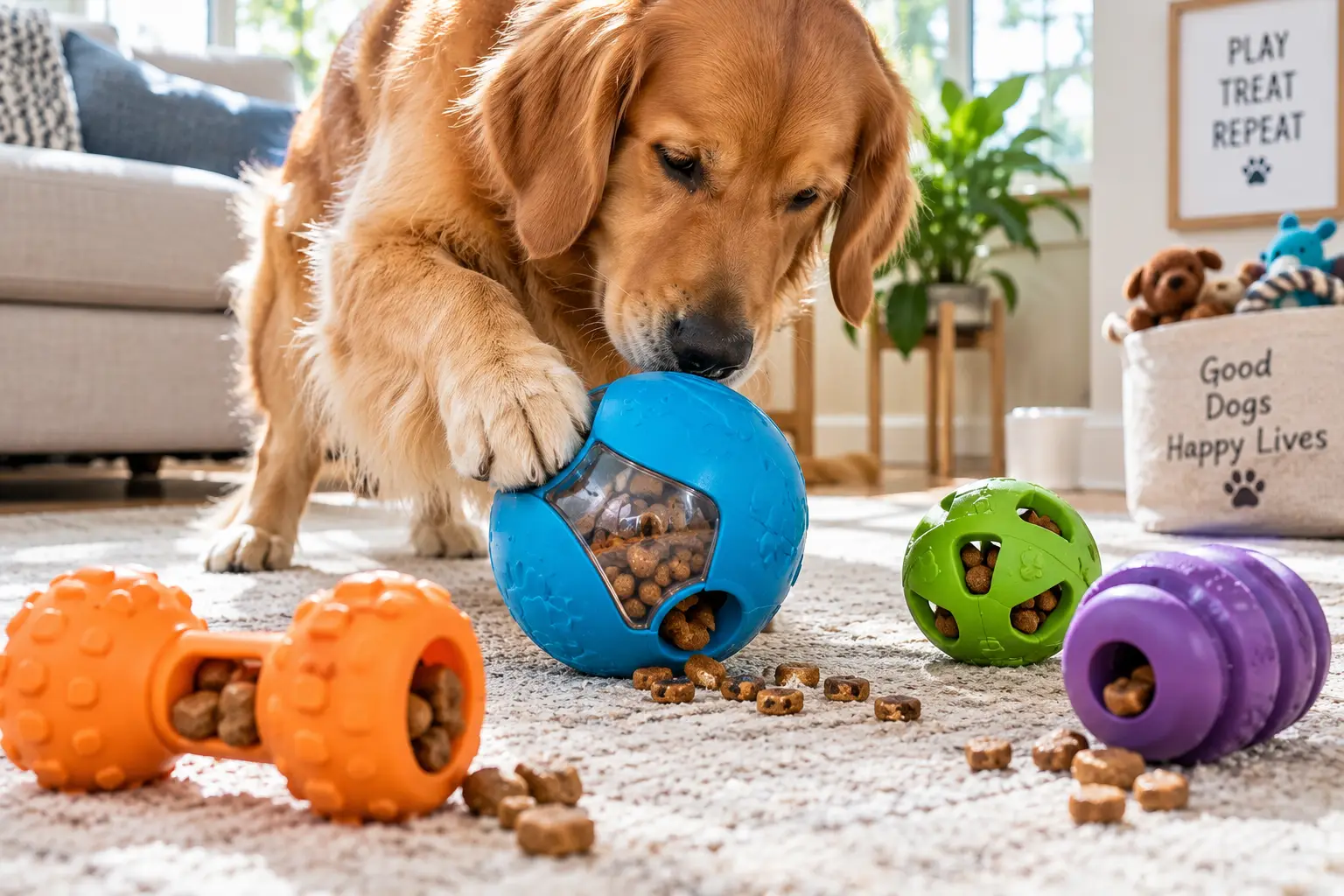
If your dog demolishes a toy in ten minutes flat but goes quiet and focused the moment there’s a treat trapped inside it, you’ve already discovered the secret that trainers and shelters have used for years: dogs work harder for food they have to earn than food that’s just handed to them. Dog toys with treats inside — sometimes called puzzle toys, treat-dispensing toys, or food puzzles — turn a few minutes of snack time into ten or twenty minutes of problem-solving, licking, and nose-work. That matters more than it sounds like it should. The ASPCA notes that food puzzles are a simple, effective way to satisfy a dog’s natural instincts to forage and problem-solve, which is exactly why these toys have become a staple for crate training, home-alone routines, and rainy-day boredom.
Not every dog toy that claims to hold treats is worth your money, though. Some crack the first week, some are too easy to be worth the price, and a few genuinely won’t survive a determined 70-pound chewer. Below, we’ve researched seven real, currently available options on Amazon — from a $10 rubber classic to a $25 advanced puzzle board — and broken down exactly who each one is built for, what the specs actually mean in daily use, and where the honest trade-offs are. We’ll also walk through how to introduce a new puzzle toy without frustrating your dog, common mistakes first-time buyers make, and how to think about safety and long-term value before you click “add to cart.”
Quick Comparison: Dog Toys With Treats Inside at a Glance
| Product | Toy Type | Difficulty | Best For | Price Range |
|---|---|---|---|---|
| KONG Classic | Stuffable rubber | Beginner–Advanced (adjustable by fill) | Most dogs, crate training | Under $20 |
| Outward Hound Snoop | Rolling ball | Beginner | Small–medium dogs, chasers | Under $20 |
| PetSafe Busy Buddy Twist ‘n Treat | Screw-adjustable dispenser | Beginner–Intermediate | Dogs progressing past a treat ball | Under $20 |
| KONG Wobbler | Weighted wobbler | Intermediate | Medium–large dogs, mealtime feeding | Around $15–$20 |
| Starmark Bob-A-Lot | Adjustable wobbler | Intermediate | Dogs who master the KONG Wobbler | Around $20–$30 |
| West Paw Toppl | Stuffable/freezable cup | Beginner–Advanced (stack for difficulty) | Licking, freezer meals, heavy chewers | Around $15–$25 |
| Outward Hound Nina Ottosson Twister | Sliding puzzle board | Advanced | Experienced puzzle solvers | Around $20–$30 |
Looking at this table, a clear pattern emerges: the toys near the top are genuinely beginner-friendly and forgiving of a dog’s first fumbling attempts, while the Nina Ottosson Twister sits at the difficult end and shouldn’t be your dog’s very first puzzle toy. If you’re not sure where your dog fits yet, the KONG Classic and West Paw Toppl are the safest starting points because their difficulty scales with how you pack them, not with how the toy is built.
💬 Found the right toy already? Check today’s price and see if it’s in stock near you!
Top 7 Dog Toys With Treats Inside: Expert Picks
1. KONG Classic — the beginner-proof original
The KONG Classic earns its spot at the top of nearly every list of dog toys with treats inside because it was one of the first products to popularize the category, and it still holds up. Made from a single piece of natural rubber shaped like a snowman, it has a wide opening at the bottom and a narrow one at the top, so you can pack it with kibble, peanut butter, wet food, or a mix, then freeze it for a longer-lasting challenge. That single design choice — a wide-to-narrow taper — is what makes it adjustable: pack it loosely for a puppy’s first try, or ram it full and freeze it for a dog that needs 30 minutes of licking to settle down.
Its erratic, unpredictable bounce (thanks to the irregular shape) also makes it a legitimate fetch toy, not just a stationary chew. Reviews consistently describe it as close to indestructible for average chewers, though owners of very aggressive chewers note that the softer “puppy” and “senior” red/pink versions wear faster than the black, extra-durable line, so matching the rubber density to your dog’s bite strength matters.
Pros:
- ✅ Freezable for extended, slower-paced enrichment
- ✅ Doubles as an unpredictable-bounce fetch toy
- ✅ Dishwasher-safe for easy cleanup
Cons:
- ❌ Extra-durable version costs more than the standard line
- ❌ Not marketed as chew-proof for the most aggressive chewers
At under $20 depending on size, the KONG Classic is one of the best value-for-money picks in this whole roundup — it’s the toy most vets and trainers recommend first, and for good reason.
2. Outward Hound Snoop — mint-scented rolling puzzle ball
The Outward Hound Snoop turns snack time into a chase game: it’s a 5-inch, USA-made ball molded from BPA-free TPE with a translucent shell and a flexible mouth that dispenses kibble or soft treats as your dog paws, noses, and rolls it around the floor. That translucent shell is a small but smart detail — your dog can see and smell the treats through the wall of the ball, which keeps engagement higher than an opaque dispenser where the reward is a mystery.
The mint infusion in the rubber is a genuine dual-purpose feature, not just marketing fluff: as your dog mouths and chews the ball to get treats out, the mint works passively on breath odor, similar to how a dental chew works through friction and flavor. The flexible opening can also be folded inside-out to widen the mouth, turning the toy into a slower, easier “bowl” mode for beginners or senior dogs who struggle with the standard opening.
Aggregated reviews frequently praise the mint scent and the see-through design, while some owners note the opening can eventually stretch or tear under heavy chewing rather than just rolling play.
Pros:
- ✅ Translucent shell keeps treats visible and enticing
- ✅ Mint infusion offers a passive dental-freshness bonus
- ✅ Flexible mouth adjusts from ball mode to easier bowl mode
Cons:
- ❌ Best suited to rolling play, not heavy chewing
- ❌ Smaller size may be too easy for large, strong dogs
Priced under $20, the Outward Hound Snoop is an easy entry point if your dog is more of a chaser than a chewer.
3. PetSafe Busy Buddy Twist ‘n Treat — the adjustable difficulty dial
What sets the PetSafe Busy Buddy Twist ‘n Treat apart from most rolling treat balls is that it’s a stationary, hard-plastic dispenser with a genuinely adjustable difficulty setting: you twist the two halves to widen or narrow the gap that releases kibble, so the same toy can grow with your dog instead of becoming obsolete once they figure it out. That’s a meaningful practical advantage — instead of buying a whole shelf of graduated puzzle toys, you own one toy that scales from “easy win” to “real challenge.”
It’s compatible with both dry kibble and softer, smearable treats, which lets you bridge between dry-food puzzle feeding and lick-mat-style enrichment using a single product. Reviews commonly note that the hard plastic shell can be noisy as it skitters across hardwood or tile floors — worth knowing if you’re in an apartment — and that, like most screw-together dispensers, it doesn’t fully disassemble for a deep clean, so a bottle brush is your best friend here.
Pros:
- ✅ Adjustable difficulty grows with your dog’s skill
- ✅ Works with both dry kibble and smearable treats
- ✅ Compact size fits into most crates
Cons:
- ❌ Can be loud rolling across hard flooring
- ❌ Doesn’t fully disassemble for deep cleaning
At around $15–$20, this is one of the smartest budget picks here precisely because it doesn’t need to be replaced as your dog improves.
4. KONG Wobbler — the wide-base mealtime feeder
The KONG Wobbler takes the “roll it to eat it” concept and scales it up for medium and large dogs who’d flatten a smaller ball in one sitting. Its weighted, wide base is the key engineering choice: it keeps the toy upright and self-righting after each nudge, so a determined dog can’t just knock it flat and shake everything out in ten seconds. Unscrew the top, load up to roughly 2.5 cups of kibble, and the adjustable dispensing hole controls how fast food comes out.
Because it holds a full meal’s worth of food, many owners use it as a replacement for a standard bowl at breakfast or dinner, effectively turning every meal into a 15–20 minute enrichment session rather than a 90-second inhale-and-done routine. That’s a genuinely useful behavior tool for dogs that eat too fast, since slower eating is associated with better digestion and less post-meal bloat risk.
Reviews widely mention the rattling noise as kibble shifts inside — some dogs find that noise part of the fun, but it’s worth testing in a room where the sound won’t bother anyone nearby.
Pros:
- ✅ Holds a full meal, not just a few treats
- ✅ Wide base resists tipping and rolling out of reach
- ✅ Adjustable hole controls dispensing speed
Cons:
- ❌ Rattles noticeably as kibble shifts inside
- ❌ Bulkier footprint than smaller treat balls
In the $15–$20 range, it’s a strong mid-tier pick for anyone who wants to turn actual mealtime into enrichment, not just snack time.
5. Starmark Bob-A-Lot — the next step up in wobbler difficulty
The Starmark Bob-A-Lot is what many owners reach for once a dog has “solved” the KONG Wobbler and stopped engaging with it. Its defining feature is a weighted base with an adjustable ring, letting you fine-tune how easily the toy tips and how much resistance your dog has to work against before treats fall — a level of tunable difficulty that flatter, fixed-weight wobblers don’t offer.
In practice, that adjustability is the whole value proposition: instead of buying a second, harder toy, you turn a dial and the same toy gets tougher. The dispensing hole is also sized differently from the KONG Wobbler’s, which changes how treats fall — some owners specifically buy this as a second wobbler-style toy to add variety once their dog has mastered the first one, since dogs do habituate to a single puzzle mechanism over time.
Aggregated reviews describe it as slightly noisier than the KONG Wobbler on hard floors, and a small number of owners with very strong chewers report the plastic lid eventually shows tooth marks, though the base itself tends to hold up well.
Pros:
- ✅ Adjustable base tunes difficulty as your dog improves
- ✅ Different dispensing mechanism adds variety for habituated dogs
- ✅ Dishwasher-safe for straightforward cleaning
Cons:
- ❌ Noisier than the KONG Wobbler on hard flooring
- ❌ Lid may show wear with very strong chewers over time
At roughly $20–$30, it’s a smart “level two” purchase rather than a first toy — buy it once the basics stop being a challenge.
6. West Paw Toppl — the freezer-friendly, dishwasher-safe stacker
The West Paw Toppl takes a different approach than the rolling and wobbling toys above: it’s a stuffable, cone-shaped cup, sold in pairs of different sizes so they can nest together and lock, adding a stacking-and-unstacking challenge on top of the licking challenge inside. That two-in-one design is genuinely clever — you can use one cup alone for a quick snack, or stack the two together with a sticky filling in between for a much longer session.
Made in the USA from West Paw’s proprietary Zogoflex material, it’s dishwasher-safe, freezer-safe, and backed by the company’s guarantee against chew damage — a meaningful signal of confidence, since most treat toys on this list don’t offer that kind of durability backing. That combination of freezer-friendly and dishwasher-safe is rarer than it sounds: a lot of “freezable” toys aren’t rated for the dishwasher’s heat cycle, which limits how easily you can rotate and clean them.
Reviews consistently highlight the material’s toughness against moderate-to-strong chewers and the convenience of tossing it straight in the dishwasher; a smaller number of owners with extreme power-chewers note that, like any chew toy, sustained aggressive gnawing will eventually wear even Zogoflex down.
Pros:
- ✅ Stacks two cups together for a longer challenge
- ✅ Dishwasher-safe AND freezer-safe — a rare combination
- ✅ Backed by a manufacturer chew-damage guarantee
Cons:
- ❌ Higher price point than basic rubber toys
- ❌ Not a match for the most extreme power-chewers over time
In the $15–$25 range depending on size, this is our pick for anyone prioritizing durability and easy cleanup over pure puzzle complexity.
7. Outward Hound Nina Ottosson Dog Twister — the advanced puzzle board
The Outward Hound Nina Ottosson Dog Twister belongs at the end of this list because it genuinely is an end-of-the-line toy: a flat puzzle board with sliding, rotating compartments that a dog has to nose, paw, and twist open in sequence to reach the treats underneath. Unlike the rolling and wobbling toys above, there’s no “just knock it around” shortcut — your dog has to learn and remember a specific manipulation to win.
That’s exactly why it’s the wrong first purchase for a dog that’s never used a puzzle toy before. Give it to a puzzle-toy novice and you risk frustration rather than engagement, which runs counter to what enrichment is supposed to do. Give it to a dog who’s already comfortable with lids, sliders, and screw-tops from something like the PetSafe Busy Buddy Twist ‘n Treat, and it becomes a genuinely stimulating, supervised-play challenge that keeps a smart dog occupied far longer than a simple ball.
Reviews from owners of food-motivated, puzzle-experienced dogs are largely positive on the challenge level; a recurring critique is that very strong chewers can eventually damage the sliding plastic pieces if the toy is left unsupervised for long stretches, so this one is best used as an interactive, supervised activity rather than an all-day, unattended toy.
Pros:
- ✅ Genuine multi-step puzzle, not just a knock-and-spill mechanism
- ✅ Sliding pieces are dishwasher-safe for easy cleaning
- ✅ Keeps experienced puzzle-solvers engaged far longer than basic toys
Cons:
- ❌ Too difficult as a first puzzle toy — can frustrate beginners
- ❌ Best used under supervision, not as an unattended all-day toy
At around $20–$30, it’s a premium pick reserved for dogs that have already graduated from the easier options on this list.
Detailed Feature Comparison: How the Top 7 Stack Up
| Product | Material | Dishwasher-Safe | Freezable | Ideal Dog Size |
|---|---|---|---|---|
| KONG Classic | Natural rubber | Yes | Yes | All sizes (size-matched) |
| Outward Hound Snoop | BPA-free TPE | Rinse recommended | No | Small–medium |
| PetSafe Busy Buddy Twist ‘n Treat | Hard plastic | Partial (hand-wash recommended) | No | Small–large |
| KONG Wobbler | Durable plastic | Yes | No | Medium–large |
| Starmark Bob-A-Lot | Durable plastic | Yes | No | Medium–large |
| West Paw Toppl | Zogoflex thermoplastic | Yes | Yes | Small–large (two sizes) |
| Nina Ottosson Twister | Food-grade plastic | Yes (sliding pieces) | No | Medium–large |
The takeaway from this table is that only the KONG Classic and the West Paw Toppl combine both freezer and dishwasher compatibility, which is exactly why they’re the two most versatile picks on this list for owners who want a single toy that works for both quick snacks and long, slow-licking sessions. If cleaning convenience matters more to you than puzzle complexity, start your search with one of those two.
✨ Ready to grab one? 🔍 Take your dog’s playtime to the next level with a toy that matches their chew strength and skill level — click through to check today’s availability and bring home an enrichment win the whole household will notice!
How to Introduce a New Treat-Dispensing Toy the Right Way
Bringing home a food puzzle toy and just tossing it in front of your dog is the single most common way owners accidentally set their dog up to fail. Start with the toy loosely filled or on its easiest setting — for something like the KONG Classic, that means using soft, sticky filling rather than dry kibble the first time, so a win happens within the first minute. Success early on is what builds a dog’s confidence to keep engaging with harder settings later.
Once your dog reliably empties the easy version, gradually increase the challenge: pack the KONG Classic tighter, freeze it, or switch to a toy with an adjustable dial like the PetSafe Busy Buddy Twist ‘n Treat or Starmark Bob-A-Lot. Watch for frustration signs — walking away, pawing aggressively at the toy, or losing interest within seconds — and dial the difficulty back down rather than pushing forward. The first 30 days are also when most chewing damage happens, so supervise closely with any new toy until you know how your specific dog interacts with it, and retire any toy once cracks, holes, or loose pieces appear.
For the first week, plan one or two short sessions a day (5–10 minutes) rather than leaving the toy out all day; that keeps novelty high and prevents your dog from associating the toy with background noise instead of active engagement.
Which Toy Fits Your Dog? Three Real-World Scenarios
Every dog’s ideal treat-dispensing toy depends on size, chew strength, and how much supervision you can realistically give — here’s how that plays out for three common situations.
If you’re a first-time puppy owner with a 12-week-old who’s never seen a puzzle toy, start with the KONG Classic loosely filled with kibble and a smear of plain peanut butter (avoid xylitol-sweetened varieties, which are toxic to dogs). It’s forgiving, easy to clean, and scales in difficulty as your puppy grows into a stronger chewer.
If you’re working from home full-time with a high-energy Labrador who eats too fast, the KONG Wobbler used as an actual meal-delivery system can turn a 90-second breakfast into a 20-minute enrichment session, buying you a real, structured break during your workday.
If you have an adult Border Collie or similar working breed that’s already bored of basic treat balls, skip straight to the Outward Hound Nina Ottosson Dog Twister for supervised evening puzzle sessions — it’s the closest thing on this list to genuine cognitive enrichment, not just a slower snack.
Common Problems With Treat-Dispensing Toys (and How to Fix Them)
Problem: My dog solves the toy in under two minutes. Increase difficulty rather than switching toys entirely — freeze the filling, pack it tighter, or move to an adjustable model like the Starmark Bob-A-Lot where you can dial up resistance instead of buying something new.
Problem: The toy is too loud on my floors. Hard-plastic wobblers like the KONG Wobbler and PetSafe Busy Buddy Twist ‘n Treat are naturally noisier on tile or hardwood; try a rubber-backed mat underneath, or switch to the quieter KONG Classic, which doesn’t roll or rattle the same way.
Problem: My dog loses interest after a few days. Rotate between two or three different mechanisms (rolling, wobbling, sliding) rather than relying on one toy — dogs habituate to a single puzzle type faster than they habituate to variety.
Problem: Cleaning is a hassle. Prioritize dishwasher-safe options like the West Paw Toppl, KONG Wobbler, and Starmark Bob-A-Lot if daily cleaning is a dealbreaker for you.
Problem: The toy shows chew damage fast. Step up material toughness — the West Paw Toppl‘s Zogoflex and the KONG Classic‘s extra-durable black rubber line are both built with aggressive chewers specifically in mind.
How to Choose Dog Toys With Treats Inside
- Match difficulty to experience. A dog who’s never used a puzzle toy needs an easy win first — start with something like the KONG Classic, not the Nina Ottosson Twister.
- Size the toy to your dog’s mouth and jaw strength. A treat ball sized for a Chihuahua will frustrate a Labrador in seconds, and vice versa.
- Check the cleaning method before you buy. If you don’t want to hand-scrub daily, prioritize dishwasher-safe models.
- Decide if you need mealtime capacity or just snack capacity. The KONG Wobbler holds a full meal; smaller balls like the Outward Hound Snoop are built for a handful of treats.
- Consider noise tolerance. Hard-plastic wobblers are louder on hard floors than rubber, stationary toys.
- Look for adjustability. Toys with a tunable dial or dispensing hole, like the PetSafe Busy Buddy Twist ‘n Treat, grow with your dog instead of becoming obsolete.
- Read the material claims closely. BPA-free, food-grade, and natural rubber are the terms to look for; vague “pet-safe plastic” claims deserve a second look.
Common Mistakes to Avoid When Buying Treat-Dispensing Dog Toys
The most frequent mistake is buying based on difficulty level alone without factoring in chew strength — an “easy” rated toy made of soft plastic can still be destroyed by a determined power-chewer in minutes, regardless of how simple the puzzle mechanism is. A second common mistake is assuming bigger is always better; oversizing a toy for a small dog just makes it harder to manipulate, not more durable. Buyers also frequently skip checking whether a toy is actually freezer- or dishwasher-rated, then get frustrated when a “freezable” claim turns out to only apply to the outer shell, not the whole product. Finally, many first-time buyers purchase only one toy and expect it to hold a dog’s interest indefinitely — as covered above, rotation between mechanisms matters more than any single “best” toy.
Treat-Dispensing Toys vs. Traditional Chew Toys
A traditional chew toy — a bone-shaped nylon chew, a plain rope, a tennis ball — offers oral satisfaction and some jaw exercise, but it doesn’t require any problem-solving. A treat-dispensing toy adds a cognitive layer on top of that same chewing or licking motivation: the dog has to figure out how to get the reward, not just chew for chewing’s sake. The AKC’s guidance on brain games for dogs frames this distinction clearly, noting that puzzle toys create both a physical and a mental challenge where the dog has to work for the reward, which is a meaningfully different kind of engagement than passive chewing.
| Factor | Treat-Dispensing Toy | Traditional Chew Toy |
|---|---|---|
| Mental stimulation | High | Low–None |
| Best for | Boredom, alone-time, slow feeding | Teething, jaw exercise |
| Supervision needed | Often minimal once mastered | Varies by material |
| Example | KONG Wobbler, Nina Ottosson Twister | Nylon bones, rope toys |
The practical implication is that these two toy categories aren’t competitors — they solve different problems. A dog that’s teething or naturally an aggressive chewer often benefits from having both types available, using the chew toy for jaw satisfaction and the treat-dispensing toy for mental engagement during alone time.
What to Expect: Everyday Performance and Cleaning
In daily use, most owners report a predictable pattern: engagement is highest in the first week of a new toy, tapers as the dog masters the mechanism, and can be reset by increasing difficulty or rotating in a second toy type. Toys that dispense dry kibble, like the KONG Wobbler and Starmark Bob-A-Lot, tend to need only occasional rinsing since dry food doesn’t leave much residue, while stuffable toys packed with wet food or peanut butter, like the KONG Classic and West Paw Toppl, benefit from a daily rinse and a weekly dishwasher cycle to prevent buildup in crevices. Rolling puzzle balls like the Outward Hound Snoop tend to pick up floor dust and pet hair on the exterior, so a quick wipe-down between uses keeps things sanitary. If your dog is a heavy drooler or plays with a toy for long stretches, expect to clean rubber and Zogoflex toys more frequently than hard plastic ones, since porous or textured surfaces trap residue faster than smooth plastic.
Dog Toys With Treats Inside for Puppies, Seniors, and Aggressive Chewers
Puppies benefit most from soft, forgiving materials and easy wins — the KONG Classic in its puppy-specific rubber compound, loosely filled, is the safest starting point since it’s gentle on developing teeth and gums. Senior dogs, especially those with reduced jaw strength or dental issues, do well with the West Paw Toppl or a softly filled KONG Classic, since licking-based enrichment is lower-effort than chewing-based enrichment and still provides mental stimulation. Aggressive chewers need the toughest materials on this list: the extra-durable KONG Classic rubber line and the West Paw Toppl‘s Zogoflex material, backed by a manufacturer guarantee, are the two best-suited options — but even then, no toy is completely indestructible, and supervision remains the best safety net for a determined chewer.
Safety, Regulations, and Standards for Pet Products
It’s worth understanding what oversight actually exists here, because it’s less than most buyers assume. Unlike children’s products, which fall under the Consumer Product Safety Commission’s mandatory toy safety rule and small-parts regulations, the CPSC’s toy safety standard specifically governs products intended for children, requiring that toys for kids under three not contain or release small parts after testing — pet toys aren’t covered by that same federal small-parts framework. That means the “BPA-free,” “food-grade,” and “non-toxic” claims you see on pet toy packaging are largely voluntary manufacturer commitments rather than mandatory, third-party-tested certifications, which is exactly why brand reputation and material transparency matter more when shopping for dog toys than they might for children’s products.
In practice, that means supervision is your real safety net, not a label. Inspect any treat-dispensing toy regularly for cracks, torn openings, or pieces that could be chewed off and swallowed, and retire it the moment you spot damage — a toy that “holds treats” is only useful if it also reliably holds together.
Long-Term Cost and Maintenance
A single $15–$20 treat-dispensing toy that survives a year of daily use is a better long-term value than three $8 toys that each last a few weeks, and the durability differences on this list are real, not marketing spin. The West Paw Toppl‘s manufacturer guarantee against chew damage effectively caps your downside risk — if it fails from normal chewing, you’re not just out the purchase price with nothing to show for it.
| Product | Approx. Price | Expected Lifespan (moderate chewer) | Replacement Frequency |
|---|---|---|---|
| KONG Classic | Under $20 | 1–3+ years | Rare |
| Outward Hound Snoop | Under $20 | 6–12 months | Occasional |
| West Paw Toppl | $15–$25 | 1–2+ years | Rare (guaranteed) |
| Nina Ottosson Twister | $20–$30 | 1–2 years (supervised use) | Occasional |
Looking at the numbers here, the KONG Classic and West Paw Toppl have the strongest cost-per-use profile in this roundup, since their expected lifespan stretches the initial price out over years rather than months. Cheaper, lighter-duty options like the Outward Hound Snoop still make financial sense if you specifically want a rolling-ball mechanic and are comfortable replacing it more often.
💬 One click helps you find the right price and availability today — see current options now! 😊
Frequently Asked Questions
❓ Are dog toys with treats inside safe to leave unsupervised?
❓ What treats work best inside a puzzle toy?
❓ How do I clean a treat-dispensing dog toy?
❓ Can puppies use treat-dispensing toys?
❓ What's the difference between a treat ball and a puzzle toy?
Conclusion
Dog toys with treats inside earn their popularity honestly: they turn idle boredom into focused, rewarding activity, and the right one can genuinely make alone-time, crate training, and rainy afternoons easier for both of you. If you want one toy that does almost everything well, the KONG Classic remains the smartest starting point on this list — it’s affordable, adjustable by how you fill it, and backed by years of real-world use across dogs of every size. If durability and easy cleanup matter more to you, the West Paw Toppl is worth the extra few dollars. And if your dog has already mastered the basics and needs a genuine mental workout, the Nina Ottosson Twister is the toy that will actually keep pace with them.
Whichever you choose, remember that no toy is a substitute for supervision, especially in the first few uses — start easy, watch how your dog interacts with the material, and scale up difficulty only once they’ve earned a few easy wins.
✨ Don’t miss these exclusive deals! 🔍 Take your dog’s enrichment routine to the next level with this carefully curated lineup — click a highlighted pick to check current pricing and availability, and give your dog a boredom-busting reward the whole household will enjoy!
Recommended for You
- stainless steel dog bowls made in usa: 7 Honest 2026 Picks (Pros & Cons)
- 7 Best Stainless Steel Dog Bowls for Large Dogs (2026 Guide)
- Best Dog Feeding Bowl: 7 Top Picks for 2026 (Vet-Backed Guide)
Disclaimer: This post contains affiliate links. As an Amazon Associate, I earn from qualifying purchases made through these links, at no additional cost to you.
✨ Found this article helpful? Share it with someone who needs it! 💬🤗