
In This Article
Why a Refrigerated Automatic Cat Feeder Changes the Wet-Food Game
If your cat eats wet food, you already know the problem. Kibble can sit in a hopper for days, but an opened can of pâté starts losing its appeal (and its safety margin) within hours. That’s exactly why the refrigerated automatic cat feeder has gone from a niche gadget to one of the most searched pet-tech categories of 2026.
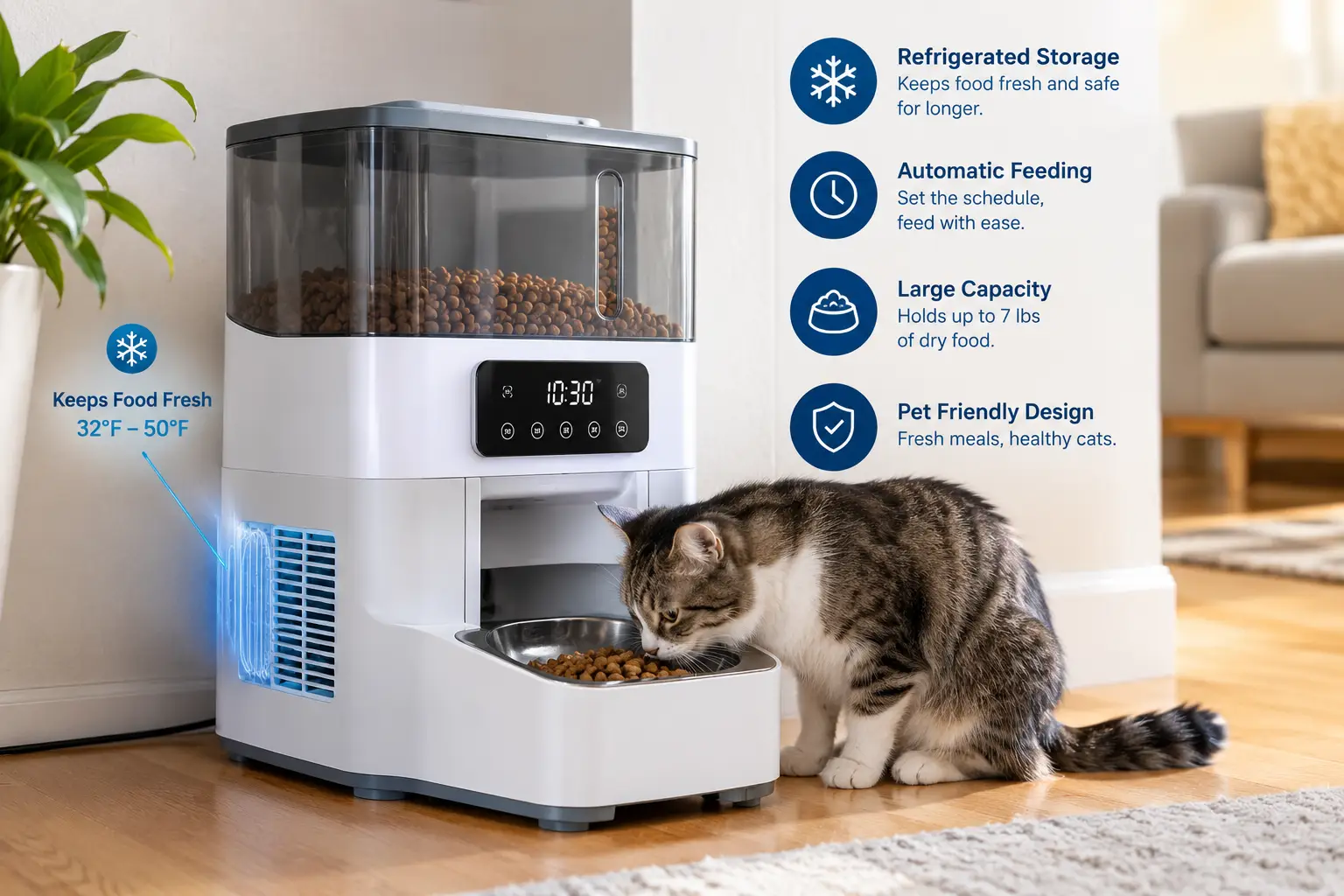
Here’s the short version: a refrigerated automatic cat feeder stores pre-portioned wet meals in a chilled compartment and serves them on a schedule you set. Some models use built-in thermoelectric (semiconductor) cooling; others rely on frozen ice packs. That difference sounds small on paper. In practice, it decides whether the feeder can cover a long workday, a weekend away, or just a single late-night snack.
Why does temperature matter so much? The U.S. Food and Drug Administration’s tips for safe handling of pet food advise promptly refrigerating or discarding leftover canned and pouched pet food, with your fridge set to 40°F or below. A bowl of wet food on the kitchen floor at 75°F simply doesn’t meet that standard for long.
In this guide, you’ll find seven real feeders available on amazon.com, from $40-ish ice-pack workhorses to app-controlled cooling units. There’s no fabricated “I tested it for six weeks” story here. Instead, every pick is judged on published specs, aggregated owner feedback from real retail and editorial reviews, and honest reasoning about what those numbers mean for your cat. Along the way, you’ll get setup tips, a troubleshooting guide, cost-of-ownership math, and a buyer decision framework — the stuff product listings never tell you.
What Is a Refrigerated Automatic Cat Feeder?
A refrigerated automatic cat feeder is a timed pet feeder that keeps wet, fresh, or prescription cat food chilled until mealtime, then opens one portion at a time on schedule. Active models use semiconductor cooling to hold food near refrigerator temperatures; passive models use removable ice packs that stay cold for several hours.
That definition hides a crucial split. An automatic wet food cat feeder with active cooling plugs into the wall and keeps working for days. A cat feeder with ice packs runs on batteries and is realistically a same-day tool. Most buying mistakes come from not knowing which of the two you’re actually looking at, because Amazon listings often use “refrigerated” for both.
Quick Comparison: The 7 Best Refrigerated Feeders at a Glance
| Feeder | Cooling Type | Meals | App | Price Range | Best for |
|---|---|---|---|---|---|
| PETLIBRO Polar | Semiconductor | 3 | Yes | ~$130–$160 | PETLIBRO Polar: overall pick, 1 cat |
| PetSafe FreshFeed | Dual semiconductor | 6 | Yes | Premium (check price) | PetSafe FreshFeed: multi-meal diets |
| Meowant MW-PF06 | Semiconductor + pre-heat | 2 bowls | No | Mid-to-upper range | Meowant MW-PF06: app-free owners, 2 cats |
| UBPET 5-Compartment | Semiconductor (cool-keeping) | 5 | No | Mid range | UBPET 5-Compartment: all-day grazing |
| Cat Mate C500 | 2 ice packs | 5 | No | ~$45–$60 | Cat Mate C500: proven budget pick |
| Cat Mate C300 | 1 ice pack | 3 | No | Under ~$45 | Cat Mate C300: small spaces, short days |
| Casfuy F13 | 4 ice packs | 6 | No | Budget tier | Casfuy F13: cordless placement |
Looking at this table, the real dividing line isn’t price — it’s cooling type. The PETLIBRO Polar, PetSafe FreshFeed, and Meowant MW-PF06 can hold food cold for days because they never “run out” of cold. The Cat Mate C500, Cat Mate C300, and Casfuy F13 are cheaper and cordless, but their ice packs cap them at roughly a workday’s worth of real freshness. The UBPET 5-Compartment sits in between, with active cooling tuned warmer than a true fridge.
💬 One click helps other shoppers make an informed choice too! 😊
Top 7 Refrigerated Automatic Cat Feeders: Expert Analysis
1. PETLIBRO Polar Wet Food Feeder (2026 Version) — the benchmark for true refrigeration
The PETLIBRO Polar is the feeder that essentially created the mainstream category when it launched in 2024, and the 2026 revision keeps the formula that made it the one to beat.
Key features and what they mean: It uses thermoelectric cooling that PETLIBRO says chills food to under 50°F within four hours and preserves meals for up to 72 hours. Clever detail: cooling pauses about 30 minutes before each meal, so the next portion drifts toward room temperature — important, because many cats snub cold food. The three wide trays hold up to about 7 oz each, and the PawShield lid keeps paws out between meals.
Who it’s for: Single-cat households that want wet food served two or three times a day while you’re at work or away for a long weekend. Because each tray holds a full meal, it suits cats on a twice-daily schedule better than grazers. Keep in mind that its “under 50°F” spec is warmer than the FDA’s 40°F fridge guideline, so treat the 72-hour window as the ceiling, not a target.
What reviews say: Editorial testers, including CNN Underscored, rate it the strongest wet-food feeder they’ve tried, often praising its quiet operation. The recurring complaints in owner reviews are bulk, weekly deep-cleaning, and occasional standby hum in bedrooms.
Pros:
- ✅ Genuine active cooling for up to three days
- ✅ Pre-meal warm-up makes food more appealing
- ✅ App scheduling and feeding logs are well-reviewed
Cons:
- ❌ Only three meal slots per fill
- ❌ Large footprint on smaller kitchen floors
Price and value: In the $130–$160 range at the time of writing (stainless trays cost more) — strong value if wet food is your cat’s main diet.
2. PetSafe FreshFeed Refrigerated Pet Feeder — six chilled meals on one tray
The PetSafe FreshFeed answers the most common complaint about the Polar — too few compartments — with a six-meal rotating tray.
Key features and what they mean: PetSafe says its dual semiconductor cooling plus insulation holds food at 40°F, which lines up with standard refrigerator guidance. Each of the six compartments holds up to about 5 fl oz, with around 4.5 cups total. In practice, that means smaller, more frequent meals: think three meals a day for two days, or six small portions for a cat on a portion-controlled plan. Scheduling runs through the PetSafe Pet Companion app, and PetSafe states no subscription is required.
Who it’s for: Cats on prescription or weight-management diets, owners who add supplements or toppers to each portion, and anyone who wants more granular meals than a three-slot feeder allows. The smaller per-compartment volume is a trade-off for bigger eaters.
What reviews say: It’s a newer 2026 release, so review volume is still limited. Early owner feedback on retail sites consistently highlights the cold holding temperature and easy assembly; some retailers have shown it out of stock at times, so availability can fluctuate.
Pros:
- ✅ Holds a true fridge-level 40°F target
- ✅ Six compartments suit frequent small meals
- ✅ Established brand with U.S. support network
Cons:
- ❌ Short track record for long-term reliability
- ❌ Smaller compartments may not fit large meals
Price and value: Premium-tier pricing — check the current price; worth it mainly if you need more than three chilled meals.
3. Meowant Automatic Wet Food Cat Feeder (MW-PF06) — cooling and warming without an app
Not everyone wants another app on their phone, and the Meowant MW-PF06 is built for exactly that owner.
Key features and what they mean: It uses semiconductor cooling around the bowls (Meowant describes it as 360° temperature control) to hold food near 40°F, then pre-heats portions about 30 minutes before the lid opens. There are two bowls with independent temperature control, and you program everything from an onboard button panel. You can record a 10-second voice call that plays when a lid opens, and the unit is listed as ETL certified.
Who it’s for: One or two cats on a simple routine — say, one bowl each, or one cat with a morning and evening meal. It’s a great fit for less tech-savvy households and anyone wary of Wi-Fi devices. However, two bowls means it’s a same-day or overnight feeder, not a weekend solution.
What reviews say: This is a very recent release, so there isn’t yet a meaningful body of verified owner reviews to summarize. What’s verifiable is the spec sheet and early coverage from gadget sites; judge long-term durability cautiously.
Pros:
- ✅ Active cooling plus true pre-heating
- ✅ No app or account needed to operate
- ✅ ETL listing adds electrical-safety reassurance
Cons:
- ❌ Just two meals per fill
- ❌ Main unit isn’t washable, only wipeable
Price and value: Mid-to-upper range — check the current price; good value if pre-warming and simplicity matter more than meal count.
4. UBPET 5-Compartment Wet Food Feeder with Cooling — active cooling at a friendlier price
The UBPET 5-Compartment feeder brings semiconductor cooling to a classic five-slot rotating tray, which is rare below premium-brand pricing.
Key features and what they mean: Each compartment holds about 330 g (roughly 11.6 oz), and you get one immediate meal plus four timed ones. Here’s the part most buyers overlook: UBPET’s own listing says the three temperature settings hold food between about 13°C and 23°C — that’s roughly 55°F to 73°F. That’s cooler than a warm kitchen, but it isn’t refrigeration by FDA standards. So the “1–4 days freshness” claim deserves real skepticism.
Who it’s for: Owners who want a single day of grazing meals kept cooler than room temperature, especially in air-conditioned homes. Think of it as a cool-keeping feeder, not a mini-fridge. It’s also useful for semi-moist foods that are less perishable.
What reviews say: Review counts are modest, and owner sentiment on retail sites is mixed-to-positive: users like the capacity and washable plates, while the temperature ceiling is the main concern raised in independent comparisons.
Pros:
- ✅ Active cooling without ice-pack swapping
- ✅ Large 330 g compartments for big eaters
- ✅ Five meals from one fill
Cons:
- ❌ Warmest temperature range in this lineup
- ❌ Limited long-term review history
Price and value: Mid-range — check the current price; fair value for same-day use, overpriced if you expect multi-day storage.
5. Cat Mate C500 5-Meal Automatic Feeder — the proven ice-pack classic
The Cat Mate C500 has been around for years, and that track record is its biggest selling point.
Key features and what they mean: Five compartments hold about 11.5 oz (330 g) each, with one open meal and four timed ones. Twin ice packs sit beneath the tray; Closer Pets (the maker) says they keep food fresh for about 6–8 hours indoors. It runs on three AA batteries for up to a year, and the lid and bowl are dishwasher safe. You can even screw it to a board to stop determined cats from tipping it.
Who it’s for: Budget-conscious owners who need wet meals covered during an eight-hour workday, or a vet-recommended split of small meals across the day. It’s also a smart backup unit for power outages, since it needs no outlet.
What reviews say: Owner feedback is broadly positive about reliability and the way cats learn the motor sound means dinner. The consistent complaint: small, uninsulated ice packs that struggle overnight, plus food sticking in tray corners.
Pros:
- ✅ Long track record and three-year guarantee
- ✅ Battery-powered, so placement is flexible
- ✅ Dishwasher-safe lid and bowl
Cons:
- ❌ Ice packs fade after roughly six to eight hours
- ❌ Food can collect in tray corners
Price and value: Around $45–$60 at the time of writing — excellent value for same-day wet feeding.
6. Cat Mate C300 3-Meal Automatic Feeder — compact and simple for short days
The Cat Mate C300 is the smaller sibling of the C500, built for owners who need to cover a gap of hours, not days.
Key features and what they mean: It has three compartments, a single ice pack under the tray, and a battery-powered digital timer. Fewer compartments and one ice pack mean less cooling reserve, so realistically you’re protecting one or two meals during a typical workday. On the upside, the smaller footprint fits tight apartment kitchens and bathrooms where a plug-in unit won’t.
Who it’s for: Owners of one cat on a two-meal schedule who just need the midday or early-evening meal handled. It also works well as a “breakfast robot” that serves at 5 a.m. so you can sleep. For anything longer than a day, look higher in this list.
What reviews say: Owner sentiment mirrors the C500: reliable timing and easy programming, with cooling duration as the main limitation. Detailed, model-specific review data is thinner than for the C500, so consider this assessment partly inferred from the shared design.
Pros:
- ✅ Very compact footprint
- ✅ Simple battery-powered timer, no Wi-Fi
- ✅ Same brand reliability as the C500
Cons:
- ❌ Single ice pack limits cooling time
- ❌ Only three meals, best for short absences
Price and value: Typically under about $45 — solid value if you only need a few hours covered.
7. Casfuy F13 Cordless 6-Meal Feeder with 4 Ice Packs — most flexible cordless setup
The Casfuy F13 stands out for one reason: it’s rechargeable and ships with two sets of ice packs, so you can rotate them.
Key features and what they mean: It offers one immediate meal plus five scheduled ones over a 12-hour cycle. Casfuy says the ice packs stay frozen for 6–8 hours; the listing’s “fresh for up to 24 hours” claim is optimistic given that. The built-in battery reportedly lasts up to three months per charge, so you can place it anywhere — a hallway, a bedroom, a spot away from the dog. Bowls are about 4.4 inches long and 1.9 inches deep.
Who it’s for: Owners who want six small wet meals across a single day, especially in homes where outlets are inconvenient. The spare ice-pack set makes swaps easy when a sitter pops in once a day.
What reviews say: Aggregated owner feedback praises easy setup, long battery life, and the extra ice packs. The most common criticisms: ice packs don’t last a full workday in warm weather, and the deep, narrow bowls bother cats prone to whisker sensitivity.
Pros:
- ✅ Cordless with months-long battery life
- ✅ Four ice packs allow easy rotation
- ✅ Six compartments for small frequent meals
Cons:
- ❌ Ice packs struggle in warm rooms
- ❌ Deep bowls may annoy whisker-sensitive cats
Price and value: Budget tier — check the current price; great value for daytime grazing, not for overnight storage.
✨ Don’t miss the right feeder for your cat!
🔍 Take your cat’s wet-food routine to the next level with this carefully curated lineup. Click a highlighted feeder to check current pricing and availability. These picks will help you serve fresher, safer meals your whole family (feline members included) will appreciate!
Side-by-Side: Detailed Comparison of the Top 7
| Feeder | Stated Cold Target | Realistic Freshness Window | Per-Meal Capacity | Power | Best for |
|---|---|---|---|---|---|
| PETLIBRO Polar | Under 50°F | Up to 72 hrs | ~7 oz | Plug-in | PETLIBRO Polar: weekends away |
| PetSafe FreshFeed | 40°F | Multi-day (per PetSafe) | ~5 fl oz | Plug-in | PetSafe FreshFeed: special diets |
| Meowant MW-PF06 | ~40°F | 1 day (2 bowls) | 1 full meal | Plug-in | Meowant MW-PF06: overnight feeding |
| UBPET 5-Compartment | ~55–73°F | Same day | ~11.6 oz | Plug-in | UBPET 5-Compartment: daytime grazing |
| Cat Mate C500 | Ice pack | ~6–8 hrs | ~11.5 oz | 3 AA | Cat Mate C500: workdays |
| Cat Mate C300 | Ice pack | A few hours | 1 meal | Battery | Cat Mate C300: short gaps |
| Casfuy F13 | Ice packs | ~6–8 hrs | Small portion | Rechargeable | Casfuy F13: cordless grazing |
This table makes one thing clear: capacity and cooling rarely come together. The UBPET 5-Compartment and Cat Mate C500 hold the biggest meals, but neither holds them at fridge temperature for long. Meanwhile, the PetSafe FreshFeed hits the coldest target yet uses the smallest compartments — which is why the PETLIBRO Polar remains the most balanced choice for a typical single-cat home.
How to Set Up Your Feeder: The First 30 Days
Buying a refrigerated automatic cat feeder is the easy part. Getting your cat to trust it — and keeping it hygienic — takes a little planning.
⚡ Week 1: Introduce it switched off
Place the feeder where your cat already eats, with the lid open or one compartment exposed. Serve normal meals from it by hand for a few days. Cats are suspicious of new objects that move and beep, so let the machine become furniture first.
🔋 Week 2: Pre-chill before the first real load
For active-cooling units like the PETLIBRO Polar or PetSafe FreshFeed, run the feeder empty for a few hours before loading so the chamber starts cold. For ice-pack models such as the Cat Mate C500, freeze packs flat for at least six hours — Closer Pets recommends this minimum.
✅ Weeks 2–3: Start with one scheduled meal
Schedule a single meal while you’re home to watch the first opening. Is your cat startled by the motor? Does the lid clear their face? Adjust placement or the voice-call feature (on the Meowant MW-PF06 or Polar) before trusting it unattended.
🧽 Every week: Deep clean
Wash trays and bowls with hot, soapy water after each fill, and give lid seals and tray joints a weekly scrub. Wet-food residue in crevices is the fastest route to smells, ants, and feline chin acne.
❌ Common first-month mistakes
- Loading food straight from a can that sat open in the fridge for days — always start fresh.
- Setting the first meal too soon after loading, before the chamber is chilled.
- Forgetting that ice packs need swapping every six to eight hours.
Which Feeder Fits Your Life? Real-World Scenarios
Specs only matter in context, so here are three common U.S. households matched to the best fit.
🏢 Scenario 1: The 10-hour workday commuter
Maya works hybrid in Chicago and is out from 7:30 a.m. to 6 p.m. three days a week. Her cat eats two wet meals plus a midday snack. A budget of around $60 points to the Cat Mate C500: fill it in the morning with fresh ice packs, and the midday meal lands well within the six-to-eight-hour cold window. If her apartment runs hot in summer, though, the late-afternoon slot gets risky — which is where upgrading to the PETLIBRO Polar earns its price.
✈️ Scenario 2: The weekend traveler
Dan visits family two weekends a month and has a neighbor check in once a day. He needs active cooling, full stop. The PETLIBRO Polar covers three meals across a long stretch, and the neighbor can top it up. If his cat eats smaller portions more often, the PetSafe FreshFeed‘s six compartments stretch coverage further.
🩺 Scenario 3: The senior cat on a prescription diet
Rose’s 15-year-old cat has kidney disease and eats small prescription meals four to five times a day. Portion accuracy and cold holding both matter. The PetSafe FreshFeed is the natural fit, since its 40°F target and six small compartments suit frequent, measured meals. On a tighter budget, the Casfuy F13 can handle daytime portions with an ice-pack swap at lunch.
The pattern? Ice packs win on budget and flexibility; active cooling wins whenever you’re away longer than a workday.
Troubleshooting: Common Problems and Fixes
Even the best refrigerated automatic cat feeder has quirks. Here are the five issues owners report most, with practical fixes.
1. “My cat won’t eat cold food.” 🥶 Choose a model with a pre-meal warm-up (the PETLIBRO Polar pauses cooling; the Meowant MW-PF06 actively pre-heats). With ice-pack feeders, schedule meals late in the cooling cycle so food has naturally warmed a little.
2. Water pooling inside the unit. 💧 Condensation is normal with thermoelectric cooling, as PETLIBRO notes in its own FAQ. Wipe the chamber at each refill and avoid placing the feeder in humid spots like laundry rooms.
3. Ants or other pests. 🐜 Wet food is a strong attractant. Clean spills around the base, check that lid seals are seated correctly, and never leave uneaten food in an open tray overnight.
4. Food stuck in compartment corners. 🍽️ Owners of the Cat Mate C500 report this often. Press pâté flat and avoid overfilling; consider the stainless-steel insert version, which many find easier to clean.
5. Ice packs thawing too fast. 🧊 Buy a spare set, freeze them flat, and keep the feeder away from sunny windows or appliance vents. If you consistently need more than eight hours, move up to an active-cooling unit rather than fighting physics.
How to Choose a Refrigerated Automatic Cat Feeder
- Decide how long you’ll be away. Under eight hours? An ice-pack model works. Longer? You need active cooling.
- Check the actual temperature spec. Fridge guidance is 40°F or below. Some “refrigerated” feeders target 50°F or even 55–73°F, which is cool-keeping, not refrigeration.
- Count meals, not days. A three-slot feeder serving twice daily lasts 1.5 days; a six-slot feeder serving three times daily lasts two.
- Match compartment size to portion size. A 3-oz pouch cat and a 5.5-oz can cat need different trays.
- Look for whisker-friendly bowls. Shallow, wide trays reduce whisker stress for sensitive cats.
- Weigh app control honestly. Apps add logs and remote changes; button panels add simplicity and fewer failure points.
- Plan for power. Plug-in units need an outlet and have no cold reserve during an outage; battery units don’t cool actively at all.
The science behind active cooling is worth a quick look, too. Most plug-in feeders use thermoelectric (Peltier) cooling, a solid-state method with no compressor. It’s quiet and compact but less powerful than a kitchen fridge, which explains why many units target 40–50°F rather than colder.
Active Cooling vs Ice Packs: Choosing an Automatic Wet Food Cat Feeder
When shoppers search for an automatic wet food cat feeder, they usually find two very different machines under one label. Understanding that split is the single most valuable thing you can learn before buying.
Active cooling (the PETLIBRO Polar, PetSafe FreshFeed, Meowant MW-PF06, and UBPET 5-Compartment) uses an electric semiconductor module to pull heat out of the food chamber continuously. The cold doesn’t “run out,” so these units can cover multi-day absences — as long as the power stays on.
A cat feeder with ice packs (the Cat Mate C500, Cat Mate C300, and Casfuy F13) is a passive cooler with a timer. Once the packs thaw, the food drifts toward room temperature. That’s fine for a workday, but not for a weekend.
| Factor | Active Cooling | Ice Packs | Best for |
|---|---|---|---|
| Freshness window | 1–3 days (model-dependent) | ~6–8 hours | Active: travelers |
| Power | Outlet required | Batteries/rechargeable | Ice packs: flexible placement |
| Upfront cost | Higher | Lower | Ice packs: tight budgets |
| Daily effort | Refill every 1–3 days | Swap packs daily | Active: busy owners |
The trade-off comes down to time away versus budget. If you’re gone less than a workday, a cat feeder with ice packs like the Cat Mate C500 delivers most of the benefit for a fraction of the cost. Anything beyond that makes an active unit like the PETLIBRO Polar the safer investment.
Features That Actually Matter (and Ones That Don’t)
Marketing copy on this category is loud, so here’s the honest filter.
✅ Features that matter
- A stated temperature, not just “keeps food fresh.” If a listing won’t give a number, assume it’s not fridge-cold.
- Pre-meal warm-up. Many cats refuse cold food, so a warm-up phase directly affects whether your cat eats.
- Removable, washable trays. Wet food leaves residue; anything you can’t scrub becomes a hygiene issue.
- Lid security. Food-motivated cats will pry at gaps; a secure lid prevents both theft and spills.
- Power-failure memory. Feeders that keep schedules after an outage, like the PETLIBRO Polar, prevent missed meals.
❌ Features that matter less than you’d think
- Voice recordings. Cute, and helpful for some cats, but the motor sound usually becomes the dinner bell anyway.
- Huge freshness-day claims. A “4 days fresh” label paired with a 55–73°F range is a red flag, not a feature.
- Built-in cameras. Some newer units add them, but a separate pet camera often does the job better and costs less.
In short, prioritize temperature, cleanability, and lid design. Everything else is a bonus.
Long-Term Cost and Maintenance of a Cooled Automatic Pet Feeder
Sticker price is only half the story for any cooled automatic pet feeder. Here’s what ownership looks like over a few years.
Electricity: Thermoelectric modules run continuously. Their draw is modest compared with a full-size fridge, but it’s not zero — expect a small but noticeable line on your utility bill if the unit runs year-round.
Consumables: Ice-pack feeders need replacement packs over time (they crack or leak), and many owners buy a spare set immediately. Rechargeable models like the Casfuy F13 will eventually see battery capacity fade.
Parts: Replacement trays and stainless inserts exist for popular models like the Cat Mate C500, which extends lifespan considerably.
| Feeder | Upfront Tier | Ongoing Costs | Long-Term Value | Best for |
|---|---|---|---|---|
| PETLIBRO Polar | ~$130–$160 | Electricity | High for daily wet feeders | PETLIBRO Polar: daily use |
| PetSafe FreshFeed | Premium | Electricity | High for special diets | PetSafe FreshFeed: medical diets |
| Cat Mate C500 | ~$45–$60 | AA batteries, packs | Excellent for workdays | Cat Mate C500: budget owners |
| Casfuy F13 | Budget | Charging, packs | Good for daytime | Casfuy F13: cordless homes |
The math favors matching the machine to your routine. A Cat Mate C500 that covers every workday for years costs very little per meal served. However, if you regularly travel, the PETLIBRO Polar pays for itself by reducing sitter visits — even one fewer paid drop-in per trip can offset the price gap over time.
Refrigerated Cat Feeder for Wet Food: Seniors, Diabetics, and Prescription Diets
A refrigerated cat feeder for wet food can be especially valuable for cats with medical needs. Senior cats and those with kidney disease, diabetes, or urinary issues are often placed on wet prescription diets, and many vets recommend smaller, more frequent meals.
Why it helps: Consistent timing supports cats whose treatment depends on routine, such as diabetic cats whose meals are coordinated with insulin. Cold holding also protects expensive prescription food from spoilage. Moreover, pre-portioned compartments make it easier to track exactly how much your cat ate.
What to look for:
- Small, measured compartments — the PetSafe FreshFeed‘s six 5-fl-oz slots fit this profile well.
- Accessible height — PETLIBRO notes the PETLIBRO Polar‘s lid edge sits about 6.1 inches high, so very small or arthritic cats may struggle.
- Feeding logs — app records help you spot appetite changes, an early warning sign worth flagging to your vet.
A caution: An automatic feeder never replaces monitoring. If your cat is diabetic, confirm with your veterinarian before automating any meal tied to insulin timing, because a missed or uneaten meal changes dosing decisions.
Safety, Food Handling, and Standards
Food safety is the whole reason this category exists, so it deserves plain talk.
Temperature: The USDA’s guidance on the “Danger Zone” explains that bacteria multiply rapidly between 40°F and 140°F. That applies to perishable food broadly, including opened wet pet food. It’s why a feeder’s stated temperature matters more than its marketing claims.
Electrical safety: For plug-in feeders, look for a recognized safety listing such as ETL or UL. The Meowant MW-PF06 advertises ETL certification; for other models, check the listing or product label before buying.
Raw diets: The FDA considers raw pet food a higher-risk category because of bacteria such as Salmonella and Listeria. If you feed raw, keep freshness windows short and choose the coldest unit available.
Hygiene habits:
- Always load freshly opened food.
- Discard uneaten portions promptly.
- Wash trays with hot, soapy water after each cycle.
- Wash your hands before and after handling pet food.
These habits cost you minutes but protect both your cat and your household.
Common Mistakes to Avoid When Buying
Even savvy shoppers trip over the same pitfalls in this category.
1. Trusting the word “refrigerated.” Many listings apply it to ice-pack models. Always check whether cooling is active or passive.
2. Ignoring the temperature number. As the UBPET 5-Compartment shows, “semiconductor cooling” doesn’t automatically mean fridge-cold.
3. Overestimating ice packs. Owners of the Cat Mate C500 and Casfuy F13 consistently report that packs fade within a workday, especially in summer.
4. Buying too few meal slots. A three-meal feeder can’t cover a four-day trip, no matter how cold it is.
5. Forgetting the cat’s anatomy. Tall lids and deep bowls can frustrate kittens, flat-faced breeds, and whisker-sensitive cats.
6. Skipping the trial period. Test at home before any trip, so you’re not discovering problems from a hotel room.
FAQ: Refrigerated Automatic Cat Feeder Questions
❓ Is a refrigerated automatic cat feeder worth buying for a weekend trip?
❓ Can I put dry food in a refrigerated automatic cat feeder?
❓ Which refrigerated automatic cat feeder is best for two cats?
❓ Does a refrigerated automatic cat feeder work during a power outage?
❓ How often should I clean a refrigerated automatic cat feeder?
Conclusion: Picking the Right Refrigerated Automatic Cat Feeder
Choosing a refrigerated automatic cat feeder really comes down to one question: how long will the food sit before your cat eats it?
If the answer is “days,” you need active cooling. The PETLIBRO Polar remains the best all-around pick for most single-cat homes, balancing true refrigeration, a pre-meal warm-up, and a well-reviewed app. Need more meals or run a special diet? The PetSafe FreshFeed and its 40°F target deserve a look. Prefer buttons over apps? The Meowant MW-PF06 keeps things simple.
If the answer is “hours,” an ice-pack model does the job for far less. The Cat Mate C500 is the proven workday workhorse, the Cat Mate C300 handles short gaps in small spaces, and the Casfuy F13 frees you from cords entirely. The UBPET 5-Compartment fills the middle ground for daytime grazers in cool homes.
Whatever you choose, remember that the machine is only half the system. Fresh food, clean trays, and a little patience during the first weeks are what actually keep your cat safe and happy. Start with a home trial, watch your cat’s reaction, and scale up to longer absences once you trust the routine.
🐾 Ready to upgrade your cat’s mealtime?
🔍 Take the guesswork out of wet feeding with one of these carefully chosen picks. Click a highlighted feeder to check current pricing and availability — your cat’s next fresh meal is only a schedule away!
Recommended for You
- Pet Dish Guide 2026: 7 Best Picks (and 5 Costly Mistakes)
- wifi bird cam 2026: 7 Brilliant Picks and 5 Costly Mistakes
- Indoor Bird Feeder: 7 Best Picks for Stunning Close-Up Views (2026)
Disclaimer: This post contains affiliate links. As an Amazon Associate, I earn from qualifying purchases made through these links, at no additional cost to you.
✨ Found this article helpful? Share it with someone who needs it! 💬🤗