In This Article
Why Your Dog Needs a Silicone Slow Feeder
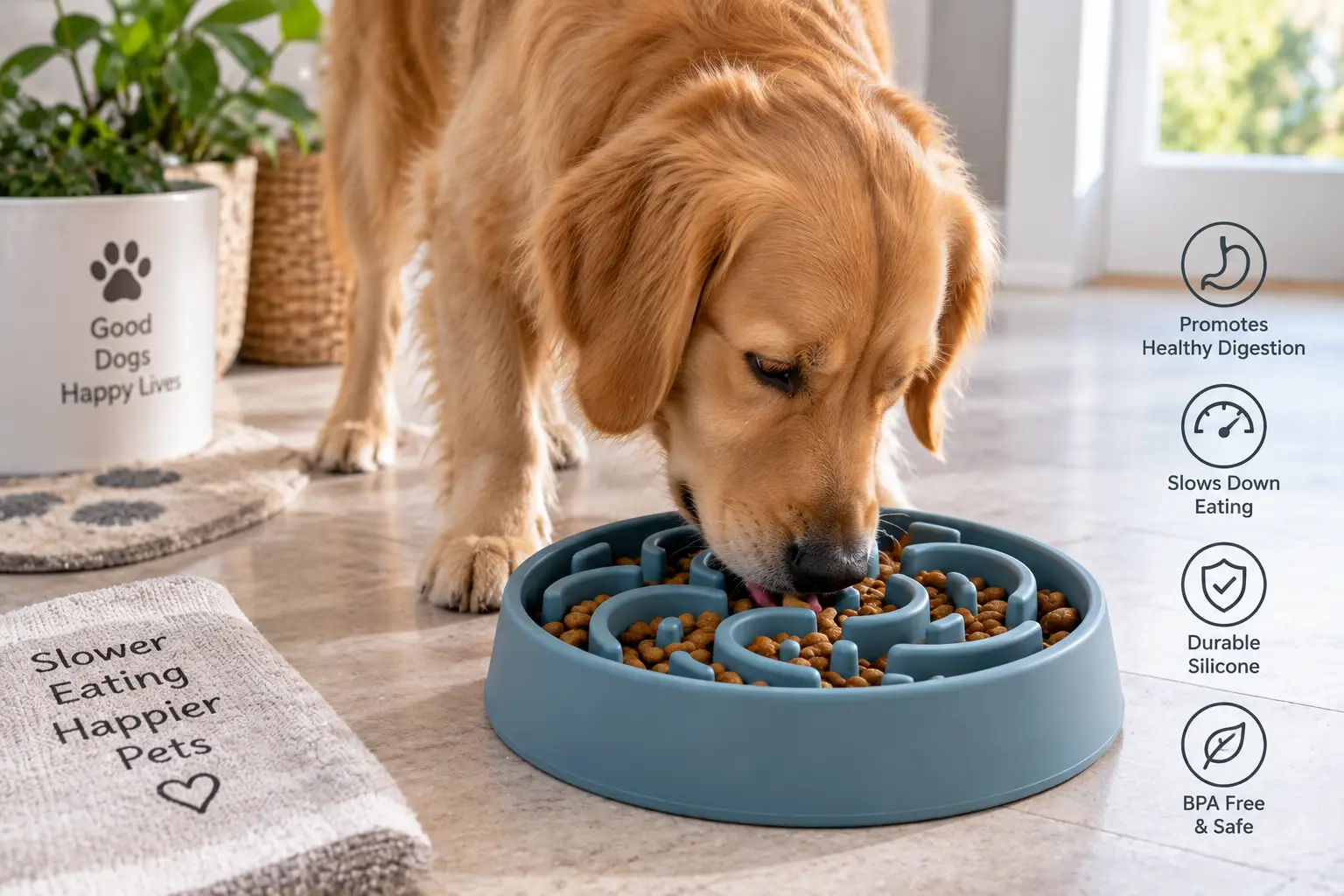
If mealtime looks like a competitive sport at your house, you’re not alone. A silicone slow feeder is a textured, maze-patterned bowl made from flexible food-grade silicone that forces dogs to work around raised ridges instead of inhaling their kibble in thirty seconds flat. That extra effort slows the pace of eating, which matters more than it sounds — fast eating is linked to choking, vomiting, excess gas, and in severe cases, a life-threatening stomach emergency called bloat.
Silicone has become the go-to material for this job for a simple reason: it’s soft enough not to scratch a dog’s nose or teeth, flexible enough to survive being flipped and gnawed on, and grippy enough to stay put on tile or hardwood without a separate mat. Compare that to rigid plastic mazes, which tend to skid across the floor, or heavy ceramic bowls, which slow eating but chip and crack.
In this guide, we’ve dug into real spec sheets, aggregated customer feedback, and veterinary research on canine bloat to help you pick the right silicone slow feeder for your specific dog — whether that’s a food-motivated Labrador who inhales dinner in under a minute, a small-breed puppy still learning table manners, or a senior dog whose vet has flagged eating speed as a concern. We’ll walk through seven real, currently available options, show you how they stack up, and cover the practical stuff — sizing, cleaning, and what a slow feeder honestly can and can’t fix.
As an Amazon Associate, we earn from qualifying purchases made through links on this page, at no additional cost to you.
Silicone Slow Feeders at a Glance
Before we dig into the full reviews, here’s a fast snapshot of how our seven picks compare on price range, best-for use case, and standout feature.
| Product | Price Range | Best For | Standout Feature |
|---|---|---|---|
| Gorilla Grip Patented Slow Feeder | Around $10–$18 | Overall value, most breeds | 4 sizes, rubber-reinforced base |
| AXEFUN Suction Cup Slow Feeder | Under $15 | Enthusiastic/anxious eaters | Suction-cup stability |
| Bifeaw Silicone Slow Feeder | Under $12 | Budget-conscious first-timers | Microwave and dishwasher safe |
| ALLYGOODS Large Breed Slow Feeder | Around $15–$20 | Large and giant breeds | Rated to 230°C/-40°C |
| Messy Mutts Silicone + Stainless Feeder | Around $17–$30 | Heavy chewers, long-term durability | Removable stainless bowl insert |
| Messy Mutts Framed Licking Mat | Around $15–$20 | Anxiety relief, enrichment | Freezer-friendly lick surface |
| Universal Silicone Slow Feeder Insert | Under $12 | Retrofitting an existing bowl | Fits stainless, glass, or ceramic bowls |
Looking at the table above, the Gorilla Grip Patented Slow Feeder is the safest starting point if you’re not sure which style your dog needs, since it comes in four capacities and works for most breeds without extra accessories. If your dog is a large or giant breed with a deep chest — the exact profile most at risk for bloat — the ALLYGOODS Large Breed Slow Feeder or the Messy Mutts Silicone + Stainless Feeder are worth the few extra dollars for their sturdier build. Budget shoppers testing the concept for the first time should start with the Bifeaw Silicone Slow Feeder or the Universal Silicone Slow Feeder Insert, since both let you try slow feeding without committing to a full bowl replacement.
💬 Found a match already? Tap the highlighted product above to check current availability and pricing on Amazon.
Top 7 Silicone Slow Feeders: Expert Analysis
We picked these seven based on real product specs, verified material composition (all are genuinely silicone, not rebranded plastic), and aggregated customer sentiment gathered from retailer review pages. Each one earns its spot for a different reason — read the “who it’s for” line before you buy.
1. Gorilla Grip Patented Slow Feeder Dog & Cat Bowl — best all-around pick for most dogs
The Gorilla Grip Patented Slow Feeder is the bowl we’d point most owners toward first, mainly because it doesn’t force you to guess on sizing. Its maze pattern uses a dense grid of raised silicone ridges that separates kibble into small pockets, and the bowl ships in four capacities — 1, 2, and 4 cups — so a chihuahua and a Labrador can both use the same design in the right size. The rubber-reinforced bottom curves around the entire base rather than relying on a thin ring of grip tape, which is a small engineering detail that matters once a determined eater starts nosing the bowl across the floor.
What most buyers overlook with maze-style bowls like this one is that the depth of the ridges, not just their pattern, is what determines how much they actually slow a dog down — shallow mazes look impressive but do little for a truly fast eater. Reviews consistently report that the Gorilla Grip Patented Slow Feeder holds up well over months of daily use without cracking, and that the silicone doesn’t retain odors the way cheaper PP-resin bowls sometimes do. This bowl is best for owners who want one dependable option without shopping around by breed or eating style.
Pros:
- ✅ Available in four sizes to match any breed
- ✅ Rubber-reinforced base resists sliding
- ✅ Dishwasher safe with no odor retention reported
Cons:
- ❌ Very determined eaters can still nudge it during meals
- ❌ Maze pattern is fixed, not adjustable for difficulty
Priced in the $10–$18 range depending on size, this is one of the better value-for-money picks in the category — you’re paying for reliable construction, not novelty shapes.
2. AXEFUN Slow Feeder with Suction Cup — best for anxious or enthusiastic eaters
The AXEFUN Slow Feeder solves a specific complaint that shows up across almost every slow-feeder review: the bowl sliding away from a dog who’s pushing hard against the ridges. Its base uses multiple suction cups instead of a flat non-slip pad, which grips smooth tile, sealed hardwood, and laminate far more aggressively than friction alone. At roughly 8 by 8 inches and under 10 ounces, it’s sized comfortably for small to medium breeds without feeling flimsy.
In practice, suction-based grip matters most for dogs that eat with visible urgency — pressing their whole face into the bowl rather than eating calmly. Based on comparing the specs against friction-only competitors, the AXEFUN Slow Feeder trades a little portability (it takes a firm press to seat the suction cups properly) for meaningfully better stability during frantic mealtimes. Reviews frequently mention this as a fix for dogs who had “graduated” past earlier, lighter slow feeders by simply shoving them around the kitchen. It’s best suited to dogs with a bit of food anxiety or multi-dog households where competition speeds up eating.
Pros:
- ✅ Suction base outperforms friction-only bowls on tile
- ✅ Amazon’s Choice status reflects strong buyer satisfaction
- ✅ Lightweight but doesn’t feel cheap in hand
Cons:
- ❌ Suction needs a smooth, clean floor to work well
- ❌ Not ideal on textured or unsealed flooring
At under $15, the AXEFUN Slow Feeder is a smart mid-tier buy if a basic maze bowl has already failed to stay put in your kitchen.
3. Bifeaw Silicone Slow Feeder Dog Bowl — best budget entry point
If you’re not sure a slow feeder will even work for your dog and don’t want to spend much finding out, the Bifeaw Silicone Slow Feeder is the low-risk way to test the concept. It’s built from soft food-grade silicone with a maze interior and a non-slip base, and — unlike several competitors in this price bracket — it’s rated both microwave and dishwasher safe, which is a genuine convenience if you warm wet food or add broth toppers.
The honest trade-off here is depth and complexity: this bowl’s ridges are gentler than the Gorilla Grip Patented Slow Feeder‘s dense grid, so it’s a better match for moderately fast eaters than for dogs who inhale food in under 20 seconds. What the spec sheet doesn’t say, but aggregated reviews suggest, is that this style tends to work particularly well for small and toy breeds, whose mouths can struggle with more aggressive maze patterns designed for bigger dogs. If your dog is a mild-to-moderate fast eater, this is a sensible first purchase before spending more on a specialized design.
Pros:
- ✅ Genuinely low price for a full silicone bowl
- ✅ Microwave and dishwasher safe
- ✅ Gentle maze works well for small breeds
Cons:
- ❌ Less effective for extreme fast eaters
- ❌ Non-slip base is adequate, not exceptional
Priced under $12, the Bifeaw Silicone Slow Feeder offers strong value for testing whether slow feeding changes your dog’s habits before you invest further.
4. ALLYGOODS Silicone Slow Feeder for Large Breeds — best for big dogs
Large and giant breeds are the exact population most at risk of gastric dilatation-volvulus (bloat), which makes a properly sized slow feeder more than a nice-to-have for them. The ALLYGOODS Silicone Slow Feeder is built specifically with that audience in mind: it’s made from 100% food-grade silicone rated for temperatures from -40°F up to roughly 446°F, meaning it tolerates dishwasher heat cycles and freezer storage without warping — a common failure point for cheaper bowls used by larger, stronger dogs.
Here’s what most buyers overlook when shopping for large-breed feeders: capacity matters as much as maze depth, because a bowl that’s technically slow-feeding but too small forces refills mid-meal, which defeats the pacing benefit entirely. The ALLYGOODS Silicone Slow Feeder‘s honeycomb-style pattern is engineered with wider capacity than typical small-breed mazes, so a 70-pound dog isn’t left scraping an empty bowl three minutes into dinner. Reviews highlight its durability under heavier jaw pressure and note it holds shape well over repeated freeze-thaw cycles for owners who pre-portion frozen meals. It’s the right call for owners of deep-chested breeds like German Shepherds, Labradors, or Weimaraners.
Pros:
- ✅ Rated for wide temperature range, freezer to dishwasher
- ✅ Larger capacity suited to big-breed portions
- ✅ Holds shape under stronger jaw pressure
Cons:
- ❌ Bulkier footprint takes up more floor space
- ❌ Overkill for small or toy breeds
In the $15–$20 range, this is a fair price for a bowl engineered around large-breed realities rather than shrunk down from a small-dog design.
5. Messy Mutts Silicone Feeder with Stainless Steel Bowl — best for long-term durability
The Messy Mutts Silicone + Stainless Feeder takes a hybrid approach: a food-grade silicone holder that grips the floor and contains spills, paired with a removable stainless-steel bowl insert that actually holds the food. This matters for two reasons Amazon listings rarely explain well. First, stainless steel doesn’t retain odors or bacteria the way silicone can over years of use, so rotating a steel insert extends the practical lifespan of the whole system. Second, the silicone holder absorbs impact and noise, so it doesn’t clatter across tile the way an unprotected metal bowl would.
Based on comparing this design against single-material silicone bowls, the trade-off is that the Messy Mutts Silicone + Stainless Feeder isn’t itself a maze-pattern slow feeder — it slows eating primarily through the raised silicone lip and a wider, shallower steel bowl shape rather than an interior labyrinth. What that means in practice: it’s a gentler slow-down than a true puzzle bowl, better suited to moderate fast eaters or as a long-term daily-use bowl than to a dog who needs maximum mealtime friction. Reviews consistently praise the swap-in, swap-out convenience for cleaning, and it’s available up to a 6-cup capacity for large breeds.
Pros:
- ✅ Stainless insert resists odor and bacteria buildup
- ✅ Silicone holder absorbs noise and prevents sliding
- ✅ Scales up to 6-cup capacity for large dogs
Cons:
- ❌ Milder slow-down than a true maze bowl
- ❌ Two-piece design means two parts to lose or misplace
Expect to pay in the $17–$30 range depending on size, which reflects the added cost of the stainless component — a reasonable long-term-value trade for households that go through bowls quickly.
6. Messy Mutts Framed Silicone Licking Bowl Mat — best for anxiety and enrichment
Not every fast eater needs a maze — some need a completely different feeding format, and that’s where the Messy Mutts Framed Licking Bowl Mat comes in. Instead of separating kibble into pockets, this design uses a grooved silicone surface meant for spreadable foods like wet food, plain yogurt, or pureed pumpkin, which a dog licks clean rather than bites and swallows. The structured nylon rim keeps the mat rigid enough to load and carry without collapsing, and it’s freezer-safe, so owners can pre-load it and freeze it for a longer-lasting activity.
What the spec sheet doesn’t say, but reviews and veterinary behavior sources both point to, is that sustained licking has a measurable calming effect on dogs — this makes it less a “speed” tool and more a stress-reduction one, useful for grooming, crate training, thunderstorms, or vet visits, not just regular meals. Reviews describe extended engagement times when the mat is frozen, sometimes stretching a single serving well past 20–30 minutes. This is not the right pick if your goal is purely slowing down a kibble-only diet, since dry food won’t cling to the grooves the way wet or pureed food does — pair it with a maze bowl instead if your dog eats dry kibble exclusively.
Pros:
- ✅ Freezer-safe for extended engagement sessions
- ✅ Doubles as an anxiety and enrichment tool
- ✅ Structured rim keeps shape better than flat lick mats
Cons:
- ❌ Not effective for dry kibble on its own
- ❌ Requires wet or spreadable food to work as intended
At roughly $15–$20, it’s a smart complementary purchase alongside a maze bowl rather than a full replacement for one.
7. Universal Silicone Slow Feeder Insert with Suction Cups — best for retrofitting an existing bowl
If you already own a bowl you like — stainless, glass, or ceramic — and just want to slow down eating without buying a whole new dish, the Universal Silicone Slow Feeder Insert solves that directly. It’s a flat, food-grade silicone disc studded with raised separators on top and multiple suction cups on the bottom, designed to press into the base of an existing bowl and stay locked in place without water or adhesive. At roughly 5.5 by 5.5 inches, it fits comfortably inside most standard-sized dog bowls.
Here’s what most buyers overlook about insert-style slow feeders: because they sit inside a separate bowl rather than forming the bowl’s walls, the insert’s raised pattern only works for the depth of food it covers — overfilling the outer bowl above the insert’s ridge height can let a fast eater bypass the slow-down effect entirely. Used correctly (matching the food portion to the insert’s coverage), reviews describe it as an effective, low-cost way to convert a favorite existing bowl into a functional slow feeder rather than replacing it outright. It’s also useful for travel, since it packs flat and can be moved between a home bowl and a travel bowl as needed.
Pros:
- ✅ Works with bowls you already own
- ✅ Strong suction holds firmly without water tricks
- ✅ Packs flat for travel between bowls
Cons:
- ❌ Only effective if food portions match insert depth
- ❌ Not a standalone bowl — requires a separate dish
Priced under $12, this is the cheapest way in this lineup to test slow feeding without replacing your dog’s existing bowl.
How to Choose a Silicone Slow Feeder
Picking the right slow feeder isn’t just about grabbing the top-rated option — it depends on your dog’s size, eating style, and diet. Here’s the criteria that actually matter, in the order we’d weigh them:
- Match maze depth to eating speed. Dogs who finish a normal-sized meal in under 30 seconds need deep, dense maze patterns like the Gorilla Grip Patented Slow Feeder; moderate fast eaters do fine with gentler designs like the Bifeaw Silicone Slow Feeder.
- Size the bowl to the breed, not just the portion. An undersized bowl forces mid-meal refills that erase the slow-down benefit — large-breed owners should look at capacity first, as with the ALLYGOODS Large Breed Slow Feeder.
- Prioritize base stability for aggressive eaters. If your current bowl slides across the floor, a suction-based design like the AXEFUN Slow Feeder will outperform a friction-only base.
- Consider food type before buying. Maze bowls are built for dry kibble; wet food, purees, and treats work better with a lick-mat format like the Messy Mutts Framed Licking Bowl Mat.
- Check material composition, not just marketing language. “Slow feeder” doesn’t guarantee silicone — some competing products are actually PP resin or hard plastic, which won’t offer the same flex or bite-resistance.
- Factor in cleaning habits. If you wash bowls daily by hand, dishwasher-safe silicone saves real time over hand-scrubbing deep maze grooves.
- Budget for one trial size before committing to a full set. Buying one bowl first lets you confirm your dog will actually tolerate the slower pace before investing in size variants or backups.
Getting Started: Your First 30 Days with a Silicone Slow Feeder
Switching a fast eater to a slow feeder isn’t always instant — some dogs adapt within a single meal, others need a short transition. In week one, introduce the bowl at a normal mealtime without changing anything else, and expect some dogs to initially eat less as they figure out the new format; this is normal and usually resolves within two to three days. If your dog seems frustrated rather than engaged, try a shallower maze pattern before assuming slow feeders “don’t work” for them.
By week two, most dogs have adjusted their pace, and this is a good point to start tracking actual eating time with a phone timer — comparing week one to week two gives you real data on whether the bowl is doing its job. Clean the maze grooves thoroughly at least every other day during this period, since trapped food residue in tight silicone ridges can encourage bacterial buildup faster than a flat bowl would. A common mistake in the first 30 days is switching food brands or portion sizes at the same time as the new bowl — isolate the bowl as the only variable so you can actually judge its effect. By day 30, if eating time hasn’t meaningfully increased, consider sizing up to a deeper maze pattern rather than assuming the category isn’t right for your dog.
Real-World Scenarios: Matching the Right Feeder to Your Dog
Consider a few common situations. A budget-conscious owner with a 15-pound terrier mix who gulps kibble in under a minute is a strong match for the Bifeaw Silicone Slow Feeder — low cost, gentle enough for a small mouth, and enough to slow a moderate fast eater without overwhelming a first-time user of the category. A multi-dog household with a food-competitive Labrador who has already pushed lighter bowls across the kitchen floor should skip straight to the AXEFUN Slow Feeder or the Gorilla Grip Patented Slow Feeder‘s largest size, since stability and maze depth both matter more than price here.
For an owner of a large, deep-chested breed like a Weimaraner or Doberman — the profile veterinary sources flag as highest-risk for bloat — the ALLYGOODS Large Breed Slow Feeder paired with smaller, more frequent meals addresses the risk factor directly rather than symbolically. And for a senior dog managing anxiety around vet visits, grooming, or thunderstorms, the Messy Mutts Framed Licking Bowl Mat, frozen with a wet-food or pumpkin filling, serves double duty as both a calming tool and a slower way to eat, without asking an older dog to work a complex maze pattern.
Common Slow Feeder Problems (and How to Fix Them)
Problem: The bowl still slides across the floor. Friction-based non-slip bases can lose their grip on very smooth or waxed flooring. Switch to a suction-cup design like the AXEFUN Slow Feeder or the Universal Silicone Slow Feeder Insert, both of which grip through vacuum pressure rather than surface friction alone.
Problem: My dog gives up or seems stressed by the maze. This usually means the pattern is too aggressive for a first-time user. Step down to a gentler design like the Bifeaw Silicone Slow Feeder before assuming your dog can’t adjust to slow feeding at all.
Problem: Food gets stuck in the grooves and smells bad between washes. Silicone’s texture traps residue more than a flat bowl. Rinse immediately after meals rather than letting food dry in the ridges, and run it through a full dishwasher cycle at least every other day.
Problem: The bowl is too small and my large dog finishes fast anyway. An undersized maze bowl forces the dog to clear each section quickly regardless of pattern complexity. Size up to a large-capacity option like the ALLYGOODS Large Breed Slow Feeder or the 6-cup Messy Mutts Silicone + Stainless Feeder.
Problem: My dog only eats wet food and the maze pattern doesn’t help. Maze bowls are built around dry kibble physics. A lick-mat format like the Messy Mutts Framed Licking Bowl Mat is designed specifically for wet and spreadable foods instead.
✨ Ready to fix mealtime for good? Browse our top picks above and grab the one that matches your dog’s exact eating style.
Silicone Slow Feeders vs. Plastic and Ceramic Alternatives
Hard plastic maze bowls, like the well-known Outward Hound Fun Feeder line, use the same basic idea — raised ridges that slow eating — but in a rigid, food-grade plastic rather than flexible silicone. The trade-off is real: plastic mazes are typically less expensive and hold their shape under aggressive chewing better than thinner silicone, but they’re also noisier, less forgiving on a dog’s nose and teeth, and more prone to sliding without a separate non-slip mat underneath.
Ceramic slow feeder bowls sit at the opposite end of the spectrum — their weight alone resists sliding, and they don’t retain odors the way silicone can over time, but they chip and crack if dropped, and they’re a poor fit for multi-dog households or anyone who travels with their dog regularly. Silicone splits the difference: it’s quieter than plastic, safer around teeth than ceramic, and light enough for travel, but it does require more frequent, careful cleaning of its textured grooves. For most households, that trade-off favors silicone — but if your dog is an aggressive chewer who treats every bowl as a toy, a stainless-and-silicone hybrid like the Messy Mutts Silicone + Stainless Feeder offers a reasonable middle ground.
What to Expect: Everyday Performance
Translating specs into real mealtime experience: a properly matched silicone slow feeder typically stretches a 60-second meal into 3 to 8 minutes, depending on maze depth and how motivated your dog is to work around it. Don’t expect miracles from a mismatched bowl — a gentle maze on a truly frantic eater might only add 30–60 extra seconds, which is why matching depth to eating speed (covered in the “How to Choose” section above) matters more than brand reputation.
Expect a short adjustment period, typically a few days to two weeks, during which some dogs eat slightly less as they figure out the mechanics. Noise levels drop noticeably compared to hard plastic or metal bowls, since silicone absorbs the clatter of kibble and paws. And expect the bowl to need more frequent cleaning attention than a flat dish — the same grooves that slow eating also trap crumbs and moisture, which is the honest maintenance cost of the format.
Long-Term Cost and Maintenance
A silicone slow feeder typically runs $10–$30 depending on size and complexity, and with regular dishwasher cleaning, a quality bowl reasonably lasts one to three years before the silicone shows wear from repeated flexing and heat cycles. Compare that to the ongoing cost of not addressing fast eating: emergency veterinary treatment for bloat-related complications, or repeated vet visits for chronic vomiting linked to overly rapid eating, can run into the hundreds or thousands of dollars — a genuinely different order of magnitude than a $15–$25 bowl.
The real long-term cost consideration is replacement frequency rather than upfront price. A cheaper bowl that degrades in six months and needs replacing twice a year can cost more over 18 months than a sturdier option like the Messy Mutts Silicone + Stainless Feeder, whose removable steel insert extends the functional life of the whole system well beyond what pure silicone alone typically manages. If you’re budgeting for the long haul, weigh total cost of ownership, not just sticker price.
Safety, Regulations, and Standards
Food-grade silicone used in slow feeder bowls is regulated in the United States under FDA rules for food-contact substances, and reputable manufacturers formulate their products to meet those standards, which generally require the material to be free of BPA, PVC, lead, and phthalates. You can read more about how the FDA evaluates food-grade silicone directly from an independent chemical safety resource, which explains the certification and testing process manufacturers reference on product listings.
On the veterinary side, Cornell University’s College of Veterinary Medicine explains gastric dilatation-volvulus in detail, including why large, deep-chested breeds face elevated risk and why eating speed is one of several contributing factors vets watch for. It’s worth being clear-eyed here: a slow feeder is a supportive tool, not a guaranteed prevention method — the broader medical literature on the condition notes that genetics, breed conformation, and overall feeding routine all play a role alongside eating pace. If your dog is a high-risk breed, talk to your veterinarian about a complete prevention plan rather than relying on a bowl alone.
Silicone Slow Feeders for Puppies and Senior Dogs
Puppies are still developing bite coordination, so a gentler maze with shallower ridges — like the one on the Bifeaw Silicone Slow Feeder — tends to work better than a deep, complex pattern that can frustrate a young dog before they’ve built confidence with the format. Reviews of puppy-specific slow feeding consistently note that starting too aggressive can backfire, discouraging a puppy from eating at all rather than teaching a healthier pace.
Senior dogs present a different set of considerations. Reduced jaw strength, dental sensitivity, or arthritis in the neck can make working around a tall, complex maze physically uncomfortable, even if the dog is food-motivated. For older dogs, a shallow maze or a licking-mat format like the Messy Mutts Framed Licking Bowl Mat — which doesn’t require repeated biting or pushing against raised ridges — is often the more comfortable option, and it doubles as gentle mental enrichment for dogs who may be getting less physical exercise than they once did.
Frequently Asked Questions
❓ Are silicone slow feeders actually safe for dogs to use daily?
❓ Do silicone slow feeders really prevent bloat in dogs?
❓ What size silicone slow feeder should I buy for a large breed dog?
❓ Can I put a silicone slow feeder in the dishwasher?
❓ How long should a silicone slow feeder actually last before I replace it?
Conclusion
A silicone slow feeder isn’t a magic fix, but for most fast-eating dogs, it’s a genuinely useful, low-cost way to slow down a habit that can lead to choking, vomiting, and in the most serious cases, a medical emergency. The right pick depends less on brand hype and more on matching maze depth, bowl size, and base stability to your specific dog’s size and eating style — a small, moderate eater and a 90-pound food-competitive Lab need very different tools, even though both fall under the same product category.
Of our seven picks, the Gorilla Grip Patented Slow Feeder remains the safest starting point for most households thanks to its size range and dependable construction, while large-breed owners should look hard at the ALLYGOODS Large Breed Slow Feeder or the Messy Mutts Silicone + Stainless Feeder for extra capacity and durability. If you’re not ready to commit to a full bowl swap, the Universal Silicone Slow Feeder Insert lets you test the concept with your dog’s existing dish. Whichever you choose, give the transition a couple of weeks before judging results, and keep an eye on how your dog’s mealtime pace changes — that’s the real measure of whether it’s working.
Recommended for You
- PetSafe Pet Feeder Manual: 7 Top Automatic Feeders Compared (2026)
- 7 Modern Elevated Dog Bowls Worth Buying in 2026 (And 3 to Skip)
- Extra Large Dog Water Dispenser: 7 Best Picks for Big Dogs (2026)
Disclaimer: This post contains affiliate links. As an Amazon Associate, I earn from qualifying purchases made through these links, at no additional cost to you.
✨ Found this article helpful? Share it with someone who needs it! 💬🤗