In This Article
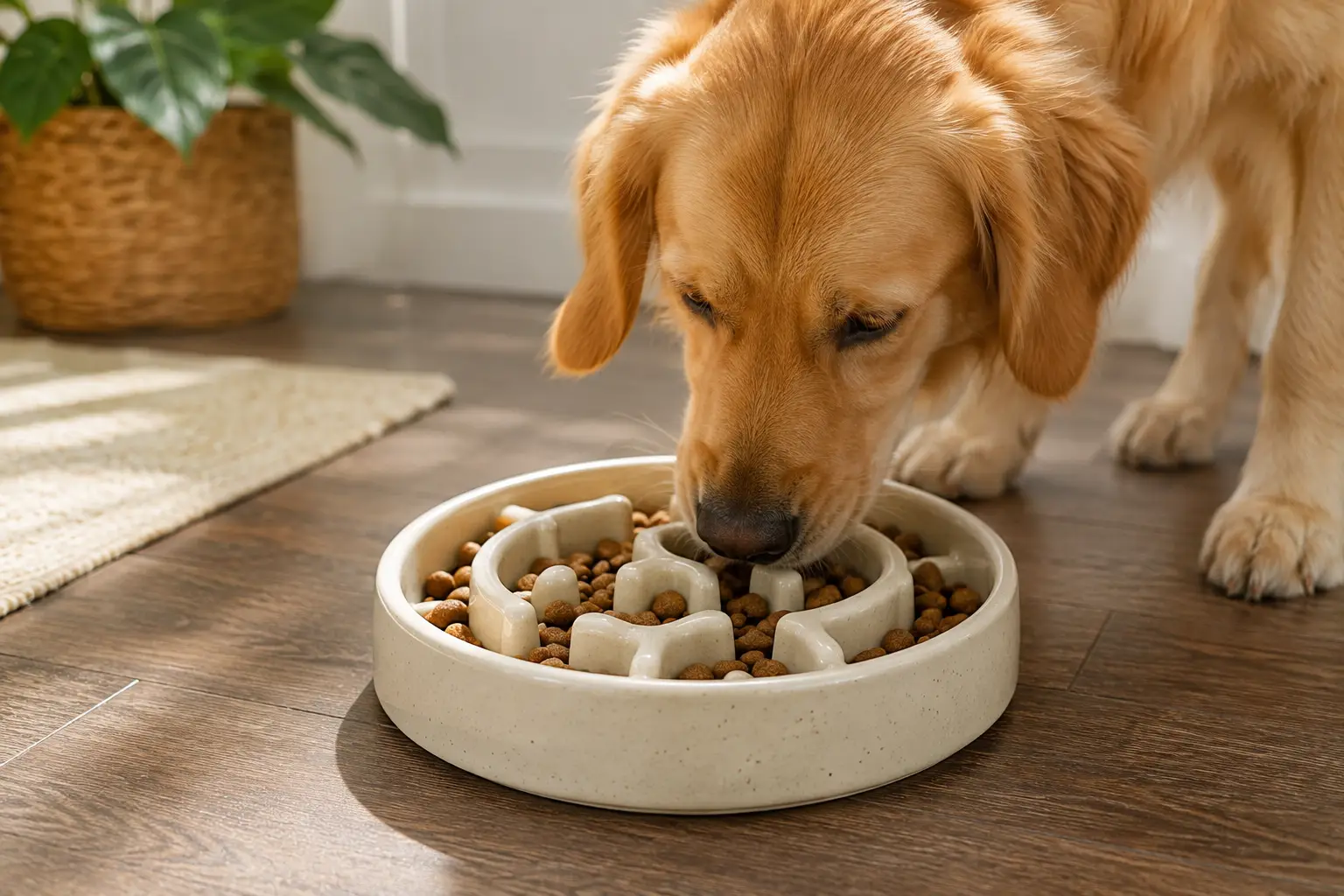
If mealtime at your house sounds like a shop-vac clearing a spill, you already know why you’re here. A ceramic slow feeder is a weighted, textured bowl — usually shaped with ridges, a maze, or a raised centerpiece — that forces a dog or cat to eat around obstacles instead of hoovering a bowl of kibble in ten seconds flat. Unlike plastic slow feeders, which scratch, stain, and can crack under an eager chewer’s teeth, a ceramic slow feeder stays heavy, stays put, and doesn’t hold onto bacteria the way a scuffed plastic surface can.
This guide skips the fluff you’d get from an Amazon listing. Instead, you’re getting genuine analysis: real products with real specs, honestly summarized customer feedback, and side-by-side comparisons that actually help you pick. We researched a spread of ceramic slow feeders — from budget-friendly small-breed bowls under $15 to premium elevated designs built for flat-faced pets — so you can match the right one to your dog’s or cat’s actual eating habits, not just whatever shows up first in search results.
Whether you’re dealing with a Labrador who treats dinner like a competitive sport or a Persian cat who needs a shallower dish for sensitive whiskers, there’s a ceramic slow feeder built for that specific problem. Let’s get into it.
Quick Comparison: Ceramic Slow Feeders at a Glance
| Product | Best For | Capacity | Price Range |
|---|---|---|---|
| LE TAUCI Ceramic Slow Feeder | Best all-around pick | 1.5 cups | Around $15–$20 |
| PawsPik Raised Ceramic Slow Feeder | Best for tilted, joint-friendly feeding | 1.8 cups | Around $20–$25 |
| Necoichi Elevated Ceramic Cat Bowl | Best for cats & flat-faced breeds | 2 cups | Around $20–$25 |
| vancasso Ceramic Floral Maze Bowl | Best-looking on a kitchen floor | 1.5 cups | Around $15–$20 |
| LE TAUCI Elevated Wooden-Stand Bowl | Best for small breeds | 0.6 cups | Around $15–$20 |
| MOPANG Ceramic Slow Feeder | Best budget pick for medium/large dogs | 2 cups | Under $15 |
| TRUVIC Ceramic Slow Feeder | Best lesser-known small-breed option | 0.6 cups | Under $15 |
Looking at the table, the split comes down to three questions: how big is your pet, does their face shape matter, and do you want the bowl elevated off the floor. The LE TAUCI Ceramic Slow Feeder covers the broadest range of dogs at a fair price, while the Necoichi Elevated Ceramic Cat Bowl solves a very specific problem — whisker fatigue — that flat maze bowls don’t address at all. Budget shoppers gravitate toward the MOPANG Ceramic Slow Feeder and the TRUVIC Ceramic Slow Feeder, both of which trade brand recognition for a lower price without giving up the core slow-feeding mechanism.
💬 Found a bowl that fits your pet already? Scroll down to see the full breakdown before you decide!
What Is a Ceramic Slow Feeder?
A ceramic slow feeder is a heavyweight pet bowl made from glazed stoneware or porcelain, molded with raised ridges, a maze pattern, or a center obstacle that breaks a flat layer of food into smaller, harder-to-reach pockets. The added weight and textured interior work together to slow down fast eaters, reducing air-gulping, choking risk, and the odds of digestive distress after a meal.
Top 7 Ceramic Slow Feeders: Expert Analysis
1. LE TAUCI Ceramic Slow Feeder — best balance of size, price, and durability
The LE TAUCI Ceramic Slow Feeder earns the top spot because it doesn’t force a trade-off: it’s sized for small-to-medium breeds, priced reasonably, and backed by one of the more established ceramic pet bowl brands on Amazon. The 8-inch bowl holds about 1.5 cups of dry food and uses a vortex-style ridge pattern that spirals food toward the outer wall, so a dog has to work the kibble loose in sections rather than scooping it in one pass. At roughly 2.87 pounds, the bowl is heavy enough to resist being pushed across a tile or hardwood floor by an enthusiastic eater.
What most buyers overlook with a bowl like this is that the “premium ceramic” claim actually matters for two practical reasons: it’s microwave-safe for warming refrigerated wet food, and it resists the fine surface scratches that let bacteria and odor build up in plastic bowls over time. That second point is why some veterinarians steer owners with dogs prone to “black chin” (a bacterial buildup on the muzzle) toward ceramic in the first place. Reviews consistently report that the vortex pattern is aggressive enough to slow determined gulpers without being so tight that a Frenchie or pug can’t get their snout into the grooves — a common complaint with narrower maze designs.
Pros:
- ✅ Holds a solid 1.5 cups for small-to-medium breeds
- ✅ Microwave-safe glaze for warming wet food
- ✅ Heavy base resists sliding on hard floors
Cons:
- ❌ Not sized for large or giant breeds
- ❌ Vortex pattern is less effective for extremely fast eaters
At around $15–$20, the LE TAUCI Ceramic Slow Feeder lands in the sweet spot of the category — not the cheapest option, but priced fairly for the durability and capacity you get.
2. PawsPik Raised Ceramic Slow Feeder — best tilted design for posture and comfort
The PawsPik Raised Ceramic Slow Feeder takes a different approach than a flat maze bowl: it’s elevated roughly 4 inches off the ground and tilted at 15 degrees, which lets a dog or cat eat from a more natural head-down angle instead of dropping straight into a bowl on the floor. That combination — elevation plus a raised interior pattern — does double duty, addressing both eating speed and, for older or arthritic pets, some of the neck strain that comes with bending all the way to the floor for every bite.
The bowl holds about 1.8 cups of dry food or 5.1 fluid ounces of liquid, and the glazed ceramic body weighs close to 2 pounds, giving it enough heft to stay stable at that elevated height. Based on comparing the specs against flat-bowl competitors, the trade-off here is footprint: a raised, tilted bowl takes up more counter or floor space than a standard maze dish, and it isn’t the right shape for a large-breed dog that needs volume over ergonomics. What the spec sheet doesn’t say, but the brand’s own product Q&A reveals, is that the tilt is specifically marketed as beneficial for senior pets and those with digestive or joint issues — a detail worth weighing if that’s your main concern.
Pros:
- ✅ 15-degree tilt eases neck strain during meals
- ✅ Elevated base suits senior or joint-sensitive pets
- ✅ Scratch-resistant glaze holds up over daily use
Cons:
- ❌ Bulkier footprint than a flat slow feeder
- ❌ Capacity is limited for large-breed portions
Priced around $20–$25 at the time of writing, this is a premium pick, and the value case rests on whether the ergonomic tilt is something your pet actually needs.
3. Necoichi Elevated Ceramic Cat Bowl — best for cats and flat-faced breeds
Most “slow feeder” marketing targets dogs, but cats — especially flat-faced breeds like Persians and Exotic Shorthairs — have their own version of the fast-eating problem, plus a related issue: whisker fatigue, where the sides of a narrow, deep bowl press against sensitive whiskers and can lead a cat to paw food out onto the floor rather than eat normally. The Necoichi Elevated Ceramic Cat Bowl solves for both. Its extra-wide 6.1-inch porcelain dish sits on a 2.75-inch leg, spreading the food across a broad, shallow surface so a cat’s whiskers never touch the rim.
The porcelain construction is tested to US, EU, and Japanese safety standards for lead and cadmium content, which matters more than it sounds — glazed dinnerware isn’t universally regulated the same way across manufacturers, and Necoichi is explicit about third-party testing in its product documentation. A removable silicone ring keeps the bowl from sliding when a “pushy” eater noses it around the floor. Here’s what to weigh: this bowl isn’t a maze-pattern slow feeder in the traditional sense — it slows eating primarily through the shallow, elevated design and portion spread rather than ridges a pet has to navigate. For cats and small dogs prone to inhaling food, that’s often gentler and more effective than a tight maze pattern they might just avoid.
Pros:
- ✅ Whisker-friendly shallow design prevents food refusal
- ✅ Elevated posture reduces neck strain for cats
- ✅ Tested against US, EU, and Japanese safety standards
Cons:
- ❌ Not a true maze pattern, so determined gulpers may still eat fast
- ❌ Higher price point than basic flat slow feeders
Expect to pay in the $20–$25 range, and if you have a flat-faced cat that’s abandoned other bowls, the value case here is strong — this addresses a problem that maze feeders simply don’t.
4. vancasso Ceramic Floral Maze Bowl — best-looking bowl that still does the job
The vancasso Ceramic Floral Maze Bowl is proof that a slow feeder doesn’t have to look clinical. Instead of the typical geometric ridge pattern, it uses a raised flower centerpiece set inside a floral-patterned maze, available in sizes from 0.6 cups (small breed) up to 3 cups (large breed) so it scales with the dog rather than forcing a one-size-fits-all bowl. The 1.5-cup medium version measures 8.5 inches across and, according to the manufacturer, weighs about 2.4 pounds — roughly six times heavier than a comparable plastic slow feeder, which translates directly into stability during an eager meal.
What sets this apart from a purely decorative bowl is that the floral ridges aren’t just for looks — they function as a genuine obstacle course, and the brand markets the pattern as slowing eating by a wide margin compared to a flat dish. Reviews consistently report that the glossy glaze resists the staining and “black chin” buildup that plastic bowls are known for, and several buyers specifically call out the design as a reason they switched from a plain maze bowl their dog had grown bored with. On paper, this means it’s a solid pick for owners who want their pet’s dinnerware to look intentional on a kitchen floor, not just functional.
Pros:
- ✅ Scales from small to large breed in multiple sizes
- ✅ Floral maze pattern is genuinely obstacle-dense, not just decorative
- ✅ Non-slip pads included for extra stability
Cons:
- ❌ Deeper ridges can be harder to fully clean by hand
- ❌ Floral texture may not suit owners who prefer a minimalist look
At around $15–$20 depending on size, it’s competitively priced with the more clinical-looking options, so the “aesthetic tax” here is close to zero.
5. LE TAUCI Elevated Wooden-Stand Bowl — best for small breeds and toy dogs
Small dogs face a different eating problem than large ones: it’s less about aggressive gulping and more about a short muzzle struggling to reach into a standard-depth bowl, plus the added strain of bending low to the floor repeatedly. The LE TAUCI Elevated Wooden-Stand Bowl addresses both by pairing a 0.6-cup ceramic slow-feed insert with a roughly 5-inch-tall wooden stand, lifting the whole setup off the ground.
This is a case where the practical interpretation of the spec sheet matters more than the numbers themselves: 0.6 cups sounds small, but it’s intentionally sized for toy and small breeds — Chihuahuas, Yorkies, Pomeranians — whose daily food intake rarely exceeds that in a single sitting anyway. Based on comparing this to flat small-breed bowls, the elevation is the real differentiator; it reduces the awkward neck-craning posture that small dogs otherwise adopt at a floor-level dish, and it keeps the bowl from getting shoved around by a food-motivated toy breed. The brand recommends transitioning skittish or first-time slow-feeder dogs to a silicone insert before ceramic, which is a fair, honestly-stated caveat rather than a blanket claim that every dog adapts instantly.
Pros:
- ✅ Elevated wooden stand reduces neck strain for small dogs
- ✅ Right-sized capacity for toy and small breeds
- ✅ Ceramic insert is removable for easier washing
Cons:
- ❌ 0.6-cup capacity is too small for medium or large breeds
- ❌ Wooden stand requires separate care from the ceramic piece
At roughly $15–$20, it’s priced similarly to flat small-breed bowls, so you’re mainly paying for the added stand — worth it if your dog struggles with a floor-level dish.
6. MOPANG Ceramic Slow Feeder — best budget pick for medium and large dogs
The MOPANG Ceramic Slow Feeder is the value play in this lineup: an 8-inch, 2-cup ceramic maze bowl that undercuts the bigger-name brands on price while still delivering the core slow-feeding mechanism. At 30 ounces of capacity, it’s sized appropriately for medium breeds and many large breeds that don’t need the full 3-cup volume of a giant-breed bowl.
The honest analysis here is that MOPANG doesn’t differentiate on extras — there’s no wooden stand, no tilt, no whisker-friendly shallow profile — it’s a straightforward maze pattern in a heavy ceramic body, and that simplicity is exactly what makes it a smart pick for owners who just need the core function without paying for design flourishes. What the spec sheet doesn’t say, but is worth flagging honestly, is that lesser-known ceramic brands can vary more in glaze consistency between production batches than established names, so it’s worth checking current listing photos and buyer feedback before ordering if batch consistency matters to you. That said, the fundamentals — weight, maze depth, dishwasher-safe glaze — line up with the pricier competitors on this list.
Pros:
- ✅ Largest capacity of the budget options at 2 cups
- ✅ Straightforward maze pattern with no unnecessary extras
- ✅ Dishwasher-safe glazed finish
Cons:
- ❌ Fewer size/color variants than bigger brands
- ❌ Brand has a shorter track record than LE TAUCI or Necoichi
Priced under $15 at the time of writing, this is one of the strongest value-for-money picks in the category if you don’t need premium extras.
7. TRUVIC Ceramic Slow Feeder — best lesser-known alternative for small breeds
Rounding out the list, the TRUVIC Ceramic Slow Feeder is a smaller, lesser-known brand’s take on the small-breed maze bowl, sized at 0.6 cups and explicitly marketed against “black chin” — the dark staining some light-coated small dogs develop from prolonged contact with certain bowl materials. It’s a direct alternative to the LE TAUCI small-breed bowl above, at a comparable or slightly lower price point.
Here’s what to weigh: because TRUVIC has a smaller market footprint than LE TAUCI or vancasso, it has fewer aggregated reviews to draw honest conclusions from, and buyers who prioritize a long public track record should factor that in. What the available product data does support is that the construction — glazed ceramic, non-slip base, maze ridges — mirrors the more established competitors closely enough that it functions as a legitimate budget alternative rather than a stripped-down knockoff. For owners specifically shopping to avoid chin staining on a light-coated breed like a Maltese or Bichon, the marketing claim aligns with a documented, real concern in the small-breed dog community, even if TRUVIC’s specific data on it is limited.
Pros:
- ✅ Specifically marketed to prevent chin staining
- ✅ Comparable construction to bigger-name small-breed bowls
- ✅ Competitive price point
Cons:
- ❌ Smaller brand with a thinner review history
- ❌ Limited to small-breed sizing only
At under $15, it’s one of the most affordable ceramic slow feeders on this list, making it a reasonable low-risk trial for small-breed owners.
Top 7 Ceramic Slow Feeders: Side-by-Side Comparison
| Product | Design Type | Ideal Pet Size | Elevated? | Price Range |
|---|---|---|---|---|
| LE TAUCI Ceramic Slow Feeder | Vortex maze | Small–medium dogs | No | $15–$20 |
| PawsPik Raised Ceramic Slow Feeder | Tilted raised bowl | Cats & small dogs | Yes | $20–$25 |
| Necoichi Elevated Ceramic Cat Bowl | Shallow elevated dish | Cats, flat-faced breeds | Yes | $20–$25 |
| vancasso Ceramic Floral Maze Bowl | Floral maze | Small–large dogs | No | $15–$20 |
| LE TAUCI Elevated Wooden-Stand Bowl | Maze + stand | Toy/small dogs | Yes | $15–$20 |
| MOPANG Ceramic Slow Feeder | Maze | Medium–large dogs | No | Under $15 |
| TRUVIC Ceramic Slow Feeder | Maze | Small dogs | No | Under $15 |
The clearest pattern in this table is that elevation and design flourishes — tilt, wooden stands, whisker-friendly shallow profiles — consistently push the price into the $20–$25 range, while flat maze bowls without extras stay under $20 regardless of brand. If your pet doesn’t have a specific posture, joint, or whisker-related issue, a flat maze bowl like the MOPANG Ceramic Slow Feeder or LE TAUCI Ceramic Slow Feeder delivers the core benefit for less money.
✨ Don’t miss these exclusive deals! 🔍 Take mealtime safety to the next level with this curated lineup. Click a highlighted pick to check current pricing and availability — your dog or cat will thank you (eventually).
Ceramic vs. Plastic and Stainless Steel Slow Feeders
Ceramic isn’t the only slow-feeder material on the market, and it isn’t automatically the right choice for every pet. Plastic slow feeders, popularized by brands like Outward Hound, are lighter, cheaper, and often come in more aggressive maze patterns — but that same lightness is a liability with a strong or anxious eater who can push a plastic bowl across the floor mid-meal. Plastic is also more prone to scratching, and scratched plastic can harbor bacteria in a way a smooth glazed ceramic surface generally resists.
Stainless steel double-wall slow feeders, meanwhile, are nearly indestructible and simple to sanitize, but most rely on a removable plastic maze insert rather than a molded pattern, which means there’s still a plastic component in the design even in a “steel” bowl. Ceramic splits the difference: it’s heavier and more resistant to scratching and staining than plastic, and unlike steel, the maze pattern is fired directly into the material rather than bolted on as a separate piece. The trade-off is fragility — a ceramic bowl dropped on a tile floor will chip or shatter, where steel simply dents and plastic might survive. For a calm eater in a low-traffic kitchen, ceramic is very often the better long-term investment; for a chaotic multi-dog household where bowls get knocked around, stainless steel may be the safer bet.
How to Choose the Right Ceramic Slow Feeder
- Match capacity to your pet’s actual portion size. A 0.6-cup bowl works for a Chihuahua’s single meal but will overflow constantly for a Labrador — check your pet’s daily food guideline before picking a size.
- Consider face shape before maze depth. Flat-faced dogs and cats (pugs, bulldogs, Persians, exotic shorthairs) generally do better with shallow, wide patterns like the Necoichi’s design rather than a deep, narrow maze.
- Weigh elevation against your pet’s health needs. Senior pets or those with neck or joint issues often benefit from a raised, tilted design; young, healthy pets usually don’t need it.
- Check the base for genuine anti-slip features. Weight alone helps, but a bowl with rubber feet or a silicone ring resists sliding on tile and hardwood far better than ceramic weight by itself.
- Confirm dishwasher and microwave safety. Most ceramic slow feeders are both, but always verify — hand-painted or decorative glazes sometimes aren’t rated for either.
- Read the maze depth honestly against your dog’s eating speed. An extreme gulper needs a tighter, deeper maze; a moderately fast eater may do better with a gentler pattern they won’t just avoid out of frustration.
- Factor in your cleaning routine. Deep floral or maze patterns trap more food residue than simple ridges, so if you’re hand-washing daily, a simpler pattern saves time.
Getting Started: Your Dog or Cat’s First 30 Days With a Slow Feeder
Introducing a slow feeder isn’t always instant. Some pets adapt within a single meal; others need a gradual transition, especially if they’ve eaten from a flat bowl their whole life. Start by using the new ceramic slow feeder for just one meal a day, keeping the other meal in the pet’s familiar bowl, so mealtime doesn’t become a source of stress. If your pet seems confused or frustrated rather than simply slowed down, try a shallower-pattern bowl instead of the deepest maze you can find — the goal is a manageable challenge, not an obstacle course they give up on.
Watch for early warning signs that the pattern is too aggressive: pawing at the bowl, walking away from meals, or excessive whining during feeding. These are all cues to size up to a gentler design. On the maintenance side, a full wash after every meal — not just a rinse — matters more with ceramic maze bowls than flat dishes, since wet food and saliva collect in the ridges and can dry into a stubborn residue if left overnight. Most of the bowls on this list are dishwasher-safe, which makes this a non-issue if you’re already running a daily load; hand-washers should budget an extra minute or two for getting into the grooves with a bottle brush. By day 30, most owners report their pet no longer needs the “easy meal” backup bowl at all — the slow feeder becomes the default.
Real-World Scenarios: Matching the Bowl to Your Pet
The competitive multi-dog household: If you’re feeding two or three dogs in the same kitchen and mealtime turns into a race, a heavier, deeper-maze bowl like the vancasso Ceramic Floral Maze Bowl or the LE TAUCI Ceramic Slow Feeder handles the anxiety-driven gulping that comes from food competition. Separate the bowls physically if possible — proximity alone can undo a slow feeder’s benefit.
The senior cat with joint stiffness: An older cat who’s started skipping meals or eating awkwardly may be dealing with neck or spine discomfort rather than a behavior problem. The PawsPik Raised Ceramic Slow Feeder or the Necoichi Elevated Ceramic Cat Bowl, both tilted and elevated, reduce the bend required to reach food.
The budget-conscious first-time buyer: If you’re not sure your dog will even tolerate a slow feeder, it doesn’t make sense to spend $25 to find out. The MOPANG Ceramic Slow Feeder or TRUVIC Ceramic Slow Feeder, both under $15, let you test the concept at low financial risk before upgrading to a premium design if it works.
Common Mistakes to Avoid When Buying a Ceramic Slow Feeder
Buying the deepest, most complex maze pattern available is the most common mistake — a pattern too aggressive for your pet’s face shape or patience level just gets avoided, which defeats the purpose entirely. A close second is ignoring capacity and buying a small-breed bowl for a medium or large dog, which forces multiple refills and negates the “one sitting” slow-feeding design. Owners also frequently skip checking for a genuine non-slip base, assuming ceramic weight alone is enough — it usually is on carpet, but on tile or hardwood, a bowl without rubber feet or a silicone ring can still skate across the floor mid-meal. Finally, some buyers overlook that ceramic is not shatterproof: placing a ceramic slow feeder in a spot where it could be knocked off a raised surface, or using it with a dog that chews the bowl itself rather than the food, creates a real breakage and injury risk that a plastic or stainless-steel bowl wouldn’t.
Long-Term Cost and Maintenance
A ceramic slow feeder typically costs more upfront than a basic plastic maze bowl — often $10–$15 more — but the total cost of ownership tends to favor ceramic over a year or two of daily use. Plastic slow feeders in the same price range frequently need replacing every 6–12 months once scratching, staining, or chew damage sets in, especially with dogs that nibble at the bowl itself. A well-made ceramic bowl, by contrast, can last for years without visible wear as long as it isn’t dropped, since the glazed surface doesn’t scratch or stain the way plastic does under normal use. The main ongoing cost with ceramic is the replacement risk from breakage rather than wear, so households with boisterous dogs or a chaotic kitchen layout should weigh that risk against the long-term savings on replacement bowls.
Safety, Regulations, and Standards for Ceramic Pet Bowls
Ceramic glazes are regulated in the US primarily through FDA Compliance Policy Guides that set allowable limits on leachable lead and cadmium — the same framework that governs human dinnerware. The FDA’s guidance on imported pottery makes clear that a “lead free” label isn’t automatically verified, and that some imported ceramicware has tested above allowable limits despite that claim — a good reason to favor established brands that reference third-party testing, like Necoichi’s stated compliance with US, EU, and Japanese safety standards. Pet bowls specifically fall into something of a regulatory gray area, since they’re not classified as human food-contact dinnerware or as children’s products under CPSIA, but reputable pet brands generally test to the same lead and cadmium thresholds voluntarily. If a ceramic bowl shows cracking, chipping, or a crazed (fine spiderweb-cracked) glaze, retire it — damaged glaze is exactly the kind of surface where leaching risk increases and bacteria can take hold.
What to Expect: Everyday Performance
Translated into daily life, a ceramic slow feeder generally turns a 30–60 second meal into a 3–8 minute one, depending on the pattern depth and how motivated your pet is. Most owners notice fewer post-meal burps, less retching, and calmer behavior immediately after eating within the first week. The most common complaint across ceramic slow feeders isn’t the slowing mechanism itself — it’s cleanup, since food residue collects in the ridges more than it would in a flat bowl. Budget a slightly longer wash cycle, whether by hand or dishwasher, and expect the bowl’s weight (typically 1.5–3 pounds) to make it noticeably less portable than a plastic equivalent if you’re traveling or bringing food bowls along on trips.
Frequently Asked Questions
❓ Are ceramic slow feeders safe for dogs that chew on their bowls?
❓ How much slower does a ceramic slow feeder actually make eating?
❓ Can I put a ceramic slow feeder in the dishwasher?
❓ Is a ceramic slow feeder better than a plastic one for a large breed?
❓ Do cats need a different type of slow feeder than dogs?
Conclusion
A ceramic slow feeder isn’t a gimmick — it’s a low-cost, low-effort way to address a genuinely dangerous habit, since fast eating is a documented contributor to choking, vomiting, and in severe cases, life-threatening bloat in dogs. The right pick depends less on brand reputation and more on matching the design to your specific pet: the LE TAUCI Ceramic Slow Feeder for a dependable all-around option, the PawsPik Raised Ceramic Slow Feeder or Necoichi Elevated Ceramic Cat Bowl for pets that need a gentler, joint-friendly angle, and the MOPANG Ceramic Slow Feeder or TRUVIC Ceramic Slow Feeder if you’d rather test the concept before spending more. Whichever you choose, the switch from a flat bowl to a ceramic slow feeder is one of the simplest mealtime changes you can make — and one your dog or cat will adjust to faster than you’d expect.
For more context on why eating speed matters so much for dogs specifically, the American Kennel Club’s guide to bloat in dogs breaks down the mechanics of GDV and why fast eaters carry measurably higher risk, and Preventive Vet’s bloat prevention resource offers additional day-to-day steps beyond just the bowl itself.
Recommended for You
- Cat Mate C500 Futterautomat Reviews: 7 Best Picks for 2026
- Cat Mate C500 Futterautomat Product Info and Reviews: 7 Picks for 2026
- Cat Mate Automatic Cat Feeder: 7 Best Picks for 2026 (Ranked)
Disclaimer: This post contains affiliate links. As an Amazon Associate, I earn from qualifying purchases made through these links, at no additional cost to you.
✨ Found this article helpful? Share it with someone who needs it! 💬🤗