In This Article
Why a Water Fountain with Filter Is the Smartest Upgrade to Your Pet’s Water Bowl
Here’s a scene most pet owners know by heart: you fill the bowl in the morning, and by noon your cat is ignoring it in favor of the bathroom faucet, the shower floor, or — somehow — your glass of water on the nightstand. A water fountain with filter exists precisely for that stubborn instinct. It keeps water moving, strains out hair and kibble crumbs, and gives your pet a reason to come back for “just one more sip.”
What Is a Water Fountain with Filter?
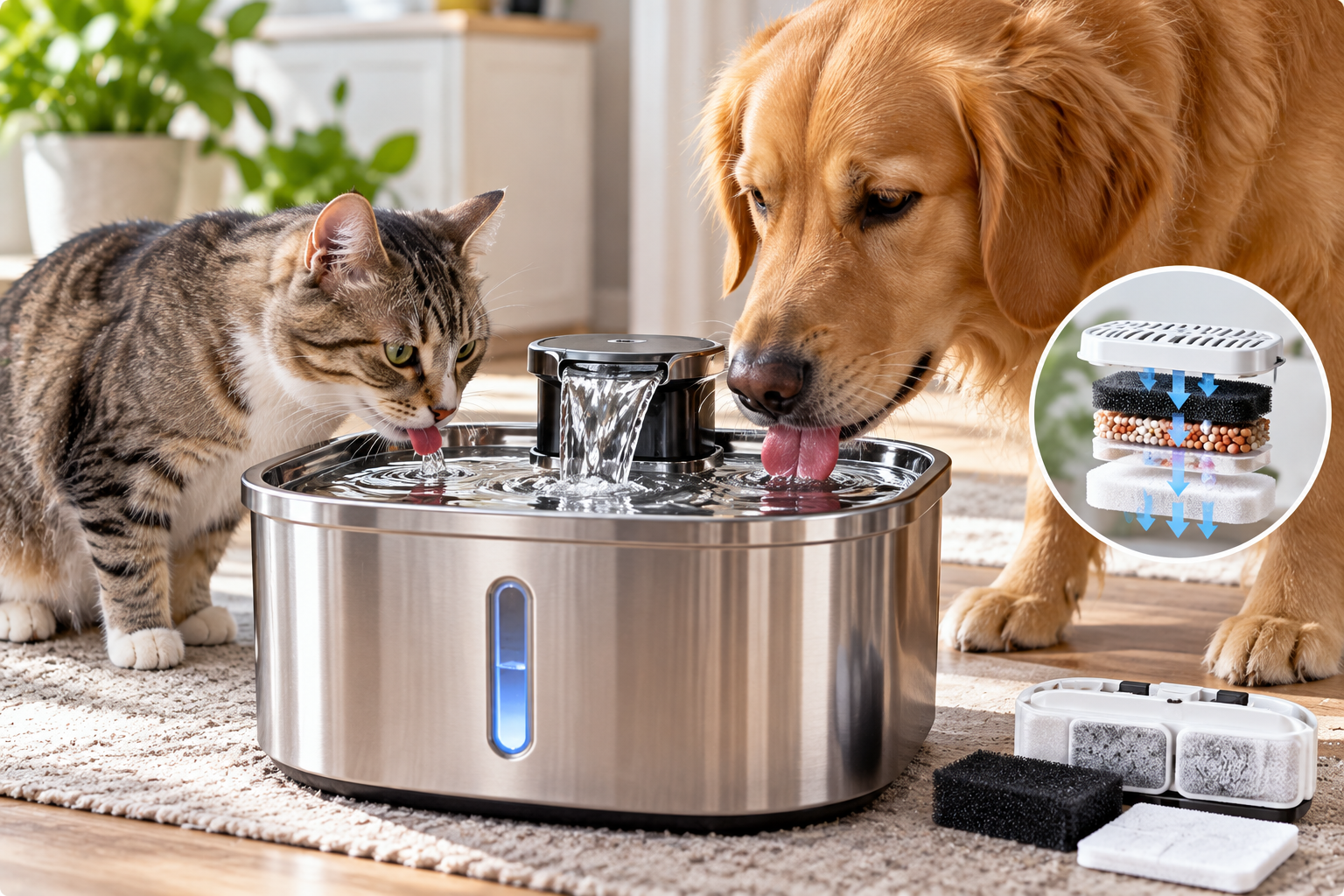
A water fountain with filter is a pet drinking station that uses a small electric pump to circulate water continuously through a replaceable filter — usually a foam pre-filter plus activated carbon, sometimes with ion-exchange resin — before returning it to a drinking surface as a stream, bubble, or gentle flow.
Why does that matter? Hydration is a genuine health issue, especially for cats. According to the Cornell Feline Health Center’s guidance on cat hydration, an average 10-pound cat needs roughly a cup of water a day, and some cats do drink more when offered a fountain — though Cornell is careful to note that individual preferences vary. That nuance is important, and we’ll come back to it: a fountain is a strong tool, not a magic cure.
In this guide, you’ll find seven real models available to US shoppers on Amazon, from a budget plastic workhorse to a cordless, battery-powered unit. Every pick is analyzed from manufacturer spec sheets and real aggregated owner feedback — not invented “test results.” You’ll also get a first-30-days setup routine, a troubleshooting guide, a filter-cost breakdown, and a straight answer to the stainless-versus-plastic debate. By the end, you’ll know exactly which pet water fountain with filter fits your home, your budget, and your very opinionated animal.
Quick Comparison: The 7 Best Water Fountain with Filter Picks at a Glance
| Fountain | Capacity | Body Material | Power | Price Range | Best For |
|---|---|---|---|---|---|
| Catit Flower Fountain | 100 oz (3 L) | BPA-free plastic | Plug-in | $30–$45 | Catit Flower Fountain: picky single cats |
| Veken 84oz Pet Fountain | 84 oz (2.5 L) | BPA-free plastic | Plug-in | $25–$40 | Veken 84oz Pet Fountain: tight budgets |
| PetSafe Drinkwell Platinum | 168 oz | BPA-free plastic | Plug-in (12V) | $50–$65 | PetSafe Drinkwell Platinum: dogs, multi-pet homes |
| PetSafe Drinkwell 360 Stainless Steel | 128 oz | Stainless steel | Plug-in | $75–$100 | PetSafe Drinkwell 360 Stainless Steel: multi-pet, durability |
| Pioneer Pet Raindrop Stainless Steel | 60 oz | Stainless steel | Plug-in (12V) | $45–$60 | Pioneer Pet Raindrop Stainless Steel: small spaces |
| PETKIT Eversweet Solo 2 | 68 oz (2 L) | BPA-free plastic | USB plug-in | $45–$60 | PETKIT Eversweet Solo 2: quiet bedrooms, app fans |
| PETLIBRO Dockstream Cordless | 2.5 L | Plastic + steel tray | Battery | $60–$90 | PETLIBRO Dockstream Cordless: no-outlet spots |
Looking at the table, the real dividing lines are capacity and power source, not price. The PetSafe Drinkwell Platinum holds nearly three times as much water as the Pioneer Pet Raindrop Stainless Steel, which matters enormously if you own a Lab rather than a single cat. Meanwhile, the PETLIBRO Dockstream Cordless is the only pick here that frees you from the outlet entirely — a niche feature, but a decisive one if your cat’s favorite drinking spot is nowhere near a plug.
💬 One click helps other shoppers make an informed choice too! 😊
Top 7 Water Fountain with Filter Models: Expert Analysis
1. Catit Flower Fountain — best all-rounder for picky cats
The Catit Flower Fountain earns its spot by solving the most common problem — a cat that simply won’t drink — with flexibility rather than gimmicks. It holds about 100 oz (3 L) and offers three flow settings: a gently flowing surface, a bubbling top, or long faucet-like streams from the flower accessory. In practice, that means you can experiment until your cat “clicks” with one style instead of buying a second fountain.
Its Triple Action Filter combines ion-exchange resin (softens hard tap water and reduces mineral scale), activated carbon (removes odors and off-tastes), and a cotton mesh that catches hair. Catit rates the cartridge for roughly 30 days. The petal-shaped top also holds small pools of water, so your cat can still drink if the pump stops.
Based on the spec sheet, this is the fountain to try first if you have one or two cats and a smallish floor area. It’s not a dog fountain — 100 oz disappears fast with a 60-pound drinker. Notably, Wirecutter’s testers named it their top pick after comparing nine fountains, citing easy maintenance. Aggregated owner feedback echoes that: people praise how simply it disassembles, while the recurring complaint is that it only accepts Catit-certified filters.
Pros:
- ✅ Three flow modes help win over fussy drinkers
- ✅ Triple-layer filter softens water and removes odors
- ✅ Petal top still offers water if power fails
Cons:
- ❌ Proprietary filters lock you into one brand
- ❌ Capacity is too small for large dogs
Usually priced between $30 and $45 (check the current price), it’s one of the best value-per-feature buys in the category.
2. Veken 84oz Pet Fountain — best value under $40
The Veken 84oz Pet Fountain is the budget option that proves “cheap” doesn’t have to mean “bare-bones.” It holds 84 oz (2.5 L), is made of BPA-free PP resin, and includes three replacement filters plus a silicone splash mat right out of the box.
Each filter combines a cotton layer, activated carbon, and ion-exchange resin — essentially the same triple-filtration recipe as pricier competitors. Veken lists three flow designs (flower waterfall, flower bubble, and gentle fountain) and a pump measured below 40 dB. Translated into everyday life: it’s quiet enough for a kitchen or living room, though light sleepers may still prefer a quieter pump for a bedroom.
Who’s it for? First-time fountain buyers who want to test whether their cat or small dog even likes moving water before spending $60 or more. The square 84oz format is also widely copied, so generic replacement filters are easy to find and inexpensive. It’s one of the most-reviewed fountains on Amazon, and aggregated sentiment is strongly positive about price and how quickly pets take to it. However, ratings on some non-Amazon retail pages are noticeably more mixed, so it’s wise to treat the pump as a part you may eventually replace.
Pros:
- ✅ Low entry price with filters and mat included
- ✅ Triple filtration comparable to premium models
- ✅ Cheap third-party filters are widely available
Cons:
- ❌ Plastic body scratches over time and can harbor slime
- ❌ Long-term pump reliability appears inconsistent
At around $25 to $40, it’s the lowest-risk way to find out whether a fountain works for your pet.
3. PetSafe Drinkwell Platinum — biggest capacity for thirsty households
The PetSafe Drinkwell Platinum is built for volume: 168 oz (about 1.3 gallons), split between the bowl and a clear snap-on reservoir that automatically tops up the drinking area. For multi-pet homes, that translates into fewer refills and fewer “the bowl is empty again” moments.
Its signature free-falling stream aerates the water, and an adjustable flow knob lets you calm it down for skittish pets. A plastic pre-filter catches hair before it reaches the motor, while a replaceable activated carbon filter tackles odors. The 12V low-voltage system and rubber feet are thoughtful details — the feet in particular matter with enthusiastic dogs that tend to shove bowls across the floor.
On paper, this is the best plug-in choice for households with a medium or large dog, or several cats. The trade-off is complexity: more parts means more nooks to scrub during cleaning, and the clear reservoir shows every water spot. Owner feedback across retailers consistently praises capacity and the transparent reservoir that shows the water level at a glance; the free-falling design can also produce a noticeable trickle sound, which some owners like and others don’t.
Pros:
- ✅ Huge 168 oz capacity means less refilling
- ✅ Adjustable stream suits both timid and bold drinkers
- ✅ Top-rack dishwasher safe (pump hand-washed)
Cons:
- ❌ More components make deep cleaning take longer
- ❌ Plastic body won’t age as gracefully as steel
Typically priced in the $50 to $65 range, it delivers the most water per dollar of any fountain on this list.
4. PetSafe Drinkwell 360 Stainless Steel — best stainless option for multi-pet homes
The PetSafe Drinkwell 360 Stainless Steel turns a fountain into a shared watering hole. Its circular design lets several pets drink from any side at once, and interchangeable spout rings deliver anywhere from one to five free-falling streams.
The 128 oz (1 gallon) stainless steel bowl is rust- and scratch-resistant, which matters more than it sounds: scratches in plastic are where biofilm hides. The fountain uses PetSafe’s Carbon Filter #3 and Foam Filter #5, so you’re getting two stages — foam for hair and debris, carbon for odor and taste. Because the bowl is open, pets can still drink if the power goes out.
Based on the specs, this is the most sensible “buy once” pick for homes with two to four cats or a mix of cats and small-to-medium dogs (PetSafe positions it for dogs under about 60 pounds). It’s dishwasher safe, excluding the pump, which turns weekly cleaning into a quick chore. Retailer summaries of owner reviews note that cats and small dogs take to the circulating water readily and that the steel helps limit buildup; the most common reservation is the price.
Pros:
- ✅ 360-degree access ends drinking-line squabbles
- ✅ Stainless steel resists scratches, rust, and slime
- ✅ Open bowl still works during power outages
Cons:
- ❌ Priciest plug-in fountain in this roundup
- ❌ Wide footprint needs more floor space
Expect roughly $75 to $100 — a premium, but one that tends to pay off in longevity.
5. Pioneer Pet Raindrop Stainless Steel — compact steel for small spaces
The Pioneer Pet Raindrop Stainless Steel squeezes a steel fountain into a modest 60 oz footprint (a 96 oz version also exists). Its raindrop shape gives pets three drinking zones: the top outlet, the sloped ramp, and a calmer bowl-style area at the bottom.
The design is refreshingly simple — essentially two main pieces — and it’s dishwasher safe. Pioneer positions the charcoal filter before the pump, which the company says protects the motor and keeps it quieter. Pioneer recommends weekly fountain cleaning, a filter change every two to four weeks, and a monthly pump cleaning. Practically, it suits apartments, countertops, and single-cat homes where a big fountain would dominate the room.
Here’s the honest analysis: steel is excellent, but 60 oz is small. With two cats or any dog, you’ll be refilling often. Aggregated owner reviews are genuinely split — many praise how easy the steel is to keep clean, while others report pump noise as the level drops and pumps failing within months. A useful plus: replacement parts, including the 12V pump, are sold separately, so a dead pump doesn’t mean a dead fountain.
Pros:
- ✅ Mostly stainless steel construction with few parts
- ✅ Three drinking zones suit different preferences
- ✅ Replacement pumps extend the fountain’s life
Cons:
- ❌ Small 60 oz capacity needs frequent refills
- ❌ Reports of pump noise and early failures
Usually between $45 and $60, it’s fair value if you accept that the pump may be a consumable.
6. PETKIT Eversweet Solo 2 — quietest smart pick for bedrooms
The PETKIT Eversweet Solo 2 is designed around one idea: separate the water from the electricity. Its magnetic “wireless” pump has no cord running through the water, and the powered base detaches from the 68 oz (2 L) tank, so you never dunk anything electrical while refilling.
PETKIT rates the pump below 25 dB — roughly a whisper — which makes it a strong candidate for bedrooms and studio apartments. Bluetooth pairing with the PETKIT app shows water level and filter status, and Smart, Normal, and Night modes let you cut flow during quiet hours. The pump shuts off automatically when water runs low, protecting it from running dry. Filters are rated for about four weeks.
One clarification matters: “wireless” does not mean cordless. PETKIT itself has publicly answered owner confusion on this point — the base still needs USB power, and the wall adapter isn’t included. Also note that its parts are not dishwasher safe. Aggregated owner feedback is enthusiastic about how quiet and easy-to-clean it is; the main complaints center on that wireless/cordless confusion.
Pros:
- ✅ Ultra-quiet pump suits bedrooms and small apartments
- ✅ Electricity stays separate from the water tank
- ✅ App tracks water level and filter life
Cons:
- ❌ USB power adapter sold separately
- ❌ Parts must be hand-washed, not dishwasher-cleaned
Priced around $45 to $60, it’s excellent value for tech-friendly owners.
7. PETLIBRO Dockstream Cordless — no outlet required
The PETLIBRO Dockstream Cordless (the battery-operated Dockstream) solves a problem no plug-in fountain can: placement. A 5,000 mAh battery powers a wireless pump, and PETLIBRO claims around 30 days per charge, depending on the mode used.
Two modes shape how long that battery lasts. Continuous flow behaves like any fountain, while the radar sensor mode starts the water only when your pet approaches — a clever way to stretch battery life and reduce unnecessary circulation. The 2.5 L tank has a detachable stainless steel drinking tray, plus low-battery and low-water indicators. The filter uses multi-layer filtration, and PETLIBRO recommends replacing the filter and foam every two weeks.
That two-week schedule is the hidden cost: it’s twice as frequent as Catit or PETKIT, so budget for filters. Also, PETLIBRO sells several “Dockstream” versions — including an app-connected model that is wall-powered with only the pump wireless — so confirm the listing explicitly says battery-operated or cordless. We could not verify a large body of US-specific owner reviews for this exact cordless variant, so we’re relying on spec analysis here; owners of PETLIBRO fountains broadly praise the stainless tray and easy pump removal.
Pros:
- ✅ Runs anywhere without an outlet
- ✅ Sensor mode saves battery and water circulation
- ✅ Stainless steel tray resists scratches and slime
Cons:
- ❌ Filters need replacing every two weeks
- ❌ Confusing model names make ordering errors easy
Expect roughly $60 to $90, which is reasonable for the only truly cordless pick here.
Side-by-Side Specs: Filters, Cleaning, and Noise
| Fountain | Filter Stages | Suggested Filter Change | Dishwasher Safe? | Noise Notes |
|---|---|---|---|---|
| Catit Flower Fountain | Resin + carbon + mesh | ~30 days | No (hand wash) | Generally quiet |
| Veken 84oz Pet Fountain | Cotton + carbon + resin | 2–4 weeks | No (hand wash) | Below 40 dB claimed |
| PetSafe Drinkwell Platinum | Pre-filter + carbon | Every few weeks | Top rack (not pump) | Stream trickle audible |
| PetSafe Drinkwell 360 Stainless Steel | Foam + carbon | Every few weeks | Yes (not pump) | Streams audible |
| Pioneer Pet Raindrop Stainless Steel | Charcoal | 2–4 weeks | Yes | Can rise when low |
| PETKIT Eversweet Solo 2 | Multi-layer | ~4 weeks | No | Under 25 dB claimed |
| PETLIBRO Dockstream Cordless | Multi-layer + foam | 2 weeks | Tray only (check manual) | Quiet; sensor mode |
The pattern is clear: stainless models win on cleaning convenience, while the quietest pumps belong to the smart plastic designs. If noise is your top concern, the PETKIT Eversweet Solo 2 stands out; if you want to throw parts in the dishwasher, the PetSafe Drinkwell 360 Stainless Steel and Pioneer Pet Raindrop Stainless Steel save the most scrubbing.
Getting Started: Your First 30 Days with a New Fountain
Most fountain “failures” happen in the first month — and almost always for reasons you can control. Here’s a practical routine that the product manuals hint at but rarely spell out in one place.
Day 1 — Prep the filter properly. Rinse carbon filters under cold water to flush loose charcoal dust, then soak them (Catit suggests about 10 minutes; PETLIBRO suggests 5). A dry filter floats, channels water poorly, and can make the pump gurgle.
Day 1 — Prime and place. Fill to the max line, plug in, and listen. Place the fountain where your pet already drinks — not in a “nicer” spot across the house. Cats in particular prefer water away from their food and litter box.
Days 2–7 — Keep the old bowl nearby. Don’t remove the familiar bowl yet. Let curiosity do the work. If your pet seems spooked, lower the flow setting or switch to a gentle bubble mode.
Week 2 — First deep clean. Unplug, disassemble, and wash every part, including the pump impeller. Pioneer recommends weekly fountain cleaning and monthly pump cleaning — a sensible baseline for any model.
Weeks 3–4 — First filter change. Mark the date on your phone calendar. Two-week models (like the PETLIBRO Dockstream Cordless) are due now; 30-day models (like the Catit Flower Fountain) are close.
Common first-month mistakes:
- ❌ Letting water drop below the minimum line (pumps get loud and wear faster)
- ❌ Washing filters with soap (residue stays in the carbon)
- ❌ Removing the old bowl on day one
🚀 Ready to build a better hydration routine?
🔍 Pick the fountain that fits your home from the lineup above — click any highlighted model to check current pricing and availability, and start your pet’s first 30 days on the right paw!
Real-World Scenarios: Matching the Right Fountain to Your Home
Specs only become useful when you map them onto real lives. Here are three common household profiles and the reasoning behind each match.
Scenario 1: The studio apartment with one finicky cat
Budget: under $60. Use: one cat, fountain sits 6 feet from the bed.
Noise is the deciding factor here. A trickling stream that’s charming in a kitchen becomes maddening at 2 a.m. The PETKIT Eversweet Solo 2 fits best: its sub-25 dB pump and Night mode keep things silent, and the 2 L tank lasts a single cat over a week. If the budget is tighter, the Catit Flower Fountain with its gentle-flow setting is the runner-up.
Scenario 2: The busy family with two cats and a Beagle
Budget: $60–$100. Use: three pets, heavy daily traffic, kids helping with chores.
Capacity and cleaning speed matter most. The PetSafe Drinkwell 360 Stainless Steel lets all three pets drink at once, and the dishwasher-safe steel means a teenager can handle weekly cleaning without a scrub brush lecture. If budget wins, the PetSafe Drinkwell Platinum offers even more water for less money — just with more parts to wash.
Scenario 3: The senior cat who drinks in the upstairs hallway
Budget: flexible. Use: one older cat, favorite spot has no outlet.
Senior cats often drink less, and Cornell notes that easy access is a key lever for intake. Moving water to where the cat already hangs out beats training a new habit. The PETLIBRO Dockstream Cordless goes anywhere, and its sensor mode starts the flow when the cat approaches. Just budget for those biweekly filters.
The takeaway: start with where your pet drinks and how many pets share it, then filter by noise and budget.
Problem → Solution: Fixing the 5 Most Common Fountain Headaches
Even the best pet water fountain with filter will act up eventually. Here’s how to fix the issues owners report most often.
1. The pump is suddenly loud or gurgling
Cause: low water or hair wrapped around the impeller. Fix: refill to the max line first. If noise persists, unplug, pop the impeller out, and rinse away hair. Models that place the filter before the pump, like the Pioneer Pet Raindrop Stainless Steel, are designed to reduce this — but they still need monthly attention.
2. Pink or slimy film on the bowl
Cause: bacterial biofilm, which loves scratched plastic and warm rooms. Fix: scrub weekly with a soft brush and mild unscented soap, rinse thoroughly, and consider upgrading to steel. The PetSafe Drinkwell 360 Stainless Steel resists scratches that shelter slime.
3. White crust around the spout
Cause: hard-water minerals (calcium and magnesium). Fix: soak parts in a diluted white vinegar solution, then rinse well. Filters with ion-exchange resin — like those in the Catit Flower Fountain and Veken 84oz Pet Fountain — help slow buildup.
4. Your pet ignores the fountain
Cause: wrong flow, wrong place, or a startling noise. Fix: switch to the gentlest mode, move it to the old bowl’s location, and keep the old bowl out for a week. Multi-mode designs give you more chances to get it right.
5. Water empties too fast
Cause: evaporation, splashing, or simply too-small capacity for your household. Fix: add a splash mat, lower the flow, or size up. Moving from a 60 oz fountain to the 168 oz PetSafe Drinkwell Platinum can cut refills dramatically.
How to Choose a Water Fountain with Filter: 7 Steps
Use this checklist in order — each step narrows the field.
- Count your drinkers. One cat can live happily with 60–85 oz; multiple pets or any medium-to-large dog points you toward 128–168 oz.
- Pick the body material. Stainless steel resists scratches and slime; plastic is cheaper and lighter. If your cat has a history of chin acne, many owners prefer steel.
- Check the filter recipe. Look for a foam or mesh pre-filter for hair plus activated carbon, which adsorbs odor- and taste-causing compounds. Resin is a bonus in hard-water areas.
- Calculate the filter schedule. Two-week filters cost roughly twice as much per year as monthly ones. More on this below.
- Consider noise. Bedroom placement? Prioritize pumps rated below 25–30 dB and gentle flow modes.
- Confirm the power situation. Plug-in, USB, or battery? Read listings carefully — “wireless pump” and “cordless fountain” are not the same thing.
- Test the cleaning story. Count the parts and check whether they’re dishwasher safe. A fountain you dread cleaning is a fountain that becomes unhygienic.
Following these steps in order prevents the most common buyer’s remorse: a gorgeous fountain that’s too small, too loud, or too fiddly to keep clean.
Cat Water Fountain with Filter: Understanding What Each Layer Actually Does
Marketing copy loves big numbers — “4-layer filtration!” — but what matters is what each layer does. A cat water fountain with filter typically combines up to four elements, and knowing their jobs helps you judge whether a fountain is worth its price.
Foam or mesh pre-filter. This is the hair catcher. Cats shed constantly, and loose fur clogs pumps. A good pre-filter is the single biggest factor in pump longevity, which is why the PetSafe Drinkwell Platinum places one in front of the motor.
Activated carbon. Carbon’s huge internal surface area traps compounds responsible for chlorine taste and odors. It does not sterilize water or kill bacteria, and it saturates over time — that’s why replacement schedules exist.
Ion-exchange resin. This swaps hard-water minerals like calcium and magnesium for other ions, reducing scale on your fountain. Catit markets its resin as softening tap water; the practical, verifiable benefit is less crusty buildup to scrub.
Cotton or non-woven fabric. This catches finer sediment that slipped past the pre-filter.
Here’s what most buyers overlook: a filter is only as good as its replacement schedule. An expired carbon cartridge stops improving taste and can become a surface where gunk accumulates. Buying a four-layer fountain and changing the filter every three months is worse than a two-layer fountain maintained on schedule.
Stainless Steel Water Fountain with Filter vs Plastic: Which Is Worth It?
This is the most common debate among shoppers, so let’s settle it with reasoning rather than hype.
| Factor | Stainless Steel | BPA-Free Plastic | Ceramic (for reference) |
|---|---|---|---|
| Scratch resistance | High | Low | High (but can chip) |
| Biofilm resistance | Better (smooth surface) | Worse once scratched | Good |
| Dishwasher friendly | Usually | Often top-rack only | Usually |
| Weight / tipping risk | Light, stable | Lightest | Heaviest |
| Price | Higher | Lowest | Mid to high |
| Best for | PetSafe Drinkwell 360 Stainless Steel, Pioneer Pet Raindrop Stainless Steel | Veken 84oz Pet Fountain, Catit Flower Fountain | Owners prioritizing weight |
The table shows why a stainless steel water fountain with filter usually wins over the long run: the issue with plastic isn’t safety on day one — modern fountains are generally BPA-free — it’s that scratches accumulate and give bacteria a foothold. Still, plastic models like the Catit Flower Fountain make excellent starter fountains, and hybrid designs such as the PETLIBRO Dockstream Cordless put steel exactly where the pet’s tongue meets the water.
A practical middle path: if you buy plastic, replace the fountain body when scratches become visible rather than running it for years.
Water Fountain vs Regular Bowl: What the Research Actually Says
It would be easy to promise that any fountain doubles your pet’s water intake. The evidence is more nuanced, and you deserve the honest version.
A controlled study of laboratory cats, published in the Journal of Feline Medicine and Surgery and available through the National Library of Medicine, measured intake from still, free-falling, and circulating water bowls — and found that bowl type had no appreciable overall effect on how much the cats drank. The authors suggested other strategies for cats whose medical conditions require more fluids.
So why buy a fountain? Because a lab average isn’t your cat. Cornell’s guidance acknowledges that some cats do drink more from fountains, while individual preferences vary. Fountains also deliver benefits beyond volume: water stays cleaner, hair is filtered out, and you can see at a glance when it needs refilling.
What the research does strongly support is that water intake matters for cats prone to urinary issues, and that wet food is one of the most reliable ways to increase total fluid intake. The smart conclusion: think of a fountain as one tool in a hydration toolkit — alongside multiple water stations, wet food, and conflict-free access in multi-cat homes — rather than a medical treatment.
If your vet has flagged kidney or urinary concerns, ask them how a fountain fits into a broader plan.
Dog Water Fountain with Filter: Sizing Up for Bigger Drinkers
Dogs change the math entirely. A dog water fountain with filter has to survive enthusiastic slurping, heavier daily volume, and occasionally being pushed across the floor.
Capacity comes first. A small dog can manage with roughly 100 oz, but medium and large breeds empty small fountains alarmingly fast — especially after exercise or in summer. The PetSafe Drinkwell Platinum at 168 oz is the strongest plug-in pick here for big dogs; the PetSafe Drinkwell 360 Stainless Steel works well for mixed households with dogs under about 60 pounds.
Stability matters. Look for rubber feet, a wide base, or a low center of gravity. The Platinum’s rubber feet and snap-on lid are there for exactly this reason.
Splash control. Dogs are messy drinkers. A receiving ramp reduces splashing, and a silicone mat underneath protects your floors. Lowering the flow also helps.
Skip cat-sized units. Fountains under 70 oz — including the PETKIT Eversweet Solo 2 and the 60 oz Pioneer Pet Raindrop Stainless Steel — are designed for cats and small dogs. A Golden Retriever will drain them in a day and run the pump dry if there’s no auto-shutoff.
Mind the cord. Puppies chew. Route cords behind furniture, or consider models with cord protection or USB bases that detach cleanly.
Water Fountain Filter Replacement and Long-Term Cost
The sticker price is only the beginning. Water fountain filter replacement is the real ongoing cost, and it varies more than most buyers realize.
| Fountain | Change Interval | Filters per Year | Estimated Annual Filter Cost* |
|---|---|---|---|
| Veken 84oz Pet Fountain | 2–4 weeks | 13–26 | ~$15–$35 (generics available) |
| Catit Flower Fountain | ~30 days | 12 | ~$25–$45 |
| PETKIT Eversweet Solo 2 | ~4 weeks | 12–13 | ~$25–$45 |
| PetSafe Drinkwell Platinum | Every few weeks | 9–13 | ~$20–$40 |
| PETLIBRO Dockstream Cordless | 2 weeks | 26 | ~$40–$70 |
*Rough ranges based on typical multipack pricing at the time of writing; prices vary — check current listings.
The table reveals something the product listings don’t: the PETLIBRO Dockstream Cordless can cost noticeably more to run each year than the Veken 84oz Pet Fountain, mostly because of its two-week filter schedule. Over three years, filter costs can rival or exceed the price of the fountain itself, so factor them into your decision.
Other ongoing costs to plan for:
- Replacement pumps. Budget models may need a new pump within a few years; Veken claims 2.5–4 years under normal use.
- Electricity. Small fountain pumps draw only a few watts — PETKIT rates the Solo 2 at 2W — so power costs are negligible.
- Cleaning supplies. A small pipe brush for spouts and impellers is worth its weight in gold.
ROI tip: buying filters in bulk (8- or 12-packs) typically lowers the per-filter cost significantly.
Common Mistakes to Avoid When Buying a Pet Water Fountain
Most regret comes from the same handful of oversights.
Mistake 1: Buying by looks alone. A flower-shaped fountain is adorable, but if it holds 60 oz and you have three cats, you’ll be refilling constantly. Start with capacity.
Mistake 2: Ignoring filter availability. Some fountains accept only proprietary cartridges. That’s fine if they’re easy to find — but check before you buy.
Mistake 3: Assuming “wireless” means cordless. As PETKIT’s own customer responses show, a wireless pump may still need a plugged-in base. Read the power specs line by line.
Mistake 4: Skipping the pump in cleaning. The impeller collects hair and slime. Cleaning only the bowl leaves the dirtiest part untouched.
Mistake 5: Choosing the wrong model variant. Brands such as PETLIBRO sell several versions under one name. Double-check capacity and power type on the exact listing.
Mistake 6: Expecting a fountain to fix a medical issue. It supports hydration, but it isn’t a substitute for veterinary care if your pet shows signs of urinary trouble or excessive thirst.
Mistake 7: Buying too small “to save space.” An undersized fountain runs low faster, which makes the pump louder and shortens its life — a false economy.
Avoid these seven, and you’ll sidestep the most common one-star review scenarios before they happen.
Safety, Materials, and Standards to Look For
A fountain combines water and electricity next to a curious animal, so a few safety basics deserve attention.
Low-voltage power. Many fountains run on low-voltage adapters — the PetSafe Drinkwell Platinum uses a 12V system, and the PETKIT Eversweet Solo 2 runs on 5V USB. Lower voltage at the fountain reduces risk if a cord gets wet or chewed. In the US, look for adapters bearing a recognized safety certification mark such as UL or ETL.
Dry-run protection. Auto-shutoff when water runs low (offered on the PETKIT Eversweet Solo 2 and PETLIBRO Dockstream Cordless) protects the pump and reduces overheating risk.
Food-contact materials. “BPA-free” claims refer to bisphenol A, a compound used in some plastics that many owners prefer to avoid. Stainless steel sidesteps the question entirely.
Indoor use only. Several fountains on this list, including the PetSafe models, are labeled indoor-only. Don’t run them on a patio exposed to rain.
Battery care. For cordless fountains, follow the manufacturer’s charging instructions and avoid off-brand chargers.
None of these concerns should scare you off — fountains are routine household products — but checking these specs takes thirty seconds and prevents the most avoidable problems.
FAQ: Water Fountain with Filter Questions Shoppers Ask Most
❓ Are filtered pet water fountains worth the money?
❓ How often should you change a water fountain filter?
❓ Can I use a pet water fountain without the filter?
❓ Which is better for dogs, a stainless steel or plastic fountain?
❓ Why is my cat water fountain making noise?
Conclusion: Choosing the Right Water Fountain with Filter for Your Pet
The best water fountain with filter isn’t the one with the most layers or the fanciest app — it’s the one sized for your household, quiet enough for its location, and simple enough that you’ll actually clean it every week.
For most single-cat homes, the Catit Flower Fountain is the confident starting point: flexible flow modes, a solid triple-action filter, and fair pricing. On a tight budget, the Veken 84oz Pet Fountain lets you test the waters cheaply. Big dogs and busy multi-pet homes should look at the PetSafe Drinkwell Platinum for raw capacity or the PetSafe Drinkwell 360 Stainless Steel for longevity. Owners of a single cat in a compact space can lean on the Pioneer Pet Raindrop Stainless Steel, light sleepers will appreciate the PETKIT Eversweet Solo 2, and anyone fighting outlet placement finally has an answer in the PETLIBRO Dockstream Cordless.
Whatever you choose, remember the bigger picture: fresh water, frequent cleaning, on-time filter changes, and easy access are what truly support your pet’s hydration. Pair the fountain with good habits, and keep your vet in the loop if your pet has urinary or kidney concerns.
🐾 Give your pet the fresh water they deserve!
💧 Upgrade your pet’s hydration with one of these carefully analyzed picks. Click any highlighted fountain to check current pricing and availability — and enjoy fewer refills, cleaner water, and a happier, healthier companion!
Recommended for You
- Dog Feeder with Camera: 7 Best Picks That Actually Deliver (2026)
- Puppy Slow Feed Bowl: 7 Best Picks to Stop Gulping (2026)
- Slow Feed Dog Dish Guide 2026: 7 Best Picks That Actually Work
Disclaimer: This post contains affiliate links. As an Amazon Associate, I earn from qualifying purchases made through these links, at no additional cost to you.
✨ Found this article helpful? Share it with someone who needs it! 💬🤗