In This Article
Why Your Fast Eater Needs a Stainless Steel Slow Feeder Bowl
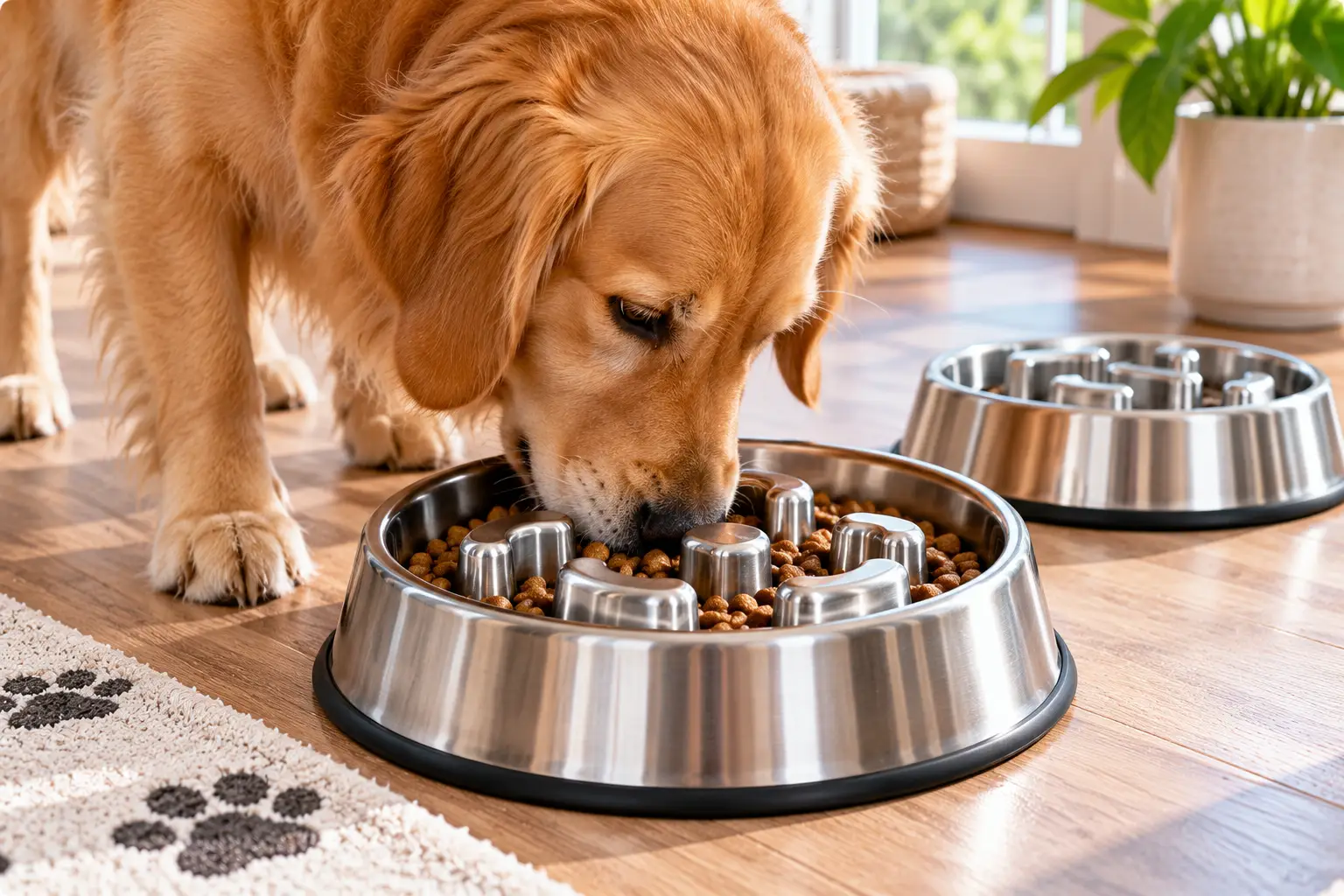
If your dog inhales dinner in the time it takes you to put the scoop away, you’re not imagining the problem. Gulping means swallowed air, barely chewed kibble, and the occasional “boomerang” meal that reappears on your kitchen floor ten minutes later. A stainless steel slow feeder bowl tackles that habit head-on: raised ridges or a maze force your dog to work around obstacles, so a 30-second vacuum job becomes a meal that takes several minutes.
So why steel instead of the bright plastic puzzle bowls that dominate pet aisles? Three practical reasons. Steel doesn’t scratch into grooves where bacteria settle, it survives teething puppies and determined chewers, and it rides through the dishwasher without warping or fading. In other words, it’s the slow feeder you buy once instead of every six months.
The stakes go beyond messy floors. The American Kennel Club’s guide to bloat notes that fast eaters carry roughly five times the bloat risk of slow eaters, and that dogs fed one meal a day are about twice as likely to bloat as dogs fed two. A bowl is not a medical cure — this guide is upfront about what the research can and can’t promise — but eating speed is one of the few risk factors you can actually control at home. ⚡
Below, you’ll find seven real stainless steel slow feeder dog bowls sold on amazon.com, from compact 2-cup dishes for small breeds to 5-cup double-sided bowls for big, hungry dogs. Each pick comes with spec-by-spec analysis, an honest summary of what customer reviews actually report, and clear notes on who should skip it. You’ll also get a first-30-days transition plan, fixes for the most common problems, and a cost-of-ownership breakdown — the practical details product listings never cover.
What Is a Stainless Steel Slow Feeder Bowl?
A stainless steel slow feeder bowl is a metal pet dish — usually food-grade 304 (18/8) stainless steel — with raised ridges, bumps, or a maze built into its floor or fitted as an insert. Those obstacles split kibble into small pockets, so your dog has to nose, lick, and maneuver for each bite, which slows the meal and reduces gulped air.
In practice, you’ll see four designs on the market:
- ✅ Stamped one-piece bowls — the pattern (paws, flowers, domes, bones) is pressed directly into the steel. Nothing to detach, nothing to lose.
- ✅ Double-wall bowls — two layers of steel make the dish heavier and quieter, with a rubber or silicone ring underneath.
- ✅ Insert-style bowls — a steel bowl paired with a removable maze insert, often plastic, for a tougher challenge.
- ✅ Double-sided bowls — flip the bowl over and you get a second pattern or a divided plate.
Each style changes how hard the puzzle is, how easy it is to clean, and how much noise your kitchen endures at 6 a.m. The metal slow feeder bowl you choose should match your dog’s snout shape, portion size, and chewing habits — which is exactly what the comparisons below help you sort out.
Quick Comparison: 7 Stainless Steel Slow Feeder Dog Bowls at a Glance
Short on time? This table gives you the essentials before the deep dives. Prices are approximate ranges at the time of writing; check the current price on Amazon before you buy.
| Bowl | Capacity | Slow-down design | Approx. price | Best for |
|---|---|---|---|---|
| Neater Pet Brands Stainless Steel Slow Feed Bowl | 3 cups (listed) | Stamped steel maze | $15–$20 | Neater Pet Brands feeder owners and raised stands |
| Outward Hound Stainless Steel Fun Feeder Slo Bowl | 2 cups | Steel bowl + removable maze insert | Under $20 | Extreme gulpers who need the hardest puzzle |
| OurPets DuraPet Slow Feed Premium Stainless Steel Dog Bowl | 3 sizes, small to large | Raised steel center + bonded rubber ring | $15–$25 | Moderate fast eaters, wet-food diets |
| AIPERRO Slow Feeder Dog Bowl Stainless Steel | 2 cups (4-cup version too) | Shallow paw-print bumps | $15–$25 | Flat-faced breeds like Pugs and Frenchies |
| Feedoo Slow Feeder Dog Bowl | 1.5, 2, or 3 cups | Double-wall steel, flower maze | $20–$35 | Bowl pushers and noise-sensitive homes |
| Oiwliur Slow Feeder Dog Bowl | 5 cups | Double-sided: hard maze / easier side | $20–$25 | Large dogs and gradual training |
| Tivray Slow Feeder Dog Bowl | 5 cups | Maze side + divided plate on reverse | $20–$30 | Large breeds on raw or mixed meals |
Looking across the table, the real dividing line isn’t price — every pick sits within roughly $15 of the others — it’s capacity and pattern depth. Small and flat-faced dogs do best with shallow designs like the AIPERRO Slow Feeder Dog Bowl Stainless Steel, while big gulpers need the volume of the Oiwliur Slow Feeder Dog Bowl or Tivray Slow Feeder Dog Bowl. If your dog has already outsmarted a stamped pattern, the insert-based Outward Hound Stainless Steel Fun Feeder Slo Bowl is the step up.
💬 One click helps other shoppers make an informed choice too! Tap a highlighted bowl to check today’s price and availability. 😊
Top 7 Stainless Steel Slow Feeder Bowls: Expert Analysis
Every pick below is a real product sold on amazon.com. The analysis is built from manufacturer specs, retailer listings, and the aggregated themes in customer reviews — not from invented test results. Where review data is thin, you’ll see that stated plainly.
1. Neater Pet Brands Stainless Steel Slow Feed Bowl — best fit for raised feeders
This bowl’s biggest selling point is that it drops straight into an elevated stand you may already own. Neater Pet Brands designed it for the Neater Feeder Medium-to-Large Express and Large Deluxe, and it fits most other raised feeders with a 7.25″ to 8″ opening.
The listed capacity is 3 cups, with a maze stamped directly into the steel. In practice, that means no separate insert to lose and no silicone to trap mildew — a point several reviewers make when comparing it to silicone slow-feed inserts they’d used before.
Based on the design, this is a strong match for medium and large dogs with longer snouts, such as Labs, shepherds, and pit mixes, whose owners already feed from a stand. One honest caveat: raised feeding itself is debated for bloat-prone giant breeds, so check with your vet before elevating a Great Dane’s bowl.
Reviews consistently report a noticeable slowdown, though some dogs needed a few days to adjust. A recurring note is that the bowl works best at around 2 cups, because filling it to 3 buries the maze.
Pros:
- ✅ Fits most raised feeders with 7.25″ to 8″ openings
- ✅ All-steel build with no mold-prone silicone parts
- ✅ Stamped maze leaves nothing to detach or chew
Cons:
- ❌ Effective slow-feed capacity closer to 2 cups
- ❌ Less stable on the floor without a stand
Expect to pay around $15 to $20 — excellent value if you already own a compatible feeder.
2. Outward Hound Stainless Steel Fun Feeder Slo Bowl — toughest maze in the lineup
If stamped bumps barely faze your dog, this is the escalation option. The Outward Hound Stainless Steel Fun Feeder Slo Bowl pairs a steel bowl with a removable insert using the brand’s “slowest” maze level.
It holds 2 cups, measures roughly 8.3 inches across, and sits on a non-slip base (model 70497). The deeper, narrower channels matter: your dog can’t simply lick across the top of a few bumps, so each bite takes real maneuvering. The trade-off is that the insert is plastic and the set is listed as hand wash.
This design suits medium dogs eating around 2 cups per meal who finish standard slow feeders in under a minute. It’s a poor choice for destructive chewers, since a determined jaw can damage the insert.
The Fun Feeder line as a whole has a large, broadly positive review base for slowing meals down. Review data specific to this steel version is thinner, so weigh the line’s reputation more than the individual listing.
Pros:
- ✅ Hardest puzzle level among the bowls in this guide
- ✅ Steel outer bowl outlasts all-plastic Fun Feeders
- ✅ Insert lifts out for a quick everyday rinse
Cons:
- ❌ Plastic insert is vulnerable to heavy chewers
- ❌ Hand wash only, with narrow channels to scrub
Usually under $20 at the time of writing — a cheap upgrade for serious gulpers.
3. OurPets DuraPet Slow Feed Premium Stainless Steel Dog Bowl — heavyweight steel, gentlest slowdown
Think of this as a premium everyday bowl with a built-in speed bump. The OurPets DuraPet Slow Feed Premium Stainless Steel Dog Bowl uses heavyweight steel with a raised center and a rubber ring permanently molded to the base.
That bonded ring is the practical win: it cuts sliding and clanging, and it can’t peel off and get lost behind the fridge. The bowl comes in three sizes and is dishwasher safe. Note that retailers list total volume (up to about 12 cups for the large), which is more than the practical meal size.
The open design is easy to wipe and handles wet food better than tight mazes. On paper, it’s ideal for moderate fast eaters, seniors, and dogs on canned diets.
Customer feedback is genuinely mixed on speed: many owners report a clear slowdown versus a plain bowl, while others say a truly determined gobbler barely noticed. Build quality draws consistent praise for thick, non-flimsy steel.
Pros:
- ✅ Thick steel that resists dents and scratches
- ✅ Bonded rubber ring reduces sliding and noise
- ✅ Open layout works well with wet food
Cons:
- ❌ Too gentle for the most extreme gulpers
- ❌ Listed capacities overstate realistic meal size
Roughly $15 to $25 depending on size — fair value for a bowl built to last years.
4. AIPERRO Slow Feeder Dog Bowl Stainless Steel — shallow design for short snouts
Flat-faced dogs often struggle with deep slow feeders, and this bowl is built around that problem. The AIPERRO Slow Feeder Dog Bowl Stainless Steel stands just 1.69 inches tall.
It’s made from 304 food-grade steel, holds 2 cups (a 4-cup version also exists), and uses well-spaced paw-print bumps formed in one piece. The low walls let a Pug, Frenchie, or Shih Tzu reach the bottom without jamming its face against the rim. However, shallow bumps also mean a moderate rather than dramatic slowdown, and kibble can spill over the low edge.
This is the pick for small, brachycephalic breeds that eat fast but get frustrated by tight mazes. Big gulpers should look elsewhere.
The bowl appears in several independent slow-feeder roundups, but a large body of verified US customer reviews was not available to confirm long-term durability. Treat it as a strong spec-based choice and note that the seller advertises a lifetime warranty.
Pros:
- ✅ Low 1.69-inch profile suits flat-faced dogs
- ✅ One-piece 304 steel with no hidden seams
- ✅ Two sizes cover small and medium breeds
Cons:
- ❌ Moderate slowdown for very determined eaters
- ❌ Low rim lets pushy eaters spill kibble
Around $15 to $25 — good value for short-snouted breeds specifically.
5. Feedoo Slow Feeder Dog Bowl — heaviest, quietest double-wall build
If your dog treats mealtime like a hockey game, weight is your friend. The Feedoo Slow Feeder Dog Bowl uses double-wall 304 (18/8) steel with a raised flower-shaped maze.
It comes in 1.5-, 2-, and 3-cup sizes (plus 2-packs) and sits on a full non-slip rubber rim with a tire-tread texture. The double wall adds heft that resists nose-pushing and dampens the metallic clang that single-wall bowls make on tile. It’s also dishwasher safe.
This is a smart buy for bowl pushers, apartment dwellers with thin floors, and small dogs that need a compact size. The 3-cup version covers most large-breed meals.
Reviews repeatedly praise the very heavy gauge steel and a flat underside that doesn’t collect dishwasher water. One recurring theme from small-dog owners is that the small size suits tiny snouts that struggle with deeper feeders.
Pros:
- ✅ Heavy double wall resists pushing and tipping
- ✅ Quieter on hard floors than single-wall steel
- ✅ Three sizes from toy breeds to large dogs
Cons:
- ❌ Costs more per bowl than single-wall options
- ❌ Heavier to handle when washing by hand
About $20 to $35 depending on size and pack — worth it if sliding and noise drive you crazy.
6. Oiwliur Slow Feeder Dog Bowl — two difficulty levels in one bowl
Most slow feeders give you one challenge level; this one gives you two. The Oiwliur Slow Feeder Dog Bowl is double-sided: one face has a deep maze, the other a simpler pattern.
It’s made from 304 stainless steel with a large 5-cup capacity. That flip design creates a built-in training path: start your dog on the easier side for the first week, then switch to the harder maze once mealtime frustration fades. The 5-cup volume also comfortably holds full meals for Labs, Goldens, and shepherds.
Based on the specs, this is the best fit for large dogs moving from a regular bowl for the first time. Owners of smaller dogs will find it oversized.
Editorial reviews highlight the two-sided design and easy cleaning. Verified long-term customer feedback is more limited than for established brands, so durability claims rest mostly on the 304 steel spec. Check whether your listing includes the non-slip mat.
Pros:
- ✅ Two difficulty levels support a gradual transition
- ✅ 5-cup capacity handles full large-breed meals
- ✅ All-steel build survives dishwashers and chewers
Cons:
- ❌ Large footprint takes up floor space
- ❌ Non-slip grip may depend on a separate mat
Typically around $20 to $25 — strong value for two bowls in one.
7. Tivray Slow Feeder Dog Bowl — maze on top, divided plate underneath
This bowl’s reverse side is the twist. The Tivray Slow Feeder Dog Bowl uses its front as a 5-cup slow feeder and its back as a partitioned dinner plate.
Built from 304 stainless steel with a non-slip base, it’s marketed as dishwasher safe. The divided reverse lets you separate raw food from toppers, serve a fresh-food portion beside kibble, or simply plate a smaller snack. That’s useful flexibility if your dog’s diet goes beyond dry kibble.
On paper, it’s a good match for large breeds on raw or mixed diets and for households that rotate meal types. If you only feed kibble, the Oiwliur Slow Feeder Dog Bowl offers more value from its second side.
Independent review data for this listing is limited, and this guide couldn’t verify a meaningful volume of customer sentiment. Judge it on its specs and confirm return terms before buying.
Pros:
- ✅ Divided reverse side handles mixed and raw meals
- ✅ 5-cup capacity suits large and giant breeds
- ✅ 304 steel is dishwasher safe and rust resistant
Cons:
- ❌ Limited verified customer review history
- ❌ Reverse plate adds little for kibble-only dogs
Generally $20 to $30 — good value only if you’ll use both sides.
Side-by-Side Spec Comparison
| Bowl | Construction | Base grip | Dishwasher | Snout fit | Best for |
|---|---|---|---|---|---|
| Neater Pet Brands Stainless Steel Slow Feed Bowl | Single-wall stamped steel | Relies on feeder | Yes | Long snouts | Raised feeder owners |
| Outward Hound Stainless Steel Fun Feeder Slo Bowl | Steel bowl + plastic insert | Non-slip base | Hand wash | Medium to long | Extreme gulpers |
| OurPets DuraPet Slow Feed Premium Stainless Steel Dog Bowl | Heavyweight single wall | Bonded rubber ring | Yes | All types | Wet food, moderate speed |
| AIPERRO Slow Feeder Dog Bowl Stainless Steel | One-piece 304 steel | Non-slip bottom | Yes | Short, flat faces | Pugs, Frenchies |
| Feedoo Slow Feeder Dog Bowl | Double-wall 304 steel | Full rubber rim | Yes | Short to medium | Bowl pushers |
| Oiwliur Slow Feeder Dog Bowl | Double-sided 304 steel | Mat (check listing) | Yes | Medium to long | Gradual training |
| Tivray Slow Feeder Dog Bowl | Double-sided 304 steel | Non-slip base | Yes | Medium to long | Raw or mixed diets |
The spec table shows a clear trade-off between challenge and convenience. The Outward Hound Stainless Steel Fun Feeder Slo Bowl slows dogs most but is the only hand-wash pick, while the all-steel bowls trade some difficulty for easy dishwasher cleanup. If stability is your top concern, the bonded or full-rim bases on the OurPets DuraPet Slow Feed Premium Stainless Steel Dog Bowl and Feedoo Slow Feeder Dog Bowl beat stick-on pads.
✨ Don’t miss these smart mealtime upgrades! 🔍 Take your dog’s feeding routine to the next level with this carefully curated lineup. Click a highlighted bowl to check current pricing and availability — the right pick helps your pup eat calmer, safer meals the whole family will appreciate! 🐶
Getting Started: Your First 30 Days With a Stainless Steel Slow Feeder Bowl
A new slow feeder is a small lifestyle change for your dog, and how you introduce it decides whether it becomes a calm routine or a nightly standoff. Here’s a practical rollout plan.
Days 1–3: Make the bowl a good place
Wash the bowl before first use to remove manufacturing oils. Then offer a few high-value treats in it between meals, with no pressure. If your dog backs away from the shine or the noise, set the bowl on a folded towel to soften the sound.
Days 4–10: Half and half
Serve half of each meal in the new bowl and half in the old one, starting with the slow feeder. Use the easier side if you bought a double-sided model like the Oiwliur Slow Feeder Dog Bowl. Time the meal on your phone so you have a baseline.
Days 11–30: Full meals and fine-tuning
Move to full meals in the slow feeder. Aim for a meal that takes noticeably longer than before — several minutes rather than seconds — without your dog quitting in frustration. If the pace creeps back up as your dog gets clever, flip to the harder side or add a little water to kibble so it clumps in the maze.
Common first-month mistakes ❌
- ❌ Filling to the rim, which buries the obstacles and defeats the purpose
- ❌ Switching abruptly on a dog that already guards food
- ❌ Skipping daily washing because steel “looks clean”
- ❌ Judging success on day two instead of week three
One more pro tip: feed two smaller meals a day instead of one large one. It pairs naturally with a slow feeder and lines up with the risk-reduction advice veterinarians already give for deep-chested dogs.
Real-World Scenarios: Matching the Bowl to Your Dog
Specs only matter once they meet a real dog. These three profiles show how the reasoning plays out.
🐕 Scenario 1: The apartment Lab who finishes in 20 seconds
Maya lives in a third-floor apartment with a 3-year-old Labrador who eats 2 cups twice a day and pushes her bowl across the tile. Her priorities are speed reduction, noise, and stability. The Feedoo Slow Feeder Dog Bowl in the 3-cup size fits best: the double wall and rubber rim stop the sliding and muffle the clang her downstairs neighbors hear. Budget: about $25 to $35.
🐶 Scenario 2: The French Bulldog who gives up on mazes
Darnell’s Frenchie gulps but snorts in frustration at deep puzzle bowls. He feeds about 1 cup per meal. The AIPERRO Slow Feeder Dog Bowl Stainless Steel works here because its 1.69-inch profile lets that flat face reach the bottom. Budget: under $25.
🐕🦺 Scenario 3: The retired couple with a raised-feeder German Shepherd
Linda and Tom already own a Neater Feeder stand and feed a senior shepherd who still eats too fast. The Neater Pet Brands Stainless Steel Slow Feed Bowl drops straight into their existing stand, so there’s no new furniture to buy — though they should ask their vet whether raised feeding still makes sense for their dog. Budget: under $20.
The pattern across all three is simple: match capacity to meal size, match depth to snout shape, and match base design to your floor.
Problem → Solution: Fixing the Most Common Slow Feeder Headaches
Even the best metal slow feeder bowl can hit snags. Here are the five complaints owners raise most, with targeted fixes.
- Problem: My dog still eats too fast. Dogs learn the pattern over time. Solution: move up a difficulty level — for example, from the OurPets DuraPet Slow Feed Premium Stainless Steel Dog Bowl to the Outward Hound Stainless Steel Fun Feeder Slo Bowl — or scatter part of the meal on a snuffle mat.
- Problem: The bowl slides across the floor. Solution: choose a bonded rubber ring or full-rim base, or place the bowl on a silicone feeding mat with a raised lip.
- Problem: The clanging drives everyone crazy. Solution: a double-wall bowl like the Feedoo Slow Feeder Dog Bowl is quieter; otherwise, a rubber mat absorbs most of the noise.
- Problem: Food gets stuck in the corners. Solution: soak the bowl in warm, soapy water for ten minutes, then use a bottle brush. Dishwasher-safe all-steel designs make this far easier.
- Problem: My dog refuses to eat from it. Solution: go back to the half-and-half method above, add a smear of wet food to the obstacles, and use the easier side of a double-sided bowl.
How to Choose a Stainless Steel Slow Feeder Dog Bowl
Picking the right bowl takes about five minutes if you work through these steps in order.
- Measure your dog’s meal. Choose a bowl whose rated capacity is about 50% larger than one meal, because a full bowl buries the obstacles.
- Look at your dog’s face. Flat-faced breeds need shallow patterns under about 2 inches; long snouts handle deeper mazes.
- Rate the gulping. Mild speed eaters do fine with a raised center; extreme gulpers need a true maze or insert.
- Check the steel grade. Look for 304 or 18/8 food-grade steel stated on the listing, not vague “premium metal.”
- Inspect the base. A bonded rubber ring or full rubber rim beats small stick-on pads that peel off in the dishwasher.
- Confirm cleaning method. All-steel designs are typically dishwasher safe; bowls with plastic inserts often aren’t.
- Think about your setup. If you use a raised stand, measure the opening before you buy.
Work through those seven points and the shortlist usually narrows to one or two bowls on its own.
Common Mistakes to Avoid When Buying a Slow Feeder
Most slow feeder regrets trace back to the same handful of buying errors.
- ❌ Buying by listed capacity alone. Many listings quote total volume, not usable slow-feed volume. Size up.
- ❌ Ignoring snout shape. A Pug in a deep maze often quits, which defeats the whole purpose.
- ❌ Assuming any bowl will “stop bloat.” No bowl can promise that; it’s one risk-reduction tool among several.
- ❌ Choosing plastic for a chewer. A gnawed plastic insert is a choking and hygiene problem waiting to happen.
- ❌ Overlooking noise. Single-wall steel on tile can be loud at 6 a.m.; a double wall or mat solves it.
- ❌ Never reassessing. Dogs get faster as they learn a pattern, so check meal times every few months.
Avoid these and even a modestly priced bowl will do its job for years.
Stainless Steel vs. Plastic, Ceramic, and Silicone Slow Feeders
Material choice shapes hygiene, durability, and how often you’ll replace the bowl. Most quality metal bowls use SAE 304 stainless steel, the same chromium-nickel alloy (often labeled 18/8) used in kitchen sinks and cookware because it resists corrosion.
| Material | Durability | Hygiene | Dishwasher | Noise | Best for |
|---|---|---|---|---|---|
| Stainless steel | Excellent; chew- and drop-proof | Non-porous, resists scratches | Usually yes | Can clang | Most dogs, chewers, long-term use |
| Plastic | Fair; scratches and chew marks | Scratches can trap bacteria | Often top rack | Quiet | Budget, short-term trials |
| Ceramic | Good until it chips or cracks | Good while glaze is intact | Usually yes | Quiet, heavy | Calm dogs, small to medium |
| Silicone | Fair; tears under teeth | Can hold odors and mildew | Usually yes | Silent | Travel, gentle eaters |
The table makes the case for steel clearly: it’s the only material that stays both hygienic and intact under years of chewing and dishwasher cycles. Its two real drawbacks — noise and less design variety — are solved by double-wall builds like the Feedoo Slow Feeder Dog Bowl or a simple rubber mat. Plastic still wins on maze complexity, which is why the Outward Hound Stainless Steel Fun Feeder Slo Bowl pairs a steel body with a plastic insert.
Slow Feeder Bowl for Large Dogs and Bloat-Prone Breeds
Big, deep-chested dogs are where a slow feeder bowl for large dogs earns its keep. Great Danes, Standard Poodles, Weimaraners, Irish Setters, and German Shepherds sit near the top of most bloat-risk lists.
Here’s the honest picture. A 2016 knowledge summary in Veterinary Evidence by Louise Buckley — “Are dogs that eat quickly more likely to develop a gastric dilatation (+/- volvulus) than dogs that eat slowly?” — found the evidence mixed and of variable quality. It concluded that slowing a dog’s eating won’t increase GDV risk and may possibly reduce it, but that the data can’t settle the question either way.
What that means for you: a slow feeder is a low-cost, low-risk habit change, not a guarantee. For large breeds, pair it with these steps:
- ✅ Feed two or more smaller meals instead of one big one
- ✅ Keep strenuous exercise away from mealtimes
- ✅ Separate multiple dogs to reduce competitive gulping
- ✅ Ask your vet about a preventive gastropexy for high-risk breeds
For capacity, look at 5-cup options like the Oiwliur Slow Feeder Dog Bowl or Tivray Slow Feeder Dog Bowl, or the 3-cup Feedoo Slow Feeder Dog Bowl.
Features That Actually Matter (and Ones That Don’t)
Listings love buzzwords. Here’s how to separate the useful from the fluff.
Features that matter ✅
- ✅ Stated 304 or 18/8 steel — a concrete grade means you know what’s touching your dog’s food.
- ✅ Bonded or full-rim non-slip base — it determines whether the bowl stays put.
- ✅ Pattern depth matched to snout — the single biggest factor in whether your dog accepts the bowl.
- ✅ Dishwasher-safe construction — it makes daily washing realistic.
Features that don’t matter much ❌
- ❌ “Bloat stop” in the product name — a marketing phrase, not a medical claim you can rely on.
- ❌ “Aerospace-grade” or “premium” steel — meaningless without a named grade.
- ❌ Mirror polish — pretty for photos, but it shows every nose print.
Based on comparing the listings in this guide, the best bowls simply state their steel grade, base design, and cleaning method clearly — and let those specs do the talking.
Long-Term Cost and Maintenance
A slow feeder looks like a $15 purchase, but the real cost is how often you replace it. Here’s how the math tends to work out.
| Bowl | Approx. price | Replacement risk | Upkeep | Value verdict |
|---|---|---|---|---|
| OurPets DuraPet Slow Feed Premium Stainless Steel Dog Bowl | $15–$25 | Low; bonded base | Dishwasher | Best long-term value |
| Feedoo Slow Feeder Dog Bowl | $20–$35 | Low; double wall | Dishwasher | Premium, but buy-once |
| Outward Hound Stainless Steel Fun Feeder Slo Bowl | Under $20 | Insert may need replacing | Hand wash | Cheap entry, more upkeep |
| Oiwliur Slow Feeder Dog Bowl | $20–$25 | Low; all steel | Dishwasher | Two bowls for one price |
All-steel bowls with bonded bases offer the lowest cost of ownership, because there’s nothing to wear out except possibly the rubber. By contrast, insert-based designs are cheaper up front but carry a replacement cost if a chewer damages the plastic. A plastic slow feeder that gets scratched and swapped every few months can quietly cost more over three years than a single steel bowl.
Maintenance schedule 🧽
- After every meal: rinse and wipe, especially after wet or raw food.
- Daily: wash with hot, soapy water or run through the dishwasher.
- Weekly: inspect the rubber base and soak the bowl to lift residue from the pattern.
- Every few months: check for dents, loose rubber, or any rust spots, which suggest lower-grade steel.
Safety, Standards, and What “Food-Grade” Really Means
Unlike human food containers, pet bowls aren’t subject to a single US certification you can look for on the box. So the burden falls on you to read specs carefully.
Start with the steel grade. Listings that name 304 or 18/8 steel are giving you a verifiable material spec; listings that just say “metal” or “premium” are not. Next, check for coatings: colored or painted steel bowls can chip, so plain brushed or polished steel is the safer default.
Then consider how you feed. Research on gastric dilatation volvulus consistently places deep-chested breeds at the highest risk, and the frequently cited Purdue University research also linked raised feeding bowls with higher risk in large and giant breeds. If you’re using an insert like the Neater Pet Brands Stainless Steel Slow Feed Bowl in an elevated stand, that’s worth a quick conversation with your vet.
Finally, know the emergency signs: a swollen, tight belly, unproductive retching, restlessness, and drooling. GDV is a surgical emergency — a slow feeder lowers one risk factor, but it never replaces a fast trip to the vet. 🚨
FAQ: Stainless Steel Slow Feeder Bowl Questions Shoppers Ask
❓ Is a stainless steel slow feeder bowl dishwasher safe?
❓ Can cats use a stainless steel slow feeder bowl?
❓ What size slow feeder should I buy for a puppy?
❓ Do vets recommend metal slow feeder bowls?
❓ Is a double-wall slow feeder worth the extra cost?
Conclusion: Pick the Bowl That Fits Your Dog, Not the Hype
A stainless steel slow feeder bowl won’t transform your dog overnight, but it quietly fixes one of the most common and controllable mealtime problems: speed. It also outlasts the plastic alternatives, survives the dishwasher, and stays hygienic for years.
Here’s the quick recap. If you own a raised stand, the Neater Pet Brands Stainless Steel Slow Feed Bowl is the easy add-on. Extreme gulpers should step up to the Outward Hound Stainless Steel Fun Feeder Slo Bowl, while moderate fast eaters and wet-food dogs fit the OurPets DuraPet Slow Feed Premium Stainless Steel Dog Bowl. Flat-faced breeds belong with the AIPERRO Slow Feeder Dog Bowl Stainless Steel, and bowl pushers with the heavy Feedoo Slow Feeder Dog Bowl. For big dogs, the Oiwliur Slow Feeder Dog Bowl offers two difficulty levels, and the Tivray Slow Feeder Dog Bowl adds a divided plate for mixed diets.
Whichever you choose, remember the bigger picture: match capacity to meal size and depth to snout shape, feed smaller meals more often, and treat the bowl as one smart habit rather than a medical guarantee. Your dog gets calmer meals, and you get fewer cleanups. 🐾
✨ Ready to slow things down? 🔍 Pick the bowl that matches your dog’s size, snout, and eating style from the lineup above. Click a highlighted bowl to check current pricing and availability — your pup’s next meal could be the calmest one yet! 🐶
Recommended for You
- Dog Feeder with Camera: 7 Best Picks That Actually Deliver (2026)
- Puppy Slow Feed Bowl: 7 Best Picks to Stop Gulping (2026)
- Slow Feed Dog Dish Guide 2026: 7 Best Picks That Actually Work
Disclaimer: This post contains affiliate links. As an Amazon Associate, I earn from qualifying purchases made through these links, at no additional cost to you.
✨ Found this article helpful? Share it with someone who needs it! 💬🤗