In This Article
Why Your Hairless Cat Needs a Smarter Feeding Setup
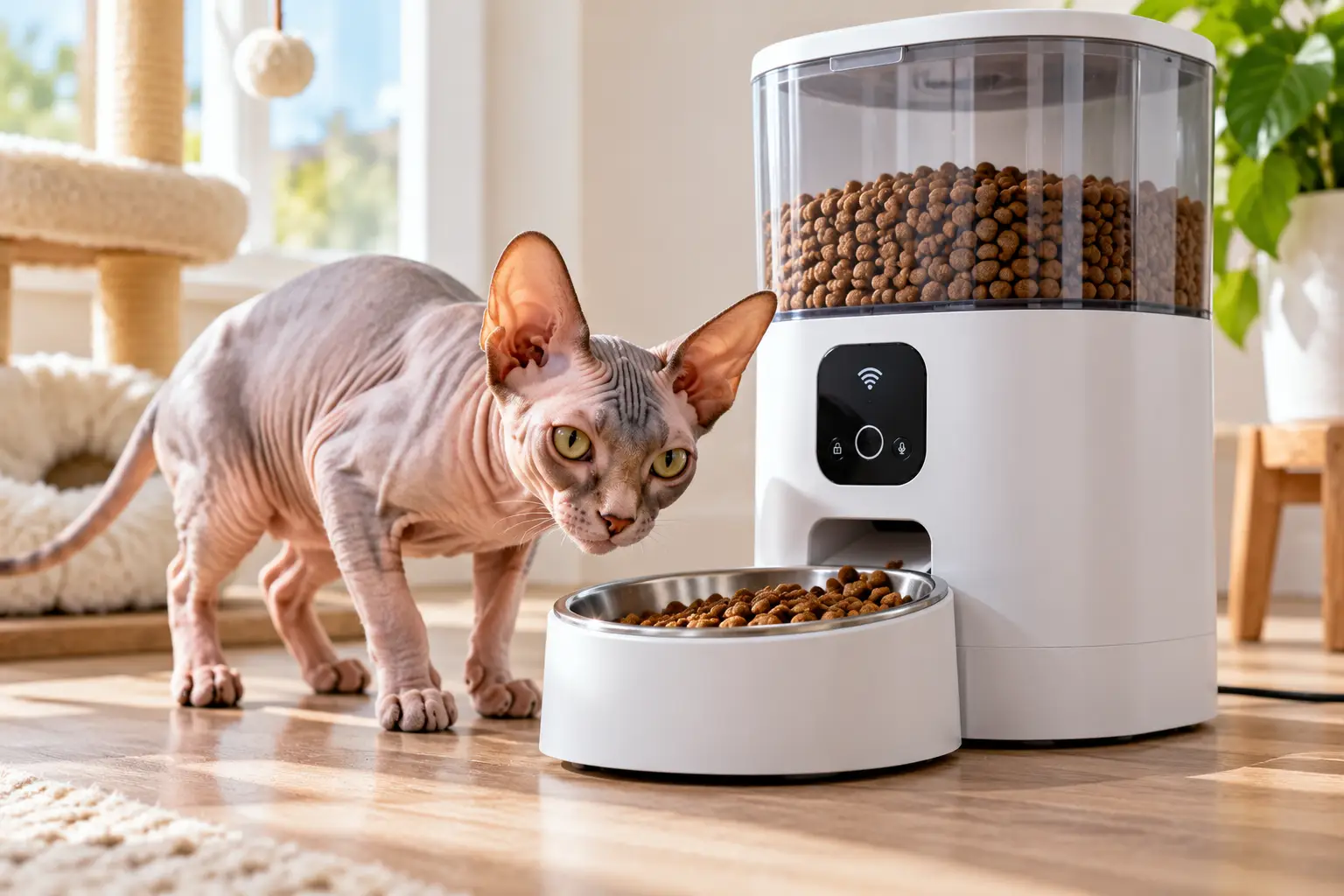
If you live with a Sphynx, you already know the routine: the 5 a.m. head-butt, the dramatic yelling at an empty bowl, the stare that says “You call that breakfast?” Choosing the right sphinx cat food feeder is less about convenience and more about matching a gadget to one of the most food-motivated breeds on the planet.
Here’s why it matters. Without a coat to hold in warmth, the Sphynx breed spends extra energy regulating its body temperature. Breed-focused nutrition sources consistently describe a faster-running metabolism and a near-constant appetite, and many recommend several small meals spread across the day rather than two big ones. That’s easy to recommend and hard to pull off when you work an 8-hour shift and commute on top of it.
A good sphinx cat food feeder bridges that gap. It portions meals so your cat doesn’t gorge and then vomit (the infamous “scarf and barf”), it keeps food fresh between servings, and — depending on the model — it handles wet food, stops a greedy housemate from stealing, or turns dinner into a hunting game.
There’s also a skin angle most guides skip. Sphynx cats have oily, exposed skin, and the chin is a hot spot for blackheads. The bowl material and shape that touch your cat’s face every day can either help or quietly make things worse.
In this guide, you’ll find seven real products, from a $15 ceramic bowl to a $300 smart feeder, with honest analysis of specs and aggregated owner feedback — not invented test stories. You’ll also get a 30-day setup plan, fixes for common problems, and a cost breakdown, so you buy once and buy right.
What Is a sphinx cat food feeder?
A sphinx cat food feeder is any feeding device chosen to suit a Sphynx cat’s needs: frequent small meals, portion control, food freshness, and skin-friendly materials. It ranges from programmable automatic dispensers and wet-food timers to microchip-activated bowls, puzzle feeders, and raised ceramic dishes.
In practice, most Sphynx owners end up combining two pieces: one device that controls when and how much (an automatic or timed feeder) and one that controls how the cat eats (a raised bowl or foraging feeder). Keep that two-part idea in mind as you read the picks below — it explains why a $15 bowl sits on the same list as a $300 robot.
Quick Comparison: The 7 Best Feeders at a Glance
| Product | Type | Food | Meals/Day | Price Range | Best for |
|---|---|---|---|---|---|
| PETLIBRO Granary WiFi Feeder | Smart automatic (5L) | Dry | Up to 10 | $75–$110 | Busy owners who want app control |
| Cat Mate C500 | Rotating tray timer | Wet, dry, raw | 5 compartments | $55–$80 | Wet-food or raw feeders |
| SureFeed Microchip Pet Feeder Connect | Microchip-activated bowl | Wet, dry | Free access (selective) | $150–$200+ | Multi-cat homes with food thieves |
| Whisker Feeder-Robot | Premium smart automatic | Dry, semi-moist | Up to 8 + snacks | Around $300 | Large capacity, USA-assembled |
| Cat Mate C3000 | Battery automatic | Dry | Up to 3 | $45–$95 | Budget, no-Wi-Fi reliability |
| Doc & Phoebe’s Indoor Hunting Feeder | Foraging feeder | Dry | You decide | $12–$25 | Bored, overeating indoor cats |
| Necoichi Raised Ceramic Cat Food Bowl | Raised, tilted bowl | Wet, dry | Manual | $15–$30 | Chin acne, neck comfort, messy eaters |
Looking at the table, the split is clear: if your Sphynx eats mostly kibble, the PETLIBRO Granary WiFi Feeder delivers the most meal flexibility for the money, while the Whisker Feeder-Robot only pulls ahead if capacity and build origin matter to you. If wet food is non-negotiable, the Cat Mate C500 is the only timed option here built for it. Meanwhile, the Necoichi Raised Ceramic Cat Food Bowl and Doc & Phoebe’s Indoor Hunting Feeder aren’t competitors to the automatic units — they’re upgrades you pair with them.
💬 One click helps other shoppers make an informed choice too! 😊
Top 7 sphinx cat food feeder Picks: Expert Analysis
1. PETLIBRO Granary WiFi Feeder — best all-round smart pick
The PETLIBRO Granary WiFi Feeder is the most practical way to give a Sphynx many small dry-food meals without living by the clock.
It holds 5 liters of kibble and lets you schedule up to 10 meals a day from the app — enough to split a daily ration into genuinely small portions instead of two big dumps. It connects to both 2.4GHz and 5GHz Wi-Fi, which sounds minor until you’ve fought a feeder that refuses to see your router. The removable stainless-steel bowl matters more for a Sphynx than for most cats, since non-porous steel is easier to keep oil- and bacteria-free than scratched plastic. A 10-second voice recording can call your cat at mealtime.
Based on the specs, this is the sweet spot for working owners who feed dry food and want remote control without paying robot money. Dual power (adapter plus batteries) means a power outage doesn’t cancel lunch.
Retailer review summaries consistently highlight reliability and ease of setup. The most common complaint is the ongoing desiccant bag — PETLIBRO suggests replacing it about every two weeks, which some owners consider a nuisance cost.
Pros:
- ✅ Up to 10 scheduled meals suits small-portion feeding
- ✅ Stainless-steel bowl is easy to sanitize daily
- ✅ Dual power keeps meals running during outages
Cons:
- ❌ Dry food only — no option for wet meals
- ❌ Desiccant bags add a small recurring cost
Typically priced between $75 and $110 (check the current price), it’s the best value-to-feature ratio on this list.
2. Cat Mate C500 — best for wet and raw meals
The Cat Mate C500 solves the one problem most automatic feeders dodge: serving wet food on a schedule.
It uses a rotating tray with five compartments, each holding roughly 3/4 lb (330g) of wet food or about 155g of dry, and a simple digital timer that opens one section at a time. Two reusable ice packs sit beneath the trays. Cat Mate’s own guidance says those ice packs keep food cool for roughly 6–8 hours indoors — so in practice, this is a “covers your workday” device, not a weekend-away device for wet food.
That’s exactly why it fits Sphynx owners who feed wet or raw diets for hydration and protein. You can portion four or five small meals in the morning and know the last one won’t be sitting warm for 12 hours. There’s no Wi-Fi, which some will see as a drawback and others as one less thing to break.
Aggregated reviews praise easy programming and dishwasher-friendly trays. Recurring complaints: ice packs fade fast on hot days, the motor noise startles some cats at first, and determined cats occasionally pry the lid because compartments aren’t individually sealed.
Pros:
- ✅ Handles wet, dry, and raw food
- ✅ Five separate meals per fill
- ✅ No app or Wi-Fi to fail
Cons:
- ❌ Ice packs struggle in warm rooms
- ❌ Clever cats may break into unopened sections
Usually in the $55–$80 range, it’s excellent value if wet food is central to your routine.
3. SureFeed Microchip Pet Feeder Connect — stops food theft in multi-cat homes
The SureFeed Microchip Pet Feeder Connect opens only for the cat it recognizes — a lifesaver when your Sphynx steals everyone’s dinner (or gets robbed).
It reads your cat’s existing implanted microchip or an included RFID collar tag, then lifts a lid when the registered cat arrives and closes it when they leave. It stores up to 32 pets, holds about 400ml (roughly two pouches of wet food), and runs on batteries rated for around six months. The Connect version pairs with a separate hub so the Sure Petcare app can log visits, but the hub needs to sit within about 30 feet of the feeder.
What most buyers overlook: this is not a timed dispenser. It controls who eats, not when. That makes it ideal for prescription diets, weight-loss plans, or a Sphynx sharing space with a slower-eating cat — and the closed lid helps wet food stay fresher between visits.
Independent reviewers report it reliably blocks food theft once cats are trained. The main complaints are the price and that nervous cats can be spooked by the moving lid; the built-in training mode, which opens the lid gradually, is the recommended fix.
Pros:
- ✅ Works with existing microchips — no new hardware
- ✅ Handles both wet and dry food
- ✅ Training mode eases nervous cats in
Cons:
- ❌ Expensive, especially with the hub
- ❌ Doesn’t schedule or portion meals
Expect roughly $150–$200 per feeder at the time of writing, plus extra for the hub — pricey but unmatched for multi-cat diet control.
4. Whisker Feeder-Robot — biggest capacity and app ecosystem
The Whisker Feeder-Robot is the premium choice for owners who want maximum capacity and a polished app.
It holds up to 32 cups of dry or semi-moist kibble (up to 5/8-inch pieces), and the Whisker app supports up to 8 scheduled meals a day plus on-demand snacks. Portions come in 1/4-cup increments. That detail matters for a Sphynx: a typical adult’s daily dry ration is often well under a cup, so 1/4-cup steps can feel coarse if you’re trying to split it into many tiny meals. Anti-jam technology and on-unit schedule storage mean meals still dispense if your Wi-Fi drops. It’s designed and assembled in the USA, and a 12V backup battery is sold separately.
On paper, this suits multi-cat or cat-and-small-dog homes, owners already using a Litter-Robot (both run in one app), and anyone who travels and wants weeks of capacity.
Review data on the manufacturer’s site is positive about app reliability, but note that Whisker aggregates reviews across its own sites, so independent sentiment is harder to verify. Treat it as a strong, well-supported product rather than an independently proven category leader.
Pros:
- ✅ Huge 32-cup hopper for long trips
- ✅ Schedule stored locally if Wi-Fi drops
- ✅ Shares an app with Litter-Robot units
Cons:
- ❌ 1/4-cup portions are coarse for tiny meals
- ❌ Backup battery costs extra
Around $300 (check current pricing), it’s worth it mainly for multi-pet or frequent-travel households.
5. Cat Mate C3000 — budget no-Wi-Fi workhorse
The Cat Mate C3000 proves you don’t need an app to feed a Sphynx consistently.
Its hopper holds 6.5 lb (about 30 cups) of dry food, and an auger mechanism dispenses accurate portions starting from roughly 2 teaspoons. You can program three meals a day, serve a meal early on demand, or use a “frequent feed” mode designed for pets with special requirements. Four C batteries are rated for about 12 months, and the bowl, hopper, lid, and nozzle are dishwasher-safe.
The precise small portions are the hidden win here. Combined with one manual meal you serve yourself, three auto meals gets a Sphynx to four daily feedings — at a fraction of smart-feeder cost. It’s also the most “set and forget” option for owners who distrust Wi-Fi gadgets or live with patchy internet.
Owner reviews generally praise portion accuracy and reliability. Common gripes: dispensing is fairly loud, and a few persistent cats have learned to fish kibble from the outlet gap over time.
Pros:
- ✅ Precise portions from about 2 teaspoons
- ✅ Year-long battery life with no outlet needed
- ✅ Dishwasher-safe food-contact parts
Cons:
- ❌ Only three programmable meals
- ❌ Noisy dispensing can startle cats
Usually between $45 and $95 depending on the retailer and timing, it’s the smartest pick for tight budgets.
6. Doc & Phoebe’s Indoor Hunting Feeder — turns meals into exercise
Doc & Phoebe’s Indoor Hunting Feeder replaces the bowl with small “mice” your cat has to find, bat, and roll to release kibble.
Created by veterinarian Dr. Liz Bales, the standard kit includes three feeder mice with fabric skins, a trainer feeder with extra holes for beginners, and a scoop holding about 1.6 tablespoons — roughly one-sixth of the daily ration of an average 10-pound cat. The plastic parts are BPA-free and dishwasher-safe; the skins are machine-washable. International Cat Care recognized it with a Cat Friendly Award in 2017.
For a Sphynx, this targets two common issues at once: eating too fast and indoor boredom. Each mouse holds a small portion and forces slow, active eating — exactly the “small, frequent meals” pattern the breed benefits from, with free exercise attached.
Owner feedback is enthusiastic about reduced early-morning begging and calmer, more engaged indoor cats. The honest caveats: it’s dry-food only, it takes training, and you’ll find mice under the couch for weeks.
Pros:
- ✅ Slows fast eaters through natural foraging
- ✅ Adds daily exercise for indoor cats
- ✅ Vet-designed and award-recognized
Cons:
- ❌ Doesn’t work with wet food
- ❌ Requires refilling and hiding twice daily
At roughly $12–$25, it’s the cheapest meaningful upgrade to any Sphynx feeding routine.
7. Necoichi Raised Ceramic Cat Food Bowl — skin-friendly, comfortable eating
The Necoichi Raised Ceramic Cat Food Bowl is the simplest product here, and possibly the one your Sphynx’s chin will thank you for most.
It’s a raised ceramic bowl with a 15-degree tilt, which keeps food gathered toward the front and reduces the need for your cat to crouch low or mash its face into corners. Ceramic is non-porous and dishwasher-safe, so it doesn’t develop the scratches where bacteria and skin oil collect in older plastic bowls — a frequently cited contributor to feline chin acne. It works for both wet and dry food.
Based on design alone, this is the ideal companion to any automatic feeder that dispenses into its own tray: serve wet meals in the Necoichi, let the machine handle kibble. It’s also a sensible first purchase for owners not ready to automate.
Reviews consistently praise the sturdy weight and note that cats stop pushing food over the edge. Some owners report less regurgitation after switching, though that’s anecdotal. Complaints: the shallow dish spills soupy food, and a few report chipping or cracking.
Pros:
- ✅ Ceramic resists oil and bacteria buildup
- ✅ Tilted, raised design reduces neck strain
- ✅ Heavy base stays put during eating
Cons:
- ❌ Shallow shape spills watery wet food
- ❌ Ceramic can chip if dropped
Usually $15–$30, it offers outstanding value for daily comfort and hygiene.
Full Comparison of the Top 7
| Product | Capacity | Power | Wi-Fi | Skin-Friendly Bowl | Best for |
|---|---|---|---|---|---|
| PETLIBRO Granary WiFi Feeder | 5L dry | Adapter + batteries | Yes (2.4/5GHz) | Stainless steel | Remote dry-food scheduling |
| Cat Mate C500 | 5 × 330g wet | Battery | No | Removable trays | Wet/raw meal timing |
| SureFeed Microchip Pet Feeder Connect | ~400ml | Battery (~6 months) | Via hub | Removable bowl | Diet control in multi-cat homes |
| Whisker Feeder-Robot | 32 cups dry | Adapter (backup optional) | Yes | Plastic std. (glass/steel optional) | High capacity, travel |
| Cat Mate C3000 | 6.5 lb dry | 4 × C batteries | No | Standard bowl | Budget precision |
| Doc & Phoebe’s Indoor Hunting Feeder | ~1.6 tbsp per mouse | None | No | N/A | Slow, active eating |
| Necoichi Raised Ceramic Cat Food Bowl | Single meal | None | No | Ceramic | Chin acne, posture |
The pattern worth noticing: the cheaper the device, the more it relies on you, and the more expensive it gets, the more it relies on your Wi-Fi. For most single-Sphynx homes, the PETLIBRO Granary WiFi Feeder paired with the Necoichi Raised Ceramic Cat Food Bowl covers 90% of needs at a moderate total cost. Upgrading to the Whisker Feeder-Robot pays off mainly when capacity and multi-pet scheduling outweigh its coarser portions.
Getting Started: Your First 30 Days with a New Feeder
Buying the feeder is the easy part. The first month decides whether your Sphynx accepts it or treats it like a hostile robot.
Week 1: Let it be furniture
Set the feeder up next to the old bowl, unplugged or switched off. Drop a few treats in the tray. You want your cat sniffing and rubbing it, not running from a sudden motor noise. For the SureFeed Microchip Pet Feeder Connect, use training mode with the lid fully open.
Week 2: Introduce the sound
Trigger small manual meals while you’re home, ideally at the times your cat already expects food. Sphynx cats are bold and food-driven, so most link the whir to dinner within days. The Cat Mate C3000 and Cat Mate C500 are louder, so stay close the first few times.
Week 3: Shift to the schedule
Now split the daily ration across the feeder’s meals. A practical start for an adult Sphynx is four to five portions spaced 3–4 hours apart while you’re awake, with one overnight meal to cut down the dawn wake-up calls. Remove the old bowl entirely, or your cat will just wait you out.
Week 4: Verify, don’t assume
Weigh your cat at the start and end of the month. Check that meals actually dispense — app logs help, but also physically look at the bowl when you get home. Jams usually come from oversized or oily kibble.
Common first-month mistakes
- ❌ Filling the hopper to the brim before your cat trusts the feeder.
- ❌ Keeping the old bowl “just in case” — it undermines portion control.
- ❌ Ignoring the desiccant or ice packs, then blaming the feeder for stale or warm food.
Real-World Scenarios: Which Feeder Fits Your Life?
Profile 1: The 9-to-5 remote-ish worker, one Sphynx, dry food
Budget: $100–$140. Context: Out of the house about 10 hours on office days. Pick: The PETLIBRO Granary WiFi Feeder plus the Necoichi Raised Ceramic Cat Food Bowl for water or a weekend wet treat. Ten meal slots let you feed every two to three hours, and the app lets you skip a meal if you fed a snack earlier. This combo hits the small-frequent-meal pattern without daily effort.
Profile 2: The wet-food devotee with a sensitive Sphynx
Budget: $70–$110. Context: Feeds wet or raw for hydration; home most evenings. Pick: The Cat Mate C500 for daytime meals, with two extra ice packs rotated through the freezer. Add Doc & Phoebe’s Indoor Hunting Feeder with a small amount of kibble for evening enrichment if your vet approves mixed feeding. Expect to swap ice packs daily in summer.
Profile 3: The two-cat household with a food thief
Budget: $200–$350. Context: A Sphynx that inhales its own meal, then raids the other cat’s bowl. Pick: One SureFeed Microchip Pet Feeder Connect for the slower cat, so the Sphynx physically can’t steal, and a timed feeder like the Cat Mate C3000 for the Sphynx’s own scheduled portions. Pricey, but cheaper than a vet visit for an overweight cat with a heart-health predisposition.
The common thread: match the feeder to your biggest problem — schedule, food type, or theft — and solve the rest with cheap add-ons.
✨ Don’t miss these smart feeding upgrades!
🔍 Take your Sphynx’s mealtime to the next level with this carefully curated lineup. Click a highlighted item to check current pricing and availability. These picks will help you build a calmer, healthier routine the whole family will enjoy!
Problem → Solution: Fixing Common Feeding Headaches
Problem 1: Your Sphynx vomits right after eating. Solution: This “scarf and barf” pattern usually means meals are too big or eaten too fast. Split the ration into more, smaller portions on the PETLIBRO Granary WiFi Feeder, or use Doc & Phoebe’s Indoor Hunting Feeder to slow eating. If vomiting persists, see your vet — it isn’t always behavioral.
Problem 2: Blackheads or crusty bumps on the chin. Solution: Replace plastic bowls with stainless steel or ceramic, like the Necoichi Raised Ceramic Cat Food Bowl, and wash bowls daily. Wipe your cat’s chin after wet meals. Persistent or inflamed spots warrant a vet check.
Problem 3: The 4 a.m. wake-up call. Solution: Schedule a small meal around 3:30–4:00 a.m. Your cat learns the machine — not you — delivers breakfast. It usually takes one to two weeks for the habit to shift.
Problem 4: Wet food goes warm and gets ignored. Solution: With the Cat Mate C500, freeze spare ice packs, start with fresh-opened food only, and limit wet portions to the first 6–8 hours. Serve the later meals as dry food or from the SureFeed Microchip Pet Feeder Connect, whose lid helps limit drying out.
Problem 5: The feeder jams. Solution: Check kibble size against the spec (the Whisker Feeder-Robot accepts pieces up to 5/8 inch), avoid high-fat, oily kibble that clumps, and keep the hopper clean and dry.
How to Choose a sphinx cat food feeder
- Start with food type. Dry food opens every automatic option; wet or raw food narrows you to timed-tray designs like the Cat Mate C500 or a covered bowl. Buying the wrong type is the No. 1 regret.
- Count the meals you need. Many Sphynx owners aim for four or more small meals. The Cornell Feline Health Center notes that cats burning more energy than average may need more calories — so flexible scheduling matters more for this breed.
- Check portion precision. Small meals require small portion steps. Fine control (like the Cat Mate C3000‘s ~2-teaspoon minimum) beats coarse 1/4-cup jumps for tiny meals.
- Prioritize bowl material. Stainless steel or ceramic is easier on oily Sphynx skin than plastic.
- Plan for power and internet outages. Battery backup and on-device schedule storage prevent missed meals.
- Consider your household. Multiple pets plus theft means selective access (microchip) beats timing alone.
- Budget for running costs. Desiccant bags, batteries, ice packs, and replacement bowls add up over three years.
Features That Actually Matter (and Ones That Don’t)
Marketing pages love long feature lists. For a Sphynx, only a handful really change your daily life.
Features that matter
- ✅ Meal count and portion size. This is the whole point for a fast-metabolism breed. More slots with smaller portions beat a giant hopper.
- ✅ Non-plastic food contact. Stainless steel or ceramic is easier to sanitize and kinder to chin skin.
- ✅ Offline reliability. A feeder that stores its schedule locally keeps working when your router reboots. Both the Whisker Feeder-Robot and the PETLIBRO Granary WiFi Feeder are built around this idea, and the Cat Mate C3000 sidesteps Wi-Fi altogether.
- ✅ Sealed storage. Seals and desiccants keep kibble from going stale or rancid — fat-rich formulas often marketed for Sphynx cats can spoil faster once exposed.
- ✅ Easy disassembly. If cleaning takes 20 minutes, you’ll skip it, and skipped cleaning is how bacteria and skin issues start.
Features that matter less than you think
- ❌ Voice recordings. Fun, but most cats learn the motor sound anyway.
- ❌ Cameras on a feeder. Helpful for anxious owners, but they add cost and privacy considerations; a separate pet camera often does the job better.
- ❌ Huge capacity for one cat. A 32-cup hopper sounds impressive, but kibble that sits for weeks loses freshness. For one Sphynx, 5 liters is plenty.
The takeaway: pay for scheduling precision and hygiene first. Everything else is a nice-to-have.
Automatic Feeder vs. Traditional Bowl: Which Wins for a Sphynx?
A plain bowl and a reliable routine can absolutely work — if you’re home often. The trouble is that a Sphynx’s appetite doesn’t respect your calendar.
| Factor | Automatic Feeder | Traditional Bowl | Best for |
|---|---|---|---|
| Meal frequency | 3–10 scheduled meals | Limited by your presence | PETLIBRO Granary WiFi Feeder for frequent meals |
| Portion control | Precise, consistent | Depends on you measuring | Cat Mate C3000 for precision on a budget |
| Wet food freshness | Limited (ice packs) | Best when served immediately | Cat Mate C500 for timed wet meals |
| Skin hygiene | Depends on bowl material | Easy with ceramic or steel | Necoichi Raised Ceramic Cat Food Bowl |
| Upfront cost | $45–$300 | $10–$30 | Bowl wins on cost |
Traditional bowls win on cost and wet-food freshness, but automatic feeders win decisively on the two things that matter most for this breed: frequency and consistency. That’s why the hybrid approach — automate the dry meals, hand-serve wet ones in a quality bowl — tends to beat either extreme. Free-feeding from an always-full bowl, by contrast, is the one option that rarely works well for a food-obsessed Sphynx.
Long-Term Cost and Maintenance
The sticker price is only part of the story. Over three years, running costs can change the value math.
| Product | Upfront (approx.) | Ongoing Costs | 3-Year Estimate | Best for |
|---|---|---|---|---|
| Cat Mate C3000 | $45–$95 | C batteries (~yearly) | Lowest overall | Budget owners |
| PETLIBRO Granary WiFi Feeder | $75–$110 | Desiccant bags | Moderate | Best balance |
| Cat Mate C500 | $55–$80 | Spare ice packs, batteries | Moderate | Wet-food homes |
| Whisker Feeder-Robot | Around $300 | Optional backup battery, bowl upgrades | High | Multi-pet, travel |
The Cat Mate C3000 is cheapest to own, but its three-meal limit means you’ll still hand-serve meals. The PETLIBRO Granary WiFi Feeder costs a bit more over time because of desiccant replacement, yet delivers far more flexibility per dollar. The Whisker Feeder-Robot only earns its premium if its capacity and app ecosystem solve a real problem for your household.
A simple maintenance routine
- Daily: Wash food bowls in hot, soapy water — especially anything touching wet food.
- Weekly: Wipe the dispensing chute and check for crumbs or oily residue.
- Every 2–4 weeks: Empty and clean the hopper fully; replace desiccant if your model uses it.
- Always: Store kibble in its original bag inside a clean, lidded container. The FDA’s pet food storage guidance recommends keeping the original packaging so you have the lot number and “best by” date if a problem or recall ever comes up.
Pouring kibble loose into a feeder hopper is convenient, but topping off old food with new can trap stale crumbs at the bottom. Run the hopper low before refilling.
Common Mistakes to Avoid When Buying a Feeder
Even careful shoppers fall into these traps — and most are easy to dodge once you know them.
Buying a dry-only feeder for a wet-food cat. It happens constantly. Read the food-type spec before anything else.
Assuming more capacity means better. For a single Sphynx, a giant hopper mostly means older, staler kibble.
Choosing plastic bowls to save a few dollars. For a breed prone to oily skin and chin acne, this “savings” can turn into vet visits and medicated wipes.
Skipping the training period. A startled cat can refuse a feeder for weeks. Budget a slow introduction, especially for lid-based designs like the SureFeed Microchip Pet Feeder Connect.
Trusting Wi-Fi blindly. App notifications are great, but a feeder without local schedule storage or battery backup can leave your cat hungry during an outage.
Using a feeder to “fix” constant hunger without a vet check. Sphynx cats are hungry by nature, but a sudden increase in appetite can signal medical issues. A feeder manages meals — it doesn’t diagnose anything.
Ignoring total portion size. Spreading food across 10 meals doesn’t help if the daily total is too high. Weigh your cat monthly and adjust.
Sphynx Feeding for Kittens, Adults, and Seniors
Kittens
Sphynx kittens burn through energy even faster than adults. Several small meals a day are typical, and wet food plays a big role. A rotating tray like the Cat Mate C500 works well here, but kittens grow fast — reassess portions with your vet regularly.
Adults
Adults usually do well on four to five small meals spread through the day. The PETLIBRO Granary WiFi Feeder or the Cat Mate C3000 handles the dry portion, while the Necoichi Raised Ceramic Cat Food Bowl serves wet meals. Keep an eye on weight; a lean Sphynx shows a defined waist without visible ribs.
Seniors
Older cats may eat less at a time and benefit from a raised, tilted bowl that eases neck and joint strain. Weight management also matters for heart health: Sphynx cats are among the breeds associated with hypertrophic cardiomyopathy, a heart muscle disease that Cornell’s Feline Health Center describes as the most commonly diagnosed heart disease in cats. A feeder can’t prevent it, but steady portions make it easier to keep your cat at a healthy weight and to notice appetite changes early.
For multi-cat households
Selective access becomes the priority. The SureFeed Microchip Pet Feeder Connect lets a senior on a special diet eat in peace while your Sphynx sticks to its own schedule.
Safety, Regulations, and Standards to Check
Pet feeders aren’t regulated like human appliances, but a few US standards and labels are still worth checking before you buy.
- Electrical safety: For plug-in models, look for a power adapter carrying a UL or ETL mark, which indicates testing by a nationally recognized lab. Avoid unbranded replacement adapters.
- FCC compliance: Wi-Fi devices sold in the US must carry FCC authorization. A visible FCC ID on the unit or listing is a basic legitimacy check for smart feeders.
- Food-contact materials: “BPA-free” claims are common (the Cat Mate C500 and Whisker Feeder-Robot both advertise BPA-free plastics), but stainless steel and ceramic remain the simplest choices for parts touching food.
- California Prop 65 warnings: Some feeder listings carry Prop 65 labels. These flag the presence of listed chemicals and don’t by themselves mean a product is unsafe, but they’re worth reading.
- Battery safety: Keep battery compartments closed and secure. Cats chew, and small batteries are a real hazard.
- Placement: Put feeders on stable, level surfaces away from heaters. Sphynx cats seek warmth, and a feeder next to a space heater warms wet food faster.
When a feeder malfunctions in a way that endangers your pet, report it to the manufacturer and keep receipts and photos — they matter for warranty claims, too.
FAQs
❓ What is the best sphinx cat food feeder for wet food?
❓ How many times a day should an automatic feeder feed a Sphynx?
❓ Are microchip feeders worth it for one Sphynx?
❓ Can automatic feeders cause chin acne in hairless cats?
❓ Do I need Wi-Fi for a sphinx cat food feeder?
Conclusion
Feeding a Sphynx well comes down to three things: small, frequent meals; consistent portions; and clean, skin-friendly surfaces. The right sphinx cat food feeder handles the first two so you can focus on the third.
For most single-cat homes eating dry food, the PETLIBRO Granary WiFi Feeder is the strongest all-round choice, especially paired with the Necoichi Raised Ceramic Cat Food Bowl for wet meals and water. If wet or raw food is the backbone of your routine, the Cat Mate C500 is the most realistic timed option — just respect its ice-pack limits. Budget-minded owners get surprising precision from the Cat Mate C3000, while multi-pet households with a food thief should look hard at the SureFeed Microchip Pet Feeder Connect. The Whisker Feeder-Robot makes sense when capacity and a shared app ecosystem genuinely solve a problem for you. And for any bored, fast-eating indoor Sphynx, Doc & Phoebe’s Indoor Hunting Feeder is a cheap way to add enrichment.
Whichever you choose, introduce it slowly, weigh your cat monthly, and talk to your vet about total daily calories. A feeder is a tool, not a diet plan — but used well, it can mean fewer 4 a.m. wake-ups, less vomiting, and a calmer, healthier cat.
🐾 Ready to upgrade your Sphynx’s mealtime?
🛒 Pick the feeder that fits your routine, click a highlighted product to check current pricing and availability, and give your hairless sidekick the steady, healthy meals they keep yelling about!
Recommended for You
- Dog Feeder with Camera: 7 Best Picks That Actually Deliver (2026)
- Puppy Slow Feed Bowl: 7 Best Picks to Stop Gulping (2026)
- Slow Feed Dog Dish Guide 2026: 7 Best Picks That Actually Work
Disclaimer: This post contains affiliate links. As an Amazon Associate, I earn from qualifying purchases made through these links, at no additional cost to you.
✨ Found this article helpful? Share it with someone who needs it! 💬🤗