In This Article
Introduction: Three Cats, One Breakfast Riot
Anyone who lives with three cats knows the 6 a.m. routine. One cat sits politely by the bowl. One cat screams at your face. And one cat — there’s always one — finishes its own breakfast in 40 seconds and then shoulders a housemate aside to finish theirs too. Multiply that by 365 days and you get a chubby cat, a skinny cat, and a very tired human.
That’s exactly the problem an automatic cat feeder for 3 cats is supposed to solve. But here’s the twist most buying guides skip: almost nobody makes a polished, name-brand feeder with three separate bowls. The big brands design for one cat or two. So “the best automatic cat feeder for 3 cats” is usually not a single gadget — it’s a setup. Sometimes that’s a dual-bowl feeder plus a single feeder. Sometimes it’s three RFID or microchip feeders, one per cat. Sometimes, if all three cats eat the same food and get along, it’s one large-hopper smart feeder with a slow-feed setting.
This guide walks you through seven real feeders sold in the US, explains what their specs actually mean when three cats are involved, and shows you how to combine them. We’ll lean on real spec sheets, real aggregated owner feedback, and veterinary guidance such as the Cornell Feline Health Center’s guide to feeding your cat, which flags obesity as the most common nutrition-related problem in cats — a problem that multi-cat food stealing makes worse.
By the end, you’ll know whether your household needs a timed dual-bowl unit, a “bouncer” feeder that only opens for the right cat, or a mix of both. Let’s get the breakfast riot under control. 🐾
What Is an Automatic Cat Feeder for 3 Cats?
An automatic cat feeder for 3 cats is a feeding setup — one device or several — that dispenses scheduled, measured meals so each of three cats gets its own portion. It may use split bowls, separate timed feeders, or RFID/microchip lids that open only for an assigned cat, preventing food stealing and overeating.
In practice, you’ll see three main designs:
- ✅ Timed dual-bowl feeders — one hopper, one dispenser, a splitter that divides each portion into two bowls. Great for two cats; you add a second unit for cat number three.
- ✅ Large-hopper single-bowl smart feeders — one bowl, big capacity, app scheduling. Works for three cats only if they eat the same food and don’t bully each other.
- ✅ Selective (RFID or microchip) feeders — a lid stays closed until the “right” cat walks up. You buy one per cat that needs protecting.
The right choice depends less on the gadget and more on your cats’ personalities and diets — which is the thread running through every section below.
Quick Comparison: Automatic Cat Feeder for 3 Cats at a Glance
| Feeder | Type | Capacity / Meals | Cats per unit | Price range | Best for |
|---|---|---|---|---|---|
| PETLIBRO Granary Dual Bowl Feeder | Timed, Wi-Fi, dual bowl | 5L hopper | 2 | Around $70–$95 | Best for budget-smart 2+1 setups |
| PETLIBRO Granary Camera Feeder (Dual Trays) | Timed, Wi-Fi, camera | 5L hopper | 2 | Around $130–$150 | Best for owners who travel and want eyes on mealtime |
| PETLIBRO One RFID Smart Feeder | Collar-tag selective | 3L, up to 10 meals/day | 1 | Premium per unit — check current price | Best for three cats on three diets |
| SureFeed Microchip Pet Feeder Connect | Microchip selective, wet or dry | Single bowl, weighs intake | 1 | Around $180 + hub | Best for medical diets and intake tracking |
| oneisall PF09 Dual Bowl Feeder | Timed, dial setup | 5L / 20 cups, 6 meals | 2 | Around $40–$60 | Best for the lowest-cost 2+1 combo |
| Cat Mate C500 | Rotating tray, wet or dry | 5 meals × ~3/4 lb | 1–2 | Around $40–$60 | Best for wet food while you’re out |
| PetSafe Smart Feed (2nd Gen) | Timed, Wi-Fi, slow feed | 24 cups, up to 12 meals | Shared | Around $130–$160 | Best for three easygoing cats on one food |
Looking at the table, the cheapest path to feeding three cats on autopilot is pairing the oneisall PF09 Dual Bowl Feeder with a second budget unit, while the most precise path is three PETLIBRO One RFID Smart Feeder units or three SureFeed Microchip Pet Feeder Connect units. The PetSafe Smart Feed (2nd Gen) is the only pick here that can realistically handle all three cats from a single bowl — but only when nobody steals and everyone eats the same kibble.
💬 One click helps other shoppers make an informed choice too! 😊
Top 7 Automatic Feeders for a 3-Cat Household: Expert Analysis
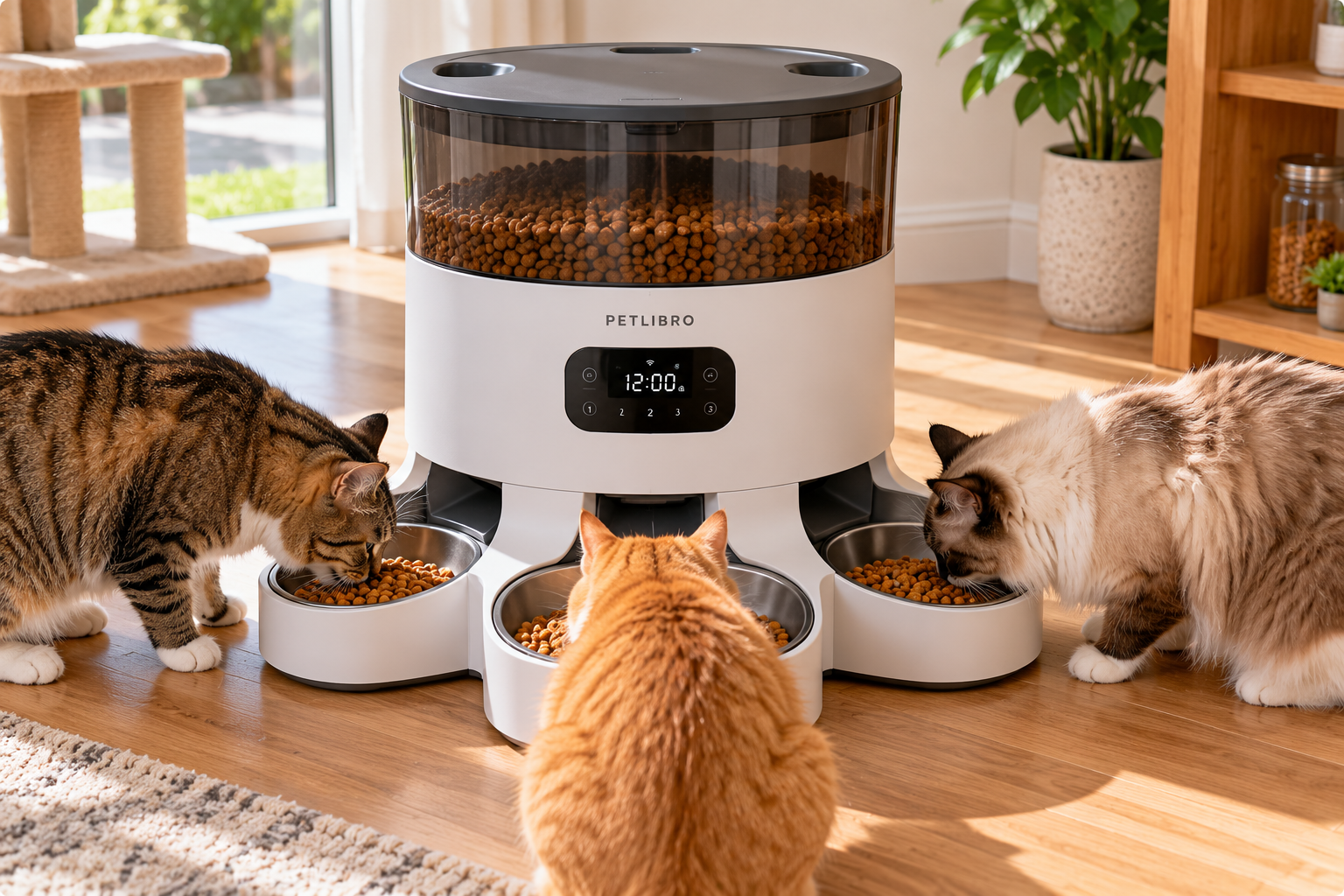
1. PETLIBRO Granary Dual Bowl Feeder — best all-round dual-bowl base
The PETLIBRO Granary Dual Bowl Feeder is the workhorse many multi-cat homes start with, because it covers two cats cleanly and leaves you room to add a third feeder.
Its 5L hopper feeds into a rotating splitter that divides each portion between two stainless steel bowls. PETLIBRO notes you can shift the splitter to send more food to one side — useful when one of your two cats is larger. An infrared sensor stops dispensing if the outlet is blocked, and three D batteries (not included) can run it during a power outage. In plain terms: fewer jams, fewer missed breakfasts.
Here’s what to weigh: one hopper means one food. If two of your three cats eat the same adult kibble and get along, this unit plus a single feeder for cat three is a tidy, affordable system. It does not stop a determined thief from switching bowls.
Aggregated owner feedback on Chewy is broadly positive about scheduling and freshness, but a recurring theme is that cats quickly learn both bowls come from the same chute, so a bossy cat can still hover. Some reviewers suggest separate chutes or separate feeders for problem eaters.
Pros:
- ✅ Adjustable splitter handles unequal portions
- ✅ Infrared jam sensor protects the dispenser
- ✅ Battery backup covers short power outages
Cons:
- ❌ Dry food only — no wet meals
- ❌ Doesn’t stop a dominant cat from stealing
💲 Around $70–$95 at the time of writing — strong value as the “two cats” half of a three-cat setup.
2. PETLIBRO Granary Camera Feeder (Dual Trays) — lets you referee from your phone
The PETLIBRO Granary Camera Feeder (Dual Trays) is essentially the dual-bowl Granary with a built-in camera, which matters more in a three-cat house than you’d think.
You get the same 5L hopper and dual stainless steel trays, plus a feeding camera you can check through the PETLIBRO app. The camera’s real value isn’t cute clips — it’s evidence. If your shy cat seems to be losing weight, you can actually see who eats from which bowl and whether the timid one gets shoved away.
Based on comparing the specs, this is the right upgrade for people who travel or work long shifts and need to confirm meals happened. For a home where everyone eats nicely, it’s a luxury; for a home with a suspected food bully, the footage helps you decide whether you need RFID feeders before you spend more.
Retailer listings describe it as designed for two pets eating simultaneously. Owner review volume on this specific variant is smaller than on the standard Granary, so the reliable takeaway is the shared Granary platform’s solid reputation for scheduling. PetSmart’s listing also notes the power system can become unstable once backup batteries run low.
Pros:
- ✅ Camera shows who actually eats each portion
- ✅ Same proven 5L Granary dispensing system
- ✅ Useful diagnostic tool before buying RFID feeders
Cons:
- ❌ Notably pricier than the non-camera version
- ❌ Still can’t block a food thief
💲 Around $130–$150 — worth it if remote monitoring is the point; overkill if it isn’t.
3. PETLIBRO One RFID Smart Feeder — one lid, one cat, no arguments
The PETLIBRO One RFID Smart Feeder solves the problem dual-bowl feeders can’t: it physically locks out every cat except the one wearing its tag.
Each unit has a 3L hopper, supports up to 10 scheduled meals a day, and connects over 2.4GHz or 5GHz Wi-Fi. An RFID reader recognizes a lightweight collar tag (about 4.2g) and only then unlocks the lid. Important nuance: PETLIBRO says it reads only its own collar tag — not your cat’s implanted microchip — and each feeder pairs with a single tag. For three cats, you need three feeders and three collars.
On paper, this is the most flexible system for a household with three different diets — say, a kitten food, a weight-control food, and a prescription kibble. If your cats hate collars, though, it’s a non-starter.
One long-term owner’s blog describes buying these after a vet prescribed an iodine-restricted diet for one cat, and reports setup was as easy as PETLIBRO’s earlier Granary. PETLIBRO also advises keeping feeders at least 10 inches apart so readers don’t confuse tags.
Pros:
- ✅ Locks out every cat except the tagged one
- ✅ Supports three totally different diets
- ✅ Dual-band Wi-Fi with feeding logs
Cons:
- ❌ Requires a collar; won’t read microchips
- ❌ You’ll need three units for three cats
💲 Premium per unit — check the current price; bundles of two or three usually lower the per-feeder cost.
4. SureFeed Microchip Pet Feeder Connect — the gold standard for medical diets
The SureFeed Microchip Pet Feeder Connect is the feeder vets and reviewers reach for when a cat’s diet is genuinely non-negotiable.
Instead of dispensing kibble from a hopper, it’s a covered bowl. When a registered cat puts its head under the arch, the feeder reads the implanted microchip (or an optional RFID tag) and slides the lid open. Built-in scales weigh the bowl, so the Sure Petcare app — via a separate hub on your router — tracks how much and how often each cat eats. It runs on four C batteries and works with wet or dry food.
Here’s what most buyers overlook: this is not a scheduler in the same way the Granary is. You fill the bowl; the feeder controls who eats it. That makes it ideal for prescription wet food and for cats that graze, and less ideal for pure “feed while I’m away for a week” scenarios.
Reviews from outlets like PetsRadar and Tech Advisor consistently praise its accuracy, while noting cats need training time to accept the moving lid, and that unusually pushy cats have occasionally gotten past it. Trusted Reviews flagged the cloud service as less reliable than expected.
Pros:
- ✅ Reads existing microchips — no collar needed
- ✅ Handles wet and dry food
- ✅ Weighs intake for vet-ready data
Cons:
- ❌ Hub sold separately for app features
- ❌ Not a multi-day dry-food dispenser
💲 Around $180 per feeder plus the hub — expensive, but unmatched for cats on medical diets.
5. oneisall PF09 Dual Bowl Feeder — cheapest way to cover two cats well
The oneisall PF09 Dual Bowl Feeder proves you don’t need an app to run a sensible multi-cat feeding schedule.
It holds 5L (about 20 cups) of dry food and serves up to six meals a day. Instead of side-by-side bowls, the two bowls sit on opposite sides of the feeder — retailers list the spacing at roughly 11 to 16 inches depending on the listing. That separation matters: cats that don’t love eating shoulder to shoulder can face away from each other. A dial makes programming straightforward, and three D batteries provide backup power.
Based on comparing the specs, this is the best value “two cats” unit for a 2+1 setup, especially for owners who’d rather not install another app. Pair it with any single-bowl feeder for cat three.
Owner feedback on Walmart and other retailers repeatedly highlights the opposite-bowl layout reducing squabbles and the large hopper stretching between refills. A common caveat is that dialing in the right portion takes some trial and error, since one portion is roughly 10 grams per bowl.
Pros:
- ✅ Opposite-facing bowls reduce face-offs
- ✅ Simple dial — no app or Wi-Fi needed
- ✅ Large 20-cup hopper means fewer refills
Cons:
- ❌ No remote control or feeding alerts
- ❌ Portion tuning takes a few days
💲 Around $40–$60 — the strongest budget value in this lineup.
6. Cat Mate C500 — wet food on a timer, no app required
The Cat Mate C500 is the old-school answer for households where at least one cat needs wet food during the day.
It’s a five-compartment rotating tray: you leave one meal open and four more stay covered until their programmed times. Each compartment holds about 3/4 lb of food, and two reusable ice packs sit under the lid to keep wet food cool. It runs on three AA batteries and carries a three-year manufacturer’s guarantee. Cat Mate notes the compartments are large enough for two cats sharing — or one cat across a long day.
Here’s what to weigh: the C500 doesn’t stop stealing, so it works best in a separate room or for one cat who has a wet-food prescription. For a three-cat home, it shines as the “third feeder” next to a dual-bowl dry feeder.
Aggregated reviews on Chewy and Walmart are generally positive about reliability and easy cleaning. Recurring complaints: the ice packs keep food cool for a same-day absence rather than days, the tray’s rotation direction confuses some owners, and the motor noise startles skittish cats at first.
Pros:
- ✅ Handles wet, dry, and raw food
- ✅ Ice packs help with same-day wet meals
- ✅ Battery powered — place it anywhere
Cons:
- ❌ Ice packs won’t stretch beyond a day
- ❌ No protection against food stealing
💲 Around $40–$60 — excellent value for wet-food schedules.
7. PetSafe Smart Feed (2nd Gen) — one big hopper for three peaceful cats
The PetSafe Smart Feed (2nd Gen) is the only pick here that can plausibly feed all three cats from one bowl — if your cats cooperate.
Its hopper holds 24 cups of dry or semi-moist food, and you can schedule up to 12 meals a day in portions from 1/8 cup to 4 cups. The standout for multi-cat homes is Slow Feed, which releases meals larger than 1/8 cup gradually over 15 minutes. With three cats, that slow trickle keeps one vacuum-eater from inhaling the whole meal before the others arrive. It needs a 2.4GHz Wi-Fi network, keeps feeding on schedule if Wi-Fi drops, and accepts four D batteries as backup.
On paper, this suits three adult cats on the same food who already share a bowl without drama. It won’t fix bullying — it simply spreads the meal out.
I couldn’t verify a large, recent pool of US owner reviews specific to multi-cat use, so treat this assessment as spec-based: the 15-minute slow feed and 12-meal scheduling are its clearest, verifiable advantages for a trio.
Pros:
- ✅ Huge 24-cup hopper for three cats
- ✅ Slow Feed spreads meals over 15 minutes
- ✅ Keeps schedule even if Wi-Fi drops
Cons:
- ❌ Single bowl — no theft protection
- ❌ Requires a 2.4GHz Wi-Fi network
💲 Around $130–$160 at the time of writing — good value if one shared station truly works for your cats.
Comparing the Top 7 Feeders Side by Side
| Feeder | Stops food stealing? | Wet food? | Power backup | App / Wi-Fi | Best for |
|---|---|---|---|---|---|
| PETLIBRO Granary Dual Bowl Feeder | No | No | 3 D batteries | Yes | Best for 2 similar cats + add-on |
| PETLIBRO Granary Camera Feeder (Dual Trays) | No | No | Batteries | Yes + camera | Best for remote monitoring |
| PETLIBRO One RFID Smart Feeder | Yes (collar tag) | No | Mains power | Yes, dual-band | Best for different dry diets |
| SureFeed Microchip Pet Feeder Connect | Yes (microchip) | Yes | 4 C batteries | Via hub | Best for prescription diets |
| oneisall PF09 Dual Bowl Feeder | No | No | 3 D batteries | No | Best for budget 2+1 combos |
| Cat Mate C500 | No | Yes | 3 AA batteries | No | Best for daytime wet meals |
| PetSafe Smart Feed (2nd Gen) | No | No | 4 D batteries | Yes, 2.4GHz | Best for three cats sharing peacefully |
The pattern is clear: only two designs actually prevent theft — the PETLIBRO One RFID Smart Feeder and the SureFeed Microchip Pet Feeder Connect — and they cost far more per cat. Everything else is a scheduling tool, so its success depends on your cats’ manners. If even one of your three is a known thief, put that cat’s victim (or the thief) on a selective feeder and let a dual-bowl unit handle the other two.
✨ Don’t miss these smart multi-cat picks!
🔍 Take your multi-cat feeding routine to the next level with this carefully curated lineup. Click a highlighted feeder to check current pricing and availability. These picks will help you get calmer mealtimes and healthier weights for all three of your cats!
Three Cats, Three Setups: Real-World Scenarios
Specs are abstract until you map them onto actual households. Here are three common three-cat situations and how the feeders above fit.
Scenario 1: The peaceful trio on one food
Three adult cats, same kibble, no bullying, and an owner who works 9-to-5 with the occasional weekend away. Budget: around $150. The simplest answer is one PetSafe Smart Feed (2nd Gen) with Slow Feed switched on, so a 1/2-cup meal trickles out over 15 minutes and everyone gets a turn. Alternatively, an oneisall PF09 Dual Bowl Feeder plus a second oneisall PF09 Dual Bowl Feeder gives you four bowls in two rooms for a similar total — better if one cat prefers eating alone.
Scenario 2: The senior on a prescription diet
Two healthy young cats plus a 14-year-old on a kidney-support wet food. Budget: $250–$300. The young pair shares a PETLIBRO Granary Dual Bowl Feeder on a twice-daily schedule. The senior gets a SureFeed Microchip Pet Feeder Connect loaded with the prescription wet food, since it reads her existing microchip and keeps the youngsters out. Bonus: the intake data gives your vet something concrete at checkups.
Scenario 3: Kitten, dieter, and a food thief
A growing kitten, an overweight adult, and a third cat who steals from both. Three diets, one villain. This is the textbook case for three PETLIBRO One RFID Smart Feeder units, each paired to one collar tag and set 10+ inches apart. The kitten gets frequent small meals, the dieter gets measured portions, and the thief only opens its own feeder. Expect the highest upfront spend of any scenario — but also the end of the daily turf war.
Notice the theme: the more your three cats differ — in diet, age, or temperament — the more you should spend on selective feeders rather than bigger feeders.
Getting Started: Your First 30 Days With a Multi-Cat Feeder
Even the best automatic feeder fails if three cats reject it. A calm rollout matters more than the brand.
Week 1: Introduce, don’t automate
Set the new feeder(s) up next to the old bowls and leave them unplugged or set to manual. Drop a few treats in the bowl. For RFID or microchip feeders, use the slowest lid setting — PETLIBRO’s One RFID offers adjustable lid speeds precisely so cats can adapt. Let each cat discover that the noise means food, not danger.
Week 2: Run one scheduled meal a day
Switch on a single automated meal (usually breakfast, the one you’d most like to skip) while you still hand-feed dinner. Watch who eats where. If a dual-bowl feeder sees one cat eating from both bowls, that’s your early warning that you need a separate station or a selective feeder.
Week 3: Go fully automatic, but measure
Move every meal to the feeders. Weigh out what a “portion” actually dispenses with a kitchen scale — kibble shape changes how many grams fit in a scoop, so manufacturer portion sizes are approximations.
Week 4: Tune and maintain
- ✅ Weigh each cat (a bathroom scale works: weigh yourself holding the cat, subtract your weight).
- ✅ Adjust portions with your vet’s calorie target in mind.
- ✅ Wash bowls and replace desiccant packs on the manufacturer’s schedule.
- ✅ Insert fresh backup batteries before your first trip away.
Common first-month mistake: going on vacation in week two. Give yourself a full month of “supervised autopilot” before you trust the setup alone.
Problem → Solution: Fixing Common Multi-Cat Feeding Headaches
Problem 1: One cat eats from every bowl
Solution: Spacing helps (the oneisall PF09 Dual Bowl Feeder‘s opposite bowls are a good start), but a determined thief needs a lock. Move the victim — or the thief — to a PETLIBRO One RFID Smart Feeder or SureFeed Microchip Pet Feeder Connect.
Problem 2: The fast eater vomits after meals
Solution: Split the daily ration into more, smaller meals. The PetSafe Smart Feed (2nd Gen) Slow Feed mode releases food over 15 minutes, which naturally slows a gulper.
Problem 3: The feeder jams with large kibble
Solution: Check the kibble size limits. The oneisall PF09 Dual Bowl Feeder listings cite kibble under roughly half an inch to 0.7 inch; PETLIBRO’s One RFID lists 2–15mm. Oversized or oily kibble is the usual culprit. Clean the rotor and keep a desiccant pack fresh to stop clumping.
Problem 4: One cat needs wet food during the day
Solution: A Cat Mate C500 with frozen ice packs handles same-day wet meals. For a cat on prescription wet food that others try to steal, the SureFeed Microchip Pet Feeder Connect is the safer bet.
Problem 5: You can’t tell who’s eating
Solution: Add visibility before you add hardware. The PETLIBRO Granary Camera Feeder (Dual Trays) shows who eats, and microchip or RFID feeders log each visit. Data beats guessing.
How to Choose an Automatic Cat Feeder for 3 Cats
- Audit your cats’ diets first. If all three eat the same food, shared or dual-bowl feeders work. Two or three different diets point straight to selective feeders.
- Identify the thief (if any). Watch a week of mealtimes. One food bully changes your entire budget, because only lock-out feeders truly stop stealing.
- Decide dry vs. wet. Hopper feeders are dry-only. Wet food needs a tray feeder like the Cat Mate C500 or a covered bowl like the SureFeed Microchip Pet Feeder Connect.
- Count bowls, not devices. Three cats generally need three eating spots, ideally spread out. A dual-bowl unit plus a single feeder is often cheaper than three singles.
- Check power backup. A power outage at breakfast means three hungry cats. Look for battery backup (most picks here use D batteries).
- Match the tech to your router and habits. Several feeders need 2.4GHz Wi-Fi; RFID tags mean collars; microchip feeders need registered chips. Pick what you’ll actually maintain.
- Plan for the long term. Desiccant packs, batteries, collars, and hubs add up. Factor them in before checkout.
Microchip Cat Feeder vs. RFID Collar Feeder
Both “selective” designs use radio-frequency identification to recognize a cat, but they recognize different things — and that changes your daily life.
A microchip cat feeder like the SureFeed Microchip Pet Feeder Connect reads the tiny chip most shelter and vet-adopted cats already carry under the skin. No collar, nothing to lose, nothing to snag. That’s a big deal for indoor cats who’ve never worn a collar and won’t start now. The trade-off is cost per bowl and the fact that it’s a covered bowl rather than a multi-day dispenser — you still fill it yourself.
An RFID cat feeder like the PETLIBRO One RFID Smart Feeder reads a tag on a collar it supplies. Setup is easy, and it’s a true scheduled dispenser with a 3L hopper, so it can feed a cat for days. But it pairs with one tag only and won’t read microchips, so a cat that pulls off collars defeats it.
Here’s how to decide in practice:
- ✅ Collar-averse cats or wet-food diets → microchip feeder.
- ✅ Collar-tolerant cats on dry food, with owners who travel → RFID dispenser.
- ✅ Mixed household → nothing stops you combining one of each.
If you’re not sure your cats are chipped, ask your vet to scan them; the overview of animal microchip implants explains why scanning compatibility matters across chip formats.
Automatic Feeders vs. Traditional Bowls for Three Cats
| Approach | Portion control | Theft prevention | Owner time per day | Best for |
|---|---|---|---|---|
| Free-fed shared bowl | None | None | Very low | Best for almost no one with 3 cats |
| Hand-fed separate rooms | Excellent | Excellent | High | Best for owners home at every meal |
| Timed dual-bowl + single feeder | Good | Weak | Low | Best for similar cats, similar diets |
| Three selective feeders | Excellent | Excellent | Low | Best for different diets or a known thief |
The data shows why automatic feeders exist: hand-feeding three cats in separate rooms is the gold standard, but almost nobody can do it twice a day forever. A timed setup gives you the schedule without the theft protection, while selective feeders give you both at a higher price — effectively automating the “separate rooms” method.
Free-feeding is the trap. With three cats sharing an always-full bowl, you have no idea who ate what, and the fastest eater usually gains weight. Cornell’s guidance on feline obesity is a good reminder of why measured meals matter so much.
Features That Actually Matter (and Ones That Don’t)
Feeder marketing is loud. Here’s the honest cut for a three-cat home.
Features that matter
- ✅ Battery backup. Every feeder that relies on mains power should have it. Most picks here take D batteries; the Cat Mate C500 runs entirely on AAs.
- ✅ Jam protection. The PETLIBRO Granary Dual Bowl Feeder‘s infrared sensor stops dispensing when blocked. With three cats depending on one device, a jam isn’t a minor annoyance.
- ✅ Selective access if diets differ. This is the single most important feature for many three-cat homes.
- ✅ Slow feed or small, frequent meals. It reduces gulping and gives slower cats a fair shot.
- ✅ Removable, washable bowls. Stainless steel is easier to keep hygienic than scratched plastic.
Features that matter less than you think
- ❌ Voice recording. Fun, but cats learn the motor sound just as well.
- ❌ Huge hopper capacity on selective feeders. One cat rarely needs more than a couple of weeks’ worth stored.
- ❌ Smart-speaker integration. Handy, not essential.
- ❌ Camera on every unit. One camera feeder to diagnose behavior is plenty; you don’t need three.
The takeaway: spend on control (who eats, how much, how reliably), not on novelty.
Long-Term Cost and Maintenance
Sticker price is only the beginning. Here’s how ownership costs stack up over a couple of years.
| Setup for 3 cats | Upfront range | Ongoing costs | Value verdict | Best for |
|---|---|---|---|---|
| 2 × oneisall PF09 Dual Bowl Feeder | Around $80–$120 | D batteries, desiccants | Excellent | Best for tight budgets |
| PETLIBRO Granary Dual Bowl Feeder + Cat Mate C500 | Around $110–$155 | Batteries, ice packs | Very good | Best for mixed wet/dry |
| 1 × PetSafe Smart Feed (2nd Gen) | Around $130–$160 | D batteries | Good if cats share | Best for one-food trios |
| 3 × SureFeed Microchip Pet Feeder Connect + hub | Several hundred dollars | 12 C batteries per cycle | Pricey but precise | Best for medical needs |
Looking at these totals, the budget combos are hard to beat if your cats get along, while the microchip route only pays off when it prevents real health costs — a prescription diet that finally works can save far more in vet bills than the hardware costs. Battery-powered selective feeders also carry a hidden recurring cost: three units means three sets of batteries.
Maintenance schedule worth following
- ✅ Daily: glance at bowls and food levels; check app alerts.
- ✅ Weekly: wash bowls and trays in warm soapy water.
- ✅ Every 2–4 weeks: empty the hopper, wipe out oily residue, replace desiccant packs.
- ✅ Every few months: swap backup batteries, even if they seem fine.
Never wash feeder bases or RFID readers under water — both PETLIBRO and oneisall warn against it.
Common Mistakes to Avoid When Buying a Multi-Cat Feeder
- Buying one dual-bowl feeder for three cats. Two bowls, three cats is a recipe for daily scuffles. Plan a third eating spot.
- Ignoring the thief. A schedule doesn’t change who’s bossiest. If one cat steals, budget for at least one selective feeder.
- Assuming RFID reads microchips. The PETLIBRO One RFID Smart Feeder uses its own collar tag only. If your cats won’t wear collars, that’s a deal-breaker.
- Putting wet food in a hopper. Hopper feeders are built for dry kibble. Wet food belongs in a tray or covered-bowl feeder.
- Clustering feeders together. Side-by-side stations invite guarding, and RFID readers can interfere when placed too close. Spread them out.
- Skipping backup batteries. A single outage can mean a missed meal for all three cats.
- Trusting portion numbers blindly. A “portion” varies by kibble shape. Weigh it once with a kitchen scale.
Avoiding just the first two mistakes will solve most multi-cat feeding problems before they start.
Safety, Power, and Food Storage Basics
An automatic feeder is an electrical appliance living near water bowls and curious paws, so a little caution goes a long way.
Electrical safety
- ✅ Use the adapter that came with the feeder. Third-party adapters may not match voltage or safety certifications.
- ✅ Keep feeders indoors, dry, and away from sinks — oneisall specifically warns against moisture exposure.
- ✅ Route cords where cats can’t chew them, or use cord protectors.
Food freshness
- ✅ Store only as much kibble in the hopper as your cats will eat in about two weeks; fats in dry food degrade over time.
- ✅ Keep desiccant packs fresh — PETSMART’s listing for the Granary camera model suggests replacing them roughly every two weeks.
- ✅ For wet food in a Cat Mate C500, use freshly opened food and frozen ice packs, and don’t leave it out beyond a day.
Behavior and health checks
- ✅ Never let a feeder replace eyes-on care. A cat that suddenly stops eating needs a vet, not a schedule tweak.
- ✅ If your cats fight at meals, address the behavior — automation won’t fix aggression, it only reduces triggers.
Treat the feeder as a helper, not a babysitter, and your three cats will be safer for it.
FAQ: Automatic Cat Feeder for 3 Cats
❓ Can one automatic feeder feed three cats?
❓ Is a microchip cat feeder worth the money for three cats?
❓ Which automatic feeder for multiple cats works with wet food?
❓ How far apart should I place feeders for three cats?
❓ What happens to an automatic cat feeder during a power outage?
Conclusion: Build the Setup Your Three Cats Actually Need
Here’s the honest bottom line: the best automatic cat feeder for 3 cats is rarely one product. It’s the combination that matches your cats’ diets and personalities.
If your trio is peaceful and eats the same food, keep it simple. The PetSafe Smart Feed (2nd Gen) can run the whole show with slow feed, or two oneisall PF09 Dual Bowl Feeder units give you more bowls for less money. If two cats share well and the third is different, pair a PETLIBRO Granary Dual Bowl Feeder with a Cat Mate C500 for wet food. If you need proof of who’s eating before you spend more, the PETLIBRO Granary Camera Feeder (Dual Trays) is your diagnostic tool.
And if diets differ or a food thief rules your kitchen, stop fighting physics. Three PETLIBRO One RFID Smart Feeder units or SureFeed Microchip Pet Feeder Connect units cost more upfront, but they’re the only options that truly lock each meal to the right cat.
Whatever you choose, roll it out slowly, weigh your cats monthly, and keep your vet in the loop. Your mornings will get quieter — and your cats’ waistlines will thank you. 🐱🐱🐱
🚀 Ready to end the mealtime turf war?
🔍 Pick the setup that fits your three cats, then click a highlighted feeder above to check current pricing and availability. A calmer, healthier feeding routine for your whole feline family starts today!
Recommended for You
- Water Fountain with Filter: 7 Best Picks Your Pet Will Love (2026)
- Stainless Steel Slow Feeder Bowl: 7 Proven Picks for Gulpers (2026)
- sphinx cat food feeder: 7 Best Picks That Actually Work (2026)
Disclaimer: This post contains affiliate links. As an Amazon Associate, I earn from qualifying purchases made through these links, at no additional cost to you.
✨ Found this article helpful? Share it with someone who needs it! 💬🤗