In This Article
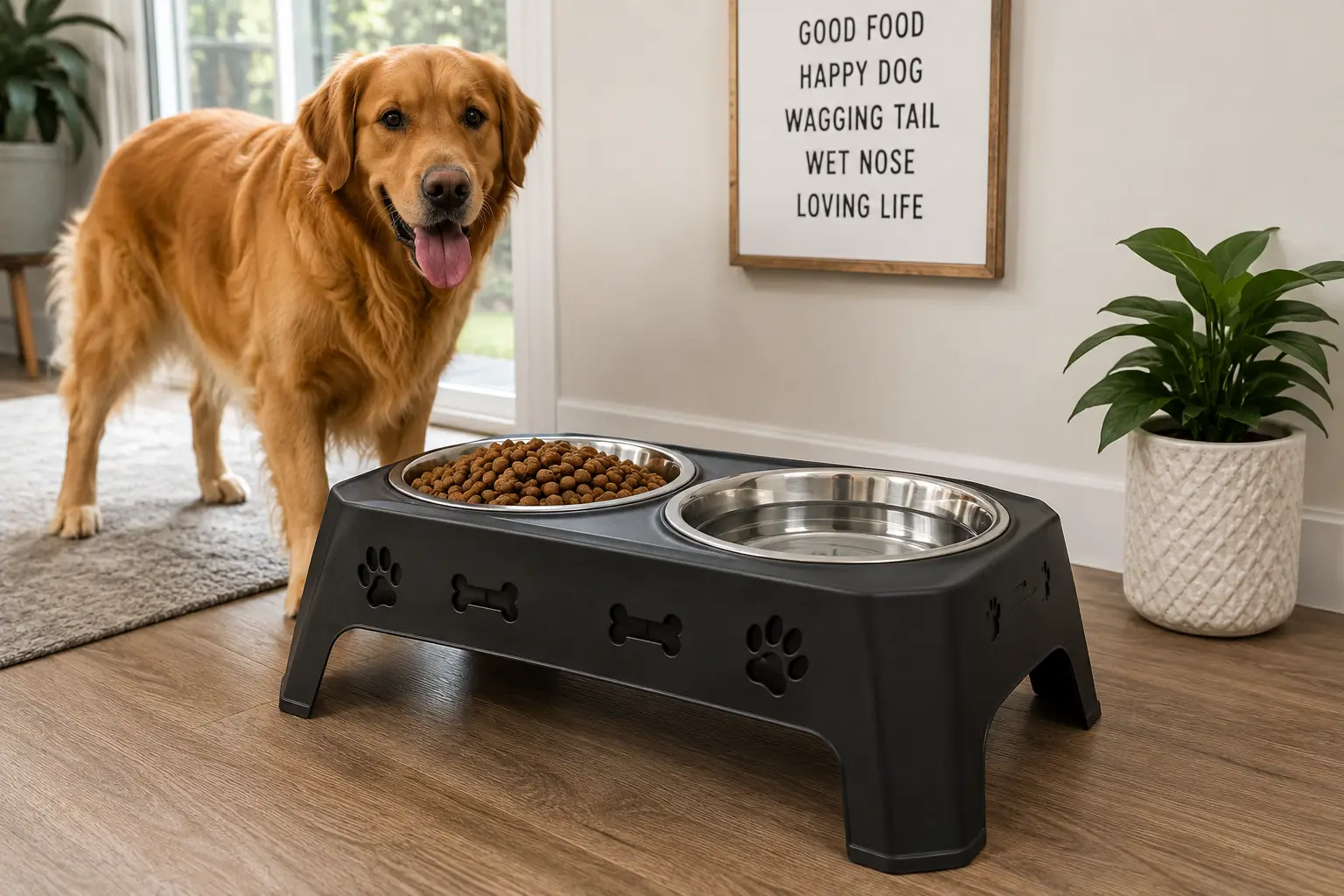
If you share your home with a Great Dane, a Mastiff, or even a food-motivated Labrador, you already know that a bowl built for a Chihuahua just won’t cut it. The best dog bowls for large dogs are wide enough for a big muzzle, deep enough to hold a full meal without a mid-dinner refill, and stable enough to survive a 90-pound dog leaning on the rim. In short, a large dog bowl is any feeding or water dish engineered with the capacity, weight, and non-slip design that big and giant breeds need to eat comfortably and safely.
Choosing the right one matters more than it looks. A bowl that’s too shallow forces your dog to gulp air along with their kibble, a bowl that skids across tile turns mealtime into a wrestling match, and a bowl made from the wrong material can chip, rust, or — in rare cases — leach substances you’d rather your dog not ingest. On top of that, large dog bowls sit right in the middle of an ongoing debate among veterinarians about elevated feeders and bloat risk, which we’ll unpack later in this guide with real research, not guesswork.
We spent time digging through manufacturer spec sheets, aggregated Chewy and Amazon customer reviews, and veterinary sources to build this list of seven real, currently available large dog bowls — from a $10 stainless steel dish to a farmhouse-style elevated feeder built for multi-dog households. Whether you’re shopping for large dog bowls for a single 70-pound dog or elevated dog bowls for large breeds with joint pain, you’ll find a genuinely good option here, along with the honest trade-offs of each one. Let’s get into it.
Quick Comparison: Best Dog Bowls for Large Dogs at a Glance
| Bowl | Material | Capacity | Best For |
|---|---|---|---|
| Neater Feeder Deluxe | BPA-free plastic base + stainless bowls | Up to 9 cups | Messy drinkers |
| Frisco Non-Skid Stainless Steel Bowl | Stainless steel | 8 cups | Tight budgets |
| Outward Hound Fun Feeder Slo Bowl | BPA-free plastic | 4 cups | Fast eaters |
| PetFusion Elevated Dog Bowls | Anodized aluminum stand + steel bowls | 7 cups per bowl | Joint support |
| Signature Housewares Bones Ceramic Bowl | Glazed stoneware | 5.25 cups | Tip-prone eaters |
| Bearwood Essentials Farmhouse Feeder | Wood, iron, stainless steel | Up to 11 cups | Multi-dog homes |
| Van Ness Heavyweight Jumbo Crock | USDA food-contact plastic | 106 oz (13+ cups) | Giant breeds, tight budgets |
Looking at the table, you’ll notice a pattern: the highest-capacity option, the Bearwood Essentials Farmhouse Feeder, and the most affordable one, the Van Ness Heavyweight Jumbo Crock, sit at opposite ends of the price spectrum but both solve the same core problem for giant breeds — running out of bowl space mid-meal. Meanwhile, the Outward Hound Fun Feeder Slo Bowl trades raw capacity for a health benefit, since it’s built to slow down dogs who eat too fast. If your dog doesn’t gulp their food, a simple, wide stainless bowl like the Frisco Non-Skid Stainless Steel Bowl will likely serve you just as well for a fraction of the cost.
💬 Ready to see the full breakdown? Scroll down for our complete, honest review of all seven bowls.
Top 7 Dog Bowls for Large Dogs: Expert Analysis
We evaluated dozens of large dog bowls on capacity, material safety, stability, and how real owners rate them after months of daily use. These seven stood out as genuinely solid, currently available options on Amazon for different budgets, dog sizes, and feeding challenges.
1. Neater Feeder Deluxe — best for containing spills
If your large dog treats water bowls like a splash zone, the Neater Feeder Deluxe was built specifically for that problem. Its patented design uses raised walls and a sloped drainage system so spilled water flows into a hidden reservoir instead of pooling on your floor, while spilled kibble stays dry on top for reuse. What most buyers overlook with this model is that it’s not just an elevated stand — it’s a full containment system, which is a meaningfully different job than a standard raised bowl does.
The Large Deluxe is sized for breeds like Golden Retrievers and Labradors and comes with two stainless steel bowls, plus the option to add leg extensions for extra height. The base is made from BPA-free plastic assembled in the USA, while the bowls themselves are sourced from India and are top-rack dishwasher safe. Based on comparing the specs against simpler elevated stands, this feeder earns its higher price by solving an actual mess problem rather than just lifting the bowl off the ground.
Reviews consistently report that owners of big, sloppy drinkers — Bernese Mountain Dogs and Newfoundlands come up often — see a dramatic drop in floor cleanup after switching. A common complaint in customer reviews involves the plastic legs, which one owner said didn’t hold up to a powerful 10-month-old Labrador on day one. Expect to pay in the $65-$85 range depending on whether you add leg extensions; for large dogs whose water bowls currently flood the kitchen, that’s a fair trade.
Pros:
- ✅ Contains food and water spills automatically
- ✅ Stainless steel bowls are fully dishwasher safe
- ✅ Optional leg extensions customize the feeding height
Cons:
- ❌ Plastic frame can struggle with very strong chewers
- ❌ Pricier than a basic stainless bowl setup
2. Frisco Non-Skid Stainless Steel Bowl — best value for large breeds
Sometimes the simplest bowl is the right bowl, and the Frisco Non-Skid Stainless Steel Bowl in the large 8-cup size is proof of that. It’s a straightforward, food-grade stainless steel dish with a rubberized ring bonded to the base, which keeps a 70-pound dog’s enthusiastic eating from sending it skidding across the kitchen floor. What most buyers overlook here is that the non-skid ring isn’t just about noise or mess — it’s what keeps a large dog from accidentally flipping a full water bowl mid-drink.
The stainless steel is 201-grade, which is a step below premium 304-grade steel but still stain-proof, rust-resistant, and non-porous enough to resist bacterial buildup when cleaned regularly. Reviews consistently report that the bowl holds up well over years of daily use, with the most repeated complaint being a stubborn manufacturer sticker on the inside that some owners found tricky to fully remove before first use.
For large dog bowls on a budget, this is genuinely hard to beat — you’re getting a dishwasher-safe, rust-resistant, non-tip dog bowl for large dogs at a price that lets you buy a backup without a second thought. Expect to pay under $20 for the large size, making it one of the best dog bowls for large dogs for the money in this entire lineup.
Pros:
- ✅ Non-skid base prevents sliding and tipping
- ✅ Rust-resistant and dishwasher safe for years of use
- ✅ Very affordable for the capacity offered
Cons:
- ❌ 201-grade steel is less premium than 304-grade options
- ❌ Manufacturer sticker residue is a recurring complaint
3. Outward Hound Fun Feeder Slo Bowl — best for gulpers
Some large dogs don’t have a portion problem, they have a pace problem, and that’s exactly what the Outward Hound Fun Feeder Slo Bowl addresses. Meal-lengthening ridges and a maze pattern molded into the bowl force your dog to work around obstacles instead of inhaling their food in under a minute, which the brand says can slow eating by up to 10 times compared to a flat dish.
The large size holds 4 cups of dry, wet, or raw food and comes in three intensity levels — Slow, Slower, and Slowest — so you can match the challenge to how fast your particular dog eats. The spec sheet doesn’t say this outright, but the real value here is preventive: fast eating is one of several factors veterinarians associate with a higher risk of gastric dilatation-volvulus (bloat) in deep-chested large breeds, which we cover in detail later in this guide.
Reviews consistently report that owners of notoriously fast eaters — Labradors and Boxers show up frequently — notice a genuine slowdown within the first few meals, and the BPA, PVC, lead, and phthalate-free plastic construction gives peace of mind for daily use. The main limitation for giant breeds is capacity: at 4 cups, dogs that eat more than that per meal will need a refill partway through. Pricing typically falls in the $10-$18 range, making it an easy add-on even if it’s not your dog’s only bowl.
Pros:
- ✅ Slows fast eaters by up to 10 times
- ✅ Three intensity levels match your dog’s pace
- ✅ Made without BPA, PVC, lead, or phthalates
Cons:
- ❌ 4-cup capacity is limiting for giant breeds
- ❌ Plastic construction is less durable than steel long-term
4. PetFusion Elevated Dog Bowls — best for joint comfort
For dogs with existing arthritis, a recent injury, or just a long torso that makes floor-level eating awkward, the PetFusion Elevated Dog Bowls in the Tall 8-inch stand raise mealtime to a more comfortable height. The stand is anodized aluminum, which the spec sheet notes is more corrosion-resistant than many stainless steel grades, color-infused so it won’t chip, and light enough to reposition without much effort.
Each of the two included US food-grade stainless steel bowls holds 7 cups (56 ounces), sized specifically for medium and large dogs, and anti-slip feet plus rubberized bowl insets keep everything from sliding around during an enthusiastic meal. Here’s what to weigh with elevated dog bowls for large breeds specifically: while raised feeding can genuinely ease strain for dogs with diagnosed neck or joint issues, current veterinary research also links elevated feeders to a higher bloat risk in large and giant breeds without those conditions — a nuance we explore fully in the analysis section below.
Reviews consistently report satisfaction with the build quality and the 12-month warranty against manufacturer defects, with the fixed 8-inch height being the most common limitation for households with multiple differently sized dogs. Expect to pay in the $40-$55 range, positioning this as a mid-tier investment for owners who’ve discussed elevated feeding with their vet.
Pros:
- ✅ Anodized aluminum resists corrosion and chipping
- ✅ US food-grade stainless steel bowls included
- ✅ Anti-slip feet keep the stand in place
Cons:
- ❌ Fixed height doesn’t adjust for growing or multiple dogs
- ❌ Elevated feeding carries debated bloat-risk trade-offs for large breeds
5. Signature Housewares Bones Ceramic Dog Bowl — best tip-resistant design
Weight alone can be a feature, and the Signature Housewares Bones Ceramic Dog Bowl leans into that in the largest 5.25-cup size. Made from glazed stoneware, it’s dense enough that a large dog nudging or pawing at it is far less likely to send it sliding than a lightweight plastic dish would. The brand states its glazes are lead-free, which matters more than it might seem — we’ll explain exactly why in the safety section further down this guide.
Beyond the weight, the bowl is both dishwasher and microwave safe, and its wide base gives large breeds room to eat without repeatedly bumping their muzzle against tall sides. What most buyers overlook with ceramic bowls generally is that they resist scratching better than plastic, which means fewer microscopic grooves where bacteria can hide between washes — a genuine hygiene advantage over the life of the bowl.
Reviews consistently report that the bowl’s heft does reduce sliding on hard floors, though a meaningful subset of reviewers pushed back on the “non-skid” claim, saying the glazed bottom still slides on smooth tile without a mat underneath. One reviewer also noted the 5.25-cup size, while generous, was still too small for a 75-pound Catahoula’s full portion — worth checking against your own dog’s serving size. At around $15-$25, it’s a mid-budget pick best paired with a rubber placemat if your floors are slick.
Pros:
- ✅ Heavy stoneware resists sliding and tipping
- ✅ Lead-free glaze, dishwasher and microwave safe
- ✅ Wide, shallow design suits large muzzles
Cons:
- ❌ “Non-skid” performance is inconsistent per reviews
- ❌ May be too small alone for the largest giant breeds
6. Bearwood Essentials Farmhouse 3-Bowl Elevated Feeder — best for multi-dog homes
Households juggling more than one large dog at feeding time have a specific problem: enough capacity, without enough chaos. The Bearwood Essentials Farmhouse 3-Bowl Elevated Feeder solves it with a genuinely clever layout — two 3.5-cup outer bowls for individual food portions, flanking a shared 11-cup center bowl deep enough to double as a communal water station for multiple large dogs.
The frame combines a wood top with an iron stand, finished in a farmhouse aesthetic that, unlike most feeding stations, actually looks intentional in a home rather than utilitarian. O-ring cutouts hold each stainless steel bowl securely in place, which addresses a common complaint with cheaper elevated feeders — bowls that spin or slide out of their slots mid-meal. Based on comparing this to single-bowl elevated stands, the dedicated center reservoir is what genuinely sets it apart for households where water bowls empty fast.
Reviews consistently report strong satisfaction from owners of two large dogs (65-pound pairs come up specifically), who note the design gives each dog separation at mealtime without full-on isolation. The wood top needs occasional wiping to stay looking sharp, and the fixed elevation is worth discussing with your vet under the same bloat-risk considerations that apply to any raised feeder for large breeds. Expect to pay in the $120-$160 range — a real investment, but one built for a specific, common problem that cheaper feeders don’t solve.
Pros:
- ✅ 11-cup center bowl works as a shared water station
- ✅ O-ring cutouts stop bowls from sliding or spinning
- ✅ Farmhouse design blends into home décor
Cons:
- ❌ Highest price point in this lineup
- ❌ Wood top requires regular wiping to maintain
7. Van Ness Heavyweight Jumbo Crock — best budget pick for giant breeds
When a Great Dane or Mastiff needs serious capacity and you don’t want to spend big to get it, the Van Ness Heavyweight Jumbo Crock delivers 106 ounces — more than 13 cups — in a single, no-frills plastic dish. It’s made from USDA food-contact approved plastic and weighted at the base to add some resistance against tipping, which the spec sheet frames as its main defense against a giant breed’s enthusiastic mealtime.
There’s no fancy engineering here, and that’s the point: this is what to weigh if what you actually need is raw volume for the lowest possible price, not a slow feeder, elevation, or a mess-containment system. Reviews consistently report years of reliable daily use from owners who simply need a bowl big enough that a Mastiff or Saint Bernard isn’t finishing their water in one sitting, though the lack of a rubberized non-skid base means it can still slide on very smooth flooring without a mat underneath.
What the spec sheet doesn’t say, but general plastic-bowl research suggests, is that any plastic dish will develop fine surface scratches over years of use, which can harbor bacteria more than stainless steel or ceramic — a trade-off worth knowing about even at this price point. At roughly $10-$18, it remains one of the most affordable large dog bowls available, and a smart pick for anyone prioritizing capacity and budget over premium materials.
Pros:
- ✅ Massive 106-ounce capacity for giant breeds
- ✅ USDA food-contact approved plastic
- ✅ Extremely affordable price point
Cons:
- ❌ No non-skid base included
- ❌ Plastic scratches over time, unlike steel or ceramic
💬 One click helps other large-dog owners make an informed choice too! 😊
Real-World Scenarios: Matching the Bowl to Your Dog
Specs only tell half the story — how a bowl performs depends heavily on your specific dog and household. Here are three common situations large-dog owners face, matched to genuinely appropriate picks from this list.
The single giant breed with a big appetite: If you’re feeding one Great Dane or Mastiff who polishes off a full bowl in one sitting, capacity is your priority. The Van Ness Heavyweight Jumbo Crock or the center bowl on the Bearwood Essentials Farmhouse Feeder both handle 11+ cups without a mid-meal refill, and neither requires you to commit to elevated feeding if you’d rather keep bowls at floor level given the bloat research discussed below.
The multi-dog household with food-motivated eaters: Two or more large dogs sharing a feeding area benefits from separation and durability more than raw capacity per bowl. The Bearwood Essentials Farmhouse Feeder‘s three-bowl layout, or simply two Frisco Non-Skid Stainless Steel Bowls spaced apart, both reduce the food-guarding tension that can crop up when big dogs eat close together.
The senior large dog with joint pain: A large or giant breed with diagnosed arthritis or a recent orthopedic surgery is often the clearest case for raised feeding, since lowering the head repeatedly can genuinely hurt. Here, the PetFusion Elevated Dog Bowls make sense — but talk to your vet first, since elevation carries its own trade-offs for dogs without a joint-specific reason to use it.
Common Large-Dog Feeding Problems — and How to Fix Them
Even the right bowl can run into predictable issues. Here’s how to solve the ones we see most often in customer reviews and vet forums.
Problem: The bowl slides across the floor mid-meal. This is almost always a base issue, not a dog behavior issue. Switch to a bowl with a bonded rubber ring like the Frisco Non-Skid Stainless Steel Bowl, or add a silicone feeding mat under any bowl that lacks one — including ceramic dishes, whose glazed bottoms are more slippery than owners expect.
Problem: Your dog finishes eating in under 60 seconds. Fast eating isn’t just messy, it’s a genuine health concern tied to digestive upset and, in deep-chested breeds, elevated bloat risk. A dedicated slow feeder like the Outward Hound Fun Feeder Slo Bowl is the most direct fix, though scattering kibble on a lick mat works as a low-cost alternative for dogs who dislike the maze pattern.
Problem: Water bowls go empty by mid-afternoon. Large and giant breeds drink more than owners often estimate — roughly 1 ounce per pound of body weight daily as a general guideline. Sizing up to a higher-capacity water bowl, like the 11-cup center bowl on the Bearwood Essentials Farmhouse Feeder, cuts down on refills without needing an automatic waterer.
Problem: Floors get soaked from splashy drinkers. Some large breeds, especially those with loose jowls, simply create more splash regardless of bowl shape. The Neater Feeder Deluxe was purpose-built for exactly this, channeling spilled water into a hidden reservoir instead of onto your floor.
Problem: You’re not sure your ceramic bowl is actually safe. This is a fair concern, and the fix is verification, not guesswork — look specifically for a manufacturer’s lead-free claim backed by published testing, which we cover in the safety section below.
How to Choose the Best Dog Bowl for Large Dogs
Cutting through marketing language, here’s the actual decision process worth following, based on comparing specs and reviews across dozens of large dog bowls:
- Start with your dog’s per-meal portion size. Measure how many cups your dog actually eats per sitting, then choose a bowl with at least 25% more capacity than that to prevent overfilling and spills.
- Check the base material for skid resistance. A rubberized ring, silicone base, or genuinely heavy material like stoneware matters more for large dogs than for small ones, since more force is involved when they eat.
- Decide on elevation deliberately, not by default. Only choose an elevated feeder if your dog has a specific joint, neck, or digestive reason to benefit from it — discuss it with your vet first given the bloat research below.
- Match the material to your priorities. Stainless steel wins on durability and hygiene, ceramic wins on stability and lead-free assurance when verified, and plastic wins on price and light weight.
- Consider eating speed. If your dog inhales food in under a minute, prioritize a slow feeder design over capacity or aesthetics.
- Factor in household size. Multi-dog homes benefit from feeders with built-in separation or a shared water reservoir rather than several unrelated single bowls.
- Confirm it’s genuinely dishwasher safe. Hand-wash-only bowls are a common source of bacterial buildup over time in busy households — don’t take “easy to clean” claims at face value.
Common Mistakes to Avoid When Buying a Large Dog Bowl
Even well-intentioned large-dog owners fall into a few predictable traps. Here’s what to watch for.
Buying based on looks over base stability. A gorgeous ceramic bowl that slides across tile isn’t actually functional for a 70-pound dog eating with enthusiasm — stability should outrank aesthetics for daily-use bowls.
Assuming “large” sizing is standardized across brands. A “large” bowl from one manufacturer might hold 4 cups while another’s “large” holds 8. Always check the actual cup or ounce capacity rather than trusting the size label alone.
Choosing elevated feeders without researching bloat risk. This is the single most common mistake we see in reviews and forums — owners assume elevation is automatically healthier, when current research actually points the other way for large and giant breeds without a specific joint condition.
Overlooking material safety on imported ceramic bowls. Not every ceramic dog bowl publishes lead-testing data, and skipping that check is a real gap — we cover exactly what to look for in the next section.
Ignoring maintenance requirements before buying. A gorgeous wood-and-iron feeder looks great in photos, but if you’re not prepared to wipe it down regularly, a simpler stainless or ceramic bowl will serve you better long-term.
Elevated vs. Floor-Level Dog Bowls: What the Research Actually Says
This is the debate every large-dog owner eventually runs into, and it deserves a straight answer instead of marketing spin. For years, elevated dog bowls for large breeds were widely recommended as a way to ease digestion and reduce neck strain. More recent research has complicated that picture considerably.
A frequently cited study published in the Journal of the American Veterinary Medical Association found that raised feeders were associated with a meaningfully higher incidence of gastric dilatation-volvulus, commonly known as bloat, in large and giant breed dogs specifically — the same population most likely to be shopping for an elevated feeder in the first place. Bloat is a sudden, life-threatening emergency, so this isn’t a minor footnote; it’s a real factor to weigh before buying a raised bowl for a deep-chested breed like a Great Dane, Boxer, or German Shepherd.
That said, the picture isn’t universally settled, and elevated feeding isn’t automatically wrong for every large dog. Dogs recovering from cervical spine surgery, those with diagnosed arthritis in the neck or forelimbs, or seniors who visibly struggle to lower their head repeatedly may genuinely benefit from raised bowls despite the general risk pattern. The honest takeaway: floor-level bowls, like the Frisco Non-Skid Stainless Steel Bowl or Van Ness Heavyweight Jumbo Crock, are the safer default for most large and giant breeds, while elevated options like the PetFusion Elevated Dog Bowls are worth considering only with a specific medical reason and your vet’s input.
Long-Term Cost and Maintenance of Large Dog Bowls
Sticker price only tells part of the story for large dog bowls, since durability and replacement frequency vary enormously by material. A $10 plastic crock might need replacing every 12-18 months as it scratches and stains, while a $20 stainless steel bowl can realistically last a decade or more with basic dishwasher care — meaning the “budget” plastic option can actually cost more over five years than the pricier steel one.
Ceramic bowls sit in the middle: the Signature Housewares Bones Ceramic Dog Bowl holds up well against scratching and staining, but a single accidental drop can end its life instantly, which stainless steel simply shrugs off. Elevated feeders like the Neater Feeder Deluxe and PetFusion Elevated Dog Bowls carry the highest upfront cost, but their replaceable bowl inserts mean you’re only buying a new stainless dish every few years rather than replacing the entire stand.
Maintenance time matters too. Non-skid rubber bases need periodic wiping to prevent grime buildup underneath, farmhouse-style wood tops like the Bearwood Essentials Farmhouse Feeder need regular surface care to avoid water staining, and any bowl — regardless of material — should be washed daily, not just rinsed, since saliva and food residue build up bacteria faster in large dog bowls simply due to the volume of food and water passing through them.
Features That Actually Matter (and Ones That Don’t)
With so many marketing claims competing for attention, it helps to know which features genuinely affect your dog’s day-to-day experience and which ones are mostly packaging language.
Actually matters: base material and weight (skid resistance), verified capacity in cups or ounces, dishwasher-safe construction, and — for ceramic bowls specifically — a lead-free glaze claim you can verify. These directly affect safety, mess, and how often you’re refilling.
Mostly marketing: decorative color patterns, “designer” branding on otherwise standard stainless steel, and vague “premium” language without a specific steel grade or material spec behind it. A polished look is nice, but it doesn’t change how the bowl performs at mealtime.
Genuinely debated: elevation. As covered above, this isn’t a simple pro or con — it’s a feature that helps some dogs and carries real risk for others, which is why it belongs in its own category rather than a blanket “pro.”
Safety, Regulations, and Standards for Pet Food Bowls
Material safety is one of the more overlooked parts of shopping for large dog bowls, and it’s worth understanding the actual rules involved. In the United States, ceramic dinnerware — including pet bowls — falls under FDA guidance on lead content, since lead has historically been used in glazes as a flux that helps them form a smooth, glass-like surface. The FDA’s own guidance confirms that ceramicware can legally contain trace lead if properly manufactured, but improperly fired or imported glazes can leach measurable amounts into food and water over time, particularly with acidic contents.
This is exactly why a manufacturer’s lead-free claim matters for products like the Signature Housewares Bones Ceramic Dog Bowl — it’s not just a marketing checkbox, it’s a material safety claim tied to real federal guidance. Stainless steel bowls sidestep this issue entirely, since food-grade steel doesn’t carry the same leaching risk, which is part of why so many veterinarians default to recommending it for daily use.
Beyond lead, look for BPA-free labeling on any plastic bowl — both the Outward Hound Fun Feeder Slo Bowl and Van Ness Heavyweight Jumbo Crock explicitly meet this standard — since BPA and phthalates are industrial compounds increasingly scrutinized for hormone-disrupting effects with repeated exposure. None of this means you need to panic about your current bowl, but it’s a legitimate factor worth checking before buying, especially for a bowl your large dog will use daily for years.
Getting Started: Introducing a New Bowl Safely
Switching bowls seems trivial, but a few first-30-days habits help large dogs adjust smoothly and help you catch any fit issues early.
Week one: Place the new bowl in the exact same spot as the old one to avoid disorienting a food-motivated large dog, and monitor how quickly they finish meals — this is your baseline for deciding whether a slow feeder is actually necessary.
Weeks two through four: Check the bowl daily for early wear signs — scratches on plastic, chips on ceramic, or rust spots on lower-grade stainless steel — since catching these early prevents a minor cosmetic issue from becoming a hygiene problem.
Ongoing maintenance: Wash food bowls after every meal rather than rinsing, and wash water bowls at least every other day, since standing water in a bowl in the $50-and-up capacity range that large dogs favor can develop biofilm faster than smaller bowls that get emptied and refilled more frequently. If you switched to an elevated feeder, recheck the height every few months if your dog is still growing, since an ill-fitted height can undo the ergonomic benefit you bought it for in the first place.
A quick note on portions: total daily intake — not bowl size — should be guided by your dog’s weight, activity level, and vet’s recommendation, similar to the general feeding guidance veterinary nutritionists give for avoiding both underfeeding and overfeeding in large breeds.
✨ Don’t miss these picks while they’re in stock!
🔍 Take your large dog’s mealtime to the next level with this carefully researched lineup. Click a highlighted bowl above to check current pricing and availability. These picks will help you get a cleaner, safer, more comfortable feeding setup your whole household will appreciate!
Frequently Asked Questions
❓ What size bowl does a large dog actually need?
❓ Are elevated dog bowls safe for large breeds?
❓ Is stainless steel or ceramic better for large dog bowls?
❓ How often should I replace my large dog's food bowl?
❓ Do slow feeder bowls actually work for large dogs?
Conclusion
There’s no single best dog bowl for large dogs — there’s a best bowl for your specific dog, household, and budget. If mess is your biggest headache, the Neater Feeder Deluxe earns its price with a genuinely clever containment design. If you’re watching your budget while still needing a reliable daily bowl, the Frisco Non-Skid Stainless Steel Bowl delivers real durability for very little money. Fast eaters do best with the Outward Hound Fun Feeder Slo Bowl, while multi-dog households will get the most out of the Bearwood Essentials Farmhouse Feeder‘s shared capacity.
Before you buy anything, though, revisit the elevation question honestly. It’s tempting to assume a raised feeder is automatically the “premium” choice, but the research on bloat risk in large and giant breeds means floor-level bowls like the Van Ness Heavyweight Jumbo Crock or Signature Housewares Bones Ceramic Bowl are the smarter default for most dogs, with elevated options reserved for genuine medical need. Whichever bowl you choose, prioritize verified material safety, a stable base, and a capacity that actually matches how much your dog eats and drinks — the rest is really just personal style.
Recommended for You
- 7 Best Horse Pellet Feeders in 2026: Top Picks Compared
- Automatic Horse Feeder With Timer: 7 Best Picks for 2026
- Automatic Hog Feeders: 7 Best Options to Save Time in 2026
Disclaimer: This post contains affiliate links. As an Amazon Associate, I earn from qualifying purchases made through these links, at no additional cost to you.
✨ Found this article helpful? Share it with someone who needs it! 💬🤗