In This Article
Automatic Hog Feeders: Why 2026 Is the Year to Upgrade Your Setup
If you’ve ever hauled a five-gallon bucket of feed through mud, snow, or 95-degree heat twice a day, you already know why automatic hog feeders exist. They’re not a luxury item — they’re the difference between feeding your pigs on your schedule instead of theirs.
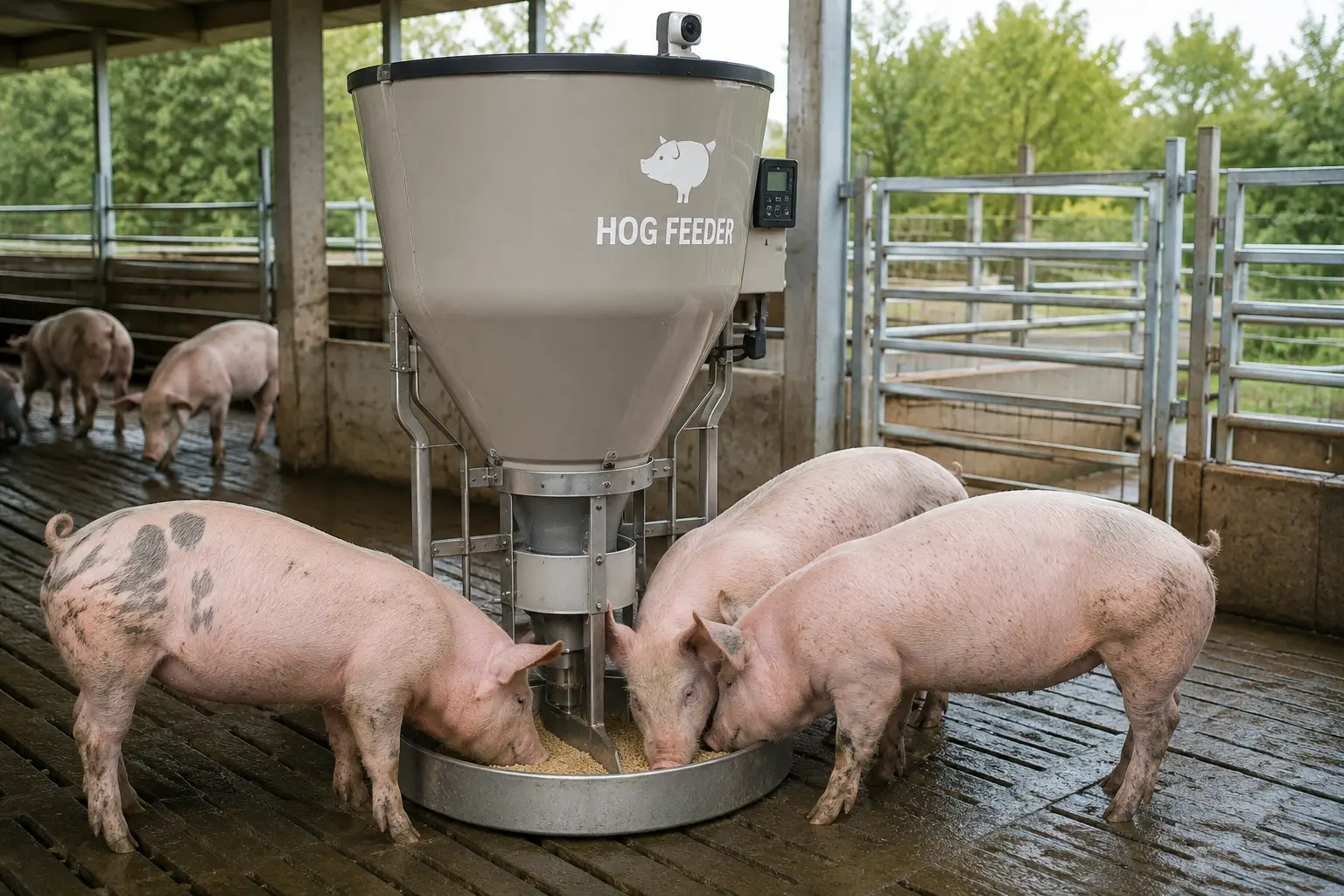
Automatic hog feeders are self-dispensing units — gravity-fed troughs or timer-driven electric hoppers — that let pigs eat on demand or on a programmed schedule, without you standing there scooping feed by hand. In practice, that means less feed spilled in the mud, fewer daily trips to the pen, and pigs that eat more consistently because the supply doesn’t run dry between visits.
This guide walks through seven real, currently available automatic hog feeders — from simple 50-pound galvanized steel troughs to WiFi-controlled electric dispensers — and breaks down which one actually fits your setup, whether you’re raising two feeder pigs for the freezer or running a small commercial operation. We’ll also cover the setup mistakes that waste the most feed, what the Swine Health Protection Act means for anyone feeding food scraps, and how to think about long-term cost instead of just sticker price. Every price mentioned below is a range, since actual pricing shifts often — always check the current price before buying.
Automatic Hog Feeders at a Glance: Quick Comparison
Before diving into full reviews, here’s how the seven feeders stack up on capacity, feeding style, and who each one suits best.
| Feeder | Type | Capacity | Price Range | Best For |
|---|---|---|---|---|
| Little Giant HGFS | Gravity, single door | 50 lb | Around $75–$90 | Tight budgets, 2–4 pigs |
| Brower 11H | Gravity, single door | 50 lb / 1.5 bushel | Around $90–$120 | Starter herds, small pens |
| Little Giant HGFD | Gravity, double door | 100 lb | Between $130–$160 | Growing litters, mid-size pens |
| VEVOR 3.7 Bushel | Gravity, double door | 3.7 bushel (~185 lb) | Around $130–$150 | Larger litters, best value per pound |
| PURRPAXZ 2-Door | Gravity, double door | 3.7 bushel (~185 lb) | Around $110–$140 | Budget buyers who want a viewing window |
| QFS Automatic Electronic Feeder | Electric, timer-driven | 50 lb | Around $300–$350 | Precise portion control, off-grid options |
| King of Feeders WiFi Feeder | Electric, app-controlled | Varies by model | Around $400–$600 | Remote monitoring, multi-site farms |
Looking at the table, the split is really between gravity feeders and electric feeders, and that split matters more than brand. The five gravity models (Little Giant HGFS, Brower 11H, Little Giant HGFD, VEVOR 3.7 Bushel, and PURRPAXZ 2-Door) all work on the same basic principle — pigs push a door or paddle and feed drops by gravity — so the real differences come down to capacity and steel gauge, not technology. The two electric options, QFS Automatic Electronic Feeder and the King of Feeders WiFi Feeder, cost three to five times more but add the ability to control exactly how much feed goes out and when, which matters most for gestating sows or anyone managing feed costs closely.
💬 One click helps other hog farmers find the right feeder too! 😊
The 7 Best Automatic Hog Feeders in 2026
We researched real spec sheets, manufacturer documentation, and aggregated customer feedback across each of these seven feeders to put together honest, practical breakdowns — not rehashed listing copy. Here’s what actually matters about each one.
1. Little Giant HGFS Single Door Hog Feeder — most affordable steel option
If you’re feeding two to four pigs and don’t need anything fancy, the Little Giant HGFS is the feeder most small-scale raisers start with, and for good reason: it does the one job it needs to do without extra cost. The single feed door is specially designed to keep out moisture and pests, while heavy-gauge steel in the trough and door resists the kind of dents and rust that cheaper feeders develop within a season. At 19 inches long, 12.75 inches wide, and 29.5 inches high, it holds 50 pounds of feed and mounts to a wall, rail, or post, or stands freestanding.
What most buyers overlook with a feeder this size is that the deep trough includes a feed-saver lip, which matters more than it sounds — that lip is what keeps feed from spilling out every time a pig noses in for a bite. Based on comparing this model against pricier competitors, the trade-off is capacity, not build quality: the steel gauge here is genuinely on par with feeders costing twice as much, but 50 pounds means more frequent refills once you’re past four grown hogs. This is the right call for beginners, 4-H and FFA projects, or homesteaders with a small starter herd who want a feeder that will still be standing in five years.
Reviews consistently report that the door mechanism holds up well against rooting and rubbing, and that the feeder ships fully assembled, which shoppers appreciate since assembly is a common complaint with cheaper import feeders. A recurring theme in feedback is that the top-loading door, which flips open from the back, makes refilling from outside the pen genuinely convenient rather than a marketing bullet point.
Pros:
- ✅ Heavy-gauge steel holds up for years of daily use
- ✅ Feed-saver lip meaningfully cuts down on waste
- ✅ Ships fully assembled, ready to mount
Cons:
- ❌ 50-lb capacity means frequent refills past 4 hogs
- ❌ Single door limits access if you’re feeding a larger group
At around $75–$90 at the time of writing, the Little Giant HGFS is one of the best value-for-money picks in this whole roundup for anyone starting small.
2. Brower 11H Single Door Hog Feeder — best for small starter herds
The Brower 11H is built by a company that’s been making animal feeding equipment for more than a century, and that experience shows in the details. It’s constructed of 20-gauge galvanized steel, a full gauge thicker than a lot of budget competitors, and it’s rated to automate feeding for up to four full-grown hogs from a single 1.5-bushel (roughly 50-pound) hopper.
What that thicker steel means in practice is a feeder that resists the dents and bent doors that happen when hungry hogs compete for access — a genuinely common failure point on thinner-gauge feeders. The adjustable feed gate at the trough lets you fine-tune flow for piglets versus adult sows, which is a small but meaningful feature most entry-level feeders skip entirely. Based on the spec sheet, this is the pick for anyone who wants Little Giant-level durability but prefers a brand with a longer manufacturing track record specifically in agricultural feeding equipment rather than general livestock gear.
Aggregated customer feedback highlights that the mounting hardware is straightforward and that the feeder secures tightly enough to withstand hogs pushing and rubbing against it — a common complaint with lighter feeders is that they work loose from fence posts within months. One recurring note in reviews is that this feeder doubles well as a large-dog feeder if trained properly, which speaks to how secure the door mechanism really is.
Pros:
- ✅ 20-gauge steel is thicker than most competitors
- ✅ Adjustable feed gate for piglets vs. adult hogs
- ✅ Secures tightly enough to resist rooting and rubbing
Cons:
- ❌ Only rated for up to 4 full-grown hogs
- ❌ Single-door design slows refilling for larger groups
Expect to pay somewhere around $90–$120, which puts the Brower 11H slightly above the Little Giant HGFS — a reasonable trade if steel thickness matters more to you than shaving a few dollars off the price.
3. Little Giant HGFD Double Door Hog Feeder — best mid-size capacity upgrade
Once you outgrow a 50-pound single-door feeder, the Little Giant HGFD is the natural next step. It doubles the capacity to 100 pounds and adds a second feed door, which effectively lets two pigs feed at once instead of queuing at a single opening — a real bottleneck once a litter starts competing for access.
The extra-thick heavy-gauge steel in the trough and doors carries over from the single-door model, and both doors are specifically engineered to block out moisture and pests while still being easy to wire open temporarily for very young pigs just learning to self-feed. What the spec sheet doesn’t say, but the design reveals, is that the top door flips open from the rear, so you can load feed from outside the pen without a hog crowding your legs while you work — a detail experienced raisers appreciate more than first-timers expect to. At 24.25 inches long, 19.75 inches wide, and 35.75 inches high, it’s a noticeably larger footprint, so measure your pen space before buying.
Here’s what to weigh: this model earns its higher price mainly through capacity and dual access, not through any dramatic leap in materials over the single-door version. For a grow-finish pen of six to eight hogs, though, that capacity difference means refilling every few days instead of daily, which adds up fast in saved time.
Pros:
- ✅ 100-lb capacity roughly doubles time between refills
- ✅ Dual doors reduce competition and queuing at feeding time
- ✅ Rear-loading top door keeps refills clear of the pen
Cons:
- ❌ Larger footprint needs more pen or fence-line space
- ❌ Costs meaningfully more than the single-door version
Pricing typically falls between $130 and $160, positioning the Little Giant HGFD as the mid-range workhorse in this lineup.
4. VEVOR 3.7 Bushel Double Door Hog Feeder — best value for larger litters
For raisers scaling past a handful of hogs, the VEVOR 3.7 Bushel feeder offers real bulk-buying logic: at roughly 185 pounds of capacity, it’s rated to feed up to eight adult pigs daily from double doors, all while staying in a similar price bracket to the smaller Little Giant HGFD. The vertical, space-saving design measures 23.62 inches long, 19.69 inches wide, and 33.07 inches tall, which keeps the footprint reasonable despite the added volume.
The galvanized steel construction is sprayed with an additional anti-rust coating, a detail that goes beyond what most competitors in this price range offer, and the rolled-edge design around the feeding area specifically prevents the scrapes and scratches that sharp-edged feeders can cause on young pigs jostling for position. Reviews consistently report that the rainproof door design genuinely keeps feed dry through wet weather, which matters enormously since damp feed is one of the fastest ways to waste money and risk mold-related illness.
Based on comparing this model to the double-door Little Giant, the VEVOR pulls ahead on raw capacity per dollar — you’re getting nearly double the feed volume for a comparable price — but the trade-off worth knowing about is that it’s a newer entrant in the U.S. livestock market, so its long-term durability track record is shorter than century-old brands like Brower. One customer review specifically called it “a game changer” for daily feeding routines, though it’s worth noting this feeder is also popular with goat owners, so hog-specific long-term feedback is still building.
Pros:
- ✅ Nearly double the capacity of comparably priced feeders
- ✅ Anti-rust coating on top of standard galvanization
- ✅ Rolled edges reduce injury risk during feeding
Cons:
- ❌ Shorter track record than legacy livestock-equipment brands
- ❌ Vertical design needs sturdy, level ground to avoid tipping
At around $130–$150 at the time of writing, the VEVOR 3.7 Bushel feeder is arguably the best capacity-per-dollar pick in this entire roundup.
5. PURRPAXZ 2-Door Hog Feeder — budget alternative with a viewing window
The PURRPAXZ 2-Door Hog Feeder matches the VEVOR model on paper — same 3.7-bushel capacity, same double-door layout, same galvanized steel build rated for up to five hogs — but adds one distinguishing feature: a visible feed design that lets you check remaining feed levels at a glance without climbing up or opening the lid.
That visibility window solves a genuinely annoying problem with sealed hopper feeders, where you either have to guess or physically open the unit to check levels — something several owners of similar closed-hopper electric feeders specifically complain about. Heavy-duty galvanized steel construction and a rainproof lid carry over from the category standard, so you’re not sacrificing durability to get that see-through convenience. What most buyers overlook is that as a newer, less-established brand compared to Little Giant or Brower, verified independent review data is still limited; what’s confirmed through manufacturer specs and available buyer feedback is solid build quality and the practical viewing feature, but a long multi-year durability record simply doesn’t exist yet the way it does for legacy brands.
This is a reasonable pick for budget-conscious buyers who want VEVOR-level capacity but at a slightly lower price point, and who value convenience features like the viewing window over brand-name recognition.
Pros:
- ✅ Feed-level viewing window is a genuinely practical extra
- ✅ Matches VEVOR’s capacity at a comparable or lower price
- ✅ Rainproof lid keeps feed dry in outdoor setups
Cons:
- ❌ Newer brand with limited long-term review history
- ❌ Fewer verified aggregated reviews than legacy competitors
Priced around $110–$140, the PURRPAXZ 2-Door feeder is worth cross-shopping against the VEVOR before you commit either way.
6. QFS Automatic Electronic Feeder — best true timer-based feeding
Every feeder above this point in the list is gravity-fed, meaning pigs decide when and how much they eat. The QFS Automatic Electronic Feeder flips that model entirely: it’s a genuinely programmable timer-driven dispenser that holds 50 pounds of pellets or grain and can be set to dispense anywhere from one to twelve times a day, in portions from one to five cups per feeding.
Here’s what that means in practice: instead of free-choice access, you control exactly how much feed goes out and when, which is the single biggest lever for managing feed costs and preventing overeating in gestating sows or pigs on a restricted diet. Setup is straightforward — plug the included 110-volt transformer into an outlet, or run it off a 12-volt battery for off-grid pens, with two AA batteries providing memory backup so a power blip doesn’t wipe your programming. Based on comparing this to every gravity feeder in this list, the QFS is the only model here that lets you separate “feeder is full” from “pig can access unlimited feed at any moment” — a distinction that matters a lot for anyone managing weight gain rather than just letting hogs free-feed to market weight.
What’s genuinely notable here is that this isn’t a hog-specific product being marketed to farmers — it’s a general livestock and pet feeder that real hog owners have adopted and reported success with. One verified buyer specifically described using it to auto-feed Kune Kune pigs on a twice-daily schedule with no issues after weeks of use, and another reviewer runs it directly for hogs, paired with a solar charging system, noting the pigs learned to recognize the feeder’s dispensing sound and come running. On the downside, the same review thread flags a real limitation: the programmable memory has an extreme cold-weather warning, and at least one owner in a sub-zero climate had to take extra precautions to keep the unit’s programming from resetting.
Pros:
- ✅ Precise, programmable portion control up to 12x daily
- ✅ Works on wall power, battery, or solar setups
- ✅ Verified reviews confirm real-world use feeding hogs
Cons:
- ❌ Cold-weather memory issues reported in sub-zero climates
- ❌ Far smaller 50-lb hopper than the bulk gravity feeders
At around $300–$350 at the time of writing, the QFS Automatic Electronic Feeder costs several times more than a gravity trough, but for anyone who needs actual portion control rather than free-choice feeding, it’s in a category by itself among the options here.
7. King of Feeders WiFi Automatic Pig Feeder — best smart, app-controlled option
The King of Feeders WiFi Automatic Pig Feeder takes the timer concept from the QFS one step further by adding WiFi connectivity, letting you manage feeding schedules remotely from a smartphone rather than programming a physical dial on-site. The dispensing mechanism itself is built from industrial-grade nylon and polyacetal for corrosion resistance, paired with a zinc-coated carbon steel auger and a 12-volt DC gear motor designed to move dry feed smoothly without jamming.
What that engineering choice means in practice is a feeder built to run unattended for longer stretches than a basic timer unit, since the auger-driven delivery system and sealed bearing setup are specifically designed to prevent the jams that cause missed feedings on cheaper mechanisms. For anyone managing multiple pens, multiple properties, or simply traveling frequently, remote schedule control is a genuine operational upgrade over walking out to reset a dial — the kind of convenience that free-choice gravity feeders can’t offer at any price.
Here’s the honest caveat: as a newer smart-feeder entrant, we could not verify a substantial body of independent, aggregated customer reviews specifically for the hog application at the time of writing, so what follows is grounded in the manufacturer’s engineering specs rather than a long track record of real-world feedback. What is verifiable is the hardware itself — a 12V gear motor and corrosion-resistant auger are legitimate design choices for reliability, and WiFi-based livestock feeders in general have grown quickly in the smart-farming space over the past few years. If remote control and app-based scheduling matter more to you than a long review history, it’s worth serious consideration; if you’d rather buy on proven track record, the QFS is the safer bet in the electric category.
Pros:
- ✅ Remote WiFi scheduling from a smartphone app
- ✅ Corrosion-resistant auger built for unattended reliability
- ✅ 12V gear motor designed to reduce feed jams
Cons:
- ❌ Limited independent long-term review history so far
- ❌ Premium price compared to every other feeder on this list
Pricing runs higher than the QFS, typically in the $400–$600 range depending on configuration, so this is really the pick for producers who specifically need remote access rather than just automated timing.
How to Set Up and Maintain Your Automatic Hog Feeder in the First 30 Days
Getting a new feeder is the easy part — the first month is where most feed gets wasted and most mistakes get made. Start by mounting or positioning the feeder on firm, level ground; a feeder that rocks or tilts even slightly will spill feed constantly and can eventually tip if hogs lean on it while competing for access. For gravity feeders, secure the unit to a post, rail, or fence with the hardware provided, and double-check that mounting after the first week once hogs have had time to test it.
For the first few days, especially with piglets just transitioning to self-feeding, wire the feed door open rather than relying on the spring or gravity mechanism — nearly every gravity feeder on this list is designed to allow this. Once pigs consistently associate the feeder with food, you can let the door function normally. Check feed levels daily even on a large-capacity unit; it’s tempting to assume a 100-pound hopper buys you a week off, but humidity and rain can cause feed to clump or “bridge” inside the hopper, stopping flow even when the bin looks full from outside.
If you’ve gone electric with a timer or WiFi feeder, spend the first week testing the actual dispensed portion against your intended amount — manufacturer settings are a starting point, not gospel, and pellet size or moisture content can throw off volume-based portioning. According to Purdue Extension’s research on managing feed waste, an estimated 3.4% of feed nationally is lost at the feeder itself, and feeder lip height greater than 8 inches specifically increases that waste by letting pigs step into the trough — a detail worth checking on any gravity feeder you buy. Finally, build a simple weekly maintenance habit: wipe down electric components, check for rust spots on galvanized steel before they spread, and confirm doors still swing freely, since a stuck door is the single most common cause of a “broken” feeder that’s actually just jammed.
✨ Ready to stop hand-feeding twice a day? Compare all 7 picks above and find your match. 🐷
Real-World Scenarios: Matching the Right Hog Feeder to Your Setup
The backyard homesteader. If you’re raising two to four feeder pigs for your own freezer, on a modest budget and feeding once or twice a week to top off, the Little Giant HGFS or Brower 11H covers your needs without overspending. Both hold enough feed to bridge several days between refills for a small group, and neither requires electricity or a learning curve — you mount it, load it, and it works.
The growing small farm. For someone scaling from a handful of pigs to six or eight, running a grow-finish operation with a defined market date, the jump to a double-door feeder like the Little Giant HGFD or the higher-capacity VEVOR 3.7 Bushel makes sense. At this scale, the labor savings from twice-weekly instead of daily refills starts to matter, and dual-door access prevents the competition-driven feed waste that happens when six hungry hogs crowd one small opening.
The precision-focused breeder. If you’re managing gestating sows, restricting intake for a boar, or simply trying to control feed costs down to the pound, free-choice gravity feeding works against you — pigs will eat more than they need when unlimited feed sits in front of them. This is exactly the use case the QFS Automatic Electronic Feeder was built for, and its portioned, timed dispensing gives you the control that a gravity trough simply can’t. For multi-site operations or anyone who travels, the King of Feeders WiFi Feeder adds the ability to check and adjust that schedule without physically being on-site.
Common Hog Feeding Problems and How to Solve Them
Problem: Feed keeps getting wet and moldy. This is almost always a door-seal or lid issue rather than a feeder-quality issue. Confirm the door closes flush against the housing after each refill, and consider adding a small overhang or roof if your feeder sits fully exposed to driving rain — even weatherproof designs benefit from extra cover in regions with sideways storms.
Problem: Feed bridges or clogs inside a large hopper. Bridging happens when damp or fine feed particles cake together and form a hollow arch above the outlet, so the gauge shows feed remaining while nothing actually dispenses. Tap the sides of the hopper gently during refills, and avoid mixing feed with high fat or molasses content in gravity units prone to this, since sticky feed is the most common culprit.
Problem: Pigs are wasting feed by rooting it onto the ground. According to research from Purdue Extension, feeders that let pigs stand upright while eating waste noticeably less than designs that force an awkward angle, and a properly sized lip — high enough to contain feed but no taller than about 8 inches — makes a measurable difference. If waste seems high, check whether your feeder’s opening height matches your pigs’ current size; a feeder set for piglets often needs adjustment as they grow toward market weight.
Problem: An electric feeder stops dispensing correctly. First check the obvious: battery backup level, transformer connection, and whether feed has clumped near the auger or outlet. Cold weather is a documented issue for at least one timer-based model in this roundup, so if you’re in a northern climate, keep spare batteries on hand and consider housing the unit’s electronics out of direct exposure.
Problem: You’re not sure how much your pigs are actually eating. This is the core argument for switching from gravity to timed feeding if cost control matters to you — a gravity feeder tells you when it’s empty, not how much any individual pig consumed. If tracking intake matters for your operation, a portioned electric feeder solves this at the source rather than requiring separate record-keeping.
How to Choose an Automatic Hog Feeder
- Start with your headcount, not your budget. A feeder rated for four hogs will bottleneck and waste feed on a pen of eight, regardless of price. Match capacity to your actual or planned herd size first.
- Decide between gravity and electric feeding. Free-choice gravity feeders are cheaper, simpler, and fine for growing pigs headed to market weight; portioned electric feeders cost more but matter for sows, boars, or anyone controlling feed costs precisely.
- Check the steel gauge, not just the capacity number. Two feeders with identical bushel ratings can differ significantly in how long they last outdoors — thicker gauge steel (like the 20-gauge used in the Brower 11H) resists dents and rust longer.
- Confirm door and lid weatherproofing. Since feed spoilage from moisture is one of the most common complaints across every feeder type, prioritize models with documented rainproof door designs over ones that only claim “weather resistant.”
- Think about refill access before you buy. A rear-loading top door that opens from outside the pen, like the design on both Little Giant models, saves real time and avoids conflict with hungry hogs during every single refill.
- Match the feeder to your terrain and mounting options. Freestanding vertical feeders like the VEVOR 3.7 Bushel or PURRPAXZ 2-Door need firm, level ground, while wall- or rail-mount options like the Little Giant line work better on existing fence infrastructure.
- Factor in your power access for electric models. The QFS Automatic Electronic Feeder can run on wall power, battery, or solar, which matters enormously if your pen is far from an outlet — confirm your chosen electric feeder has an off-grid option before committing.
Common Mistakes to Avoid When Buying a Hog Feeder
The most common mistake is buying strictly on price without checking capacity math against your actual herd size — a $75 feeder that needs refilling every single day isn’t actually cheaper than a $150 feeder you fill twice a week once you count your own time. A close second is ignoring door and lid design in favor of a bigger capacity number; a large hopper with a weak seal will waste more feed to spoilage than a smaller, well-sealed one ever saves in refill trips.
Buyers also frequently underestimate mounting requirements, especially with freestanding vertical units, and end up with a feeder that tips or shifts on uneven ground. What most first-time buyers overlook is that electric feeders require an actual maintenance plan — batteries, transformers, and augers all need periodic checks — whereas gravity feeders are genuinely closer to install-and-forget. Finally, don’t assume all “automatic” listings mean the same thing: in this category, “automatic” gravity feeders and “automatic” timer feeders solve completely different problems, and confusing the two is the single most common regret buyers report after purchase.
Automatic Hog Feeders vs. Hand-Feeding and Trough Feeding
Hand-feeding from an open trough twice a day is still how a lot of small operations start, and it has real advantages: zero equipment cost, complete visibility into how much each pig eats, and no moving parts to maintain. But it comes with a fixed labor cost that never goes away, and open troughs are exceptionally vulnerable to weather — a single rainstorm can spoil an entire day’s feed if you’re not there to cover it.
Automatic feeders, gravity or electric, trade a one-time equipment cost for a dramatic reduction in daily labor and weather exposure. According to Oregon State University Extension, self-fed feeders work well for concentrate feeds and are a standard recommendation for growing pigs, though the same guidance notes that daily hand feeding still offers better control for situations like gestating sows where precise ration monitoring matters most.
| Feeding Method | Labor | Weather Protection | Feed Waste Control | Best For |
|---|---|---|---|---|
| Open trough, hand-fed | High — 2x/day | None | Low (spillage risk) | Very small herds, close monitoring |
| Gravity automatic (e.g. Little Giant HGFS) | Low — weekly refill | Good, sealed doors | Moderate (lip design dependent) | Growing pigs, market weight goals |
| Timer/electric (e.g. QFS Automatic Electronic Feeder) | Very low | Good | High (portion-controlled) | Sows, boars, cost-sensitive operations |
The table makes the trade-off pretty clear: labor drops sharply as you move from hand-feeding to gravity to electric, but so does your direct, real-time visibility into consumption per animal. For most growing-pig operations focused on getting hogs to market weight efficiently, a gravity feeder like the VEVOR 3.7 Bushel hits the sweet spot between cost and convenience, while precision-focused breeders get more value from the control that the King of Feeders WiFi Feeder provides.
💬 Still deciding between gravity and electric? Scroll back up and compare specs side by side. 😊
Automatic Hog Feeders for Every Type of Producer
Beginners and 4-H/FFA families generally do best starting with a simple, budget-friendly gravity feeder like the Little Giant HGFS — it’s forgiving, needs no power source, and teaches the fundamentals of self-feeding without a steep learning curve or a big financial commitment for what might be a single project litter.
Small commercial and market-hog operations raising six or more pigs to sale weight benefit most from higher-capacity gravity feeders like the VEVOR 3.7 Bushel or PURRPAXZ 2-Door, where the labor savings from less-frequent refills genuinely offset the higher upfront cost within a season or two.
Breeders managing sows and boars have different priorities entirely — restricted, precise feeding matters more than raw capacity, since overfeeding a gestating sow creates real health and farrowing complications. This is where electric, portion-controlled feeders like the QFS Automatic Electronic Feeder earn their higher price tag; free-choice gravity feeding simply isn’t designed for restricted diets.
Multi-site or absentee producers, including those managing pens at a rented property or splitting time between locations, are the clearest use case for the King of Feeders WiFi Feeder — the ability to confirm feeding happened and adjust a schedule remotely solves a real operational gap that no gravity feeder, however well-built, can address.
Long-Term Cost and Maintenance of Hog Feeding Equipment
The sticker price is only part of the real cost of a hog feeder. Galvanized steel gravity feeders like the Little Giant line and Brower 11H have essentially no ongoing costs beyond occasional hardware tightening and, eventually, replacing worn door hinges after years of heavy use — these units are built to last the better part of a decade with minimal upkeep. Electric models introduce a different cost structure: batteries need periodic replacement, transformers can fail, and augers or motors are wear items that a purely mechanical trough simply doesn’t have.
| Feeder Type | Upfront Cost | Ongoing Cost | Expected Lifespan |
|---|---|---|---|
| Basic gravity (Little Giant HGFS) | Low | Minimal (hardware only) | 8–10+ years |
| Large-capacity gravity (VEVOR 3.7 Bushel) | Moderate | Minimal | 6–8 years |
| Timer-based electric (QFS Automatic Electronic Feeder) | High | Batteries, occasional parts | 5–10 years, per multi-year owner reports |
| WiFi-controlled electric (King of Feeders WiFi Feeder) | Highest | Batteries, connectivity/app dependency | Track record still developing |
Reading the table, the real long-term cost story isn’t the equipment itself — it’s feed waste. As University of Minnesota Extension notes, good feeder design and care directly affect measured feed intake and waste, meaning a well-designed $150 feeder that wastes less feed over its lifetime can easily out-earn a $75 feeder that spills more with every use. For most raisers, the smartest long-term move is buying one capacity tier above your current herd size — it costs a bit more upfront but avoids both the waste of an undersized feeder and the expense of replacing it within a year or two of growth.
Safety, Regulations, and Standards for Hog Feeding
Automatic hog feeders themselves aren’t subject to federal safety certification the way electrical appliances are, but what you feed through them absolutely is regulated, and it’s worth knowing the rules before you get creative with feed sourcing. Under the Swine Health Protection Act, enforced by USDA APHIS, any food waste containing or having contacted meat, poultry, or fish — commonly called “garbage feeding” — requires state licensing and must be heated to 212°F for 30 minutes before it reaches your pigs. This isn’t a bureaucratic formality: garbage feeding has historically been a documented pathway for spreading serious swine diseases, including African swine fever, which is why many states prohibit the practice outright and others require licensing and routine inspection for anyone who does it.
For most backyard and small-farm raisers feeding commercial pelleted or bagged feed through any of the automatic feeders in this guide, none of this applies directly — the regulation is specifically about feeding restaurant, cafeteria, or institutional food waste, not standard livestock feed. But if you’re supplementing with kitchen scraps or considering food-waste partnerships to cut feed costs, check your state’s current status before doing so, since the rules genuinely vary by state and enforcement is active. Beyond feed sourcing, basic equipment safety still applies: secure any feeder tightly enough that hogs — which can weigh 200-plus pounds and push hard when competing for access — can’t tip or dislodge it, and keep electric feeder wiring and transformers protected from moisture and out of reach of curious animals.
Frequently Asked Questions About Automatic Hog Feeders
❓ What is the best automatic hog feeder for a small backyard farm?
❓ How much do automatic hog feeders cost?
❓ Do automatic hog feeders actually reduce feed waste?
❓ Can one automatic hog feeder work for both piglets and adult hogs?
❓ How often should I refill an automatic hog feeder?
Conclusion: Finding Your Best Automatic Hog Feeder
There’s no single best automatic hog feeder — there’s only the best one for your herd size, your budget, and how much control you actually need over feeding. If you’re starting small, the Little Giant HGFS or Brower 11H will serve you honestly and reliably for years without asking much in return. Scaling up to a growing litter or small commercial pen points toward the Little Giant HGFD, VEVOR 3.7 Bushel, or PURRPAXZ 2-Door, all of which trade a modest price increase for real capacity and labor savings. And if precise, programmed feeding matters more to your operation than raw capacity — whether that’s managing a gestating sow’s diet or simply wanting remote visibility into your farm — the QFS Automatic Electronic Feeder and King of Feeders WiFi Feeder are purpose-built for exactly that.
Whichever direction you go, the math tends to work in your favor fast: less time spent hauling feed twice a day, less feed lost to rain and spillage, and pigs that eat more consistently because supply doesn’t run dry between your visits. Match the feeder to your actual headcount rather than buying for where you hope to be in two years, check current pricing before you commit, and you’ll likely be feeding smarter within a single season.
✨ Don’t miss these exclusive deals! 🐷 Take your hog-raising setup to the next level with this carefully curated lineup. Click a highlighted pick above to check current pricing and availability. These feeders will help you get more consistent, lower-waste feeding your whole operation will benefit from!
Recommended for You
- Auto Fill Dog Water Bowl: 7 Best Picks That Never Run Dry (2026)
- Self Filling Water Bowl: 7 Best Picks to End Daily Refills (2026)
- Automatic Outdoor Dog Waterer: 7 Best Picks for 2026 (Ranked)
Disclaimer: This post contains affiliate links. As an Amazon Associate, I earn from qualifying purchases made through these links, at no additional cost to you.
✨ Found this article helpful? Share it with someone who needs it! 💬🤗