In This Article
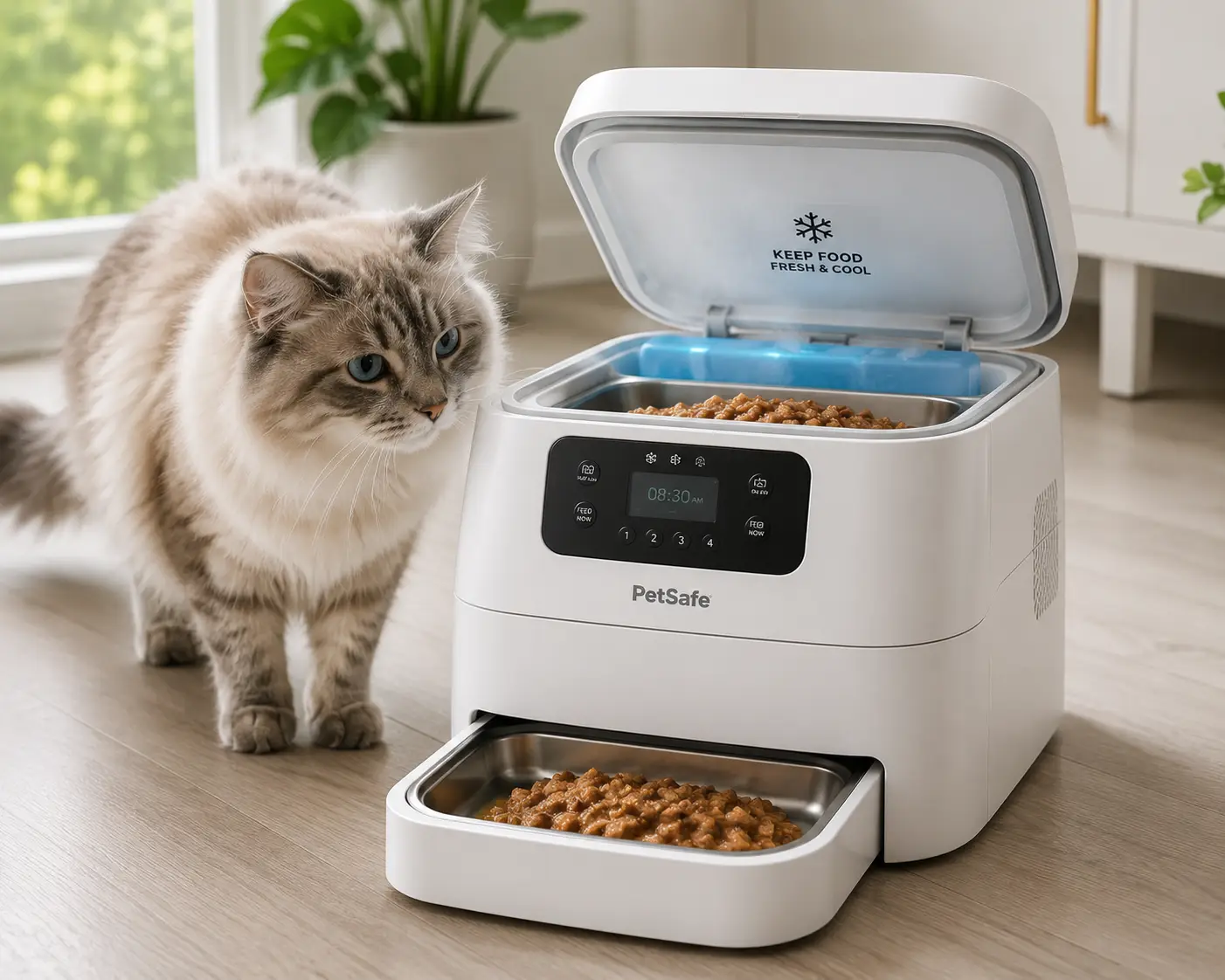
If you feed wet food and you’ve ever come home to a bowl of curdled mush baking on the counter, you already know why a refrigerated cat feeder exists. A refrigerated cat feeder is an automatic pet feeder that actively chills pre-portioned wet or raw meals — usually with a small thermoelectric (semiconductor) cooling chip or built-in ice packs — so food stays safe and appetizing for hours or even days instead of spoiling within a couple hours at room temperature.
That distinction matters more than most product listings let on. Plenty of “automatic feeders” on Amazon are really just timed dry-food dispensers with a cute name; a true refrigerated wet food cat feeder has to actually manage temperature, not just rotation. That’s a harder engineering problem, and it’s why prices and quality vary so widely across the category.
According to Cats.com’s independent testing of automatic cat feeders, most cats prefer wet food served closer to room temperature than fridge-cold, which is exactly why the better refrigerated models pause cooling just before mealtime rather than serving food straight from the chill cycle. Over the next several thousand words, we’ll dig into seven real, currently available models — from a $70 ice-pack unit to a $230 microchip-controlled system — and break down exactly what each one does well, where it falls short, and who should actually buy it. We’ll also cover the food-safety science behind cooling technology, how to avoid the most common buying mistakes, and what your first month with a cat feeder with cooling should look like. Whether you’re managing a single picky eater or a multi-cat household with conflicting diets, there’s a refrigerated cat feeder here that fits your budget and your cat’s habits.
This post contains affiliate links, and as an Amazon Associate we may earn a commission from qualifying purchases — more on that at the end of the article.
Quick Comparison: 7 Refrigerated Cat Feeders at a Glance
| Product | Cooling Type | Meals/Day | Price Range | Best For |
|---|---|---|---|---|
| PETLIBRO Polar Wet Food Feeder | Semiconductor | 3 | $130–$200 | First-time buyers wanting true refrigeration |
| PETLIBRO Polar 2026 5-Meal Upgrade | Semiconductor + heat | 5 | $150–$220 | Owners who want more meals and a steel bowl |
| UBPET F10 | Semiconductor | 5 | $70–$100 | Budget shoppers who still want real cooling |
| Cat Mate C500 | Ice packs | 5 | $70–$95 | No-frills, no-app reliability |
| Casfuy Cordless Feeder | Ice packs | 4 | $50–$80 | Tightest budgets, cordless convenience |
| SureFeed Microchip Feeder Connect | Sealed lid (no active cooling) | Free-feed | $180–$230 | Multi-cat homes with food-stealing issues |
| EVOTAILS Camera Feeder | Semiconductor + heat | 5 | $150–$220 | Owners who want a camera and remote “meal call” |
Looking at the table above, the split between semiconductor (thermoelectric) cooling and traditional ice packs is the single biggest factor separating these seven picks — semiconductor units like the PETLIBRO Polar Wet Food Feeder and UBPET F10 actively maintain a cold temperature for days, while ice-pack models like the Cat Mate C500 and Casfuy Cordless Feeder rely on a melting block that loses effectiveness within 12–24 hours. Neither approach is automatically “better” — it depends on how long your cat’s food actually needs to stay cold between servings, which we’ll unpack in the sections below. If food-stealing between cats is your main problem rather than spoilage, the SureFeed Microchip Feeder Connect solves a completely different issue and shouldn’t be judged by cooling specs alone.
💬 Bookmark this table now — you’ll want to scroll back to it once you’ve read the full breakdown below.
Top 7 Refrigerated Cat Feeders — Expert Analysis
1. PETLIBRO Polar Wet Food Feeder — the original true-refrigeration pick
The PETLIBRO Polar Wet Food Feeder was one of the first mainstream automatic feeders to replace ice packs with an actual thermoelectric cooling chip, and it’s still the most tested model in this category. According to the brand’s own lab data, when the room sits at 77°F, the Polar can chill food down to roughly 54°F — cold enough to meaningfully slow bacterial growth without freezing the texture of pâté or gravy-style food. A built-in sensor pauses cooling about 30 minutes before each scheduled meal, so your cat isn’t served a fridge-cold bowl. This model is best suited to single-cat households or owners who only need three defined meals a day, since that’s the hard ceiling on its scheduling. Reviews consistently report that the app is easy to navigate and that the PawShield lid design keeps curious cats from prying it open early, though the condensation tray under the cooling unit needs periodic wiping to prevent buildup. A verified buyer noted an occasional tray-rotation glitch, resolved after a reset — worth knowing about but not a dealbreaker for most owners.
Pros:
- ✅ Genuine semiconductor refrigeration, not a melting ice pack
- ✅ App lets you pick exact compartments and feeding windows
- ✅ Infrared anti-pinch sensor adds a real safety layer
Cons:
- ❌ Capped at three meals per day
- ❌ Condensation tray needs regular manual wiping
Expect to pay in the $130–$200 range depending on promotions; for buyers testing the refrigerated-feeder concept for the first time, it’s a reasonable entry price for the peace of mind true cooling provides.
2. PETLIBRO Polar 2026 Upgraded 5-Meal Feeder — more meals, steel bowl, gentle reheating
Building on the original Polar, this 2026 version adds two extra meal slots and swaps the plastic tray for a 304 stainless steel bowl — a meaningful upgrade if you’re feeding multiple cats or want a surface that won’t retain odors or scratch marks the way plastic does. The standout feature here is the added reheating step: the semiconductor unit doesn’t just chill food, it gently warms the next portion in the minutes before serving, addressing the common complaint that refrigerated feeders serve unappetizing cold meals. Based on comparing the spec sheets, this model is best for households that outgrew the three-meal limit of the base Polar but still want the brand’s app ecosystem and feeding-log history. What most buyers overlook is that the unit needs a continuous Wi-Fi connection to stay in sync — a dropped connection can delay scheduled meals, so it’s worth checking your router’s range near the feeder’s intended spot before committing.
Pros:
- ✅ Five meal slots instead of three
- ✅ Stainless steel bowl resists odor and scratching
- ✅ Active pre-serve warming step improves palatability
Cons:
- ❌ Requires a stable, continuous Wi-Fi connection
- ❌ Higher price than the base Polar for the added capacity
Priced roughly $150–$220, this is the mid-to-premium pick for owners who’ve already decided a refrigerated wet food cat feeder is worth the investment and just need more daily capacity.
3. UBPET F10 Automatic Cat Feeder — real refrigeration at a budget price
The UBPET F10 Automatic Cat Feeder is proof that semiconductor cooling cat feeder technology has trickled down to the budget tier. It uses the same category of thermoelectric chip as the pricier PETLIBRO models, with three adjustable cooling settings that keep food between roughly 55°F and 73°F depending on what you’re feeding. What most shoppers miss is that the freshness window shrinks depending on food type: the manufacturer states canned food stays good for 1–4 days, cooked meat 1–2 days, and raw meat just one day — a distinction that matters a lot if you feed a raw or lightly cooked diet. The five-compartment tray and digital button panel (no app required) make this a solid choice for owners who want real cooling without buying into another smartphone ecosystem, and reviewers note the motor runs under 40 decibels, which matters in a small apartment.
Pros:
- ✅ True semiconductor cooling well under $100
- ✅ Three selectable cooling intensity levels
- ✅ Quiet operation, no app account required
Cons:
- ❌ Freshness window for raw or cooked meat is short (1–2 days)
- ❌ No remote monitoring if you’re away from home
At roughly $70–$100, the UBPET F10 is arguably the best value-for-money pick in this entire lineup for anyone who wants a genuinely refrigerated automatic cat feeder without paying premium-brand pricing.
4. Cat Mate C500 — the reliable, no-app classic
The Cat Mate C500 isn’t a semiconductor unit — it uses two removable ice packs — but it earns its spot here as the benchmark for owners who distrust smart features and just want something that works every single day. Five compartments hold up to 11.5 ounces each, and a simple LCD timer lets you set four scheduled meals plus an immediate feed, no Wi-Fi or app account required. On paper, this means less precise temperature control than the semiconductor models above, but in practice, ice packs are perfectly adequate for absences under 12–24 hours, which covers a typical workday. Reviews consistently report strong long-term reliability, with owners praising it for managing fast eaters and cats with digestive sensitivities like IBS by spacing meals out automatically. A recurring complaint involves the tray occasionally misaligning, which the manufacturer addresses with a documented button-reset sequence rather than manual adjustment (forcing it by hand can damage the motor).
Pros:
- ✅ Runs roughly 12 months on 3 AA batteries — no outlet needed
- ✅ Dishwasher-safe bowl and lid
- ✅ No app, account, or Wi-Fi dependency whatsoever
Cons:
- ❌ Ice packs only hold safe temperatures for about half a day
- ❌ No smartphone notifications if something goes wrong
Priced around $70–$95, the Cat Mate C500 is the traditional alternative against which every semiconductor model in this article should really be judged — it trades multi-day cooling for rock-solid simplicity.
5. Casfuy Automatic Cat Feeder Cordless — the tightest-budget pick
If your absolute priority is spending as little as possible while still getting some cooling protection, the Casfuy Automatic Cat Feeder Cordless fills that niche. It ships with four ice packs and, unlike many budget feeders that eat through AA batteries, runs on a rechargeable internal battery — genuinely cordless, with a low-battery indicator so you’re not caught off guard. The programmable timer covers up to four meals, which is a notch below the five-meal capacity of several competitors here, and the compartments run slightly smaller than the Cat Mate C500‘s. What the spec sheet doesn’t say, but aggregated buyer feedback suggests, is that this model is best treated as a short-absence solution — think a workday or an overnight trip — rather than a multi-day away-from-home system, since ice packs alone can’t match semiconductor cooling once you’re past the 24-hour mark.
Pros:
- ✅ Rechargeable, fully cordless design
- ✅ Lowest price point in this roundup
- ✅ Low-battery indicator prevents surprise outages
Cons:
- ❌ Only four meal slots versus five on similarly priced rivals
- ❌ Ice-pack cooling window is shorter than semiconductor models
Expect to pay in the $50–$80 range — a sensible starting point if you’re not yet sure a refrigerated cat feeder is worth a bigger investment.
6. SureFeed Microchip Pet Feeder Connect — solves food theft, not just spoilage
The SureFeed Microchip Pet Feeder Connect approaches freshness from a completely different angle than the other six products here. Instead of active cooling, it uses your cat’s existing microchip (or an included collar tag) to unlock a rubber-sealed lid that only opens for the registered pet, closing again the moment they walk away — which both blocks food-stealing housemates and keeps air and flies off exposed wet food between visits. This is honest analysis, not marketing: the sealed lid slows spoilage but does not refrigerate food the way the semiconductor models do, so it’s not the right pick if your goal is multi-day cold storage. Where it shines is multi-cat households managing different diets — a cat on prescription renal food, for instance, can be kept away from a housemate’s regular food entirely. Reviews are mixed on long-term durability, with some owners reporting units failing after several months, and nearly everyone notes that the optional Hub (needed for full app monitoring) is sold separately, pushing the real cost higher than the sticker price suggests.
Pros:
- ✅ Microchip access reliably blocks food theft between cats
- ✅ Slow, quiet lid reduces the chance a nervous cat avoids the feeder
- ✅ App-based Hub tracks eating frequency, useful for spotting health changes early
Cons:
- ❌ No active refrigeration — relies on a sealed lid, not cooling
- ❌ Full smart features require buying the separate Hub
Base units run about $180–$230, with the Hub adding roughly $50 more if you don’t already own one — a real investment, but for the right multi-pet household, arguably a game-changer.
7. EVOTAILS Wet Food Automatic Cat Feeder with Camera — smart monitoring meets refrigeration
Rounding out the list, the EVOTAILS Wet Food Automatic Cat Feeder with Camera pairs semiconductor cooling and gentle pre-serve heating — the same core approach as the premium PETLIBRO models — with a built-in camera and two-way “meal call” feature that lets you see and talk to your cat remotely through the app. The five-meal stainless steel tray keeps it competitive on capacity, and the camera adds genuine value for owners who want visual confirmation their cat is actually eating, not just that the feeder dispensed on schedule. Here’s what to weigh: as a newer entrant compared to established brands like PETLIBRO or Cat Mate, it has a thinner long-term reliability track record, and stacking a camera, Wi-Fi, and a cooling unit into one device means more components that can eventually need troubleshooting. For tech-comfortable owners who already use camera feeders for dogs, this is a natural next step for a refrigerated wet food cat feeder.
Pros:
- ✅ Live camera plus two-way audio “meal call”
- ✅ Semiconductor cooling and pre-serve heating in one unit
- ✅ Stainless steel bowl across all five compartments
Cons:
- ❌ Newer brand with less long-term reliability history
- ❌ More connected components mean more potential points of failure
Typical pricing lands around $150–$220, positioning it as a direct alternative to the PETLIBRO 2026 upgrade for buyers who specifically want camera monitoring built in.
Setting Up Your Refrigerated Cat Feeder: The First 30 Days
Getting a new cat feeder with cooling right in the first month prevents most of the support tickets and one-star reviews you’ll see online. Start by running the unit empty for a few hours before loading food, so you can confirm the cooling element actually reaches temperature in your specific room — a garage or sunroom that regularly tops 86°F will struggle to keep any semiconductor unit at a safe temperature, per most manufacturer guidance. Load only as much food as your cat will realistically eat within the stated freshness window rather than filling every compartment out of habit; overfilling is one of the most common reasons owners report “wasted” food.
During week one, keep your original feeding schedule and simply route it through the new device rather than changing meal times and feeder type simultaneously — cats adjust to new equipment faster when the timing stays familiar. Clean the tray, lid, and (for semiconductor models) the condensation collection area every two to three days regardless of how “clean” it looks; residue buildup is invisible until it starts affecting the seal. Finally, budget 10–15 minutes to fully understand the app or button sequence before your first extended absence — test a full 24-hour cycle while you’re still home so you can catch scheduling errors before they matter.
Real-World Scenarios: Which Refrigerated Feeder Fits Your Life
Not every household needs the same feeder, so it helps to think in terms of actual routines rather than feature checklists.
The 9-to-5 commuter with one cat: If you’re gone eight to ten hours on a predictable schedule and just need lunch to stay fresh until dinner, the Cat Mate C500‘s ice packs are more than sufficient, and you save money you’d otherwise spend on semiconductor cooling you don’t fully need.
The frequent business traveler: Someone gone for two or three days at a stretch needs genuine multi-day refrigeration, which points toward the PETLIBRO Polar Wet Food Feeder or the UBPET F10 — both rated for multi-day freshness rather than a single workday.
The multi-cat household with a food thief: If spoilage isn’t actually your problem — one cat bullying another away from their bowl is — the SureFeed Microchip Pet Feeder Connect solves a completely different pain point that no amount of cooling technology addresses.
Troubleshooting Common Refrigerated Feeder Problems
Even well-reviewed units run into predictable snags. Here’s how to solve the ones that come up most often.
Problem: Food still looks or smells slightly off despite the cooling running. Check that the unit is rated for the food type you’re using — as UBPET’s own documentation shows, raw meat has a much shorter safe window (about one day) than canned wet food (up to four days), even in the same feeder.
Problem: The app won’t sync or meals are served late. This is almost always a Wi-Fi range issue rather than a hardware fault; move your router closer or add a mesh extender near the feeder before assuming the unit itself is defective.
Problem: Condensation pooling under the tray. This is normal for semiconductor units and simply needs manual wiping every few days — it’s a byproduct of active cooling meeting room-temperature air, not a sign of malfunction.
Problem: A multi-cat household still has one cat stealing another’s food. No amount of cooling technology fixes this — it requires a microchip- or RFID-gated feeder like the SureFeed Microchip Pet Feeder Connect instead.
✨ Ready to stop guessing and just fix your cat’s mealtime for good? 🐾 Compare the seven picks above side by side and pick the one that matches your actual schedule — not just the flashiest feature list. Your future self (and your cat) will thank you.
How to Choose a Refrigerated Cat Feeder
- Match cooling type to absence length. Ice-pack models like the Cat Mate C500 are fine for a single workday; semiconductor units like the PETLIBRO Polar Wet Food Feeder are worth the extra cost for multi-day trips.
- Count your actual meals, not the marketing number. A three-meal cap only matters if your cat genuinely eats three separate meals a day — don’t overpay for five slots you won’t use.
- Decide if you need an app at all. If you’re rarely away for more than a day, a no-frills digital timer like the one on the UBPET F10 removes an entire category of potential Wi-Fi headaches.
- Check bowl material for your cat’s sensitivities. Cats prone to feline acne or chin irritation often do better with stainless steel trays, like those on the PETLIBRO Polar 2026 Upgraded 5-Meal Feeder, over plastic.
- Consider multi-cat dynamics separately from freshness. If food theft between pets is the real issue, look at the SureFeed Microchip Pet Feeder Connect instead of chasing better cooling specs.
- Factor in cleaning frequency, not just capacity. Every refrigerated feeder needs the tray and seals cleaned every two to three days regardless of listed freshness duration — plan for that time commitment upfront.
- Read the fine print on room temperature limits. Most semiconductor units, including the PETLIBRO Polar Wet Food Feeder, specify a maximum ambient temperature (commonly around 86°F) beyond which cooling performance drops.
Common Mistakes to Avoid When Buying a Refrigerated Cat Feeder
The single biggest mistake shoppers make is confusing “automatic feeder” with “refrigerated feeder” — plenty of listings use similar language while only offering a basic ice-pack compartment or no cooling at all, which matters enormously if you’re feeding raw or lightly cooked food. A second common error is buying based purely on meal count without checking whether the freshness window actually covers your absence length; five meal slots are useless if the food is unsafe by meal three. Buyers also frequently underestimate ongoing costs — ice-pack models need replacement packs over time, and semiconductor units draw continuous power, both of which add up. Finally, don’t assume every “smart” feeder needs a Hub or subscription: as the SureFeed Microchip Pet Feeder Connect demonstrates, some core features are locked behind an accessory that isn’t included in the base price, so read the full product listing before assuming the advertised price is your final cost. As Apartment Therapy’s hands-on review of the PETLIBRO Polar notes, even well-reviewed feeders can surprise you with small maintenance details, like condensation buildup, that rarely make it into the headline product description.
Semiconductor Cooling vs. Ice Packs: What Actually Keeps Food Safe
This is the comparison that matters most in the refrigerated cat feeder category, and it’s worth understanding the mechanics rather than just trusting a badge on the box. Semiconductor (thermoelectric/Peltier) cooling uses an electrical current to actively pull heat away from the food compartment, which is why models like the PETLIBRO Polar Wet Food Feeder and UBPET F10 can maintain a consistently cold temperature for two to four days as long as they stay plugged in and within their rated ambient temperature range. Ice packs, by contrast, are a passive, finite cooling source — the Cat Mate C500 and Casfuy Automatic Cat Feeder Cordless both rely on frozen gel packs that gradually warm as they absorb heat from the surrounding air, typically holding a safe temperature for roughly 12 to 24 hours before needing to be swapped or refrozen.
Neither system is objectively superior; they’re built for different absence lengths. According to FDA guidance on safe pet food handling, pet food and treats can carry harmful bacteria capable of causing foodborne illness much like improperly handled human food can, which is exactly why a feeder’s cooling method should match how long food actually sits before your cat eats it. If you’re gone eight hours a day, ice packs are functionally adequate and considerably cheaper over the product’s lifetime. If you travel for a long weekend, only a semiconductor unit realistically keeps pace, and running out of cold ice packs mid-trip isn’t something you want to discover after the fact.
Long-Term Cost and Maintenance of a Refrigerated Cat Feeder
The sticker price is only part of what you’ll actually spend. Semiconductor models like the PETLIBRO Polar Wet Food Feeder and EVOTAILS Wet Food Automatic Cat Feeder with Camera draw continuous low-wattage power to keep the cooling chip running, which adds a modest but real amount to your electricity bill over a year — typically a few dollars, but worth knowing if you’re comparing total cost of ownership. Ice-pack models like the Cat Mate C500 avoid that ongoing electrical draw but need replacement ice packs periodically as the originals lose their cooling capacity after repeated freeze-thaw cycles, which is a small recurring cost most buyers don’t budget for upfront.
Battery-powered units, including the Casfuy Automatic Cat Feeder Cordless, save on outlet dependency but need periodic recharging or battery replacement, and app-connected models add an indirect cost: your home Wi-Fi needs to reach the feeder reliably, which occasionally means budgeting for a mesh extender. Across all seven products here, the most overlooked long-term cost is replacement trays and seals — rubber gaskets on lids like the SureFeed Microchip Pet Feeder Connect‘s do wear out over months of daily use, and factoring in an occasional $10–$20 replacement part keeps your total cost estimate realistic.
Safety, Regulations, and Standards for Refrigerated Cat Feeders
Pet food safety in the US isn’t governed by a feeder-specific regulation, but the same food-handling science that applies to human meals applies directly here. the USDA Food Safety and Inspection Service defines the “danger zone” for perishable food as the range between 40°F and 140°F, where bacteria can double in number roughly every 20 minutes — precisely the range an underperforming or malfunctioning refrigerated feeder can accidentally sit in. This is also why manufacturers specify a maximum operating room temperature: a semiconductor chip working against an 86°F+ kitchen simply can’t hold food safely below that danger zone threshold no matter how well-engineered it is.
Look for products constructed from BPA-free plastics and food-grade stainless steel, both of which every model in this roundup uses for food-contact surfaces. If you’re feeding raw meat specifically, note that several manufacturers — PETLIBRO among them — explicitly advise against using their refrigerated units for raw diets due to raw food’s faster spoilage rate and higher baseline bacterial risk, a distinction that’s easy to miss in a product listing’s headline claims. When in doubt, remember that most cats generally prefer wet food closer to room temperature than served fridge-cold when programming your feeder’s serving schedule, since a reluctant eater sometimes just needs a longer warm-up window before mealtime, not a different feeder entirely.
Frequently Asked Questions
❓ What's the real difference between a refrigerated cat feeder and a regular automatic feeder?
❓ How long does food actually stay fresh in a refrigerated cat feeder?
❓ Do refrigerated cat feeders work during a power outage?
❓ Can I use a refrigerated cat feeder for multiple cats?
❓ Are refrigerated cat feeders safe to leave running while I'm on vacation?
Conclusion
A refrigerated cat feeder isn’t a luxury gadget so much as a practical answer to a real food-safety problem: wet food simply doesn’t stay safe sitting out the way dry kibble does. Across the seven models here, the right pick comes down to how long your cat is actually left unattended between meals and how much you value app control versus simplicity. For most single-cat households easing into the category, the PETLIBRO Polar Wet Food Feeder remains the most balanced starting point, while budget-focused buyers get genuine semiconductor cooling from the UBPET F10 without the premium price tag. If your household’s real problem is food theft rather than spoilage, remember that the SureFeed Microchip Pet Feeder Connect is solving a different question entirely, and no amount of cooling power will fix a multi-cat power struggle over the food bowl.
Whichever direction you go, treat the freshness window and the ambient temperature limits as hard constraints rather than marketing footnotes — that’s the difference between a feeder that quietly does its job and one that leaves you with a vet bill. Take the time to match the product to your actual routine, and a good refrigerated wet food cat feeder should more or less disappear into the background of your daily life, which is exactly what it’s supposed to do.
✨ Found the right feeder for your cat? 🐱 Check current pricing and availability on any of the seven picks above before you decide — prices shift often, so it’s worth a quick look at the time you’re ready to buy.
Recommended for You
- Dog Bowls for Flat Faced Dogs: 7 Best Options for Easier Feeding in 2026
- 7 Best Dog Bowls for Large Dogs in 2026 (Vet-Reviewed Picks)
- Automatic Water for Cats: 7 Best Fountains That Actually Work (2026)
Disclaimer: This post contains affiliate links. As an Amazon Associate, I earn from qualifying purchases made through these links, at no additional cost to you.
✨ Found this article helpful? Share it with someone who needs it! 💬🤗