In This Article
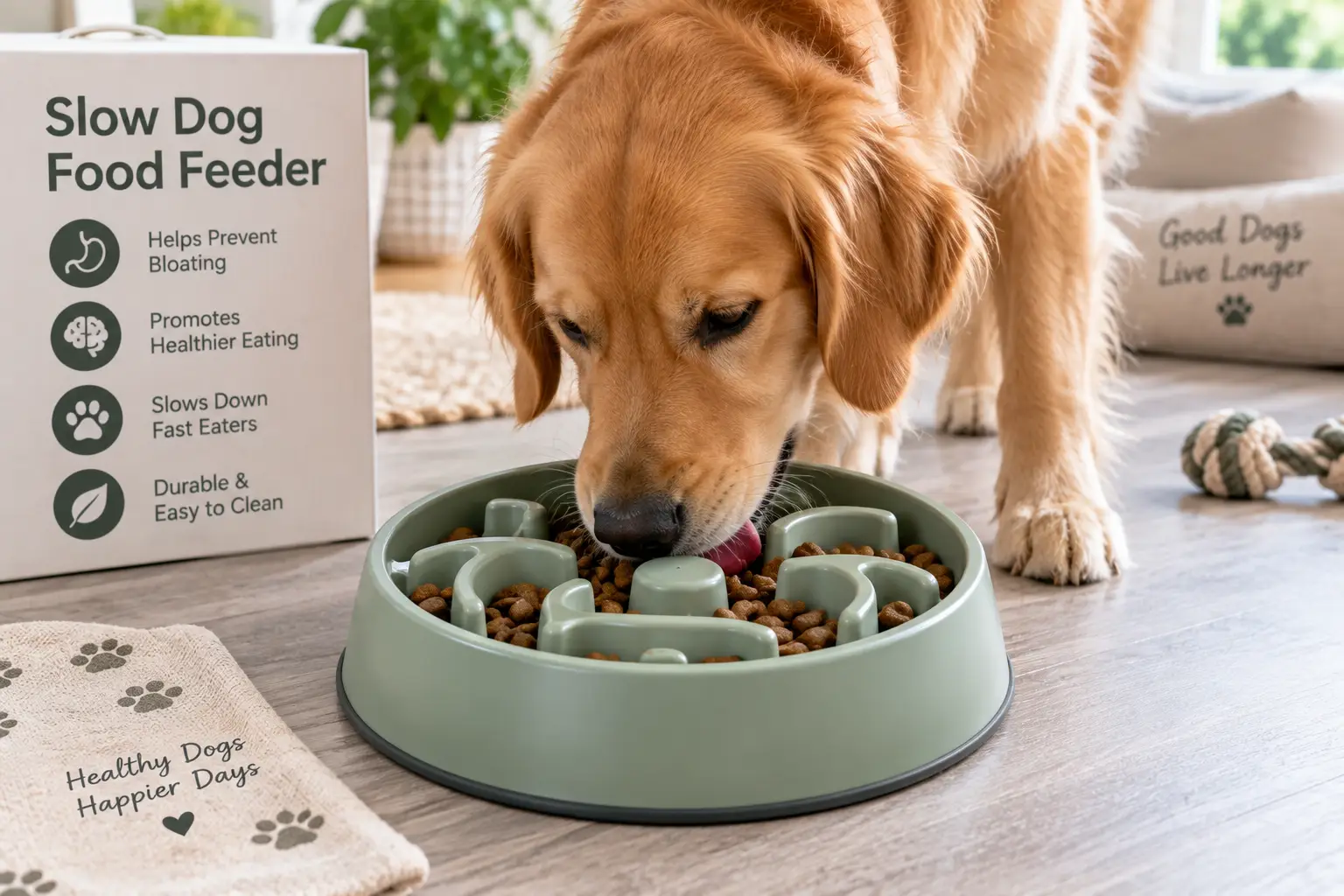
If mealtime at your house sounds like a shop vac clearing a spill, you already know why you searched for a slow dog food feeder. A slow dog food feeder is a bowl or puzzle-style dish built with raised ridges, mazes, or chambers that force your dog to work around obstacles instead of inhaling an entire meal in ten seconds flat. It’s a low-effort, high-impact fix for one of the most common (and most overlooked) mealtime problems in dog ownership.
Fast eating isn’t just messy — it’s a legitimate health concern. Dogs that gulp their food swallow air along with it, which can trigger vomiting, gas, and in the worst cases, a life-threatening emergency called bloat, or gastric dilatation-volvulus. We’ll dig into that risk in detail later, but the short version is this: slowing down your dog’s eating pace is one of the simplest, cheapest interventions you can make at home.
This guide breaks down seven real, currently available slow dog food feeder bowls — from $10 budget mazes to USA-made enrichment bowls — based on their actual design mechanics, materials, and aggregated owner feedback. You’ll also get a buyer’s framework, common feeding mistakes to avoid, and answers to the questions people ask most before buying. Whether you have a Labrador who treats kibble like a competitive sport or a French Bulldog who needs a gentler, shallower design, there’s a feeder on this list built for your dog’s specific eating style.
Quick Comparison: The 7 Best Slow Dog Food Feeders at a Glance
| Feeder | Best For | Material | Capacity | Price Range |
|---|---|---|---|---|
| Outward Hound Fun Feeder Slo-Bowl | Best overall | BPA-free plastic | 3/4–4 cups | around $10–$20 |
| Frisco Bone Shaped Ridges Slow Feed Bowl | Best budget pick | BPA-free plastic | 3 cups | around $10–$15 |
| Gorilla Grip Slow Feeder Dog Bowl | Best size range | BPA-free plastic | 1–4 cups | around $12–$20 |
| SodaPup Honeycomb eBowl | Best for large/chewy eaters | FDA-compliant TPE | 4 cups | around $25–$35 |
| Neater Pet Brands Stainless Steel Slow Feed Bowl | Best for hygiene | Stainless steel | 3/4–3 cups | around $15–$30 |
| LickiMat Slomo XL | Best for wet food & flat faces | Food-grade polypropylene/rubber | up to 3 cups | around $15–$25 |
| Nina Ottosson Lickin’ Layers 3-in-1 | Best puzzle-level challenge | Polypropylene/TPR | 1.5–2 cups | around $15–$25 |
Looking at the table above, the Outward Hound Fun Feeder Slo-Bowl earns its “best overall” spot mostly on versatility — it comes in three difficulty levels and multiple sizes, so it scales with almost any dog. Budget-focused shoppers should note that the Frisco Bone Shaped Ridges Slow Feed Bowl and Gorilla Grip Slow Feeder Dog Bowl both undercut it on price while still delivering a genuine maze mechanism, not just decorative ridges. If your dog is a committed chewer or gulps hard enough to flip lighter bowls, the SodaPup Honeycomb eBowl and Neater Pet Brands Stainless Steel Slow Feed Bowl are worth the extra cost for their added durability.
💬 One click helps other shoppers make an informed choice too! 😊
Top 7 Slow Dog Food Feeders — Expert Analysis
Below is a closer look at each pick, based on published specs, manufacturer materials data, and aggregated customer sentiment from retailer review sections. Prices shift constantly on Amazon, so treat every figure here as a general range — always check the current price before buying.
1. Outward Hound Fun Feeder Slo-Bowl — proven maze design that scales to any dog
The Fun Feeder Slo-Bowl is the name most people already picture when they hear “slow feeder,” and that reputation is earned rather than marketed. Its raised ridges and grooves create a shallow maze that forces kibble into narrow channels, and it comes in three graduated difficulty levels — Slow, Slower, and Slowest — so you can match the challenge to how fast your dog actually eats, not just guess.
What sets this bowl apart in practice is the range: it’s sold in small (3/4 cup), medium (2 cup), and large (3–4 cup) sizes, plus a shallow variant designed specifically for flat-faced breeds. That’s a meaningful detail most competitors skip — a Frenchie or Pug can’t physically navigate a deep, narrow maze the same way a Labrador can, so having a dedicated shallow pattern matters more than it sounds. The base is wider than the bowl itself and topped with a non-slip coating, which keeps enthusiastic eaters from shoving it across the kitchen floor mid-meal.
This is the feeder to start with if you’re not sure how determined a puzzle-solver your dog is. Beginners and food-motivated dogs both tend to adapt to it within a few meals, and its moderate depth means it rarely frustrates a dog into giving up on eating altogether — a real risk with more extreme maze designs.
Reviews consistently report that the Fun Feeder Slo-Bowl noticeably stretches mealtime, with many owners citing meals that used to take under a minute now taking several. A recurring theme in aggregated feedback is that determined chewers can eventually gnaw at the raised ridges, so it’s marketed as a feeding tool rather than a chew toy.
Pros:
- ✅ Three difficulty levels match the bowl to your dog’s pace
- ✅ Available in a shallow style for flat-faced breeds
- ✅ Top-rack dishwasher safe and free of BPA, PVC, and phthalates
Cons:
- ❌ Aggressive chewers can eventually damage the raised plastic ridges
- ❌ The shallowest “Slow” level offers limited challenge for very fast eaters
Expect to pay somewhere in the $10–$20 range depending on size, which makes this one of the best value-to-effectiveness ratios on this entire list.
2. Frisco Bone Shaped Ridges Slow Feed Bowl — best entry point for first-time slow feeder buyers
If you’ve never tried a slow feeder and aren’t sure your dog will tolerate one, the Frisco Bone Shaped Ridges bowl is a low-risk way to test the waters. It uses a bone-shaped ridge pattern inside a standard-depth bowl, which is gentle enough that most dogs adjust within their first couple of meals rather than needing a training period.
The bowl holds 3 cups and measures roughly 9 inches at its widest with a 1.5-inch depth, so it’s suited to small and medium dogs eating dry kibble rather than large breeds needing bigger portions in one sitting. The ergonomic opening makes it easy to pick up and wash, and the non-skid bottom keeps it anchored during use — a small detail that matters more than it sounds once a hungry dog starts nosing at an empty corner.
Where this bowl earns its “original content” value over a plain listing is in who it’s actually built for: it’s a strong match for households transitioning a puppy onto slower eating habits, or for owners managing a dog with a sensitive stomach who needs smaller, more controlled bites without the added expense of a premium enrichment bowl.
Reviews consistently mention that the bowl holds up well over time and slows eating noticeably, with several owners specifically praising it for helping dogs manage gastrointestinal sensitivity. A common thread in feedback is that dogs eating very large kibble may struggle to fit a full 3-cup portion around the ridges without some spilling over the top.
Pros:
- ✅ Gentle ridge pattern that’s easy for slow feeder beginners
- ✅ Non-skid base keeps the bowl in place during meals
- ✅ Budget-friendly price point for a name-brand bowl
Cons:
- ❌ Not deep enough to meaningfully slow determined large-breed gulpers
- ❌ Large kibble can crowd the ridge pattern at full capacity
At around $10–$15, this is a smart first purchase if you’re testing whether your dog will even accept a slow feeder before investing in a pricier option.
3. Gorilla Grip Slow Feeder Dog Bowl — best for matching bowl size to breed size
Gorilla Grip’s slow feeder stands out for one practical reason: it comes in more granular capacity options than most competitors, spanning 1-cup, 2-cup, and 4-cup versions built on the same maze design. That means you’re not stuck sizing up or down to the nearest “small/medium/large” label — you can pick the exact portion size that matches your dog’s actual meal.
The maze pattern inside is a continuous, winding channel rather than isolated ridges, which tends to hold a dog’s attention longer because there’s no obvious shortcut around it. The rubber bottom wraps around the entire base of the bowl rather than sitting as a separate pad, which does a better job resisting sliding than bowls with a simple flat rubber ring.
What most buyers overlook with this model is its cross-species flexibility — the same bowl works for cats as well as dogs, which is a genuine convenience in multi-pet households where you’d otherwise be buying and storing two different slow feeder designs. It’s also rated for use with wet food, dry food, and even frozen treats, extending its usefulness well past standard kibble meals.
Reviews consistently describe the maze as “just difficult enough” — engaging without provoking the frustration that can come from overly aggressive puzzle patterns. A recurring complaint in aggregated feedback is that very strong eaters can still nudge the bowl slightly during frantic bites, even with the wraparound rubber base.
Pros:
- ✅ Four capacity sizes for precise portion matching
- ✅ Works across wet food, dry kibble, and frozen treats
- ✅ Rubber base wraps the entire bottom for extra grip
Cons:
- ❌ Very forceful eaters can still shift the bowl slightly during meals
- ❌ Maze pattern is less effective once food levels drop below halfway
Pricing generally falls in the $12–$20 range depending on capacity, putting it squarely in the mid-budget tier.
4. SodaPup Honeycomb eBowl — best for large breeds and determined chewers
The SodaPup Honeycomb eBowl is a different category of product entirely. It’s manufactured in the USA from FDA-compliant TPE (thermoplastic elastomer) rather than injection-molded plastic, and it shows: the material has enough flex and bite-resistance to hold up to dogs that would eventually chew through a standard plastic ridge pattern.
Its signature feature is a 2-inch-deep honeycomb maze of hexagonal chambers, which is noticeably more aggressive than the shallow grooves found on most budget bowls. That depth matters specifically for large and giant breeds — the dogs most at risk of bloat-related complications — because a shallow maze simply doesn’t slow down a 90-pound dog’s bite force the way it slows a 15-pound dog’s. The bowl holds a full 4 cups, so it accommodates a complete meal for bigger breeds without needing a refill mid-feeding.
Based on comparing the specs against lighter competitors, this bowl’s biggest practical advantage is versatility beyond kibble: it’s freezer-safe and microwave-safe, which means you can pack it with a wet-food-and-kibble mix and freeze it for a longer-lasting enrichment session, or gently warm refrigerated food to make it more appealing for a picky eater.
Reviews consistently praise the honeycomb design for genuinely extending mealtime for fast eaters, particularly large and deep-chested breeds that are hardest to slow down with shallower bowls. A common critique in aggregated feedback is that TPE bowls carry a noticeably higher price tag than plastic competitors, which some owners feel is steep for what is still fundamentally a feeding bowl.
Pros:
- ✅ Deep honeycomb maze built specifically for large, determined eaters
- ✅ USA-made from FDA-compliant TPE that resists chewing damage
- ✅ Freezer- and microwave-safe for frozen or warmed meals
Cons:
- ❌ Noticeably pricier than plastic slow feeders of similar capacity
- ❌ Not intended as a chew toy despite its bite-resistant material
Expect a price range of roughly $25–$35, which reflects the domestic manufacturing and premium material rather than a markup for branding alone.
5. Neater Pet Brands Stainless Steel Slow Feed Bowl — best for hygiene-conscious households
If you’d rather avoid plastic and TPE altogether, the Neater Pet Brands Stainless Steel Slow Feed Bowl solves the slow-eating problem with a raised dome in the center rather than a maze pattern. Food sits in the channel around the dome, and the dog has to work the perimeter instead of diving straight into the middle of a full bowl.
Stainless steel carries real, practical advantages over plastic slow feeders: it doesn’t retain odors the way porous plastic can over time, it’s naturally resistant to bacterial buildup, and it holds up to both dishwasher cycles and daily scrubbing without scratching or clouding. It’s sold in multiple capacities — a 3/4-cup size for small dogs up through a 3-cup option for larger breeds — and several sizes are designed to drop directly into Neater Feeder elevated feeding stations, which is a nice bonus if you’re already managing a dog with mobility issues or messy drinking habits.
What the spec sheet doesn’t say, but reviews reveal, is that the dome-style mechanism tends to be gentler and less frustrating for dogs that struggled with deep maze bowls — it slows eating through geometry rather than forcing a dog to navigate tight channels, which some picky or anxious eaters tolerate better.
Reviews consistently highlight the hygiene benefit as the main reason owners switch to this bowl, alongside genuine praise for how effectively the raised center curbs gulping. One recurring theme in aggregated feedback is mixed: some owners find the dome design slows eating less dramatically than a deep maze pattern, particularly for the fastest eaters.
Pros:
- ✅ Stainless steel resists odor, bacteria, and staining better than plastic
- ✅ Dome mechanism is gentler for dogs frustrated by deep mazes
- ✅ Fits directly into compatible Neater Feeder elevated stations
Cons:
- ❌ Less aggressive slowdown than deep honeycomb or maze-style bowls
- ❌ Smaller sizes may not suit dogs needing a full large-breed portion
Pricing runs from about $15 for smaller sizes up to around $30, depending on capacity and whether you buy the bowl alone or as part of a full Neater Feeder set.
6. LickiMat Slomo XL — best for wet food, raw diets, and flat-faced breeds
The LickiMat Slomo XL takes an entirely different mechanical approach: instead of a maze that food gets pushed into, it’s a textured mat-style feeder with deep pockets, raised nubs, and recessed channels designed to be licked rather than gulped. That distinction matters because it’s the only feeder on this list explicitly built to handle wet food, raw diets, and liquid meals as easily as dry kibble — something most rigid maze bowls handle poorly.
Measuring roughly 11.8 by 11.8 inches with a shallow 1.2-inch lip, the Slomo XL is designed for medium, large, and giant breeds and made from food-safe polypropylene with a non-slip rubber base. Because the surface is flat and wide rather than a deep bowl, it’s genuinely one of the better options for brachycephalic (flat-faced) breeds like Bulldogs and Boxers, who often struggle to physically reach food packed into a narrow maze channel.
Here’s what most buyers overlook: the licking mechanism doesn’t just slow eating, it also stimulates extra saliva production, which some owners use as a secondary calming tool during stressful situations like vet visits or grooming, not just at regular mealtimes. That dual purpose is a genuine point of differentiation from a standard bowl-shaped feeder.
Reviews consistently note that dogs adapt to the licking motion quickly, often faster than they adapt to a maze-style puzzle bowl, and that it handles mixed wet-and-dry meals without much spillage. A recurring complaint in aggregated feedback is that the rubber-textured surface takes more scrubbing effort to fully clean than a smooth plastic or steel bowl, even though it’s dishwasher safe.
Pros:
- ✅ Handles wet food, raw diets, and liquid meals without a mess
- ✅ Shallow, wide design works well for flat-faced breeds
- ✅ Dishwasher, freezer, and microwave safe
Cons:
- ❌ Textured surface takes more effort to scrub clean by hand
- ❌ Less effective than a deep maze for dry-kibble-only gulpers
Prices generally land in the $15–$25 range for the XL size, with smaller versions available at a lower cost for compact breeds.
7. Nina Ottosson Lickin’ Layers 3-in-1 — best for dogs who’ve outgrown basic slow feeders
For dogs that have already mastered a standard maze bowl and barely slow down anymore, the Nina Ottosson Lickin’ Layers pushes the difficulty up a level. It combines three spinning, textured layers that a dog has to rotate and lick through to reach food underneath, rather than a static pattern they can memorize after a few meals.
Rated as a Level 2 intermediate puzzle by its manufacturer, this feeder holds up to 2 cups and measures about 10.4 by 10.4 inches, making it best suited to medium and large dogs rather than toy breeds. It’s built from a blend of polypropylene and thermoplastic rubber, giving the spinning layers enough grip resistance that a dog has to genuinely work the mechanism rather than just flip it over.
Based on comparing this design against the static maze bowls earlier on this list, its real advantage is mental engagement, not just physical slowdown. A dog that’s bored of a standard slow feeder often speeds back up over time as the pattern becomes predictable; a rotating, multi-layer design keeps introducing enough novelty that it stays genuinely challenging for longer, which matters for high-energy or highly food-motivated breeds.
Reviews consistently describe this as noticeably more engaging than single-layer slow feeders, with many owners specifically buying it as a step up once a simpler bowl stopped working. A common theme in aggregated feedback is that dogs new to puzzle feeders can find the three-layer mechanism confusing at first and may need a short adjustment period with a couple of layers left open.
Pros:
- ✅ Three spinning layers add real mental challenge, not just physical slowdown
- ✅ Over 100 treat compartments extend mealtime significantly
- ✅ Dishwasher-safe components for easy cleanup
Cons:
- ❌ Steeper learning curve than single-layer slow feeder bowls
- ❌ Smaller 2-cup capacity isn’t a full meal for larger dogs
Expect to pay roughly $15–$25, positioning it as a mid-tier purchase best reserved for dogs who’ve already outpaced a basic maze bowl.
✨ Don’t miss these exclusive deals! 🔍 Take your dog’s mealtime to the next level with this carefully curated lineup. Click a highlighted item to check current pricing and availability. These picks will help you get calmer, healthier eating habits the whole family will enjoy!
How to Introduce a Slow Feeder Without Frustrating Your Dog
Switching a fast eater onto a slow feeder isn’t always instant — some dogs adapt within one meal, others need a short transition period. Getting the first week right makes the difference between a bowl that gets used daily and one that ends up in a drawer.
Start with the shallowest, easiest pattern you have access to, even if you eventually plan to size up. A dog who’s frustrated by a deep maze on day one may refuse to eat at all, which defeats the entire purpose. If you bought a bowl with adjustable difficulty, like the Outward Hound Fun Feeder Slo-Bowl’s Slow/Slower/Slowest levels, begin on the easiest setting for the first three to five meals.
Mix in a little extra encouragement during the first few feedings. Hand-placing a few pieces of kibble into the maze channels before setting the bowl down helps some dogs understand the mechanism faster than being left to figure it out cold. For wet food or lick-mat-style feeders like the LickiMat Slomo, smearing a thin layer across the textured surface — rather than dumping food in one pile — teaches the licking motion more naturally.
Watch for genuine frustration versus normal adjustment. A dog pawing, nosing, and working at the bowl is adjusting normally. A dog that walks away repeatedly, barks at the bowl, or won’t approach it after a few tries needs an easier design, not more patience. Once your dog is reliably clearing a slow feeder in three to five minutes instead of under a minute, you can consider sizing up to a more challenging pattern if they’re still a fast eater relative to that benchmark.
Clean the feeder after every meal, especially maze and honeycomb-style bowls where food debris can lodge in tight channels. A build-up of old food residue isn’t just unhygienic — it can also make the maze pattern less effective as leftover bits fill in the very channels designed to slow eating down.
Real-World Scenarios: Matching the Right Feeder to Your Dog
The large-breed gulper. A 75-pound Labrador that finishes a full bowl in under 30 seconds, multiple times a day, needs a deep, high-capacity design that can’t be out-muscled. The SodaPup Honeycomb eBowl‘s 2-inch maze depth and 4-cup capacity is built for exactly this profile, and its bite-resistant TPE construction holds up to the stronger jaw pressure large breeds bring to mealtime.
The budget-conscious first-time buyer. Someone testing whether their dog will even tolerate a slow feeder, without wanting to spend $30 to find out, is better served starting with the Frisco Bone Shaped Ridges Slow Feed Bowl or the entry-level Gorilla Grip Slow Feeder. Both offer a real maze mechanism at a price low enough to experiment without much financial risk.
The flat-faced or senior dog. A Bulldog, Pug, or older dog with dental sensitivity often struggles physically with deep maze bowls — not because they’re not smart enough to solve the puzzle, but because their muzzle shape or mouth comfort can’t reach into narrow channels comfortably. The LickiMat Slomo XL‘s shallow, wide surface removes that physical barrier while still meaningfully slowing eating pace.
The multi-pet household mixing wet and dry food. Owners feeding a combination diet, or juggling different food types across multiple pets, benefit most from a feeder rated for both wet and dry use. The Gorilla Grip Slow Feeder and LickiMat Slomo XL both handle this cleanly, while a rigid maze-only bowl can trap wet food in ways that are harder to clean and less effective at slowing eating.
The bored, food-motivated escape artist. A dog that’s already mastered a basic slow feeder and started speeding back up over time needs more mental complexity, not just physical obstruction. The Nina Ottosson Lickin’ Layers 3-in-1‘s rotating compartments introduce enough novelty to keep even a determined puzzle-solver engaged past the point a static bowl would stop working.
What Is a Slow Dog Food Feeder?
A slow dog food feeder is a specially designed bowl, mat, or puzzle dish that uses raised ridges, mazes, chambers, or textured surfaces to physically limit how much food a dog can access per bite. Instead of a smooth, open bowl that allows a dog to inhale an entire meal in seconds, the obstacles force smaller, slower bites — typically stretching a meal from under a minute to several minutes.
The core idea isn’t new: it mimics the effort involved in natural foraging, where wild canines work for scattered food rather than eating from a single concentrated pile. Slow feeders simply recreate that friction in a domestic feeding bowl, which is why many designs double as light mental enrichment tools rather than purely mechanical eating obstacles.
Fast, uncontrolled eating is also closely tied to overeating in general — a dog that finishes a bowl in seconds has less time for the brain’s normal fullness signals to catch up before a second helping goes down. That connection matters given how common the underlying issue is: the Association for Pet Obesity Prevention has found that well over half of U.S. dogs are classified as overweight or obese by their veterinarian, and pacing meals is one of the few free, low-effort habits that meaningfully supports a healthy weight over time.
How to Choose a Slow Dog Food Feeder
Picking the right slow feeder comes down to matching the design to your specific dog, not just grabbing whichever bowl has the most five-star reviews. Here’s the framework worth working through before you buy.
- Measure your dog’s eating speed honestly. If a full bowl disappears in under 15 seconds, you need a deep maze or honeycomb pattern, not a shallow ridge design. If it’s closer to 30–45 seconds, a moderate maze bowl will likely be enough.
- Consider muzzle shape before difficulty level. Flat-faced breeds physically struggle with deep, narrow channels regardless of how motivated they are — prioritize shallow, wide designs like a lick-mat-style feeder over a deep maze.
- Match capacity to actual meal size, not bowl size alone. A feeder rated for “2 cups” that barely fits your dog’s real portion will overflow around the maze pattern and lose most of its slowing effect.
- Factor in material based on chewing behavior. Determined chewers do better with bite-resistant TPE or stainless steel; dogs that eat and walk away do fine with standard BPA-free plastic.
- Check whether it handles your dog’s actual diet. Wet food, raw diets, and mixed meals need a feeder explicitly rated for non-dry food — many rigid maze bowls are dry-kibble-only in practice, even if not by label.
- Prioritize a non-slip base for enthusiastic eaters. A bowl that slides across tile mid-meal quickly becomes a bowl your dog stops using, no matter how good the maze design is.
- Plan for an adjustment period, not instant results. If your dog seems frustrated in the first few meals, that’s a sign to size down the difficulty, not a sign the whole concept doesn’t work for your dog.
Slow Feeders vs. Puzzle Toys vs. Elevated Bowls
These three categories get lumped together often, but they solve different problems and aren’t interchangeable. A standard slow feeder bowl — like the Outward Hound Fun Feeder or Frisco Bone Shaped Ridges — is built to replace your dog’s everyday food bowl at every meal, with a maze pattern engineered specifically around slowing bite speed during normal feeding.
Puzzle toys, including rotating designs like the Nina Ottosson Lickin’ Layers, sit somewhere between a feeding bowl and an enrichment toy. They slow eating too, but their primary design goal is cognitive engagement — working through compartments, spinning layers, or hidden chambers — which makes them a better fit for dogs that need mental stimulation on top of a slower pace, rather than dogs who just eat too fast physically.
Elevated bowls, like the Neater Feeder systems, solve a related but distinct problem: feeding height and mess containment, particularly for large or senior dogs with joint discomfort. Elevated feeders aren’t inherently slow feeders on their own, but several — including the Neater Pet Brands Stainless Steel Slow Feed Bowl — combine both functions by pairing a raised platform with a dome-style slow-feed insert.
The practical takeaway: if your dog just eats too fast, a dedicated slow feeder bowl is the most direct fix. If your dog is also bored, anxious, or under-stimulated, a puzzle-style feeder adds value a standard bowl can’t. And if joint pain or mess is a secondary issue, an elevated slow-feed combo solves two problems with one purchase rather than layering separate products.
Common Mistakes to Avoid When Buying a Slow Feeder
Even a well-chosen slow feeder can fail to deliver results if it’s used incorrectly. Here are the pitfalls that come up most often in aggregated owner feedback.
Buying too aggressive a maze on the first try. Jumping straight to the deepest, most complex design available often backfires — a dog that gets frustrated in the first few meals may avoid the bowl entirely rather than push through the learning curve.
Ignoring muzzle shape and breed-specific needs. A deep, narrow maze that works beautifully for a Border Collie can be genuinely difficult for a Bulldog or Pug to navigate, not because of intelligence, but because of physical reach and breathing constraints around a shorter muzzle.
Overfilling the bowl beyond its rated capacity. Packing more food into a maze bowl than it’s designed to hold flattens the obstacle pattern, letting your dog scoop across the top of the ridges instead of working through the intended channels.
Skipping regular cleaning. Food residue that builds up in maze channels and honeycomb chambers isn’t just a hygiene issue — it physically fills in the obstacles the bowl relies on, reducing its slowing effect over time.
Treating a slow feeder as a permanent fix for underlying anxiety-driven eating. Some dogs gulp food out of resource-guarding stress or anxiety rather than simple habit. A slow feeder helps the mechanics, but persistent anxious eating patterns are worth mentioning to your veterinarian rather than assuming a bowl alone will resolve it.
Safety, Regulations, and Standards for Slow Feeders
Pet feeding products sold in the United States fall under general consumer product safety expectations, and most reputable slow feeder brands voluntarily disclose material compliance even though dog bowls aren’t subject to the same regulatory testing as children’s products. Look for bowls explicitly labeled BPA-free, PVC-free, phthalate-free, and — for anything marketed to touch human-grade food-contact standards — FDA-compliant materials, which several brands on this list, including SodaPup and LickiMat, specifically call out.
Material choice matters more for safety than most buyers realize. Stainless steel is naturally non-porous and doesn’t leach chemicals under normal use, which is part of why it’s frequently recommended by veterinary and consumer health organizations as a hygienic default for pet bowls generally. Plastic and TPE bowls from reputable brands are formulated to be food-safe, but they’re not designed to withstand serious chewing — manufacturer guidance across nearly every product in this category, including every SodaPup and Outward Hound listing, explicitly states that slow feeders are feeding tools, not chew toys, and should be supervised and replaced if damaged.
On the health side, the underlying reason slow feeders exist at all is worth taking seriously. Fast eating increases the amount of air a dog swallows during meals, which veterinary sources link to a heightened risk of gastric dilatation-volvulus, commonly called bloat — a sudden, life-threatening emergency most common in large, deep-chested breeds. According to the American Kennel Club, bloat occurs when the stomach fills with gas and pressure builds enough to disrupt blood flow, sending a dog into shock if not treated immediately. Slowing eating pace is one of several risk-reduction strategies, not a guaranteed prevention method — Cornell University’s Riney Canine Health Center notes that surgical gastropexy remains the most effective preventive measure for genuinely high-risk breeds, alongside general feeding management. If your dog shows signs of distress, restlessness, unproductive retching, or a visibly swollen abdomen after eating, that’s an emergency requiring immediate veterinary care, not a wait-and-see situation.
Long-Term Cost and Maintenance
Slow feeders are one of the rare pet products where the cheapest option and the smartest long-term purchase often aren’t the same thing. A $10 plastic maze bowl is perfectly adequate for a moderate eater with gentle chewing habits, but that same bowl replaced every few months due to chew damage can end up costing more over a year than a single $30 stainless steel or TPE bowl built to last.
Factor in durability against your specific dog’s habits, not just the sticker price. A dog that eats and walks away needs almost no durability consideration — a basic plastic bowl like the Frisco Bone Shaped Ridges will last indefinitely under normal use. A dog that lingers, noses, or gnaws at the bowl after finishing needs the added investment in TPE or stainless steel to avoid a replacement cycle every few months.
Maintenance costs are minimal across every product on this list — all seven are dishwasher safe on some setting, which keeps ongoing upkeep to essentially zero beyond a normal load of dishes. The real long-term value consideration is health-related rather than financial: reduced vomiting, reduced gas, and lower bloat risk in predisposed breeds represent a cost-avoidance benefit that’s harder to put a number on but matters more than the price difference between a $10 and a $30 bowl.
Frequently Asked Questions
❓ Do slow feeder bowls actually work for fast eaters?
❓ What size slow feeder do I need for a large dog?
❓ Are slow feeder bowls safe for puppies?
❓ Can a slow feeder prevent bloat in dogs?
❓ How do I clean a slow feeder bowl properly?
Conclusion
A slow dog food feeder is one of the easiest upgrades you can make to your dog’s daily routine — inexpensive, low-effort, and directly tied to a real health concern rather than just a mealtime convenience. The right choice comes down to matching the design to your dog, not chasing the single “best” bowl on the internet.
If you want a proven, adaptable starting point, the Outward Hound Fun Feeder Slo-Bowl covers the widest range of dogs with its adjustable difficulty levels. Budget-focused buyers testing the concept should start with the Frisco Bone Shaped Ridges Slow Feed Bowl or Gorilla Grip Slow Feeder. Large, determined eaters need the depth and durability of the SodaPup Honeycomb eBowl, while hygiene-focused households will prefer the Neater Pet Brands Stainless Steel Slow Feed Bowl. Flat-faced breeds and wet-food diets are best served by the LickiMat Slomo XL, and dogs who’ve outgrown a basic bowl are ready for the added challenge of the Nina Ottosson Lickin’ Layers 3-in-1.
Whichever feeder you choose, the goal is the same: a calmer mealtime, less mess, and one less variable working against your dog’s digestive health.
Recommended for You
- PetSafe Pet Feeder Manual: 7 Top Automatic Feeders Compared (2026)
- 7 Modern Elevated Dog Bowls Worth Buying in 2026 (And 3 to Skip)
- Extra Large Dog Water Dispenser: 7 Best Picks for Big Dogs (2026)
Disclaimer: This post contains affiliate links. As an Amazon Associate, I earn from qualifying purchases made through these links, at no additional cost to you.
✨ Found this article helpful? Share it with someone who needs it! 💬🤗