In This Article
Introduction: Why Feeding Two or More Cats Is a Different Game
Affiliate disclosure: this article contains Amazon affiliate links. If you buy through them, we may earn a commission at no extra cost to you.
If you live with more than one cat, you already know mealtime isn’t just “put food in bowl.” It’s a negotiation. One cat inhales breakfast in ninety seconds, then wanders over to “help” the slow eater. Another is on a prescription renal diet that the healthy cat would happily steal. And the moment you’re running late from work, the 6 p.m. chorus begins.
That’s exactly the problem an automatic feeder for multiple cats is built to solve, but here’s the catch most shoppers miss: “multi-cat” can mean two completely different machines. Some feeders simply serve several bowls on a schedule. Others actually recognize each cat and lock everyone else out. Buy the wrong type, and you’ve automated the food theft instead of stopping it.
What Is an Automatic Feeder for Multiple Cats?
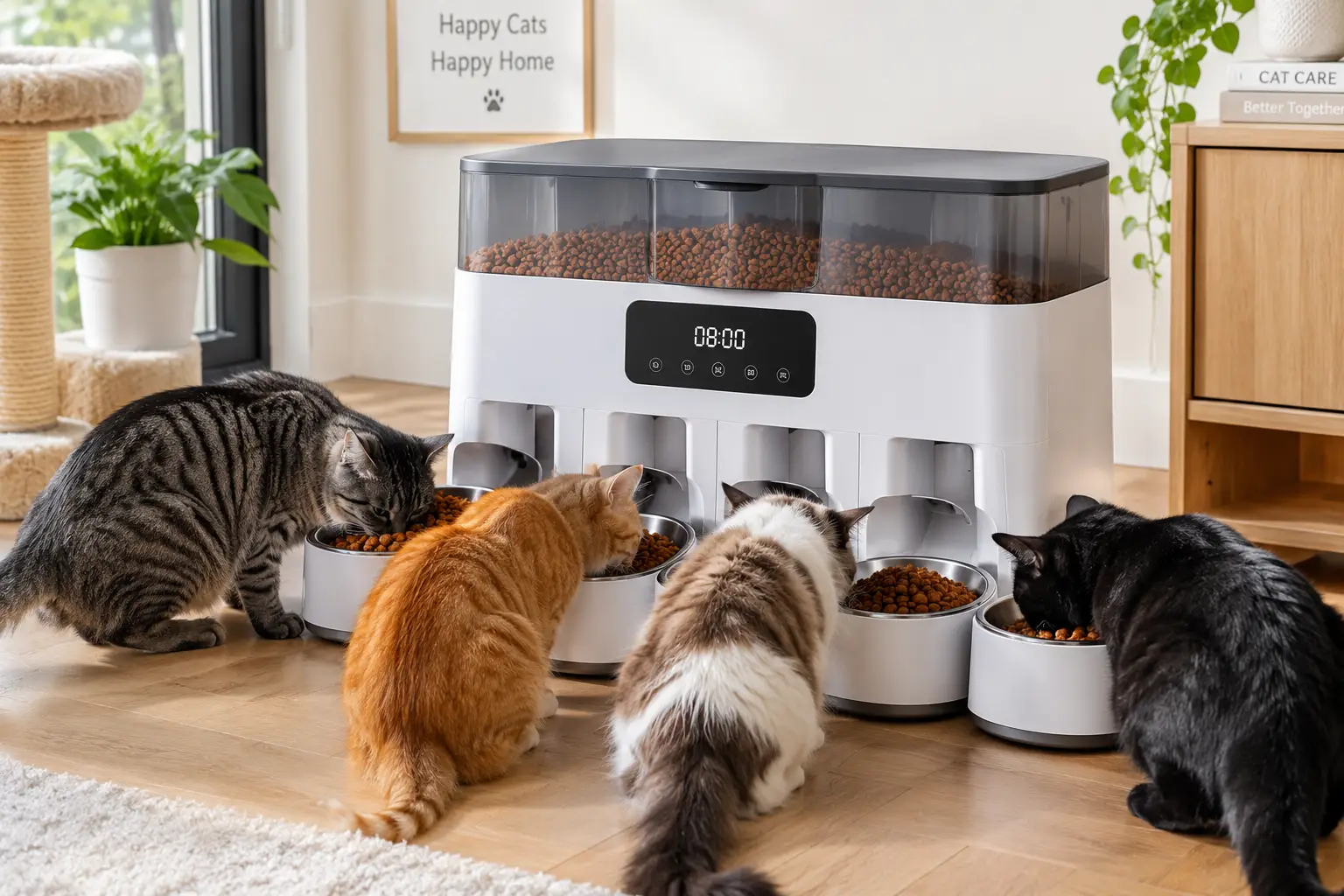
An automatic feeder for multiple cats is a programmable device that dispenses measured meals to two or more cats on a schedule, either into several bowls at once (dual- or triple-bowl feeders) or into individual bowls that open only for a recognized cat via a microchip, RFID collar tag, or AI camera.
The Cornell Feline Health Center’s feeding guidance notes that some cats overeat when food is always available, and that feeding cats separately can help. That single idea shapes this whole guide. Below, you’ll find seven real feeders available to US shoppers, honest analysis of who each one actually suits, setup and troubleshooting advice the product listings skip, and a decision framework that matches the hardware to your household rather than to a marketing badge.
Quick Comparison: The 7 Best Multi-Cat Feeders at a Glance
| Feeder | Type | Food | Cats per unit | Approx. price | Best for |
|---|---|---|---|---|---|
| Cat Mate C500 | 5-tray rotating timer | Wet, dry, raw | 1–2 (shared meal) | Under $50 | Cat Mate C500: wet-food households |
| oneisall Dual-Bowl 5L Feeder (PFD-002) | Dual-bowl timer | Dry | 2 | Around $50 | oneisall Dual-Bowl 5L Feeder (PFD-002): two peaceful cats on a budget |
| Vacqueen 3-Bowl 6L Smart Feeder | Triple-bowl Wi-Fi | Dry | 3 | Around $70 | Vacqueen 3-Bowl 6L Smart Feeder: three cats, one unit |
| PETLIBRO Granary Dual 5L Wi-Fi Feeder | Dual-bowl Wi-Fi | Dry | 2 | $70–$110 | PETLIBRO Granary Dual 5L Wi-Fi Feeder: app scheduling for two |
| PETLIBRO One RFID (PLAF301) | RFID collar-tag lid | Dry | 1 protected cat | $140–$160 | PETLIBRO One RFID (PLAF301): dry-food diet protection |
| SureFeed Microchip Pet Feeder (MPF001) | Microchip lid | Wet & dry | 1 protected cat | $170–$220 | SureFeed Microchip Pet Feeder (MPF001): prescription diets |
| PETLIBRO Granary 2 Vision Duo (PLAF205) | AI camera + scale | Dry | 2 | Premium, $150+ | PETLIBRO Granary 2 Vision Duo (PLAF205): tracking who ate what |
Reading this table top to bottom, notice that price climbs as the feeder gets smarter about which cat is eating, not as hopper size grows. The oneisall Dual-Bowl 5L Feeder (PFD-002) and Vacqueen 3-Bowl 6L Smart Feeder feed more cats per dollar, but neither can stop a bully. If a diet must stay with one cat, the SureFeed Microchip Pet Feeder (MPF001) or PETLIBRO One RFID (PLAF301) is the real fix, and you’ll typically need one per protected cat.
💬 One click helps other shoppers make an informed choice too! 😊
Top 7 Automatic Feeders for Multiple Cats: Expert Analysis
1. Cat Mate C500 — best for wet and raw diets
The Cat Mate C500 solves the problem most dry-food hoppers ignore entirely: serving wet food on a timer without leaving it out to spoil. It uses a rotating tray with five compartments, one initial meal plus four timed ones, and each compartment holds up to 330 g (about 11.5 oz) of wet food.
In practice, that means one compartment can hold a full meal for two cats sharing peacefully, or you can run two units in separate rooms so each cat gets its own timed trays. Twin ice packs sit under the tray and keep food cooler for several hours, which is what makes wet or raw feeding on a workday realistic. It runs on 3 × AA batteries for up to roughly 12 months, so there’s no cord for a curious cat to chew.
Based on comparing the specs, this is the right pick for households that feed canned or raw food, or that want a cheap, cord-free backup for short absences. It has no cat recognition at all, so it won’t stop a thief.
Customer reviews consistently praise how well it keeps wet food fresh and how simple the LCD timer is to program. The most common complaint is battery-only operation and occasional tray misalignment.
Pros:
- ✅ Handles wet, dry, and raw food equally well
- ✅ Ice packs keep meals cool for hours
- ✅ Battery-powered, so no cord to chew
Cons:
- ❌ No pet recognition or food-theft protection
- ❌ Only five meals before you must refill
Usually under $50; excellent value if wet food is part of your routine.
2. oneisall Dual-Bowl 5L Feeder (PFD-002) — cheapest way to feed two at once
The oneisall Dual-Bowl 5L Feeder (PFD-002) is the budget workhorse of the dual-bowl category: one 5 L (about 20-cup) hopper, two stainless steel bowls, and one schedule that feeds both cats at the same moment.
Portions are roughly 10 g each, with up to six meals a day, which gives you fine enough control to split a daily ration without overfeeding. The two bowls sit on opposite sides of the unit, a small but meaningful detail, because cats that face away from each other while eating are less likely to start a standoff. A built-in voice recorder lets you call them to dinner, and backup batteries keep the clock running through brief outages.
Here’s what to weigh: it doesn’t know which cat is at which bowl. That makes it ideal for two cats who already respect each other’s space, and a poor choice if one is a known food bully.
Aggregated owner feedback is broadly positive, and it was rated around 4.6 out of 5 on Chewy at the time of writing; reviewers highlight simple dial controls and reliable dispensing. Some note kibble larger than average can occasionally jam.
Pros:
- ✅ Feeds two cats simultaneously from one unit
- ✅ Stainless bowls are easy to clean
- ✅ Very affordable for a dual-bowl design
Cons:
- ❌ Same food in both bowls, no diet separation
- ❌ Cannot stop a fast eater from raiding
Around $50; arguably the best value for two easygoing cats.
3. Vacqueen 3-Bowl 6L Smart Feeder — built specifically for three cats
The Vacqueen 3-Bowl 6L Smart Feeder is one of the few single units designed around three bowls instead of two, with a 6 L (about 25-cup) hopper that stretches refills out for days.
Its spout rotates to each of three removable 304 stainless steel bowls in turn, so you can program portions and up to ten meals a day through the app on a 2.4 GHz Wi-Fi network. A desiccant pack helps keep kibble crisp, and backup batteries keep the schedule alive during outages. One practical quirk: it won’t dispense unless all bowls are seated, which prevents spills but can catch you off guard after washing.
On paper, this is the tidiest answer for three cats who eat calmly together. The rotation is the catch: bowls fill one after another, not simultaneously, so the first-filled bowl can become a magnet.
Reviews are mixed. Chewy’s listing showed an average near 3.9 out of 5 at the time of writing, with praise for capacity and easy app setup, and recurring complaints that sequential dispensing triggers jostling.
Pros:
- ✅ True three-bowl design in one footprint
- ✅ Large 6 L hopper means fewer refills
- ✅ App control with remote feeding
Cons:
- ❌ Bowls fill sequentially, not all at once
- ❌ 2.4 GHz Wi-Fi only; dry food only
Around $70; solid value if you need three bowls and your cats get along.
4. PETLIBRO Granary Dual 5L Wi-Fi Feeder — the dependable smart-schedule pick
The PETLIBRO Granary Dual 5L Wi-Fi Feeder is the step up from basic dual-bowl timers, adding a polished app, dual-band Wi-Fi, and stronger freshness sealing.
It splits one 5 L hopper into two stainless trays, supports dry kibble between 2 and 15 mm, and on the Wi-Fi version lets you set up to ten meals with fine portion steps. PETLIBRO uses a USB 5V adapter with D-cell batteries as emergency backup. Translated into real life: you can adjust tomorrow’s breakfast from your office, get a low-food alert before the hopper runs dry, and still have meals drop during a short power cut. Note that on battery backup, the app connection generally drops even though the schedule keeps running.
What most buyers overlook is that a splitter still serves the same food to both cats. Two trays are not two diets.
Reviews consistently report easy setup, dishwasher-friendly trays, and reliable dispensing. Catster named the Granary two-cat feeder its best overall automatic cat feeder pick in its 2026 roundup, though some owners mention occasional app hiccups.
Pros:
- ✅ Reliable dual-tray dispensing with low-food alerts
- ✅ Supports both 2.4 and 5 GHz Wi-Fi
- ✅ Well-sealed hopper keeps kibble fresher
Cons:
- ❌ Dry food only, kibble 2–15 mm
- ❌ No recognition, so bullies still win
Roughly $70 to $110 depending on version; strong value for app-minded owners.
5. PETLIBRO One RFID (PLAF301) — smart diet protection without a microchip
The PETLIBRO One RFID (PLAF301) brings selective feeding to dry-food homes: its lid unlocks only when it reads the cat’s assigned collar tag.
The 3 L (about 13-cup) hopper, up to ten scheduled meals, and dual-band Wi-Fi make it a full smart feeder, while the app logs when that specific unit dispenses. Important detail: it reads PETLIBRO’s own 4.2 g collar tag, not implanted microchips, and each feeder pairs with one tag. So two protected cats means two units.
Based on comparing the specs, this is the most affordable way to keep a weight-loss or special dry diet with one cat. The trade-off is that your cat must keep wearing the collar; a snap-release collar lost under the sofa is a lost key.
Owner feedback is generally positive on quiet operation and app data. A recurring theme in community reviews is that a second cat can still squeeze in beside the authorized cat while the lid is open.
Pros:
- ✅ Locks out non-tagged cats and dogs
- ✅ Full app scheduling and dispensing logs
- ✅ Cheaper than most microchip feeders
Cons:
- ❌ Requires a collar tag; ignores microchips
- ❌ Dry food only; one tag per feeder
Typically $140 to $160; good value for dry-diet protection.
6. SureFeed Microchip Pet Feeder (MPF001) — gold standard for prescription diets
The SureFeed Microchip Pet Feeder (MPF001) is the feeder veterinary teams most often point to when one cat’s food must stay with that cat, full stop.
It reads your cat’s existing implanted microchip (or an included RFID collar tag), and its sealed lid opens only for registered pets. It stores up to 32 pet IDs, uses a roughly 400 ml bowl that handles wet or dry food, and runs on 4 × C alkaline batteries for about six months. If an unauthorized pet approaches while the lid is open, the lid is designed to close. In practice, that seal also keeps wet food fresher and flies out between visits.
Here’s what to weigh: it’s a single-meal bowl, not a multi-day hopper. You’re buying a lock, not a pantry. For a renal, urinary, or diabetic diet, that’s exactly what you want.
Reviews consistently report years of reliable use and very easy chip pairing. Common complaints are the price and that a determined cat may sneak in from behind; Sure Petcare sells a rear cover for that reason.
Pros:
- ✅ Reads implanted microchips, no collar needed
- ✅ Handles wet and dry food
- ✅ Sealed lid protects freshness
Cons:
- ❌ One meal only, not a scheduled hopper
- ❌ Highest price per protected cat
Usually $170 to $220; worth it whenever a medical diet is on the line.
7. PETLIBRO Granary 2 Vision Duo (PLAF205) — best for knowing who ate what
The PETLIBRO Granary 2 Vision Duo (PLAF205) is the newest, most data-heavy option here, pairing two bowls with an AI camera that identifies each cat and logs meals per profile.
Its 1080p camera with night vision records mealtimes, a built-in bowl scale measures food to within about 1 g, and the 5 L hopper offers either scheduled meals or a “Smart Refill” mode that tops bowls up automatically. What that means for you: instead of guessing whether your shy cat ate, the app tells you who ate, how much, and when, and alerts you if habits change, which can be an early sign worth raising with your vet.
PETLIBRO’s Granary 2 series page also describes a mode where the camera opens a bowl only for a designated pet. Confirm the specific listing you’re viewing supports it before relying on it for strict diet separation.
As a recent release, independent long-term review data is still thin; we couldn’t verify a meaningful body of aggregated owner reviews yet.
Pros:
- ✅ Per-cat intake logs via AI recognition
- ✅ Gram-level bowl scale tracks real consumption
- ✅ No collars or microchips required
Cons:
- ❌ Premium price for a dry-food feeder
- ❌ Limited long-term reliability data so far
Premium pricing, generally above $150; check the current price, and buy it for the data, not just the dispensing.
Feature-by-Feature Comparison of the Top 7
| Feeder | Recognition | Capacity | Power | Wet food? | Best for |
|---|---|---|---|---|---|
| Cat Mate C500 | None | 5 × 330 g trays | 3 × AA | Yes | Cat Mate C500: canned or raw diets |
| oneisall Dual-Bowl 5L Feeder (PFD-002) | None | 5 L hopper | Adapter + battery backup | No | oneisall Dual-Bowl 5L Feeder (PFD-002): budget duo |
| Vacqueen 3-Bowl 6L Smart Feeder | None | 6 L hopper | Adapter + battery backup | No | Vacqueen 3-Bowl 6L Smart Feeder: three calm cats |
| PETLIBRO Granary Dual 5L Wi-Fi Feeder | None | 5 L hopper | USB 5V + 3 × D backup | No | PETLIBRO Granary Dual 5L Wi-Fi Feeder: app-first owners |
| PETLIBRO One RFID (PLAF301) | RFID collar tag | 3 L hopper | Mains + 3 × D backup | No | PETLIBRO One RFID (PLAF301): dry diet lock |
| SureFeed Microchip Pet Feeder (MPF001) | Microchip / tag | ~400 ml bowl | 4 × C | Yes | SureFeed Microchip Pet Feeder (MPF001): medical diets |
| PETLIBRO Granary 2 Vision Duo (PLAF205) | AI camera | 5 L hopper | Adapter + battery backup | No | PETLIBRO Granary 2 Vision Duo (PLAF205): intake tracking |
The pattern is clear: only two feeders here handle wet food, and only three identify individual cats. If you need both wet food and theft protection, the SureFeed Microchip Pet Feeder (MPF001) is the only single device that does it. Everyone else is choosing between capacity (Vacqueen 3-Bowl 6L Smart Feeder, PETLIBRO Granary Dual 5L Wi-Fi Feeder) and control (PETLIBRO One RFID (PLAF301), PETLIBRO Granary 2 Vision Duo (PLAF205)).
Getting Started: Setup and Your First 30 Days
A great feeder set up badly will still produce a hungry, suspicious cat. Here’s a practical first-month plan.
Week 1: Introduce, don’t replace
Place the new feeder exactly where your cats already eat, unplugged and filled with a few treats. Let them sniff it. For lid-based models like the SureFeed Microchip Pet Feeder (MPF001), use training mode so the lid movement is introduced gradually, because a sudden clack can scare a timid cat off for days.
Week 2: Switch one variable at a time
Keep the same food and the same daily grams. Change only the delivery method. Switching food, location, and feeder on the same Monday is the fastest way to trigger a hunger strike.
Weeks 3–4: Verify real portions
Weigh a few dispensed portions on a kitchen scale. Hoppers measure by volume, so “one portion” varies with kibble size and density. If the scale says 12 g when the app says 10 g, adjust.
Common first-month mistakes
- ❌ Placing two feeders side by side, which recreates one shared station
- ❌ Running dual-bowl feeders on batteries full time (most are backup-only)
- ❌ Assuming the cats ate because the food is gone
- ❌ Forgetting to wash bowls weekly; biofilm can cause food refusal
✨ Don’t miss these smart feeding upgrades!
🔍 Take your multi-cat mealtime from chaos to calm with this carefully curated lineup. Click a highlighted feeder to check current pricing and availability. These picks will help you get peaceful, portion-perfect meals the whole household will enjoy!
Real-World Scenarios: Matching Cats to Feeders
Specs only matter once you map them to an actual home. Here are three common profiles.
Profile 1: Two young siblings, same kibble, tight budget
Budget: under $60. Both cats eat dry food, neither guards. The oneisall Dual-Bowl 5L Feeder (PFD-002) fits perfectly: one schedule, two bowls, and opposite-facing trays. Watch the first few meals; if one cat finishes both bowls, move up a tier.
Profile 2: A senior on a renal diet plus a food-motivated youngster
Budget: around $200 to $250. The senior’s prescription wet food cannot go to the younger cat. One SureFeed Microchip Pet Feeder (MPF001) for the senior, placed in a quieter room, plus an inexpensive timer or ordinary bowl for the youngster elsewhere. The lock protects the diet; distance protects the peace.
Profile 3: Three indoor cats, two working parents, frequent overnight trips
Budget: $70 to $150. If the cats eat together calmly, the Vacqueen 3-Bowl 6L Smart Feeder handles all three with app control. If one of the three is dieting, pair a PETLIBRO One RFID (PLAF301) for that cat with the Vacqueen for the other two. And for a vet who wants to see actual intake numbers, the PETLIBRO Granary 2 Vision Duo (PLAF205) logs exactly who ate what.
The lesson across all three: solve your highest-stakes problem first (usually a medical diet), then handle the easygoing cats with the affordable gear.
Problem → Solution: Fixing the 5 Most Common Multi-Cat Feeder Headaches
Problem 1: One cat eats both portions. Solution: A dual-bowl feeder can’t fix this. Move the bowls into separate rooms using two single feeders, or switch the thief’s victim to a PETLIBRO One RFID (PLAF301) or SureFeed Microchip Pet Feeder (MPF001).
Problem 2: A second cat sneaks into a locked feeder. Solution: Space selective feeders apart (Sure Petcare recommends at least about 30 cm, roughly a foot) and add a rear cover to the SureFeed if raids happen from behind.
Problem 3: Kibble jams. Solution: Check kibble size against the spec. PETLIBRO hoppers expect 2–15 mm; Vacqueen recommends kibble no larger than 12 mm. Oversized or oily pieces are the usual culprits.
Problem 4: Wet food spoils. Solution: Use a Cat Mate C500 with frozen ice packs, or the sealed SureFeed Microchip Pet Feeder (MPF001), and empty uneaten wet food the same day.
Problem 5: You can’t tell if the shy cat is eating. Solution: An app log or camera, such as the PETLIBRO Granary 2 Vision Duo (PLAF205), shows per-cat intake. If appetite drops, call your vet; a feeder is not a diagnosis.
How to Choose an Automatic Feeder for Multiple Cats
Follow these steps in order and stop at the first one that defines your need.
- Identify any protected diet. If a vet prescribed food one cat must eat alone, you need a lock (microchip or RFID) or a separate room. Nothing else counts.
- Decide wet or dry. Most hoppers are dry-only. Wet food points you to rotating trays or a sealed microchip bowl.
- Count your cats, then count your stations. Two cats can share a dual-bowl unit; three or more usually benefit from multiple feeders spread out.
- Check how your cats behave at the bowl. Guarding or bullying means recognition hardware, not more bowls.
- Plan for power outages. Look for a battery backup and confirm whether Wi-Fi stays on during it.
- Weigh smart features honestly. Apps and cameras are great for monitoring, but a lock is what stops theft.
- Factor in cleaning. Removable stainless bowls and dishwasher-safe parts make weekly hygiene realistic.
This sequence reflects the American Association of Feline Practitioners’ feeding guidelines, which recommend separate, visually isolated feeding stations in multi-cat homes and mention programmable feeders, including microchip-activated ones, as useful tools.
Microchip vs RFID vs Dual-Bowl Feeders: What Actually Differs
These three categories are often lumped together, but they solve different problems.
A dual-bowl (or triple-bowl) feeder, like the oneisall Dual-Bowl 5L Feeder (PFD-002) or Vacqueen 3-Bowl 6L Smart Feeder, is a scheduling tool. It guarantees food appears on time in more than one place. It has no idea who eats it.
An RFID feeder, like the PETLIBRO One RFID (PLAF301), reads a tag on the collar. It’s affordable and pairs with smart features, but the tag is a physical key that can be lost, and it ignores implanted chips.
A microchip feeder, like the SureFeed Microchip Pet Feeder (MPF001), reads the chip already implanted under your cat’s skin. Most pet microchips are passive RFID transponders, as Wikipedia’s overview of animal microchip implants explains, which is why a feeder can read them at close range without any power source in the cat. No collar means nothing to lose, which matters for indoor cats who never wear one.
Finally, AI camera feeders, like the PETLIBRO Granary 2 Vision Duo (PLAF205), recognize cats visually. They excel at tracking and logging; treat their locking function as newer and less proven than a microchip lid.
Choosing an Automatic Cat Feeder for 2 Cats
Two cats is the sweet spot for most multi-cat feeders, and an automatic cat feeder for 2 cats is where you’ll find the widest selection.
If your pair eats the same food and neither guards, a single dual-bowl unit is efficient and cheap. The oneisall Dual-Bowl 5L Feeder (PFD-002) and PETLIBRO Granary Dual 5L Wi-Fi Feeder both deliver simultaneous meals so neither cat waits and sulks. Simultaneous dispensing matters more than people think: when portions drop at the same second, there’s less incentive to hover by the other bowl.
If one of the two is on a diet, skip the shared unit and run two separate stations, one locked. Many owners use a microchip cat feeder for the dieting cat and a basic timer for the other.
Placement is the underrated variable. Even with an automatic cat feeder for 2 cats, try to put bowls where each cat can eat facing a wall or doorway with an escape route. A cat that feels cornered eats faster, eats less, or doesn’t eat at all.
Choosing an Automatic Cat Feeder for 3 Cats (or More)
Once you hit three cats, a single device starts to strain. An automatic cat feeder for 3 cats like the Vacqueen 3-Bowl 6L Smart Feeder works well for calm trios, but remember its bowls fill one after another, which can spark jostling over whichever bowl gets food first.
For three or more cats, the “one feeder per cat” approach often wins. Three modest single feeders can cost about the same as one premium multi-bowl unit, and they give you redundancy: if one jams, only one cat misses a meal instead of all three.
A practical hybrid for larger households:
- 🐱 One locked feeder for each cat with a special diet
- 🐱 One shared multi-bowl or timer unit for the easygoing majority
- 🐱 Stations spread across at least two rooms
The AAFP’s guidance on visually separated stations becomes more important, not less, as cat count rises. More cats means more social tension, and food is the most common resource cats compete over.
Advantages Over Traditional Feeding Methods
| Method | Portion control | Theft protection | Works while you’re away | Best for |
|---|---|---|---|---|
| Free-feeding open bowl | Poor | None | Yes, but overfeeding risk | Single, non-overweight cats |
| Gravity feeder | Poor | None | Yes | Short absences only |
| Manual meals | Good | Only if supervised | No | Owners home at mealtimes |
| Automatic multi-bowl feeder | Good | None | Yes | oneisall Dual-Bowl 5L Feeder (PFD-002) and similar: peaceful groups |
| Microchip / RFID feeder | Excellent | Strong | Yes | SureFeed Microchip Pet Feeder (MPF001): diets and thieves |
Gravity feeders look like the cheapest multi-cat solution, but they quietly reward the fastest, greediest cat in the house. Automatic feeders add the one thing gravity can’t: a schedule with measured portions. Only selective feeders add the third pillar, ensuring the right cat gets the right meal.
Features That Actually Matter (and Ones That Don’t)
Matter a lot:
- ⚡ Recognition method. Microchip, RFID, or camera determines whether theft is solved.
- 🔋 Backup power. A feeder that dies with the power grid is a liability.
- 🥣 Bowl material. Stainless steel resists scratches where bacteria hide, unlike scuffed plastic.
- 📏 Portion size step. Around 10 g per step lets you fine-tune weight-loss rations.
- 🧊 Wet-food capability. Most hoppers can’t; know before you buy.
Matter less than marketing suggests:
- 🎙️ Voice recorders. Cute, but cats respond to the motor sound within days anyway.
- 📹 Cameras on non-recognition feeders. Nice for peace of mind, but a camera is a witness, not a lock.
- 📦 Huge hoppers. Kibble goes stale; a 6 L hopper for one small cat may hold food longer than is ideal.
The smartest buys put money into the first list. A basic feeder with a microchip lock beats a camera feeder with no lock for any household where one cat steals.
Long-Term Cost and Maintenance
The sticker price is only part of the story. Here’s a realistic ownership picture.
| Feeder | Upfront | Recurring costs | Typical maintenance | Best for |
|---|---|---|---|---|
| Cat Mate C500 | Under $50 | 3 × AA yearly | Daily tray wash with wet food | Cat Mate C500: low-cost wet feeding |
| oneisall Dual-Bowl 5L Feeder (PFD-002) | ~$50 | Backup batteries | Weekly bowl wash, monthly hopper clean | oneisall Dual-Bowl 5L Feeder (PFD-002): lowest total cost |
| PETLIBRO One RFID (PLAF301) | $140–$160 per cat | Replacement tags if lost | Weekly bowl and tag check | PETLIBRO One RFID (PLAF301): mid-cost diet control |
| SureFeed Microchip Pet Feeder (MPF001) | $170–$220 per cat | 4 × C batteries about every six months | Clean sensors and bowl regularly | SureFeed Microchip Pet Feeder (MPF001): long service life |
The value math favors cheap timers for peaceful cats, but the cost of a sabotaged prescription diet, think extra vet visits, easily exceeds a microchip feeder’s price. Battery-heavy designs like the SureFeed Microchip Pet Feeder (MPF001) add a small recurring cost, while the oneisall Dual-Bowl 5L Feeder (PFD-002) stays the cheapest to run over several years.
Maintenance tips that extend lifespan:
- Wash bowls weekly at minimum, daily for wet food.
- Wipe sensors on microchip and RFID feeders so they read reliably.
- Replace desiccant packs when indicators change color.
- Use alkaline batteries where manufacturers specify them.
Safety, Food Hygiene, and Standards
Two safety issues matter most with automatic feeders: food spoilage and electrical reliability.
Wet food and spoilage
Wet food left at room temperature becomes a bacterial risk within hours. The FDA’s general food-safety guidance for perishable foods emphasizes limiting time at room temperature, written for human food but a sensible benchmark for your cat’s bowl too. That’s why ice packs on the Cat Mate C500 and a sealed lid on the SureFeed Microchip Pet Feeder (MPF001) genuinely matter. Throw out uneaten wet food daily.
Power and wireless
Wi-Fi feeders sold in the US are FCC-certified radio devices, and responsible makers publish manuals detailing approved battery types. Follow them: some models warn against rechargeable cells, and most dual-bowl feeders treat batteries as emergency backup only.
Physical safety
- Secure cords out of reach; cats chew.
- Choose BPA-free plastic and food-grade stainless steel bowls.
- Watch for heavy units tipping when a cat paws at them; set feeders on a flat, stable surface.
Finally, no feeder replaces supervision for long absences. For more than a day or two, have someone check water, litter, and every cat in person.
FAQs
❓ Can one automatic feeder feed two cats different foods? ✅ Not if it uses a single hopper; both bowls get the same kibble. For two diets, use two separate feeders, ideally with a microchip or RFID lock on the protected cat’s bowl so the other can’t reach it…
❓ Do microchip cat feeders work with every microchip? ✅ Microchip feeders like SureFeed read most common pet microchips worldwide, but RFID-only models like the PETLIBRO One read their own collar tag instead. Check compatibility with your cat’s chip number before buying…
❓ How long can I leave multiple cats with an automatic feeder? ✅ For healthy adults, a day or two with plenty of fresh water and clean litter is reasonable. Longer trips need a sitter or friend to check on every cat, since feeders can’t fix spills or illness…
❓ Is an automatic feeder for multiple cats worth it for a single dieting cat? ✅ Yes, if other pets share the home. A selective feeder keeps the diet with the right cat, which is often the hardest part of weight-loss plans. Ask your vet for a daily calorie target first…
❓ Do automatic cat feeders work with wet food? ✅ Most hopper feeders are dry-only. Rotating tray feeders with ice packs, like the Cat Mate C500, or sealed microchip bowls handle wet food. Discard leftovers daily to keep meals safe and appealing…
Conclusion: Pick the Lock Before You Pick the Bowl
The best automatic feeder for multiple cats isn’t the one with the most features; it’s the one that matches your household’s real problem. If your cats eat peacefully, a dual- or triple-bowl unit like the oneisall Dual-Bowl 5L Feeder (PFD-002), PETLIBRO Granary Dual 5L Wi-Fi Feeder, or Vacqueen 3-Bowl 6L Smart Feeder delivers punctual, measured meals at a friendly price. If wet food is on the menu, the Cat Mate C500 is the budget hero.
But if one cat steals, guards, or eats a prescription diet, a schedule alone won’t help. That’s when a lock earns its price, whether the collar-tag PETLIBRO One RFID (PLAF301), the implant-reading SureFeed Microchip Pet Feeder (MPF001), or the data-rich PETLIBRO Granary 2 Vision Duo (PLAF205) for owners who want to know exactly who ate what.
Start with the step-by-step framework above: identify any protected diet, decide wet or dry, then count stations rather than bowls. Introduce the new feeder gradually, weigh a few portions, and keep stations visually separated. Do that, and an automatic feeder for multiple cats stops being a gadget and becomes a genuine peace treaty for your home.
🐾 Ready to end the mealtime wars?
🛒 Find the feeder that fits your crew. Click any highlighted product above to check current pricing and availability, and give every cat in your home a calmer, fairer meal starting this week!
Recommended for You
- Dog Treat Ball Toy: 7 Best Picks That Beat Boredom (2026)
- Maze Bowl Guide 2026: 7 Best Picks That Actually Slow Gulpers
- Cute Dog Bowls With Stand: 7 Adorable Picks That Actually Work (2026)
Disclaimer: This post contains affiliate links. As an Amazon Associate, I earn from qualifying purchases made through these links, at no additional cost to you.
✨ Found this article helpful? Share it with someone who needs it! 💬🤗