In This Article
Introduction: Why a Facial Recognition Cat Feeder Is the 2026 Upgrade Multi-Cat Homes Needed
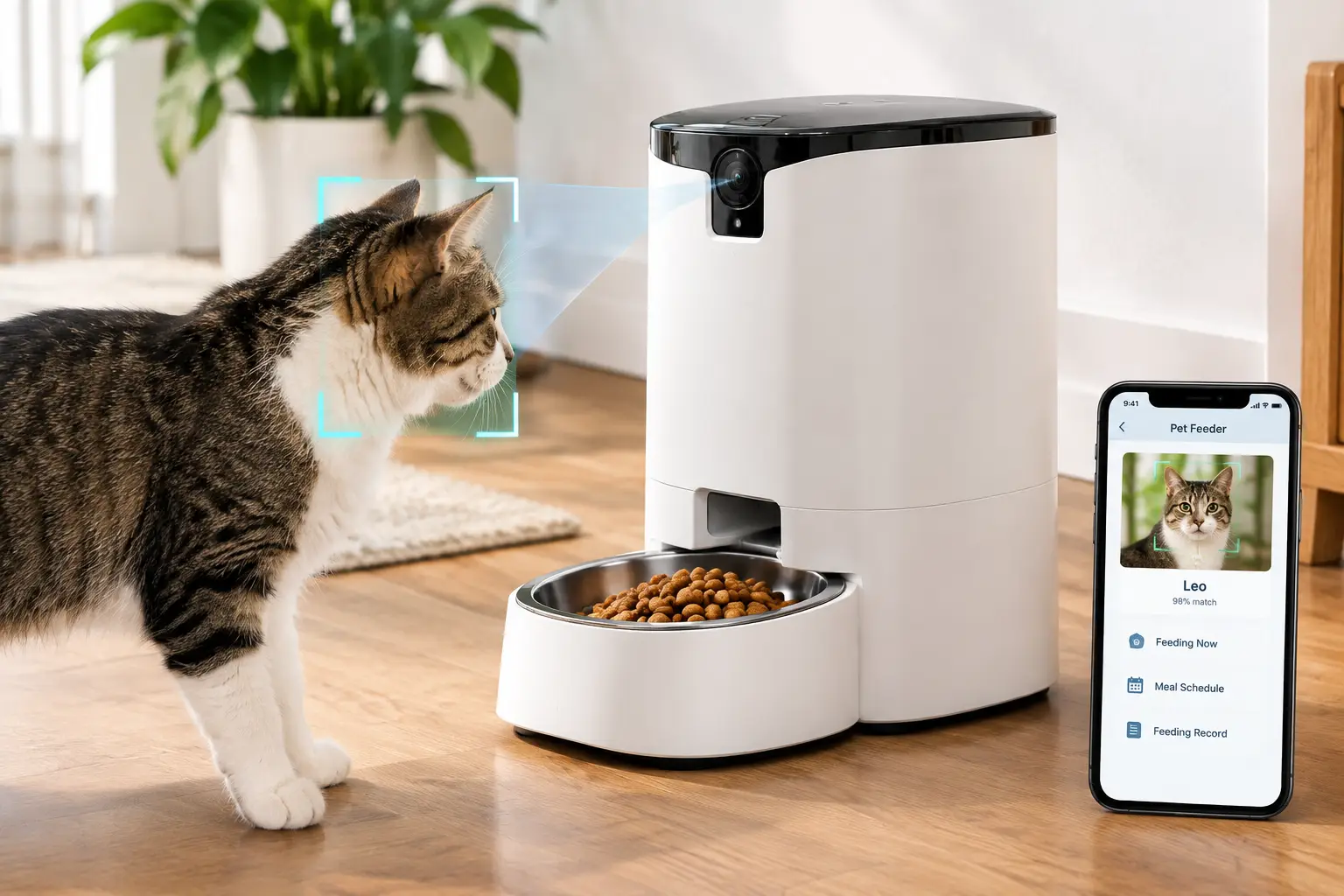
If you live with more than one cat, you already know the routine: one cat inhales breakfast in ninety seconds, then strolls over to finish everyone else’s. A facial recognition cat feeder is built to end that daily heist. Instead of trusting a timer, it uses a camera and onboard AI to figure out which cat is standing at the bowl, then logs, opens, or dispenses accordingly.
The category has grown up fast. At CES 2026, Cheerble showed off a dome-shaped feeder that only opens for the right face, and by September, Purina’s Petivity brand had a camera feeder on shelves that tracks up to five cats by sight. PETKIT and PETLIBRO, two of the biggest names in automatic feeders on Amazon, now sell models that tag every meal to an individual cat. In other words, the facial recognition cat feeder has moved from trade-show novelty to something you can actually put on your kitchen floor.
Here’s the catch: not every “AI feeder” does the same job. Some physically lock out intruders. Others simply record who ate what and leave the bowl open to anyone. That difference matters enormously if one of your cats is on a prescription kidney diet and the other is a professional food thief. 🐾
This guide breaks down seven real models, translates their spec sheets into everyday consequences, and shows you exactly which type of facial recognition cat feeder fits your household, your budget, and your cats’ personalities.
What Is a Facial Recognition Cat Feeder?
A facial recognition cat feeder is an automatic pet feeder with a built-in camera and AI software that identifies individual cats by their facial features. Depending on the model, it uses that identity to log each cat’s meals, dispense personalized portions, or open a lid only for the cat assigned to that bowl.
Under the hood, it borrows the same basic idea as a facial recognition system for humans: the camera maps distinctive features (eye spacing, nose shape, coat markings around the face), compares them to stored profiles, and makes a match decision in a fraction of a second. The difference is that cat faces are furrier, rounder, and far less cooperative about holding still. ⚡
Quick Comparison: The 7 Best Facial Recognition Cat Feeder Picks at a Glance
Before we dig into each model, here’s the 30-second version. The single most important column is “What face ID does,” because it tells you whether the feeder blocks the wrong cat or just reports on it.
| Feeder | What face ID does | Cats recognized | Food type | Price range | Best for |
|---|---|---|---|---|---|
| PETKIT YumShare Dual-Hopper 2 | Logs each cat’s meals | Up to 15 | Dry, freeze-dried | $150–$180 | PETKIT YumShare Dual-Hopper 2: best all-rounder for big households |
| PETKIT YumShare Solo 2 | Logs each cat’s meals | Up to 15 | Dry, freeze-dried | $120–$150 | PETKIT YumShare Solo 2: small spaces and tighter budgets |
| Petivity Smart Feeder for Cats | Tracks intake per cat | Up to 5 | Dry | Around $150 | Petivity Smart Feeder for Cats: health-minded owners, no subscription |
| PETLIBRO Granary 2 Vision | Tags meals + gram-level scale | Up to 10 | Dry | $190–$210 | PETLIBRO Granary 2 Vision: precise intake data |
| PETLIBRO Granary 2 X | Personalized portions per cat | Multiple | Dry | Around $250 | PETLIBRO Granary 2 X: different portion sizes per cat |
| CATLINK Facelink | Locks the lid (face + RFID tag) | Multiple | Dry | $250–$300 | CATLINK Facelink: prescription-diet protection |
| Cheerble Match G1 | Opens dome only for the right cat | Up to 6 | Wet + dry | Around $260 | Cheerble Match G1: wet food and privacy-first homes |
Prices are ranges at the time of writing and change often; check the current price before buying.
Reading the table top to bottom, a clear split appears. The two PETKIT models, the Petivity Smart Feeder for Cats, and the PETLIBRO Granary 2 Vision are “know who ate” feeders: superb for monitoring, but they won’t stop a determined thief. The CATLINK Facelink and Cheerble Match G1 are “only you may eat” feeders, and that physical barrier is exactly what you pay the premium for, while the PETLIBRO Granary 2 X sits in between by tailoring portions to each recognized cat.
💬 One click helps other shoppers make an informed choice too! 😊
Top 7 Facial Recognition Cat Feeder Models: Expert Analysis
Every pick below is a real, currently sold product. The analysis is based on manufacturer spec sheets, published hands-on coverage, and aggregated owner feedback where it exists. Where reviews are still thin (several of these launched in 2026), we say so plainly.
1. PETKIT YumShare Dual-Hopper 2 — best all-rounder for big households
The PETKIT YumShare Dual-Hopper 2 (model P592) packs the most recognition capacity per dollar in this roundup. 🐱
Its camera recognizes up to 15 cats and logs who ate, when, and how much, with before-and-after bowl photos as proof. Two hoppers share a 5-liter (21-cup) capacity, so you can run regular kibble in one side and freeze-dried toppers in the other without buying a second feeder. Dual-band Wi-Fi (2.4 GHz and 5 GHz) is a quiet win: many apartments run crowded 2.4 GHz networks, and 5 GHz support means fewer dropped connections.
Based on comparing the specs, this is the feeder for households with three or more cats who want data rather than a locked bowl. It does not physically block a thief, so it suits homes where all cats eat the same food. The four-D-battery backup keeps meals dispensing during outages, although the camera shuts off on battery power.
Owner feedback on PETKIT’s store is consistently positive about seeing each cat’s intake in the app; independent reviewers note that recognition currently covers cats only and that video history beyond seven days of free highlights needs a subscription.
Pros:
- ✅ Recognizes up to 15 cats individually
- ✅ Dual hoppers handle two different dry foods
- ✅ Supports both 2.4 GHz and 5 GHz Wi-Fi
Cons:
- ❌ No lid lock, so thieves can still eat
- ❌ Longer video history requires a paid plan
💲 Typically $150 to $180; outstanding value if monitoring, not blocking, is your goal.
2. PETKIT YumShare Solo 2 — compact face ID for small spaces
The PETKIT YumShare Solo 2 (model P572) brings the same 15-cat facial recognition to a smaller footprint.
Its 3-liter (12-cup) hopper holds about 2.9 pounds of kibble, roughly 15 days for one adult cat, which in practice means weekly refills for two or three cats. You can schedule 1 to 10 meals a day with 1 to 5 portions each, and kibble up to 12 mm fits. Five AAA batteries provide up to 14 days of backup dispensing, though again the camera goes dark on battery.
On paper, this is the PETKIT YumShare Dual-Hopper 2 minus one hopper, which makes it ideal for studio apartments, two-cat homes, or owners adding a second station in another room. The privacy controls (a camera schedule and a toggle for voice recording) are a thoughtful touch if the feeder sits in a living space.
Reviews of the original Solo praise its compact build and reliable dispensing; the face-recognition upgrade in the Solo 2 is newer, so long-term owner data on recognition accuracy is still building.
Pros:
- ✅ Same 15-cat recognition in a smaller body
- ✅ Up to 14 days of battery backup feeding
- ✅ Camera schedule and voice toggle protect privacy
Cons:
- ❌ 3-liter hopper means frequent refills for several cats
- ❌ Single hopper limits you to one food type
💲 Usually $120 to $150; the smartest entry point into face-ID feeding.
3. Petivity Smart Feeder for Cats — health insights backed by Purina
The Petivity Smart Feeder for Cats is Purina’s first feeder, and it leans hard into health tracking rather than gatekeeping. 🩺
Its built-in camera and sensors recognize up to five cats and track portion consumption, meal frequency, and eating patterns over time. Purina says the AI was trained on more than 21,000 real feeding sessions, 1,400-plus hours of video, and images of over 15,000 cats. The bowl is shallow to reduce whisker stress and the parts are dishwasher-safe.
What most buyers overlook is that this feeder does not swap foods or lock out other cats; it tells you if someone ate food they shouldn’t. That makes it strongest for owners who also use the Petivity Smart Litter Box Monitor, since the app can show food intake alongside litter box data, which is a genuinely useful early-warning combo.
It launched in late September 2026, so verified owner reviews are still sparse. Early press coverage highlights that it works without a subscription.
Pros:
- ✅ No subscription required for core tracking
- ✅ Pairs with Petivity’s litter box monitor
- ✅ Shallow, dishwasher-safe bowl
Cons:
- ❌ Tracks intake but doesn’t block other cats
- ❌ Caps out at five recognized cats
💲 Around $150; strong value for health-focused, budget-aware owners.
4. PETLIBRO Granary 2 Vision — gram-level intake data
The PETLIBRO Granary 2 Vision pairs an AI camera with a built-in scale accurate to roughly 1 gram, and that combination is its whole point. ⚖️
Most feeders know what they dispensed. A scale under the bowl knows what was actually eaten, and the camera assigns that number to a specific cat, with recognition for up to 10 cats. Add 1080p video, night vision, two-way audio, and 5 GHz Wi-Fi support, and you have the most measurement-focused option here.
Here’s what to weigh: if you’re tracking a diabetic cat’s appetite or a senior cat’s slow weight loss, “dispensed 40 g” and “ate 22 g” tell very different stories. That makes the PETLIBRO Granary 2 Vision the pick for vet-guided weight management.
The Granary 2 series began shipping in late July 2026, so aggregated reviews are limited. Early hands-on coverage has been favorable toward the scale-plus-camera concept, while longer-term reliability data isn’t available yet.
Pros:
- ✅ Scale measures what each cat actually eats
- ✅ Recognizes up to 10 cats without collars
- ✅ 1080p night vision and two-way audio
Cons:
- ❌ Still a newer model with few long-term reviews
- ❌ Costs noticeably more than PETKIT’s face-ID models
💲 Roughly $190 to $210; worth it when intake precision matters medically.
5. PETLIBRO Granary 2 X — personalized portions per cat
The PETLIBRO Granary 2 X sits at the top of PETLIBRO’s 2026 lineup and adds individualized portioning to AI recognition.
Where the PETLIBRO Granary 2 Vision records who ate, the PETLIBRO Granary 2 X uses recognition to serve each cat a portion matched to its own dietary plan. Practically, that means your 16-pound tabby on a weight-loss plan and your lean, active youngster can share one station while receiving different amounts.
Based on the published specs, this is the right step-up for households where cats eat the same food but need different quantities, which is the most common real-world multi-cat scenario. If your cats need entirely different formulas, a locking feeder is still the safer choice.
PETLIBRO has published fewer granular specs for this model than for the Vision, and verified owner reviews are still limited, so check the listing’s Q&A for recognition limits before ordering.
Pros:
- ✅ Different portion sizes for each recognized cat
- ✅ Builds on the scale-equipped Granary 2 platform
- ✅ No collars or microchips needed
Cons:
- ❌ Fewer published specs than its sibling
- ❌ Premium price for a dry-food-only feeder
💲 Around $250; justified mainly for multi-cat weight management.
6. CATLINK Facelink — strongest lockout for prescription diets
The CATLINK Facelink is built around one job: keeping the wrong cat out of the bowl. 🔒
Its rapid-lock shield snaps closed when an unauthorized cat approaches, triggered by facial recognition paired with RFID tag verification. CATLINK says the face model runs on the device, so identification keeps working if your internet drops. You also get a 1080p night-vision camera, video calls, a 3.5-liter hopper, and detailed per-cat health reports.
The spec sheet doesn’t trumpet this, but CATLINK’s own FAQ confirms each cat needs a dedicated RFID collar tag, so this is face plus collar, not face instead of collar. That double check is exactly why it’s the strongest choice for protecting a prescription diet, but cats who refuse collars are a dealbreaker. Enrollment also takes 5 to 8 clear photos per cat.
Most published commentary comes from CATLINK and affiliate sites; independent long-term owner reviews are still scarce, so weigh the brand’s accuracy claims accordingly.
Pros:
- ✅ Physical shield locks out food thieves
- ✅ Dual face-plus-tag verification
- ✅ Detailed per-cat health reports
Cons:
- ❌ Every cat must wear an RFID collar tag
- ❌ 2.4 GHz Wi-Fi only, smaller 3.5-liter hopper
💲 Roughly $250 to $300; worth it when one wrong meal could mean a vet bill.
7. Cheerble Match G1 — wet food and privacy-first design
The Cheerble Match G1 is the CES 2026 headliner, and its enclosed dome is unlike anything else here. 🏠
The dome opens only from the front and fits one cat at a time; it unlocks only when the on-device AI recognizes the assigned cat within about 25 cm (10 inches). Cheerble says the model was trained on more than 1,000 cats and claims 99.9% accuracy in internal testing. It handles wet and dry food, includes an ice-pack slot for wet meals, and uses a dishwasher-safe 304 stainless steel bowl. Schedules keep running if Wi-Fi drops.
The Cheerble Match G1 is the only pick here built for wet food, which matters because many prescription renal and urinary diets are canned. Biometric data stays on the device, a real plus for privacy-minded owners. Supporting up to six cats, it’s a one-cat-per-station design, so most homes will need one per protected cat.
Independent reviews are positive about the concept and design, but long-term owner data is limited. Availability on Amazon varies, so check Cheerble’s storefront if it isn’t listed.
Pros:
- ✅ Works with wet food, plus an ice-pack slot
- ✅ Enclosed dome physically blocks other pets
- ✅ Recognition runs fully on the device
Cons:
- ❌ One protected cat per feeder in practice
- ❌ Accuracy figures come from internal testing
💲 Around $260 MSRP; the best value for wet-food lockout.
Side-by-Side Spec Comparison
| Feeder | Capacity | Wi-Fi | Lockout | Backup power | Best for |
|---|---|---|---|---|---|
| PETKIT YumShare Dual-Hopper 2 | 5 L, two hoppers | 2.4 + 5 GHz | No | 4 D batteries | PETKIT YumShare Dual-Hopper 2: 3+ cats, mixed dry foods |
| PETKIT YumShare Solo 2 | 3 L | 2.4 + 5 GHz | No | 5 AAA, up to 14 days | PETKIT YumShare Solo 2: small homes |
| Petivity Smart Feeder for Cats | Not published in detail | Yes | No | Check listing | Petivity Smart Feeder for Cats: health tracking |
| PETLIBRO Granary 2 Vision | 5 L class | 2.4 + 5 GHz | No | Check listing | PETLIBRO Granary 2 Vision: measured intake |
| CATLINK Facelink | 3.5 L | 2.4 GHz | Shield + RFID | Check listing | CATLINK Facelink: prescription dry diets |
| Cheerble Match G1 | Single bowl | Yes, offline logic | Dome | Check listing | Cheerble Match G1: wet prescription diets |
The pattern is striking: the feeders with the biggest hoppers don’t lock, and the feeders that lock carry smaller food reserves. That trade-off is by design, because a lockout station is built to guard one cat’s meal, not to feed a crowd for two weeks. If you need both, the realistic setup is a large logging feeder for the group plus one locking station for the cat with the special diet.
✨ Don’t miss these smart feeding upgrades!
🔍 Take your multi-cat mealtime from chaos to calm with this carefully curated lineup. Click a highlighted feeder to check current pricing and availability. These picks will help you make sure every cat gets the right meal, every single time! 🐾
How to Set Up a Facial Recognition Cat Feeder: Your First 30 Days
A facial recognition cat feeder is only as accurate as its training, and most disappointed owners skipped the boring setup steps. Here’s a practical roadmap.
Days 1–3: Placement and enrollment 📸
- Light matters more than anything. Place the feeder where it gets steady, even light. Backlighting from a window behind the cat turns faces into silhouettes, and dark-coated cats suffer most.
- Enroll with real-life photos. Use the app’s guided flow and capture each cat from several angles in the feeder’s actual spot. CATLINK, for example, asks for 5 to 8 clear photos per cat.
- Keep the old bowl nearby. Cats are suspicious of new objects. Run the feeder in open mode (or leave the lid unlocked) while the old bowl stays beside it.
Days 4–14: Supervised trial runs 👀
- Watch at least two meals live through the app and correct any misidentified sessions; several brands use those corrections to refine recognition.
- Introduce locking gradually. On the CATLINK Facelink or Cheerble Match G1, a lid that moves unexpectedly can spook a timid cat. Pair the first locked meals with a favorite topper.
Days 15–30: Fine-tuning ⚙️
- Compare logged intake with your cat’s weight every week. A kitchen scale and a consistent weigh-in time are enough.
- Adjust portions in small steps, never more than about 10% at a time, and loop in your vet for any cat on a therapeutic diet.
Ongoing maintenance 🧽
Wash stainless steel bowls daily or every other day, wipe the camera lens weekly (kibble dust fogs it fast), and empty and dry the hopper monthly so oils don’t go rancid. Replace desiccant packs on the schedule the manufacturer recommends.
Real-World Scenarios: Matching the Right Feeder to Your Household
Specs are abstract until you picture your own kitchen. Here are four common households and the reasoning behind each match.
🏙️ Maya, two cats, one-bedroom apartment, $150 budget
Both cats eat the same kibble, but Maya travels for work two nights a month and wants to know they both ate. The PETKIT YumShare Solo 2 fits: compact, under budget, and its per-cat logs answer her real question (“did Luna eat?”). A lockout feeder would be money spent solving a problem she doesn’t have.
🩺 The Garcias, three cats, one on a renal diet
Their 14-year-old needs a canned prescription food, and the two younger cats treat it like dessert. This is precisely the job of the Cheerble Match G1: wet-food capable, an ice-pack slot for longer gaps, and a dome that only opens for the senior. The younger cats can share a PETKIT YumShare Dual-Hopper 2 nearby.
⚖️ Jordan, four cats, one overweight
All four eat the same weight-management kibble, but the big orange boy needs less of it. The PETLIBRO Granary 2 X serves personalized portions to each recognized cat, while the scale-based logs give Jordan’s vet hard numbers at the next checkup.
🐶 The Lees, one cat and a beagle
Here, the main thief is a dog. Since face recognition on several feeders is trained for cats, a physical barrier matters more than analytics. The CATLINK Facelink, mounted at cat height, or the enclosed Cheerble Match G1 keeps the beagle’s snout out.
Problem → Solution: Fixing the 5 Most Common Facial Recognition Cat Feeder Headaches
Even the best facial recognition cat feeder hits snags. These are the issues owners report most, and the fixes that actually work.
- “It confuses my two black cats.” Low light is the usual culprit, not the AI. Move the feeder near a steady light source, add a small motion-activated night light, and re-enroll both cats with fresh photos taken in that spot.
- “My cat won’t eat from it.” Motor noise and moving lids scare some cats. Run the feeder in unlocked mode for a week, sprinkle a high-value topper, and only then enable locking. Purina reported that 99.5% of cats ate from its feeder during development, but individual cats still vary.
- “The thief waits and sneaks in after.” A logging-only feeder can’t stop this. Either switch the protected cat to a locking model such as the CATLINK Facelink, or set short meal windows so leftover food disappears quickly.
- “Kibble jams.” Check kibble size: PETKIT models list a 12 mm limit for kibble and 9 mm for freeze-dried pieces. Oily, oversized, or irregular foods jam impellers.
- “Wi-Fi keeps dropping.” Choose a model with 5 GHz support (both PETKIT picks and the PETLIBRO Granary 2 Vision), or move your router closer. Feeders with on-device recognition, like the Cheerble Match G1, keep schedules running offline.
How to Choose a Facial Recognition Cat Feeder: 7 Expert Criteria
Use these seven questions in order; the first two eliminate most of the market for you.
- Do you need to block or just to know? If your cats eat different foods, you need a physical lockout (CATLINK Facelink, Cheerble Match G1). If they share one food, a logging feeder saves money.
- Wet, dry, or both? Only the Cheerble Match G1 in this roundup is built for wet food. Every other pick dispenses dry or freeze-dried food.
- How many cats, really? Count the cats who’ll use the station, then add one for future adoptions. Limits range from five (Petivity Smart Feeder for Cats) to 15 (both PETKIT models).
- Collar tolerance. If any cat is a collar escape artist, avoid systems that require tags.
- Do you need measured intake? Dispensed portions aren’t eaten portions. For medical monitoring, a scale-equipped model like the PETLIBRO Granary 2 Vision gives truer numbers.
- Network and power. Check 5 GHz support and battery backup; a feeder that stops during a storm defeats the purpose.
- Ongoing costs. Read the subscription terms before buying, not after.
Whichever you choose, the feeder serves a nutrition plan rather than replacing one. The Cornell Feline Health Center’s guide to feeding your cat is a solid, vet-backed starting point for setting portions and choosing between dry and canned food.
Facial Recognition Cat Feeder vs. Microchip, RFID, and Timer Feeders
Face ID isn’t the only way to identify a cat at the bowl. Microchip and collar-tag feeders rely on radio-frequency identification (RFID), the same short-range radio technology behind contactless key cards, and plain timer feeders identify nobody at all.
| Feature | Facial recognition | Microchip/RFID | Timer-only |
|---|---|---|---|
| Needs collar or chip | No (except CATLINK Facelink) | Yes | No |
| Per-cat meal logs | Yes | Often | No |
| Video of meals | Yes | Rarely | Sometimes |
| Sensitive to lighting | Yes | No | No |
| Typical price range | $120–$300 | $100–$250 | $30–$150 |
| Best for | Collar-averse multi-cat homes | Proven, light-independent lockout | Single-cat homes |
The table reveals the honest trade-off: face ID removes the collar but adds a dependence on good lighting, while RFID is immune to darkness but only works if a tag stays on (or a cat already has a compatible implanted microchip). Timer feeders remain perfectly fine for one cat. For a multi-cat home with a collar-hating cat, a facial recognition cat feeder is the only option that combines identity with zero wearables.
Features That Actually Matter (and Ones That Don’t)
Marketing pages list dozens of features. Here’s how to separate the useful from the decorative.
✅ Features that genuinely earn their keep
- Physical lockout. If diets differ, nothing else matters as much.
- On-device recognition. Feeders that identify cats locally (like the Cheerble Match G1 and CATLINK Facelink) keep working when the internet doesn’t.
- Battery backup. Power outages happen; scheduled meals shouldn’t stop.
- A scale. Measured intake beats dispensed estimates for any health goal.
- Dishwasher-safe stainless steel bowls. Easier hygiene, and stainless steel is the usual recommendation over plastic for cats prone to chin acne.
🤷 Features that rarely change outcomes
- Auto-generated “cat vlogs” with music. Fun for a week.
- Two-way audio. Some cats find a disembodied voice stressful rather than comforting.
- Inflated accuracy claims. “99.9%” figures come from manufacturers’ internal tests, not independent labs. Treat them as marketing until third-party data exists.
The bottom line: pay for lockout, offline reliability, and real measurement. Skip the premium tier if its extras are mostly entertainment.
Privacy, Safety, and Standards: What US Buyers Should Check
A camera that watches your kitchen floor 24/7 deserves the same scrutiny as any home security camera. 🔐
Privacy
There are two architectures. Edge, or on-device, processing keeps face data inside the feeder; the Cheerble Match G1 is built this way, and CATLINK says the CATLINK Facelink face model runs locally. Cloud-connected models upload clips for highlights and history. Neither is automatically unsafe, but you should: use a unique password, turn on two-factor authentication if the app offers it, place the feeder so the camera sees the bowl rather than your living room, and use camera schedules (the PETKIT YumShare Solo 2 has one) when you’re home.
Electrical and radio safety
Any Wi-Fi device sold in the US must carry FCC authorization for its radio, so look for the FCC ID on the label or listing. For the power adapter, a UL or ETL mark indicates independent safety testing. Route cords behind furniture or through a cord protector, because cats chew cables.
Food-contact materials
Look for 304 (18/8) stainless steel bowls, which is what most picks here use, and avoid scratched plastic bowls, which harbor bacteria.
Long-Term Cost and Maintenance of a Facial Recognition Cat Feeder
The sticker price is only the first bill. Here’s what ownership really costs over a few years.
| Cost item | What to expect | Models most affected | Best for minimizing cost |
|---|---|---|---|
| Upfront price | $120–$300 | Lockout models cost most | PETKIT YumShare Solo 2 |
| Video subscription | Optional for extended history | PETKIT models | Petivity Smart Feeder for Cats (no subscription) |
| Replacement RFID tags | Lost or chewed collars | CATLINK Facelink | Collar-free models |
| Desiccants, batteries, ice packs | Small but recurring | All; ice packs for Cheerble Match G1 | Any |
| Second station | Needed for each locked cat | Cheerble Match G1, CATLINK Facelink | Logging feeders |
The hidden multiplier is the second station: lockout feeders protect one cat per unit, so a home with two special-diet cats should budget for two. Subscriptions are the other quiet cost, though most owners find the free tiers enough for daily checks. Weighed against a single emergency vet visit for a cat who ate the wrong prescription food, a well-chosen feeder often pays for itself.
Common Mistakes to Avoid When Buying a Facial Recognition Cat Feeder
These errors account for most returns and frustrated reviews. ⚠️
- Buying a logger when you need a lock. A feeder that reports “Oreo ate Milo’s renal food” doesn’t help Milo’s kidneys.
- Ignoring food format. Discovering after delivery that your cat’s prescription diet is canned, and your feeder only takes kibble, is painfully common.
- Placing it in a dark corner. Recognition accuracy drops sharply in poor light, especially for black or dark-faced cats.
- Expecting instant accuracy. Recognition improves as you correct misidentified meals; give it a couple of weeks.
- Overlooking kibble size. Pieces larger than the stated limit jam the dispenser.
- Trusting headline accuracy blindly. Manufacturer figures are internal; watch real sessions during week one.
- Forgetting the dog. Several feeders recognize cats only. If a dog is the thief, prioritize a physical barrier.
Facial Recognition Cat Feeder for Seniors, Kittens, and Special Diets
Different life stages change what you should prioritize. 🐈
Senior cats
Older cats often need renal, urinary, or easily digestible diets, many of them canned. They also tend to lose weight slowly and quietly. The Cheerble Match G1 protects wet prescription food, and the PETLIBRO Granary 2 Vision flags gradual appetite drops through measured intake, which is an early warning many owners would otherwise miss.
Kittens
Kittens’ faces change quickly as they grow, so expect to re-enroll photos every few weeks. Cheerble says its model adapts to appearance changes over time, but checking the logs during growth spurts is still wise. Kittens also need more frequent small meals, so pick a feeder with flexible schedules (PETKIT models allow up to 10 meals a day).
Weight-loss and diabetic cats
Precision is the priority. The PETLIBRO Granary 2 X delivers individualized portions, and scale data makes vet conversations factual instead of guesswork. Always set targets with your veterinarian rather than the app’s defaults.
FAQ: Facial Recognition Cat Feeder Questions Shoppers Ask Most
❓ Is a facial recognition cat feeder worth it for just one cat?
❓ Can a facial recognition cat feeder tell two look-alike cats apart?
❓ Does a facial recognition cat feeder work without Wi-Fi?
❓ Do facial recognition cat feeders require a monthly subscription?
❓ Will a facial recognition cat feeder keep my dog out of the cat food?
Conclusion: Picking the Facial Recognition Cat Feeder That Ends Mealtime Drama
The smartest way to choose a facial recognition cat feeder is to start with one honest question: do you need to block the wrong cat, or simply know who ate?
If your cats share one food and you want peace of mind, a logging feeder is the value play. The PETKIT YumShare Dual-Hopper 2 suits bigger households, the PETKIT YumShare Solo 2 fits smaller ones, and the Petivity Smart Feeder for Cats shines for health tracking without a subscription. Want measured intake? The PETLIBRO Granary 2 Vision and its portion-personalizing sibling, the PETLIBRO Granary 2 X, turn guesswork into grams.
If one cat’s health depends on eating only its own food, pay for a physical barrier. The CATLINK Facelink is the strongest dry-food lockout (provided your cat tolerates a tag), and the Cheerble Match G1 is the go-to for wet prescription diets and privacy-first homes.
Whatever you choose, the feeder is a tool, not a nutrition plan. Obesity is the most common nutrition-related problem in cats, so work with your veterinarian on portions and review Cornell’s guidance on feline obesity before you program those schedules. Set it up in good light, give it two weeks to learn, and you may never referee breakfast again. 🐾
🚀 Ready to end the food fights for good?
🛒 Pick the feeder that matches your household from the lineup above, click its highlighted name to check current pricing and availability, and give every cat the meal that’s truly theirs. Your cats (and your vet) will thank you! 💚
Recommended for You
- Dog Treat Ball Toy: 7 Best Picks That Beat Boredom (2026)
- Maze Bowl Guide 2026: 7 Best Picks That Actually Slow Gulpers
- Cute Dog Bowls With Stand: 7 Adorable Picks That Actually Work (2026)
Disclaimer: This post contains affiliate links. As an Amazon Associate, I earn from qualifying purchases made through these links, at no additional cost to you.
✨ Found this article helpful? Share it with someone who needs it! 💬🤗