
In This Article
Why the Best Slow Feeder for French Bulldog Owners Looks Different
If your Frenchie inhales dinner in 20 seconds flat, then stares at you like you forgot to serve it, you’re in very good company. French Bulldogs are famously food-motivated, and that enthusiasm is exactly why finding the best slow feeder for french bulldog mealtimes matters more than most owners realize.
Here’s the twist most bowl roundups miss: the slow feeder that works brilliantly for a Labrador can be a frustrating — even counterproductive — choice for a flat-faced dog. Deep mazes and tall ridges were designed for long muzzles that can dip into channels and lift out again. A Frenchie’s face is short and broad, so a deep puzzle bowl often means pressing the nose into plastic, snorting, giving up, or (worst case) gulping even harder at whatever kibble they can reach.
Breathing is part of the story too. French Bulldogs are one of the breeds most associated with brachycephalic obstructive airway syndrome, and Cornell University’s Riney Canine Health Center explains how a shortened skull compresses the airway — which helps explain why many Frenchies swallow extra air while eating and then burp, gag, or regurgitate afterward.
What Is a Slow Feeder for a French Bulldog?
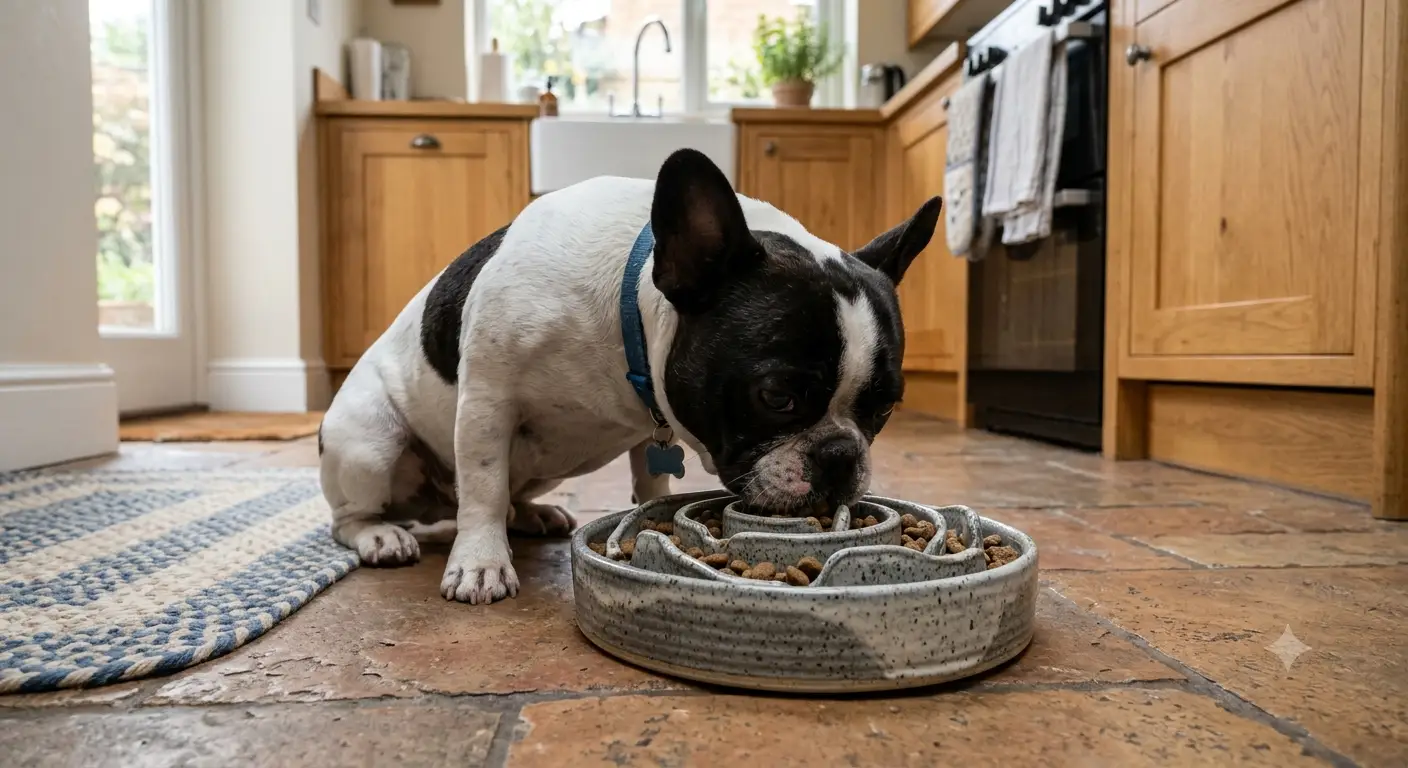
A slow feeder for a French Bulldog is a bowl or tray with raised ridges, pockets, or patterns that break a meal into small portions, forcing your dog to take smaller bites. The best versions for Frenchies are shallow and wide, so a short snout reaches food comfortably without pressing into deep channels.
In this guide, you’ll find seven real products compared on depth, material, capacity, and how reviews say they perform for flat-faced dogs — plus a transition plan, problem-solving tips, and the features that genuinely matter (and the ones that are mostly marketing).
Quick Comparison: The 7 Best Slow Feeders for Frenchies at a Glance
| Product | Style | Material | Capacity | Price Range | Best for |
|---|---|---|---|---|---|
| Outward Hound Fun Feeder Slo Tray | Low-ridge tray | Plastic | Up to 1.5 cups | Under $20 | Outward Hound Fun Feeder Slo Tray: most Frenchies, best all-rounder |
| SodaPup eTray | Shallow enrichment tray | TPE (rubber-like) | Small meals | $20–$35 | SodaPup eTray: dogs with noisy breathing |
| Leashboss Flat Face Feeder | Tilted maze | BPA-free plastic | Small–medium meals | $20–$25 | Leashboss Flat Face Feeder: neck comfort |
| Outward Hound Fun Feeder Slo Bowl (Small) | Classic maze bowl | Plastic | Up to 2 cups | $10–$15 | Outward Hound Fun Feeder Slo Bowl: budget buyers |
| LE TAUCI Ceramic Slow Feeder | Ceramic maze | Ceramic | 1.5 cups | $15–$25 | LE TAUCI Ceramic Slow Feeder: plastic-free homes |
| Neater Pet Brands Stainless Steel Slow Feed Bowl | Pocket bowl | Stainless steel | 3/4 cup to 3 cups | $10–$20 | Neater Pet Brands Stainless Steel Slow Feed Bowl: hygiene-focused owners |
| Neater Feeder Express with Slow Feed Bowl | Raised mess-proof diner | Steel + plastic | 3/4 cup | $25–$35 | Neater Feeder Express with Slow Feed Bowl: messy drinkers |
Looking at the table above, the pattern is clear: the three products designed specifically around flat faces — the Outward Hound Fun Feeder Slo Tray, the SodaPup eTray, and the Leashboss Flat Face Feeder — trade “maximum slowdown” for comfort and access. If your Frenchie is a moderately fast eater with a sensitive airway, that trade is almost always worth it. The Outward Hound Fun Feeder Slo Bowl and the Neater Pet Brands Stainless Steel Slow Feed Bowl slow eating more aggressively but demand more nose work, so they suit Frenchies with slightly longer muzzles or a tougher appetite to tame.
💬 One click helps other shoppers make an informed choice too! 😊
Top 7 Slow Feeders: Expert Analysis for Flat-Faced Eaters
Every pick below is a real product sold in the US. Specs come from manufacturer and retailer listings; review sentiment is summarized from aggregated customer feedback and labeled as such. I haven’t personally tested these bowls, so the commentary is analysis — what the specs mean for a short-snouted dog, and what owner feedback consistently reports.
1. Outward Hound Fun Feeder Slo Tray — purpose-built for flat faces
This is the closest thing to a “default answer” for Frenchie owners, because Outward Hound designed the Slo Tray specifically for brachycephalic breeds rather than adapting a deep bowl after the fact.
The tray uses low ridges instead of tall maze walls and holds up to 1.5 cups of wet or dry food. Outward Hound claims it slows eating by up to 5x — notably less than the 10x it claims for its deeper bowls, and that’s the point: the ridges are short enough for a pushed-in nose to reach every pocket. It’s top-rack dishwasher safe on a low-heat setting, though it isn’t microwave safe.
Based on comparing the specs, this is the right first purchase for most adult Frenchies eating 1 to 1.5 cups per meal. A typical adult French Bulldog’s portion fits comfortably, the flat profile keeps the head in a neutral position, and wet food spreads easily across the surface.
At the time of writing, I couldn’t verify a large body of customer reviews specific to the tray version, so weigh it mainly on its design — which is exactly what flat-face guidance recommends.
Pros:
- ✅ Low ridges sized for short, flat snouts
- ✅ Holds a full adult Frenchie meal comfortably
- ✅ Dishwasher safe for quick daily cleaning
Cons:
- ❌ Gentler slowdown than deep maze bowls
- ❌ Plastic can scratch if your dog chews it
Typically priced under $20 — strong value for a design made for this exact breed.
2. SodaPup eTray — shallowest option for noisy breathers
SodaPup positions its eTray as a shallow slow feeder rather than a bowl, and for a Frenchie with obvious snoring or snorting, that distinction is genuinely useful.
The eTray is roughly 1 to 2 inches deep and made in the USA from a food-safe TPE (a soft, rubbery thermoplastic). SodaPup also sells deeper “eBowls” that are about twice as deep, which tells you something honest about the trade-off: the tray prioritizes comfort, while the bowl prioritizes slowdown. In practice, a shallow, wide surface lets your dog lick and nibble with its head level instead of tilting down into channels.
Who’s it for? Frenchies with significant airway noise, seniors, and dogs on wet or raw diets that spread nicely into a textured surface. The softer material is also quieter on hard floors than rigid plastic or steel.
Aggregated sentiment around SodaPup’s flat-face lineup tends to praise the comfort and enrichment angle; a recurring theme is that very determined eaters may still finish fairly quickly on the shallowest designs.
Pros:
- ✅ Very shallow surface keeps the head neutral
- ✅ Made in the USA from food-safe TPE
- ✅ Doubles as an enrichment or lick-style tray
Cons:
- ❌ Less slowdown for extremely fast gulpers
- ❌ Soft material isn’t for dedicated chewers
Usually in the $20–$35 range, depending on design — check the current price; worth it if airway comfort is your top priority.
3. Leashboss Flat Face Feeder — tilted design for neck comfort
The Leashboss Flat Face Feeder tackles a problem other bowls ignore: Frenchies are stocky, and bending all the way to floor level while also navigating a maze is awkward.
Its key feature is a tilted platform with a maze pattern on top. The angle brings the food surface toward your dog’s face, which in practice reduces how much the Frenchie must push its nose downward. Retail listings describe it as BPA-free plastic with a rubber base, and it’s dishwasher safe. Leashboss built it specifically for short-snouted dogs, and Bustle named it its top slow feeder for flat-faced breeds.
Based on the design, this is a smart pick for Frenchies who eat with their elbows splayed or who seem to shove the bowl around trying to get a better angle. The tilt also helps kibble collect toward the lower edge, which matters as the bowl empties.
Customer review volume is modest compared with mass-market bowls; the available feedback is generally positive about access for flat faces, with fewer data points than the big brands.
Pros:
- ✅ Tilt reduces strain on neck and face
- ✅ Maze designed around short snouts
- ✅ BPA-free and dishwasher safe
Cons:
- ❌ Smaller review base than leading brands
- ❌ Angled shape takes more cabinet space
Around $20–$25 — fair value for a specialist design.
4. Outward Hound Fun Feeder Slo Bowl (Small) — best value with variety
This is the bestselling classic of the slow-feeder world, and its small size can work for Frenchies — as long as you pick the pattern carefully.
The Small holds up to 2 cups and the X-Small about 3/4 cup. Outward Hound claims up to 10x slower eating, and the bowls come in multiple difficulty patterns. It has a non-slip base and goes on the top rack of the dishwasher. In practice, the 10x claim comes from tall ridges — great for a Beagle, potentially frustrating for a flat face.
My honest take: if you choose this bowl for a Frenchie, choose an easier, more open pattern (the “drop” or petal-style designs) rather than a tight spiral. It’s an excellent budget option for Frenchies with a slightly longer muzzle or a ferocious appetite.
Aggregated reviews are strong — the small size carried roughly 4.6 out of 5 across 600+ ratings on a major US retailer listing. A recurring complaint from owners of flat-faced dogs, however, is that narrow spiral sections can be hard to reach.
Pros:
- ✅ Huge choice of sizes, patterns, and colors
- ✅ Strong slowdown for determined gulpers
- ✅ Very affordable and dishwasher safe
Cons:
- ❌ Tall ridges can frustrate very flat faces
- ❌ Tight spiral patterns trap kibble in corners
Typically $10–$15 — unbeatable value if your Frenchie handles the ridges.
5. LE TAUCI Ceramic Slow Feeder — premium plastic-free pick
For owners who want to ditch plastic entirely, LE TAUCI’s ceramic maze bowl is one of the most popular choices — and its proportions happen to suit Frenchies well.
The 1.5-cup version measures about 8 x 8 x 1.8 inches, so it’s wide with relatively low walls — a good shape for a short face. Ceramic is heavy, which means the bowl stays put even with a pushy eater, and the glazed surface is dishwasher safe. LE TAUCI also markets it as microwave safe, handy for warming wet food slightly.
Based on comparing the specs, this is a great fit for Frenchies prone to chin acne or skin irritation, since owners often switch away from scratched plastic for that reason. The weight also makes it the least likely to skate across the kitchen.
Aggregated review sentiment is consistently positive on looks, weight, and stability; the common caution is simple: it’s ceramic, so a drop on tile can chip or crack it.
Pros:
- ✅ Wide, low profile suits short snouts
- ✅ Heavy base resists sliding and tipping
- ✅ Plastic-free and dishwasher safe
Cons:
- ❌ Breakable if dropped on hard floors
- ❌ Heavier to carry and store
Usually $15–$25 — good value for a durable, plastic-free bowl.
6. Neater Pet Brands Stainless Steel Slow Feed Bowl — most hygienic material
Stainless steel is the material many veterinarians and hygiene-focused owners prefer, and Neater’s slow feed bowl brings it to the slow-feeder category with a pocket design.
Instead of a maze, it uses recessed pockets around a raised center, so each pocket holds only a little food. Sizes run from a small 3/4-cup bowl up to 3 cups; the 1.5-cup version measures about 7 inches across the top and 2 inches tall. Neater says the steel bowls are made in India, and they’re dishwasher safe and lead-free according to retailer listings.
Who’s it for? Owners who want a bowl that won’t scratch, hold odors, or break. For a Frenchie, the 3/4-cup or 1.5-cup size makes sense; the pockets are fairly forgiving compared with a deep spiral maze.
Reviews on US pet retailer listings repeatedly mention owners upgrading from plastic slow feeders — sometimes because plastic irritated a dog’s skin — and praise easy cleaning.
Pros:
- ✅ Non-porous steel won’t hold odors
- ✅ Multiple sizes for precise portioning
- ✅ Practically indestructible for daily use
Cons:
- ❌ Lightweight versions can slide on smooth floors
- ❌ Pockets need a bottle brush to clean well
Generally $10–$20 by size — excellent long-term value.
7. Neater Feeder Express with Slow Feed Bowl — mess-proof raised diner
If your Frenchie’s mealtime ends with kibble across the floor and water splashed to the baseboards, this all-in-one setup solves several problems at once.
The small version (model 200-210-SF) pairs a 3/4-cup stainless slow feed bowl with a water bowl inside a raised plastic stand with protective walls. It measures roughly 12.9 x 8.75 x 4.75 inches, and Neater makes its stands from BPA-free plastic in the USA. The slight elevation reduces how far your dog has to bend, while the walls catch spills and the water section drains overflow into a reservoir.
Based on the design, this suits Frenchies who are messy drinkers (very common with flat faces) and owners who want food and water in one tidy footprint. Note the 3/4-cup slow bowl: larger adult Frenchies may need their meal split into two servings.
A listing I checked showed roughly 4.1 out of 5 from about 250 reviews; common praise centers on cleaner floors, while some feedback mentions the small bowl capacity.
Pros:
- ✅ Contains spills from food and water
- ✅ Slight elevation eases neck strain
- ✅ Stainless bowls are easy to sanitize
Cons:
- ❌ Small bowl may not fit a full meal
- ❌ Bulkier than a standalone bowl
Around $25–$35 — worth it if mess control is half your problem.
Side-by-Side Specs: How the 7 Slow Feeders Really Compare
| Product | Depth/Profile | Claimed Slowdown | Dishwasher Safe | Flat-Face Design | Best for |
|---|---|---|---|---|---|
| Outward Hound Fun Feeder Slo Tray | Low ridges | Up to 5x | Yes (top rack, low heat) | Yes | Outward Hound Fun Feeder Slo Tray: everyday feeding |
| SodaPup eTray | ~1–2 in. | Not specified | Check label | Yes | SodaPup eTray: airway-sensitive dogs |
| Leashboss Flat Face Feeder | Tilted maze | Not specified | Yes | Yes | Leashboss Flat Face Feeder: stiff necks |
| Outward Hound Fun Feeder Slo Bowl (Small) | Tall ridges | Up to 10x | Yes (top rack) | No | Outward Hound Fun Feeder Slo Bowl: extreme gulpers |
| LE TAUCI Ceramic Slow Feeder | ~1.8 in. tall | Not specified | Yes | Partly (wide, low) | LE TAUCI Ceramic Slow Feeder: stability |
| Neater Pet Brands Stainless Steel Slow Feed Bowl | ~2 in. pockets | Not specified | Yes | Partly | Neater Pet Brands Stainless Steel Slow Feed Bowl: hygiene |
| Neater Feeder Express with Slow Feed Bowl | Raised stand | Not specified | Yes (bowls) | Partly | Neater Feeder Express with Slow Feed Bowl: mess control |
Reading across the “Claimed Slowdown” column, notice that only Outward Hound publishes a number — and its flat-face tray deliberately claims half the slowdown of its classic bowl. That’s a useful reality check: deeper equals slower, but not necessarily safer for a Frenchie. If your dog regurgitates or snorts heavily, prioritize the “Flat-Face Design” column first and slowdown second.
How to Switch Your Frenchie to a Slow Feeder (First 30 Days)
A new slow feeder can confuse a dog who’s used to vacuuming a plain bowl. A little structure makes the transition smooth.
Week 1: Make it easy and rewarding
Start by serving only part of the meal in the new bowl — or scatter a handful of high-value treats across it — while the rest goes in the old bowl. Your goal is a quick win, not a puzzle exam. If you’re using the Outward Hound Fun Feeder Slo Tray or the SodaPup eTray, spread food thinly so every bite is visible.
Week 2: Move to full meals
Once your Frenchie approaches the new bowl eagerly, serve the full meal there. Time it: if a meal that used to take 30 seconds now takes 2 to 4 minutes, that’s a solid improvement for a flat-faced dog.
Weeks 3–4: Fine-tune
- ✅ Add a splash of warm water or mix in wet food if your dog struggles to pick up dry kibble.
- ✅ Watch for frustration signs: pawing, flipping, barking at the bowl, or walking away hungry.
- ✅ Check the bowl surface for chew marks weekly and replace damaged plastic.
Common first-month mistakes
Don’t jump straight to the hardest maze, don’t overfill (food piled above the ridges defeats the purpose), and don’t leave wet food sitting in the grooves overnight. Wash after every meal — crevices are bacteria magnets.
Finally, remember that a bowl is one tool, not the whole plan. The American Kennel Club’s guidance on bloat recommends combining slower eating with sensible habits such as splitting food into smaller meals and avoiding vigorous exercise right after eating.
Real-World Scenarios: Matching the Right Bowl to Your Frenchie
Specs are easier to apply when you picture an actual dog. Here are three common Frenchie profiles and the reasoning behind each match.
Scenario 1: The apartment snorer
Picture a 3-year-old, 24-pound Frenchie in a city apartment who snores loudly, eats 1 cup of kibble twice a day, and sometimes regurgitates right after meals. Budget: around $30. The best match is the Outward Hound Fun Feeder Slo Tray or the SodaPup eTray. Both keep the head level, which matters for a dog already working hard to breathe. Since regurgitation is in the picture, a veterinary check is also wise — regurgitation in flat-faced breeds can be linked to the airway itself, not just eating speed.
Scenario 2: The bottomless pit
Now imagine a young, energetic Frenchie with a relatively longer muzzle who finishes meals in 15 seconds and shows no obvious breathing struggle. Budget is tight — under $15. The Outward Hound Fun Feeder Slo Bowl in Small, with an open “drop” pattern, delivers strong slowdown for the money. If the dog seems frustrated after a week, step down to the tray.
Scenario 3: The messy senior
Finally, consider a 10-year-old Frenchie with mild arthritis who splashes water everywhere and eats about 3/4 cup per meal. The Neater Feeder Express with Slow Feed Bowl combines slight elevation, a portion-sized steel slow bowl, and spill walls — three problems handled in one footprint. If the owner prefers a heavier standalone bowl, the LE TAUCI Ceramic Slow Feeder paired with a separate shallow water dish is a solid alternative.
🔍 Ready to upgrade your Frenchie’s mealtime?
✨ These picks are matched to real flat-faced needs, not generic dog bowls. Click a highlighted product to check current pricing and availability — and give your Frenchie calmer, comfier meals starting this week!
Problem → Solution: Fixing the Most Common Slow Feeder Headaches
Even the right bowl can create new quirks. Here’s how to solve the issues Frenchie owners mention most often.
Problem 1: “My Frenchie gives up and walks away.” Solution: The pattern is too deep or tight. Switch to a shallower design like the Outward Hound Fun Feeder Slo Tray or the SodaPup eTray, or add warm water to soften kibble so it slides out of grooves more easily.
Problem 2: “The bowl slides across the floor.” Solution: Lightweight plastic and steel bowls can skate on tile. Place the bowl on a rubber mat, or choose a heavier option like the LE TAUCI Ceramic Slow Feeder. A raised diner like the Neater Feeder Express with Slow Feed Bowl also anchors the bowl inside a stand.
Problem 3: “He still vomits or regurgitates after eating.” Solution: First, rule out medical causes with your vet — flat-faced breeds often regurgitate because of airway and digestive anatomy, not just speed. Then split daily food into three smaller meals and keep play quiet for an hour afterward.
Problem 4: “Food gets stuck in corners and smells.” Solution: Choose dishwasher-safe bowls (all seven picks are, or check the label for the SodaPup tray), and use a bottle brush on pocket designs such as the Neater Pet Brands Stainless Steel Slow Feed Bowl.
Problem 5: “She flips the bowl to dump the food.” Solution: Switch to a weighted or stand-mounted option. Clever Frenchies learn that flipping beats puzzling — so remove the option entirely.
How to Choose a Slow Feeder Bowl for French Bulldog Needs
Choosing a slow feeder bowl for french bulldog anatomy comes down to a handful of criteria, in this order of priority.
- Check the depth first. Shallow beats deep for flat faces. Look for low ridges or a profile around 2 inches or less so your dog’s nose isn’t jammed into channels.
- Match capacity to one meal. Most adult Frenchies eat roughly 1 to 1.5 cups per meal depending on food and activity; a bowl that holds exactly one meal keeps food spread out instead of piled up.
- Pick the right pattern. Open petals, low waves, and wide pockets work better than tight spirals. The AKC’s advice on slowing a dog’s eating notes there are many slow-feeder designs, so choose one your dog can actually solve.
- Choose a material you can keep clean. Stainless steel and glazed ceramic resist scratches; plastic is lighter and cheaper but should be replaced when gouged.
- Prioritize stability. A non-slip base or heavy material prevents chasing the bowl around the room.
- Consider height. A tilted or slightly raised feeder can ease neck strain for stocky Frenchies, especially seniors.
- Confirm it’s dishwasher safe. Slow feeders have more crevices than regular bowls, so easy sanitizing is a must.
In short, the best slow feeder for french bulldog comfort is the one your dog can work through calmly in a few minutes — not the one with the scariest maze.
Common Mistakes to Avoid When Buying a French Bulldog Slow Feeder
Buying a french bulldog slow feeder seems simple, yet several pitfalls show up again and again in owner feedback.
Mistake 1: Buying the “hardest” bowl available. Marketing loves big slowdown numbers, but a 10x claim usually means tall ridges. For a Frenchie, a puzzle that’s too hard often leads to frustration, bowl-flipping, or awkward face-pressing.
Mistake 2: Choosing size by “small dog” labels alone. An X-Small bowl may hold only 3/4 cup, which may not fit a full adult Frenchie meal. Check the actual cup capacity against what your dog eats.
Mistake 3: Ignoring the water bowl. Flat-faced dogs are notoriously messy drinkers. A slow food bowl paired with a deep, narrow water bowl still leaves a puddle problem — a combined setup like the Neater Feeder Express with Slow Feed Bowl handles both.
Mistake 4: Keeping scratched plastic forever. Grooves and chew marks trap food residue. Plan to replace plastic slow feeders when the surface is visibly damaged.
Mistake 5: Treating the bowl as a medical fix. A slow feeder reduces gulping, but persistent regurgitation, gagging, or noisy breathing in a Frenchie deserves a vet visit. The bowl supports good habits; it doesn’t treat airway disease.
Mistake 6: Skipping the transition. Switching cold turkey can make a dog suspicious of the new bowl. A week of easy wins (see the 30-day plan above) pays off for months.
Slow Feeder vs. Regular Bowl: What Changes for a Flat-Faced Dog?
Is a slow feeder really better than a standard bowl, or just a gadget? For a gulping Frenchie, the differences are meaningful.
| Factor | Regular Bowl | Shallow Slow Feeder | Deep Maze Slow Feeder | Best for |
|---|---|---|---|---|
| Eating speed | Fastest | Moderately slower | Much slower | Shallow slow feeder (e.g., Outward Hound Fun Feeder Slo Tray) for most Frenchies |
| Air swallowing | Highest | Reduced | Reduced, but face-pressing possible | Shallow slow feeder |
| Face comfort | Good | Very good | Often poor for flat faces | SodaPup eTray |
| Mental enrichment | None | Light | High | Outward Hound Fun Feeder Slo Bowl for longer-muzzled Frenchies |
| Cleaning effort | Easy | Moderate | Harder | Neater Pet Brands Stainless Steel Slow Feed Bowl |
The table shows why the shallow slow feeder hits the sweet spot for French Bulldogs: you get most of the speed and air-swallowing benefit without the face-pressing problem of deep mazes. A regular bowl is only “better” on cleaning convenience, and deep mazes only win on enrichment — which a Frenchie can get more safely from lick mats or treat toys.
Beyond the table, think about behavior. A slow feeder turns a 20-second feeding frenzy into a few minutes of focused foraging, which many owners find calms post-meal zoomies and begging. For a breed prone to weight gain, a longer meal can also make a measured portion feel more satisfying.
Features That Actually Matter (and Ones That Don’t)
Shopping pages are full of buzzwords. Here’s how to sort useful features from fluff when picking a dog bowl for flat-faced dogs.
✅ Features that matter
- Ridge height and spacing. This is the single biggest factor for a Frenchie. Low, widely spaced ridges let a short snout reach every bite.
- Real capacity in cups. “Small,” “medium,” and “mini” mean different things at different brands. Cups are the only honest comparison.
- Non-slip base or heavy material. A bowl that moves turns mealtime into a chase.
- Dishwasher-safe construction. Slow feeders have far more surface area and crevices than flat bowls.
- Food-safe material claims. BPA-free plastic, food-grade stainless steel, or lead-free glazed ceramic are the baseline.
❌ Features that matter less than you think
- Huge slowdown multipliers. “10x slower” sounds great but usually signals tall walls that may not suit a flat face.
- Novelty shapes. Cute bone or flower outlines don’t matter unless the pattern itself is shallow and open.
- “Vet recommended” badges without details. Slow feeders in general are commonly recommended for fast eaters; a badge doesn’t tell you the bowl suits brachycephalic anatomy.
- Matching color sets. Nice for your kitchen, irrelevant to your dog.
Bottom line: spend your attention on depth, capacity, and stability — those three decide whether your Frenchie eats comfortably.
Long-Term Cost and Maintenance
A slow feeder is a small purchase, but material choice changes what you’ll spend over several years.
| Material | Typical Upfront Cost | Expected Lifespan | Ongoing Care | Best for |
|---|---|---|---|---|
| Plastic (Outward Hound Fun Feeder Slo Tray, Outward Hound Fun Feeder Slo Bowl) | $10–$20 | Replace when scratched or chewed | Dishwasher, low heat | Budget buyers |
| TPE (SodaPup eTray) | $20–$35 | Long if not chewed | Wash after each meal | Comfort-first owners |
| Ceramic (LE TAUCI Ceramic Slow Feeder) | $15–$25 | Years, unless dropped | Dishwasher; check for chips | Plastic-free homes |
| Stainless steel (Neater Pet Brands Stainless Steel Slow Feed Bowl) | $10–$20 | Many years | Dishwasher plus brush | Lowest cost of ownership |
Over five years, stainless steel usually wins on total cost: one bowl can outlast several plastic replacements. Plastic remains the cheapest way to test which pattern your Frenchie likes before committing. Ceramic sits in between — durable in daily use, but a single drop on tile can end its life.
Maintenance routine that keeps any bowl safe
- Wash after every meal, especially with wet or raw food.
- Run it through the dishwasher (top rack for plastics) at least daily.
- Inspect weekly for cracks, chips, or chew marks.
- Replace plastic once grooves look rough or discolored.
Safety, Regulations, and Standards for Dog Bowls
Here’s something many shoppers don’t know: in the US, there isn’t a dedicated federal certification program for dog food bowls the way there is for, say, children’s products or electrical appliances. That means “safe” claims on pet bowls rely mostly on the manufacturer’s material choices and labeling.
So what should you look for in practice?
- Plastic: Look for clear “BPA-free” and “food-safe” claims. Avoid bowls with strong chemical odors or flaking surfaces.
- Stainless steel: Food-grade stainless is the gold standard for hygiene; some listings also state “lead-free,” as Neater’s does.
- Ceramic: Choose reputable brands that state the glaze is lead-free and food-safe. Retire any chipped or crazed ceramic bowl, since cracks can harbor bacteria.
- TPE/silicone: Look for food-grade or FDA-compliant material claims, like SodaPup’s.
The bigger safety question for Frenchies is anatomical. The American College of Veterinary Surgeons’ overview of brachycephalic syndrome describes how narrowed nostrils and an elongated soft palate affect breathing in flat-faced breeds. For feeding, that translates into practical rules: avoid bowls that force your dog’s face into deep channels, keep meals calm, and watch for signs of breathing distress during or after eating.
Finally, if your Frenchie ever shows a swollen belly, unproductive retching, or sudden restlessness after a meal, treat it as an emergency and call your veterinarian immediately. No bowl replaces prompt veterinary care.
French Bulldog Slow Feeder Advice for Puppies and Seniors
Age changes what “the right bowl” looks like.
Frenchie puppies
Puppies often eat three or four small meals a day, so capacity matters less than accessibility. A shallow option like the SodaPup eTray or the Outward Hound Fun Feeder Slo Tray is ideal: easy wins build a positive association with slower eating. Avoid hard plastic mazes for teething puppies who may chew the edges, and supervise meals until you know your pup won’t gnaw the bowl.
Adult Frenchies
This is the stage where most owners can experiment. If your adult dog handles the tray easily and still eats too fast, try the Leashboss Flat Face Feeder or an open-pattern Outward Hound Fun Feeder Slo Bowl. Weight management is a major concern for the breed, so a slower meal paired with measured portions is a meaningful habit.
Senior Frenchies
Older dogs may have stiff necks, dental issues, or reduced appetite. Comfort comes first: the tilted Leashboss Flat Face Feeder or the slightly raised Neater Feeder Express with Slow Feed Bowl reduces bending. If dental problems make kibble hard to manage, softened food in a shallow tray keeps the slow-feeding benefit without the struggle.
Across every age group, the rule is the same: if your dog seems stressed by the bowl, it’s too hard. A slow feeder should feel like a game, not a test.
FAQs
❓ Do slow feeders really work for French Bulldogs?
❓ What size slow feeder bowl for french bulldog adults should I buy?
❓ Can I use wet food in a french bulldog slow feeder?
❓ Is stainless steel or ceramic better for a slow feeder for frenchie mealtimes?
❓ How long should it take my Frenchie to eat from a slow feeder?
Conclusion
Finding the best slow feeder for french bulldog mealtimes isn’t about buying the most complicated maze on the shelf. It’s about respecting a Frenchie’s anatomy: a short snout, a sensitive airway, and a stocky build that doesn’t love bending into deep bowls.
For most owners, the Outward Hound Fun Feeder Slo Tray is the safest starting point — purpose-built for flat faces, sized for a typical meal, and easy to clean. If your dog snores heavily or struggles with any ridges at all, the ultra-shallow SodaPup eTray puts comfort first. The Leashboss Flat Face Feeder is the smart upgrade for neck comfort, while budget buyers with a hard-core gulper can try the Outward Hound Fun Feeder Slo Bowl in an open pattern.
Prefer durable materials? The LE TAUCI Ceramic Slow Feeder stays put and keeps plastic out of the kitchen, and the Neater Pet Brands Stainless Steel Slow Feed Bowl offers the lowest long-term cost. And if mealtime always ends in a puddle, the Neater Feeder Express with Slow Feed Bowl cleans up food and water in one setup.
Whatever you choose, pair the bowl with smaller meals, calm post-meal routines, and regular vet checkups. Your Frenchie will still love dinner — it’ll just last long enough for you to enjoy watching.
🐾 Give your Frenchie a calmer, healthier mealtime today!
✨ You’ve seen the specs, the trade-offs, and the real-world matches. Click a highlighted pick to check current pricing and availability — and turn that 20-second gulp into a comfy, slower meal your Frenchie will still adore!
Recommended for You
- Equine Automatic Feeder: 7 Best Picks That Actually Work in 2026
- Automatic Pig Feeder with Timer: 7 Best Picks That Save Time (2026)
- Dog Treat Machine Guide 2026: 7 Best Picks That Actually Work
Disclaimer: This post contains affiliate links. As an Amazon Associate, I earn from qualifying purchases made through these links, at no additional cost to you.
✨ Found this article helpful? Share it with someone who needs it! 💬🤗