In This Article
Why an Equine Automatic Feeder Changes Your Barn Routine
If your horse’s breakfast depends on you beating rush-hour traffic, an equine automatic feeder can feel like hiring a barn hand who never calls in sick. Horses evolved to nibble for most of the day, yet most stabled horses still get two big meals squeezed around their owners’ work hours. That gap between how horses are built and how we actually feed them is exactly where an equine automatic feeder earns its keep.
What Is an Equine Automatic Feeder?
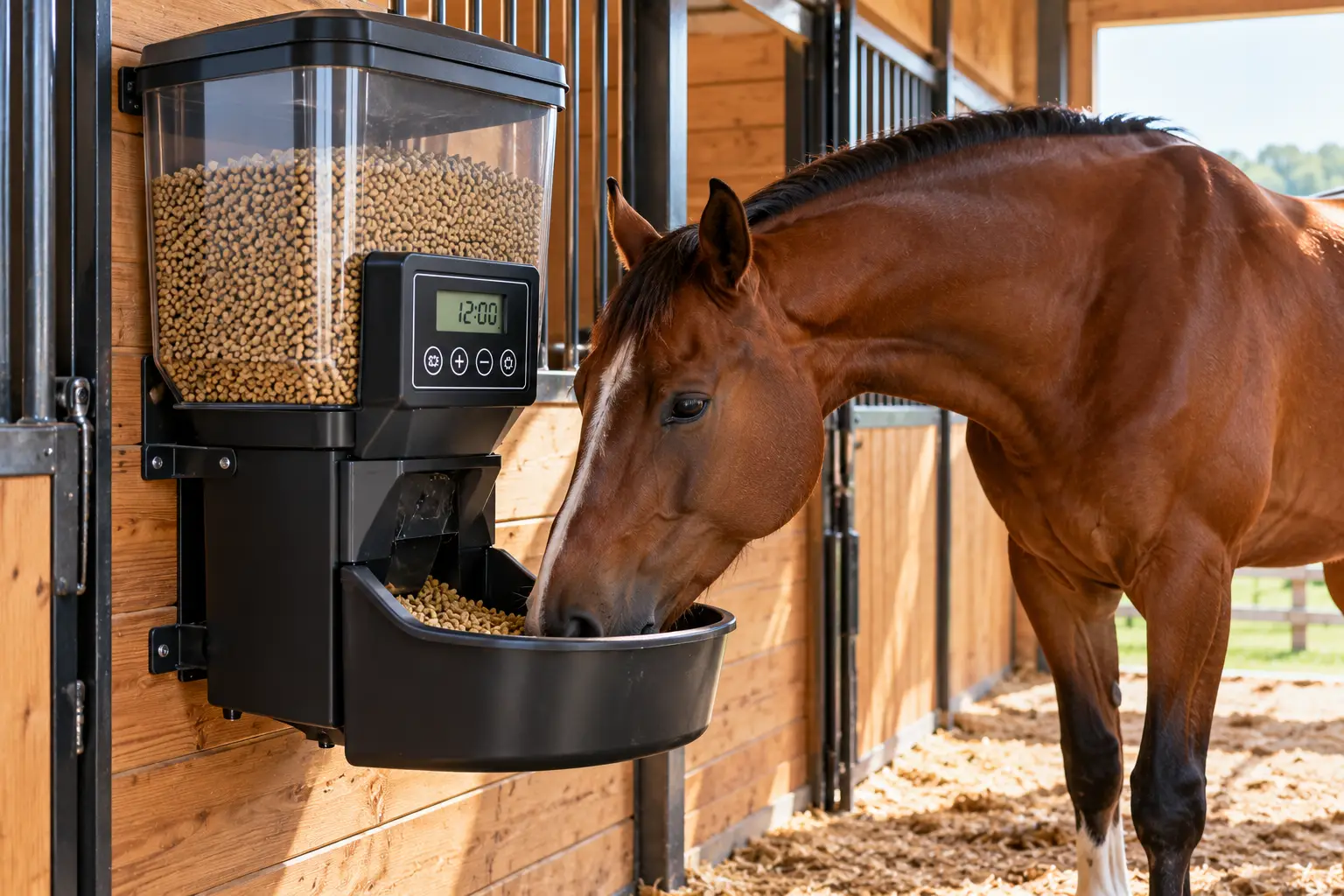
An equine automatic feeder is a programmable device that releases pre-measured portions of grain, pellets, hay cubes, or hay at set times, without a person present. Most use a digital timer, a motorized dispenser or door, and a hopper, running on household current, a 12-volt battery, or solar power.
The idea isn’t new. The science of equine nutrition has long pointed out that a horse’s stomach is small relative to its body and handles a steady trickle of food better than a couple of large meals. An automatic horse feeder simply makes that “little and often” approach practical for people with jobs, kids, and lives.
Here’s the honest catch: this category is small and specialized. Several of the best-built units are sold mainly through their manufacturers, while Amazon carries a narrower selection whose availability shifts often. So in this guide, we compare seven real products on their published specs, real owner feedback where it exists, and practical fit, and we tell you plainly where something can’t be verified.
You’ll also find a setup plan for the first 30 days, troubleshooting fixes, a buying framework, and a cost breakdown, so you can pick the right equine automatic feeder once and skip the expensive second try. ⏰🐴
Quick Comparison: The 7 Best Equine Automatic Feeder Options at a Glance
Before the deep dives, here’s the short version. Each row lists what the feeder actually dispenses, how often it can feed, and how it’s powered, because those three specs decide fit faster than any marketing line.
| Feeder | Feed type | Max feedings | Power | Best for |
|---|---|---|---|---|
| Quick Feed Automatic Single Feeder | Grain, pellets, supplements | Up to 12/day | Plug-in, battery, or solar versions | Quick Feed: best all-round grain pick |
| iFEED Automatic Feeder | Grain, pellets | Up to 48 schedules/day | 110V power supply | iFEED: stalled horses needing micro-meals |
| Equine Automation X5-CD | Grain, cubes, chopped forage, soaked feed | Up to 16 times (5 preloaded) | 12V rechargeable, solar option | X5-CD: metabolic and senior diets |
| Stable Grazer Automatic Feeder Kit | Hay and grain together | 6 timed shelves | Battery | Stable Grazer: hay plus grain in one unit |
| EEZFEEDER by Eezkeeper | Hay flakes, cubes, pellets | 1 to 18 per day or week | 8 D-cell batteries | EEZFEEDER: no-wiring paddocks |
| HayBox Single Mini | Small-bale or partial big-bale hay | 6/day | Grid, solar add-on | HayBox: hands-off pasture forage |
| Amouu Equine FeedPilot | Hay | Timed release | Digital timer lock | Amouu FeedPilot: budget overnight hay |
Looking at the table, the split is clear: Quick Feed, iFEED, and the X5-CD are concentrate specialists, while Stable Grazer, EEZFEEDER, HayBox, and the Amouu FeedPilot focus on forage. If your horse’s main problem is long overnight gaps without hay, a grain dispenser won’t fix it, no matter how precise its timer is. Start by deciding whether you’re automating grain, hay, or both, and the list shrinks to two or three candidates quickly.
💬 One click helps other shoppers make an informed choice too! 😊
Top 7 Equine Automatic Feeder Picks: Expert Analysis
Every pick below is a real, currently marketed product. Where a feeder is sold mainly by its manufacturer rather than on Amazon, we say so, because nothing is more frustrating than falling for a feeder you can’t actually order.
1. Quick Feed Automatic Single Feeder — best all-round grain timer
The Quick Feed Automatic Single Feeder is the closest thing this category has to a household name, with the brand dating back to 1997.
On paper, it dispenses 1 to 5 cups per serving, up to 12 times a day, from a hopper holding up to 50 pounds of grain or pellets. In practice, that means a typical 3-4 pound daily concentrate ration can be split into six or more small meals instead of two big ones. The timer also holds its settings through a power outage, which matters more than it sounds in storm season.
Based on comparing the specs, this is the feeder for owners automating concentrates, senior feeds, or pelleted diets. It is not a hay solution, so pair it with a slow-feed net.
Owner reviews on the manufacturer’s site are strongly positive, with recurring stories of senior horses fed every two hours for years. The Amazon listing, however, has been intermittently unavailable and carries complaints about returns, so check who the seller is.
Pros:
- ✅ Proven design with a long owner track record
- ✅ Plug-in, battery, and solar versions available
- ✅ Timer keeps settings during power outages
Cons:
- ❌ Grain and pellets only, no hay
- ❌ Five-cup cap means splitting larger meals
At the time of writing, single and double versions run roughly between $330 and $510 depending on power option, solid value for a feeder built to run for years; check the current price.
2. iFEED Automatic Feeder — most frequent micro-meals
The iFEED Automatic Feeder takes “little and often” further than anything else on this list.
It can deliver feed up to 48 times a day, with up to 15 small portions each time, and one 2-amp power supply runs up to 16 feeders. For a barn, that means one wiring run can serve an entire aisle. The unit mounts outside the stall and feeds through a funnel into a bucket, so the horse never touches the electronics.
This is the pick for stalled performance horses and ulcer-prone horses on concentrate-heavy diets. Notably, Colorado State University researchers used an iFEED unit to deliver grain in 20 hourly feedings in a study presented at the 2017 AAEP Convention, and that group showed no rise in squamous ulcer scores while twice-daily-fed horses’ scores increased.
Aggregated owner sentiment, much of it from show barns, centers on calmer behavior at feeding time and less waste. Independent consumer reviews are thin, so weigh that.
Pros:
- ✅ Unmatched schedule flexibility for micro-meals
- ✅ Mounts outside the stall, away from teeth
- ✅ One power supply scales to 16 stalls
Cons:
- ❌ Needs 110V power, not ideal for remote paddocks
- ❌ Feed must fit size limits for the dispenser
The one-stall starter pack sits just under $600 at the time of writing, with two-stall kits a little over $1,000, strong value for multi-horse barns; check the current price.
3. Equine Automation X5-CD — handles soaked feed
The Equine Automation X5-CD solves a problem most feeders ignore: wet, soaked feed.
Its five separate compartments each hold one preloaded meal, so soaked beet pulp or hay pellets never sit in a shared hopper. You can program up to 16 feed times, refilling as needed, and it runs on a rechargeable 12-volt battery with an optional solar panel. Grain capacity tops out around 30 pounds.
Here’s what to weigh: if your vet has your horse on soaked feed for dental issues, choke history, insulin resistance, or metabolic syndrome, this is one of very few automatic designs that can handle it. Easy keepers on dry pellets will get more capacity per dollar elsewhere.
Public reviews are limited; the manufacturer’s site hosts a testimonial from a Connecticut farm reporting durability through New England winters and use in safely refeeding thin rescue mares. Treat that as encouraging but not independent.
Pros:
- ✅ Dispenses soaked and mixed feeds
- ✅ Battery and solar power for anywhere setup
- ✅ Separate meals can change day to day
Cons:
- ❌ Only five preloaded meals per fill
- ❌ Few independent reviews to verify
Pricing is quoted by Equine Automation directly and wasn’t verifiable for this guide, so check the current price before budgeting.
4. Stable Grazer Automatic Feeder Kit — hay and grain together
The Stable Grazer Automatic Feeder Kit is built for owners who want one unit to handle the whole ration.
It uses six timed feed shelves behind a patented drop-down door, run by a battery-powered control panel with a built-in programmable timer. Because each shelf can hold hay, grain, or both, a full day of meals is staged in advance. The kit ships complete, and it’s made in Hillsboro, Oregon, by Carter2 Systems.
Based on comparing the specs, this suits single-horse owners who travel or work long shifts and want to skip the twice-daily barn run entirely. The shelf design favors flakes over loose hay, so plan portions by weight.
Verified independent reviews are sparse; owner discussion in horse forums frames it as reliable but on the pricier side. That’s thin evidence, so ask the maker for references.
Pros:
- ✅ Feeds hay and grain at the same time
- ✅ Battery power needs no wiring
- ✅ Complete kit with US manufacturing
Cons:
- ❌ Six feedings cap daily flexibility
- ❌ Installation takes more planning than plug-in units
Pricing is set by the manufacturer and wasn’t verifiable here; check the current price, and factor in the time it saves.
5. EEZFEEDER by Eezkeeper — runs a year on D-cells
The EEZFEEDER by Eezkeeper is the low-fuss option for paddocks with no power at all.
It arrives fully assembled and runs on eight D-cell batteries the maker says last over a year. It can feed 1 to 18 times per day or per week, and it handles large-volume hay flakes, cubes, and pellets. That “per week” option is unusual and useful for weekend coverage.
This is a fit for owners who want hay on a schedule without hiring an electrician or babysitting a charger. Because battery life claims depend on temperature and usage, keep a spare set on hand in cold climates.
Owner testimonials on the brand’s site praise reliable twice-daily feeding over multi-year use. Independent, third-party reviews are hard to verify, so read them as directional.
Pros:
- ✅ Ships fully assembled, ready to place
- ✅ Long battery life, no wiring required
- ✅ Handles real hay flakes, not just pellets
Cons:
- ❌ Sold mainly direct, not through Amazon
- ❌ Cold weather can shorten battery life
Pricing comes from the maker and wasn’t verifiable for this guide; check the current price.
6. HayBox Single Mini — hands-off pasture forage
The HayBox Single Mini is the heavy-duty end of the market, built for forage at scale.
It holds three small bales or about a quarter of a 3x3x8 big bale, measures roughly 54 inches wide by 41 inches tall, and weighs about 500 pounds. It opens up to six times a day. That weight is a feature: a horse can’t shove it around.
Here’s what to weigh: this is a capital purchase for easy keepers, insulin-resistant horses, or anyone tired of free-choice hay waste. The maker positions timed access as a middle path between long fasting gaps and overeating, which aligns with mainstream nutrition advice.
Independent reviews are limited given the price and niche; owner feedback tends to come through the maker. A solar add-on is offered for field use.
Pros:
- ✅ Holds days of hay in one load
- ✅ Heavy steel build resists horse damage
- ✅ Solar option for open pasture
Cons:
- ❌ High upfront cost for one horse
- ❌ Needs equipment to move and load
At the time of writing, it runs around $5,500, with the solar kit under $400, a strong long-term buy only if hay waste or labor is costing you real money; check the current price.
7. Amouu Equine FeedPilot — budget overnight hay
The Amouu Equine FeedPilot is the most accessible entry point, and it’s sold on Amazon.
It’s a 30-liter hanging hay bag made from 500D PVC with a digital timer lock. You feed the current meal, load the next portion, and the lock releases it later, typically overnight. It’s simple, portable, and needs no installation.
Based on comparing the specs, this suits owners who just want to skip the late-night barn check. It won’t deliver multiple micro-meals or handle grain. Hanging bags also need safe placement away from hooves.
It’s a new release on Amazon, and we couldn’t verify a meaningful body of customer reviews yet, so be cautious about durability claims until more owners report back.
Pros:
- ✅ Lowest-cost way to automate one meal
- ✅ Portable for trailers and shows
- ✅ No wiring or mounting hardware
Cons:
- ❌ One timed release, not multiple meals
- ❌ Too few reviews to judge durability
Pricing changes often on Amazon; check the current price and compare it against a manual slow-feed net.
Side-by-Side: Capacity, Power, and Value
| Feeder | Capacity | Power | Typical price range | Best for |
|---|---|---|---|---|
| Quick Feed Automatic Single Feeder | Up to 50 lb grain | Plug-in, battery, solar | About $330-$510 | Quick Feed: daily grain schedules |
| iFEED Automatic Feeder | Small portions, many times | 110V | Under $600 per stall | iFEED: ulcer-prone stall horses |
| Equine Automation X5-CD | 5 meals, up to ~30 lb grain | 12V, solar | Check current price | X5-CD: soaked diets |
| Stable Grazer Automatic Feeder Kit | 6 shelves | Battery | Check current price | Stable Grazer: full rations |
| EEZFEEDER by Eezkeeper | 1-9 hay flakes per cycle | 8 D-cells | Check current price | EEZFEEDER: off-grid hay |
| HayBox Single Mini | 3 small bales | Grid, solar | Around $5,500 | HayBox: pasture easy keepers |
| Amouu Equine FeedPilot | 30 L bag | Timer lock | Check current price | Amouu FeedPilot: one overnight meal |
Reading across the rows, the value sweet spot for most single-horse owners is the Quick Feed Automatic Single Feeder paired with a slow-feed hay net. Multi-stall barns get better per-horse economics from the iFEED Automatic Feeder thanks to its shared power supply. The HayBox Single Mini only pays off when hay waste and labor are large, recurring costs.
✨ Don’t miss these exclusive deals!
🔍 Take your horse’s feeding routine to the next level with this carefully curated lineup. Click a highlighted item to check current pricing and availability. These picks will help you get calmer, steadier mealtimes your whole barn will appreciate!
How to Set Up an Equine Automatic Feeder: Your First 30 Days
Buying the feeder is the easy part. The first month decides whether your horse trusts it or treats it like a monster on the wall. 🛠️
Week 1: Install and Run It Empty
Mount the unit where the horse can’t rub, kick, or chew it. Outside the stall wall with a chute or funnel is ideal, which is why designs like the iFEED Automatic Feeder feed through the bars. Then run several cycles empty while the horse watches. Horses are naturally suspicious of new motor noises, and a few harmless clicks build familiarity.
Week 2: Pair It With Meals You Already Feed
Keep feeding by hand, but program the feeder to drop a small portion at the same moment you arrive. The horse quickly links the sound to food. Many owners report horses learning “their” feeder’s sound within days.
Week 3: Shift One Meal to Automation
Automate a single daytime meal first, never the overnight one, so you can watch the reaction. Weigh the dispensed portion with a kitchen scale on three different days; grain density varies by bag, and a few seconds of run time can mean half a pound of difference.
Week 4: Build the Full Schedule
Now split the daily ration into smaller meals. A common pattern is 4 to 6 concentrate meals spaced across waking hours, with forage covering overnight. Keep any change in total ration gradual.
Ongoing Maintenance Checklist
- ✅ Check battery charge or power weekly
- ✅ Empty and dry the hopper before each new feed bag
- ✅ Inspect chutes for moisture clumps after rain
- ✅ Replace backup batteries every season
Real-World Scenarios: Matching the Right Feeder to Your Situation
Specs only make sense against a real routine. Here are three common owner profiles and the reasoning behind each match. 🐎
The Commuter With One Senior Horse
Situation: A 26-year-old gelding on a soaked senior-feed diet, an owner who leaves at 6 a.m. and gets home at 7 p.m. Budget: a few hundred dollars, with flexibility for the right fit.
Best match: The Equine Automation X5-CD. Soaked feed rules out almost everything else, and five preloaded compartments cover the long daytime gap. The battery and solar option means no outlet is needed in an older barn.
The Boarding Barn With Eight Show Horses
Situation: Performance horses stalled most of the day, high-concentrate diets, a manager worried about ulcers. Feeding happens daily, all year.
Best match: The iFEED Automatic Feeder. One power supply can drive up to 16 units, so per-stall cost drops as the barn scales, and its micro-meal scheduling mirrors the frequent-feeding approach used in ulcer research.
The Weekend Traveler With an Easy Keeper
Situation: A pasture-kept pony prone to weight gain, a paddock with no electricity, and an owner who shows on weekends.
Best match: The EEZFEEDER by Eezkeeper. D-cell power handles the off-grid setup, hay flakes keep the diet forage-first, and its per-week scheduling covers Saturday-to-Monday absences. A grain feeder like the Quick Feed Automatic Single Feeder would be the wrong tool here, because the pony doesn’t need more concentrates.
Troubleshooting: Common Problems and Practical Fixes
Even a well-chosen automatic horse feeder will hiccup occasionally. Here’s how to solve the issues owners run into most. 🔧
Problem 1: The feeder dispenses inconsistent amounts. Solution: Feed density changes between bags, and humidity makes pellets swell. Recalibrate by weighing three test cycles whenever you open a new bag, and keep the hopper lid sealed.
Problem 2: Feed clumps or bridges in the hopper. Solution: This usually means moisture. Move the unit under cover, empty it fully between bags, and avoid sweet feeds with heavy molasses in humid months. For soaked diets, use a compartment design like the Equine Automation X5-CD instead of forcing wet feed through an auger.
Problem 3: The horse bangs or chews the feeder. Solution: Relocate it outside the stall or add a protective guard. Patents for horse feeders have long noted that horses who learn where food comes from may strike or bite the device, so mounting position matters as much as build quality.
Problem 4: Rodents and raccoons raid the hopper. Solution: Mount higher, seal gaps, and clean spills daily. Quick Feed owners specifically mention that high mounting keeps raccoons out.
Problem 5: The battery dies in winter. Solution: Cold cuts battery capacity. Check charge weekly from November to March, keep a charged spare, and consider a solar trickle charger where the model supports one.
How to Choose an Equine Automatic Feeder
Choosing an equine automatic feeder comes down to seven decisions, made in this order:
- Define the feed type first. Grain, pellets, hay, or soaked mash each need a different mechanism, and no single unit does all four well.
- Count the meals you actually need. A horse on 3 pounds of concentrate may only need 4 to 6 drops; an ulcer-prone athlete may benefit from far more.
- Match power to location. Barn aisles with outlets suit plug-in units; paddocks need battery or solar.
- Check portion precision. Look for adjustable run times or cup settings, then verify with a scale.
- Plan the mounting spot. Outside-the-stall mounting protects both horse and machine.
- Confirm weather and pest resistance. Sealed lids and high mounting keep out moisture and raccoons.
- Verify support and parts. A feeder is only as good as the replacement timer you can order next year.
Why does meal frequency deserve the top-three slot? Because the evidence is strongest there. In the Colorado State study summarized by The Horse, young Quarter Horses fed grain in many small automated meals avoided the rise in squamous ulcer scores seen in horses fed twice daily. That’s one study, not a guarantee, but it’s a meaningful signal for horses in heavy work.
Automatic Horse Feeder With Timer vs Slow-Feed Hay Nets
An automatic horse feeder with timer isn’t the only way to stretch eating time. The cheaper rival is the humble slow-feed hay net, and it deserves a fair hearing. 🧺
Research from the University of Minnesota Extension found that small- and medium-holed nets slowed hay intake substantially, stretching a meal from roughly three hours to five or more. That’s a big win for a few dollars.
However, a net only slows the meal you hand it. It can’t deliver hay at 2 a.m. if you’re asleep, and it does nothing for grain. An automatic feeder controls when food arrives; a net controls how fast it disappears. Many owners get the best results combining both.
| Factor | Equine automatic feeder | Slow-feed hay net | Manual twice-daily feeding |
|---|---|---|---|
| Controls meal timing | Yes, programmable | No | Only when you’re there |
| Slows eating rate | Indirectly, via small portions | Yes | No |
| Handles grain | Most models | No | Yes |
| Upfront cost | Moderate to high | Low | None |
| Labor saved | High | Low | None |
| Best for | Busy owners, ulcer-prone horses | Easy keepers on a budget | Owners home at mealtimes |
The table makes the trade-off plain: nets win on price, while automation wins on timing and labor. If your horse’s main issue is bolting hay, start with a net. If it’s long fasting gaps while you’re at work, an automatic feeder is the only tool that actually closes them.
Timed Hay Feeder for Horses vs Automatic Grain Feeder for Horses
This is the decision most buyers skip, and it’s the most expensive one to get wrong.
A timed hay feeder for horses, such as the HayBox Single Mini, the EEZFEEDER by Eezkeeper, or the Amouu Equine FeedPilot, addresses the forage side of the diet. Since forage should make up the bulk of what most horses eat, this is where overnight gaps hurt most. Hay feeders tend to be bulkier and slower to refill, but they replace the biggest chunk of daily labor.
An automatic grain feeder for horses, such as the Quick Feed Automatic Single Feeder or the iFEED Automatic Feeder, splits concentrates into small meals. That matters most for hard keepers, performance horses, and seniors on complete feeds, where large single grain meals can overwhelm the small intestine.
Which do you need? If your horse eats little or no grain, a grain dispenser is solving a problem you don’t have. If your horse is on a complete pelleted feed because it can’t chew hay, a grain-style feeder effectively is your forage feeder. And if you need both, the Stable Grazer Automatic Feeder Kit is one of the few designs built to stage hay and grain together.
Long-Term Cost and Maintenance
The sticker price is only the first line of the real budget. 💵
Over five years, you’ll also pay for batteries or electricity, occasional replacement parts like timers and motors, and your own time cleaning and calibrating. Battery-run units need fresh cells or a charger; plug-in units need a safe outlet, which may mean an electrician.
On the savings side, the biggest line is usually labor. If you currently pay someone for a second daily feeding visit, even a modest per-visit fee adds up to thousands of dollars a year. Some makers also claim reduced feed waste; iFEED’s partner has cited barns reporting up to 30% lower feed costs, though that’s a manufacturer-side figure, not an independent audit.
| Cost factor | Grain feeder (e.g., Quick Feed) | Hay feeder (e.g., HayBox) | Budget timer bag (Amouu FeedPilot) |
|---|---|---|---|
| Upfront | A few hundred dollars | Several thousand dollars | Lowest |
| Ongoing power | Low | Low to moderate | Minimal |
| Labor saved per day | 1-2 feeding visits | 1-2 feeding visits | One overnight visit |
| Lifespan signals | Owners report many years | Heavy steel build | Unproven so far |
| Best for | Most single-horse owners | Pasture setups with high hay waste | Trying automation cheaply |
Reading the table, payback speed depends almost entirely on what you currently pay in labor or lost time. A grain feeder that replaces a paid midday visit can pay for itself within months; a premium hay feeder needs real waste savings to justify itself.
Features That Actually Matter (and Ones That Don’t)
Marketing pages love feature lists. Here’s how to cut through them.
Features that matter:
- ✅ Power-outage memory. A timer that forgets its schedule after a storm is a liability.
- ✅ Portion adjustability. Run-time or cup settings let you fine-tune as your horse’s weight changes.
- ✅ Outside-the-stall mounting. It protects the machine and the horse.
- ✅ Malfunction alerts or visible status. Knowing a meal failed matters more than a sleek design.
- ✅ Available spare parts. Timers and motors eventually wear out.
Features that matter less than you’d think:
- ❌ Hundreds of feedings per day. Few horses need more than 10 to 20 drops; extreme numbers are mostly a spec-sheet flex.
- ❌ Giant hoppers for grain. Feed stored for weeks in a humid barn can go stale or moldy.
- ❌ Cosmetic finishes. Your horse doesn’t care about the color.
The practical rule: pay for reliability and precision, not for headline numbers.
Safety, Regulations, and Standards
There’s no federal safety standard written specifically for horse feeders, so the responsibility falls on how you install and use one. ⚡
Electrical safety: Barns are dusty, damp, and full of curious animals. The National Electrical Code includes a dedicated article for agricultural buildings, and ground-fault (GFCI) protection is the widely recommended baseline for barn outlets. Look for power supplies with a recognized testing-lab mark such as UL or ETL, keep cords out of reach, and have a licensed electrician check your local code before adding circuits.
Battery safety: Charge lead-acid batteries in a ventilated spot, away from hay, and inspect terminals for corrosion.
Physical safety: Mount units so there are no sharp corners at head height and nothing a hoof can catch.
Nutritional safety: Automation doesn’t replace judgment. University of Kentucky guidance shared through Extension’s horse resources notes that infrequent meals and sudden feeding changes can raise colic risk, so change rations gradually and keep forage available. Talk to your veterinarian before automating a diet for a horse with a medical condition.
Common Mistakes to Avoid When Buying an Equine Automatic Feeder
Most disappointing purchases trace back to a handful of avoidable errors.
- ❌ Buying a grain feeder to fix a hay problem. The fasting gap is usually forage, not concentrate.
- ❌ Skipping calibration. Assuming “5 seconds” means the same amount with every bag leads to over- or underfeeding.
- ❌ Mounting inside the stall without protection. Horses that associate a machine with food will test it with teeth and hooves.
- ❌ Going fully hands-off. An automatic feeder reduces visits; it doesn’t replace daily eyes on your horse, water, and health.
- ❌ Ignoring the power plan. Discovering your paddock has no outlet after delivery is an expensive surprise.
- ❌ Trusting thin reviews. In this niche, many products have few verified reviews, so ask makers for references and return policies before buying.
🐴 Ready to reclaim your mornings?
⏰ Pick the equine automatic feeder that matches your horse’s diet and your barn’s power setup. Click a highlighted pick above to check current pricing and availability, and give your horse steadier meals starting this week!
FAQ: Equine Automatic Feeder Questions Answered
❓ Can I buy an equine automatic feeder on Amazon?
❓ How many times a day should an automatic horse feeder run?
❓ Is an automatic horse feeder with timer worth it for one horse?
❓ Can a timed hay feeder for horses work without electricity?
❓ Will an automatic grain feeder for horses work with sweet feed?
Conclusion: Finding the Right Equine Automatic Feeder for Your Horse
The best equine automatic feeder isn’t the one with the biggest spec sheet. It’s the one that fixes your horse’s real gap, whether that’s an empty stomach at 2 a.m., grain gulped in two big meals, or a soaked mash nobody’s home to serve.
Here’s the quick recap. For most owners automating grain, the Quick Feed Automatic Single Feeder offers the best balance of track record and value. Barns with several stalled athletes will get the most from the iFEED Automatic Feeder and its micro-meal scheduling. Horses on soaked diets have a clear match in the Equine Automation X5-CD. If you want hay and grain in one unit, look at the Stable Grazer Automatic Feeder Kit; for off-grid hay, the EEZFEEDER by Eezkeeper. Pasture setups fighting hay waste can justify the HayBox Single Mini, while the Amouu Equine FeedPilot is the low-risk way to try automation for one overnight meal.
Whichever you choose, follow the 30-day introduction plan, calibrate with a scale, and keep eyes on your horse every day. Automation is a tool for better care, not a substitute for it. Done right, it gives your horse steadier digestion and gives you back hours every week. 🐴✨
🚀 Give your horse a better feeding rhythm today!
🔍 Compare the picks above, click a highlighted feeder to check current pricing and availability, and set up the schedule your horse’s stomach was built for!
Recommended for You
- Automatic Cat Feeder for 3 Cats: 7 Best Picks That End Food Fights (2026)
- Wooden Dog Feeder: 7 Best Picks for 2026 (Honest, Vet-Aware Guide)
- Water Fountain with Filter: 7 Best Picks Your Pet Will Love (2026)
Disclaimer: This post contains affiliate links. As an Amazon Associate, I earn from qualifying purchases made through these links, at no additional cost to you.
✨ Found this article helpful? Share it with someone who needs it! 💬🤗