In This Article
What Is a French Bulldog Food Bowl?
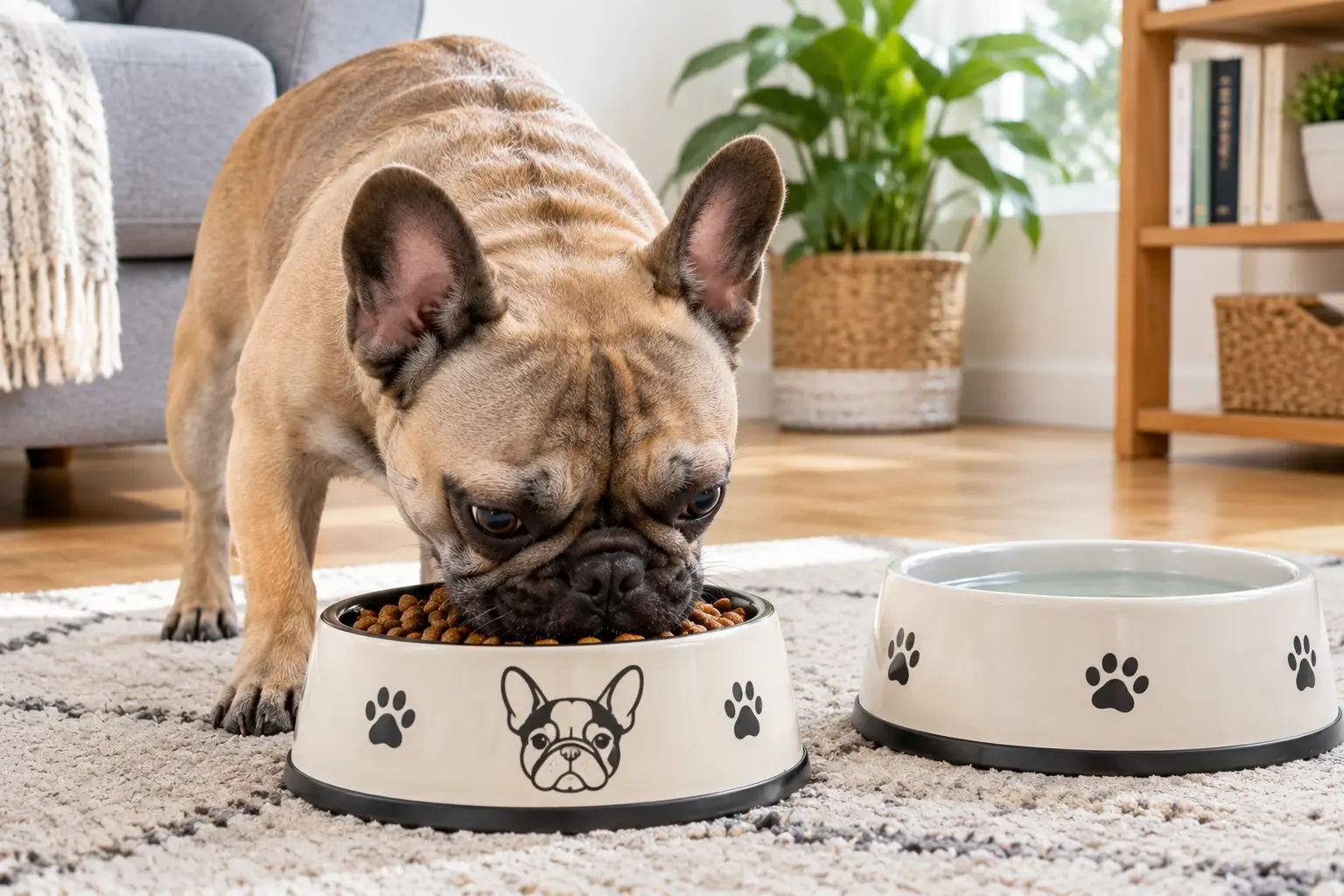
A french bulldog food bowl is a feeding dish shaped around the breed’s short, flat muzzle — usually tilted about 15 degrees, slightly raised, and wide at the mouth — so a Frenchie can reach every piece of food without jamming its face into the bowl, gulping air, or chasing kibble across the floor.
If you’ve ever watched your Frenchie nose the last few pieces of kibble around a round dish like a tiny, frustrated hockey player, you already understand the problem. A standard bowl is designed for a dog with a muzzle. Your dog doesn’t really have one. As the American Kennel Club’s French Bulldog breed profile describes, this is a compact, flat-faced companion breed — and that flat face changes how mealtime works.
Here’s what most new owners overlook: the bowl isn’t just about mess. French Bulldogs are a brachycephalic (short-skulled) breed, and veterinary literature links that anatomy to more regurgitation, gagging, and air swallowing than you’d see in a Labrador. The right french bulldog food bowl won’t cure any of that, but it can remove a daily source of strain: bending the neck too low, pressing the nose against a wall of steel, and inhaling half a meal in 40 seconds.
This guide compares seven real products available on amazon.com — from a budget tilted bowl to a slow feeder built for squished faces to premium porcelain. Every recommendation is based on manufacturer specs and aggregated customer review themes, plus practical analysis of what those specs mean for a short-nosed, 16-to-28-pound dog. No invented tests, no made-up testimonials — just honest reasoning you can apply to your own Frenchie.
You’ll also find dedicated sections on the tilted bowl for french bulldog debate, choosing an elevated dog bowl for french bulldog height, and when a slow feeder bowl for french bulldog makes sense — plus a first-30-days setup guide and a problem-solving section.
Quick Comparison: The 7 Best French Bulldog Food Bowls at a Glance
| Product | Type | Material | Capacity | Price Range | Best For |
|---|---|---|---|---|---|
| SuperDesign Mess Free 15° Slanted Bowl | Fixed tilt | Melamine + stainless | 0.5–2 cups | $10–$25 | Budget-conscious first-time owners |
| JWPC Bulldog Bowl | Adjustable tilt | Resin (ceramic option) | 2–3.5 cups | $14–$35 | Fine-tuning the angle |
| Leash Boss Flat Face Slow Feeder | Tilted slow feeder | BPA-free plastic | 1.5 cups | $15–$25 | Fast eaters and gulpers |
| Nicelock Stainless Steel Slanted Dog Bowl | Low tilt | 304 stainless steel | 1.5–2.5+ cups | $15–$35 | Hygiene and durability |
| JYHY Ceramic Bulldog Bowl | Tilted + stand | Ceramic | ~1.5 cups | $30–$40 | Heavy, stay-put feeding |
| SSAWcasa Elevated Dog Bowls | Raised station | Bamboo + stainless | Varies by bowl | $25–$40 | Growing puppies, seniors |
| Necoichi Raised Dog Food Bowl | Raised, extra wide | Porcelain | Shallow plate | $30–$45 | Wet food and style-minded homes |
Looking at the table, the SuperDesign Mess Free 15° Slanted Bowl and the JWPC Bulldog Bowl cover the budget end, and the main difference is flexibility: SuperDesign locks you into one 15° angle, while JWPC lets you change it. If your Frenchie eats too fast, the Leash Boss Flat Face Slow Feeder is the only pick here that actually slows the meal down. Spend more on the JYHY Ceramic Bulldog Bowl or Necoichi Raised Dog Food Bowl only if weight, wet food, or looks genuinely matter to you.
💬 One click helps other shoppers make an informed choice too! 😊
Top 7 French Bulldog Food Bowls: Expert Analysis
1. SuperDesign Mess Free 15° Slanted Bowl — the proven budget classic
This is the bowl many Frenchie owners try first, and its spec sheet explains why. A melamine base holds a removable stainless steel insert at a fixed 15° angle, with a raised back arc that stops kibble from being pushed over the rim. In practice, the tilt pools food at the front-low point where a short muzzle can actually reach it, while the stainless insert gives you a non-porous, dishwasher-safe eating surface.
Sizing matters more than buyers expect. The medium is listed for pets of roughly 6.6–19.8 lb with about a 1-cup capacity (a 5-inch bowl, 2.75 inches deep), so a typical adult Frenchie usually belongs in the large 2-cup version, while the medium suits puppies. Based on the specs, this is the best low-risk way to find out whether your dog benefits from a tilted bowl at all — it’s cheap enough that you won’t regret experimenting.
Across its very large Amazon review base, owners consistently report less “chasing food to the edge” and cleaner floors. Recurring complaints: the steel insert can be fiddly to lift out, and because it’s tilted, it holds noticeably less water than its rated capacity.
Pros:
- ✅ Fixed 15° tilt keeps food centered for short muzzles
- ✅ Stainless insert and melamine base are dishwasher safe
- ✅ Multiple sizes, from puppy to adult
Cons:
- ❌ Tilted design makes a mediocre water bowl
- ❌ Some owners report sliding on smooth floors
💲 Usually around $10–$25 depending on size and pattern — excellent value as a starter bowl.
2. JWPC Bulldog Bowl — adjustable tilt on a budget
The JWPC Bulldog Bowl solves a problem fixed-angle bowls ignore: not every Frenchie wants the same angle. Its teardrop-shaped bowl sits loosely in a flexible non-slip base, so you can rotate and reposition it to change the slope. That matters for puppies, dogs with pronounced underbites, and seniors whose posture changes over time.
The listing specifies resin construction, about 13.4 ounces, and dishwasher-safe care, with 2-cup (small/medium) and 3.5-cup (medium/large) options plus a ceramic-bowl variant. For most adult Frenchies, the 2-cup size is plenty. Here’s what to weigh: the two-piece design means you can pull the bowl out for washing and leave the base on the floor — handy for daily cleaning.
On paper, this is the most flexible budget option in this guide. It’s ideal if you’re not sure what angle your dog prefers and you’d rather adjust than buy twice. Reviews consistently mention flat-faced dogs eating with less help and fewer spills. A recurring note in customer feedback is that the bowl is hard resin rather than soft rubber, despite what the product title implies — worth knowing if your Frenchie is a chewer.
Pros:
- ✅ Adjustable angle adapts to different faces and ages
- ✅ Bowl lifts out of the base for easy washing
- ✅ Lightweight and inexpensive
Cons:
- ❌ Hard resin, not the soft rubber some buyers expect
- ❌ Loose bowl can be nudged around by pushy eaters
💲 Typically $14–$35 depending on size and material — strong value for the adjustability.
3. Leash Boss Flat Face Slow Feeder — best slow feeder for squished faces
Most slow feeders punish flat-faced dogs: their ridges are tall and narrow, perfect for a Border Collie’s snout and miserable for a Frenchie’s. The Leash Boss Flat Face Slow Feeder flips that logic with a shallow maze of wide, rounded channels on a gentle incline, sized to hold 1.5 cups of dry, wet, or raw food.
The brand describes the material as BPA-, PVC-, and phthalate-free, with a non-slip rubber grip and dishwasher-safe construction. What that means in practice: your dog has to work around obstacles, which stretches the meal out, but the channels are open enough that the nose can still reach the food. For a breed already prone to swallowing air and regurgitating, slower eating is a meaningful upgrade.
This is the pick for gulpers — Frenchies who vacuum their dinner and then burp, gag, or bring it back up. Aggregated reviews on Amazon and other US retailers consistently report noticeably slower meals and less gagging, with some dogs hesitant for the first few days before adjusting. The brand itself is unusually candid that dedicated “bowl flippers” may not be a good match.
Pros:
- ✅ Shallow maze designed specifically for flat faces
- ✅ Measurably slows down fast eaters
- ✅ Dishwasher safe with a non-slip base
Cons:
- ❌ 1.5-cup capacity limits larger single meals
- ❌ Not ideal for dogs that flip their bowls
💲 Usually in the $15–$25 range — the best value here if speed-eating is your real problem.
4. Nicelock Stainless Steel Slanted Dog Bowl — all-steel durability
If you’d rather nothing plastic touches your dog’s food, the Nicelock Stainless Steel Slanted Dog Bowl is the cleanest-material option in this lineup. The body is 304 food-grade stainless steel with a slanted interior, and a removable BPA-free silicone ring underneath keeps it from skating across the kitchen.
That removable ring is a small detail with a big payoff: you can pull it off and put the entire bowl through the dishwasher without trapping gunk under the rubber. Steel won’t chip like ceramic or scratch like resin, so it stays easier to sanitize over years. Nicelock offers several sizes — around 1.5 cups for small and 2.5 cups for medium — plus stackable multi-packs if you want a rotation of clean bowls.
Based on comparing the specs, this is the long-haul pick for hygiene-focused owners and multi-dog homes. Keep in mind it’s a low-profile bowl — the slant helps, but it doesn’t raise food much. Honest note on reviews: the US review pool for this specific slanted model is thinner than for SuperDesign or JWPC, so aggregated sentiment is less established; the available feedback centers on sturdiness and easy cleaning.
Pros:
- ✅ 304 stainless steel with no plastic food contact
- ✅ Removable silicone ring allows full dishwasher cleaning
- ✅ Stackable sizes make bowl rotation easy
Cons:
- ❌ Low profile offers little elevation
- ❌ Smaller review history than bigger-name rivals
💲 Generally $15–$35 depending on size and pack count — great value per year of use.
5. JYHY Ceramic Bulldog Bowl — heavy ceramic that stays put
Ceramic’s biggest advantage is weight, and the JYHY Ceramic Bulldog Bowl leans into it. The tilted, wide-mouthed bowl measures roughly 6.9 × 6.5 × 3.8 inches, holds about 1.5 cups, and sits on an anti-skid rubber mat, so even an enthusiastic eater has trouble shoving it around.
What the spec sheet doesn’t say, but experience with ceramic in general suggests, is that a glazed surface is non-porous and easy to wipe clean — until it chips. A chip exposes porous material where bacteria can settle, so this bowl rewards careful handling. The wide mouth is especially practical for wet food, which tends to smear against the walls of narrower bowls.
This is a strong fit for owners who feed canned or fresh food, have a dog that pushes lighter bowls, or simply want something that looks good in the kitchen. JYHY also sells the ceramic bowl alone as a replacement, which takes some sting out of an accidental drop. Aggregated feedback is generally positive about stability and appearance, with the usual ceramic caveats about fragility.
Pros:
- ✅ Heavy ceramic resists pushing and tipping
- ✅ Wide mouth works well for wet food
- ✅ Replacement bowl sold separately
Cons:
- ❌ Can chip or break if dropped
- ❌ Pricier than resin or melamine options
💲 Usually around $30–$40 — fair value if stability and wet-food feeding matter most.
6. SSAWcasa Elevated Dog Bowls — adjustable station for growing pups
The SSAWcasa Elevated Dog Bowls setup is less a bowl and more a feeding station: a bamboo stand with adjustable height that holds stainless steel bowls at a 15° tilt. Versions with two bowls let you keep food and water side by side at the same comfortable height.
Here’s why adjustability matters for this breed specifically. A Frenchie puppy might be half its adult height when you bring it home, and a senior Frenchie with spinal or joint issues may prefer a different level than it did at three. A stand that grows and changes with your dog saves you from buying twice. The stainless bowls are easy to clean, and bamboo is sturdy, though it should be wiped dry rather than soaked.
Based on the specs, this is the best pick for puppy owners planning ahead and for seniors who struggle to bend down. One caution: Frenchies are short, so resist the temptation to max out the height — the goal is a neutral neck, not a dog stretching upward. Honest note: beyond the listing details and its mid-pack ranking in Amazon’s raised-bowl category, we couldn’t verify a detailed pattern of US review sentiment for this model.
Pros:
- ✅ Adjustable height adapts from puppy to senior
- ✅ Tilted stainless bowls are easy to clean
- ✅ Dual-bowl layout keeps water handy
Cons:
- ❌ Bamboo needs drying, not soaking
- ❌ Limited verifiable review data for this model
💲 Usually $25–$40 — good value if you’d otherwise replace bowls as your dog grows.
7. Necoichi Raised Dog Food Bowl — premium porcelain, extra wide
Necoichi is a Japanese brand best known for raised cat bowls, and the Necoichi Raised Dog Food Bowl in its “Extra Wide Tilted” version brings that same design thinking to small dogs. It’s a raised porcelain dish with a 15° tilt, a subtle inner lip to catch spills, and a curved floor that keeps food centered.
What that means in practice: an extra-wide, shallow surface suits a Frenchie’s broad face better than a deep bowl, and it’s especially kind to dogs on wet or fresh food. The porcelain is non-absorbent, and the brand lists it as both dishwasher- and microwave-safe — handy if you warm refrigerated food slightly before serving.
This is the premium option for owners who want furniture-grade looks and a raised, tilted design in one piece, with no stand to assemble. The trade-off is capacity: a wide, shallow dish holds less than a deep bowl, so check portions against your dog’s meal size. Most of the strong review sentiment for Necoichi’s tilted ceramic line comes from cat owners praising the wide, shallow shape; dog-specific feedback for this version is thinner.
Pros:
- ✅ Extra-wide, shallow design suits broad flat faces
- ✅ Dishwasher- and microwave-safe porcelain
- ✅ Raised and tilted in one solid piece
Cons:
- ❌ Lower capacity than deeper bowls
- ❌ Dog-specific review data is limited
💲 Typically $30–$45 — worth it mainly for wet-food feeders and design-conscious homes.
Side-by-Side Feature Breakdown
| Product | Tilt | Raised? | Slows Eating? | Dishwasher Safe | Review Consensus | Best For |
|---|---|---|---|---|---|---|
| SuperDesign Mess Free 15° Slanted Bowl | Fixed 15° | Slightly | No | Yes | Large, positive | Trying a tilted bowl cheaply |
| JWPC Bulldog Bowl | Adjustable | Slightly | No | Yes | Large, positive | Dogs with unusual bites |
| Leash Boss Flat Face Slow Feeder | Gentle incline | Slightly | Yes | Yes | Positive | Gulpers |
| Nicelock Stainless Steel Slanted Dog Bowl | Low slant | No | No | Yes | Limited | Hygiene-first homes |
| JYHY Ceramic Bulldog Bowl | Tilted | Yes (stand) | No | Yes | Generally positive | Wet food, pushy eaters |
| SSAWcasa Elevated Dog Bowls | 15° | Adjustable | No | Bowls yes | Limited | Puppies and seniors |
| Necoichi Raised Dog Food Bowl | 15° | Yes | No | Yes (+ microwave) | Strong (mostly cat line) | Premium wet-food feeding |
Reading across the rows, only one product — the Leash Boss Flat Face Slow Feeder — tackles eating speed, so it’s the clear choice if regurgitation after fast meals is your main worry. For most owners whose issue is simply reach and mess, the SuperDesign Mess Free 15° Slanted Bowl or JWPC Bulldog Bowl gets you 80% of the benefit for the lowest price. The ceramic and porcelain options earn their premium only if weight, wet food, or looks are priorities.
✨ Find the Bowl That Fits Your Frenchie’s Face!
🔍 Every Frenchie eats a little differently — click any highlighted product above to check current pricing, sizes, and availability, and give your dog a calmer, cleaner mealtime starting this week! 🐾
Getting Started: Your First 30 Days With a New Bowl
Switching bowls sounds trivial, but Frenchies can be surprisingly suspicious of new things that make noise or move. A smooth transition makes the difference between “instant upgrade” and “dog refuses dinner.”
Days 1–3: Introduce, don’t replace
Set the new bowl beside the old one and drop a few high-value treats in it. Let your dog investigate on its own terms. For a slow feeder like the Leash Boss Flat Face Slow Feeder, start with just a small portion of the meal in the maze so the challenge feels winnable.
Days 4–10: Make the switch
Serve full meals in the new bowl, at the same spot and time. Watch posture: the neck should look relaxed, roughly level with or slightly below the shoulders. If your dog is craning down or stretching up, adjust the angle (easy with the JWPC Bulldog Bowl) or height (with the SSAWcasa Elevated Dog Bowls).
Days 11–30: Fine-tune and build a routine
- 🧽 Wash the bowl after every meal — not “when it looks dirty.”
- 📏 Re-measure portions; tilted bowls can make a cup look smaller than it is.
- 📝 Note any change in burping, gagging, or vomiting frequency over the month.
Common mistakes in the first month
Don’t use a tilted food bowl as the water bowl — tilt reduces usable capacity and invites spills. Don’t put a slow feeder on a slick floor without a mat. And don’t judge the bowl on day one; many dogs need a week before their eating rhythm settles.
Real-World Scenarios: Matching the Bowl to Your Frenchie
Specs only tell half the story. Here’s how the picks map onto three common Frenchie households.
Scenario 1: The new puppy owner on a budget
Budget: under $30. Situation: 10-week-old puppy, three small meals a day, apartment with laminate floors.
Start with the medium SuperDesign Mess Free 15° Slanted Bowl, which is sized for small pets and cheap enough to outgrow without regret. Pair it with a rubber mat to stop sliding on laminate. If you’d prefer one purchase that lasts from puppyhood to adulthood, the SSAWcasa Elevated Dog Bowls stand is the stronger long-term bet because its height adjusts as your dog grows.
Scenario 2: The adult gulper who brings meals back up
Budget: $20–$40. Situation: 3-year-old, 25-lb Frenchie finishes kibble in under a minute, then burps or regurgitates.
This is exactly the profile the Leash Boss Flat Face Slow Feeder was designed for. Its shallow maze slows intake without frustrating a short nose. If you also want a separate water station, add a plain, heavy water bowl rather than a tilted one. And if regurgitation continues after a few weeks, that’s a conversation for your vet, not just a bowl swap.
Scenario 3: The senior Frenchie on wet food
Budget: $35–$50. Situation: 10-year-old with stiff joints, fed canned food twice daily.
A raised, wide, heavy dish helps most here. The Necoichi Raised Dog Food Bowl gives a shallow, broad surface that wet food won’t smear up the walls of, and the JYHY Ceramic Bulldog Bowl adds weight that keeps the bowl from drifting while an older dog eats slowly. Either reduces how far a stiff neck has to bend.
Problem → Solution: Fixing Common Frenchie Mealtime Problems
Most “bad bowl” complaints fall into a handful of patterns. Here’s how to troubleshoot them.
Problem 1: Kibble ends up all over the floor. ✅ Solution: Choose a bowl with a raised back lip or arc, like the SuperDesign Mess Free 15° Slanted Bowl, and put a silicone mat underneath. Messy eaters push food forward; the back wall catches it.
Problem 2: Your dog gulps, burps, or regurgitates. ✅ Solution: Slow the meal down with a flat-face-friendly maze such as the Leash Boss Flat Face Slow Feeder, and consider splitting daily food into more, smaller meals. Veterinary nursing literature on managing digestive problems in brachycephalic dogs notes that regurgitation and vomiting are the most common digestive signs in these breeds and even discusses bowl type as part of the conversation with owners.
Problem 3: The bowl slides or flips. ✅ Solution: Go heavy (the JYHY Ceramic Bulldog Bowl) or use a model with a removable silicone ring (the Nicelock Stainless Steel Slanted Dog Bowl). Avoid lightweight shallow feeders if your Frenchie is a known flipper.
Problem 4: Your dog leaves the last few pieces behind. ✅ Solution: That’s a reach problem. A tilted bowl concentrates food at one low point; the JWPC Bulldog Bowl lets you increase the angle until the last kibble rolls within range.
Problem 5: Food smears and dries on the walls. ✅ Solution: For wet food, choose wide and shallow (the Necoichi Raised Dog Food Bowl) over deep and narrow, and soak the bowl right after meals.
How to Choose a French Bulldog Food Bowl
Choosing the right bowl comes down to seven practical checks.
- Measure your dog’s meal. Most adult Frenchies need a bowl that comfortably holds 1.5–2 cups; puppies need less. Too big encourages overfilling.
- Check the tilt. Around 15° is the common standard for flat-faced dogs. Adjustable designs help if your dog has an underbite.
- Decide on elevation. A slight lift is usually enough for this short breed; adjustable stands suit puppies and seniors.
- Match material to habits. Stainless steel for hygiene, ceramic for weight, melamine/resin for low cost.
- Consider eating speed. If your dog finishes in under a minute, a flat-face slow feeder is worth more than any tilt.
- Look for stability features. Rubber rings, weighted bases, and non-slip mats prevent sliding and flipping.
- Confirm easy cleaning. Dishwasher-safe parts and removable inserts make daily washing realistic.
Here’s the expert logic behind the order: capacity and tilt determine whether your dog can comfortably eat at all, while material and cleaning determine whether the bowl stays hygienic over months. For the “why” behind all of this, a University of Cambridge study on conformational risk factors for airway disease in pugs, French Bulldogs, and bulldogs is a useful read — it notes, among other findings, that frequent regurgitation was associated with some underweight Frenchies in the most severely affected group.
Tilted Bowl for French Bulldog vs. Standard Round Bowl
The core question most shoppers have is whether a tilted bowl for french bulldog feeding is genuinely better than the regular stainless dish already in the cupboard. Here’s how they compare in real use.
| Factor | Tilted Frenchie Bowl | Standard Round Bowl | Best For |
|---|---|---|---|
| Reaching the last bites | Food pools at one low point | Food scatters to the edges | Tilted for flat faces |
| Neck posture | Less bending required | More bending required | Tilted, especially seniors |
| Mess control | Raised back lip catches pushes | Food easily shoved out | Tilted for messy eaters |
| Water use | Reduced usable capacity | Full capacity | Standard round for water |
| Cost | $10–$45 | Often under $15 | Standard if budget is tight |
The pattern is clear: a tilted bowl wins on reach, posture, and mess, while a standard round bowl still makes the better water dish. Many owners land on the most practical combination — a tilted bowl for food like the SuperDesign Mess Free 15° Slanted Bowl, paired with a heavy, regular bowl for water.
Commentary worth adding: a tilted bowl for french bulldog use isn’t a medical device. It reduces strain and frustration, but it doesn’t change anatomy. If your dog’s eating issues are severe, the bowl is a supporting player, not the fix.
Elevated Dog Bowl for French Bulldog: How High Is Right?
The elevated dog bowl for french bulldog question trips people up because “elevated” products are often designed for much taller dogs. A Frenchie stands roughly 11–13 inches at the shoulder, so a stand built for a Golden Retriever is far too tall.
The practical rule
Aim for a bowl rim that sits at or slightly below the point of your dog’s chest, so the neck stays roughly neutral while eating. For most Frenchies, that means only a few inches of lift — which is why compact raised designs like the JYHY Ceramic Bulldog Bowl and Necoichi Raised Dog Food Bowl work well right out of the box.
When adjustable makes sense
Adjustable stands like the SSAWcasa Elevated Dog Bowls earn their place in two situations: puppies who’ll grow several inches, and seniors with joint or spine discomfort who may benefit from a slight change over time. Watch your dog eat after each adjustment — relaxed shoulders and an easy head position mean you’ve found the sweet spot.
What to avoid
Don’t raise the bowl so high that your dog has to stretch upward or stand on hind legs. And remember that any elevated dog bowl for french bulldog use still needs a stable base; a tall, light stand is easier to topple.
Slow Feeder Bowl for French Bulldog: When It Helps
A slow feeder bowl for french bulldog feeding is the right tool when speed — not reach — is the issue. If your Frenchie finishes a meal in under a minute, then burps, coughs, or brings food back up, slowing intake is often more useful than any tilt.
Why most slow feeders fail Frenchies
Traditional slow feeders use tall, narrow ridges. A long-nosed dog threads its muzzle between them; a Frenchie just presses its face against the plastic and gives up. That’s why a flat-face-specific maze, like the Leash Boss Flat Face Slow Feeder, with shallow, rounded channels, is the safer bet.
How to introduce it
Start with a portion of the meal in the maze and the rest in the regular bowl, then shift the ratio over a week. Some dogs act unsure at first — that’s normal and usually short-lived.
When to skip it
If your dog already eats slowly, or gets visibly stressed by puzzle feeders, a slow feeder bowl for french bulldog use adds frustration without benefit. A simple tilted bowl is the better choice there.
Materials Compared: Stainless Steel, Ceramic, Melamine, and Resin
Material affects hygiene, weight, durability, and long-term cost more than most features on the box.
| Material | Example in This Guide | Typical Price | Durability | Hygiene | Best For |
|---|---|---|---|---|---|
| Stainless steel | Nicelock Stainless Steel Slanted Dog Bowl | $15–$35 | Excellent | Excellent | Long-term, hygiene-first homes |
| Ceramic/porcelain | JYHY Ceramic Bulldog Bowl, Necoichi Raised Dog Food Bowl | $30–$45 | Good (can chip) | Excellent if intact | Wet food, heavy stay-put bowls |
| Melamine + steel insert | SuperDesign Mess Free 15° Slanted Bowl | $10–$25 | Good | Very good (steel contact) | Budget tilted feeding |
| Resin/plastic | JWPC Bulldog Bowl, Leash Boss Flat Face Slow Feeder | $14–$35 | Fair to good | Good, declines with scratches | Adjustability and slow feeding |
The takeaway: stainless steel is the best value over years because it neither chips nor scratches easily, which is why the Nicelock Stainless Steel Slanted Dog Bowl quietly wins on total cost of ownership. Ceramic offers weight and good looks but needs gentle handling. Resin and plastic are perfectly usable — just replace them once deep scratches appear, since scratches can trap residue.
Common Mistakes to Avoid When Buying a French Bulldog Food Bowl
Even careful shoppers make a few predictable errors with this category.
❌ Buying for the puppy, not the adult
A bowl sized for a 10-week-old will be too small within months. Either buy adult-sized from the start or choose an adjustable setup.
❌ Assuming “elevated” means “better”
Height designed for big dogs can strain a Frenchie’s neck in the opposite direction. Small lifts beat tall stands for this breed.
❌ Choosing a standard slow feeder
Deep, narrow ridges frustrate flat faces. If you need a slow feeder, choose one explicitly designed for brachycephalic dogs.
❌ Ignoring the floor surface
Even good bowls slide on tile or laminate. A non-slip ring, weighted base, or silicone mat matters as much as the bowl design.
❌ Using the food bowl for water
Tilted bowls hold less water and spill more easily. Keep a separate, stable water bowl.
❌ Trusting marketing claims about “preventing bloat”
Product listings sometimes promise health outcomes the bowl alone can’t guarantee. Treat these as comfort and convenience tools, and talk to your vet about genuine digestive symptoms.
Long-Term Cost and Maintenance
The cheapest bowl isn’t always the cheapest over five years. Here’s how to think about total cost of ownership for a french bulldog food bowl.
Replacement cycles
Resin and plastic bowls tend to scratch, and scratched surfaces are harder to sanitize, so plan on replacing them periodically. Melamine bases last well, especially when the food-contact surface is a steel insert. Stainless steel can last many years. Ceramic lasts indefinitely — until a drop ends its career.
Daily cleaning matters more than material
The FDA’s tips for safe handling of pet food and treats recommend washing pet food bowls and scoops with soap and hot water after each use, and not using the bowl itself as a scoop. In practice, that makes dishwasher-safe, removable-insert designs worth their price — you’ll actually stick to the routine.
A simple maintenance schedule
- 🍽️ After every meal: hot soapy wash or a dishwasher cycle.
- 💧 Daily: wash the water bowl and refill with fresh water.
- 🔍 Monthly: check for scratches, chips, cracked rubber rings, or warped bases.
- 🔄 Yearly (or sooner): replace scratched plastic or chipped ceramic.
Owning two identical bowls and rotating them is the easiest way to make every-meal washing realistic — the multi-pack Nicelock Stainless Steel Slanted Dog Bowl options make this especially simple.
French Bulldog Food Bowl for Puppies, Adults, and Seniors
The right french bulldog food bowl shifts as your dog ages, so it helps to think in life stages.
Puppies (8 weeks to 12 months)
Small portions, multiple meals, rapid growth. A small tilted bowl like the SuperDesign Mess Free 15° Slanted Bowl works well early on, while an adjustable stand like the SSAWcasa Elevated Dog Bowls can follow your puppy into adulthood. If your puppy gulps, a flat-face slow feeder can be introduced gradually.
Adults (1 to 8 years)
Most adults do well with a 1.5–2-cup tilted bowl at a modest height. This is also when eating-speed issues become obvious — the stage where the Leash Boss Flat Face Slow Feeder often proves its value.
Seniors (8 years and up)
Joint stiffness, dental changes, and a shift toward softer food are common. Raised, wide, stable designs like the Necoichi Raised Dog Food Bowl or JYHY Ceramic Bulldog Bowl reduce how far your dog has to bend and make wet food easier to finish.
Whatever the age, watch your dog eat every so often. Comfortable posture, a clean finish, and fewer post-meal burps are the real signs the bowl is working.
FAQ: French Bulldog Food Bowl Questions Answered
❓ What size bowl does an adult French Bulldog need?
❓ Can I use a slanted bowl for water as well?
❓ Is stainless steel or ceramic better for a Frenchie?
❓ Should French Bulldog puppies use a slow feeder?
❓ How often should I replace my Frenchie's food bowl?
Conclusion: The Right Bowl Makes Every Meal Easier
Choosing a french bulldog food bowl comes down to understanding your specific dog. If reach and mess are the problem, a tilted design like the SuperDesign Mess Free 15° Slanted Bowl or the adjustable JWPC Bulldog Bowl solves it affordably. If your Frenchie eats like it’s being timed, the Leash Boss Flat Face Slow Feeder is the standout. Hygiene-focused owners will appreciate the all-steel Nicelock Stainless Steel Slanted Dog Bowl, while the JYHY Ceramic Bulldog Bowl and Necoichi Raised Dog Food Bowl reward wet-food feeders and anyone who wants a heavier, better-looking dish. And if you’re raising a puppy or caring for a senior, the SSAWcasa Elevated Dog Bowls stand adapts as your dog changes.
No bowl replaces veterinary care for a brachycephalic breed — persistent regurgitation, gagging, or weight loss deserve a vet visit. But the right shape, height, and speed can turn a daily struggle into a calm, clean, comfortable meal. Start with the problem you actually see at mealtime, pick the bowl that solves it, and give your dog a week to adjust.
🐶 Ready to Upgrade Your Frenchie’s Mealtime?
⚡ Click any highlighted bowl in this guide to check today’s price and size options on Amazon. A better bowl is one of the smallest, smartest upgrades you can make for your flat-faced best friend! 🛒✨
Recommended for You
- Flat Face Dog Bowl: 7 Best Picks That Actually Help in 2026
- Foldable Water Bowl: 7 Best Picks Worth Packing in 2026
- Animal Feeders: 7 Best Picks That Actually Work in 2026
Disclaimer: This post contains affiliate links. As an Amazon Associate, I earn from qualifying purchases made through these links, at no additional cost to you.
✨ Found this article helpful? Share it with someone who needs it! 💬🤗