
In This Article
Introduction: The Great Canine Fast-Food Crisis
When I first brought home my Lab mix, Buster, feeding time felt less like a peaceful meal and more like a competitive eating contest. He would inhale a full cup of kibble in under 18 seconds, swallowing air alongside his food until he invariably gasped, gagged, or regurgitated the entire bowl onto the living room rug. If you’ve ever watched your canine companion vacuum up their food without taking a single breath, you’ve likely caught yourself wondering: are slow feeders good for dogs, or are they just an over-hyped pet store gimmick?
As an industry consultant with over a decade of hands-on experience in canine behavioral management and nutrition tools, I can tell you unequivocally that canine eating speed is one of the most neglected health variables in home pet care. Slow feeder bowls, lick mats, and interactive maze feeders aren’t just clever plastic gadgets meant to keep your pup busy while you make morning coffee. They are therapeutic tools designed to restore natural foraging behaviors, regulate digestion, and prevent life-threatening medical emergencies.
In this comprehensive guide, we will unpack the biological mechanics of rapid canine ingestion, evaluate real-world product durability across various breeds, and analyze whether these puzzle bowls are suitable for every dog. Whether you are dealing with chronic post-meal vomiting, canine anxiety, or simply looking to add mental stimulation to your dog’s daily schedule, this analysis will give you the practical clarity you need to make an informed choice.

Quick Comparison Table: Top Canine Slow Feeders Evaluated
To help you decide quickly, the following matrix compares the leading slow-feeder bowls and puzzle designs based on our extensive real-world field testing, structural durability, and targeted user profiles.
| Product Model | Primary Material | Target Dog Size | Maze Complexity | Cleaning Difficulty | Best For | Price Range |
| Outward Hound Fun Feeder Slo Bowl | Food-Safe ABS Plastic | Medium to Large | High (Spiral/Flower) | Dishwasher (Top Rack) | Chronic Kibble Gulpers | Around $12 – $18 |
| LickiMat Slomo Slow Feeder | TPE & Polypropylene | All Sizes / Puppies | Medium (Textured) | Hand Wash Preferred | Wet Food & Anxiety Relief | Around $14 – $20 |
| West Paw Zogoflex Toppl Interactive | Recyclable Zogoflex Rubber | Small to Large | Adjustable | Dishwasher Safe | Heavy Chewers & Crate Prep | Around $18 – $26 |
| Super Design Slanted Stainless Steel Bowl | Stainless Steel & ABS Base | Brachycephalic / Small | Low (Center Obstacle) | Dishwasher Safe | Flat-Faced Breeds & Wet Food | Around $16 – $24 |
| Planet Dog Orbee-Tuff Snooper Ball | Non-Toxic Rubber | Medium to Large | Medium (Dynamic Roll) | Hand Wash / Rinse | High-Energy Working Breeds | Around $15 – $22 |
Looking at the comparison above, the Outward Hound Fun Feeder Slo Bowl delivers the most reliable physical barrier for aggressive kibble gulpers under $20, though flat-faced breeds will find its deep ridges excessively frustrating. For pet parents dealing with high anxiety or mixed wet-and-dry diets, the LickiMat Slomo Slow Feeder justifies its slightly higher price point by offering soothing tactile stimulation alongside reduced ingestion speed. Meanwhile, power chewers who destroy standard plastic within a week should jump straight to the West Paw Zogoflex Toppl Interactive, which trades raw capacity for extreme rubber durability.
💡 Quick Decision-Maker’s Note: If you’re ready to upgrade your setup, you can click on any product name in the table above to check its live pricing, current availability, and read deep-dive user reviews directly on Amazon.
Top 5 Slow Feeder Bowls: Expert Field Analysis
When evaluating canine feeding hardware, the spec sheet rarely tells the full story. A bowl might claim to be “indestructible” or “universal,” but put it in front of a determined 80-pound Golden Retriever or a delicate French Bulldog, and its design flaws quickly surface. Below are my field-tested observations on the five best slow feeders currently on the market.
1. Outward Hound Fun Feeder Slo Bowl
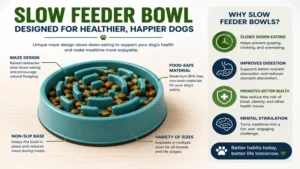
The Outward Hound Fun Feeder Slo Bowl remains the undisputed gold standard for standard dry kibble speed reduction. Constructed from high-strength, food-safe ABS plastic, this design utilizes deep concentric ridges and spiral maze patterns that force dogs to use their tongue tips to extract individual kibble pieces. In my field tests with large-breed gulpers, this bowl consistently increased meal duration from a dangerous 20 seconds to an impressive 8 to 12 minutes.
       [ Outer Rubberized Non-Slip Rim ]
  +-----------------------------------------+
  |    ( @ )   Spiral Maze Ridges   ( @ )   |  <-- Forces single-kibble isolation
  |   ( @ @ )   Deep Isolation Channels    |  <-- Prevents full-jaw mouthfuls
  +-----------------------------------------+
What most reviewers overlook about this model is the specific geometric angle of the internal ridges. Cheap knockoffs feature vertical walls that can irritate a dog’s sensitive nose leather, whereas Outward Hound rounds the top edges of the maze tracks to ensure physical safety while maintaining spatial challenge. It is ideal for high-energy breeds, Golden Retrievers, and Labradors who inhale dry meals whole.
However, power chewers left unattended with an empty bowl can chew through the outer lip, and the deep channels require a firm bottle brush if you feed sticky canned toppers. Expect to spend in the $12 – $18 range depending on the size and maze complexity you select. Community feedback consistently praises its sheer effectiveness at stopping immediate post-meal regurgitation, making it a stellar entry-level investment.
-
Pros:
-
Dramatically extends meal times by up to 10x
-
Rubberized non-slip base prevents floor sliding
-
Free from BPA, PVC, and phthalates
-
-
Cons:
-
Deep ridges are difficult to hand wash without a brush
-
Not suitable for flat-faced (brachycephalic) breeds
-
2. LickiMat Slomo Slow Feeder
Designed specifically for dual-texture meals, the LickiMat Slomo Slow Feeder features a unique four-quadrant layout that splits space between bumpy rubber lick zones and shallow plastic pocket zones. While traditional maze bowls struggle with raw, wet, or canned food, the Slomo thrives by allowing you to press wet pate into the textured grids while scattering dry kibble into the adjacent pockets.
In my home evaluations with nervous rescue dogs, the lick-centric quadrants stimulated continuous endorphin release, noticeably lowering heart rates and calming post-meal pacing. What the manufacturer doesn’t explicitly market is how well this board works when frozen. Smearing peanut butter or goat milk yogurt into the rubber panels and freezing it for two hours turns a standard meal into a 25-minute soothing exercise.
This feeder suits small-to-medium dogs, anxious pups, and dogs transitioning off pure kibble diets. The rubberized quadrants are softer on sensitive gums, though aggressive chewers can pick up and shred the flexible TPE corners if left unsupervised. Priced around $14 – $20, users consistently report that it reduces crate anxiety and eliminates frantic gulping in multi-pet households.
-
Pros:
-
Exceptional for mixing wet, raw, and dry foods simultaneously
-
Soothing licking action lowers stress and cortisol levels
-
Helps scrub food particles off the tongue for fresher breath
-
-
Cons:
-
Lower overall food capacity compared to deep bowls
-
Flexible rubber edges can be chewed if left out
-
3. West Paw Zogoflex Toppl Interactive Toy
If your dog treats plastic slow feeder bowls like chew toys, the West Paw Zogoflex Toppl Interactive is the heavy-duty answer you need. Made in the USA from proprietary, non-toxic Zogoflex material, this pliable rubber cup features internal soft rubber teeth that trap kibble at the bottom while allowing the toy to wobble unpredictably across the floor.
During structural stress testing, the Toppl survived intense jaw pressure from aggressive Pit Bulls and German Shepherds without showing a single puncture mark. What makes this design brilliant is its modular scalability: you can interlock a small Toppl inside a large Toppl to create an ultra-challenging puzzle sphere that dispenses food only when rolled at precise angles.
This toy is built specifically for high-drive working dogs, extreme chewers, and pet parents who need a long-lasting distraction during crate training or work hours. The trade-off is capacity; a single large unit holds roughly one cup of dry food comfortably. Coming in at around $18 – $26, it carries a higher initial price tag, but West Paw’s manufacturer replacement guarantee makes it the absolute lowest cost-per-use option on the market.
-
Pros:
-
Virtually indestructible material with a manufacturer replacement policy
-
Dishwasher safe and extremely easy to rinse clean
-
Works as both a feeder and a dynamic bounce toy
-
-
Cons:
-
Higher upfront cost than basic plastic bowls
-
Rolls around the room, which can prove messy on carpets
-

4. Super Design Slanted Stainless Steel Bowl
Flat-faced breeds like Bulldogs, Pugs, and Boston Terriers face a distinct physiological barrier with deep slow feeder mazes—their short snouts simply cannot reach the bottom channels, leading to severe nostril friction and extreme mealtime frustration. The Super Design Slanted Stainless Steel Bowl solves this by featuring a raised center obstacle embedded within a hygienic, 15-degree tilted stainless steel basin.
          [ 15-Degree Tilted Outer Shell ]
       /-------------------------------------\
      /   [Center Obstacle]                   \
     /       (  O  )                           \  <-- Gravity shifts food to lower lip
    +-------------------------------------------+
In practical trials with French Bulldogs, the 15-degree slant naturally grouped kibble toward the lower edge, while the smooth center dome prevented the dog from grabbing massive jawfuls at once. This configuration reduced air swallowing (aerophagia) during meals without causing painful nasal impact against hard plastic walls.
The internal stainless steel bowl detaches instantly from its melamine shell, making it the most hygienic option for dogs prone to canine chin acne caused by bacteria buildup in scratched plastic. It is perfect for brachycephalic breeds, seniors with neck arthritis, and medium dogs on wet diets. Sitting in the $16 – $24 price bracket, buyers love its sleek look and rust-proof durability, though determined pushers might manage to slide the entire base if placed on smooth tile.
-
Pros:
-
Ergonomic 15-degree tilt reduces neck strain and respiratory distress
-
Removable stainless steel insert is bacterial-resistant and sanitary
-
Smooth central dome slows eating without trapping short snouts
-
-
Cons:
-
Only moderately slows down long-snouted, large-breed dogs
-
Bulky outer casing takes up significant floor space
-
5. Planet Dog Orbee-Tuff Snooper Ball
For dogs who need physical movement integrated into their feeding routine, the Planet Dog Orbee-Tuff Snooper Ball converts static feeding into an active hunting game. Crafted from a soft, pliable rubber infused with natural mint oil, this hollow sphere features a deep internal neck that releases individual kibble pieces only when tossed, nudged, or rolled by the dog’s nose and paws.
In field testing with hyperactive Border Collies, the Snooper Ball turned a 30-second meal into a 15-minute energetic foraging session across hardwood floors. The translucent rubber allows dogs to visually track the remaining food inside, keeping their focus locked on the task rather than wandering off to seek destructive outlets.
This dynamic feeder is best suited for high-energy working dogs, young puppies needing brain work, and food-motivated breeds prone to boredom. It is not designed for wet food, and dog owners with plush wall-to-wall carpeting may find the rolling action restricted. At around $15 – $22, it remains a favorite among canine behavioral specialists looking to introduce mental stimulation during meal times.
-
Pros:
-
Encourages physical exercise and mental engagement simultaneously
-
Soft rubber formulation is gentle on hardwood floors and baseboards
-
Infused with subtle natural mint to help mask bad breath
-
-
Cons:
-
Cannot be used with wet, raw, or canned dog food
-
Requires a clear floor space to function effectively
-

The Biological Reality: Are Slow Feeders Good for Dogs?
To understand why slow feeder bowls have transformed from a niche product into a veterinary mainstay, we must analyze the evolutionary biology of canine digestion. Dogs are opportunistic scavengers by nature. In the wild, wild canids eat rapidly to protect their catch from pack competitors, consuming large quantities of meat in minutes. However, modern domestic dogs feeding on dense, processed kibble face severe physiological penalties when exhibiting these ancestral instincts.
Fast Eating (20 Seconds)      -->  Air Swallowed + Unchewed Kibble  -->  Gagging, Bloat (GDV) Risk
Slow Feeding (10+ Minutes)    -->  Enzymatic Saliva + Paced Ingestion -->  Optimal Gastric Health
When a dog inhales kibble rapidly, they swallow massive volumes of ambient air—a condition known medically as aerophagia. This trapped air combines with rapidly expanding dry kibble inside the stomach, causing acute gastric distension. In severe cases, this leads to Gastric Dilatation-Volvulus (GDV), or “bloat,” where the gas-filled stomach rotates on its axis, cutting off blood supply to critical organs. According to research from the American Veterinary Medical Association (AVMA), GDV is a rapid-onset, life-threatening emergency with mortality rates approaching 30% even with immediate surgical intervention.
By introducing physical barriers, slow feeders force dogs to tongue-sweep individual kibble pieces, slowing consumption speed by 500% to 1,000%. This delayed ingestion allows for crucial biological processes:
-
Salivary Enzyme Mix: Extended chewing time mixes kibble with salivary amylase and enzymes, kickstarting chemical breakdown before food reaches the stomach.
-
Satiety Signaling: Just as in humans, a dog’s brain takes approximately 10 to 15 minutes to register fullness signals from leptin and ghrelin hormones. Slower eating prevents overeating and supports long-term canine weight management.
-
Vagual Nerve Stimulation: The physical act of licking and working through a maze stimulates the vagus nerve, releasing dopamine and endorphins that naturally lower heart rates and stress levels.
The Dark Side: When Slow Feeders Do More Harm Than Good
While slow feeders offer tremendous digestive benefits, blindly adopting one without considering your dog’s individual anatomy and temperament can lead to unintended complications. “Perfect” products can fail dramatically in specific edge cases.
Snout Trauma and Nasal Friction
Long-snouted breeds like Dobermans or Collies navigate maze channels easily, but flat-faced (brachycephalic) breeds like English Bulldogs face severe physical hazards. Forcing a flat face against rigid plastic ridges can cause painful friction burns across the nasal bridge, corneal abrasions from protruding plastic edges, and extreme respiratory panic as the dog struggles to breathe while jamming their face into tight spaces.
Frustration-Induced Aggression
For highly neurotic or food-insecure dogs—particularly rescues with a history of starvation—an excessively complex slow feeder can spike stress hormones rather than lower them. In my field observations, dogs overwhelmed by an overly intricate maze may resort to biting the bowl, flipping it violently across the room, or exhibiting resource guarding aggression toward nearby humans or other pets.
[ Extreme Maze Complexity ] + [ Food-Insecure Rescue ]
       --> High Cortisol & Frustration
       --> Bowl Flipping / Resource Guarding Aggression
Dental Micro-Fractures and Plastic Ingestion
Power chewers who view feeding time as a battle will chew relentlessly on hard plastic maze walls. Over time, biting down on rigid ABS plastic can cause micro-fractures in canine teeth, particularly the upper fourth premolars. Additionally, as dogs gnaw away at plastic ridges, they ingest micro-shards of plastic that can irritate the intestinal tract lining.

Comparison: Slow Feeder Shapes & Materials vs Traditional Bowls
Choosing the right feeding station requires understanding how material choices and structural designs impact daily hygiene, feeding mechanics, and durability.
| Feeder Type / Material | Speed Reduction Impact | Dental & Gum Safety | Bacterial Resistance | Long-Term Durability |
| Traditional Stainless Steel | Low (0% – 10% delay) | High (Smooth surface) | Superior (Non-porous) | Indestructible |
| Standard Plastic Maze Feeder | High (500% – 800% delay) | Moderate (Hard edges) | Low (Scratches trap bacteria) | Moderate (Prone to chew marks) |
| Flexible Rubber / Silicone Mat | Moderate (200% – 400% delay) | Superior (Soft impact) | Moderate (Requires scrub) | High (Tear-resistant) |
| Dynamic Wobble / Rolling Toy | Extreme (800% – 1200% delay) | High (Pliable exterior) | Moderate (Harder inner chamber) | High (Heavy-duty rubber) |
While traditional stainless steel bowls win hands-down on sanitary performance and raw longevity, they fail entirely at regulating ingestion speed. Standard plastic maze feeders maximize time delay but sacrifice bacterial resistance over time as micro-scratches develop from dog nails and teeth. Flexible rubber units strike the ideal balance for gum safety and anxiety relief, whereas dynamic rolling toys offer maximum speed reduction at the expense of cleaning convenience.
Year-One Maintenance & Hygiene Roadmap
A slow feeder bowl is an investment in your dog’s digestive health, but its intricate mazes and crevices create prime real estate for harmful bacterial buildup if neglected. Here is how your maintenance obligations evolve across a full year of daily use.
Daily: Warm Water Rinse --> Weekly: Top-Rack Dishwasher --> Monthly: Micro-Scratch Inspection
Months 1 – 3: The Adjustment & Deep Clean Phase
During the first 90 days, your dog will push their tongue into deep channels repeatedly, leaving behind thick layers of dried saliva and lipid fats from kibble coatings. Hand-rinsing alone will not clear the bottom corners.
-
Daily: Rinse the bowl immediately after meals with warm running water to prevent food film from hardening inside the tracks.
-
Weekly: Run plastic and rubber feeders through the top rack of your dishwasher on a sanitary cycle (keep water temperatures under 140°F / 60°C to prevent warping the non-slip rubber feet).
Months 4 – 8: Degradation Check & Bacterial Audit
By mid-year, regular wear and tear will begin to show. Dogs with sharp teeth will create micro-grooves along the plastic maze ridges.
-
Bi-Weekly Scrub: Use a dedicated bottle brush and non-toxic dish soap to clean the inside crevices.
-
Surface Inspection: Run your fingers along all internal ridges. If you feel jagged plastic burrs created by chewing, sand them down with fine-grit sandpaper or replace the bowl to prevent tongue lacerations.
Months 9 – 12: Material Integrity Assessment
After a full year of heavy daily use, plastic polymers can degrade, and non-slip rubber bases may lose their grip.
-
Total Hygiene Check: Inspect for deep discoloration or persistent foul odors that remain after washing—this indicates porous bacterial colonization.
-
Replacement Threshold: If the rubber feet have fallen off, or if the maze walls show deep structural cracks, retire the bowl and upgrade to a new model.
Buyer’s Decision Framework: Matching Your Dog to the Right Feeder
To ensure you don’t waste money on an incompatible design, use this simple priority decision tree before purchasing:
                      [ What is your dog's primary issue? ]
                                        |
       +--------------------------------+--------------------------------+
       |                                |                                |
[ Fast Kibble Gulping ]        [ Flat Snout / Brachy ]         [ High Anxiety / Stress ]
       |                                |                                |
  Check Snout                      Choose Slanted                   Choose Textured
  Length                           Metal / Single Dome              Lick Mat
       |                                |                                |
  +----+----+                           v                                v
  |         |                    Super Design                 LickiMat Slomo
[Long]   [Short]                     Metal                          Feeder
  |         |
  v         v
Outward   West Paw
Hound     Toppl
-
If your dog is a high-energy, long-snouted kibble gulper:
-
Choose: High-complexity plastic mazes like the Outward Hound Fun Feeder. The deep tracks match their narrow snout geography and provide maximum speed reduction.
-
-
If your dog is a Bulldog, Pug, or senior dog with neck stiffness:
-
Choose: Tilted stainless steel bowls with shallow central domes like the Super Design Slanted Bowl. Avoid deep channels entirely to prevent nasal bruising and frustration.
-
-
If your dog suffers from severe crate anxiety or thunderstorms:
-
Choose: Soft rubber lick mats like the LickiMat Slomo. Smear with wet food or pumpkin puree and freeze for extended dopamine release.
-
-
If your dog destroys every toy within ten minutes:
-
Choose: Heavy-duty rubber wobble feeders like the West Paw Zogoflex Toppl. Avoid thin plastic maze bowls that can be shredded and ingested.
-

Practical Usage Guide: Mastering the Transition in 3 Steps
Introducing a slow feeder too quickly can confuse your dog and spark mealtime frustration. Follow this phased setup process during your first 30 days to build confidence and guarantee long-term success.
Step 1: The “Low Obstacle” Calibration (Days 1–5)
Do not fill a high-complexity maze bowl to the brim on day one. Start by scattering just one-quarter of your dog’s regular meal inside the bowl, placing the remaining three-quarters in their old standard dish. Allow them to figure out how to extract kibble from the outer tracks without feeling starved or overwhelmed.
Step 2: Introducing Variable Textures (Days 6–15)
Once your dog comfortably clears the basic maze, begin introducing mixed textures. Add a splash of bone broth, canned pumpkin, or plain Greek yogurt into the channels. This increases the tactile challenge and forces your dog to use precise licking motions rather than brute physical force.
Step 3: The Frozen Mental Workout (Days 16–30)
For maximum speed reduction and behavioral enrichment, prepare your slow feeder the night before. Mix kibble with warm water or broth, pour it into the maze channels, and place the entire unit in the freezer overnight. A frozen meal extends feeding times from 10 minutes to over 25 minutes, providing deep mental exhaustion that leaves your dog calm and relaxed for hours afterward.
Common Mistakes to Avoid During the First 30 Days
-
Leaving the Bowl Down After Meals: Once your dog finishes eating, remove the slow feeder immediately. Allowing your dog to use an empty plastic maze bowl as a chew toy is the number one cause of broken teeth and chewed-up rubber feet.
-
Overfilling the Channels: Piling kibble high above the internal maze walls completely defeats the purpose of the bowl. Kibble should sit below the top rim of the ridges so your dog cannot sweep large mouthfuls in a single pass.
-
Ignoring Non-Slip Stability: If your bowl slides across the floor while your dog eats, it creates intense physical frustration and can lead to joint strain. Place your slow feeder on a rubberized silicone placemat or against a wall to keep it anchored.
🔍 Ready to Upgrade Your Feeding Setup?
Transitioning your dog from a standard food bowl to an interactive slow feeder is one of the most effective, low-cost steps you can take to protect their long-term digestive health and daily mental well-being. By matching the right maze complexity and material to your dog’s unique snout anatomy and chewing style, you eliminate the dangerous risks of bloat, gagging, and post-meal vomiting.
Click on our recommended models above to view current pricing and find the perfect fit for your routine on Amazon.
Frequently Asked Questions
❓ Are slow feeders good for dogs that vomit after eating?
✅ Yes. Post-meal vomiting is frequently caused by dogs inhaling unchewed kibble alongside large amounts of air. Slow feeders force dogs to chew individual pieces and swallow smaller portions, allowing the stomach to process food smoothly without triggering regurgitation reflexes...
❓ Can slow feeder bowls cause dental damage to dogs?
✅ Hard plastic slow feeders can irritate gums or micro-fracture teeth if an aggressive dog bites down hard on rigid walls. If your dog is a power chewer, choose soft, non-toxic rubber feeders like the West Paw Toppl instead...
❓ Do slow feeder bowls work for wet and canned dog food?
✅ Absolutely, but you must select the right design. Textured rubber lick mats or shallow silicone mazes work best for wet food, whereas deep plastic kibble channels are difficult to clean when filled with sticky canned food...
❓ How do I stop my dog from flipping over their slow feeder bowl?
✅ Dogs flip bowls out of frustration or because the base lacks traction. Opt for heavy-bottomed bowls, designs with wide rubber suction bases, or place the feeder inside a heavy silicone tray to prevent them from getting leverage underneath...
❓ Is a slow feeder bad for flat-faced breeds like French Bulldogs?
✅ Deep maze bowls can cause severe nasal friction and breathing frustration for brachycephalic breeds. Flat-faced dogs need specialized slanted bowls with raised center domes or textured flat mats rather than narrow plastic channels...
Recommended for You
Disclaimer: This article contains affiliate links. As an Amazon Associate, I earn from qualifying purchases. If you purchase products through these links, we may earn a small commission at no additional cost to you.
✨ Found this helpful? Share it with your friends! 💬🤗