In This Article
Why an Auto Dog Treat Dispenser Is Worth a Look in 2026
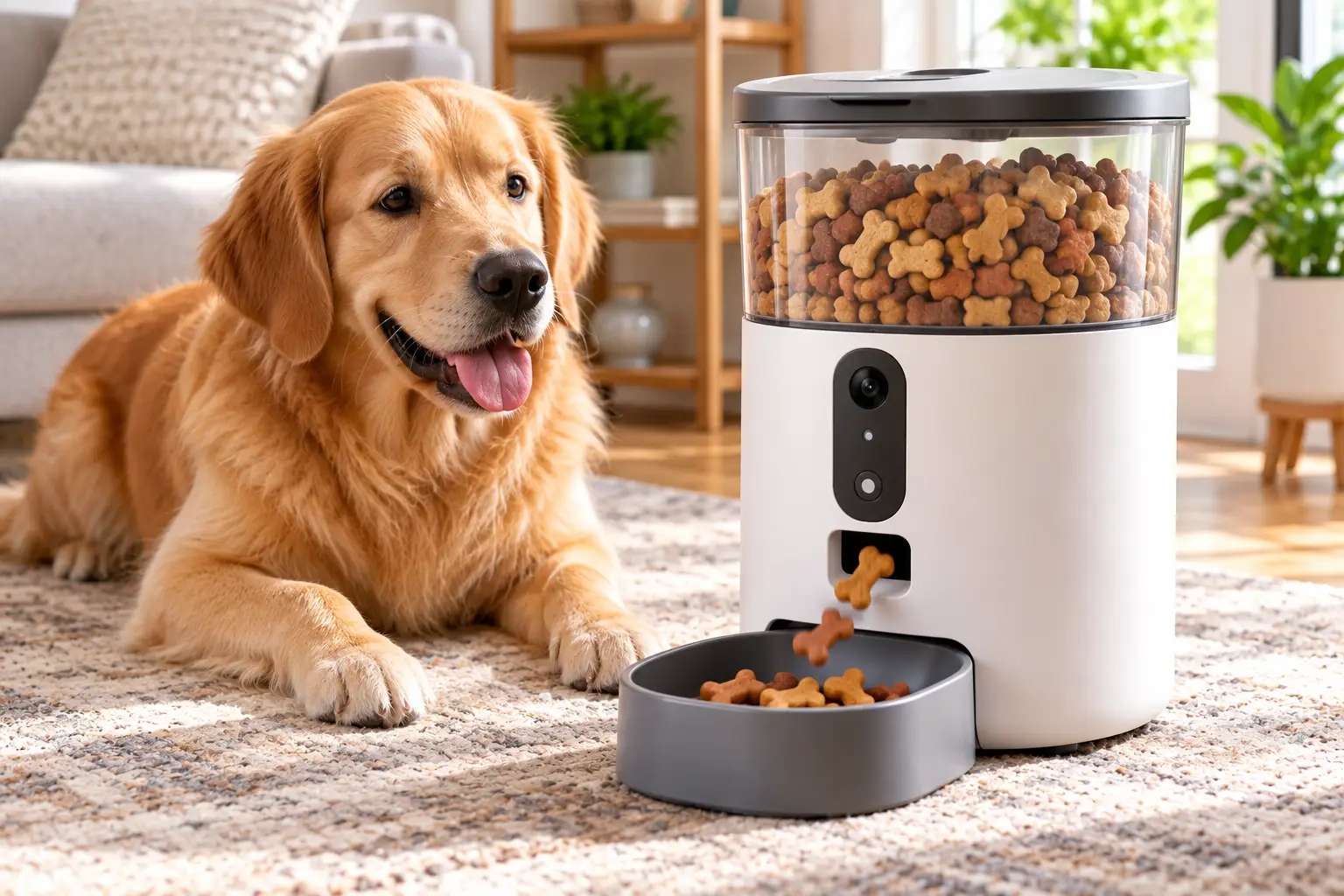
Picture this: you’re stuck in a 3 p.m. meeting, and your phone buzzes with a barking alert. Your dog is pacing by the front door again. A few years ago, all you could do was feel guilty. Today, an auto dog treat dispenser lets you check in, say a few calm words, and toss a reward across the living room—all from your phone.
But here’s the thing most “best of” lists skip: an auto dog treat dispenser isn’t one kind of product. It’s at least three. Some are Wi-Fi cameras that fling treats on command. Some are remote-controlled training tools built for teaching “down-stay” from across the yard. Others are interactive puzzle toys your dog learns to operate with a paw. Buy the wrong category, and you’ll own a very expensive kibble jar.
This guide cuts through that confusion. We compared spec sheets, manufacturer documentation, independent hands-on reviews, and the aggregated sentiment in real customer reviews to rank seven genuinely available options on amazon.com—from budget enrichment toys to premium AI-powered cameras.
You’ll also get what product listings never tell you: how to pick the right treat size so the thing doesn’t jam, how to keep treat calories from quietly piling up, how to introduce the device without spooking a sensitive dog, and what each option really costs over two or three years. If you’ve ever wondered whether an automatic dog treat dispenser is a gimmick or a genuinely useful tool, by the end of this article you’ll know—and you’ll know exactly which one fits your dog, your home, and your budget.
What Is an Auto Dog Treat Dispenser?
An auto dog treat dispenser is a powered device that releases treats or kibble without you handing them out—either on command from a smartphone app or remote, on a timer, or when your dog triggers it by pressing a button. Most models are used for training, enrichment, or remote check-ins.
That simple definition hides an important split. The “auto” part can mean three very different things:
- App-controlled release 📱 — a dog camera with treat dispenser (like the Furbo or Petcube lines) that you trigger from anywhere with Wi-Fi.
- Remote-controlled release 🎯 — a handheld remote fires the dispenser from a short distance, perfect for timing rewards during training.
- Dog-triggered release 🐾 — an interactive dog treat dispenser that pays out when your dog presses a button, turning snack time into a brain game.
Why does the category matter so much? Because positive reinforcement depends on timing. Behavior science tells us a reward works best when it lands within a second or two of the behavior you want—the same principle behind clicker training. A treat tossing dog camera excels at “I see you being calm, here’s a reward.” A remote trainer excels at “you just lay down on your mat, here’s a reward—right now.” A puzzle toy excels at “keep yourself busy while I’m cooking dinner.” Different jobs, different tools.
One more thing worth knowing up front: every treat counts. The American Kennel Club explains that treats should stay under roughly 10 percent of your dog’s daily calories—and an always-available dispenser makes it surprisingly easy to blow past that line.
Quick Comparison: The 7 Best Auto Dog Treat Dispensers at a Glance
| Product | Type | Treat Capacity | Control | Approx. Price Range | Best For |
|---|---|---|---|---|---|
| Furbo 360° Dog Camera | Wi-Fi treat camera | ~100 small treats | App, anywhere | $130–$210 | Furbo 360° Dog Camera: Best overall remote check-ins |
| Furbo Mini 360° | Compact Wi-Fi camera | ~10 small treats | App, anywhere | $40–$80 | Furbo Mini 360°: Small apartments, second rooms |
| Petcube Bites 2 Lite | Wi-Fi treat camera | Up to 1.5 lb | App + autoplay | $60–$150 | Petcube Bites 2 Lite: Big treat capacity on a budget |
| eufy Pet Dog Camera D605 | Wi-Fi treat camera | Small compartment | App, 3 distances | $100–$200 | eufy Pet Dog Camera D605: No-subscription local storage |
| PetSafe Treat & Train | Remote trainer | Treats or kibble | Handheld remote (~100 ft) | $100–$150 | PetSafe Treat & Train: Serious training & reactivity work |
| PETGEEK Automatic Dog Treat Dispenser | Button-press toy | ~850 ml | Dog button + remote | $30–$60 | PETGEEK Automatic Dog Treat Dispenser: Budget brain games |
| Potaroma Dog Puzzle Feeder Toy | Button-press toy | ~280 ml | Dog button + remote | $40–$65 | Potaroma Dog Puzzle Feeder Toy: Apartment enrichment |
Prices are approximate ranges at the time of writing—check the current price on Amazon, as prices may vary.
Looking at the table above, the split is clear: the four cameras (Furbo 360° Dog Camera, Furbo Mini 360°, Petcube Bites 2 Lite, eufy Pet Dog Camera D605) solve the “I’m not home” problem, while the PetSafe Treat & Train, PETGEEK Automatic Dog Treat Dispenser, and Potaroma Dog Puzzle Feeder Toy solve the “I’m home but need help” problem. If you work long hours away from the house, start with the cameras. If your goal is better manners or a busier, calmer dog in the evenings, the trainers and puzzle toys deliver far more value per dollar.
💬 One click helps other shoppers make an informed choice too! 😊
Top 7 Auto Dog Treat Dispensers: Expert Analysis
1. Furbo 360° Dog Camera — the benchmark for remote treat tossing
The Furbo 360° Dog Camera is the model most competitors are measured against, and for good reason: it pairs a rotating camera with a dependable treat launcher.
Its 1080p camera uses a 132° wide-angle lens with 4x digital zoom, and the body rotates so you can pan around the room—meaning you can follow your dog instead of staring at an empty couch. Color night vision keeps the feed useful after sunset. The hopper holds about 100 pieces, and Furbo recommends round treats roughly 0.5 inch (1 cm) across; there’s also an adjustable small/large treat setting, which helps you avoid overfeeding a little dog.
Based on comparing the specs, this is the pick for owners who are away for full workdays and want the most polished all-around experience. The full-duplex two-way audio (you and your dog can “talk over” each other, like a phone call) is a meaningful upgrade over the walkie-talkie style audio on the original Furbo. The catch: many of the AI features—person alerts, activity alerts, highlight videos—sit behind the optional Furbo Nanny subscription.
Customer reviews consistently praise the video quality and easy setup. A common complaint is barking alerts that fire when the dog isn’t actually barking, plus frustration that some features require a paid plan.
Pros:
- ✅ Smooth 360° rotation with auto dog tracking
- ✅ Roomy hopper for about 100 small treats
- ✅ Full-duplex audio feels like a real conversation
Cons:
- ❌ Best AI alerts require an ongoing subscription
- ❌ Picky about treat shape and size
💰 Expect roughly $130–$210 at the time of writing; strong value if you’ll use it daily, weaker if you hate subscriptions.
2. Furbo Mini 360° — big Furbo brains, tiny footprint
The Furbo Mini 360° shrinks the Furbo experience into a palm-sized camera with sharper video and a much smaller treat compartment.
It records in 2K QHD—noticeably crisper than the full-size Furbo’s 1080p—and keeps the rotating view and Auto Pet Tracking. Furbo markets it as offering “lite” treat tossing, and that’s the key word: independent reviews repeatedly note it holds only around 10 small treats. In practice, that means it’s a “say hi and give a reward or two” device, not an all-day dispenser.
Here’s what to weigh: if you live in a studio or one-bedroom, or you already own a full-size camera and want coverage of a second room, the Furbo Mini 360° is a smart, low-cost add-on. Its small capacity is actually a quiet advantage for small breeds or dogs on a diet—it physically limits how much you can give.
Reviews consistently report that the 2K picture impresses and setup is quick; the most frequent complaint, by far, is the tiny treat capacity. Note that Furbo sells several “Mini” variants, and at least one non-360 Mini has no treat tosser at all—double-check the listing.
Pros:
- ✅ Sharp 2K video in a compact body
- ✅ Core features work without a subscription
- ✅ Natural portion limit for small dogs
Cons:
- ❌ Holds only about ten small treats
- ❌ Confusing lineup makes it easy to buy the wrong model
💰 Typically $40–$80 at the time of writing; excellent value as a starter or secondary camera.
3. Petcube Bites 2 Lite — the capacity champion
The Petcube Bites 2 Lite is the camera to beat if you want to load treats once and forget about refills for a while.
Its hopper holds up to about 1.5 pounds of treats—dramatically more than either Furbo. Petcube includes three inserts for small (under 12 mm), medium (12–16 mm), and large (over 16 mm) treats, which solves the treat-size headache that plagues many cameras. The 160° wide-angle lens covers a large room from a fixed position, and an autoplay mode can dispense treats on a schedule.
Based on the specs, this is a great fit for multi-pet homes or bigger dogs who’d blow through a 10-treat compartment in a minute. It’s lighter and cheaper than the discontinued aluminum Bites 2 because it uses hard plastic—fine for a shelf, less ideal near a determined chewer. Petcube recommends placing it at least 3 feet off the floor, so plan for a table or bookcase.
Aggregated review sentiment is positive about capacity, image clarity, and adjustable toss distance (swipe higher on the screen to throw farther). Some owners report the toss motor failing after about a year, and one independent reviewer described day-to-day monitoring as a mixed experience.
Pros:
- ✅ Huge treat hopper means rare refills
- ✅ Three inserts handle different treat sizes
- ✅ Usable out of the box without a subscription
Cons:
- ❌ Fixed lens—no rotation or tracking
- ❌ Some reports of motor wear around year one
💰 Usually somewhere between $60 and $150, with frequent swings—check the current price; outstanding value at the lower end.
4. eufy Pet Dog Camera D605 — smart alerts without the monthly bill
The eufy Pet Dog Camera D605 wins over subscription-weary buyers by storing recordings locally instead of in a paid cloud.
It pairs a 1080p camera and 170° lens with a 270° rotatable body, so the treat launcher can aim in different directions—turning tosses into a little game of fetch. There are three toss distances, a patented anti-clog design, and 16 GB of built-in local storage. eufy’s own support notes say treats should not exceed 0.60 inch (16 mm), or the launcher may fail.
What most buyers overlook is the “attention” sound eufy plays before a toss. You can pair it with a squeaky-toy noise, Pavlov-style, so your dog learns that the sound means food is coming—genuinely useful for building the habit. Its AI can also flag when your dog poops or licks its paws, which may help you notice health changes to discuss with your vet.
Independent testers (Reviewed named it a best overall pick) praise the free storage and reliable aim. A consumer-testing panel in Australia found setup easy but noted that not every dog paid attention to the treat alert, and one reviewer mentioned the launch noise could bother some dogs.
Pros:
- ✅ Free 16 GB local storage, no subscription needed
- ✅ Rotating launcher with three toss distances
- ✅ Anti-clog design reduces stuck treats
Cons:
- ❌ Launch noise may startle sound-sensitive dogs
- ❌ Smaller treat compartment than the Petcube
💰 Typically $100–$200 at the time of writing; very good long-term value since there’s no recurring fee.
5. PetSafe Treat & Train — the trainer’s secret weapon
The PetSafe Treat & Train (formerly sold as the Manners Minder) isn’t a camera at all—it’s a remote treat dispenser for dogs designed to deliver perfectly timed rewards during training.
You press a handheld remote, and the base drops a treat or piece of kibble from up to about 100 feet away. That distance matters: it lets you reward a dog for staying calm on its mat while a guest walks in, without you hovering nearby. The base runs on four D batteries (sold separately), and an extendable wand lets you use it with or without the base. PetSafe’s newer Teach & Treat version follows the same concept with tutorial videos led by a certified trainer.
Based on comparing it to cameras, this is the right tool if your goal is behavior change—door manners, reactivity to visitors, agility distance work. It isn’t a “check in from the office” device, and it shines only when you put in structured sessions.
Owner reviews are strongly positive among people doing agility and obedience, and several praise PetSafe’s customer service. One recurring, honest theme: the included program makes progress look faster than it is—expect weeks, not ten days.
Pros:
- ✅ Precise reward timing from about 100 feet
- ✅ Works with treats or regular kibble
- ✅ No Wi-Fi, app, or subscription required
Cons:
- ❌ Needs four D batteries, not included
- ❌ No camera or remote viewing at all
💰 Around $100–$150 at the time of writing; worth every penny if you’ll actually train with it.
6. PETGEEK Automatic Dog Treat Dispenser — budget brain game
The PETGEEK Automatic Dog Treat Dispenser turns snack time into a cause-and-effect puzzle: your dog presses a button, and treats come out.
Its roughly 850 ml container holds a generous load of kibble, and an adjustable treat window controls how much drops per press. It runs on batteries or USB power and includes a remote that the manufacturer rates at up to 164 feet indoors, so you can also trigger rewards yourself. The ABS plastic build is sturdy for gentle paws, though it’s still plastic.
Here’s what to weigh: this interactive dog treat dispenser is ideal for food-motivated, curious dogs who get bored easily—especially young dogs with energy to burn. It teaches a “press for reward” behavior that can carry over into fun tricks. It is not a monitoring device, and it doesn’t limit total daily intake on its own, so you need to measure what goes in.
Aggregated Amazon review data points to generally positive but mixed sentiment—most owners say their dogs learn the button quickly, while some report the window needs fine-tuning to avoid dumping too much food per press.
Pros:
- ✅ Large container suits meal-sized portions
- ✅ Battery or USB power flexibility
- ✅ Doubles as a remote reward tool
Cons:
- ❌ Portion window takes trial and error
- ❌ Plastic won’t survive a dedicated chewer
💰 Typically $30–$60 at the time of writing; strong value for daily enrichment.
7. Potaroma Dog Puzzle Feeder Toy — rechargeable apartment enrichment
The Potaroma Dog Puzzle Feeder Toy is a rechargeable press-and-reward toy with a separate button your dog can learn to operate from a distance.
It holds about 280 ml, recharges instead of eating batteries, and includes a voice-recording feature so you can attach a cue to each payout. Because the button is separate from the dispenser, you can gradually increase the distance between them—turning a snack into a walk-press-run-eat loop that burns a surprising amount of energy. A Chewy Q&A answer notes the battery lasts roughly 3–5 days and that it can’t release one single treat at a time.
Based on the specs and owner feedback, this is a great match for apartment dwellers with small or medium dogs who need indoor enrichment on rainy or icy days. The removable tray and button holder can be cleaned, which matters once drool gets involved.
Reviews consistently report that dogs pick it up fast and that it’s easy to charge and clean. Common caveats: owners of larger dogs say it may be too small, and some note the button can slide during enthusiastic play.
Pros:
- ✅ Rechargeable—no battery swaps
- ✅ Separate button adds a movement element
- ✅ Washable parts handle drool well
Cons:
- ❌ Smaller capacity than the PETGEEK
- ❌ Can’t dispense precisely one treat
💰 Usually $40–$65 at the time of writing; good value for small-to-medium dogs.
🚀 Ready to upgrade snack time?
🔍 Take your dog’s training and enrichment to the next level with this carefully curated lineup. Click any highlighted product to check current pricing and availability on Amazon—these picks will help you build a calmer, happier pup the whole family will enjoy!
Side-by-Side: Key Specs Compared
| Product | Video | Rotation | Subscription Needed? | Power | Best For |
|---|---|---|---|---|---|
| Furbo 360° Dog Camera | 1080p, 132° | Yes | Optional (for AI alerts) | Wall plug | Furbo 360° Dog Camera: Full-day remote monitoring |
| Furbo Mini 360° | 2K QHD | Yes | No (core features) | Wall plug | Furbo Mini 360°: Small spaces |
| Petcube Bites 2 Lite | 1080p, 160° | No | No (optional plan) | Wall plug | Petcube Bites 2 Lite: High capacity |
| eufy Pet Dog Camera D605 | 1080p, 170° | 270° | No (16 GB local) | Wall plug | eufy Pet Dog Camera D605: Subscription-free smarts |
| PetSafe Treat & Train | None | N/A | No | 4 D batteries | PetSafe Treat & Train: Precision training |
| PETGEEK Automatic Dog Treat Dispenser | None | N/A | No | Batteries/USB | PETGEEK Automatic Dog Treat Dispenser: Budget play |
| Potaroma Dog Puzzle Feeder Toy | None | N/A | No | Rechargeable | Potaroma Dog Puzzle Feeder Toy: Indoor enrichment |
Reading the table this way reveals a hidden cost driver: subscriptions. The eufy Pet Dog Camera D605 is the only camera here that gives you saved recordings without a monthly plan, while the Furbo 360° Dog Camera reserves its smartest alerts for subscribers. Meanwhile, the three non-camera options never cost a cent beyond batteries and treats—something to remember when you run the two-year math later in this guide.
Getting Started: Your First 30 Days With an Automatic Dog Treat Dispenser
Unboxing is the easy part. The first month decides whether your dog loves the device—or hides from it. Here’s a practical week-by-week plan.
Week 1: Make it boring, then make it great 🐶
Set the device on the floor (unplugged or switched off) and let your dog sniff it. Drop a few treats near it by hand. For cameras, trigger a toss only while you’re in the room, and pair it with a happy cue word. The goal is a simple association: machine sound = good stuff.
Week 2: Nail the treat size ⚙️
Most “it doesn’t work” complaints are really “wrong treat” problems. Use small, round, dry treats near the manufacturer’s spec: about 0.5 inch for Furbo, under 0.60 inch for eufy, and the matching insert size for Petcube. Avoid soft, greasy, or crumbly treats—they smear and jam. Break larger biscuits into pieces, and keep calories in check while you’re at it.
Week 3: Increase difficulty gradually 📈
For puzzle toys like the Potaroma Dog Puzzle Feeder Toy, move the button a few feet farther from the dispenser every few sessions. For the PetSafe Treat & Train, start rewarding short “down” positions, then lengthen the duration before each reward. For cameras, try remote tosses during short absences—five minutes, then fifteen.
Week 4: Build a sustainable routine 🗓️
Pick consistent windows—say, one mid-morning check-in and one mid-afternoon check-in—rather than tossing treats every time you get bored at work. Subtract dispenser treats from your dog’s daily food. Clean the hopper weekly; oils and crumbs are the number-one cause of jams.
Common first-month mistakes: placing a camera where your dog can knock it off a low table, using treats that are too large, rewarding barking by tossing a treat mid-bark, and skipping the “boring” introduction for noise-sensitive dogs.
Which Dispenser Fits Your Life? Three Real-World Scenarios
Specs are abstract. Real lives aren’t. Here’s how the picks map to three common situations.
👩💼 Scenario 1: The 9-to-5 commuter with a 50-lb Lab mix
You’re gone about nine hours, five days a week. Your dog is food-obsessed and mildly anxious when you leave. Budget: up to $200. Best match: the Petcube Bites 2 Lite or the Furbo 360° Dog Camera. The Petcube’s large hopper suits a big eater and means you won’t run dry by lunchtime; the Furbo’s rotation and tracking help if your dog roams between rooms. Use two or three scheduled check-ins, not twenty.
🏙️ Scenario 2: The apartment dweller with a 15-lb terrier
You work from home three days a week. Your dog has energy to spare, and winter walks get short. Budget: under $80. Best match: the Potaroma Dog Puzzle Feeder Toy for daily indoor enrichment, plus a Furbo Mini 360° for the days you’re out. The Mini’s small treat capacity naturally limits portions for a small dog, and the Potaroma’s separate button turns a portion of dinner into a mini workout.
🎓 Scenario 3: The training-focused owner with a reactive rescue
Your dog barks and lunges when guests arrive. You’re working with a trainer and can commit to short daily sessions. Budget: $100–$150. Best match: the PetSafe Treat & Train. Its ~100-foot remote lets you reward calm behavior on a mat while visitors enter—without you standing next to your dog. A camera won’t give you that precision, and a puzzle toy would reward the wrong behavior entirely.
The pattern? Match the device to the moment you need help: away from home, bored at home, or actively training.
Problem → Solution: Fixing Jams, Ignored Treats, and Overfeeding
Even the best auto dog treat dispenser hits snags. Here are the five most common problems and how to fix them.
1. Treats jam or won’t launch 🔧 Solution: Check size first—eufy’s guidance is no larger than 0.60 inch, and Furbo favors round treats around 0.5 inch. Then empty and clean the container; crumbs and oily residue block the mechanism. Switch to drier, harder treats.
2. Your dog is scared of the sound 😟 Solution: Go back to Week 1. Trigger tosses from another room at low volume while your dog is eating something delicious. On the eufy Pet Dog Camera D605, try a friendlier pre-toss sound. Never force proximity.
3. Your dog ignores the device 🙄 Solution: Use higher-value treats during the learning phase, then fade back to kibble. Some dogs, as a consumer-testing panel observed, simply don’t react to alerts at first—consistency over several weeks usually changes that.
4. Weight creeps up ⚖️ Solution: Count every toss. A dog eating 600 calories a day has about a 60-calorie treat budget. VCA Animal Hospitals notes that a single large biscuit can carry roughly 85 calories—more than that entire budget. Use tiny pieces or your dog’s regular kibble in the dispenser.
5. Multiple dogs fight over the button 🐕🐕 Solution: Use puzzle toys like the PETGEEK Automatic Dog Treat Dispenser only when dogs are separated, and watch for resource guarding. Cameras with wide toss ranges (like the eufy Pet Dog Camera D605) can spread treats so each dog gets a turn.
How to Choose an Auto Dog Treat Dispenser
Follow these seven steps in order, and you’ll avoid most buyer’s remorse.
- Define the job first. Remote check-ins, structured training, or boredom busting? Each points to a different category.
- Match capacity to your dog’s size. A Lab will empty a 10-treat compartment in minutes; a Chihuahua might be better off with that limit.
- Check treat-size compatibility. Confirm the max treat diameter and whether your dog’s favorite treat fits—or plan to switch.
- Decide your subscription tolerance. If you won’t pay monthly, favor models with local storage or full core features, like the eufy Pet Dog Camera D605.
- Consider your dog’s sound sensitivity. Noisy launchers can spook timid dogs; plan a slow introduction.
- Think about placement. Cameras need an outlet and, often, a raised spot; puzzle toys need floor space away from stairs.
- Budget for the long haul. Factor in treats, batteries, and possible subscriptions—not just the sticker price.
The short version: the right automatic dog treat dispenser is the one that fits your daily routine, not the one with the longest feature list.
Dog Camera With Treat Dispenser vs. Remote Trainer vs. Puzzle Toy
Each category beats the traditional alternative—you handing out treats or leaving a stuffed chew toy—in specific ways.
| Approach | Works When You’re Away | Reward Timing | Mental Stimulation | Typical Cost | Best For |
|---|---|---|---|---|---|
| Hand-delivered treats | ❌ | Excellent (if you’re there) | Low | Treats only | Basic home training |
| Stuffed chew toy (e.g., Kong) | ✅ | None | Medium | $10–$25 | Quiet solo time |
| Dog camera with treat dispenser | ✅ | Good (remote) | Low–Medium | $40–$210 | Furbo 360° Dog Camera, Petcube Bites 2 Lite: Remote check-ins |
| Remote treat dispenser for dogs | ❌ (short range) | Excellent | Medium | $100–$150 | PetSafe Treat & Train: Behavior work |
| Interactive button toy | ✅ (supervised) | Instant (self-triggered) | High | $30–$65 | PETGEEK Automatic Dog Treat Dispenser: Enrichment |
Comparing these side by side, no single option wins everything. A treat tossing dog camera is the only choice that lets you interact while away, but it offers less enrichment than a puzzle toy. The PetSafe Treat & Train beats hand-feeding when distance matters—you can’t toss a treat 100 feet with perfect aim—while a basic stuffed chew still wins on price for simple alone-time comfort.
In practice, many owners do best with a combination: an inexpensive puzzle toy for daily enrichment plus a camera for workdays. The camera keeps you connected; the toy keeps your dog thinking. That pairing often costs less than a single premium camera with a two-year subscription.
Features That Actually Matter (and Ones That Don’t)
Marketing copy loves big numbers. Here’s what genuinely affects daily life with an auto dog treat dispenser.
✅ Features that matter
- Treat-size flexibility. Petcube’s three inserts and Furbo’s small/large toggle prevent jams and overfeeding. This affects you every single day.
- Anti-clog design. eufy’s patented approach directly targets the top owner complaint.
- Field of view and rotation. A 160–170° lens or a rotating body means you actually see your dog instead of an empty corner.
- Local storage or meaningful free features. Avoids paying forever to review your own footage.
- Reliable two-way audio. Full-duplex audio (like the Furbo 360° Dog Camera) feels natural; laggy push-to-talk can confuse dogs.
❌ Features that matter less than you think
- Ultra-high zoom numbers. Digital zoom degrades quality; you rarely need 8x to see a dog in a living room.
- “AI selfies” and highlight reels. Fun, but they don’t change your dog’s wellbeing.
- Voice recordings on puzzle toys. Helpful for cues, but your dog will learn the mechanical sound just as well.
- Massive capacity for small dogs. A 1.5-lb hopper can encourage overfeeding a 10-lb dog.
The takeaway: prioritize what reduces daily friction (jams, refills, blind spots) over what looks impressive in a product video.
Long-Term Cost and Maintenance
Sticker price is only the first chapter. Here’s a realistic two-year view.
| Product | Approx. Upfront | Recurring Costs | Maintenance Notes | Best For |
|---|---|---|---|---|
| Furbo 360° Dog Camera | $130–$210 | Optional Furbo Nanny plan | Wipe hopper weekly | Furbo 360° Dog Camera: Owners who’ll use AI alerts |
| Furbo Mini 360° | $40–$80 | Optional plan | Frequent small refills | Furbo Mini 360°: Low-cost entry |
| Petcube Bites 2 Lite | $60–$150 | Optional Petcube Care plan | Watch motor wear | Petcube Bites 2 Lite: Value seekers |
| eufy Pet Dog Camera D605 | $100–$200 | None required | Clean container regularly | eufy Pet Dog Camera D605: Lowest 2-year camera cost |
| PetSafe Treat & Train | $100–$150 | D batteries | Clean disc and tray | PetSafe Treat & Train: Training investment |
| PETGEEK Automatic Dog Treat Dispenser | $30–$60 | Batteries or USB power | Adjust window, wash container | PETGEEK Automatic Dog Treat Dispenser: Lowest total cost |
| Potaroma Dog Puzzle Feeder Toy | $40–$65 | Electricity only | Wash tray and button holder | Potaroma Dog Puzzle Feeder Toy: No-battery convenience |
Running the numbers, a subscription-dependent camera can end up costing more over two years than its upfront price suggests—so if you know you’ll want saved clips and smart alerts, the eufy Pet Dog Camera D605 often comes out ahead. On the other end, the PETGEEK Automatic Dog Treat Dispenser and Potaroma Dog Puzzle Feeder Toy have the lowest total cost of ownership by a wide margin.
Maintenance schedule that prevents 90% of problems:
- Weekly: empty, wipe, and dry treat containers.
- Monthly: check firmware updates on cameras; inspect cords for chew marks.
- Every 3–6 months: replace batteries on battery-powered units before they die mid-session, and re-check your dog’s weight with your vet’s guidance.
And don’t forget the biggest recurring cost of all: treats. Using your dog’s regular kibble in the dispenser (where the mechanism allows) can cut that expense dramatically.
Automatic Dog Treat Dispenser for Anxious Dogs and Separation Training
Many people shop for an automatic dog treat dispenser hoping it will “fix” separation anxiety. It can help—but only as part of a plan.
The ASPCA’s guidance on treating separation anxiety explains that mild cases may respond to counterconditioning—teaching a dog to associate being alone with something good—while moderate to severe cases need a more gradual desensitization program, often with professional help. Dogs with true separation anxiety may bark, howl, chew, or try to escape, sometimes within minutes of being left.
Here’s where each type fits:
- Cameras (like the Furbo 360° Dog Camera or eufy Pet Dog Camera D605) let you observe what really happens after you leave—incredibly valuable information to share with your vet or trainer.
- Puzzle toys (like the Potaroma Dog Puzzle Feeder Toy) give a dog something absorbing to do right as you walk out, which can support counterconditioning in mild cases.
- Remote trainers (like the PetSafe Treat & Train) help build calm “settle” behaviors while you’re home, which is often step one.
A critical caution: tossing a treat while your dog is actively panicking or barking can accidentally reward the distress. Aim to reward calm moments instead. And if your dog shows severe signs—self-injury, destroyed doorframes, nonstop vocalizing—a dispenser is not enough on its own. Talk to your veterinarian or a certified behavior professional.
For senior dogs, low-effort cameras with gentle toss distances are kinder than puzzle toys that demand repeated pressing. For puppies, keep sessions short and treats tiny.
Common Mistakes to Avoid When Buying an Auto Dog Treat Dispenser
A little foresight saves a return trip to Amazon.
1. Buying a camera when you need a trainer. If your real problem is jumping on guests, a remote treat dispenser for dogs like the PetSafe Treat & Train will help far more than any camera.
2. Ignoring treat compatibility. Many buyers discover after purchase that their dog’s favorite treats are too big or too soft. Check the max diameter before buying.
3. Underestimating subscription costs. Read what’s free versus paid. The difference between “core features” and “AI features” can be dramatic over time.
4. Choosing capacity backward. Small dogs often do better with smaller hoppers like the Furbo Mini 360°; big dogs need something like the Petcube Bites 2 Lite.
5. Expecting instant results. Even enthusiastic owners of the PetSafe Treat & Train note that real training progress takes weeks, not days.
6. Forgetting placement. A camera that needs to sit 3 feet off the floor won’t work if you lack a sturdy shelf near an outlet.
7. Buying the wrong variant. Some product lines (Furbo in particular) include similar-looking models without treat tossing. Read the listing title carefully before you click “Buy.”
8. Skipping the calorie math. An always-available dispenser is a calorie leak waiting to happen. Set a daily treat budget before day one.
Safety, Privacy, and Standards for Smart Treat Dispensers
Smart pet gadgets live in your home 24/7, so safety goes beyond “will my dog like it?”
🔌 Electrical safety
Use only the included power adapter or a replacement from the manufacturer. Look for recognized safety certification marks (such as UL or ETL) on adapters, keep cords out of chewing range, and never place a plugged-in device where it can fall into a water bowl.
📡 Wireless compliance
Wi-Fi devices sold in the US must be authorized by the FCC for radio emissions. Reputable brands list an FCC ID on the device or packaging—a quick sign you’re buying a legitimate product rather than a mystery import.
🔒 Privacy and security
A dog camera with treat dispenser is still a camera in your home. Set a strong, unique password; enable two-factor authentication if the app offers it; keep firmware updated; and consider pointing the camera away from areas where you’d rather not be recorded. Local storage (like the eufy Pet Dog Camera D605‘s 16 GB) keeps footage in your home, though you should still secure your account.
🦴 Choking and ingestion
Choose treats sized appropriately for your dog—small enough to dispense reliably, but not so small a large dog gulps them whole. Puzzle toys made of ABS plastic aren’t chew toys; supervise until you know how your dog interacts with them.
🥩 Food safety
Dispensers trap oils and crumbs that can go rancid. Wash food-contact parts regularly, store treats in sealed containers, and toss anything that smells off.
FAQ: Auto Dog Treat Dispenser
❓ What is the best auto dog treat dispenser for large dogs?
❓ Do automatic dog treat dispensers work without Wi-Fi?
❓ Can I put regular kibble in a treat tossing dog camera?
❓ Is a dog camera with treat dispenser worth it without a subscription?
❓ How many treats should a dispenser give per day?
Conclusion: Choosing the Right Auto Dog Treat Dispenser for Your Dog
The best auto dog treat dispenser isn’t the flashiest one—it’s the one that matches the moment your dog actually needs you.
If you’re away all day and want to see, talk to, and reward your dog, start with a camera. The Furbo 360° Dog Camera remains the most polished all-rounder, the Petcube Bites 2 Lite wins on capacity and value, the eufy Pet Dog Camera D605 is the smart pick for anyone allergic to subscriptions, and the Furbo Mini 360° is a clever, low-cost entry for small spaces.
If your goal is better behavior, the PetSafe Treat & Train is in a league of its own for perfectly timed rewards at a distance. And if your dog simply needs more to think about, the PETGEEK Automatic Dog Treat Dispenser and Potaroma Dog Puzzle Feeder Toy deliver serious enrichment for very little money.
Whatever you choose, remember the three habits that make any automatic dog treat dispenser succeed: introduce it slowly, pick the right treat size, and count every calorie. Do that, and you won’t just own a gadget—you’ll own a tool that makes your dog calmer, sharper, and happier while strengthening the bond you share. 🐾
🎁 Find your dog’s perfect match today!
✨ Don’t wait to make snack time smarter. Click any highlighted product above to check current pricing and availability on Amazon—and give your pup the reward system they’ll be wagging about for years!
Recommended for You
- Automatic Cat Feeder for 3 Cats: 7 Best Picks That End Food Fights (2026)
- Wooden Dog Feeder: 7 Best Picks for 2026 (Honest, Vet-Aware Guide)
- Water Fountain with Filter: 7 Best Picks Your Pet Will Love (2026)
Disclaimer: This post contains affiliate links. As an Amazon Associate, I earn from qualifying purchases made through these links, at no additional cost to you.
✨ Found this article helpful? Share it with someone who needs it! 💬🤗