In This Article
Dog Treat Dispenser Training: Why Perfect Timing Changes Everything
Your dog sits politely while the doorbell rings — for exactly one second. By the time you’ve fished a treat out of your pocket, he’s already launched himself at the door, and guess which behavior just got paid? That tiny gap between “good dog” and “here’s your cookie” is where most home training quietly falls apart.
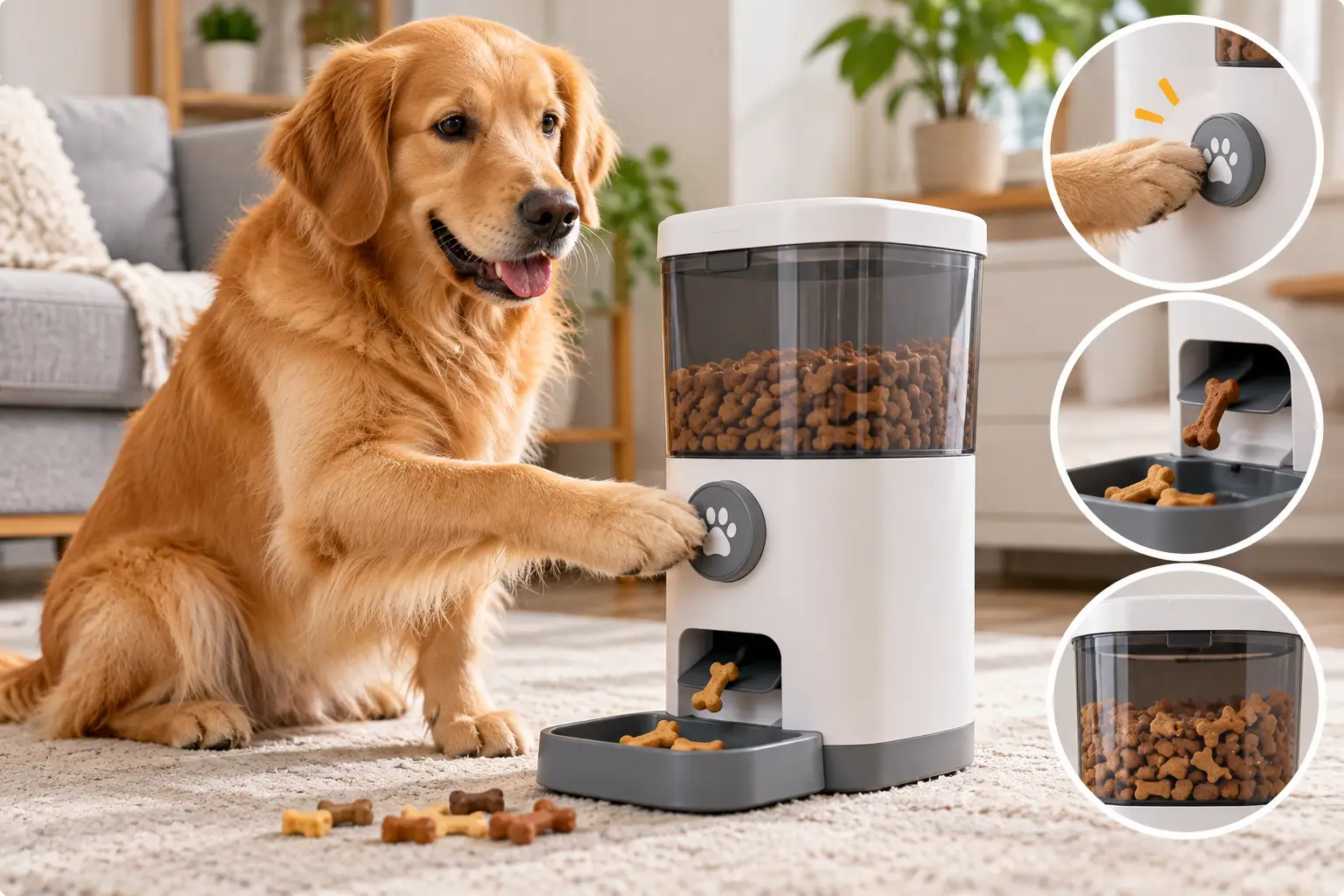
Dog treat dispenser training closes that gap. Instead of fumbling with pouches and sticky fingers, you let a machine — or a cleverly designed toy — deliver the reward at the right moment and in the right place, sometimes while you’re across the room or across town. It runs on the same learning science behind clicker training and operant conditioning: behaviors that pay off get repeated, and the faster the payoff arrives, the clearer the lesson.
But “treat dispenser” covers wildly different gadgets. A remote treat dispenser for dogs that drops kibble on cue is a precision instrument for teaching down-stays and calm greetings. A dog camera with treat dispenser is mostly a long-distance check-in tool with a training bonus. And treat dispensing dog toys are enrichment workhorses that teach patience and problem-solving while you’re busy doing literally anything else.
In this 2026 guide, we compare seven real products available to US shoppers on Amazon, translate their spec sheets into plain English, summarize what owners actually report in their reviews, and hand you a practical 30-day plan. No fake test diaries, no invented star ratings — just honest analysis so you can match the right tool to your dog, your budget, and your goals. 🐾
What Is Dog Treat Dispenser Training?
Dog treat dispenser training is a positive reinforcement method in which a device — a remote-controlled dispenser, a treat-tossing camera, or a food-puzzle toy — delivers a food reward the instant your dog performs a behavior you want. It sharpens reward timing, lets you reinforce at a distance, and keeps every session consistent.
Think of it as outsourcing the “delivery” half of training while you stay in charge of the “teaching” half. You still decide what earns a reward; the dispenser simply makes sure the reward lands fast and in a predictable spot. That predictability matters more than most owners realize, because a dog who knows where food appears stops mugging your hands and starts offering behaviors instead.
Three broad categories exist, and each one solves a different problem:
- 🎯 Remote reward trainers — tabletop dispensers triggered by a handheld remote. Ideal for structured lessons like “go to your mat,” down-stays, and calm behavior around visitors.
- 📱 Treat cameras — Wi-Fi cameras that toss treats when you swipe in an app. Ideal for reinforcing quiet, settled behavior while you’re away and for checking in during crate or alone-time practice.
- 🧩 Puzzle dispensers — non-electronic toys that release food as your dog pushes, rolls, or works them. Ideal for enrichment, slowing fast eaters, and building self-entertainment skills.
The common thread is positive reinforcement dog training: rewarding what you want instead of punishing what you don’t. Pick the category first, and the product choice gets a whole lot easier.
Quick Comparison: 7 Best Treat Dispensers for Training at a Glance
| Product | Type | Control | Approx. Price (USD) | Best for |
|---|---|---|---|---|
| PetSafe Treat & Train Remote Reward Dog Trainer | Remote reward trainer | Handheld remote, ~100 ft | $150–$190 | Down-stays, calm greetings, distance work |
| PetSafe Teach & Treat Remote Reward Trainer | Remote reward trainer | Handheld remote, ~30 yd | $150–$200 | Beginners who want guided video lessons |
| Furbo 360° Dog Camera | Treat camera | Smartphone app | $100–$200 | Alone-time training and barking check-ins |
| Petcube Bites 2 Lite | Treat camera | Smartphone app | $50–$150 | Budget app rewards with adjustable toss |
| KONG Wobbler | Puzzle dispenser | Dog-powered | $15–$35 | Fast eaters and solo enrichment |
| Starmark Bob-A-Lot | Puzzle dispenser | Dog-powered, adjustable | $15–$25 | Adjustable difficulty, bigger meals |
| PetSafe Busy Buddy Twist ’n Treat | Puzzle dispenser | Dog-powered, twist-adjust | $9–$20 | Tight budgets, soft-to-medium chewers |
Looking at the table, the seven picks split into three price tiers that map neatly onto three jobs. If you want to teach a specific behavior on cue, the two PetSafe remote trainers are the only options here built for it — the PetSafe Treat & Train Remote Reward Dog Trainer for longer range, the PetSafe Teach & Treat Remote Reward Trainer for its guided lessons. If your real problem is what happens after you leave, the cameras win; and if you mostly need a calmer, more tired dog, a $20 toy like the KONG Wobbler can deliver more value per dollar than any gadget. Prices are approximate ranges at the time of writing — check the current price before you buy.
💬 One click helps other shoppers make an informed choice too! 😊
Top 7 Dog Treat Dispenser Training Tools: Expert Analysis
Each pick below is a real product sold to US shoppers, analyzed from manufacturer spec sheets and aggregated owner feedback. We start with the precision trainers, move to treat cameras, and finish with the budget-friendly puzzle toys.
1. PetSafe Treat & Train Remote Reward Dog Trainer — the precision tool for distance work
This is the dispenser that brought remote rewards into mainstream pet training, and it still sets the bar for hands-off, perfectly timed reinforcement.
Invented by the late veterinarian and animal behavior expert Dr. Sophia Yin (it was originally sold as the Manners Minder), the PetSafe Treat & Train Remote Reward Dog Trainer pairs a tabletop dispenser with a handheld remote rated to about 100 feet. In practice, that range lets you reward a dog lying on his bed in the living room while you answer the front door — the exact moment most dogs fall apart. It runs on four D batteries (sold separately), and an extendable wand means you can use it with or without its base.
Based on comparing the specs, this is the most capable structured-training tool in the lineup: down-stays, “go to your mat,” calm behavior while guests arrive, and agility or obedience distance drills. On the flip side, it has no camera and no app, so it’s overkill if you just want to toss a cookie from the office.
Owner reviews consistently report that it speeds up learning but is not a shortcut — several note that real progress takes longer than the included lessons imply, while agility handlers praise it for building distance work. PetSafe’s customer service also earns positive mentions.
Pros:
- ✅ Long remote range for genuine distance training
- ✅ Designed by a veterinary behaviorist, not a marketing team
- ✅ Works anywhere without Wi-Fi or an app
Cons:
- ❌ Four D batteries add ongoing cost and weight
- ❌ Stock can be spotty across retailers
💵 Expect roughly $150–$190 at the time of writing — the best value here if structured, distance-based training is your goal.
2. PetSafe Teach & Treat Remote Reward Trainer — guided lessons for first-time trainers
The PetSafe Teach & Treat Remote Reward Trainer is the newer, more beginner-friendly sibling, built around step-by-step video tutorials led by a certified trainer.
Its remote reaches up to 30 yards (90 feet), slightly shy of the PetSafe Treat & Train Remote Reward Dog Trainer — a difference you’ll rarely notice indoors. The kit includes the dispenser, the remote, a target for your dog to run to, and two treat-dispensing discs, so you can match the mechanism to kibble or slightly larger treats. The quiet motor matters more than it sounds: a clunky dispenser can startle noise-sensitive dogs and sour the very reward you’re delivering. Like its sibling, it runs on four D batteries, and PetSafe suggests setting it on top of a crate to reward calm behavior inside.
Here’s what to weigh: if you’ve never trained with a remote, the structured lessons and included target are genuinely useful scaffolding. Experienced trainers will get more flexibility from the longer-range model.
An honest note on reviews: at the time of writing, we couldn’t verify a large body of detailed US customer reviews for this model, and several retailer listings show few or none. What is verifiable is the spec sheet and PetSafe’s long track record in the category.
Pros:
- ✅ Video tutorials take the guesswork out of starting
- ✅ Included target supports go-to-place training
- ✅ Quiet motor suits sound-sensitive dogs
Cons:
- ❌ Limited independent review data so far
- ❌ Shorter range than its older sibling
💵 Typically in the $150–$200 range — good value for beginners who will actually follow the lessons.
3. Furbo 360° Dog Camera — best for training while you’re away
The Furbo 360° Dog Camera turns your phone into a long-distance treat dispenser, so you can reward calm behavior from work, the gym, or the grocery line.
On paper, you get a rotating 360° view with automatic dog tracking, 1080p Full HD video, 4x digital zoom, color night vision, two-way audio, and a hopper that holds about 100 treats. Furbo recommends round treats roughly 0.4–0.5 inch across. The rotating lens matters because you can only reward calm behavior you can actually see, and a roaming dog won’t stay politely in one frame. An optional “snack call” sound before each toss can become a conditioned marker that tells your dog food is coming, while barking alerts tell you when to check in.
This is the pick for alone-time skills, crate comfort, and window barking. It’s less precise for in-room lessons, because app latency and a tossing arc make timing looser than a handheld remote. The core see, talk, and toss features work without a subscription; the optional Furbo Nanny plan (starting around $9.99/month) adds smarter alerts and video history.
Reviews consistently praise the treat toss and barking alerts; the most common complaint is an occasional treat jam, usually with irregularly shaped treats.
Pros:
- ✅ Large 100-treat hopper covers long workdays
- ✅ 360° rotation keeps active dogs in view
- ✅ Core features work without a monthly fee
Cons:
- ❌ Picky about treat shape and size
- ❌ Best AI features sit behind a subscription
💵 Usually between $100 and $200 depending on promotions — strong value if alone-time training is your priority.
4. Petcube Bites 2 Lite — adjustable tosses on a budget
The Petcube Bites 2 Lite delivers app-based rewards for less, and its adjustable toss distance is a sneaky-good training feature.
The spec sheet lists a 1080p HD camera with a 160° wide-angle view, 8x digital zoom, night vision, two-way audio, and a hopper holding up to 1.5 lb of treats. It accepts crunchy treats up to about 1 inch, and three inserts control how many pieces fly out at once. Practically speaking, a short toss rewards a dog for staying on his bed, while a long toss sends him chasing — a great reset after a barking fit. The hopper is detachable and dishwasher safe, and Petcube recommends placing the unit at least 3 feet off the floor.
It’s the value pick for budget-minded owners who want app rewards without paying flagship prices. Just remember the lens doesn’t rotate, so placement decides what you can see.
Reviews report quick setup (one detailed review clocked about 10 minutes) and a dispenser that works reliably; everyday monitoring gets mixed marks, and the hard-plastic body feels less premium than the aluminum on the discontinued Bites 2.
Pros:
- ✅ Adjustable toss distance adds training flexibility
- ✅ Large hopper accepts a wide range of treat sizes
- ✅ Dishwasher-safe treat container simplifies cleanup
Cons:
- ❌ Fixed view can miss a roaming dog
- ❌ Plastic build feels less sturdy than older models
💵 Its price swings widely, from roughly $50 up to its ~$150 list price — check the current price, because at the low end it’s the best-value camera here.
5. KONG Wobbler — enrichment that quietly teaches patience
The KONG Wobbler isn’t a cue-based trainer, but it’s a training tool in disguise: it rewards persistence, independent play, and settling down after work.
It sits upright until your dog nudges it with a paw or nose, then wobbles, spins, and rolls, releasing kibble or treats through a hole near the top. Made of food-grade, high-strength polymer, it unscrews for filling and goes in the top rack of the dishwasher. The small size suits dogs under about 30 lb and holds roughly half a cup of food; the large suits bigger dogs and holds about a cup. That capacity means a whole meal can go inside — so the reward is calorie-neutral because it is dinner.
What most buyers overlook is the unpredictable motion: because the payout is irregular, even experienced dogs stay engaged, which is exactly what you want for a dog learning to entertain himself. It’s ideal for gulpers, high-energy breeds, and dogs who need a job while you work from home.
Owner feedback is broadly enthusiastic; the main caveats are that it isn’t meant to be chewed and that some dogs get frustrated once it’s empty, so pick it up when the food is gone.
Pros:
- ✅ Holds a full meal for slow, engaged eating
- ✅ Dishwasher safe and easy to unscrew
- ✅ Durable food-grade polymer from a trusted brand
Cons:
- ❌ Not designed as a chew toy
- ❌ Some dogs get frustrated once it’s empty
💵 Roughly $15–$35 depending on size — outstanding value per meal served.
6. Starmark Bob-A-Lot — adjustable difficulty for bigger meals
The Starmark Bob-A-Lot lets you dial the challenge up or down, which makes it a hands-off lesson in shaping.
It bobs and tilts on a weighted, anti-slip base, and dual chambers hold treats or kibble. Adjustable openings control how fast food comes out, and the large size is listed as holding up to about 3 cups. Translated: you can start wide open so your dog wins often and doesn’t quit, then tighten the opening as his skills improve — the same “keep success high, raise the bar gradually” logic professional trainers use.
It’s a natural next step for dogs who’ve already cracked the KONG Wobbler, and its capacity suits large-breed kibble eaters. Power chewers need supervision.
Reviewers praise the adjustable aperture and how well it tires dogs out; the most frequent complaint is noise as it clatters against hard floors and furniture, and at least one Chewy reviewer reported a determined dog breaking the sliding door within hours.
Pros:
- ✅ Adjustable openings let difficulty grow with your dog
- ✅ Large size holds a substantial meal
- ✅ Weighted base resists tipping and sliding
Cons:
- ❌ Noisy on hard floors and against furniture
- ❌ Sliding door can fail with power chewers
💵 Usually $15–$25 — excellent value for daily enrichment.
7. PetSafe Busy Buddy Twist ’n Treat — the low-risk starter puzzle
The PetSafe Busy Buddy Twist ’n Treat is the cheapest way to find out whether your dog enjoys food puzzles before spending more.
Two halves twist together: twist them farther apart for quick rewards, closer together for more challenge. PetSafe’s patented Treat Meter releases treats randomly as your dog plays, and you can trim its prongs to speed things up. It accepts hard, soft, and smearable fillings, comes in extra-small through large, and is top-rack dishwasher safe. In practice, that adjustable gap changes difficulty in seconds, and a smear of your dog’s wet food turns it into a licking activity that many dogs find settling.
It’s a solid crate companion for puppies and small dogs, and a sensible backup puzzle to rotate with the bigger toys so novelty stays high.
Honest note: beyond aggregate star ratings, we couldn’t verify a large body of detailed US review commentary. What’s verifiable is PetSafe’s own rating — it’s built for soft to medium chewers, so don’t leave it with a power chewer unsupervised.
Pros:
- ✅ Difficulty adjusts with a simple twist
- ✅ Accepts dry, soft, and smearable fillings
- ✅ Four sizes from toy breeds to large dogs
Cons:
- ❌ Not built for power chewers
- ❌ Smaller capacity than the larger puzzle toys
💵 Around $9–$20 depending on size — the lowest-risk entry point in this guide.
Side-by-Side Specs: The Top 7 Compared
| Product | Control / Range | Capacity | Power | Aggregated review sentiment | Best for |
|---|---|---|---|---|---|
| PetSafe Treat & Train Remote Reward Dog Trainer | Remote, ~100 ft | Kibble and small treats | 4 × D batteries | Effective, but takes patience | Distance and down-stay work |
| PetSafe Teach & Treat Remote Reward Trainer | Remote, ~30 yd | 2 treat discs | 4 × D batteries | Limited data so far | Guided beginners |
| Furbo 360° Dog Camera | App, anywhere with Wi-Fi | ~100 treats (~0.4–0.5 in) | Wall adapter | Loved tosses, occasional jams | Alone-time training |
| Petcube Bites 2 Lite | App, adjustable toss | Up to 1.5 lb (treats ≤1 in) | Wired USB-C | Reliable dispenser, mixed monitoring | Budget app rewards |
| KONG Wobbler | Dog-powered | ~½–1 cup | None | Highly engaging, not a chew toy | Fast eaters |
| Starmark Bob-A-Lot | Dog-powered, adjustable | Up to ~3 cups (large) | None | Great challenge, noisy | Big meals, puzzle pros |
| PetSafe Busy Buddy Twist ’n Treat | Dog-powered, twist-adjust | Small | None | Limited detailed data | Starter puzzle |
The “Power” column hides a real ownership detail: the remote trainers burn through D batteries, while the cameras need an outlet near where your dog actually hangs out, which quietly dictates placement. The puzzle toys cost nothing to run, but their capacity decides whether they replace a meal or just a snack — the Starmark Bob-A-Lot can handle dinner for a big dog, while the PetSafe Busy Buddy Twist ’n Treat is a snack-sized challenge.
✨ Don’t miss these top training picks!
🔍 Take your dog’s training to the next level with this carefully curated lineup. Click a highlighted product to check current pricing and availability. These picks will help you build calm, confident habits the whole family will enjoy! 🐶
Getting Started: Your First 30 Days of Dog Treat Dispenser Training
The dispenser is only as good as the routine around it, so here’s a week-by-week plan that works with any remote trainer or treat camera (and adapts easily to puzzle toys).
Week 1: Make the machine mean “jackpot” 🎉
Before asking for anything, press the remote 10–15 times per session and let your dog discover that every sound or movement produces food. If he’s nervous, hand-feed a few pieces right beside the unit first — PetSafe itself recommends hand-feeding until a dog is comfortable eating from its dispensers. Train one dog at a time, and schedule sessions when he’s a little hungry, even using part of a meal.
Week 2: Capture one simple behavior
Pick a single, easy target: lying on a mat near the dispenser. The moment all four paws land on the mat, press. Don’t lure or chatter; let the machine do the talking. Keep sessions to 5–10 minutes so your dog finishes eager rather than bored.
Week 3: Add duration and distance
Gradually wait a few extra seconds before each reward, then step farther away. With a remote trainer, vary the interval (3 seconds, then 8, then 5) so your dog learns that staying calm keeps paying. With a camera, practice short absences — leave for two minutes, reward a settled dog, come back.
Week 4: Introduce real-life distractions
Now test the skill against the doorbell, a visitor, or the dinner table. Lower your expectations at first: reward a dog who stays on his mat for even two seconds while the bell rings, then build from there.
⚠️ A crucial housekeeping rule: training treats count toward your dog’s daily intake, and the American Kennel Club advises that you count every training reward toward the 10% treat limit. The easiest fix is to fill your dispenser with part of your dog’s regular kibble.
Which Dispenser Fits Your Dog? Three Real-World Scenarios
Specs only make sense in context, so here are three common US households and the setup that fits each one best.
🏢 Scenario 1: The apartment barker
Maya works a 9-to-5 and lives in a third-floor apartment with Rocket, a one-year-old Lab mix who barks at every hallway noise. Her budget is around $150, and she needs help while she’s gone, not while she’s home. The Furbo 360° Dog Camera is the match: barking alerts tell her when Rocket is triggered, and a toss for quiet moments rewards calm instead of noise. Pairing it with a KONG Wobbler breakfast before she leaves burns off morning energy, so the camera is working with a more relaxed dog.
🏡 Scenario 2: The nervous rescue
Derek just adopted Juniper, a shy three-year-old rescue who hides when guests arrive. He’s a first-time owner with about $200 to spend and ten minutes a day to train. The PetSafe Teach & Treat Remote Reward Trainer fits because its video lessons guide him step by step, its quiet motor won’t spook her, and the dispenser lets guests become “the people who make treats appear” without anyone reaching toward her.
🏃 Scenario 3: The sport-dog household
Priya competes in agility with Dash, a four-year-old Border Collie who needs both precision and an off switch. She trains five days a week. The PetSafe Treat & Train Remote Reward Dog Trainer builds the distance work agility demands, since rewards arrive away from her body and Dash stops checking her hands. On rest days, a Starmark Bob-A-Lot set to its tightest opening gives that busy brain a puzzle without another hour of fetch.
Notice the pattern: the right purchase depends less on which product is “best” and more on when your dog needs help — while you’re away, while you’re training, or while you’re simply busy.
Problem → Solution: Fixing Common Treat Dispenser Hiccups
Even good tools hit snags. Here are the five problems owners run into most often, with fixes that actually work.
- Problem: Your dog is scared of the dispenser. 😨 Solution: go back to Week 1. Hand-feed beside the unit while it’s switched off, then trigger it from across the room so the noise is quieter. A model with a quiet motor, like the PetSafe Teach & Treat Remote Reward Trainer, makes this phase faster.
- Problem: Treats keep jamming. Solution: use small, dry, uniformly shaped treats. The Furbo 360° Dog Camera works best with round pieces around 0.4–0.5 inch, while the Petcube Bites 2 Lite handles crunchy treats up to about 1 inch with the right insert. Soft or greasy treats are the usual culprits.
- Problem: Your dog stares at the machine instead of offering behaviors. Solution: that fixation is actually progress — he understands the machine pays. Now make him earn it. Place the dispenser a few feet from where the behavior happens, and use a consistent marker word (“yes!”) right before pressing, so the word, not the machine, becomes the signal.
- Problem: Your dog destroys puzzle toys. Solution: size up, supervise, and choose tougher designs. The PetSafe Busy Buddy Twist ’n Treat is rated for soft to medium chewers, and owners report that determined dogs can damage the Starmark Bob-A-Lot sliding door, so these aren’t unattended toys for power chewers.
- Problem: Your dog is gaining weight. Solution: subtract every reward from meals. Weigh out the day’s kibble each morning, load the dispenser or toy from that portion, and serve whatever’s left at dinner.
If a problem persists for more than two weeks — especially fear or reactivity — a certified, reward-based trainer or veterinary behaviorist is worth the investment.
How to Choose the Right Tool for Dog Treat Dispenser Training
Choosing well comes down to matching the tool to the behavior you’re trying to build. Follow these seven steps in order:
- Name the behavior first. “Stay on the mat when guests arrive” points to a remote trainer; “stop barking when I leave” points to a camera; “eat slower and settle” points to a puzzle toy.
- Decide where you’ll be. If you’re in the room, timing precision matters most. If you’re away, remote visibility matters most.
- Check treat compatibility. Cameras are picky about treat shape and size; puzzle toys and remote trainers are more forgiving. Buy the treats you plan to use before the device.
- Match size and chew strength. Puzzle toys come in sizes for a reason — too small is a choking risk, and soft-chewer designs won’t survive a power chewer.
- Count the running costs. D batteries, optional subscriptions, and replacement parts add up over a year (see the cost section below).
- Consider noise. Sound-sensitive dogs do better with quiet motors and lighter, less clattery toys.
- Stick with reward-based methods. The American Veterinary Society of Animal Behavior recommends reward-based methods for all dog training, including behavior problems — and every tool in this guide is built around exactly that.
Follow those steps and you’ll avoid the most common regret in this category: buying an impressive gadget that doesn’t fit the problem you actually have.
Remote Treat Dispenser for Dogs vs Treat Cameras vs Hand-Feeding
Hand-delivering treats from a pouch is free and flexible, so why bother with a remote treat dispenser for dogs at all? The answer is about where the reward appears and how fast.
When you hand over every treat, your dog learns that you are the vending machine. That’s fine for heelwork, but it backfires for behaviors that happen away from you — staying on a bed, ignoring the door, settling in a crate. A remote dispenser puts the reward exactly where you want the dog to be, and the press of a button is faster than any pocket dig. A dog camera with treat dispenser extends that idea across distance, at the cost of some timing precision. Puzzle toys, meanwhile, aren’t really competing with any of these — they reward independent work when nobody is cueing anything.
| Factor | Hand delivery (treat pouch) | Remote reward trainer | Treat camera | Puzzle toy |
|---|---|---|---|---|
| Reward timing | Variable, often late | Very fast | Moderate (app delay) | Dog-controlled |
| Reward location | At your hands | Wherever you place it | Wherever you place it | Wherever the toy rolls |
| Works while you’re away | No | No | Yes | Yes |
| Upfront cost | ~$0–$20 | ~$150–$200 | ~$50–$200 | ~$9–$35 |
| Best for | Heeling, close work | Stays, place, calm greetings | Alone-time, barking | Enrichment, slow eating |
The table shows why most households end up combining two approaches rather than picking one. Hand delivery still wins for close-range obedience, but the dispensers win anywhere the reward needs to land away from your body or arrive while you’re gone. If you can only buy one device, choose the column that matches your dog’s biggest daily problem.
Features That Actually Matter (and Ones That Don’t)
Marketing pages love feature lists. Here’s an honest cut through them. ⚡
✅ Features that matter
- Reward latency. The shorter the delay between press and treat, the clearer the lesson. Handheld remotes beat apps here.
- Treat flexibility. A device that only works with one treat shape will cost you money and patience. Look for adjustable discs, inserts, or openings.
- Adjustable difficulty. On puzzle toys, adjustable openings or twist gaps let you keep success high early on and raise the bar later.
- Cleanability. Dishwasher-safe hoppers and toys prevent rancid residue — a hygiene issue and a common reason dogs lose interest.
❌ Features that matter less than you think
- Ultra-high video resolution. For deciding whether your dog is calm or barking, 1080p is plenty; extra pixels mostly help when you zoom.
- Treat-toss selfies and highlight reels. Fun, but they don’t change behavior.
- Huge hopper capacity on a small dog. A small dog’s daily treat budget is tiny, so a giant reservoir just means stale treats.
The short version: pay for timing, flexibility, and hygiene — not for bells and whistles that make a better ad than a better-trained dog.
Long-Term Cost and Maintenance
The sticker price is only the first chapter. Here’s what ownership looks like over time.
| Product | Upfront range | Ongoing costs | Maintenance | Best for |
|---|---|---|---|---|
| PetSafe Treat & Train Remote Reward Dog Trainer | $150–$190 | 4 × D batteries | Wipe dispenser, check remote battery | Serious structured training |
| PetSafe Teach & Treat Remote Reward Trainer | $150–$200 | 4 × D batteries | Wipe dispenser, swap discs | Guided beginners |
| Furbo 360° Dog Camera | $100–$200 | Optional subscription (from ~$9.99/mo) | Clean hopper, clear jams | Owners away all day |
| Petcube Bites 2 Lite | $50–$150 | Optional cloud plan | Dishwasher-safe hopper | Budget camera buyers |
| KONG Wobbler | $15–$35 | None | Top-rack dishwasher | Daily meal enrichment |
| Starmark Bob-A-Lot | $15–$25 | None | Hand wash chambers | Large-breed meals |
| PetSafe Busy Buddy Twist ’n Treat | $9–$20 | None | Top-rack dishwasher | Starter puzzle |
Over a year, the puzzle toys are almost free to run, which makes their value per use hard to beat. The remote trainers have predictable battery costs, while the cameras carry the biggest long-term variable: whether you add a subscription. If you only need see-talk-toss, skip the plan and the Furbo 360° Dog Camera becomes far cheaper to own. One more hidden cost applies to every device — treats themselves — which is why using kibble from your dog’s daily ration pays off twice.
Common Mistakes to Avoid When Buying a Treat Dispenser
Most disappointments in this category trace back to a handful of avoidable buying mistakes.
- Buying a camera to fix in-room behavior. If the problem happens while you’re home, a camera’s app delay works against you. A remote trainer or hand delivery fits better.
- Ignoring treat specs. Many owners load cameras with the treats already in the pantry, then blame the device for jams. Check recommended shapes and sizes first.
- Choosing the wrong toy size. A toy that’s too small for a big dog can become a choking hazard; one that’s too big frustrates a small dog.
- Expecting the device to train for you. Reviews of the PetSafe Treat & Train Remote Reward Dog Trainer repeatedly make this point: the tool speeds learning, but you still have to teach.
- Forgetting about noise. Hard plastic puzzle toys on tile floors can be loud, which matters in apartments and for light sleepers.
- Overlooking subscriptions. Read what a camera does without a paid plan before you buy, so the features you want aren’t locked behind a monthly fee.
Avoid these six traps and almost any product on this list will earn its keep.
Safety, Treat Calories, and Standards
Treat dispensers are low-risk tools, but a few safety basics protect your dog and your home. 🛡️
Watch the calories
Veterinary nutritionists at Tufts University note that treats should supply only about 10% of daily calories — for a 10-pound dog, that’s roughly 30 calories, and for an average 75-pound dog, about 140. Dispenser training can blow through that budget quickly, so use tiny pieces or regular kibble and reduce meals accordingly. Dogs with medical conditions should get treat guidance from their veterinarian.
Check electrical and wireless compliance
For plug-in cameras, use the manufacturer’s adapter and look for recognized safety certification marks such as UL or ETL on power supplies. Wi-Fi devices sold in the US must be authorized by the FCC, so be wary of no-name imports without clear compliance labeling. Protect your home network with a strong password and keep the app updated, since a camera is only as secure as the Wi-Fi it’s on.
Supervise toys and cords
There’s no dedicated federal safety standard for pet toys, so judgment is your best safeguard. Choose the right size, inspect toys for cracks, retire damaged ones, and keep power cords out of chewing range. Puppies especially should be supervised with any new dispenser.
Dog Treat Dispenser Training for Puppies, Seniors, and Anxious Dogs
Dog treat dispenser training adapts beautifully to different life stages — as long as you adjust the tool and the pace.
🐶 Puppies
Puppies learn fast but tire faster. Keep sessions to a few minutes, use their regular kibble as rewards, and lean on a remote trainer for crate and potty-area manners. A small puzzle toy like the extra-small PetSafe Busy Buddy Twist ’n Treat gives teething puppies something appropriate to work on, under supervision.
🧓 Senior dogs
Older dogs often have stiffer joints, dimmer eyesight, and pickier stomachs. Low-effort rewards work best: a remote trainer placed right beside a comfortable bed, or a puzzle toy set to its easiest level. Mental work keeps aging brains engaged without demanding athleticism, which makes puzzles a gentle daily exercise.
😟 Anxious or reactive dogs
For fearful dogs, remote rewards are gold because they let good things happen without a person looming over them. Start with the quietest device you can find, keep sessions short, and pair rewards with calm moments rather than demands. Treat cameras can help with mild alone-time stress, but true separation anxiety deserves a plan from your veterinarian or a veterinary behaviorist — a device supports that work but can’t replace it.
FAQ: Dog Treat Dispenser Training Questions, Answered
❓ Can a remote treat dispenser for dogs replace a clicker?
❓ Do treat cameras actually help with separation anxiety?
❓ What treats work best in an automatic treat dispenser?
❓ How long does dog treat dispenser training take to work?
❓ Is it safe to leave treat dispensing dog toys with my dog alone?
Conclusion: Pick the Tool That Matches the Moment
The best dispenser isn’t the fanciest one — it’s the one that delivers rewards at the moment your dog needs help most. For structured lessons and distance work, the PetSafe Treat & Train Remote Reward Dog Trainer remains the precision choice, while the PetSafe Teach & Treat Remote Reward Trainer gives beginners guided lessons and a gentler learning curve. If your challenges happen after you walk out the door, the Furbo 360° Dog Camera leads on coverage and treat capacity, and the Petcube Bites 2 Lite delivers adjustable tosses for less.
Don’t underestimate the humble puzzle toys, either. The KONG Wobbler, Starmark Bob-A-Lot, and PetSafe Busy Buddy Twist ’n Treat cost a fraction of the electronics yet build patience, slow down fast eaters, and teach dogs to entertain themselves — the foundation for calm behavior when you’re busy or away.
Whichever path you choose, remember the three rules that make dog treat dispenser training work: reward fast, reward where you want your dog to be, and count every treat toward the daily calorie budget. Start with the 30-day plan above, keep sessions short and upbeat, and adjust as your dog grows more confident. A device can deliver the treat, but the consistency — and the bond that grows from it — still comes from you. 🐾
🚀 Ready to start training smarter today?
🔍 Pick the dispenser that fits your dog’s biggest daily challenge from the lineup above. Click a highlighted product to check current pricing and availability. A calmer, happier, better-behaved companion could be just a few short sessions away!
Recommended for You
- Water Fountain with Filter: 7 Best Picks Your Pet Will Love (2026)
- Stainless Steel Slow Feeder Bowl: 7 Proven Picks for Gulpers (2026)
- sphinx cat food feeder: 7 Best Picks That Actually Work (2026)
Disclaimer: This post contains affiliate links. As an Amazon Associate, I earn from qualifying purchases made through these links, at no additional cost to you.
✨ Found this article helpful? Share it with someone who needs it! 💬🤗