In This Article
Why a Flat Face Dog Bowl Matters More Than You Think
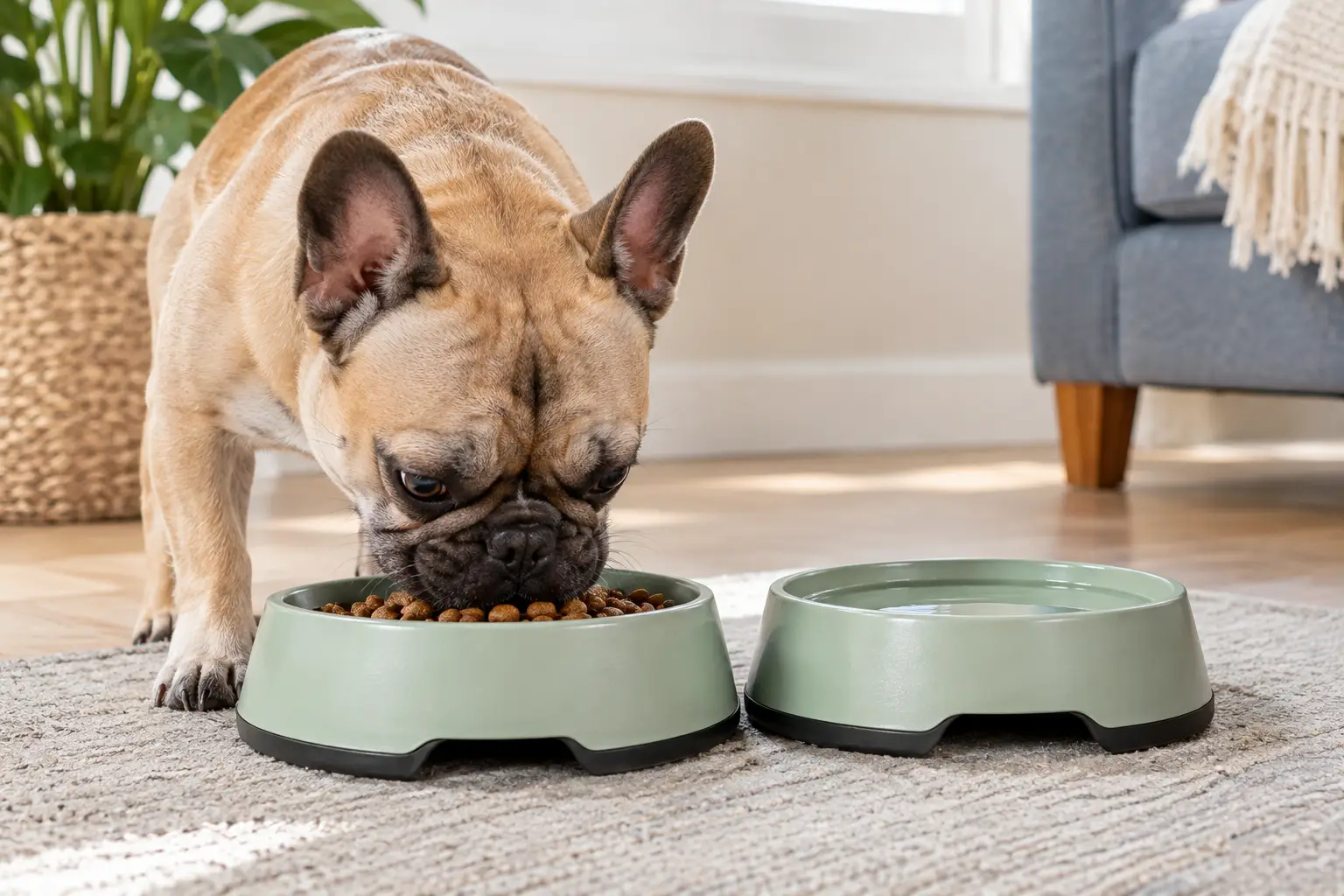
If you share your home with a Frenchie, pug, Boston terrier, Shih Tzu, or English bulldog, you already know the dinnertime soundtrack: snorting, snuffling, kibble skidding across the floor, and a nose pressed so deep into a regular bowl that breathing becomes an afterthought. A flat face dog bowl is designed to fix exactly that. Instead of forcing a short-snouted dog to dig, it tilts the food toward the dog so they can reach it without mashing their face into the dish.
That might sound like a small upgrade, but for flat-faced breeds it addresses a real anatomical limitation. According to the American College of Veterinary Surgeons, brachycephalic (“short-headed”) breeds are bred with shortened muzzles, which often leaves their throat and breathing passages undersized or flattened. When a dog with an already-narrow airway buries its nose in a deep bowl, it’s essentially trying to eat and breathe through the same crowded doorway.
Here’s the honest part, though: no bowl cures brachycephalic breathing problems, and marketing claims about “less gas” or “better digestion” are mostly manufacturer statements rather than settled science. What a well-designed bowl can do is make mealtime more comfortable, reduce mess, and cut down on the frustrated pushing and gulping that leads to messy floors and messy faces.
In this guide, you’ll find seven real flat face dog bowl options available on amazon.com, from budget-friendly stainless steel to elevated bamboo stations. Each one comes with honest analysis based on spec sheets and aggregated owner feedback, plus practical advice on choosing, switching, and maintaining the right bowl for your dog.
What Is a Flat Face Dog Bowl?
A flat face dog bowl is a feeding dish designed for brachycephalic breeds like pugs, French bulldogs, and Boston terriers. It’s usually tilted (often around 15 degrees), shallow, and wide, with a raised back or ridge that pushes food toward the front. This lets short-snouted dogs reach their food without pressing their nose into the bowl.
You’ll also see these sold as a tilted dog bowl, a slanted dog bowl for French bulldog owners, or a bowl for brachycephalic dogs. They come in three main styles:
- ✅ Floor-level slanted bowls with a built-in angle or ridge
- ✅ Bowls on a tilted stand, where a removable dish sits on an angled base
- ✅ Elevated tilted feeding stations, which add height and tilt together
The style you pick depends on your dog’s size, eating speed, and whether they have joint issues that make bending down uncomfortable.
Flat Face Dog Bowl Quick Comparison
| Product | Style | Material | Capacity Range | Price Range | Best for |
|---|---|---|---|---|---|
| Enhanced Pet Bowl | Floor slanted, raised ridge | Stainless steel + rubber base | 3 sizes (5–100 lb dogs) | Around $20–$35 | Best all-round pick |
| JWPC Bulldog Bowl | Tilted on rubber slope base | Rubber + removable bowl | 2 cups or 3.5 cups | Around $15–$25 | Bowl pushers |
| Leashboss Flat Face Feeder | Tilted slow feeder | Food-safe plastic | Up to 1.5 cups | Around $15–$25 | Fast eaters |
| Super Design 15° Slanted Bowl | Bowl on 15° stand | Melamine + stainless steel | 0.5 to 4 cups | Around $12–$35 | Budget + size choice |
| Nicelock Slanted Dog Bowl | Floor slanted, stepped interior | Stainless steel + silicone ring | ~1.5 to 3.8 cups | Around $12–$25 | Medium dogs, multi-pet homes |
| YMAXGO Ceramic Tilted Feeding Bowl | Elevated tilted | Ceramic + plastic bracket | Around 2 cups | Around $20–$35 | Seniors, style-conscious owners |
| SSAWcasa Elevated Tilted Feeding Station | Elevated double station | Bamboo + steel or ceramic | Two bowls | Around $25–$40 | Food + water in one spot |
Looking at the table above, the Enhanced Pet Bowl and Nicelock Slanted Dog Bowl cover the widest range of dog sizes, which matters if you own a heavier English bulldog rather than a 12-pound pug. If your dog inhales dinner in seconds, the Leashboss Flat Face Feeder is the only pick here that deliberately slows eating while staying flat-face friendly. Owners of senior dogs should look first at the elevated options, the YMAXGO Ceramic Tilted Feeding Bowl and SSAWcasa Elevated Tilted Feeding Station, which reduce how far a stiff neck has to bend.
💬 One click helps other shoppers make an informed choice too! 😊
Top 7 Flat Face Dog Bowls for 2026: Expert Analysis
1. Enhanced Pet Bowl — best overall for true flat faces
The Enhanced Pet Bowl is one of the few designs built from the ground up for flat-faced pets rather than adapted from a generic tilted dish. Its signature feature is a raised ridge at the back of an oversized stainless steel bowl, which the brand says is patented. In practice, that ridge acts like a backstop: kibble slides toward your dog’s mouth instead of retreating into a corner they can’t reach.
It comes in three sizes. The small is recommended for pets around 5–20 lb, and the large for dogs roughly 45–100 lb, so it genuinely covers everyone from a Pekingese to a hefty English bulldog. The rubber base adds grip on tile and hardwood.
Based on comparing the specs, this bowl suits owners who want a simple, floor-level solution without stands or assembly. Stainless steel is also the easiest material to keep hygienic, which matters for breeds prone to skin-fold irritation around the face. The brand references clinical trials at a California animal hospital; treat that as a manufacturer claim rather than independent research.
Across roundups and owner reports, it’s consistently one of the most recommended bowls in flat-faced breed communities, and reviewers frequently praise the build quality of the steel.
Pros:
- ✅ Raised ridge purpose-built for short-snouted dogs
- ✅ Three sizes cover small through large breeds
- ✅ Stainless steel is easy to sanitize
Cons:
- ❌ No height, so not ideal for stiff senior necks
- ❌ Sizing guide must be read carefully before ordering
At the time of writing, it typically runs around $20–$35 depending on size, which is strong value for a bowl that should last years.
2. JWPC Bulldog Bowl — best grip for bowl pushers
The JWPC Bulldog Bowl targets the classic bulldog habit of shoving the dish across the kitchen. It pairs a tilted bowl with a detachable rubber slope base, and that base is the real selling point: heavy, grippy rubber resists sliding far better than a lightweight plastic stand.
It comes in a 2-cup version for small to medium dogs and a 3.5-cup version for medium to large dogs. The sloped base angles the bowl toward your dog, so a pug or Frenchie can reach food without pressing in, and the detachable design means you can wash the bowl separately.
Here’s what to weigh: rubber grips beautifully but can attract hair and dust, and a determined chewer may treat it as a toy. If your dog is a chewer, supervise early meals. For pushers who aren’t chewers, though, this is one of the most practical designs in the category.
At the time of writing, the larger 3.5-cup listing showed an average rating of around 4.4 out of 5 stars from several thousand ratings on amazon.com. Reviews consistently highlight how well it stays put, while some owners note the rubber holds onto pet hair.
Pros:
- ✅ Heavy rubber base resists sliding and tipping
- ✅ Two capacities suit small and larger flat-faced breeds
- ✅ Detachable design simplifies cleaning
Cons:
- ❌ Rubber can collect pet hair and dust
- ❌ Not ideal for dogs that chew their gear
Usually priced around $15–$25, it’s a sensible mid-budget pick for dogs who treat dinner like a hockey game.
3. Leashboss Flat Face Feeder — the slow feeder that doesn’t squash snouts
The Leashboss Flat Face Feeder solves a problem most slow feeders create. Standard maze bowls have deep, narrow channels that a pug or Frenchie simply can’t reach into. This patented design instead uses a gentle incline with wide, shallow, rounded channels.
It holds up to 1.5 cups of food, and the 8-inch model (FFACE-BLUE-8IN) is listed as suitable for French bulldogs, pugs, Boston terriers, Pekingese, Shih Tzus, and boxers. In plain terms, your dog still gets the “puzzle” effect that forces smaller bites, but the channels are shaped for a short face rather than a long snout.
Why does this matter? Many flat-faced dogs gulp, and gulping plus a compromised airway is a recipe for coughing, gagging, and regurgitation. Slowing the pace is one of the few changes owners can make that may genuinely help mealtime comfort. Ask your vet if regurgitation is frequent, since that can signal something more serious.
Notably, the manufacturer itself warns that bowl flippers may not be a good fit because of its shape. That kind of honest disclosure is rare. Owner feedback generally praises the slower eating pace, with the flip-risk caveat as the recurring complaint.
Pros:
- ✅ Slow-feed channels shaped for short snouts
- ✅ Gentle incline keeps food reachable
- ✅ Holds a generous 1.5 cups
Cons:
- ❌ Can be flipped by enthusiastic eaters
- ❌ Channels take more effort to clean
Expect around $15–$25 at the time of writing, a fair price for a specialty slow feeder.
4. Super Design 15° Slanted Bowl — most size options on a budget
The Super Design 15° Slanted Bowl wins on flexibility. It’s a removable stainless steel bowl seated in a melamine stand angled at 15 degrees, which concentrates kibble at the low end so your dog isn’t chasing the last few pieces.
The size range is unusually wide: S/0.5 cup, M/1 cup, M/1.5 cup, L/2 cup, L/3 cup, and XL/4 cup. The smallest is aimed at pets under about 6.6 lb, so it can work for toy breeds like a tiny Shih Tzu or Japanese Chin. Both the melamine stand and the steel bowl are listed as dishwasher safe, which is a real convenience if you’re following daily washing guidance.
On paper, this is the most budget-friendly entry point to a tilted dog bowl, and the stand gives a slight lift without being a full elevated feeder. That makes it a nice middle ground for young, healthy dogs.
Reviews consistently praise the stability and easy cleaning. A common complaint, though, is that the smallest sizes hold less than buyers expect, with at least one reviewer noting the small bowl held only about a quarter cup in practice. Check your dog’s portion before picking a size.
Pros:
- ✅ Six sizes from tiny to large breeds
- ✅ Both stand and bowl are dishwasher safe
- ✅ Removable steel insert stays hygienic
Cons:
- ❌ Small sizes may hold less than expected
- ❌ Melamine can chip if dropped
Prices range from around $12 for the smallest up to the low $30s for large marble-finish versions.
5. Nicelock Slanted Dog Bowl — smartest pick for medium-size bulldogs
The Nicelock Slanted Dog Bowl is a stainless steel slanted bowl with a removable, BPA-free silicone ring on the bottom to prevent sliding. Its interior uses a stepped, ladder-like design meant to slow how fast food slides down, which encourages more chewing.
Sizing is clear and broad: small for puppies up to about 20 lb, medium (2.5 cups) for dogs around 20–45 lb, and large (3.8 cups) for dogs roughly 45–70 lb. It’s also sold in 2-packs, so you can match food and water bowls.
Based on comparing specs, the medium size is a sweet spot for French bulldogs and Boston terriers, and the large suits many English bulldogs. The removable silicone ring is a quiet advantage: you can pull it off and wash it, rather than letting gunk build up under a glued-on rubber base.
We couldn’t verify a large body of detailed US reviews for every size, but roundup coverage and available owner feedback generally describe it as sturdy and stable, with the stepped interior seen as a mild slow-feed bonus.
Pros:
- ✅ Removable silicone ring is easy to clean
- ✅ Clear weight-based sizing up to 70 lb
- ✅ Stackable and available in value 2-packs
Cons:
- ❌ No elevation for dogs with joint stiffness
- ❌ Stepped interior is harder to wipe quickly
At around $12–$25 depending on size and pack, it’s one of the best values in this lineup.
6. YMAXGO Ceramic Tilted Feeding Bowl — gentle height for senior Frenchies
The YMAXGO Ceramic Tilted Feeding Bowl combines a glazed ceramic bowl with a plastic bracket that raises and angles it. The set includes non-slip mats, and the angled bowl is designed so food gathers at the bottom where a flat-faced dog can reach it.
Third-party coverage lists the set at roughly 7.9 x 7.9 x 7.7 inches with a capacity of about 2 cups. The ceramic bowl is described as microwave-friendly and dishwasher safe, and ceramic doesn’t rust or hold odors the way scratched plastic can.
What most buyers overlook with this model is weight and fragility. Ceramic adds heft, which helps stability, but it can crack if knocked over. Owner reviews repeatedly mention placing it in a low-traffic corner, and several Frenchie owners say the height feels just right for their dog. It’s an especially good fit for older dogs, since the lift reduces how far they need to bend.
Reviews consistently report that dogs adapt to it quickly and that it looks good on a kitchen floor. The fragility of ceramic is the most common caution.
Pros:
- ✅ Elevated and tilted for less neck strain
- ✅ Ceramic resists odors and rust
- ✅ Attractive enough to leave out in the kitchen
Cons:
- ❌ Ceramic can crack if kicked or dropped
- ❌ Best suited to small and medium dogs only
At the time of writing, it generally falls around $20–$35, reasonable for an elevated tilted setup.
7. SSAWcasa Elevated Tilted Feeding Station — food and water in one tidy spot
The SSAWcasa Elevated Tilted Feeding Station is a bamboo stand holding two removable bowls at a 15-degree angle. Assembly is tool-free: three bamboo boards and two wooden pegs slot together, no screws needed.
The listing (ASIN B09FTB2T19) measures about 16.7 x 7.1 x 7.7 inches and weighs roughly 2.1 lb, with stainless steel or ceramic bowls that are dishwasher safe. The brand pitches it for small and medium dogs and cats, specifically naming French bulldogs, pugs, and Boston terriers.
Here’s what to weigh: a double station keeps water and food together, which is convenient and tidy, but it means your dog’s water bowl is also tilted. For some flat-faced dogs that’s helpful; for others, a tilted water bowl holds less water and needs refilling more often. If your dog drinks heavily, plan on topping it off during the day.
Owner feedback generally praises the look and easy assembly. Bamboo is attractive but should be wiped dry rather than soaked, since prolonged moisture can affect wood finishes over time.
Pros:
- ✅ Two bowls on one stable bamboo stand
- ✅ Tool-free assembly in a few minutes
- ✅ Dishwasher-safe removable bowls
Cons:
- ❌ Tilted water bowl holds less water
- ❌ Bamboo stand needs hand cleaning only
Expect around $25–$40 at the time of writing, a fair price for a complete feeding station.
✨ Don’t miss these vet-friendly mealtime upgrades!
🔍 Take your flat-faced pup’s dinner routine to the next level with this carefully curated lineup. Click a highlighted bowl to check current pricing and availability. These picks will help you get calmer, cleaner, snort-free mealtimes the whole family will enjoy! 🐶
Side-by-Side: Features That Separate the Top 7
| Product | Tilt Style | Elevated? | Slow-Feed Effect | Dishwasher Safe | Best for |
|---|---|---|---|---|---|
| Enhanced Pet Bowl | Raised back ridge | No | Mild | Bowl yes | Pugs to English bulldogs |
| JWPC Bulldog Bowl | Rubber slope base | Slightly | No | Bowl yes | Bowl pushers |
| Leashboss Flat Face Feeder | Gentle incline | No | Strong | Check listing | Gulpers |
| Super Design 15° Slanted Bowl | 15° stand | Slightly | No | Yes, both parts | Toy breeds, budget buyers |
| Nicelock Slanted Dog Bowl | Slanted + stepped | No | Mild | Yes | Medium breeds |
| YMAXGO Ceramic Tilted Feeding Bowl | Angled bracket | Yes | No | Bowl yes | Senior dogs |
| SSAWcasa Elevated Tilted Feeding Station | 15° bamboo stand | Yes | No | Bowls yes | Food + water combo |
The pattern here is clear: you’re mostly choosing between tilt alone, tilt plus height, or tilt plus slow feeding. Only the Leashboss Flat Face Feeder delivers a strong slow-feed effect, while the YMAXGO Ceramic Tilted Feeding Bowl and SSAWcasa Elevated Tilted Feeding Station are the only true elevated options. If you need all three features, you’ll likely end up pairing two products.
How to Switch Your Dog to a Tilted Dog Bowl: The First 30 Days
Most dogs adapt to a new bowl within days, but flat-faced breeds can be surprisingly suspicious of change. A smooth transition prevents skipped meals and stress.
Week 1: Introduce without pressure
Place the new flat face dog bowl next to the old one and put a few high-value treats in it. Let your dog investigate. Don’t remove the old bowl yet. If your dog eats from the new one voluntarily, praise calmly.
Week 2: Split meals
Serve half of each meal in the new bowl and half in the old. Watch how your dog eats from the angled dish. Are they reaching food easily? Is the bowl sliding? If it slides, put it on a rubber mat or switch to a heavier base.
Week 3: Full switch
Move all meals to the new bowl. Watch for coughing, gagging, or regurgitation, and note whether eating speed changes. A slower, calmer pace is a good sign.
Week 4: Fine-tune height and placement
If you’re using an elevated bowl, check posture. Your dog’s neck should stay comfortable, roughly level with or slightly below the shoulders, rather than stretched upward. Move fragile ceramic bowls out of walkways.
Common first-month mistakes:
- ❌ Switching cold turkey on a nervous dog
- ❌ Choosing a size that’s too small for the full portion
- ❌ Ignoring sliding, which teaches dogs to push and chase
- ❌ Forgetting to wash the new bowl after every meal
Stick with it for a full month before judging. Many owners who give up after two days would have seen the payoff by week three.
Real-World Scenarios: Matching the Right Bowl to Your Dog
Specs only go so far. Here’s how the lineup maps to real households.
Scenario 1: The apartment Frenchie who inhales dinner
You live in a city apartment with a 2-year-old, 24-lb French bulldog who finishes a cup of kibble in under a minute and sometimes coughs it back up. Your budget is under $30.
Best match: the Leashboss Flat Face Feeder. The wide, shallow channels slow eating without frustrating a short snout. Put it on a non-slip mat to reduce flipping risk. If your Frenchie is also a pusher, the JWPC Bulldog Bowl is the backup choice.
Scenario 2: The 10-year-old pug with stiff joints
Your senior pug weighs 16 lb, eats slowly, and seems reluctant to lower her head. You want something that looks nice in the kitchen and is easy to clean.
Best match: the YMAXGO Ceramic Tilted Feeding Bowl. The elevation reduces bending, the tilt keeps food reachable, and ceramic is easy to keep clean. Place it against a wall to avoid accidental kicks.
Scenario 3: A two-dog household with a big English bulldog
You have a 55-lb English bulldog and a 15-lb Boston terrier. You want matching bowls that are durable and dishwasher friendly, ideally in value packs.
Best match: the Nicelock Slanted Dog Bowl in large for the bulldog and small or medium for the Boston, or the Enhanced Pet Bowl in two sizes. Both are stainless steel and simple to wash daily.
The takeaway? Start with your dog’s biggest mealtime problem, whether that’s speed, posture, sliding, or size, and let that single priority choose the bowl.
Problem → Solution: Fixing Common Mealtime Headaches
Every flat-faced dog owner eventually runs into one of these. Here’s how to fix them.
Problem 1: Food ends up all over the floor. ✅ Solution: Your dog is probably pushing food to reach the last pieces. A raised ridge like the one on the Enhanced Pet Bowl keeps kibble at the front. Add a silicone feeding mat underneath for crumbs.
Problem 2: The bowl travels across the kitchen. ✅ Solution: Upgrade to a heavier base. The rubber slope base of the JWPC Bulldog Bowl or the removable silicone ring of the Nicelock Slanted Dog Bowl both help. Avoid placing bowls on slick tile without a mat.
Problem 3: Your dog gulps and then gags or regurgitates. ✅ Solution: Slow the pace with the Leashboss Flat Face Feeder, or split meals into smaller portions. If regurgitation keeps happening, see your vet. The University of Florida’s veterinary hospital notes that brachycephalic dogs may vomit or regurgitate because of breathing effort or reflux, so it’s worth ruling out underlying causes.
Problem 4: Your senior dog hesitates to eat. ✅ Solution: Try an elevated tilted dog bowl like the YMAXGO Ceramic Tilted Feeding Bowl or the SSAWcasa Elevated Tilted Feeding Station. Less bending may make meals more comfortable, though a vet should check any sudden appetite change.
Problem 5: Facial folds get irritated after meals. ✅ Solution: Use stainless steel or ceramic instead of scratched plastic, wash bowls after every meal, and gently wipe facial folds dry after eating.
How to Choose a Flat Face Dog Bowl
Choosing the right flat face dog bowl comes down to seven practical checks:
- Measure your dog’s weight and portion size. Capacity matters more than you think; a bowl that can’t hold a full meal invites spills.
- Pick the right tilt. Around 15 degrees is the most common angle for tilted stands, and it’s a sensible starting point for most flat-faced dogs.
- Decide whether you need height. Senior dogs and those with joint stiffness may benefit from elevation; young, healthy small dogs usually don’t need much.
- Choose a hygienic material. Stainless steel and glazed ceramic are easier to sanitize than plastic, which can scratch and trap bacteria.
- Check stability. Rubber bases, silicone rings, and weighted stands reduce sliding, which is a top complaint with flat-faced breeds.
- Consider eating speed. Gulpers may need a slow-feed design shaped specifically for short snouts.
- Confirm cleaning method. If you’ll rely on the dishwasher, make sure every part, not just the bowl, is listed as dishwasher safe.
Run through these in order, and most owners land on one or two clear candidates within minutes.
Tilted Dog Bowl vs. Standard Bowl: What Actually Changes
A standard round bowl assumes your dog has a muzzle long enough to reach the bottom while breathing comfortably. For a pug or Frenchie, that assumption breaks down. Here’s how the two compare.
| Factor | Standard Round Bowl | Flat Face Dog Bowl | Best for |
|---|---|---|---|
| Reaching last bites | Food scatters to edges | Food gathers at the front | Short-snouted dogs |
| Face pressure | Nose pushed into bowl | Less face contact | Brachycephalic breeds |
| Mess | Often pushed out | Reduced with ridge or tilt | Messy eaters |
| Price | Very low | Moderate | Budget vs. comfort |
The biggest functional difference is how the food behaves. In a standard bowl, kibble spreads outward as your dog pushes, so the last few pieces end up in the corners, just out of reach. A tilted or ridged bowl uses gravity to keep food where a short muzzle can get it.
That said, a standard bowl isn’t dangerous, and some flat-faced dogs eat from one without trouble. If your dog eats calmly, finishes meals, and doesn’t make a mess, a specialty bowl is a comfort upgrade rather than a necessity. But if you see frustration, snorting, pushing, or scattered food, the switch is one of the cheapest quality-of-life upgrades you can make. Cross-reference the problem-solution section above to match your dog’s specific frustration with the right design.
Slanted Dog Bowl for French Bulldog Owners: Specific Advice
French bulldogs are now among the most popular breeds in the US, and they have some particular mealtime needs worth calling out.
Size matters. Most adult Frenchies weigh around 20–28 lb, which puts them in “medium” territory for many bowl brands. The Nicelock Slanted Dog Bowl medium (rated for roughly 20–45 lb) or the JWPC Bulldog Bowl 2-cup are natural fits.
Watch the gulping. Many Frenchies are enthusiastic eaters. A slanted dog bowl for French bulldog owners should ideally slow eating as well as tilt, so the Leashboss Flat Face Feeder deserves a look.
Mind the airway. The Cornell University College of Veterinary Medicine explains that BOAS is often diagnosed between one and four years of age and that milder cases can have normal life expectancies. A comfortable bowl won’t treat that condition, but reducing mealtime struggle is a reasonable everyday support. If your Frenchie snores heavily, tires quickly, or gags often, a vet visit should come before any bowl purchase.
Keep it simple for puppies. Frenchie puppies grow fast, so a mid-size bowl with room to grow, or an inexpensive size you’ll replace later, makes more sense than buying a premium small bowl you’ll outgrow in months.
Elevated Tilted Dog Bowl: Height, Joints, and the Bloat Question
An elevated tilted dog bowl adds height to the tilt. That can help senior dogs and dogs with neck or front-leg discomfort, since they don’t have to lower their head as far. For older flat-faced dogs, many owners report that raised bowls make meals look noticeably more comfortable.
But there’s an important caveat that many listings skip. A widely cited Purdue University study published in 2000 found that raised feeders were associated with a higher risk of gastric dilatation-volvulus (bloat) in large and giant breeds. Most flat-faced breeds are small or medium and aren’t the high-risk population in that research, but owners of larger brachycephalic dogs, like boxers or Dogue de Bordeaux, should talk to their vet before choosing an elevated feeder.
Here’s a practical way to think about height:
- ✅ Small, healthy, young dogs: floor-level tilt is usually enough.
- ✅ Seniors or dogs with joint stiffness: modest elevation may help.
- ✅ Large or deep-chested breeds: ask your vet first.
Also, ignore marketing claims that a bowl “prevents bloat.” No bowl can promise that, and when a listing says it does, treat it as advertising rather than medical evidence. Elevation is a comfort choice, and the right answer depends on your individual dog.
Stainless Steel vs. Ceramic vs. Melamine vs. Rubber: Which Material Wins?
Material affects hygiene, durability, and how the bowl behaves on your floor.
Stainless steel is the hygiene champion. It’s non-porous, doesn’t hold odors, and survives the dishwasher indefinitely. Flat-faced breeds are prone to skin-fold irritation around the mouth, so a bowl that’s easy to sanitize is a real advantage. The Enhanced Pet Bowl, Nicelock Slanted Dog Bowl, and steel insert of the Super Design 15° Slanted Bowl all fall here.
Ceramic looks great and is heavy enough to stay put, but it can chip or crack. A chipped glaze can harbor bacteria, so replace a damaged ceramic bowl rather than continuing to use it. The YMAXGO Ceramic Tilted Feeding Bowl is the main example.
Melamine is a tough, lightweight plastic often used for stands. It’s fine for the base, but you generally want the food to touch steel or ceramic. Check the manufacturer’s care instructions for heat limits.
Rubber grips well and absorbs noise. It’s excellent for bases, as on the JWPC Bulldog Bowl, though it can collect hair and isn’t ideal for chewers.
Bamboo looks warm and natural, but it should be wiped down rather than soaked.
The best setup for most flat-faced dogs is a stainless steel or ceramic eating surface on a grippy, stable base.
Long-Term Cost and Maintenance
Flat-faced dog bowls are inexpensive compared with most pet gear, but the long-term costs vary by material.
| Product | Upfront Price Range | Expected Lifespan | Ongoing Costs | Best for |
|---|---|---|---|---|
| Enhanced Pet Bowl | Around $20–$35 | Many years | Minimal | Buy-once owners |
| Nicelock Slanted Dog Bowl | Around $12–$25 | Many years | Replacement ring if lost | Value seekers |
| Super Design 15° Slanted Bowl | Around $12–$35 | Years (stand may chip) | Possible stand replacement | Budget buyers |
| YMAXGO Ceramic Tilted Feeding Bowl | Around $20–$35 | Until it cracks | Replacement if broken | Careful households |
Stainless steel offers the lowest cost of ownership because it practically never wears out. A steel flat face dog bowl at around $25 that lasts many years beats a cheaper plastic one replaced every year or two once scratches build up. Ceramic is the wild card: it lasts indefinitely if it’s never dropped, but one bad bump ends its life.
Maintenance schedule that keeps bowls safe:
- ✅ After every meal: wash food bowls with hot, soapy water or run them through the dishwasher.
- ✅ Daily: wash water bowls and refill with fresh water.
- ✅ Weekly: remove rubber rings and bases and scrub underneath.
- ✅ Monthly: inspect for chips, cracks, or deep scratches.
That routine follows the FDA’s tips for safe handling of pet food and treats, which recommend washing pet food bowls with soap and hot water after each use and washing your hands before and after handling pet food. It sounds like a lot, but with a dishwasher-safe bowl it takes seconds.
Common Mistakes to Avoid When Buying a Flat Face Dog Bowl
Even with a good shortlist, a few avoidable mistakes trip up buyers.
Buying by breed name instead of weight. Listings often say “for French bulldogs,” but Frenchies vary widely in size. Always check the capacity and weight range against your own dog.
Assuming more tilt is better. Steeper isn’t automatically better. Too much angle can make food slide out or leave water bowls holding very little. Around 15 degrees is the common, sensible default.
Ignoring the base. A great tilt on a sliding bowl just creates a chase game. Stability is as important as angle.
Believing medical claims. “Reduces gas,” “prevents bloat,” and “improves digestion” are common marketing lines. Some may help some dogs, but they aren’t guarantees, and none replace veterinary care.
Choosing plastic for the eating surface. Scratched plastic can trap bacteria near a face that already has skin folds prone to irritation.
Overlooking cleaning. If a bowl is a pain to clean, you’ll clean it less often. Pick something you’ll realistically wash after every meal.
Skipping the vet. If your dog regularly gags, regurgitates, or struggles to breathe while eating, a bowl is not the solution. It’s a signal to book an appointment.
FAQs
❓ What is the best flat face dog bowl for a pug?
❓ Are tilted dog bowls good for French bulldogs?
❓ Should a flat face dog bowl be elevated?
❓ What angle should a tilted dog bowl be?
❓ Can I use a flat face dog bowl for water too?
Conclusion
A flat face dog bowl won’t change your dog’s anatomy, but it can make one of the most frequent parts of their day noticeably easier. For short-snouted breeds, the simple act of tilting food toward the mouth means less face-pressing, less pushing, and often a calmer, cleaner meal.
If you want one bowl that suits most flat-faced dogs, the Enhanced Pet Bowl is the most purpose-built option, with a ridge designed specifically for short faces and sizes up to large breeds. For gulpers, the Leashboss Flat Face Feeder is the standout. Budget buyers and toy-breed owners will appreciate the size range of the Super Design 15° Slanted Bowl, while the Nicelock Slanted Dog Bowl offers excellent value for medium bulldogs. Senior dogs may be happiest with the elevation of the YMAXGO Ceramic Tilted Feeding Bowl or the SSAWcasa Elevated Tilted Feeding Station, and pushers will appreciate the grip of the JWPC Bulldog Bowl.
Whatever you choose, remember the basics: match the bowl to your dog’s weight, keep it stable, wash it after every meal, and treat persistent gagging or regurgitation as a reason to see your vet rather than a reason to buy another bowl.
🐾 Ready to upgrade your dog’s dinner routine?
👉 Pick the bowl that matches your dog’s biggest mealtime struggle and click a highlighted product to check current pricing and availability. A calmer, cleaner, snort-free mealtime is just one small upgrade away! ✨
Recommended for You
- Farm Animal Feeder Guide 2026: 7 Best Picks That Stop Waste
- Facial Recognition Cat Feeder: 7 Best Picks to Stop Food Theft 2026
- Automatic Feeder for Multiple Cats: 7 Proven Picks (2026 Guide)
Disclaimer: This post contains affiliate links. As an Amazon Associate, I earn from qualifying purchases made through these links, at no additional cost to you.
✨ Found this article helpful? Share it with someone who needs it! 💬🤗