In This Article
Why a Slow Dog Feeder Insert Is the Easiest Fix for a Gulper
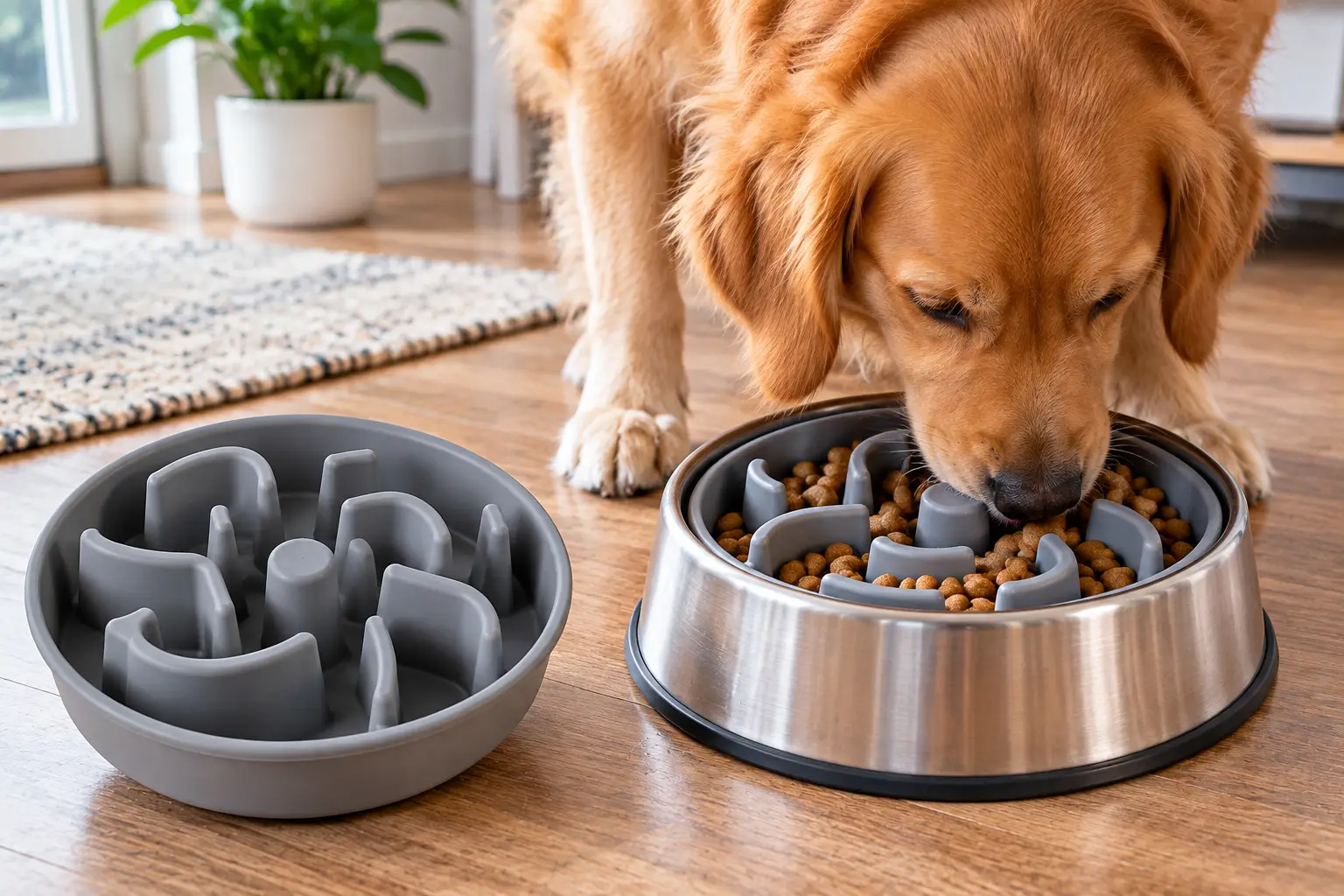
You pour the kibble, turn around to put the bag away, and by the time you turn back, the bowl is licked clean. Sound familiar? A slow dog feeder insert is one of the cheapest, least disruptive ways to change that. Instead of buying a whole new bowl, you drop a ridged or spiraled silicone (or plastic) piece into the bowl your dog already uses, and suddenly every bite takes a little work.
What Is a Slow Dog Feeder Insert?
A slow dog feeder insert is a removable obstacle, usually a spiral, maze, or set of soft fins, that sits inside an existing food bowl. It breaks a meal into small pockets your dog has to work around, which stretches mealtime from seconds to minutes and reduces the amount of air swallowed with each mouthful.
Why does that matter? The American Kennel Club points out that dogs who eat too quickly gulp excess air along with their food, which can lead to vomiting, discomfort, and an increased chance of bloat. Slowing down is one of the few eating habits you can actually change at home.
The beauty of the insert format is flexibility. If you love your stainless steel bowl, your ceramic dish, or the raised feeder that matches your kitchen, a slow dog feeder insert lets you keep it. If your dog decides the insert is too hard, you pop it out in five seconds. And because most inserts are flexible silicone, they’re gentler on noses than the hard plastic mazes many owners tried first.
In this guide, you’ll find seven real inserts available on amazon.com, an honest breakdown of what each one does well (and where it falls short), plus practical setup tips, troubleshooting, and the safety context most listings leave out. No invented reviews, no fake “I tested it” stories, just a straight analysis of specs and real customer sentiment.
Quick Comparison: The 7 Best Slow Dog Feeder Insert Picks at a Glance
| Product | Design | Material | Best for | Typical price range |
|---|---|---|---|---|
| Mighty Paw Spiral Slow Feeder Insert | Spiral with 6 floppy fins | Silicone | Mighty Paw Spiral Slow Feeder Insert: wide or sensitive noses, wet food | $15–$25 |
| Mighty Paw Slow Feed Dog Bowl Insert | Maze with varied ridge heights | Silicone | Mighty Paw Slow Feed Dog Bowl Insert: 7″ bowls, 3-cup meals | $10–$20 |
| OurPets Spiral Slow Feeder Insert | Spiral | Silicone | OurPets Spiral Slow Feeder Insert: 4–11 cup bowls | $10–$20 |
| Anipaw Spiral Slow Feeder Insert | Spiral, 36 suction cups | Silicone | Anipaw Spiral Slow Feeder Insert: dogs that pull inserts out | $10–$20 |
| Leashboss Slow Feed Bowl Insert | Raised-tunnel maze with lip | Food-safe plastic | Leashboss Slow Feed Bowl Insert: raised feeder stands | $15–$25 |
| Animire Silicone Slow Feeder Insert | Ridged maze | Silicone | Animire Silicone Slow Feeder Insert: mixed bowl materials | $10–$20 |
| Bestalk Silicone Slow Feeder Insert | Ridged pattern with suction cups | Silicone | Bestalk Silicone Slow Feeder Insert: tight budgets | $10–$15 |
Looking at the table, the split is really about where your dog eats and how your dog eats. Floor-bowl owners with an aggressive gulper should look hard at the Anipaw Spiral Slow Feeder Insert or the Mighty Paw Slow Feed Dog Bowl Insert, while anyone with an elevated stand is better served by the Leashboss Slow Feed Bowl Insert, which is built to drop into feeder holes. Dogs with flat or wide muzzles tend to do better with the soft fins of the Mighty Paw Spiral Slow Feeder Insert.
💬 One click helps other shoppers make an informed choice too! 😊
Top 7 Slow Dog Feeder Insert Options: Expert Analysis
1. Mighty Paw Spiral Slow Feeder Insert — gentlest on wide noses
The Mighty Paw Spiral Slow Feeder Insert stands out because its obstacles move: instead of rigid walls, it uses six floppy silicone fins.
Those fins come in two textures, which means wet food, pumpkin, or yogurt smeared between them turns into a licking challenge rather than a single slurp. The base suctions to flat bowl bottoms, and the whole piece is dishwasher-safe. On paper, that combination makes it equal parts slow feeder and enrichment toy.
Based on the design, this is the insert to try first for dogs with broad or short muzzles. Rigid mazes can press against the sides of a wide nose; flexible fins bend instead of scraping. It’s also a smart pick for anxious dogs, since licking is a naturally calming behavior.
Reviews on the brand’s own storefront consistently report big jumps in meal duration and repeatedly praise the soft fins for not irritating sensitive noses. A common theme is that it fits both stainless and ceramic bowls well. We couldn’t verify a large, consistent Amazon review sample at the time of writing, so check the current listing.
Pros:
- ✅ Soft fins are kind to wide or sensitive muzzles
- ✅ Two textures make wet food a real challenge
- ✅ Top-rack dishwasher-safe for easy cleanup
Cons:
- ❌ Less effective with large dry kibble than a dense maze
- ❌ Suction needs a flat, smooth bowl bottom
Expect it in the $15–$25 range; for wet-food feeders and flat-faced breeds, the value is strong.
2. Mighty Paw Slow Feed Dog Bowl Insert — best for big kibble meals
The Mighty Paw Slow Feed Dog Bowl Insert takes the opposite approach: a dense maze built to slow down dry-food vacuums.
It’s designed for bowls around 7 inches in diameter, stands about 2 inches tall, and holds up to 3 cups of dry food. The raised ridges vary in height, which matters more than it sounds: uneven walls stop dogs from “learning” one sweeping tongue motion that clears every channel. A quick-pull paw tab lets you lift it out without touching slobbery silicone.
Here’s what most buyers overlook: this insert can also be used on its own as a standalone bowl. That gives you a backup if your favorite bowl is in the dishwasher, or a travel option for weekend trips. For medium and large dogs eating 2–3 cups per meal, the capacity is right where you need it.
Because it’s made of BPA-free silicone, it handles kibble, wet, or raw food. Customer feedback on retailer listings generally describes noticeably longer mealtimes, though very determined large dogs can still work through shallow channels faster than owners hope.
Pros:
- ✅ 3-cup capacity suits medium and large breeds
- ✅ Varied ridge heights resist “learned” shortcuts
- ✅ Works as a standalone bowl, too
Cons:
- ❌ Sized for roughly 7-inch bowls, so measure first
- ❌ Deep channels take more scrubbing after wet food
Usually priced between $10 and $20, it’s one of the best dollar-per-cup values in this lineup.
3. OurPets Spiral Slow Feeder Insert — widest bowl compatibility
The OurPets Spiral Slow Feeder Insert earns its spot by fitting an unusually broad range of bowls without fuss.
OurPets lists the ideal range as bowls from 4 cups up to 11 cups, and it’s positioned for stainless steel, ceramic, and even raised bowls. The spiral layout forces your dog to chase food along a curved path, which slows intake without making the puzzle confusing. The brand also pitches it as an alternative to a snuffle mat, which is fair: it adds a foraging element without the fabric that’s hard to sanitize.
Who’s it for? Households with more than one bowl size, or anyone who’s not sure which bowl they’ll keep using. If you have a 4-cup dish for a Beagle and an 8-cup dish for a Lab, one model can plausibly serve both. Based on the spec range, this is the safest “I don’t want to measure twice” choice.
We could not verify a large, consistent pool of Amazon reviews for this exact listing at the time of writing, so treat it as a solid spec-sheet pick from an established US pet brand rather than a crowd-proven bestseller. Check the live listing before ordering.
Pros:
- ✅ Fits a wide 4–11 cup bowl range
- ✅ Simple spiral is easy for beginners
- ✅ BPA-free silicone for everyday food contact
Cons:
- ❌ Simpler spiral may not challenge expert gulpers
- ❌ Limited verifiable review data at writing time
Typically found in the $10–$20 range, it’s a sensible value for multi-bowl homes.
4. Anipaw Spiral Slow Feeder Insert — strongest grip in the group
The Anipaw Spiral Slow Feeder Insert is built around one problem: dogs that grab the insert and drag it out of the bowl.
Its underside carries 36 octopus-style suction cups designed to grip glass, plastic, ceramic, and stainless bottoms, and the brand says you don’t need to wet it to install. Six tapered handles around the edge let you pull it free after meals, which solves the classic suction-cup dilemma of “it stays put, but now I can’t get it out.” It’s rated for bowls in the 4–11 cup range and is dishwasher-safe.
Based on the spec sheet, this is the pick for pushy, pawing eaters. More suction points spread the holding force, so a single tug on one edge is less likely to break the seal. The spiral itself is moderately challenging, enough for most dogs, not so hard that picky eaters walk away.
One honest caveat from the brand itself: it’s not a chew toy. Strong chewers should be supervised, and any insert showing tooth marks should be replaced. We couldn’t confirm a large verified Amazon review base, so check current listing feedback.
Pros:
- ✅ 36 suction cups resist pulling and pawing
- ✅ Tapered handles make removal easy
- ✅ Fits common 4–11 cup bowls
Cons:
- ❌ Not safe for unsupervised power chewers
- ❌ Suction cups trap residue if not cleaned well
Usually sits between $10 and $20, a strong value if your dog is an insert thief.
5. Leashboss Slow Feed Bowl Insert — made for raised feeder stands
The Leashboss Slow Feed Bowl Insert is the only hard-plastic option here, and it exists for a very specific job: replacing the bowl in an elevated feeder.
It has a lip that hangs in a feeder hole, with sizes including a 1.5-cup version for 6–6.25 inch openings, a 2-cup version for 7.5–8 inch openings, and a 4-cup model. Leashboss lists compatibility with large stands from brands like Pet Zone, PetFusion, Neater Feeder, and IRIS. The plastic is BPA-, PVC-, and phthalate-free and top-rack dishwasher-safe, and the company backs it with a five-year warranty.
Here’s what to weigh: because it’s a full bowl rather than a flexible mat, it can’t adapt to odd shapes, so measuring your feeder hole is non-negotiable. Leashboss itself says it’s not recommended for bowl-flipping dogs and suggests supervising strong chewers because of the lip.
Retailer reviews are genuinely mixed. Many owners report it slows their dogs and works well with dry food, while a minority say their dog was barely slowed, and some found the tunnels hard to clean without a brush.
Pros:
- ✅ Drops straight into standard raised feeder holes
- ✅ Five-year warranty from a US-based brand
- ✅ Rigid tunnels hold their shape for years
Cons:
- ❌ Must match your feeder hole size exactly
- ❌ Tunnels need a brush for thorough cleaning
Expect roughly $15–$25; for elevated-feeder owners, it’s the most purpose-built value here.
6. Animire Silicone Slow Feeder Insert — easiest to keep clean
The Animire Silicone Slow Feeder Insert focuses on comfort and cleanup more than raw difficulty.
Its raised ridges and maze-like patterns slow intake, while the soft silicone is marketed as gentle on noses and skin. Animire says it works with plastic, ceramic, stainless, and glass bowls, in both regular and elevated setups. The smooth, non-stick surface is the practical highlight: wet food rinses off more easily than from textured or porous materials.
Based on comparing the specs, this is a good fit for owners who feed wet or mixed diets and hate scrubbing. It’s also a reasonable “first slow feeder” for a dog who’s never used one, because the maze is approachable rather than punishing. If your dog quits on harder puzzles, a moderate design like this keeps them eating.
Honest note: we couldn’t verify a substantial, consistent body of Amazon customer reviews for this listing at the time of writing, and some international listings note specs and packaging may vary. Read the current Amazon page carefully for dimensions before buying, and confirm it matches your bowl’s floor diameter.
Pros:
- ✅ Smooth surface releases wet food easily
- ✅ Approachable maze suits first-time users
- ✅ Works in regular and elevated bowls
Cons:
- ❌ May not slow very determined large-breed gulpers
- ❌ Limited verifiable review data at writing time
Often found around $10–$20, it’s a fair value for wet-food households.
7. Bestalk Silicone Slow Feeder Insert — lowest-cost way to start
The Bestalk Silicone Slow Feeder Insert is the budget entry, and sometimes budget is exactly the point.
It’s a soft silicone insert with suction cups, sold for small, medium, and large dogs and marketed to fit both basic bowls and elevated bowls. After meals, it lifts out for separate cleaning, which is more hygienic than leaving food film trapped between insert and bowl. The concept is simple: ridges break up the food bed, and suction keeps it in place.
Who should buy it? Owners who aren’t sure their dog will accept a slow feeder at all. Spending less on the experiment lowers the stakes, and if your dog takes to it, you can always upgrade to a model with stronger suction or a more complex pattern later. Based on the listing, it’s also a reasonable spare for a second feeding station.
Review data is thin: the listing we checked showed a positive rating but a small sample, so we can’t speak to long-term durability with confidence. Treat it as a low-risk trial rather than a proven long-term workhorse.
Pros:
- ✅ Lowest entry cost in this lineup
- ✅ Suction base for floor or elevated bowls
- ✅ Lifts out for separate washing
Cons:
- ❌ Durability data is limited
- ❌ Simpler pattern challenges fast eaters less
Usually priced in the $10–$15 range, it’s the best value for testing the waters.
✨ Don’t miss these smart mealtime upgrades!
🔍 Take your dog’s feeding routine to the next level with this carefully curated lineup. Click a highlighted item to check current pricing and availability. These picks will help you turn rushed gulping into calmer, healthier meals your whole family will notice!
Spec-by-Spec: How the 7 Inserts Really Compare
| Product | Grip method | Removal aid | Raised-feeder friendly | Difficulty | Best for |
|---|---|---|---|---|---|
| Mighty Paw Spiral Slow Feeder Insert | Suction base | — | With flat-bottom bowl | Moderate (licking) | Mighty Paw Spiral Slow Feeder Insert: wet food, flat faces |
| Mighty Paw Slow Feed Dog Bowl Insert | Fits 7″ bowls | Paw pull tab | With 7″ bowl | High (maze) | Mighty Paw Slow Feed Dog Bowl Insert: big kibble meals |
| OurPets Spiral Slow Feeder Insert | Fit + flexibility | — | Yes | Moderate | OurPets Spiral Slow Feeder Insert: multiple bowl sizes |
| Anipaw Spiral Slow Feeder Insert | 36 suction cups | 6 tapered handles | Yes | Moderate | Anipaw Spiral Slow Feeder Insert: insert-pullers |
| Leashboss Slow Feed Bowl Insert | Lip + non-slip grip | — | Built for it | High (tunnels) | Leashboss Slow Feed Bowl Insert: elevated stands |
| Animire Silicone Slow Feeder Insert | Fit + flexibility | — | Yes | Low–moderate | Animire Silicone Slow Feeder Insert: easy cleanup |
| Bestalk Silicone Slow Feeder Insert | Suction cups | — | Yes | Low–moderate | Bestalk Silicone Slow Feeder Insert: budget trials |
The pattern here is a trade-off between grip, difficulty, and cleanability. The Mighty Paw Slow Feed Dog Bowl Insert and the Leashboss Slow Feed Bowl Insert offer the most resistance, but their deeper channels take longer to clean. The Anipaw Spiral Slow Feeder Insert wins on staying power, while the Animire Silicone Slow Feeder Insert and Bestalk Silicone Slow Feeder Insert prioritize ease over challenge.
Getting Started: How to Install a Slow Feeder Insert for Dog Bowl Setups
A slow feeder insert for dog bowl use only works if it stays put and your dog actually accepts it. A few minutes of setup makes a big difference.
Day 1: Install it right.
- Wash both the bowl and the insert in hot, soapy water. Oil from old food is the number one reason suction fails.
- Dry the bowl completely. Some brands, like Anipaw, say no water is needed; others suggest a light rinse of the cups. Follow the listing.
- Press from the center outward, pushing out air bubbles, then tug one edge to test the seal.
Days 1–7: Introduce it gradually.
- ✅ Start with the insert holding only part of the meal, and scatter a few high-value treats in the easy outer channels.
- ✅ Stay nearby for the first several meals. Frustration (pawing, barking, walking away) means the puzzle is too hard for now.
- ✅ If your dog gives up, switch to a softer pattern rather than forcing it.
Weeks 2–4: Build the habit.
Once your dog finishes calmly, serve full meals in the insert. Time a few meals with your phone so you know whether it’s working. Going from under a minute to four or five minutes is a realistic, meaningful improvement for many dogs.
Common first-30-day mistakes:
- ❌ Putting it in a bowl with a curved or textured floor, so the suction never seals.
- ❌ Leaving wet food residue overnight, which breeds bacteria in the channels.
- ❌ Letting a chewer “play” with it unsupervised.
Maintenance schedule: wash after every wet-food meal, at least daily for dry food, and inspect weekly for tears, tooth marks, or cloudy, stiff silicone. Replace any insert with pieces missing immediately.
Real-World Scenarios: Matching the Right Insert to Your Dog
Specs only mean something when they meet a real dog. Here are three common profiles and the reasoning behind each match.
The 75-pound Lab who inhales 3 cups of kibble
Budget: moderate. Frequency: twice daily, every day. A Lab eating large dry meals needs capacity and real resistance. The Mighty Paw Slow Feed Dog Bowl Insert fits, with 3 cups of space and varied ridge heights that resist one-swipe clearing. If this dog eats from a raised stand, swap in the correctly sized Leashboss Slow Feed Bowl Insert instead, and measure the feeder hole before ordering.
The French Bulldog on a wet-food diet
Budget: flexible. Frequency: twice daily. Flat faces and rigid mazes don’t mix well; the walls press against the muzzle and dogs give up. The Mighty Paw Spiral Slow Feeder Insert makes more sense here because its fins bend, and its textured surfaces turn wet food into a lick-based challenge. Expect longer meals without the nose irritation some owners report with hard plastic.
The rescue mutt who drags everything out of the bowl
Budget: tight. Frequency: twice daily, plus a food-guarding history. This dog needs stability above all. The Anipaw Spiral Slow Feeder Insert‘s 36 suction cups give it the best chance of staying in place, and the tapered handles keep removal simple for you. If you’re unsure the dog will accept slow feeding at all, the Bestalk Silicone Slow Feeder Insert is a cheaper trial before committing.
In every case, the rule is the same: match resistance to your dog’s skill level, and grip to your dog’s personality.
Problem → Solution: Fixing Common Slow Feeder Insert Headaches
Even the best slow dog feeder insert can run into trouble. Here are the issues owners mention most often and how to solve them.
Problem 1: The insert won’t stay stuck. Solution: Degrease the bowl with dish soap, dry it fully, and check that the bowl floor is flat. Curved or ridged bottoms simply won’t seal. If your dog still pries it loose, move to a model with more suction points, like the Anipaw Spiral Slow Feeder Insert.
Problem 2: My dog still eats too fast. Solution: Your dog has likely mastered the pattern. Try a denser maze such as the Mighty Paw Slow Feed Dog Bowl Insert, split meals into two or three smaller portions, or rotate between two different inserts so the puzzle stays fresh.
Problem 3: My dog won’t eat from it. Solution: Make it easier, not harder. Put most of the food on the outer edge, add a few tasty toppers, and choose a gentler design like the Animire Silicone Slow Feeder Insert. Underweight or picky dogs should be monitored, because a puzzle that’s too hard can reduce intake.
Problem 4: Food gets stuck in the grooves. Solution: Soak the insert in warm, soapy water for 10 minutes before washing, use a bottle brush on deep channels (especially on the Leashboss Slow Feed Bowl Insert), and run silicone pieces through the top rack of the dishwasher if the listing allows.
Problem 5: My dog is chewing the insert. Solution: Remove it immediately after meals and supervise every session. Persistent chewing means a slow feeder insert may not be safe for that dog; a heavy stainless slow-feed bowl or hand-feeding during training can be better alternatives.
How to Choose a Slow Dog Feeder Insert
Picking the right slow dog feeder insert comes down to a few practical checks. Follow these in order:
- Measure the bowl floor, not the rim. Inserts sit on the bottom, so the flat interior diameter is the number that matters. A 9-inch rim can hide a 6-inch floor.
- Check the bowl’s bottom shape. Suction needs a flat, smooth surface. Hammered or domed bottoms won’t hold.
- Match capacity to meal size. A dog eating 3 cups per meal needs an insert that leaves room for 3 cups, like the 3-cup-rated maze from Mighty Paw.
- Match difficulty to your dog’s skill. First-timers do better with spirals; experienced gulpers need dense mazes with varied heights.
- Consider your dog’s face. Flat-faced and wide-muzzled dogs usually prefer flexible fins over rigid walls.
- Think about cleanup. Wet and raw feeders should favor smooth silicone that’s dishwasher-safe.
- Plan for chewing. If your dog chews everything, supervise meals or skip inserts entirely in favor of a sturdier bowl.
Get these seven right, and almost any insert on this list will perform the way it’s supposed to.
Slow Dog Feeder Insert vs. Dedicated Slow Feeder Bowl
Should you buy an insert or a whole new slow feeder bowl? Both work, but they solve slightly different problems.
| Factor | Slow dog feeder insert | Dedicated slow feeder bowl | Plain bowl + DIY trick (ball in bowl) |
|---|---|---|---|
| Keeps your existing bowl | Yes | No | Yes |
| Typical cost | $10–$25 | $10–$40+ | Nearly free |
| Fits raised feeders | Often (check size) | Only if sized for it | Yes |
| Swappable difficulty | Easy, just change insert | Requires a new bowl | Limited |
| Choking/chewing risk | Low if supervised | Low | Depends on the object used |
| Best for | Owners who love their bowl | Starting from scratch | Short-term emergencies |
The table makes the case for inserts clear: they’re the most flexible option, especially if you’ve already invested in a nice stainless steel bowl or a raised feeder. A dedicated bowl can be simpler for someone starting from scratch, since you never have to worry about suction failing. The DIY “tennis ball in the bowl” trick works in a pinch, but it’s easy for a dog to nudge aside, and any object small enough to swallow is a real hazard.
There’s also an advantage most comparisons miss: with an insert, you can rotate difficulty. Keep a gentle spiral for busy mornings and a tougher maze for dinner. That rotation keeps meals mentally engaging, which is exactly what enrichment-focused trainers recommend for bored or anxious dogs.
Silicone Slow Feeder Insert vs. Hard Plastic: Features That Actually Matter
When shopping for a silicone slow feeder insert, it’s easy to get lost in marketing terms. Here’s what genuinely affects your dog’s experience, and what mostly doesn’t.
Features that actually matter:
- ✅ Food-grade, BPA-free material. You’re putting food on it twice a day; this is the baseline.
- ✅ Grip design. The number and quality of suction points determine whether the insert stays put for an enthusiastic eater.
- ✅ Removal aid. Tabs or handles, like those on Mighty Paw’s maze and the Anipaw spiral, save your fingers and your patience.
- ✅ Channel depth and variation. Mixed heights resist the “one sweep” technique that experienced dogs develop.
- ✅ Dishwasher compatibility. Daily washing is non-negotiable; easy washing is the difference between a habit and a hassle.
Features that matter less than advertised:
- ❌ “Slows eating 10x.” Results depend entirely on your dog and food type; treat multipliers as marketing.
- ❌ “Prevents bloat.” No insert can guarantee that (more on this below).
- ❌ Color options. Nice for matching your kitchen, irrelevant to performance.
Silicone versus hard plastic is mostly a comfort-versus-durability trade. Silicone flexes, so it’s gentler on noses and fits more bowl shapes; hard plastic, like the Leashboss Slow Feed Bowl Insert, holds sharp maze walls for years and drops neatly into feeder holes. If your dog has a sensitive or flat face, silicone usually wins. If you need a rigid, exact-fit bowl for a stand, plastic makes sense.
Slow Feeder Insert for Elevated Dog Bowl Setups
A slow feeder insert for elevated dog bowl stands is its own category, and it trips up a lot of buyers.
Raised feeders typically hold a bowl through a circular hole, so you have two paths. You can put a flexible silicone insert into the existing raised bowl, which works if that bowl has a flat floor (models like the OurPets Spiral Slow Feeder Insert, Animire Silicone Slow Feeder Insert, and Bestalk Silicone Slow Feeder Insert are marketed for this). Or you can replace the bowl entirely with a lipped maze like the Leashboss Slow Feed Bowl Insert, which hangs directly in the feeder hole.
Measure the hole’s inner diameter carefully. Leashboss sizes include 6–6.25 inch and 7.5–8 inch openings, and a quarter inch off means a wobbly or unusable fit.
There’s also a health question worth knowing about. Elevated feeding is often recommended for large dogs or dogs with neck and joint issues, but veterinary literature has been mixed. Some practitioners list eating from a raised bowl among proposed bloat risk factors, while others consider the evidence inconclusive. If you own a large, deep-chested breed, talk to your veterinarian about whether raised feeding is right for your dog before adding a slow feeder to the stand. A slow feeder doesn’t make a raised bowl riskier, but it’s smart to make the height decision deliberately rather than by default.
Long-Term Cost and Maintenance of a Dog Bowl Slow Feeder Insert
A dog bowl slow feeder insert is a small purchase, but it’s worth thinking about over a full year of daily use.
| Product | Typical price range | Expected replacement trigger | Maintenance effort | Value verdict |
|---|---|---|---|---|
| Mighty Paw Spiral Slow Feeder Insert | $15–$25 | Torn fins or failing suction | Low | Strong for wet food |
| Mighty Paw Slow Feed Dog Bowl Insert | $10–$20 | Bite marks, residue buildup | Medium | Excellent per cup |
| Anipaw Spiral Slow Feeder Insert | $10–$20 | Damaged suction cups | Medium | Strong for pullers |
| Leashboss Slow Feed Bowl Insert | $15–$25 | Cracks (covered by warranty) | Medium–high | Best long-term rigid pick |
| Bestalk Silicone Slow Feeder Insert | $10–$15 | Wear or tears | Low | Best low-risk trial |
Over a year, the price difference between these inserts is small; what really drives cost is how often you replace them. The Leashboss Slow Feed Bowl Insert‘s five-year warranty makes its higher upfront range easier to justify, while silicone pieces like the Bestalk Silicone Slow Feeder Insert are cheap enough to replace when they wear. For most households, any of these costs less than a single vet visit for a vomiting episode.
Maintenance tips that extend life:
- Wash promptly; dried wet food is what stains silicone and clogs suction cups.
- Avoid harsh abrasive pads, which roughen silicone and give bacteria places to hide.
- Store silicone flat so the suction base doesn’t warp.
- Keep a second insert on hand, so one can dry fully while the other is in use.
Safety, Standards, and What Slow Feeders Can (and Can’t) Do About Bloat
Many listings claim their slow dog feeder insert “prevents bloat.” It’s worth understanding what the evidence actually says.
Bloat, or gastric dilatation-volvulus (GDV), is a life-threatening emergency in which the stomach fills with gas and can twist. Cornell University’s Riney Canine Health Center lists eating too quickly among several GDV risk factors, alongside a deep-chested build and exercising soon after meals. A frequently cited case-control study published in the Journal of the American Animal Hospital Association found that eating rapidly, eating one meal daily, and a fearful temperament were associated with higher GDV risk.
However, the evidence isn’t airtight. A 2016 review in Veterinary Evidence concluded that the research on eating speed is mixed and of variable quality, while noting that slowing eating won’t increase risk and may possibly reduce it. The honest takeaway: a slow feeder is a reasonable, low-cost risk-reduction step, not a guarantee.
On product safety standards: there’s no mandatory US certification specific to pet bowl inserts, so look for clear “food-grade” and “BPA-free” claims, and buy from brands that list materials plainly.
Know the emergency signs: a swollen belly, unproductive retching, restlessness, and pale gums mean an immediate trip to the emergency vet, no matter what bowl your dog eats from.
Common Mistakes to Avoid When Buying a Slow Dog Feeder Insert
A few predictable mistakes cause most of the “this didn’t work” stories.
Buying by rim size. The rim tells you nothing about the flat floor where the insert sits. Measure the bottom.
Ignoring the bowl’s floor texture. Hammered stainless, ridged ceramic, and domed bottoms can defeat even 36 suction cups.
Going too hard, too fast. A dense maze for a dog who’s never used a puzzle feeder can lead to frustration and skipped meals. Start moderate, then step up.
Choosing difficulty over face shape. A brachycephalic dog may struggle with rigid walls no matter how motivated it is. Flexible fins usually work better.
Forgetting the chewer factor. Silicone is not a chew toy. If your dog destroys everything, supervise meals or choose a sturdier solution.
Expecting a medical miracle. An insert slows eating; it doesn’t replace smaller, more frequent meals, calm feeding environments, or your vet’s advice for at-risk breeds.
Skipping the cleaning plan. If you don’t have time to wash an insert daily, buy two and rotate. A dirty insert is worse than none at all.
Avoid these, and your slow dog feeder insert will do exactly what it’s meant to do: turn a 30-second sprint into a calmer, healthier meal.
FAQ About Slow Dog Feeder Inserts
❓ Can I use a slow dog feeder insert with wet or raw food?
❓ Can I cut a silicone slow feeder insert to fit my bowl?
❓ How long should my dog take to eat with a slow feeder insert?
❓ Is a slow dog feeder insert safe for puppies?
❓ Can two dogs share a slow feeder insert?
Conclusion: Choosing the Right Slow Dog Feeder Insert for Your Dog
A slow dog feeder insert is one of those rare pet products that’s cheap, simple, and genuinely useful. It lets you keep the bowl you already like while turning a frantic gulp into a calmer, more engaging meal.
If you want the short version: choose the Mighty Paw Slow Feed Dog Bowl Insert for big kibble eaters, the Mighty Paw Spiral Slow Feeder Insert for flat faces and wet food, and the Anipaw Spiral Slow Feeder Insert for dogs who yank inserts out. Raised-feeder owners should measure carefully and look at the Leashboss Slow Feed Bowl Insert. If you need flexibility across several bowl sizes, the OurPets Spiral Slow Feeder Insert covers the widest range, while the Animire Silicone Slow Feeder Insert keeps cleanup easy and the Bestalk Silicone Slow Feeder Insert is the low-risk way to test the idea.
Whichever you pick, set it up properly, introduce it gradually, and keep it clean. And remember the bigger picture: slowing your dog down is one smart, evidence-supported step, but smaller meals, calm feeding spaces, and a conversation with your vet about your dog’s specific risk matter just as much.
Your dog may grumble at first. Give it a week. Most dogs come to treat the puzzle like part of the fun.
🐾 Ready to slow down mealtime for good?
🛒 Pick the insert that fits your dog’s bowl, face, and eating style, then click a highlighted product to check current pricing and availability. A few extra minutes per meal can make a real difference to your dog’s comfort!
Recommended for You
- Outdoor Dog Water: 7 Best Waterers That Actually Work in 2026
- Best Raised Dog Bowls 2026: 7 Smart Picks & 1 Crucial Warning
- Chip reader cat feeder 2026: 7 Proven Picks to End Food Theft
Disclaimer: This post contains affiliate links. As an Amazon Associate, I earn from qualifying purchases made through these links, at no additional cost to you.
✨ Found this article helpful? Share it with someone who needs it! 💬🤗