In This Article
Introduction: Why Your Dog’s Bowl Deserves a Rethink
You set the bowl down, turn around to grab a paper towel, and by the time you turn back, it’s empty. Licked clean. Possibly spun across the kitchen floor for good measure. If that sounds like dinnertime at your house, a slow feed dog dish is probably the cheapest, simplest upgrade you can make to your dog’s daily routine.
Speed-eating isn’t just a funny quirk. Dogs that inhale their kibble tend to swallow a lot of air along with it, and that’s linked to vomiting, regurgitation, gas, and — in the worst case — a life-threatening emergency called bloat. The American Kennel Club explains that eating too fast may raise the risk of gastric dilatation-volvulus (GDV), the condition where the stomach expands and can twist inside the abdomen. A slow feeder dog bowl doesn’t make that risk disappear, but it directly targets one behavior you can actually control: how fast the food goes down.
The catch? Not all slow feeders are created equal. Some mazes are so shallow a determined Lab clears them in under a minute. Others are so aggressive that a flat-faced Frenchie gives up and walks away hungry. Material matters too: plastic, stainless steel, and ceramic each age, clean, and hold up differently.
This guide cuts through the marketing. We compared spec sheets, aggregated customer review themes from US retailers, and veterinary guidance to rank seven real products you can order on amazon.com in 2026 — from a sub-$10 bowl insert to a grass-style foraging feeder that turns dinner into a sniff-and-lick workout.
What Is a Slow Feed Dog Dish?
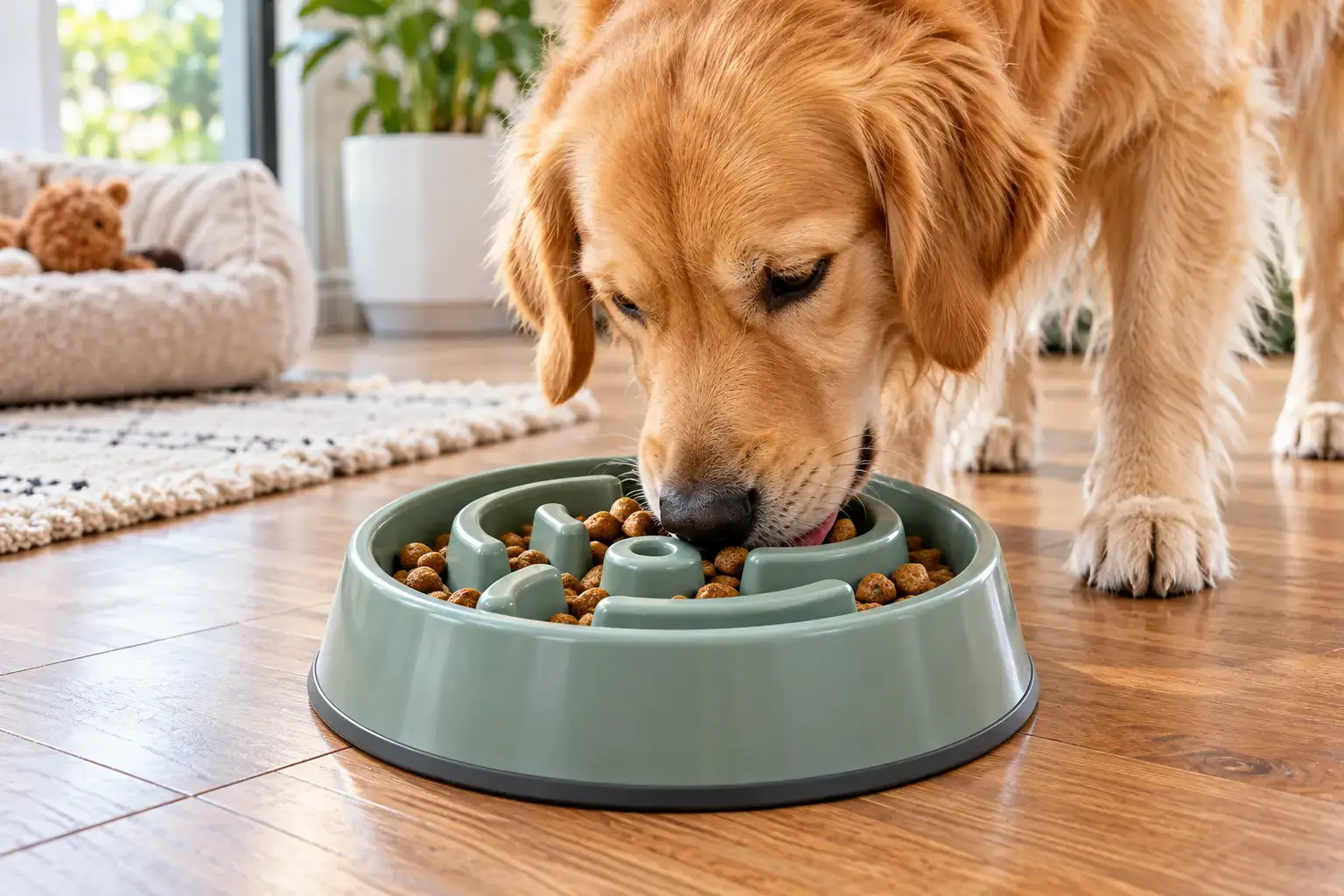
A slow feed dog dish is a food bowl built with ridges, mazes, posts, or raised obstacles that break your dog’s meal into small, hard-to-reach pockets. Instead of scooping huge mouthfuls, your dog has to nose, lick, and maneuver around each barrier, which stretches mealtime from seconds to several minutes and reduces swallowed air.
Slow Feed Dog Dish Quick Comparison
Short on time? Here’s the at-a-glance version before we dig into each pick.
| Product | Material | Difficulty | Price Range | Best For |
|---|---|---|---|---|
| Outward Hound Fun Feeder Slo Bowl | Food-safe plastic | Slow to Slowest (by pattern) | Under $20 | Outward Hound Fun Feeder Slo Bowl: most dogs, best all-rounder |
| Dogit Go Slow Anti-Gulping Dog Dish | Plastic | Mild | Under $15 | Dogit Go Slow Anti-Gulping Dog Dish: beginners, flat-faced dogs, water gulpers |
| JW Pet Skid Stop Slow Feed Bowl | Plastic + rubber base | Mild | Under $12 | JW Pet Skid Stop Slow Feed Bowl: tight budgets, bowl-pushers |
| Neater Pet Brands Stainless Steel Slow Feed Bowl | Stainless steel | Mild to moderate | Around $15–$30 | Neater Pet Brands Stainless Steel Slow Feed Bowl: hygiene-focused owners, elevated stands |
| LE TAUCI Ceramic Slow Feeder | Ceramic | Moderate | Around $20–$30 | LE TAUCI Ceramic Slow Feeder: small to medium dogs, style-conscious homes |
| Company of Animals Green Slow Interactive Feeder | Polypropylene | Hard | Around $25–$40 | Company of Animals Green Slow Interactive Feeder: extreme gulpers, enrichment |
| Loving Pets Gobble Stopper | BPA-free plastic insert | Mild to moderate | Under $12 | Loving Pets Gobble Stopper: converting a bowl you already own |
Looking at the table, the Outward Hound Fun Feeder Slo Bowl is the safest default because you can choose the difficulty level that matches your dog, while the Company of Animals Green Slow Interactive Feeder is the heavy artillery for dogs that defeat ordinary mazes. If your budget is the main constraint, the JW Pet Skid Stop Slow Feed Bowl and the Loving Pets Gobble Stopper deliver the core benefit for roughly the price of a fast-food lunch. Prices shift often, so check the current price before you buy.
💬 One click helps other shoppers make an informed choice too! 😊
Top 7 Slow Feed Dog Dish Picks for 2026: Expert Analysis
1. Outward Hound Fun Feeder Slo Bowl — the most adjustable all-rounder
What makes this one stand out is choice: you’re not buying one bowl, you’re picking from a family of maze patterns rated Slow, Slower, and Slowest. That matters because the right difficulty for a 12-pound Shih Tzu is useless against a 90-pound shepherd. Sizes run from an extra-small bowl that holds about 3/4 cup up to a large that the brand rates for up to 4 cups of kibble, and it works with wet, dry, or raw food. The non-slip base keeps it from skating across tile, and it’s top-rack dishwasher safe, which removes the biggest daily headache of maze bowls. The plastic is listed as BPA-, PVC-, and phthalate-free.
Based on comparing the specs, this is the right first slow feeder for most households: affordable enough to experiment with, and easy to “level up” by switching patterns if your dog cracks the code. The brand claims it can slow eating by up to 10x, but treat that as a best case — real results depend on your dog’s muzzle shape and determination.
Reviews consistently report a dramatic drop in gulping, especially with the Slowest patterns. A recurring complaint is capacity: some owners say a full 4 cups doesn’t fit comfortably once the ridges take up space.
Pros:
- ✅ Multiple difficulty levels to match your dog
- ✅ Top-rack dishwasher safe for easy cleanup
- ✅ Non-slip base reduces sliding and spills
Cons:
- ❌ Real capacity can feel smaller than advertised
- ❌ Plastic can scratch under heavy chewing
Typically under $20 depending on size — excellent value for a proven, flexible design.
2. Dogit Go Slow Anti-Gulping Dog Dish — gentlest entry into slow feeding
Instead of a complex maze, this dish uses a raised center post that forces your dog to eat around the edges in smaller bites. That simplicity is the point: it’s a mild challenge that won’t frustrate dogs who’ve never seen a slow feeder before. US retailers list sizes from about 1/2 cup up to 2.5 cups, and it’s dishwasher safe. Unusually, Dogit markets it for both food and water, which is handy for dogs that slurp water so fast they cough or vomit afterward.
Here’s what to weigh: the single-post design slows a moderate gulper but probably won’t hold back a truly obsessive eater, who can learn to circle the post at speed. Where it shines is with flat-faced breeds like Pugs and Boston Terriers, whose short muzzles struggle with deep, narrow mazes. It’s also a smart “transition bowl” before stepping up to something harder.
We couldn’t verify a large body of detailed US reviews for this exact model, so we won’t overstate the feedback. What’s consistent across retailer listings is its positioning as an easy-to-clean, low-cost starter bowl, and its capacity tops out lower than larger maze bowls.
Pros:
- ✅ Simple design suits beginners and short muzzles
- ✅ Doubles as a slow water bowl
- ✅ Dishwasher safe and easy to clean
Cons:
- ❌ Too easy for determined speed-eaters
- ❌ Limited capacity for large breeds
Usually under $15 — good value as a starter or water dish.
3. JW Pet Skid Stop Slow Feed Bowl — best bargain for bowl-pushers
If your dog treats mealtime like a hockey game, the thermoplastic rubber rim on the base is the reason to look here. It grips vinyl, tile, wood, and even carpet, so the bowl stays put while your dog works. Inside, large indentations spread kibble out so your dog has to move its snout around rather than shoveling. It’s made from stain-resistant, BPA-free plastic and is dishwasher safe.
On paper, this is the no-frills workhorse of the category. The indentation design is less challenging than a true maze, so expect a moderate slowdown rather than a dramatic one. That makes it a strong fit for budget-conscious owners, multi-dog homes that need several bowls, and dogs that eat fast but not dangerously so.
One honesty note on sizing: retailers list capacities inconsistently — some show a medium around 1 cup, others list medium, large, and jumbo sizes with much larger capacities. Check the cup capacity printed on the specific listing before ordering. Customer feedback at US retailers generally centers on the grippy base and the low price; we found few detailed long-term durability reports.
Pros:
- ✅ Rubber base genuinely resists sliding
- ✅ Very affordable, easy to buy in multiples
- ✅ BPA-free and dishwasher safe
Cons:
- ❌ Milder slowdown than true maze bowls
- ❌ Inconsistent size labeling across listings
Usually under $12 — hard to beat for value if your dog is a moderate gulper.
4. Neater Pet Brands Stainless Steel Slow Feed Bowl — the hygiene-first choice
This is for owners who want the cleanliness of stainless steel without giving up the slow-feeding benefit. The bowl uses a raised center with a paw-print design that your dog has to work around, and it comes in roughly 1-cup and 4-cup versions. A practical bonus: it’s shaped to fit most elevated feeder stands built for standard two-quart bowls, so you can drop it into a raised setup you already own.
Why does stainless matter? It doesn’t scratch the way plastic does, and fewer scratches mean fewer places for bacteria and food oils to hide. It also won’t crack if knocked off a counter, and it shrugs off dishwasher heat. The tradeoff is difficulty: a single raised center is less challenging than a multi-ridge maze, so this suits moderate eaters more than extreme gulpers.
Third-party roundups frequently place this bowl near the top of their lists for durability and ease of cleaning. Review themes we found are broadly positive about build quality; the main reservation is that very fast eaters may still outpace the relatively simple obstacle.
Pros:
- ✅ Stainless steel resists scratches and odors
- ✅ Fits many standard elevated feeder stands
- ✅ Durable enough to last for years
Cons:
- ❌ Simpler obstacle than plastic maze bowls
- ❌ Can be noisy on hard floors
Expect around $15–$30 depending on size — strong long-term value given its lifespan.
5. LE TAUCI Ceramic Slow Feeder — stylish and heavy enough to stay put
If plastic bowls clash with your kitchen and stainless feels clinical, this glazed ceramic maze bowl is the designer option. It holds about 1.5 cups, which places it squarely in small-to-medium dog territory, and it comes in several colors. The weight of ceramic is a quiet advantage: heavier bowls are harder for a dog to shove around, even without a rubber base.
What most buyers overlook is that ceramic is only as safe as its glaze. A smooth, intact glaze is non-porous and easy to clean, but a chipped or cracked ceramic bowl can trap bacteria and leave sharp edges, so inspect it regularly and retire it if it’s damaged. It’s also breakable — dropping it on tile is usually the end of the story.
Roundups that feature this bowl highlight its looks and its moderate maze difficulty. Some review summaries note that the pattern may be a little tricky for dogs that have never used a slow feeder, so very new users might start with an easier design first.
Pros:
- ✅ Attractive glazed finish in multiple colors
- ✅ Naturally heavy, resists sliding
- ✅ Non-porous surface when glaze is intact
Cons:
- ❌ Breakable if dropped on hard floors
- ❌ Capacity too small for large breeds
Typically around $20–$30 — fair value for small dogs in style-focused homes.
6. Company of Animals Green Slow Interactive Feeder — maximum slowdown for extreme gulpers
Forget mazes: this feeder looks like a tuft of artificial grass. You scatter kibble over the top, and your dog has to nose and lick it out from between dozens of rounded plastic “blades” — 43 on the regular model, 32 on the Mini. It’s made from phthalate-free polypropylene, works with wet or dry food, and is dishwasher safe. The regular version measures roughly 15.7 × 11.4 × 3.7 inches.
Based on comparing designs, this is the most demanding feeder in our lineup — and the most enriching. Because your dog has to forage rather than chase food around a channel, it doubles as mental exercise, which can help bored, high-energy dogs. It’s also a smart tool for dogs on a weight-loss plan, since a smaller portion takes longer to finish.
Reviews consistently describe big slowdowns; some owners report dogs going from eating in about a minute to taking five to ten minutes. The common complaints are cleaning (food gets stuck between blades, so many owners use a brush), dishwasher space, and kibble getting pushed onto the floor.
Pros:
- ✅ Most challenging design in this lineup
- ✅ Doubles as daily mental enrichment
- ✅ Works for wet and dry food
Cons:
- ❌ Fiddly to clean between the blades
- ❌ Kibble often scatters onto the floor
Usually around $25–$40 — premium price, but unmatched for serious gulpers.
7. Loving Pets Gobble Stopper — turns any bowl into a slow feeder
This is the clever outlier: not a bowl at all, but a canopy-shaped insert that sticks to the bottom of the bowl you already own with a suction cup. Your dog has to eat around and underneath it. It comes in three sizes — small for bowls under 6 inches across, medium for 6 to 8 inches, and large for 8 inches and up — and it’s made of BPA-free plastic and is top-rack dishwasher safe.
Here’s what to weigh: the insert is cheap, packs flat for travel, and lets you keep a bowl you like, whether that’s stainless, ceramic, or an elevated setup. But its effectiveness depends entirely on the suction seal. The brand’s “up to 500%” slowdown claim assumes the insert stays put — and that’s precisely where real-world results vary.
Customer feedback is mixed. The small batch of reviews we found at one US retailer included complaints that the suction cup wouldn’t stay attached to stainless steel and that a puppy pulled it out. Other sources note it grips best on smooth, flat-bottomed bowls such as ceramic. Clean, dry surfaces help the seal.
Pros:
- ✅ Works with a bowl you already own
- ✅ Very low cost and travel-friendly
- ✅ Dishwasher safe and easy to swap
Cons:
- ❌ Suction can fail on some stainless bowls
- ❌ Determined dogs may pull it loose
Usually under $12 — excellent value if your bowl has a smooth, flat bottom.
Top 7 Slow Feeders Side by Side
| Product | Capacity (approx.) | Dishwasher Safe | Non-Slip Feature | Review Sentiment | Best For |
|---|---|---|---|---|---|
| Outward Hound Fun Feeder Slo Bowl | 3/4 to 4 cups | Top rack | Non-slip base | Strongly positive; capacity complaints | Outward Hound Fun Feeder Slo Bowl: most dogs |
| Dogit Go Slow Anti-Gulping Dog Dish | 1/2 to 2.5 cups | Yes | Not a key feature | Limited verified data | Dogit Go Slow Anti-Gulping Dog Dish: starters, water |
| JW Pet Skid Stop Slow Feed Bowl | Varies by listing | Yes | Rubber rim base | Positive on grip and price | JW Pet Skid Stop Slow Feed Bowl: bowl-pushers |
| Neater Pet Brands Stainless Steel Slow Feed Bowl | ~1 or ~4 cups | Yes | Fits feeder stands | Positive on durability | Neater Pet Brands Stainless Steel Slow Feed Bowl: hygiene |
| LE TAUCI Ceramic Slow Feeder | ~1.5 cups | Check listing | Heavy ceramic weight | Positive on style | LE TAUCI Ceramic Slow Feeder: small dogs |
| Company of Animals Green Slow Interactive Feeder | Scatter-feed (full meal) | Yes | Wide, flat footprint | Strong slowdown; hard to clean | Company of Animals Green Slow Interactive Feeder: extreme gulpers |
| Loving Pets Gobble Stopper | Depends on your bowl | Top rack | Suction cup | Mixed; suction issues | Loving Pets Gobble Stopper: budget conversions |
Reading across the rows, there’s a clear tradeoff between difficulty and convenience: the harder a feeder is to beat, the harder it tends to be to clean. The Company of Animals Green Slow Interactive Feeder sits at the extreme of both, while the Neater Pet Brands Stainless Steel Slow Feed Bowl sits at the easy-clean, milder end. For most households, the Outward Hound Fun Feeder Slo Bowl lands in the sweet spot between the two.
Getting Started: Your First 30 Days With a Slow Feed Dog Dish
Buying the bowl is the easy part. Getting your dog to accept it — without frustration or a hunger strike — takes a little strategy.
Week 1: Make it a win. Start with an easier pattern or put only part of the meal in the new bowl, with the rest in the old one. Toss a few high-value treats into the grooves so your dog’s first experience is “jackpot,” not “puzzle from hell.” Stay nearby the first few meals and watch how your dog approaches it.
Week 2: Phase out the old bowl. Once your dog eats confidently, move the full meal into the slow feeder. Time a few meals. If your dog is still finishing in under a minute, the design is too easy; if they walk away with food left, it’s too hard.
Week 3: Adjust difficulty. This is where adjustable designs like the Outward Hound Fun Feeder Slo Bowl pay off — move up a level if needed. If you’re using the Loving Pets Gobble Stopper, check the suction seal every meal at this stage.
Week 4: Build a cleaning routine. Maze bowls trap residue, especially with wet food. Rinse right after meals before food dries in the ridges, and run a full wash daily. A bottle brush or old toothbrush is your best friend for deep grooves.
⚡ Common first-month mistakes: switching cold turkey with a very hard bowl, ignoring signs of frustration (pawing, flipping, barking), and letting wet food sit in crevices overnight. Also watch for broken teeth or chewing — a slow feeder is a feeding tool, not a chew toy, and you should always supervise early meals.
🐾 Ready to tame the gulp? Your dog’s calmer mealtime starts with one smart bowl!
🔍 Take your dog’s feeding routine to the next level with this carefully curated lineup. Click any highlighted product to check current pricing and availability. These picks will help you get slower, safer, more satisfying meals your whole family will enjoy watching!
Real-World Scenarios: Matching the Right Bowl to the Right Dog
Specs are abstract. Here’s how the picks map onto real households.
🐕 Scenario 1: The apartment-dwelling Frenchie owner. Your French Bulldog eats twice a day, about 3/4 cup per meal, and has a short, flat muzzle that struggles with deep mazes. Budget: under $20. The Dogit Go Slow Anti-Gulping Dog Dish is the logical start because its single center post is shallow enough for a short face. If that proves too easy, step up to an extra-small Outward Hound Fun Feeder Slo Bowl with a Slow-level pattern rather than jumping straight to the hardest design.
🐕🦺 Scenario 2: The Great Dane family. You have a giant, deep-chested breed eating 4+ cups a day split into two meals, and you’re worried about bloat. Budget is flexible. Combine strategies: the Company of Animals Green Slow Interactive Feeder for maximum slowdown, plus split meals and calm time after eating. If cleaning the grass-blade design becomes a chore, a large Outward Hound Fun Feeder Slo Bowl with a Slowest pattern is a practical backup. Most importantly, talk to your vet about bloat risk and whether a preventive procedure makes sense.
🐶 Scenario 3: The busy multi-dog household. Two medium mixed breeds, one of whom shoves bowls across the kitchen. You want something cheap, durable, and dishwasher-friendly in multiples. Two JW Pet Skid Stop Slow Feed Bowl units solve the pushing problem at minimal cost. If you already own matching stainless bowls, a pair of Loving Pets Gobble Stopper inserts can work — but test the suction on your specific bowls first.
The pattern across all three: match difficulty to muzzle shape and eating intensity first, then layer in material, budget, and cleaning tolerance.
Problem → Solution: Fixing the Most Common Slow Feeder Frustrations
Even the right bowl can hit snags. Here are the issues owners run into most, with fixes.
Problem 1: “My dog won’t eat from it.” Usually a sign the design is too hard too soon. Solution: drop to an easier pattern, mix in a few favorite treats, or try a gentler design like the Dogit Go Slow Anti-Gulping Dog Dish before working back up.
Problem 2: “The bowl travels across the floor.” Solution: choose a feeder with a rubber rim like the JW Pet Skid Stop Slow Feed Bowl, a heavier ceramic option like the LE TAUCI Ceramic Slow Feeder, or place any bowl on a silicone feeding mat with a raised lip.
Problem 3: “Food gets everywhere.” This is common with the Company of Animals Green Slow Interactive Feeder, since dogs push kibble out sideways. Solution: feed on a lipped mat or tray, or feed in an easy-to-sweep area.
Problem 4: “It smells, even after washing.” Scratched plastic and dried wet food are the usual culprits. Solution: wash promptly, scrub grooves with a brush, and replace plastic bowls once they’re heavily scratched or chewed. If hygiene is a top priority, consider the Neater Pet Brands Stainless Steel Slow Feed Bowl.
Problem 5: “My dog figured it out in a week.” Smart dogs learn patterns. Solution: step up a difficulty level, rotate between two different designs, or move to a foraging-style feeder for a fresh challenge.
How to Choose a Slow Feed Dog Dish
Follow these steps in order, and you’ll avoid most buying regrets:
- Time your dog’s current meals. If your dog finishes in under a minute, you need a moderate-to-hard design; if it’s two or three minutes, a mild one is enough.
- Match the design to muzzle shape. Flat-faced breeds need shallow, wide channels; long-nosed breeds can handle deep, narrow mazes.
- Check real capacity, not just the label. Ridges eat into volume, so choose a size with some headroom above your dog’s full meal.
- Pick a material you’ll actually clean. Stainless steel and glazed ceramic resist odors; plastic is cheaper and lighter but scratches over time.
- Prioritize stability. A rubber base, heavy material, or non-slip mat prevents the bowl from becoming a toy.
- Confirm dishwasher compatibility. If you won’t hand-scrub grooves daily, top-rack dishwasher safe is non-negotiable.
- Factor in your dog’s size and health risks. Large, deep-chested breeds benefit most from a strong slowdown — pair the bowl with your vet’s broader bloat-prevention advice.
The order matters: difficulty and muzzle fit decide whether your dog will use the bowl at all, while material and cleaning decide whether you’ll keep using it.
Slow Feeder Dog Bowl vs Regular Bowl vs Puzzle Toys
A slow feeder dog bowl sits in the middle of the feeding spectrum: harder than a plain bowl, easier and more practical than a full puzzle toy for every meal. Here’s how the main options compare.
| Feature | Regular Bowl | Slow Feeder Dog Bowl | Puzzle Toy / Foraging Feeder |
|---|---|---|---|
| Eating speed | Fastest | Moderate to slow | Slowest |
| Mental stimulation | Minimal | Moderate | High |
| Ease of cleaning | Easiest | Moderate | Often hardest |
| Daily practicality | High | High | Moderate |
| Best For | Slow, relaxed eaters | Most fast eaters (e.g., Outward Hound Fun Feeder Slo Bowl) | Extreme gulpers and bored dogs (e.g., Company of Animals Green Slow Interactive Feeder) |
The takeaway is that a slow feeder delivers most of the benefit of a puzzle toy with far less cleaning and setup, which is why it’s the realistic everyday choice for most owners. Puzzle-style feeders make sense when your dog defeats ordinary mazes or needs more enrichment. Even the AKC notes a DIY version — flipping a smaller bowl upside down inside a larger one — as a temporary stopgap.
There’s one more thing worth knowing: not every bloated belly is GDV. Veterinary literature distinguishes food bloat from true gastric dilatation and volvulus, and the two are managed very differently. Any dog with a swollen abdomen, unproductive retching, or restlessness after eating needs a vet immediately — no bowl replaces that.
Stainless Steel Slow Feeder vs Plastic vs Ceramic: Which Material Wins?
Material is the decision most owners make last but live with longest.
Stainless Steel 🥇
A stainless steel slow feeder like the Neater Pet Brands Stainless Steel Slow Feed Bowl is the hygiene champion. It’s non-porous, doesn’t scratch easily, doesn’t crack, and tolerates daily dishwasher cycles for years. The downsides are that stainless maze designs tend to be simpler, they can clang on hard floors, and suction inserts like the Loving Pets Gobble Stopper may not grip every stainless surface reliably.
Plastic 🔷
Plastic is where you’ll find the most intricate mazes and the lowest prices — think Outward Hound Fun Feeder Slo Bowl and JW Pet Skid Stop Slow Feed Bowl. Look for BPA-free, food-safe plastics. The weakness is aging: scratches from teeth and scrubbing create tiny grooves that hold residue, so plan to replace plastic bowls when they look worn.
Ceramic 🏺
Ceramic, like the LE TAUCI Ceramic Slow Feeder, is heavy, attractive, and easy to clean while the glaze is intact. But it chips and breaks, and damaged glaze is a hygiene problem. It’s best for small-to-medium dogs in calm households.
Bottom line: if you’ll keep the bowl for years, stainless steel is the smartest investment; if you want maximum difficulty for the money, plastic wins; ceramic is for style and stability in gentler homes.
Slow Feeder for Large Dogs and Deep-Chested Breeds
If you’re shopping for a slow feeder for large dogs, the stakes are different. Large and giant breeds with deep chests are the population most associated with GDV. A UK study of dogs seen at emergency-care clinics found Great Danes had dramatically higher odds of a presumptive GDV diagnosis than crossbreeds, with Akitas and Dogues de Bordeaux also near the top of the list. The overview of gastric dilatation volvulus on Wikipedia is a useful plain-language primer on why chest shape matters.
For these dogs, prioritize three things:
✅ Capacity with headroom. A big dog’s full meal must fit without spilling over the ridges. The large Outward Hound Fun Feeder Slo Bowl and the regular Company of Animals Green Slow Interactive Feeder are the most realistic choices in this lineup.
✅ Real difficulty. Large dogs have large tongues and strong noses. Mild center-post designs often don’t slow them enough, so aim for Slowest-level mazes or foraging feeders.
✅ A complete routine. Pair the bowl with smaller, more frequent meals, avoid vigorous exercise right around mealtime, and ask your vet about prophylactic gastropexy if your dog is a high-risk breed.
One honest caveat: slow feeders reliably slow eating, but there’s no large controlled trial proving they directly reduce GDV cases. Think of the bowl as one sensible layer of risk reduction, not a guarantee.
Long-Term Cost and Maintenance
The sticker price is only part of the story. Here’s how total cost of ownership shakes out over a few years.
| Product | Typical Price Range | Expected Lifespan | Replacement Trigger | Best For |
|---|---|---|---|---|
| JW Pet Skid Stop Slow Feed Bowl | Under $12 | 1–2 years | Scratches, chew marks | JW Pet Skid Stop Slow Feed Bowl: lowest upfront cost |
| Outward Hound Fun Feeder Slo Bowl | Under $20 | 1–3 years | Deep scratches, odor | Outward Hound Fun Feeder Slo Bowl: balanced value |
| Neater Pet Brands Stainless Steel Slow Feed Bowl | Around $15–$30 | Many years | Rarely needed | Neater Pet Brands Stainless Steel Slow Feed Bowl: lowest long-term cost |
| Company of Animals Green Slow Interactive Feeder | Around $25–$40 | Several years | Cracks, chewing damage | Company of Animals Green Slow Interactive Feeder: enrichment value |
The surprise here is that the cheapest bowl isn’t always the cheapest to own: replacing a scratched plastic bowl every year or two can match the cost of one stainless bowl that lasts far longer. Lifespan estimates are reasoned from materials and typical wear, not from controlled testing, so your dog’s chewing habits will shift the math. If your dog chews bowls, durable materials pay for themselves quickly.
Maintenance tips that extend lifespan: rinse immediately after wet-food meals, use the top rack for plastic, keep a dedicated brush for grooves, and check suction inserts and rubber bases monthly for wear.
Features That Actually Matter (and Ones That Don’t)
Marketing copy for slow feeders is loud. Here’s what genuinely moves the needle.
Matters a lot:
- 🔋 Obstacle depth and spacing — the single biggest factor in how much your dog slows down.
- ⚡ Non-slip stability — a sliding bowl turns dinner into a chase, and dogs often eat faster while chasing.
- ✅ Cleanability — if it’s miserable to clean, it’ll end up in a cabinet.
- ✅ Correct size — too small and food spills; too big and dogs can sometimes get around obstacles.
Matters less than you’d think:
- “Vet recommended” badges — often vague and unverified. The FTC’s guidance on health claims expects health-related marketing to be backed by solid evidence, so treat unsupported badges with healthy skepticism.
- Exact “10x slower” claims — these are best-case numbers. Your dog’s results depend on breed, muzzle, and motivation.
- Cute shapes — fun, but a novelty pattern isn’t automatically more effective than a plain maze.
The guiding principle: judge a slow feeder by its geometry and practicality, not by its packaging.
Common Mistakes to Avoid When Buying a Dog Bowl for Fast Eaters
Shopping for a dog bowl for fast eaters seems simple, but these pitfalls show up again and again in customer reviews.
❌ Buying the hardest design first. Extreme difficulty can frustrate dogs into flipping bowls or refusing meals. Start moderate, then level up.
❌ Ignoring muzzle shape. A deep, narrow maze is a nightmare for brachycephalic breeds. Shallow, wide channels or a center-post design work better.
❌ Trusting capacity labels blindly. Ridges reduce usable volume, which is the most common capacity complaint about maze bowls.
❌ Choosing a suction insert for the wrong bowl. The Loving Pets Gobble Stopper depends on a smooth, flat-bottomed surface. Test it before committing.
❌ Forgetting about cleaning time. The most effective feeder is useless if you dread washing it.
❌ Treating the bowl as a complete bloat plan. It’s one tool. Meal splitting, calm post-meal time, and your vet’s advice matter just as much.
FAQ: Slow Feed Dog Dish Questions Answered
❓ Is a slow feed dog dish worth buying for a puppy?
❓ Can I use a slow feeder dog bowl for wet food?
❓ What is the best slow feeder for large dogs that eat really fast?
❓ Are stainless steel slow feeders better than plastic ones?
❓ Where can I buy a slow feed dog dish online in the US?
Conclusion: Slower Meals, Happier Dogs
A slow feed dog dish is one of those rare pet products that’s inexpensive, easy to adopt, and genuinely useful. It won’t replace good veterinary care or a smart feeding routine, but it directly tackles the behavior that makes gulping risky: speed.
Here’s the quick recap. For most dogs, the Outward Hound Fun Feeder Slo Bowl is the best all-around starting point, thanks to its adjustable difficulty. Beginners and flat-faced breeds will do well with the gentle Dogit Go Slow Anti-Gulping Dog Dish, while bowl-pushers on a budget should grab the JW Pet Skid Stop Slow Feed Bowl. If hygiene and longevity top your list, the Neater Pet Brands Stainless Steel Slow Feed Bowl is the long-term winner; for style in a smaller home, the LE TAUCI Ceramic Slow Feeder fits beautifully. Extreme gulpers need the Company of Animals Green Slow Interactive Feeder, and if you love your current bowl, the Loving Pets Gobble Stopper converts it for pocket change.
Whatever you choose, introduce it gradually, time a few meals to make sure it’s working, and keep it clean. And if your dog is a large, deep-chested breed, treat the bowl as one part of a bigger conversation with your vet.
Your dog won’t thank you in words. But a calmer, comfier belly after dinner says plenty.
✨ Don’t miss these top-rated slow feeders!
🔍 Take your dog’s mealtime to the next level with this carefully curated lineup. Click a highlighted product to check current pricing and availability. These picks will help you get slower, healthier meals your whole family will enjoy!
Recommended for You
- Best Dog Puzzle Feeder: 7 Smart Picks That Actually Work (2026)
- Unique Dog Bowls: 7 Brilliant Picks That Beat Boring in 2026
- Dog Bowls Outside: 7 Best Tough Picks That Won’t Tip (2026)
Disclaimer: This post contains affiliate links. As an Amazon Associate, I earn from qualifying purchases made through these links, at no additional cost to you.
✨ Found this article helpful? Share it with someone who needs it! 💬🤗