In This Article
Why Unique Dog Bowls Deserve a Spot in Your Kitchen in 2026
Your dog eats from the same spot twice a day, every day, for a decade or more. That’s roughly 7,000 meals served from one piece of gear — and most of us grab whatever basic dish is closest to the checkout. Unique dog bowls flip that habit on its head. Instead of a plain steel dish that skids across the tile, you get a bowl designed around a real problem: a dog who inhales dinner in nine seconds, a Lab who turns every drink into a flood, a hiker who needs water at mile six, or an owner who’s simply tired of a bowl that clashes with the kitchen.
The good news? The category has matured. In 2026, the most interesting bowls on amazon.com aren’t gimmicks — they’re built around feeding behavior, hygiene, and durability, and the best ones pull double duty as home décor.
What Are Unique Dog Bowls?
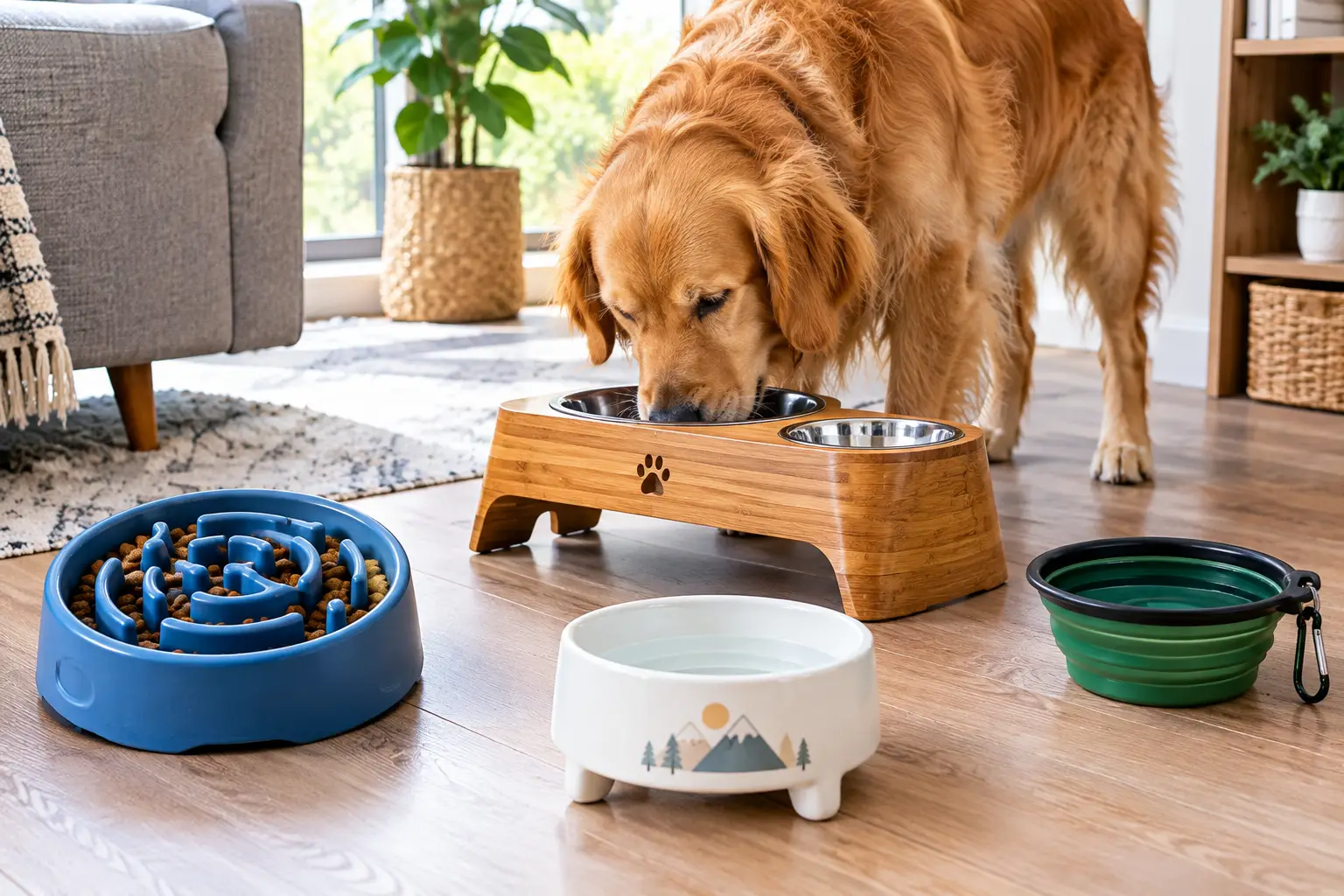
Unique dog bowls are feeding dishes that go beyond the standard round bowl by solving a specific problem or adding design value. Common types include slow-feeder and puzzle bowls, mess-proof feeding stations, insulated water bowls, collapsible travel bowls, and designer stoneware — each built around how a particular dog eats, drinks, or lives.
Why does it matter? Fast eating is one of the risk factors discussed in research on canine bloat, formally called gastric dilatation volvulus, a life-threatening emergency in deep-chested breeds. A bowl won’t prevent every health problem, but the right one can change how your dog eats — and that’s a surprisingly big lever. Below, you’ll find seven real, well-reviewed options, side-by-side comparisons, and practical guidance you won’t find on a product listing.
Quick Comparison: Unique Dog Bowls at a Glance
| Product | Bowl Type | Standout Trait | Price Range | Best For |
|---|---|---|---|---|
| Northmate Green Interactive Feeder | Puzzle/slow feeder | “Grass blade” foraging design | Around $30–$50 | Northmate Green Interactive Feeder: dogs that need mental stimulation |
| Outward Hound Fun Feeder Slo Bowl | Maze slow feeder | Three difficulty levels | Under $20 | Outward Hound Fun Feeder Slo Bowl: budget-minded owners of gulpers |
| YETI Boomer 8 Dog Bowl | Heavy-duty stainless | Non-slip, near-indestructible build | Around $50–$65 | YETI Boomer 8 Dog Bowl: big, rowdy, or bowl-pushing dogs |
| Neater Feeder Deluxe | Mess-proof station | Splash walls + drainage tray | Between $40 and $80 | Neater Feeder Deluxe: sloppy drinkers |
| Coldest Dog Bowl | Insulated stainless | Triple-wall insulation | Around $25–$45 | Coldest Dog Bowl: hot climates and outdoor water |
| Le Creuset Stoneware Pet Bowl | Designer stoneware | Enamel finish, kitchen-worthy look | Around $30–$55 | Le Creuset Stoneware Pet Bowl: style-first homes |
| Kurgo Collaps-A-Bowl | Collapsible travel | Folds under 1 inch thick | Under $20 | Kurgo Collaps-A-Bowl: hikes, road trips, and errands |
Reading across the table, the split is obvious: three bowls change how your dog eats (Northmate Green Interactive Feeder, Outward Hound Fun Feeder Slo Bowl, Neater Feeder Deluxe), while the others change where and in what they eat. If your main worry is speed, start with the two slow feeders; if it’s mess or durability, the Neater Feeder Deluxe and YETI Boomer 8 Dog Bowl are the stronger bets. Prices are approximate at the time of writing — check the current price before you buy.
💬 One click helps other shoppers make an informed choice too! 😊
Top 7 Unique Dog Bowls: Expert Analysis
1. Northmate Green Interactive Feeder — turns dinner into a foraging game
The Northmate Green Interactive Feeder looks like a tuft of lawn, and that’s exactly the point: it recreates the experience of a dog nosing through grass for food. The full-size version is a one-piece molded tray of hard, phthalate-free plastic, about 40 × 29 cm, with 43 rounded “blades” of varying heights. In practice, uneven blade heights mean some kibble is easy to reach and some isn’t — so your dog works in small bites instead of shoveling. A smaller Northmate Green Interactive Feeder “Mini” (32 blades, roughly 29 × 22.5 cm) exists for small breeds and puppies.
Based on comparing designs, this is the most genuinely different option on the list. Maze bowls slow dogs with walls; the Northmate Green Interactive Feeder adds a sniffing-and-nudging challenge that also reads as enrichment. It’s ideal for bored, high-energy dogs, though less ideal for dogs with sore gums — the manufacturer itself advises against using it with mouth injuries.
Reviews consistently report that it slows dogs down more effectively than simpler slow feeders, with some owners noting their dogs learn to flick kibble out with their tongues rather than flip the tray.
Pros:
- ✅ Most engaging foraging design in this lineup
- ✅ Works with dry food and, thanks to the rim, wet food
- ✅ Dishwasher safe and holds its shape well
Cons:
- ❌ Large footprint needs real floor space
- ❌ Not suitable for dogs with gum or mouth issues
Expect to pay around $30–$50; for a dog who needs a brain workout at mealtime, that’s strong value.
2. Outward Hound Fun Feeder Slo Bowl — budget slow feeder with three difficulty levels
The Outward Hound Fun Feeder Slo Bowl is the slow feeder many vets and owners reach for first, and its tiered system explains why. It comes in Slow, Slower, and Slowest levels, plus sizes from an X-Small that holds about 3/4 cup to a Large that holds up to 4 cups. The brand claims it can slow eating up to 10X; treat that as a best-case figure, since results depend entirely on the dog and the pattern you choose.
Here’s what to weigh: the difficulty level matters more than the color or pattern. A Slow-level maze barely bothers a determined Labrador, while the Slowest level can frustrate a timid dog at first. That flexibility makes the Outward Hound Fun Feeder Slo Bowl the best entry point for first-time slow-feeder buyers. It’s made from food-safe, BPA-, PVC-, and phthalate-free plastic with a non-slip base, and it’s top-rack dishwasher safe.
Customer reviews consistently mention fewer post-meal vomiting episodes and less gulping. A common caveat: some dogs are hesitant or whine at first, and a few owners report that a second dog chewed the plastic.
Pros:
- ✅ Very affordable entry into slow feeding
- ✅ Multiple sizes and difficulty levels to match your dog
- ✅ Non-slip base and top-rack dishwasher safe
Cons:
- ❌ Plastic can be chewed by determined dogs
- ❌ Deep mazes take extra effort to scrub clean
Usually under $20, it’s the best value-for-money slow feeder in this guide.
3. YETI Boomer 8 Dog Bowl — the bowl your dog can’t push around
The YETI Boomer 8 Dog Bowl is the cooler-brand answer to the flimsy bowl problem. It’s built from 18/8 stainless steel in a double-wall (non-insulated) design, holds 8 cups (64 oz), measures about 8 inches across and 3.5 inches tall, and weighs around 2 pounds empty. A BearFoot non-slip ring on the bottom and a DuraCoat colored exterior round it out.
On paper, that 2-pound weight plus the rubber ring is what you’re paying for. A typical lightweight steel bowl weighs a fraction of that, which is why big dogs nose it across the room. The YETI Boomer 8 Dog Bowl suits large breeds, outdoor dogs, and owners who’d rather buy once. Note that “double-wall, non-insulated” means it isn’t designed to keep water cold — if that’s your goal, see the Coldest Dog Bowl below.
Reviews consistently praise how stable and durable it is, especially with puppies who knock bowls over. The recurring complaint is price; a smaller number of reviewers mention cosmetic scratching or stubborn sticker residue.
Pros:
- ✅ Heavy, stable build resists pushing and tipping
- ✅ Kitchen-grade stainless steel is easy to sanitize
- ✅ Dishwasher safe with a durable color coating
Cons:
- ❌ Expensive for what is still a single bowl
- ❌ Not insulated despite the double-wall build
Around $50–$65 — pricey, but strong long-term value if bowls in your house tend to die young.
4. Neater Feeder Deluxe — mess-proof station for sloppy eaters
The Neater Feeder Deluxe is less a bowl and more a feeding system. The top tray holds two stainless steel bowls (in the medium dog version, roughly 7-cup and 9-cup sizes) and catches spilled kibble, while splash water drains through into a separate lower reservoir. It’s raised, comes with leg extensions for height adjustment, is made in the USA, and is offered in cat, small, medium, large, and extra-large sizes.
What most buyers overlook: the drainage separation is the clever part. Food that falls stays dry and edible; water ends up out of sight instead of under your feet. That makes the Neater Feeder Deluxe ideal for jowly drinkers — Labs, Mastiffs, Boxers — and homes with hardwood floors. One honest caution: it’s an elevated feeder, which matters for some large, deep-chested breeds (see the safety section below).
Reviews consistently say it keeps floors noticeably drier. The most common complaint is that food gets pushed into the gap behind the bowls’ top lip, which some owners find annoying to clean.
Pros:
- ✅ Separates spilled water from spilled food
- ✅ Height-adjustable with included leg extensions
- ✅ Wide size range from cats to giant breeds
Cons:
- ❌ Kibble can lodge behind the bowl lip
- ❌ Elevated design isn’t ideal for every large breed
Between $40 and $80 depending on size; worth it if water puddles are a daily chore.
5. Coldest Dog Bowl — triple-wall insulation for cold water all day
The Coldest Dog Bowl borrows tech from insulated drinkware: a triple-wall stainless steel build with an insulating middle layer, plus a non-slip bottom grip. It comes in several capacities (including 42 oz and 64 oz, with larger versions listed) and a wide range of colors and finishes, from polished steel to glitter patterns.
The practical meaning is simple: water stays cooler for longer, which matters on a sunny patio, in a garage, or in a hot apartment without AC. Insulation also helps with wet food on warm days. Based on comparing the specs, the Coldest Dog Bowl is the better water bowl, while the YETI Boomer 8 Dog Bowl is the better food bowl for big pushers. It’s a smart fit for Southern states, outdoor dogs, and dogs who drink more when their water is cool.
Reviews consistently mention that water stays cold for hours and that the base stays put. Some reviewers note it’s heavier than a regular bowl — which most see as a plus — and that bright colors can show smudges.
Pros:
- ✅ Triple-wall insulation keeps water cooler longer
- ✅ Non-slip base and rust-resistant steel
- ✅ Huge choice of colors and finishes
Cons:
- ❌ Heavier than standard steel bowls when full
- ❌ Lighter colors can show dirt quickly
Around $25–$45 depending on size — solid value for a premium water bowl.
6. Le Creuset Stoneware Pet Bowl — designer looks with kitchen-grade durability
The Le Creuset Stoneware Pet Bowl is for owners who want the bowl to look like it belongs next to the Dutch oven. It comes in a Medium (about 18 cm wide, roughly 450 ml) and a Large (about 23 cm wide, roughly 850 ml), made from dense, fully enameled stoneware with a wide base designed to prevent tipping. It’s dishwasher safe and resists chipping, staining, and odor absorption.
In practice, that enamel surface is the hygienic win: unlike scratched plastic, it doesn’t absorb smells or hide grime in grooves. It’s best for small to medium dogs — even the Large is modest at roughly 3.5 cups, so it’s more of a food bowl for a mid-size dog than a water bowl for a Shepherd. Stoneware can still break if dropped on tile, so it suits calm indoor dogs more than rough-and-tumble ones.
What’s verifiable: the specs and care claims above come from retailer and brand listings. What’s harder to verify: there’s limited US-specific aggregated review data, and availability on amazon.com can vary by color and size — check current listings before you commit.
Pros:
- ✅ Gorgeous, kitchen-matching enamel finishes
- ✅ Non-porous surface resists odors and stains
- ✅ Wide base resists tipping
Cons:
- ❌ Modest capacity limits use with large dogs
- ❌ Can crack or chip if dropped on hard floors
Typically around $30–$55 — you’re paying for design, so value depends on how much that matters to you.
7. Kurgo Collaps-A-Bowl — pocket-sized water on the trail
The Kurgo Collaps-A-Bowl solves the “my dog is thirsty and I’m two miles from the car” problem. It’s made of food-grade silicone, holds up to 24 fl oz, expands to about 3.5 inches tall and 6 inches wide, and collapses to less than an inch. A carabiner clips it to a pack, leash, or belt loop, and it’s top-rack dishwasher safe and free of BPA and PVC.
At roughly a third of a pound, it disappears in a daypack — that’s the whole value proposition. Twenty-four ounces covers most medium dogs on a day hike if you refill; for a big dog on a long trail, Kurgo also makes a larger zippered version. The Kurgo Collaps-A-Bowl is a smart second bowl for anyone who walks, hikes, travels, or runs errands with a dog in the car.
Reviews generally describe it as convenient and durable for travel, with repeat buyers among them. As with most collapsible silicone bowls, it’s light, so it’s not a great everyday home bowl.
Pros:
- ✅ Collapses flat and weighs almost nothing
- ✅ Carabiner keeps it within reach on walks
- ✅ Food-grade silicone and dishwasher safe
Cons:
- ❌ Too light to stay put as a home bowl
- ❌ 24 oz is small for giant breeds
Usually under $20 — excellent value as a dedicated travel bowl.
Head-to-Head: Specs and Value Compared
| Product | Material | Capacity | Dishwasher Safe | Non-Slip | Best For |
|---|---|---|---|---|---|
| Northmate Green Interactive Feeder | Phthalate-free plastic | Full meal (scattered) | Yes | Wide, stable tray | Northmate Green Interactive Feeder: enrichment seekers |
| Outward Hound Fun Feeder Slo Bowl | BPA-free plastic | 3/4 cup–4 cups | Top rack | Yes | Outward Hound Fun Feeder Slo Bowl: fast eaters on a budget |
| YETI Boomer 8 Dog Bowl | 18/8 stainless | 8 cups | Yes | BearFoot ring | YETI Boomer 8 Dog Bowl: large, pushy dogs |
| Neater Feeder Deluxe | Plastic stand + steel bowls | ~7 & 9 cups (medium) | Top rack | Rubber feet | Neater Feeder Deluxe: messy drinkers |
| Coldest Dog Bowl | Triple-wall stainless | 42–64+ oz | Yes | Yes | Coldest Dog Bowl: warm climates |
| Le Creuset Stoneware Pet Bowl | Enameled stoneware | ~450–850 ml | Yes | Weighted wide base | Le Creuset Stoneware Pet Bowl: style-focused homes |
| Kurgo Collaps-A-Bowl | Food-grade silicone | 24 fl oz | Top rack | Light grip | Kurgo Collaps-A-Bowl: travel |
The table makes one trade-off very clear: the two plastic slow feeders win on behavior change, while the steel and stoneware bowls win on hygiene and lifespan. A smart combo for many households is a slow feeder for meals plus the Coldest Dog Bowl or YETI Boomer 8 Dog Bowl for water. Capacity also matters — the Le Creuset Stoneware Pet Bowl is a small-to-medium-dog bowl, full stop.
✨ Don’t miss these standout picks!
🔍 Take your dog’s mealtime to the next level with this carefully curated lineup. Click a highlighted bowl to check current pricing and availability — these picks will help you get calmer meals, cleaner floors, and a happier pup the whole family will enjoy!
How to Introduce a Unique Dog Bowl: Your First 30 Days
New bowls change a routine your dog has rehearsed thousands of times, so a little strategy goes a long way.
Days 1–3: Make it easy
Start any puzzle or slow feeder with the easiest setup possible. With the Outward Hound Fun Feeder Slo Bowl, a Slow-level pattern beats jumping straight to Slowest. With the Northmate Green Interactive Feeder, scatter only part of the meal on top and serve the rest in the old bowl. Success early means your dog sees the new bowl as a game, not a wall between them and dinner.
Days 4–14: Raise the challenge gradually
Move the full meal into the new bowl. Watch for frustration signals — pawing, barking, walking away. A little effort is the goal; quitting is not. If your dog gives up, step back a level for a few more days.
Days 15–30: Lock in habits
By now, eating should be noticeably slower. This is the moment to set a cleaning routine (more on that below) and check placement: bowls should sit on a level, non-slip surface away from heavy foot traffic.
Common first-month mistakes
- ✅ Supervise puzzle feeders initially — chewers may treat plastic as a toy.
- ✅ Don’t switch food and bowl in the same week; you won’t know what caused any tummy upset.
- ✅ For mess-proof stations like the Neater Feeder Deluxe, empty the lower reservoir daily so standing water doesn’t turn stale.
For travel bowls like the Kurgo Collaps-A-Bowl, practice at home first. Some dogs are wary of a bowl that wobbles slightly, and a backyard rehearsal beats a standoff at a trailhead.
Real-World Scenarios: Matching Unique Dog Food Bowls to Real Dogs
Unique dog food bowls make the most sense when you picture the dog in front of them. Here are three common profiles.
Profile 1: The vacuum-cleaner Lab (budget around $20–$60)
A 70-pound Labrador who finishes breakfast before you’ve put the scoop away, eats twice a day, and splashes water everywhere. The best match is the Outward Hound Fun Feeder Slo Bowl (Slower or Slowest level, Large size) for meals, plus the Neater Feeder Deluxe or a floor-level heavy bowl for water. Why? The first addresses speed; the second addresses mess. Labs are a mid-to-large breed, so discuss raised-feeder height with your vet before going elevated.
Profile 2: The apartment Frenchie with a design-loving owner (budget around $30–$55)
A 22-pound French Bulldog in a city apartment, fed twice daily, with an owner who cares about how the kitchen looks. The Le Creuset Stoneware Pet Bowl (Medium) fits both capacity and aesthetics, and its wide base helps with a short-snouted dog who pushes with their face. If gulping is an issue, the X-Small or Small Outward Hound Fun Feeder Slo Bowl can handle meals while the stoneware handles water.
Profile 3: The weekend trail dog (budget around $50–$80)
A Border Collie mix who hikes most weekends and lives in a hot Southern state. The Coldest Dog Bowl keeps backyard water cool, the Kurgo Collaps-A-Bowl rides along on hikes, and the Northmate Green Interactive Feeder burns off mental energy on rest days. That trio costs less than many single smart feeders and covers home, heat, and trail.
Problem → Solution: Fixing Common Mealtime Headaches
Most bowl shopping starts with a frustration. Here’s how to map the problem to the fix.
Problem 1: “My dog inhales food and sometimes throws it back up.” ✅ Solution: A slow feeder. Start with the Outward Hound Fun Feeder Slo Bowl; if your dog cracks the maze quickly, step up to the Northmate Green Interactive Feeder. Persistent vomiting deserves a vet visit, though — a bowl isn’t a diagnosis.
Problem 2: “The bowl ends up across the kitchen.” ✅ Solution: Weight plus grip. The YETI Boomer 8 Dog Bowl at around 2 pounds empty with a rubber ring is the most direct fix.
Problem 3: “There’s a puddle every time my dog drinks.” ✅ Solution: Containment. The Neater Feeder Deluxe channels splashes into a hidden reservoir rather than onto your floor.
Problem 4: “The water gets warm and my dog won’t drink it.” ✅ Solution: Insulation. The Coldest Dog Bowl‘s triple wall slows heat gain, especially outdoors. Refresh water at least daily regardless.
Problem 5: “I never have a bowl when we’re out.” ✅ Solution: Keep the Kurgo Collaps-A-Bowl clipped to the leash or stashed in the glovebox permanently — the best travel bowl is the one you never forget.
How to Choose Unique Dog Bowls: 7 Expert Steps
Use this checklist to narrow the field fast.
- Name the problem first. Speed, mess, durability, heat, travel, or style — each points to a different design. A bowl that solves the wrong problem is just décor.
- Match capacity to your dog. A bowl should hold a full meal (or a day’s water) with room to spare; overfilled slow feeders lose their effect.
- Prioritize materials. Stainless steel and enameled stoneware are non-porous and easy to sanitize. Plastic slow feeders are fine but should be replaced when scratched or chewed.
- Check stability. Look for a weighted build, rubber ring, or wide base — especially for big or enthusiastic eaters.
- Think hard about height. Research led by Purdue’s Dr. Larry Glickman and published in JAVMA in 2000 associated raised feeders with higher bloat risk in large and giant breeds. Ask your vet before elevating.
- Confirm cleaning. Dishwasher-safe is ideal. Deep mazes and grass blades need a brush.
- Budget for the long run. A steel bowl that lasts a decade often costs less per year than repeatedly replacing cheap plastic.
Designer Dog Bowls: When Style Is the Point
Designer dog bowls are a legitimate category, not just vanity. If a bowl lives in your kitchen for 10+ years, it’s furniture. The trick is to choose designer dog bowls that still pass the practical tests above — the Le Creuset Stoneware Pet Bowl does, thanks to its enamel and wide base. Avoid designer dog bowls with unglazed ceramic interiors, hairline-crack-prone materials, or decorative coatings of unknown origin on food-contact surfaces.
Unique Dog Bowls vs Standard Bowls: Is the Upgrade Worth It?
A standard bowl does one job: hold food. Unique dog bowls aim to do that job plus something else — slow eating, contain mess, stay put, stay cool, or travel. The question is whether that “plus” is worth the extra cost for your dog.
| Factor | Standard Bowl | Unique Dog Bowls | Best For |
|---|---|---|---|
| Eating speed | No effect | Slow feeders like the Outward Hound Fun Feeder Slo Bowl add resistance | Fast eaters |
| Spill control | Minimal | Systems like the Neater Feeder Deluxe contain splashes | Messy drinkers |
| Stability | Often slides | Weighted/non-slip builds like the YETI Boomer 8 Dog Bowl | Large, pushy dogs |
| Temperature | None | Insulated options like the Coldest Dog Bowl | Hot climates |
| Portability | Bulky | Collapsible options like the Kurgo Collaps-A-Bowl | Travel and hiking |
The pattern is clear: if your dog has no feeding quirks, a standard stainless bowl is perfectly fine and you don’t need to upgrade. But if even one of those rows describes your daily life, a targeted bowl fixes it for a modest one-time cost. Upgrade for the problem, not the trend.
Cool Dog Bowls That Earn Their Place
The phrase “cool dog bowls” often means flashy colors, but the coolest bowls change behavior or save you time. A glitter finish on the Coldest Dog Bowl is fun; its insulation is the real reason it’s on this list. When you evaluate cool dog bowls, ask what happens after the novelty fades — will it still be in use next year?
Features That Actually Matter (and Ones That Don’t)
Marketing language around pet bowls can get loud. Here’s how to separate signal from noise.
Features that matter
- ✅ Food-safe, easy-to-clean materials. 18/8 stainless steel and enameled stoneware resist scratches where bacteria can hide.
- ✅ Non-slip bases. A bowl that stays put means less spilling and less frustration.
- ✅ Adjustable difficulty in slow feeders. Dogs learn; the Outward Hound Fun Feeder Slo Bowl‘s three levels give you room to grow.
- ✅ Appropriate capacity. Too small means constant refilling; too large on a slow feeder means kibble piles above the maze.
- ✅ Dishwasher compatibility. It makes daily washing realistic.
Features that matter less than you’d think
- ❌ “Vet recommended” labels. These are marketing claims; they don’t tell you which vet or for which dog.
- ❌ Fancy patterns. Within a slow-feeder line, difficulty level matters far more than the shape of the maze.
- ❌ Double-wall without insulation. It adds durability (as on the YETI Boomer 8 Dog Bowl), but don’t expect cold water from it.
Unusual Dog Bowls: Clever or Gimmick?
Unusual dog bowls range from brilliant to baffling. The Northmate Green Interactive Feeder is a great example of unusual dog bowls done right: an odd-looking design with a clear functional purpose. A good test for unusual dog bowls: if you can’t explain in one sentence what problem it solves, skip it.
Safety, Materials, and the Raised-Bowl Debate
Safety is where unique dog bowls deserve the most scrutiny, because a bowl touches your dog’s food and water every day.
Material safety
Look for stainless steel, enameled stoneware, or plastics labeled BPA-free, PVC-free, and phthalate-free (the Outward Hound and Northmate lines advertise these). Replace any plastic bowl once it’s deeply scratched or chewed — rough surfaces are harder to clean and can shed fragments. Ceramic and stoneware should be fully glazed on food-contact surfaces; chips mean retirement.
The elevated-feeder question
Raised bowls were long recommended to prevent bloat. The research picture changed. The AKC Canine Health Foundation’s summary of the Purdue bloat study notes that common prevention practices, including raising the food bowl, didn’t appear effective — and that raised bowls were associated with a higher incidence of bloat. The study was observational, so it shows association rather than proof of cause.
What does that mean in practice? For large and giant deep-chested breeds — Great Danes, Standard Poodles, Irish Setters, Weimaraners — floor-level feeding is the cautious default unless your vet advises otherwise. For seniors with arthritis or dogs recovering from neck issues, a modestly raised feeder like the Neater Feeder Deluxe may still make sense. This is a vet conversation, not a shopping decision.
Supervision
Puzzle feeders like the Northmate Green Interactive Feeder come with a “don’t leave your dog unattended” warning for a reason: heavy chewers can damage plastic. Supervise until you’re sure your dog eats rather than chews.
Long-Term Cost and Cleaning: The Real Price of a Bowl
The sticker price is only part of the story. Durability and hygiene drive total cost of ownership.
| Product | Upfront Range | Expected Lifespan | Ongoing Costs | Best For |
|---|---|---|---|---|
| Outward Hound Fun Feeder Slo Bowl | Under $20 | Replace when scratched/chewed | Periodic replacement | Outward Hound Fun Feeder Slo Bowl: low upfront spend |
| YETI Boomer 8 Dog Bowl | Around $50–$65 | Many years | Near zero | YETI Boomer 8 Dog Bowl: buy-once owners |
| Neater Feeder Deluxe | Between $40 and $80 | Years (stand + steel bowls) | Occasional replacement bowls | Neater Feeder Deluxe: floor protection |
| Le Creuset Stoneware Pet Bowl | Around $30–$55 | Years, unless dropped | Breakage risk | Le Creuset Stoneware Pet Bowl: careful indoor use |
Spread over five years, the YETI Boomer 8 Dog Bowl can cost less per year than a cheap bowl replaced annually, while plastic slow feeders are a low-cost consumable you should expect to refresh. The Neater Feeder Deluxe also “pays back” in a different currency: fewer water-damaged floors and less mopping.
A cleaning routine that actually works
A North Carolina State University study of dog owners’ feeding practices — published in PLOS ONE and available via the NIH — found that owners who followed FDA pet food and dish-handling guidelines had significantly less bacterial contamination on their dogs’ bowls. The study also found few owners were aware those guidelines existed.
- ✅ Wash food bowls after each meal with hot, soapy water (or the dishwasher).
- ✅ Wash water bowls at least daily.
- ✅ Use a bottle brush on slow-feeder ridges and grass blades.
- ✅ Wash your hands before and after handling pet food.
Unique Dog Bowls for Puppies, Seniors, and Flat-Faced Breeds
Different life stages and face shapes change what “best” means.
Puppies
Puppies grow fast and chew everything. A heavy stainless option like the YETI Boomer 8 Dog Bowl survives teething; a small slow feeder, such as the X-Small Outward Hound Fun Feeder Slo Bowl or the Northmate Green Interactive Feeder Mini, teaches calm eating early. Supervise any plastic.
Seniors
Older dogs may have stiff joints or dental wear. Shallow, stable bowls help. For senior dogs with arthritis, ask your vet whether modest elevation — like the adjustable Neater Feeder Deluxe — is appropriate. Avoid hard puzzle feeders for dogs with sore gums or missing teeth.
Flat-faced (brachycephalic) breeds
Pugs, Frenchies, and Shih Tzus struggle with deep, narrow bowls. Wide, shallow designs like the Le Creuset Stoneware Pet Bowl let them reach food without jamming their face against the sides. Choose shallow slow feeder patterns rather than deep mazes.
Multi-dog homes
Separate bowls, separate spots. Fast and slow eaters often need different bowls — and sometimes different rooms — to prevent resource guarding and food stealing.
Common Mistakes to Avoid When Buying Unique Dog Bowls
Even good bowls fail when they’re mismatched. Watch out for these traps.
- Buying for looks alone. A beautiful bowl that’s too small or too light becomes a daily annoyance.
- Choosing the hardest slow feeder first. Frustrated dogs may refuse to eat; build difficulty gradually.
- Elevating a large breed by default. Given the Purdue findings, check with your vet before raising bowls for big, deep-chested dogs.
- Ignoring cleaning difficulty. Intricate designs need brushes and time. If you won’t scrub daily, choose simpler shapes.
- Keeping scratched plastic forever. Grooves trap bacteria; retire worn plastic bowls.
- Using a travel bowl at home. The Kurgo Collaps-A-Bowl is a trail tool — too light to stay put on a kitchen floor.
- Expecting a bowl to fix a medical issue. Repeated vomiting, sudden appetite changes, or a swollen belly need a vet, not a new dish.
Bottom line: the right unique dog bowls are chosen like shoes — for fit and function first, then style.
FAQ About Unique Dog Bowls
❓ Are unique dog bowls worth buying for an average dog?
❓ Where can I buy unique dog bowls online?
❓ What is the best unique dog bowl for a dog that eats too fast?
❓ Are expensive dog bowls like YETI worth the money?
❓ Can unique dog bowls go in the dishwasher?
Conclusion: Find the Bowl That Fits Your Dog, Not the Trend
The best unique dog bowls aren’t the flashiest — they’re the ones that fix something real in your dog’s daily routine. If speed is the issue, the Outward Hound Fun Feeder Slo Bowl is the low-risk starting point, and the Northmate Green Interactive Feeder is the step up for dogs who crave a challenge. If your floors are suffering, the Neater Feeder Deluxe is the most effective containment system here. For sheer toughness, the YETI Boomer 8 Dog Bowl is built to last; for cool water on hot days, the Coldest Dog Bowl is the specialist. Style-driven homes will love the Le Creuset Stoneware Pet Bowl, and every adventurous dog deserves a Kurgo Collaps-A-Bowl clipped to the leash.
Whatever you choose, remember three rules: match capacity and design to your dog’s size, keep bowls clean daily, and talk to your vet before raising food bowls for large, deep-chested breeds. Get those right, and a simple bowl upgrade can mean calmer meals, cleaner floors, and a happier, healthier dog for years.
🐾 Ready to upgrade your dog’s mealtime?
🔍 Click any highlighted bowl above to check current pricing and availability on Amazon. Pick the one that solves your dog’s biggest mealtime headache — and enjoy calmer, cleaner, more fun feedings starting this week! ✨
Recommended for You
- Outdoor Dog Water: 7 Best Waterers That Actually Work in 2026
- Best Raised Dog Bowls 2026: 7 Smart Picks & 1 Crucial Warning
- Chip reader cat feeder 2026: 7 Proven Picks to End Food Theft
Disclaimer: This post contains affiliate links. As an Amazon Associate, I earn from qualifying purchases made through these links, at no additional cost to you.
✨ Found this article helpful? Share it with someone who needs it! 💬🤗