In This Article
Introduction: Why Your Puppy Eats Like It’s a Competitive Sport
You set the bowl down, turn around to grab the paper towels, and by the time you look back, the kibble is gone. Your puppy is licking an empty dish with a look that says, “Was there food? I don’t remember any food.” Sound familiar? Then a puppy slow feed bowl might be the cheapest, easiest upgrade you make this year.
Puppies gulp for perfectly understandable reasons. Many grew up competing with littermates at a shared pan, where the fastest eater got the most. That habit doesn’t magically switch off when they come home with you. Unfortunately, speed-eating can mean swallowed air, regurgitated kibble on your rug, hiccups, a bloated-looking belly, and in some cases, choking on pieces that never got chewed.
What Is a Puppy Slow Feed Bowl?
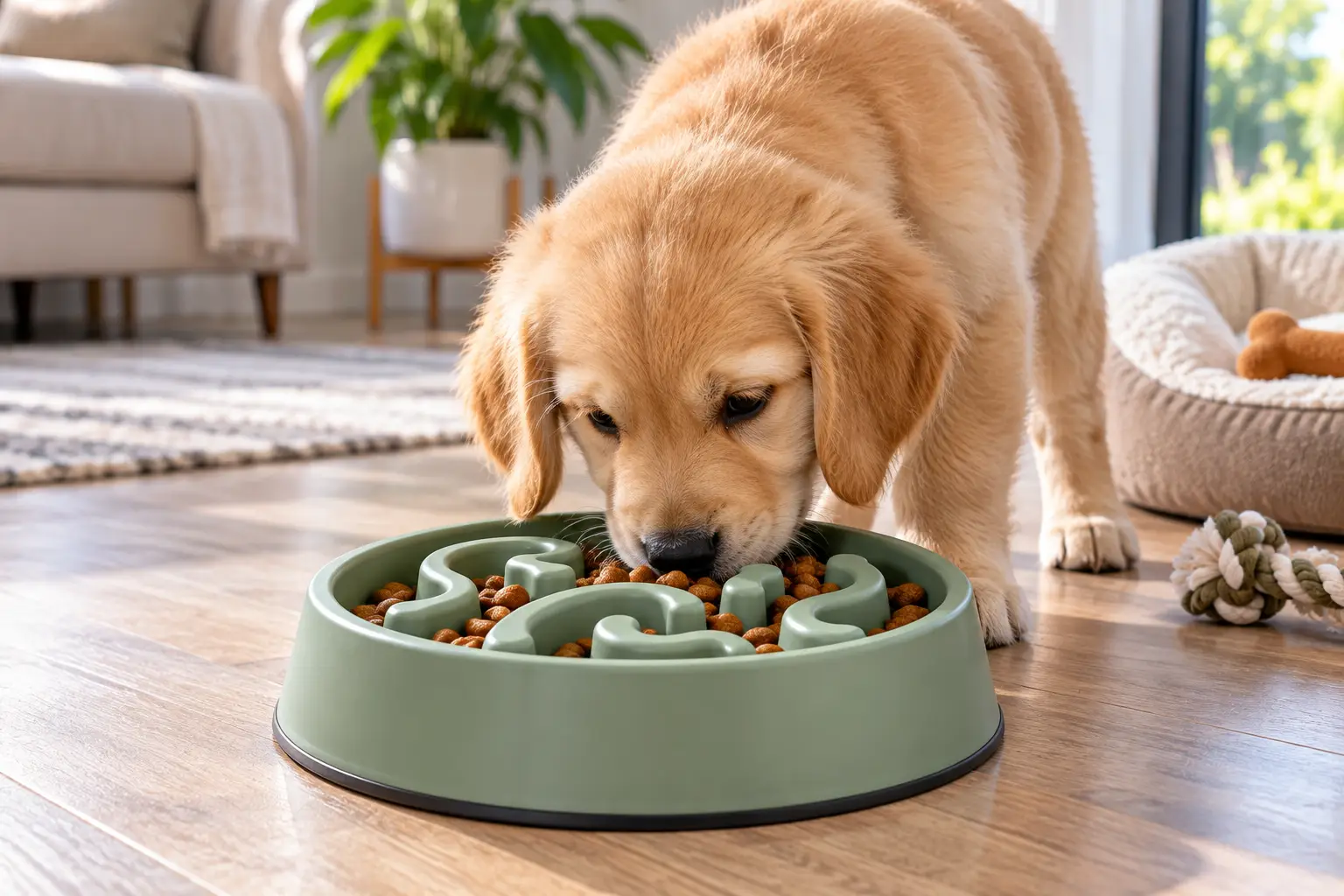
A puppy slow feed bowl is a food dish with raised ridges, mazes, or blades molded into the eating surface. Instead of scooping up mouthfuls, your puppy has to nose, lick, and work kibble out of the gaps, which naturally stretches a 30-second meal into several minutes and reduces gulping, air-swallowing, and post-meal vomiting.
The American Kennel Club’s guide to slowing down a fast eater lists slow-feeder bowls right alongside food puzzles and smaller, more frequent meals as practical ways to tame a speed eater. That’s useful context, because the right slow feeder bowl for puppies isn’t just “any bowl with bumps.” Size, depth, material, and pattern difficulty all change how well it works for a 10-week-old Yorkie versus a 5-month-old Great Dane.
In this guide, you’ll get a quick comparison of seven real, widely available options, an honest breakdown of each one, a 30-day introduction plan, troubleshooting fixes, and a straight answer on what slow feeders can and can’t do for bloat.
Quick Comparison: The 7 Best Puppy Slow Feed Bowls at a Glance
| Product | Material | Puppy-Friendly Size | Difficulty | Best for |
|---|---|---|---|---|
| Outward Hound Fun Feeder Slo Bowl | BPA-free plastic | Mini/X-Small (¾ cup) to Large (4 cups) | Slow → Slowest | Outward Hound Fun Feeder Slo Bowl: most puppies, best all-rounder |
| GORILLA GRIP Slow Feeder Bowl | BPA-free plastic | 1, 2, or 4 cups | Moderate | GORILLA GRIP Slow Feeder Bowl: toy and small-breed puppies |
| LE TAUCI Ceramic Slow Feeder | Glazed ceramic | ~0.6, 1.5, or 3 cups | Moderate | LE TAUCI Ceramic Slow Feeder: chewers and chin-acne-prone pups |
| Neater Pets Stainless Steel Slow Feed Bowl | Stainless steel | ¾ cup (Small) to 5 cups (XL) | Gentle–moderate | Neater Pets Stainless Steel Slow Feed Bowl: hygiene-first owners |
| Dogit Go Slow Anti-Gulping Bowl | Plastic | ½ cup to 2.5 cups | Gentle | Dogit Go Slow Anti-Gulping Bowl: budget buyers and first-timers |
| Company of Animals Green Mini Interactive Feeder | Phthalate-free polypropylene | Mini (small dogs, puppies) | Hard | Company of Animals Green Mini Interactive Feeder: smart, bored, food-obsessed pups |
| SodaPup Flower eBowl | USA-made TPE | Deep (~2″) | Medium | SodaPup Flower eBowl: large-breed puppies |
Looking at the table, the Outward Hound Fun Feeder Slo Bowl wins on flexibility because you can buy the same design at three difficulty levels and grow into a bigger size later. If your puppy is a determined chewer, though, the LE TAUCI Ceramic Slow Feeder and the Neater Pets Stainless Steel Slow Feed Bowl sidestep the “puppy gnawed the ridges off” problem entirely. And if you want maximum brain work, the Company of Animals Green Mini Interactive Feeder is the toughest puzzle here, so it’s better as a second-stage bowl than a first one.
💬 One click helps other shoppers make an informed choice too! 😊
Top 7 Puppy Slow Feed Bowls: Expert Analysis
1. Outward Hound Fun Feeder Slo Bowl — best all-around starter bowl
The Outward Hound Fun Feeder Slo Bowl earns its reputation by giving you a ladder to climb rather than a single fixed challenge. Outward Hound sells it in three “slow levels” (Slow, Slower, and Slowest) and multiple sizes, from an X-Small/Mini that holds about ¾ cup up to a Large that holds about 4 cups. In practice, that means you can start a nervous 9-week-old on a shallow, simple maze and graduate to a deeper pattern once they’ve figured out the game. The material is listed as BPA-, PVC-, lead-, and phthalate-free, and the bowl is top-rack dishwasher safe, which matters when you’re washing it two or three times a day.
The brand’s “up to 10x slower” claim is a best-case manufacturer figure, so treat it as a ceiling rather than a promise. Based on the design, the biggest win for puppies is the non-slip base: a bowl that skates across the floor teaches puppies to push it instead of eating from it.
Customer reviews across major retailers consistently report that it genuinely slows fast eaters. A recurring caveat is that some puppies whine or walk away at first, and a few owners note that a chewy dog will gnaw on the plastic ridges.
Pros:
- ✅ Three difficulty levels let you scale the challenge
- ✅ Wide size range from tiny pups to giant breeds
- ✅ Top-rack dishwasher safe for frequent puppy meals
Cons:
- ❌ Plastic ridges can be chewed by teething puppies
- ❌ Deep “Slowest” patterns may frustrate very young pups
Price and value: Usually in the $8–$20 range depending on size (check the current price); outstanding value for a first slow feeder.
2. GORILLA GRIP Slow Feeder Bowl — sturdiest pick for toy breeds
The GORILLA GRIP Slow Feeder Bowl is built around one idea: tiny puppies need a small bowl that doesn’t move. It comes in 1-cup, 2-cup, and 4-cup sizes, and the 1-cup version is marketed specifically to prevent puppy overeating, which tells you exactly who it’s designed for. The bowl is BPA-free and uses a weighted, grippy base, so a 3-pound Chihuahua can push with their whole face and the bowl still stays put.
Here’s what most buyers overlook: for toy breeds, the pattern spacing matters more than the pattern complexity. A maze with gaps sized for Labrador kibble does almost nothing for a puppy eating tiny pieces, because the kibble simply slides out. The 1-cup GORILLA GRIP keeps the grooves proportionate to small mouths, which makes it a smarter fit for Maltese, Pomeranians, and Shih Tzus than simply buying “the small version” of a big-dog bowl.
Review sentiment is positive about stability, with owners frequently mentioning that the weighted base and sturdy feel keep it from sliding. Detailed long-term durability feedback for puppies who chew is less consistent, so supervise early meals.
Pros:
- ✅ True 1-cup size proportioned for toy breeds
- ✅ Weighted base resists sliding and tipping
- ✅ Several colors and sizes for growing pups
Cons:
- ❌ Plastic surface is vulnerable to persistent chewing
- ❌ Less challenging for clever medium-breed puppies
Price and value: Typically between $8 and $20 depending on size; strong value for toy-breed owners specifically.
3. LE TAUCI Ceramic Slow Feeder — chew-proof and easy to keep clean
The LE TAUCI Ceramic Slow Feeder solves the biggest complaint about plastic slow feeders: puppies chewing them. Because the maze is part of a solid glazed ceramic bowl, there’s nothing soft for teething gums to destroy. Sizes include a small version listed at roughly 0.6 cups, an 8-inch bowl that holds about 1.5 cups, and a 9.5-inch, 3-cup model for larger pups.
The weight is a feature, not a bug. A ceramic bowl weighing well over 2 pounds doesn’t scoot, so you don’t need a mat or suction cup. On paper, glazed ceramic is also non-porous, which is why many owners whose dogs develop chin acne on plastic bowls switch to ceramic or steel, often on their vet’s suggestion.
Reviews report that it does slow dogs down and is easy to rinse clean, and they praise its looks. The recurring warnings are honest ones: ceramic can chip or crack if dropped, and some owners say the 1.5-cup bowl only reaches that capacity when kibble is heaped high, which reduces the slowing effect. Listings have also been inconsistent about dishwasher and microwave use, so follow the care marks on your specific bowl.
Pros:
- ✅ Nothing for teething puppies to chew apart
- ✅ Heavy enough to stay put without accessories
- ✅ Non-porous glaze is easy to sanitize
Cons:
- ❌ Can chip or crack if dropped on hard floors
- ❌ Real capacity is lower than heaped “max” figures
Price and value: Generally around $20–$35 depending on size; worth the premium if your puppy chews everything.
4. Neater Pets Stainless Steel Slow Feed Bowl — hygiene-first stainless design
The Neater Pets Stainless Steel Slow Feed Bowl is the pick for owners who want the durability and cleanability of steel without giving up the slow-feeding effect. The non-tip version comes in several sizes, starting with a Small that holds about ¾ cup (roughly 5 inches across the top and 1.5 inches tall) and climbing to an XL that holds about 5 cups. It sits on a removable non-skid rubber base, and Neater also sells a 3-cup insert version designed to fit elevated feeders with a 7.25″–8″ bowl opening.
What that means in practice: you can start a small puppy on the ¾-cup bowl and, if you later move to a raised feeder for a large breed, Neater has a compatible insert. Steel won’t absorb odors, won’t crack like ceramic, and won’t get gnawed like plastic. The trade-off is that steel slow feeders tend to have gentler patterns because metal can’t be molded into sharp, deep mazes as easily.
Customer reviews of the stainless insert are generally positive, with owners specifically appreciating that steel won’t develop mold the way some silicone inserts can. Some buyers of very fast eaters say the pattern is “challenging enough” rather than truly difficult, which matches Neater’s own framing.
Pros:
- ✅ Steel resists chewing, odors, and cracking
- ✅ Removable non-skid base for easier washing
- ✅ Insert version fits many elevated feeders
Cons:
- ❌ Gentler pattern than the toughest plastic mazes
- ❌ Smallest size may be outgrown quickly
Price and value: Commonly in the $15–$25 range depending on size; excellent long-term value since it won’t need replacing.
5. Dogit Go Slow Anti-Gulping Bowl — best budget first bowl
The Dogit Go Slow Anti-Gulping Bowl is the simplest design on this list: a single raised center hump that forces food into a ring around it. That sounds almost too basic, and for a hardened adult speed-eater it might be. For a young puppy, though, simple is often exactly right, because the goal in week one is to make the bowl feel normal, not intimidating. US retailers list it in several sizes, roughly ½ cup, 1¼ cups, and 2½ cups, and it’s dishwasher safe.
One genuinely useful detail is that Dogit markets it for food or water. If your puppy also gulps water and then coughs or vomits it back up, a second Dogit as a water dish can help, which is something most maze bowls can’t do because water simply floods the pattern.
Customer feedback generally describes it as effective for moderately fast eaters and appreciated for its low price. The most common criticism is predictable: very determined eaters learn to work around the single hump quickly, so treat it as a starter or a water bowl rather than your final answer for a vacuum-cleaner puppy.
Pros:
- ✅ Very approachable design for nervous young puppies
- ✅ Doubles as a slow water bowl
- ✅ Low cost and dishwasher safe
Cons:
- ❌ Too easy for extremely fast or clever eaters
- ❌ Lightweight plastic can slide without a mat
Price and value: Usually around $8–$15; the best low-risk way to test whether your puppy accepts a slow feeder.
6. Company of Animals Green Mini Interactive Feeder — toughest puzzle for brainy pups
The Company of Animals Green Mini Interactive Feeder doesn’t look like a bowl at all; it looks like a tuft of plastic grass. You scatter kibble across the “blades,” and your puppy has to sniff, lick, and nudge each piece free. The Mini version is designed for small dogs, puppies, and flat-faced breeds, and it measures roughly 11.4 × 8.9 × 2.6 inches. It’s made from phthalate-free polypropylene and is dishwasher safe.
Based on the design, this is the most effective slowing tool here, and also the one with the steepest learning curve. Because food is spread across a wide surface instead of pooled in grooves, there’s simply no way to take a big mouthful. That makes it fantastic for high-energy herding and sporting puppies who need mental work, and for pups on a calorie-controlled plan who finish meals feeling unsatisfied.
Reviews commonly report meals stretching from under a minute to several minutes and describe it as mentally tiring in a good way. The repeated complaints are about cleanup: it takes up a lot of dishwasher space, it’s awkward to scrub by hand once food dries, and some kibble gets pushed onto the floor, so many owners pair it with a lipped mat.
Pros:
- ✅ Most effective slowing design in this lineup
- ✅ Satisfies foraging instincts and burns mental energy
- ✅ Mini size suits puppies and flat-faced breeds
Cons:
- ❌ Harder to clean than a standard bowl
- ❌ Steep learning curve for very young puppies
Price and value: Typically in the $20–$35 range; worth it for bored, clever pups, overkill for mellow eaters.
7. SodaPup Flower eBowl — made in USA for large-breed puppies
The SodaPup Flower eBowl is aimed squarely at the puppies who’ll grow into the dogs most associated with bloat: medium, large, and giant breeds. SodaPup is based in Boulder, Colorado, and lists the eBowl as made in the USA from FDA-compliant TPE (thermoplastic elastomer), a slightly rubbery material that’s gentler on teeth than rigid plastic. At about 2 inches deep, it’s clearly sized for bigger mouths; SodaPup itself says it’s best suited for medium and large dogs.
What that means for you: if you’ve brought home a Great Dane, Doberman, Standard Poodle, or German Shepherd puppy, starting with a properly deep bowl builds a slow-eating habit early, before your pup is big enough to inhale a 4-cup meal. The petal-shaped ridges are rated as medium difficulty, which is a sensible middle ground for a large-breed puppy who’s eager but not yet a puzzle expert.
Honest caveat: at the time of writing, I couldn’t verify a large body of independent aggregated reviews comparable to the Outward Hound or Gorilla Grip bowls, so weigh the manufacturer’s claims (including its “up to 10x” slowing figure) accordingly. TPE also isn’t chew-proof, so supervise teething pups.
Pros:
- ✅ US-made with FDA-compliant food-contact material
- ✅ Depth suits large-breed puppy muzzles
- ✅ Medium difficulty avoids early frustration
Cons:
- ❌ Too deep for toy and small-breed puppies
- ❌ Fewer verifiable independent reviews than rivals
Price and value: Generally in the $20–$35 range (check current pricing); a reasonable premium for US manufacturing and large-breed sizing.
Side-by-Side Specs for All 7 Bowls
| Product | Smallest Size | Dishwasher | Chew Resistance | Anti-Slip Method | Best for |
|---|---|---|---|---|---|
| Outward Hound Fun Feeder Slo Bowl | ~¾ cup | Top rack | Low–medium | Non-slip base | Outward Hound Fun Feeder Slo Bowl: scaling difficulty |
| GORILLA GRIP Slow Feeder Bowl | 1 cup | Check listing | Low–medium | Weighted grip base | GORILLA GRIP Slow Feeder Bowl: toy breeds |
| LE TAUCI Ceramic Slow Feeder | ~0.6 cup | Per bowl marking | High | Sheer weight | LE TAUCI Ceramic Slow Feeder: chewers |
| Neater Pets Stainless Steel Slow Feed Bowl | ~¾ cup | Yes | High | Removable rubber base | Neater Pets Stainless Steel Slow Feed Bowl: hygiene |
| Dogit Go Slow Anti-Gulping Bowl | ~½ cup | Yes | Low | None built in | Dogit Go Slow Anti-Gulping Bowl: budget/water |
| Company of Animals Green Mini Interactive Feeder | Mini | Yes | Medium | Feet/footprint | Company of Animals Green Mini Interactive Feeder: enrichment |
| SodaPup Flower eBowl | One deep size | Check listing | Medium | Grippy TPE | SodaPup Flower eBowl: large breeds |
The pattern here is clear: chew resistance and difficulty usually pull in opposite directions. The toughest materials (the LE TAUCI Ceramic Slow Feeder and the Neater Pets Stainless Steel Slow Feed Bowl) have moderate patterns, while the toughest puzzles (the Company of Animals Green Mini Interactive Feeder and the Outward Hound Fun Feeder Slo Bowl at “Slowest”) are made of plastic. Decide which problem is bigger for your puppy, chewing or speed, and let that pick your category.
✨ Don’t miss these puppy-approved picks!
🔍 Make mealtime calmer and cleaner with this carefully curated lineup. Click a highlighted bowl to check current pricing and availability, and give your puppy a healthier eating habit that lasts into adulthood! 🐶
How to Introduce a Puppy Slow Feed Bowl: Your First 30 Days
A slow feeder only works if your puppy actually eats from it. Here’s a simple, low-stress rollout.
Days 1–3: Make the bowl boring
Place a few pieces of kibble in the bowl alongside your puppy’s regular dish. Don’t force anything. You want the new bowl to smell like food and nothing else. If your pup sniffs it and walks away, that’s fine.
Days 4–7: Split the meal
Put about a quarter of the meal in the slow feeder and the rest in the old bowl. Feed the slow feeder portion first, while your puppy is hungriest and most motivated. Sprinkle kibble mostly on the tops of the ridges, where it’s easy to reach, so early wins come quickly.
Week 2: Flip the ratio
Move to roughly three-quarters in the slow feeder. Now start letting kibble settle into the grooves. A short whine or a pawing session is normal problem-solving; repeated walking away is your cue to make it easier again.
Weeks 3–4: Full meals and fine-tuning
Serve the entire meal in the slow feeder and time it. If a meal that used to take 30 seconds now takes three to five minutes, you’re in a good place. If your pup still finishes in under a minute, step up a difficulty level (for example, from the Dogit Go Slow Anti-Gulping Bowl to the Outward Hound Fun Feeder Slo Bowl).
Maintenance tips puppy owners miss
- ✅ Wash after every meal; wet food dries fast in grooves.
- ✅ Keep a small bottle brush or old toothbrush just for the bowl.
- ✅ Inspect plastic ridges weekly for chew marks or sharp edges.
- ❌ Don’t leave a slow feeder down as a chew toy between meals.
The most common first-month mistake is jumping straight to the hardest pattern. A frustrated puppy may start flipping the bowl or refusing food, which is the exact opposite of the calm, steady eating you’re trying to build.
Real-World Scenarios: Which Bowl Fits Which Puppy?
Specs are useful, but it’s easier to choose when you can see yourself in a situation. Here are three common profiles.
Scenario 1: The apartment toy-breed puppy
Profile: A 12-week-old Yorkie in a city apartment, eating about ¼ cup of small-bite kibble three or four times a day. Budget is under $20.
Best fit: The GORILLA GRIP Slow Feeder Bowl (1-cup). The grooves are proportionate to tiny kibble, and the weighted base handles a puppy who pushes with their face. If your budget is even tighter, the smallest Dogit Go Slow Anti-Gulping Bowl is a decent starter, and you can upgrade later.
Scenario 2: The teething Lab with a chewing habit
Profile: A 4-month-old Labrador eating about 1 cup three times a day, actively teething and already chewing table legs. Budget around $30.
Best fit: The LE TAUCI Ceramic Slow Feeder in the 1.5-cup size now, moving to the 3-cup later, or the Neater Pets Stainless Steel Slow Feed Bowl. Both remove the risk of your puppy swallowing chewed-off plastic. Labs are famously food-motivated, so if the ceramic pattern feels too easy, add a few minutes of scatter-feeding on a snuffle mat as a bonus.
Scenario 3: The large-breed puppy in an active family
Profile: A 10-week-old Great Dane or German Shepherd puppy in a busy household with kids. The puppy eats three meals a day and will triple in size within months.
Best fit: The SodaPup Flower eBowl for its depth and puppy-appropriate difficulty, or the Large Outward Hound Fun Feeder Slo Bowl at the “Slower” level. For a deep-chested breed, building a slow-eating habit early pairs naturally with other habits your vet may recommend, such as smaller multiple meals and calm time after eating.
The thread connecting all three: match size and material to the puppy you have today, and plan your upgrade path for the dog you’ll have in six months.
Puppy Slow Feeder Problems and How to Fix Them
Even the best puppy slow feed bowl can hit a few bumps. These are the most common issues owners report, with practical fixes.
Problem 1: “My puppy won’t eat from it”
Solution: The pattern is too hard or too strange. Go back to placing kibble on the ridge tops, or temporarily switch to a gentler design like the Dogit Go Slow Anti-Gulping Bowl. Mixing in a spoonful of warm water to soften the smell of the kibble can also help win them over.
Problem 2: “The bowl slides across the kitchen”
Solution: Use a bowl with a weighted or rubber base (the GORILLA GRIP Slow Feeder Bowl and the Neater Pets Stainless Steel Slow Feed Bowl both address this), set it on a silicone mat, or wedge it into a corner so your pup can’t push it far.
Problem 3: “My puppy flips it over”
Solution: Flipping is frustration plus opportunity. Lower the difficulty, then switch to something heavy, like the LE TAUCI Ceramic Slow Feeder, that’s physically hard to tip.
Problem 4: “He’s chewing the ridges”
Solution: Stop using that plastic bowl immediately if pieces are missing. Pick up the bowl as soon as the meal is done, and move to ceramic or stainless steel for the teething months.
Problem 5: “She still eats too fast”
Solution: Upgrade the challenge. Move from a single-hump bowl to a maze like the Outward Hound Fun Feeder Slo Bowl, or to the scatter-style Company of Animals Green Mini Interactive Feeder. You can also split meals into smaller portions, which slows intake no matter which bowl you use.
How to Choose a Puppy Slow Feed Bowl
Here’s a simple, seven-step checklist to pick the right bowl the first time.
- Match capacity to one meal, not a day. Puppies eat several small meals, so a ¾- to 1½-cup bowl is right for most small and medium puppies. An oversized bowl lets kibble pool, which reduces the slowing effect.
- Size the grooves to the kibble and the muzzle. Small-bite puppy kibble needs narrower channels; a flat-faced puppy needs shallow ones so they aren’t jamming their nose into deep slots.
- Pick your material by your puppy’s chewing level. Mild chewers can use plastic; teething destroyers do better with ceramic or stainless steel.
- Start easy, then level up. Choose a gentle first bowl, then upgrade if meals still take under a minute.
- Check stability. A non-slip base, weighted bottom, or heavy material prevents the push-and-chase game.
- Think about cleaning reality. If you’ll wash it two or three times a day, dishwasher-safe matters more than fancy patterns.
- Plan for growth. For large breeds, buy a design that comes in bigger sizes, or budget for a second bowl around four to six months.
Following these steps in order saves money, because most “this slow feeder didn’t work” stories come from skipping step 1 or step 4: the bowl was too big, or the pattern was too hard for a beginner.
Slow Feeder Bowl for Puppies vs Regular Bowls, Puzzle Toys, and Snuffle Mats
A slow feeder isn’t the only way to slow a puppy down. Here’s how it stacks up against the alternatives.
| Option | Slowing Effect | Ease of Cleaning | Daily Practicality | Best for |
|---|---|---|---|---|
| Regular bowl | None | Very easy | Very high | Slow, calm eaters only |
| Slow feeder bowl (e.g., Outward Hound Fun Feeder Slo Bowl) | Moderate–high | Easy–moderate | High | Outward Hound Fun Feeder Slo Bowl: everyday meals |
| Scatter feeder (e.g., Company of Animals Green Mini Interactive Feeder) | Very high | Moderate–hard | Medium | Company of Animals Green Mini Interactive Feeder: enrichment meals |
| Snuffle mat | High | Hard (fabric) | Medium | Dry kibble and treats |
| DIY muffin tin or upside-down bowl | Moderate | Easy | Medium | Trying the idea for free |
The takeaway is that a slow feeder bowl hits the best balance for daily meals: it slows eating meaningfully, cleans up easily, and works with wet or dry food. Snuffle mats and scatter feeders slow puppies down even more but are harder to keep hygienic for every meal. The DIY options (the AKC itself suggests a muffin tin or an inverted smaller bowl inside a bigger one) are great for testing whether slower eating helps before you spend anything.
When a regular bowl is still fine
If your puppy naturally takes several minutes to eat, chews thoroughly, and never vomits after meals, you don’t need a slow feeder. It’s a tool for a problem, not a mandatory puppy accessory.
Features That Actually Matter (and Ones That Don’t)
Shopping for a slow feeder bowl means wading through a lot of marketing. Here’s how to separate signal from noise.
Features that matter
- Correct size for one meal. This affects slowing more than any pattern does.
- Non-slip stability. A rubber base, weight, or grippy material keeps your puppy eating instead of chasing.
- Food-safe material claims. BPA-free plastic, food-grade stainless steel, lead-safe glazed ceramic, or food-contact-compliant TPE.
- Cleanability. Dishwasher-safe construction and grooves you can actually reach with a brush.
- Difficulty options. Brands like Outward Hound that offer graded patterns let you adjust without guessing.
Features that don’t matter as much as you’d think
- “Up to 10x slower” claims. Nearly every brand uses some version of this. It’s a best-case figure, not a comparable benchmark.
- Elaborate shapes. A bone, flower, or galaxy pattern looks cute, but spacing and depth decide whether it works.
- “Vet recommended” badges without specifics. Your own vet’s advice for your puppy is worth more than a label.
The overlooked one: groove width
Here’s what the spec sheet rarely spells out. If grooves are much wider than your puppy’s kibble, food slides out easily; if they’re too narrow for your puppy’s tongue and muzzle, your pup gets frustrated. Comparing groove width to kibble size is the single most practical “spec” you can check, usually by looking closely at product photos with food in the bowl.
Safety, Materials, and Standards: What Slow Feeders Can and Can’t Do
Let’s talk honestly about bloat, because it’s the reason many owners start shopping in the first place.
GDV vs “food bloat”
Gastric dilatation-volvulus (GDV) is a life-threatening emergency in which the stomach fills with gas and can twist on itself. The overview of gastric dilatation volvulus on Wikipedia is a good plain-language starting point. It’s most strongly associated with large, deep-chested breeds, and a large UK emergency-care study of more than 77,000 dogs found that the odds of GDV rose with age and were highest in breeds like the Great Dane, Akita, and Dogue de Bordeaux.
Puppies are more likely to experience food bloat, a swollen belly from overeating, which veterinarians distinguish from true GDV. A Veterinary Record commentary on telling food bloat apart from GDV explains why that distinction matters for treatment. Either way, any puppy with a hard, swollen belly, unproductive retching, restlessness, or drooling needs a vet immediately. Don’t wait to see if it passes.
What the evidence supports
Slow feeders reliably slow eating, and slower eating means less air-swallowing, less regurgitation, and less choking risk. However, as of 2026 there’s no large randomized trial proving that slow feeders on their own reduce GDV rates. Think of a slow feeder as one sensible habit alongside smaller, more frequent meals and calm time after eating, rather than a bloat guarantee.
Materials and US standards
There’s no CPSC certification or UL-style safety mark specifically for dog bowls in the US. Instead, look for clear material claims: BPA-, PVC-, and phthalate-free plastics; food-grade stainless steel; lead-safe ceramic glazes; and food-contact-compliant TPE. Replace any bowl with cracks, chips, or chewed ridges, since sharp edges and swallowed fragments are the real-world hazards here.
Long-Term Cost and Maintenance
A slow feeder seems like a tiny purchase, but over a puppy’s first two years, material choice changes the real cost.
| Product | Typical Price Range | Expected Lifespan* | Replacement Likelihood | Best for |
|---|---|---|---|---|
| Dogit Go Slow Anti-Gulping Bowl | ~$8–$15 | Months to years | Medium–high | Dogit Go Slow Anti-Gulping Bowl: lowest upfront cost |
| Outward Hound Fun Feeder Slo Bowl | ~$8–$20 | 1–2+ years without chewing | Medium | Outward Hound Fun Feeder Slo Bowl: best value overall |
| LE TAUCI Ceramic Slow Feeder | ~$20–$35 | Years, unless dropped | Low | LE TAUCI Ceramic Slow Feeder: one-time buy for chewers |
| Neater Pets Stainless Steel Slow Feed Bowl | ~$15–$25 | Many years | Very low | Neater Pets Stainless Steel Slow Feed Bowl: lowest cost of ownership |
*Lifespan estimates are reasoned from material properties and recurring review themes, not lab testing; prices vary, so check current listings.
Running the numbers, a plastic bowl that gets chewed and replaced two or three times during teething can easily cost as much as a stainless or ceramic bowl bought once. For a gentle eater, plastic remains the smartest value; for a chewer, the Neater Pets Stainless Steel Slow Feed Bowl usually ends up cheapest over time.
Simple maintenance schedule
- After every meal: Rinse and scrub grooves, especially with wet food.
- Daily: Run plastic and steel bowls through the dishwasher if the care label allows.
- Weekly: Check for chew damage, chips, or cracks; wash any rubber bases separately.
- Every 6 months: Reassess size; growing puppies often need an upgrade.
Common Mistakes to Avoid When Buying a Puppy Slow Feeder
Most slow-feeder disappointments come from a handful of avoidable mistakes.
Buying the adult size “to grow into”
It feels economical, but a 4-cup bowl holding ½ cup of food lets kibble spread out and pool, so your puppy eats almost as fast as from a flat dish. Buy for the meal size you’re feeding now.
Starting with the hardest pattern
A brutal maze can make a young puppy anxious about mealtime. Start gentle and level up.
Ignoring the chewing phase
Teething puppies chew everything. If yours does, a plastic slow feeder left down between meals can become a chew toy, and swallowed plastic is a far bigger problem than fast eating. Pick up the bowl after meals or choose ceramic or steel.
Using a slow feeder as the whole plan
A bowl can’t fix a puppy who’s being fed one huge meal a day. Smaller, more frequent meals matter just as much, and your vet can tell you how much and how often your puppy should eat.
Forgetting about face shape
Flat-faced breeds like French Bulldogs, Pugs, and Shih Tzus struggle with deep, narrow mazes. Choose shallow designs like the Company of Animals Green Mini Interactive Feeder, which is specifically marketed for flat-faced breeds, or a gentle bowl like the Dogit Go Slow Anti-Gulping Bowl.
Trusting the “max capacity” number
Several reviewers note that listed capacities assume kibble heaped above the ridges. Aim to fill a slow feeder only to the top of the pattern, and size up if that’s not enough for one meal.
Puppy Slow Feeder Advice for Small-Breed vs Large-Breed Puppies
Breed size changes almost everything about the right choice, so here’s tailored advice for each.
Small and toy breeds
Toy puppies eat tiny portions of tiny kibble, so the main risk isn’t GDV; it’s regurgitation, choking on unchewed pieces, and low blood sugar if they vomit a meal back up. Choose a bowl with narrow grooves and a small footprint, like the GORILLA GRIP Slow Feeder Bowl (1-cup), the X-Small Outward Hound Fun Feeder Slo Bowl, or the small Neater Pets Stainless Steel Slow Feed Bowl. Keep difficulty modest: a frustrated toy puppy may simply skip the meal, which isn’t safe for very small dogs.
Medium breeds
Beagles, Cocker Spaniels, and Border Collies tend to be food-motivated and smart, which is a perfect combination for puzzle-style feeding. The Company of Animals Green Mini Interactive Feeder or a “Slower” Outward Hound Fun Feeder Slo Bowl gives them a real job at mealtime.
Large and giant breeds
This is the group where slow-eating habits matter most long term, because deep-chested breeds carry the highest GDV risk as adults. Choose deeper bowls sized for bigger muzzles, like the SodaPup Flower eBowl or a Large Outward Hound Fun Feeder Slo Bowl, and plan for an upgrade as your puppy’s meals grow. Talk to your vet about bloat prevention as a whole package, including feeding schedules and, for some high-risk breeds, whether a preventive gastropexy makes sense.
FAQ: Puppy Slow Feed Bowl Questions Answered
❓ At what age can a puppy use a slow feeder bowl?
❓ Should I buy a slow feeder for my puppy or wait until adulthood?
❓ Can I put wet puppy food in a slow feeder bowl?
❓ Is a stainless steel or plastic slow feeder better for puppies?
❓ How long should it take a puppy to eat from a slow feeder?
Conclusion: Calmer Meals Start With the Right Bowl
A puppy slow feed bowl won’t turn your little vacuum cleaner into a refined diner overnight, but it’s one of the simplest, most affordable ways to reduce gulping, post-meal vomiting, and choking risk, while giving your pup a bit of daily brain work too.
If you want one safe recommendation, start with the Outward Hound Fun Feeder Slo Bowl in the right size for your puppy’s meals. Its graded difficulty makes it easy to adjust as your puppy learns. Toy-breed owners will appreciate the GORILLA GRIP Slow Feeder Bowl, teething chewers do best with the LE TAUCI Ceramic Slow Feeder or the Neater Pets Stainless Steel Slow Feed Bowl, and tight budgets are well served by the Dogit Go Slow Anti-Gulping Bowl. Brainy, food-obsessed pups will love the challenge of the Company of Animals Green Mini Interactive Feeder, and large-breed families should take a close look at the SodaPup Flower eBowl.
Whichever you choose, introduce it gradually, size it to one meal, keep it clean, and remember that it’s one part of a bigger feeding plan your vet can help you build. Watch for any signs of a swollen belly or unproductive retching, and treat them as an emergency.
🐾 Ready to slow down mealtime for good?
🛒 Pick the bowl that matches your puppy’s size, chewing style, and appetite, then click a highlighted product to check current pricing and availability. Your puppy (and your rug) will thank you! ✨
Recommended for You
- Silicone Slow Feed Dog Bowl: 7 Best Picks That Actually Work in 2026
- Best Dog Puzzle Feeder: 7 Smart Picks That Actually Work (2026)
- Unique Dog Bowls: 7 Brilliant Picks That Beat Boring in 2026
Disclaimer: This post contains affiliate links. As an Amazon Associate, I earn from qualifying purchases made through these links, at no additional cost to you.
✨ Found this article helpful? Share it with someone who needs it! 💬🤗