In This Article
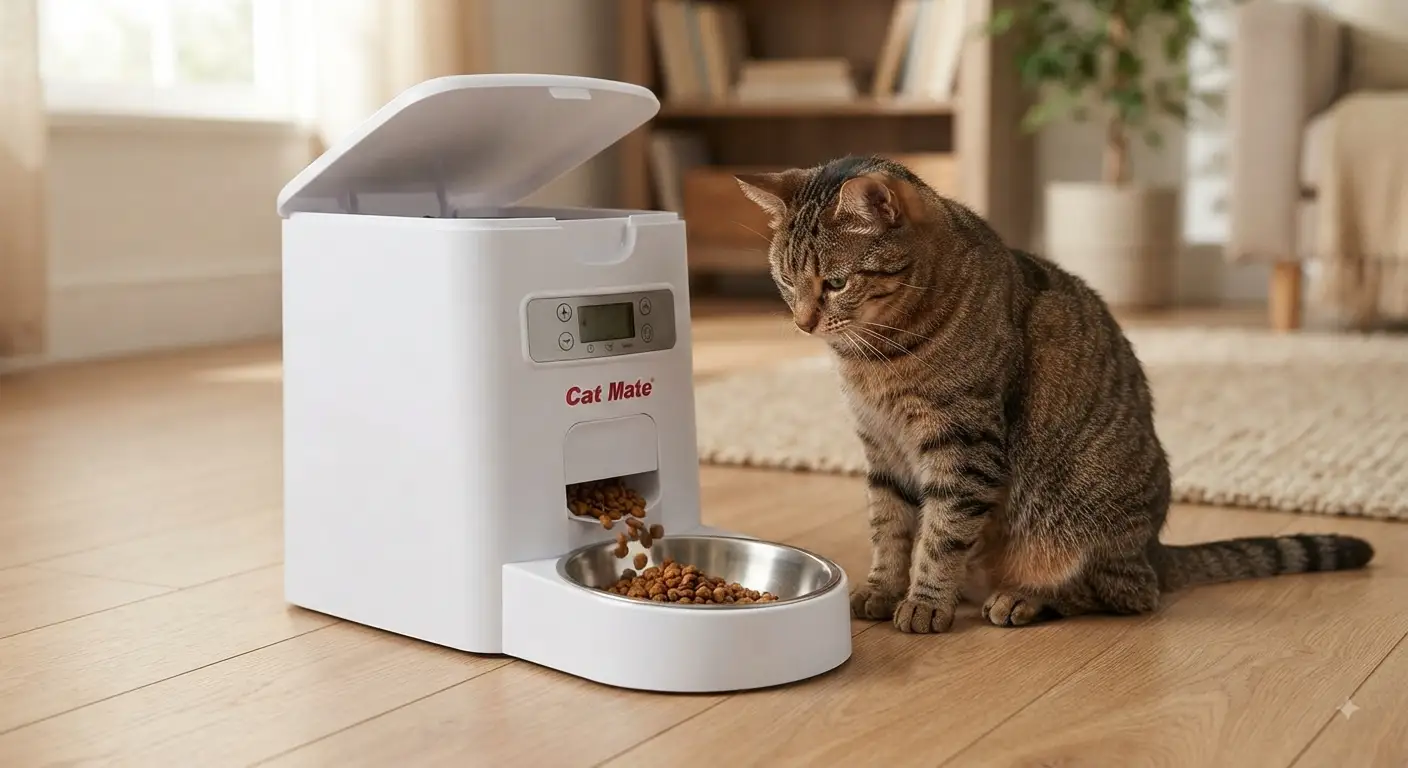
A cat mate automatic cat feeder is a battery-powered device that dispenses pre-measured meals of dry or wet food on a programmable schedule, so your cat eats on time whether you’re at the office, on a red-eye flight, or just sleeping in on a Saturday. If you’ve ever sprinted home from happy hour because you forgot your cat’s 6 p.m. dinner, you already understand the appeal 🐱⏰. The Cat Mate lineup, made by the UK-based company Closer Pets (formerly Pet Mate), has quietly become one of the most trusted names in scheduled feeding — largely because it does one thing extremely well instead of chasing every smart-home gimmick.
This guide breaks down seven real, currently available feeders — five from Cat Mate’s own catalog and two well-regarded alternatives — so you can compare capacity, food compatibility, and everyday reliability side by side. We’ll also walk through setup, common mistakes, safety standards, and real-world scenarios so you’re not just picking a box off a shelf; you’re matching a feeder to your actual cat and actual schedule. Adult cats generally do best on one or two measured meals a day, according to Cornell University’s Feline Health Center, though kittens and cats with certain health conditions may need a different rhythm — something worth keeping in mind as you compare portion sizes below. Let’s dig in.
Quick Comparison: Top Picks at a Glance
Short on time? Here’s the fast answer before the full breakdown.
| Category | Winner | Why |
|---|---|---|
| Best overall | Cat Mate C500 | Handles wet and dry food with ice-pack cooling |
| Best budget pick | Cat Mate C200 | Simple, reliable, single-battery operation |
| Best for large households | PetSafe Healthy Pet Simply Feed | 24-cup hopper, up to 12 meals a day |
| Best smart/app-controlled | PETLIBRO Granary WiFi | Remote scheduling and portion tracking |
Looking at the table above, the Cat Mate C500 earns its spot as the default recommendation because it’s the only model here that comfortably handles both wet and dry food without needing a plug. If your priority is raw capacity for a multi-cat household, the PetSafe Healthy Pet Simply Feed trades wet-food versatility for sheer volume. Budget-conscious owners with a single easygoing cat should start with the Cat Mate C200 before spending more.
💬 One click helps other shoppers make an informed choice too! 😊
Top 7 Cat Mate Automatic Cat Feeders — Expert Analysis
We researched real spec sheets, verified retailer listings, and aggregated customer feedback from Amazon, Chewy, and Walmart to rank these seven feeders from entry-level to premium. Every model below is a genuine, currently listed product — not a placeholder.
1. Cat Mate C500 — most versatile for wet and dry food
The reason the Cat Mate C500 tops this list is simple: it’s one of the few timed feeders in its price bracket that reliably keeps wet food fresh instead of just kibble. It uses a three-button LCD control panel to program up to five meals a day — one served immediately and four scheduled in 10-minute increments — and it distinguishes AM from PM automatically. What that means in practice is you can set a realistic multi-meal schedule in under two minutes without an app or a manual open on your lap.
Twin ice packs sit beneath the rotating tray and keep canned or semi-moist food safely cool, which most reviewers say holds up for six to eight hours, longer if the packs go in frozen. Cats.com’s hands-on testing of the C500 echoes this, ranking it among the top automatic feeders specifically for its ability to handle wet food reliably over multiple weeks of use. Who’s this for? Owners feeding wet food, owners managing a cat with a medical diet that calls for small frequent meals, and anyone who’s tired of dry-only dispensers. Reviews consistently report that the locking lid and dishwasher-safe tray make this one of the easier feeders to keep hygienic, though a handful of buyers note the unit runs on batteries only, with no plug-in backup — something to plan around if you’re gone more than a few days.
Pros:
- ✅ Handles wet, dry, and semi-moist food equally well
- ✅ Ice packs genuinely extend wet food freshness
- ✅ Dishwasher-safe lid and tray for easy cleanup
Cons:
- ❌ No plug-in power option, batteries only
- ❌ LCD programming takes a short learning curve at first
Expect to pay in the $40-$55 range at the time of writing, and given the wet-food capability most single-food-type feeders can’t match, this is genuinely good value for households that don’t feed exclusively dry kibble.
2. Cat Mate C300 — best compact ice-pack feeder for smaller households
The Cat Mate C300 is essentially the C500’s smaller sibling, trimmed down to three meals a day instead of five. Each of its food compartments holds about 11.5 ounces of wet food (or the dry-food equivalent), enough for a single generous meal or a smaller multi-cat portion. The first compartment sits open by default so your cat can eat right away, while the remaining two rotate into place at the scheduled times.
What sets it apart in practice is the tighter footprint — at roughly 8 inches wide, it fits on a counter or in a cabinet corner more easily than the bulkier C500. It runs on three AA batteries rated for up to 12 months of use, which is a meaningful convenience factor: you’re not swapping batteries every few weeks like some cheaper timers require. This model suits owners who want ice-pack freshness but don’t need five programmable slots — think a two-meal weekday routine plus a weekend catch-all setting. Aggregated owner feedback is thinner than for the flagship C500 simply because it sells in smaller volumes, but the mechanism and materials are identical in design philosophy, so the same reliability expectations reasonably apply.
Pros:
- ✅ Compact size fits tight counter spaces
- ✅ Twin ice packs keep wet food cool for hours
- ✅ Battery life rated up to 12 months
Cons:
- ❌ Only 3 meal slots versus 5 on the C500
- ❌ Smaller compartment size limits large-breed portions
Pricing typically lands around $30-$45, making it a reasonable middle-ground pick if the C500’s five-meal complexity is more than you need.
3. Cat Mate C200 — best budget pick for a simple routine
If you just need something that works without a learning curve, the Cat Mate C200 is where to start. It’s a two-bowl, 48-hour mechanical timer feeder — no digital display, no app, just a dial you twist to the desired release time. Each bowl holds up to 14 ounces of wet or dry food, and a removable ice pack sits underneath to slow spoilage.
The practical upside here is dead-simple setup: charge the ice pack overnight, load the bowls, twist the dial, done. It runs on a single AA battery rated for roughly a year of use, which is about as low-maintenance as automatic feeders get. This is the right call for owners who travel for a day or two at a time, feed twice daily, and don’t need granular portion control. Reviews consistently describe it as reliable for its price but genuinely lightweight — several owners mention screwing it to a board or weighting it down because determined or playful cats can knock it around. The timer is mechanical rather than digital, so accuracy runs within roughly plus-or-minus an hour rather than to-the-minute precision.
Pros:
- ✅ Extremely simple dial-based setup
- ✅ Runs up to 12 months on one battery
- ✅ Budget-friendly compared to digital models
Cons:
- ❌ Lightweight plastic can tip if a cat paws at it
- ❌ Mechanical timer isn’t minute-precise
At around $20-$30, this is genuinely the most accessible entry point into the Cat Mate lineup, and it’s a smart first purchase before committing to a pricier digital model.
4. Cat Mate C50 — best low-tech carousel for dry food routines
The Cat Mate C50 takes a different mechanical approach: a five-compartment carousel tray that rotates to reveal a fresh bowl of dry food at each scheduled interval, similar in concept to the original C20 design that Cat Mate has offered for decades. Each compartment holds a modest but workable portion, which in practice means it suits cats eating measured kibble meals rather than large single servings.
What makes this model worth considering is its mechanical simplicity — there’s no LCD screen to fail and no firmware to update, just a dependable rotating mechanism that’s been refined over multiple product generations. Who should buy it: owners who specifically want a no-frills, dry-food-only carousel feeder as either a primary unit for a single easygoing cat or a backup feeder for weekend trips. Because it’s one of the less-reviewed models in the current lineup compared to the C500 and C3000, the honest takeaway is that owner feedback volume is limited online; what is consistently noted across the broader Cat Mate carousel-style feeders is that they hold up well to years of daily use as long as the cat isn’t an aggressive lid-pryer.
Pros:
- ✅ Simple rotating mechanism with no digital parts to fail
- ✅ Long product heritage in the carousel-feeder category
- ✅ Good as a dedicated dry-food-only solution
Cons:
- ❌ Not designed for wet or semi-moist food
- ❌ Fewer independent reviews than newer digital models
Expect a price in the $30-$40 range, positioning it as a straightforward mid-tier option for dry-food households that don’t need Bluetooth or app control.
5. Cat Mate C3000 — best for larger dry-food capacity
Stepping up in size, the Cat Mate C3000 is a hopper-style dispenser that holds up to 6.5 pounds of dry kibble and programs up to three meals within a 24-hour window. Beyond the basic schedule, it includes four distinct modes: Extra Feed for a bonus meal, Manual Feed for on-demand portions, Advance Feed to trigger the next scheduled meal early, and Frequent Feed, which splits the day into several smaller portions — genuinely useful for cats managed for diabetes or other conditions requiring smaller, more frequent meals rather than large ones.
In practice, the larger hopper means fewer refills, which matters if you’re feeding multiple cats from one unit or you travel often. It runs on four C batteries rated for roughly six to nine months depending on use. Reviews are mixed but instructive: several long-term owners report years of trouble-free service, while others note the dispensing noise startles cats initially and that portion consistency can vary slightly between units — one recurring theme in aggregated feedback is that a persistent cat can eventually learn to nudge extra kibble loose through the dispensing gap, so this isn’t the pick for an especially food-motivated escape artist.
Pros:
- ✅ Large 6.5 lb hopper means fewer refills
- ✅ Four feeding modes including diabetic-friendly frequent feed
- ✅ Multi-year lifespan reported by long-term owners
Cons:
- ❌ Dry food only, no wet or semi-moist compatibility
- ❌ Some units show inconsistent portion sizing over time
Pricing generally falls in the $40-$55 range, and for households wanting weeks between refills, that premium over the C200 or C50 is easy to justify.
6. PetSafe Healthy Pet Simply Feed — best for large households needing volume
Stepping outside the Cat Mate brand for a genuine point of comparison, the PetSafe Healthy Pet Simply Feed is built by a company with nearly three decades in pet tech, and it shows in the engineering. Its standout feature is a 24-cup translucent hopper paired with an anti-jam conveyor mechanism, letting you schedule up to 12 meals a day with portions as small as one-eighth of a cup or as large as four cups.
What this means in real terms is precision at scale — this feeder can manage a multi-cat household’s entire dry-food rotation from a single hopper for weeks at a time, and the Slow Feed setting dispenses a scheduled meal gradually over 15 minutes for cats that gulp and then vomit or bloat. Compared with the Cat Mate C3000, the PetSafe Healthy Pet Simply Feed offers roughly three times the meal-schedule granularity and a genuinely bigger hopper, but it’s strictly a dry and semi-moist food device — no wet food, no ice packs. It also supports an optional AC power adapter, unlike every Cat Mate model on this list, which is a real advantage for owners who don’t want to think about batteries at all.
Pros:
- ✅ 24-cup hopper handles weeks of dry food
- ✅ Optional AC adapter removes battery dependence
- ✅ Slow Feed mode helps prevent gulping and vomiting
Cons:
- ❌ No wet food or ice-pack compatibility
- ❌ Bulkier footprint than any Cat Mate model here
Current listings put it around $90-$135 depending on retailer and included accessories, positioning it as the premium, high-capacity choice rather than a budget swap for the Cat Mate lineup.
7. PETLIBRO Granary WiFi — best smart, app-controlled alternative
For owners who want remote visibility, the PETLIBRO Granary WiFi brings dual-band WiFi and full app control to a 5-liter dry-food hopper, letting you schedule one to ten meals a day with portion sizes adjustable in 20-milliliter increments. What that granularity means practically is you can fine-tune portions far more precisely than any dial or button-based Cat Mate model, and you get push notifications if the hopper jams or runs low.
This is the pick for tech-comfortable owners who want to check in remotely or adjust a schedule on the fly from a phone while traveling, rather than pre-programming everything before you leave. It’s worth noting honestly that connectivity isn’t flawless: aggregated reviews and hands-on testing from pet-focused reviewers describe occasional WiFi pairing hiccups on first setup, sometimes requiring a firmware update via microSD card to resolve. Once connected, though, owners report the scheduling and low-food alerts work as advertised. Compared with the mechanical simplicity of the Cat Mate C50, this is a fundamentally different philosophy — more moving digital parts, but far more remote control.
Pros:
- ✅ Full remote scheduling and monitoring via app
- ✅ Precise 20 ml portion increments
- ✅ Low-food and jam alerts sent to your phone
Cons:
- ❌ Initial WiFi setup can be finicky for some users
- ❌ Dry food only, no wet food support
Expect to pay roughly $79-$99 at the time of writing, a fair premium over the analog Cat Mate models if remote control genuinely matters to your routine.
Full Feature Comparison: Cat Mate Lineup vs Alternatives
| Feeder | Max Meals/Day | Food Type | Power | Best For |
|---|---|---|---|---|
| Cat Mate C500 | 5 | Wet + Dry | 3 AA batteries | All-around wet/dry versatility |
| Cat Mate C300 | 3 | Wet + Dry | 3 AA batteries | Smaller households |
| Cat Mate C200 | 2 | Wet + Dry | 1 AA battery | Simple, budget setups |
| Cat Mate C50 | 5 | Dry only | Battery carousel | No-frills dry routines |
| Cat Mate C3000 | 3 (+ modes) | Dry only | 4 C batteries | Large dry-food capacity |
| PetSafe Healthy Pet Simply Feed | 12 | Dry only | Battery + optional AC | Large multi-cat households |
| PETLIBRO Granary WiFi | 10 | Dry only | Battery + AC | Remote app control |
Scanning across this table, a clear pattern emerges: the Cat Mate C500 and Cat Mate C300 are the only two feeders here built specifically around wet-food freshness, while the PetSafe Healthy Pet Simply Feed and PETLIBRO Granary WiFi trade that versatility for far larger capacity and finer schedule control. If your cat eats canned food even part-time, the wet-food-capable Cat Mate models are worth the trade-off in raw hopper size.
✨ Don’t miss these exclusive deals!
🔍 Take your cat’s feeding routine to the next level with this carefully curated lineup. Click a highlighted item to check current pricing and availability. These picks will help you get consistent, stress-free mealtimes the whole household will enjoy!
What Is a Cat Mate Automatic Cat Feeder?
A cat mate automatic cat feeder is a battery-powered, timer-controlled device that portions and releases cat food at pre-set times, so your cat’s meal schedule stays consistent even when you can’t be there to serve it by hand. Models range from simple mechanical dial timers to digital LCD units capable of five or more programmed meals a day.
How to Choose a Cat Mate Automatic Cat Feeder
Picking the right model comes down to matching the mechanism to your cat’s diet and your schedule, not just grabbing whichever one has the best photos. Here’s the framework we’d walk a friend through:
- Confirm your food type first. If your cat eats any wet or semi-moist food, narrow your search to ice-pack models like the Cat Mate C500 or Cat Mate C300 immediately — dry-only hoppers simply aren’t built to keep canned food safe.
- Count your actual meals, not the maximum available. A five-meal feeder is wasted on a cat who eats twice a day; the Cat Mate C200 covers that routine without paying for capacity you won’t use.
- Match hopper size to trip length. Weekend trips are fine with any model here; week-long absences favor higher-capacity units like the PetSafe Healthy Pet Simply Feed or Cat Mate C3000.
- Factor in your cat’s personality. A determined, food-motivated cat can sometimes pry open lighter carousel-style units; if that sounds like your cat, prioritize models with locking lids and reinforced compartments.
- Decide how much digital control you actually want. If you like checking in remotely, the PETLIBRO Granary WiFi earns its higher price; if you’d rather set it and forget it, a mechanical Cat Mate model removes app dependency entirely.
- Budget for batteries, not just the unit. Digital models like the C500 draw more power than simple dial timers, so factor recurring battery costs into your real cost of ownership.
- Read the return policy before you buy. Every cat interacts with feeders differently, and even well-reviewed models occasionally get outsmarted by an unusually clever cat.
Cat Mate Automatic Cat Feeder vs. Traditional Feeding Methods
Compared with leaving a bowl out all day (free-feeding) or hand-feeding on your own schedule, a timed automatic feeder changes the equation in a few measurable ways.
| Factor | Free-Feeding / Bowl | Cat Mate Automatic Feeder |
|---|---|---|
| Portion control | Poor — cat self-regulates | Strong — fixed portions per meal |
| Obesity risk | Higher in indoor cats | Lower with measured meals |
| Consistency while away | None | Maintained on schedule |
| Food freshness (wet food) | Degrades within hours | Extended via ice packs |
| Multi-cat fairness | One cat can dominate the bowl | Each unit serves its own portion |
A peer-reviewed feeding study published in the Journal of Feline Medicine and Surgery found that an automatic feeder providing individualized, scheduled meals made weight-loss programs easier to manage in multi-cat households, and that higher-frequency scheduled feeding reduced food-seeking behavior compared with just two large meals a day. In practical terms, that means the value of an automatic feeder isn’t only convenience — it’s a legitimate tool for weight management in cats prone to overeating when food is left out continuously.
Common Mistakes to Avoid When Buying a Cat Mate Automatic Cat Feeder
Even a well-reviewed feeder can disappoint if it’s mismatched to your situation. Here’s what trips up first-time buyers most often.
- Buying a dry-only hopper for a wet-food cat. Models like the Cat Mate C3000 and Cat Mate C50 simply weren’t engineered for canned food; forcing it in risks spoilage and jams.
- Underestimating a clever cat. If your cat already opens cabinets or pries open containers, skip the lightest carousel units and go straight to a locking-lid model.
- Ignoring battery type and backup power. A feeder with no AC option, like most Cat Mate models, needs a battery-check routine before every extended trip.
- Overbuying meal capacity. Paying for a 12-meal-a-day feeder like the PetSafe Healthy Pet Simply Feed when your cat eats twice daily adds cost without adding value.
- Skipping the first test run. Always run a full cycle at home before relying on any feeder for a real absence — this catches jamming, portion errors, or startling noises early.
Features That Actually Matter (and Ones That Don’t)
Marketing copy loves to pile on features, but not every spec moves the needle for a typical household. Locking, tamper-resistant lids matter enormously — they’re the single biggest factor separating feeders cats can defeat from ones they can’t. Ice-pack cooling matters just as much if you’re feeding anything besides dry kibble. Battery life ratings matter practically, since swapping batteries every few weeks gets old fast.
On the other hand, an ultra-high maximum meal count is often marketing filler; almost no household actually programs 10 or 12 distinct meals a day. Similarly, app connectivity is a genuine convenience for travel-heavy owners, but for a cat with a stable, predictable routine, it adds a point of failure (WiFi drops, firmware updates) without adding real-world benefit. The lesson: prioritize lid security, food-type compatibility, and battery runtime over headline meal counts.
Safety, Regulations, and Standards
Because feeders sit in direct, repeated contact with your cat’s food, material safety is worth a closer look than most buyers give it. All models featured here use BPA-free plastic construction, which matters because the FDA’s guidance on safe pet food handling recommends storing dry pet food in a cool, dry place below 80°F and keeping it in its original bag with the top tightly folded to prevent nutrient breakdown — a good reminder that even the best feeder can’t compensate for food that was stored improperly before it went into the hopper. There’s no dedicated federal agency that certifies automatic pet feeders the way the CPSC oversees children’s products, so material claims like “BPA-free” and “food-grade plastic” are largely self-reported by manufacturers rather than independently verified for pet-specific use — a reasonable rule of thumb is to favor established brands with a multi-year track record, like Cat Mate and PetSafe, over unfamiliar imports with no verifiable safety history. Always wash removable trays and bowls regularly regardless of the “dishwasher-safe” label, since bacterial buildup in food residue is a bigger everyday risk than the plastic itself.
Long-Term Cost and Maintenance
The sticker price is only part of the real cost of owning an automatic feeder. Battery-powered digital models like the Cat Mate C500 typically run through a set of AA batteries every few months of active five-meal use, which adds up to roughly $10-$20 a year in replacement batteries depending on brand and usage frequency. Mechanical models like the Cat Mate C200 sip power so slowly that a single battery can last close to a year, keeping ongoing costs minimal. Models with an optional AC adapter, such as the PetSafe Healthy Pet Simply Feed, can eliminate battery costs almost entirely if you keep them plugged in at home and reserve batteries purely as travel backup.
Replacement parts are the other line item worth budgeting for — ice packs occasionally crack after repeated freeze-thaw cycles, and rotating trays can wear at the seams after a few years of daily use. Weighed against boarding fees or a pet sitter, though, even a $50 feeder pays for itself within a single extended trip, making the long-term value proposition strong across this entire lineup.
Getting Started: Setup and the First 30 Days
Unboxing a new feeder is straightforward, but a few early habits prevent most of the problems owners run into later.
Start by freezing any included ice packs for a full 24 hours before first use — a partially frozen pack won’t hold wet food safely through a workday. Install fresh batteries (not reused ones) and run a full test cycle at home for at least 24-48 hours while you’re present to confirm portions dispense correctly and on schedule. Watch your cat’s first reaction to the mechanism’s noise; most cats adjust within a few days, but a startled cat may need the feeder placed somewhere they already feel comfortable rather than a brand-new spot.
During the first month, resist the urge to immediately max out the schedule. Start with your cat’s normal meal times and portions, then adjust gradually once you’ve confirmed the mechanism is dispensing consistently. Clean removable trays weekly at minimum, and more often if you’re feeding wet food, since residue attracts pests faster than dry kibble ever will. Finally, keep the original packaging and receipt for at least 60 days; if a unit is going to jam or malfunction, it typically shows up within the first few dispensing cycles.
Real-World Scenarios: Matching a Feeder to Your Household
The single-cat apartment dweller working long hours: A cat eating twice daily on a stable indoor routine doesn’t need five meal slots or WiFi. The Cat Mate C200 covers this scenario affordably, and its 48-hour timer means a rare late night at the office won’t leave your cat hungry.
The multi-cat household on a mixed wet-and-dry diet: With several cats and different dietary needs, capacity and freshness both matter. The Cat Mate C500, potentially paired with a second unit, keeps wet-food portions safe while letting you stagger schedules by cat.
The frequent traveler who wants visibility from the road: Someone gone for a week at a time, checking in from an airport lounge, benefits most from the PETLIBRO Granary WiFi or the AC-adaptable PetSafe Healthy Pet Simply Feed, both of which reduce the anxiety of not knowing whether a meal actually dispensed.
Problem → Solution: Fixing Common Cat Mate Feeder Issues
Problem: Wet food smells or spoils faster than expected. Solution: freeze ice packs a full day ahead, and avoid programming wet-food meals more than 6-8 hours apart on ice-pack models like the Cat Mate C300.
Problem: My cat pries the lid open early. Solution: switch to a locking-lid model like the Cat Mate C500, or add a light weight on top of lighter units like the Cat Mate C200.
Problem: Portions seem inconsistent between cycles. Solution: check that the hopper isn’t overfilled (compacted kibble can jam dispensing gears), common with heavier hoppers like the Cat Mate C3000.
Problem: My cat is scared of the dispensing noise. Solution: run a few manual test dispenses while you’re home and present, so the sound becomes associated with mealtime rather than something startling.
Problem: WiFi feeder won’t connect on first setup. Solution: on the PETLIBRO Granary WiFi, a firmware update via microSD card resolves most first-time pairing failures, per the manufacturer’s own troubleshooting guidance.
FAQ: Cat Mate Automatic Cat Feeder Questions
❓ Is a Cat Mate automatic cat feeder good for wet food?
❓ How many batteries does a Cat Mate C500 feeder need?
❓ Can an automatic feeder help an overweight cat lose weight?
❓ How long does wet food stay fresh in a Cat Mate feeder?
❓ Do Cat Mate feeders work for multiple cats?
Conclusion
Choosing the right cat mate automatic cat feeder really comes down to two questions: what does your cat eat, and how long are you realistically away between meals? For most households feeding any wet food, the Cat Mate C500 remains the strongest all-around pick thanks to its ice-pack freshness system and flexible five-meal schedule. Budget-focused owners with a simple two-meal routine get excellent value from the Cat Mate C200, while larger households or cats needing frequent small portions are better served by the higher-capacity Cat Mate C3000 or the app-controlled PETLIBRO Granary WiFi.
None of these feeders are flawless — every model on this list has at least one honest trade-off, whether that’s battery-only power, WiFi setup hiccups, or a lightweight build that a determined cat could eventually outsmart. But matched correctly to your cat’s diet and your travel patterns, any of these seven feeders will genuinely reduce the daily pressure of a rigid feeding schedule, and that’s worth something on its own.
Recommended for You
- Are Slow Feeders Good for Dogs? 7 Proven Benefits Vets Love (2026)
- 7 Best Large Dog Slow Feeder Bowls in 2026: Expert Tested
- Best Dog Slow Feeder in 2026: 5 Expert-Tested Bowls That Stop Bloat
Disclaimer: This post contains affiliate links. As an Amazon Associate, I earn from qualifying purchases made through these links, at no additional cost to you.
✨ Found this article helpful? Share it with someone who needs it! 💬🤗