In This Article
Why a Silicone Slow Feed Dog Bowl Beats a Regular Dish
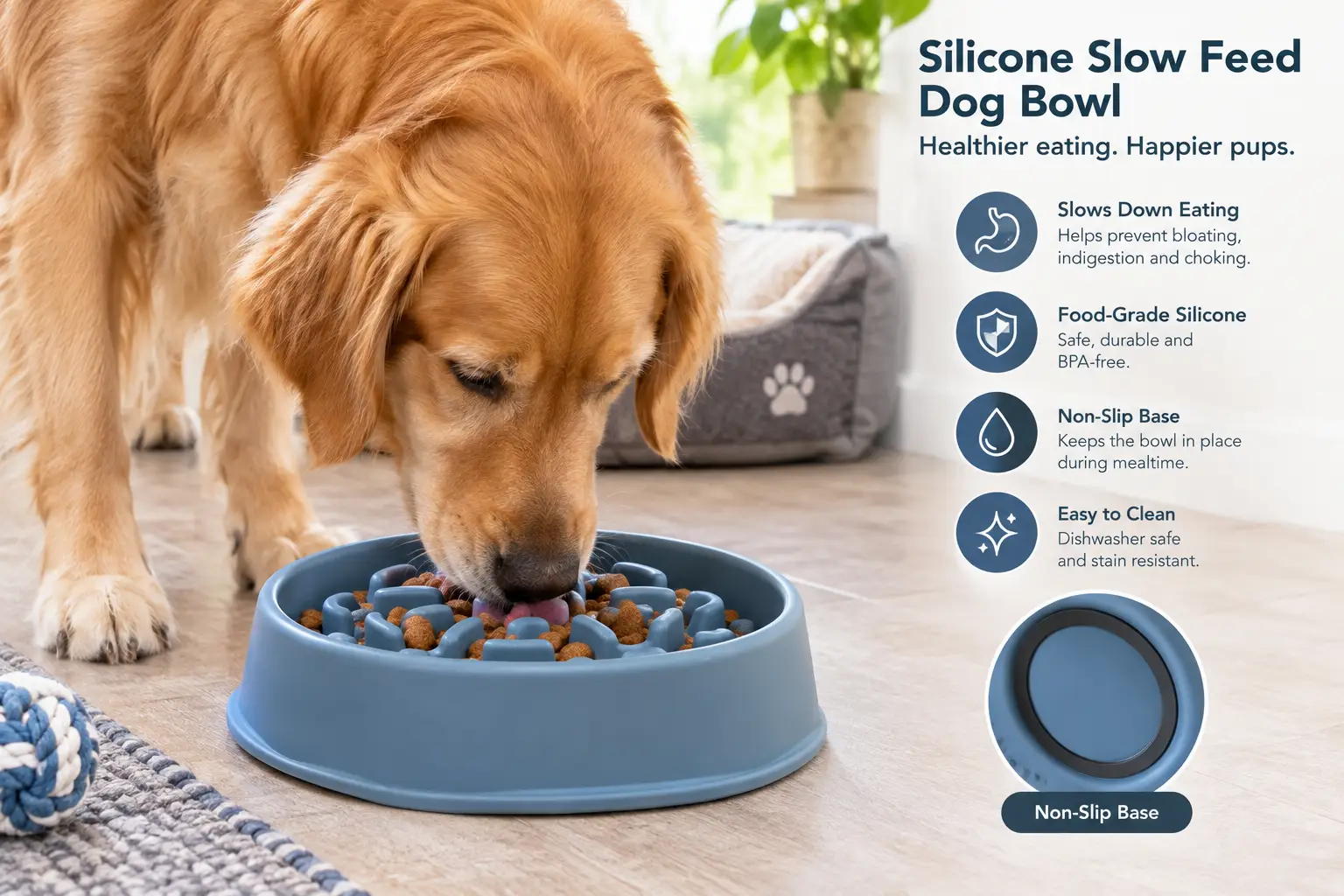
A silicone slow feed dog bowl is a soft, food-grade silicone dish (or bowl insert) molded with ridges, spirals, fins, or bristles that force your dog to work around obstacles for every bite. The goal is simple: stretch a 30-second gulp-fest into a calmer, multi-minute meal that’s easier on the stomach.
If your dog inhales dinner like it’s a timed competition, you already know the soundtrack: frantic crunching, a loud cough, and sometimes an encore you have to clean off the rug. Speed eating isn’t just gross, though. According to Cornell University’s Riney Canine Health Center, eating too quickly is one of several recognized risk factors for gastric dilatation-volvulus (GDV), the life-threatening emergency most people call “bloat,” alongside a deep chest and exercising right after meals.
So why silicone specifically, when hard plastic slow feeders have been around for years? Three practical reasons. First, silicone is quiet and gentle, so it won’t clatter across tile or scrape a sensitive muzzle. Second, many silicone designs use suction cups or grippy bases, which matters for dogs that “chase” their bowl around the kitchen. Third, quality food-grade silicone is non-porous, dishwasher-friendly, and doesn’t crack the way cheap plastic can.
That said, a silicone slow feed dog bowl isn’t a magic wand. Some designs are too easy for determined eaters, some are too small for big breeds, and nearly all of them can be shredded by a committed chewer. In this guide, you’ll find seven real, currently sold options, an honest breakdown of who each one suits, and practical advice on sizing, cleaning, and training your dog to actually use it. No fake testing stories—just spec-sheet analysis, aggregated review themes, and the veterinary context you need to choose wisely.
Quick Comparison: Silicone Slow Feed Dog Bowl Picks at a Glance
| Product | Type | Capacity / Size | Grip Method | Price Range | Best for |
|---|---|---|---|---|---|
| Dexas Silicone Slow Feeder | Full bowl with bristles | ~48 oz, 8.5″ wide | Non-slip base | $20–$30 | Dexas Silicone Slow Feeder: medium-large gulpers |
| Wild One Slow Feeder | Full bowl / insert | 2.5 cups, 7.4″ | Silicone base ring + suction | $15–$25 | Wild One Slow Feeder: design-minded owners |
| Messy Mutts Silicone Interactive Slow Feeding Bowl | Full bowl | Medium (check listing) | Suction cups + raised edge | $15–$25 | Messy Mutts Silicone Interactive Slow Feeding Bowl: wet/raw feeders |
| Mighty Paw Spiral Slow Feeder Insert | Insert | Fits most standard bowls | Strong central suction | Under $20 | Mighty Paw Spiral Slow Feeder Insert: upgrading an existing bowl |
| Bestalk Silicone Slow Feeder Insert | Insert | Multiple sizes | Suction cups | $10–$15 | Bestalk Silicone Slow Feeder Insert: elevated feeders |
| OHMO Silicone Slow Feeder (Small) | Full bowl | ~5.9″ x 1″ | Large suction cup | $10–$15 | OHMO Silicone Slow Feeder (Small): toy breeds and puppies |
| Bifeaw Silicone Slow Feeder Bowl | Full bowl | Check size options | Non-slip base | Under $20 | Bifeaw Silicone Slow Feeder Bowl: budget buyers |
Prices are ranges at the time of writing and change often—always check the current price on Amazon.
Looking at the table above, the split is clear: full bowls like the Dexas Silicone Slow Feeder and Messy Mutts Silicone Interactive Slow Feeding Bowl give you a one-piece solution, while inserts like the Mighty Paw Spiral Slow Feeder Insert and Bestalk Silicone Slow Feeder Insert turn the stainless bowl you already own into a slow feeder for less money. If your dog weighs over 60 pounds, capacity is the column to watch—the OHMO Silicone Slow Feeder (Small) simply won’t hold a big dog’s meal.
💬 One click helps other shoppers make an informed choice too! 😊
Top 7 Silicone Slow Feed Dog Bowl Picks: Expert Analysis
Each pick below was chosen from products sold to US shoppers, covering budget, mid-range, and premium tiers. Where verified review data was thin, we say so plainly rather than filling the gap with guesses.
1. Dexas Silicone Slow Feeder — bristles that tame big gulpers
The Dexas Silicone Slow Feeder stands out because it doesn’t rely on ridges at all—it uses a forest of soft silicone bristles that kibble settles between.
Per retailer spec listings, it holds about 48 ounces and measures roughly 8.5 inches across and 2.75 inches tall, with a non-slip base, BPA- and phthalate-free construction, and dishwasher-safe cleanup. In practice, that 48-ounce volume comfortably handles a full meal for a 50- to 80-pound dog, and the bristle field means your dog has to lick and nose food free rather than scooping a mouthful from an open channel. Dexas also markets the bristles as gentle on gums; treat that as a nice side effect, not a dental-care plan.
Based on the design, this is the strongest choice here for a medium or large dog who defeats simple ridge bowls in seconds. It’s less ideal for wet food, because paté can pack into the bristle base and requires a real scrub. Across retailer listings, owner feedback tends to praise how effectively the bristles slow dry kibble, while the recurring caveat is cleaning effort with soft or sticky foods.
Pros:
- ✅ Bristle design is harder to “solve” than ridges
- ✅ Large capacity suits bigger dogs
- ✅ Dishwasher safe and BPA/phthalate free
Cons:
- ❌ Wet food clings between the bristles
- ❌ Not suitable for dogs who chew bowls
Expect to pay in the $20–$30 range—strong value if your dog has beaten cheaper bowls.
2. Wild One Slow Feeder — sleekest two-in-one design
The Wild One Slow Feeder is built for owners who want a slow feeder that doesn’t look like a kids’ toy on the kitchen floor.
According to Wild One’s own product page, it’s 100% silicone, BPA- and phthalate-free, holds 2.5 cups (600 ml), and measures 7.4 inches long by about 1.6 inches tall. It’s designed to nest inside the Wild One Standard Bowl or work freestanding on a silicone base ring that resists sliding. That dual use matters: you can run it as a standalone travel bowl, then drop it into the heavier stainless bowl at home for extra stability.
On paper, the ridges-and-valleys pattern is moderately challenging—enough to break up a gulper’s rhythm, but not the toughest maze in this lineup. That makes it a great fit for small-to-medium dogs, multi-dog homes that care about aesthetics, and anyone who travels. Verified review volume on Wild One’s site was very limited at the time of writing, so we can’t summarize broad owner sentiment with confidence; what we can verify is the build specs and dishwasher-safe cleanup.
Pros:
- ✅ Works freestanding or inside a matching bowl
- ✅ Lightweight and easy to pack for trips
- ✅ Clean, minimalist look in muted colors
Cons:
- ❌ Moderate challenge level for expert gulpers
- ❌ Amazon availability can vary by color
Usually found in the $15–$25 range; you’re paying partly for design, so check the current price.
3. Messy Mutts Silicone Interactive Slow Feeding Bowl — best for wet and raw diets
The Messy Mutts Silicone Interactive Slow Feeding Bowl is aimed at the owner who feeds a mix of kibble, canned, and raw food and hates cleaning splatter off the baseboards.
The brand describes grooves and a textured surface to slow intake, integrated suction cups to lock the bowl to the floor, and a raised outer edge to keep wet, dry, or raw food contained. It’s made from BPA/PVC-free food-grade silicone and is freezer safe. That freezer-safe detail is quietly useful: you can smear wet food into the grooves, freeze it, and turn dinner into a longer enrichment session for a bored or anxious dog.
Honestly analyzed, the raised edge is the real selling point. Many silicone slow feeders are flat-ish trays that let food escape over the side when a dog pushes hard; a lip changes that. It’s a natural fit for raw feeders and messy eaters, though the groove pattern is likely less effective with large kibble than a bristle bowl. We couldn’t verify a large body of US review data for this specific bowl, so weigh the specs over the star count.
Pros:
- ✅ Raised edge reduces spills and splatter
- ✅ Freezer safe for enrichment-style meals
- ✅ Suction cups keep it from wandering
Cons:
- ❌ Limited verified review data to lean on
- ❌ Suction needs a smooth, clean floor surface
Expect roughly $15–$25; worth it if mess control is your top priority.
4. Mighty Paw Spiral Slow Feeder Insert — easiest way to upgrade your current bowl
The Mighty Paw Spiral Slow Feeder Insert turns the stainless or ceramic bowl you already own into a slow feeder, so you keep your favorite heavy base.
Mighty Paw’s listing highlights six floppy silicone fins with two different textures, a strong suction attachment, a quick-pull paw tab for removal, BPA-free food-grade silicone, and top-rack dishwasher safety. The floppy fins are clever: they bend, so food hides behind them rather than simply sitting in a channel, and the two textures add lick-friendly zones for soft food or spreads.
From a value angle, this is the smartest buy for owners who already like their bowl’s height, weight, or look. Stainless steel bowls are heavy and hard to tip, so pairing one with a suction insert gives you the best of both materials. The main thing to weigh is fit: an insert only works if your bowl has a flat, smooth floor wide enough for the suction base. Owner feedback on inserts generally centers on that same theme—great when it fits, frustrating when the bowl floor is curved or textured.
Pros:
- ✅ Reuses the bowl you already own
- ✅ Pull tab makes removal mess-free
- ✅ Two textures work for kibble and spreads
Cons:
- ❌ Needs a flat, smooth bowl bottom
- ❌ Flexible fins tempt chewers to bite
Typically under $20 depending on size and color—excellent value per dollar.
5. Bestalk Silicone Slow Feeder Insert — built for elevated feeders
The Bestalk Silicone Slow Feeder Insert is marketed specifically to fit basic bowls and elevated dog bowls, which makes it a practical pick for large dogs that eat from a raised stand.
It’s a soft silicone insert with suction cups on the underside, sold in multiple sizes for small, medium, and large dogs. Here’s why the elevated-bowl angle matters: raised feeders often use removable stainless bowls, and those bowls are exactly where a separate slow-feeding insert shines, because you can’t swap a raised stand for a floor-level silicone bowl without changing your dog’s whole setup.
Based on the design, it’s best for owners who’ve already invested in a raised feeder and want to slow things down without buying new hardware. The tradeoff is the same as any insert: you need to measure your bowl’s inner floor before ordering. Retail review volume we could verify was small (a few dozen ratings on Walmart’s listing), with owners mainly noting that it fit their existing bowls well; treat that as encouraging but limited evidence.
Pros:
- ✅ Designed to fit raised-feeder bowls
- ✅ Multiple sizes for different dogs
- ✅ Low cost compared with replacing a feeder
Cons:
- ❌ Must measure bowl diameter carefully first
- ❌ Smaller verified review base than bigger brands
Usually around $10–$15—an easy, low-risk upgrade.
6. OHMO Silicone Slow Feeder (Small) — gentle choice for tiny mouths
The OHMO Silicone Slow Feeder (Small) is sized for puppies, cats, and small dogs, with a decorative “Tree of Life” ridge pattern.
The listing gives dimensions of about 15 x 15 x 2.5 cm (roughly 5.9 inches wide and 1 inch tall), a large suction cup underneath for smooth tile or feeding mats, and non-toxic, BPA-free food-grade silicone that’s machine washable. The shallow 1-inch height matters for short-snouted breeds like Pugs or French Bulldogs, which can struggle with deep slow feeders that force them to jam their faces into narrow gaps.
Notably, OHMO’s own listing warns that it isn’t meant for aggressive chewers—an honest disclosure more brands should make. That points to the ideal user: a small, gentle eater who gobbles but doesn’t destroy. It’s not a fit for medium or large dogs; the capacity is simply too small for a full meal. Verified US review detail was limited, so focus on the sizing specs when deciding.
Pros:
- ✅ Shallow profile suits flat-faced breeds
- ✅ Strong single suction cup resists tipping
- ✅ Machine washable and BPA free
Cons:
- ❌ Too small for medium or large dogs
- ❌ Brand warns against use with heavy chewers
Generally around $10–$15—good value for toy breeds.
7. Bifeaw Silicone Slow Feeder Bowl — budget-friendly best seller
The Bifeaw Silicone Slow Feeder Bowl is a no-frills option that, according to third-party Amazon sales tracking, ranked among the top sellers in its category in mid-2026.
Its listing describes dishwasher- and microwave-safe silicone, a puzzle-style ridge layout, and a non-slip design, offered in several colors. Microwave safety is mainly useful if you warm refrigerated wet food or bone broth directly in the bowl—just stir and test the temperature before serving. The non-slip base helps on hard floors, though it isn’t the same as true suction.
On paper, this bowl is for budget-minded owners who want to test whether a silicone slow feed dog bowl helps before spending more. Strong sales volume suggests many shoppers are satisfied enough, but sales rank isn’t the same as verified quality, and we couldn’t confirm detailed spec data such as exact capacity for every size. Check the size chart against your dog’s meal volume before buying.
Pros:
- ✅ Low entry price for first-time buyers
- ✅ Dishwasher and microwave safe
- ✅ Several colors and size options
Cons:
- ❌ Limited published specs on capacity
- ❌ Non-slip base is weaker than suction
Typically under $20—a sensible starter bowl if the sizing fits.
✨ Don’t miss these smart mealtime upgrades!
🔍 Take your dog’s mealtime to the next level with this carefully curated lineup. Click a highlighted item to check current pricing and availability. These picks will help you get calmer, healthier meals the whole family will enjoy!
Side-by-Side: Challenge Level, Cleaning, and Durability
| Product | Challenge Level | Cleaning Effort | Chewer Resistance | Best for |
|---|---|---|---|---|
| Dexas Silicone Slow Feeder | High | Moderate (bristles) | Low | Dexas Silicone Slow Feeder: expert gulpers |
| Wild One Slow Feeder | Moderate | Easy | Low | Wild One Slow Feeder: travel + home |
| Messy Mutts Silicone Interactive Slow Feeding Bowl | Moderate | Easy | Low | Messy Mutts Silicone Interactive Slow Feeding Bowl: wet/raw |
| Mighty Paw Spiral Slow Feeder Insert | Moderate–High | Easy | Low | Mighty Paw Spiral Slow Feeder Insert: steel bowl owners |
| Bestalk Silicone Slow Feeder Insert | Moderate | Easy | Low | Bestalk Silicone Slow Feeder Insert: raised feeders |
| OHMO Silicone Slow Feeder (Small) | Moderate | Easy | Low | OHMO Silicone Slow Feeder (Small): small dogs |
| Bifeaw Silicone Slow Feeder Bowl | Moderate | Easy | Low | Bifeaw Silicone Slow Feeder Bowl: budget testing |
Notice the “Chewer Resistance” column reads “Low” across the board—that’s not a typo. Silicone is soft by nature, so none of these are safe to leave with an unsupervised chewer. If you need maximum challenge, the Dexas Silicone Slow Feeder leads; if you want the easiest cleanup, any of the ridge-style bowls beat bristles.
Getting Started: Your First 30 Days With a Silicone Slow Feeder
Buying the bowl is the easy part. Getting a food-obsessed dog to use it calmly takes a short adjustment period, and a little planning prevents frustration.
Week 1: Make it easy
Start by filling the slow feeder only partway—or scatter part of the meal in the bowl and part in their old dish. The goal is a win, not a puzzle they give up on. Stay nearby and watch for stress signals like pawing aggressively, barking at the bowl, or walking away.
Week 2: Full meals, full supervision
Move to full meals in the slow feeder. Supervision matters most now, because frustrated dogs are the ones most likely to start chewing the silicone. If you see teeth on the ridges rather than tongue and nose, pick the bowl up once the meal is done and don’t leave it out as a toy.
Weeks 3–4: Fine-tune
Time a few meals. If your dog now takes several minutes instead of 30 seconds, you’re in a good place. If they still finish almost instantly, the pattern is too easy—consider a bristle bowl like the Dexas Silicone Slow Feeder or adding an insert such as the Mighty Paw Spiral Slow Feeder Insert.
Ongoing maintenance schedule
- ✅ Rinse after every meal so fats don’t dry into the ridges
- ✅ Run it through the dishwasher (top rack) every day or two
- ✅ Inspect weekly for tears, bite marks, or loose suction cups
- ✅ Replace any bowl with missing chunks immediately
A common first-month mistake is leaving wet food residue overnight. Silicone itself resists odors well, but food film in deep grooves won’t stay fresh.
Which Bowl for Which Dog? Three Real-World Scenarios
Specs are useful, but decisions get easier when you picture an actual household. Here are three common profiles and the reasoning behind each match.
Scenario 1: The 75-pound Lab who vacuums kibble
Picture a young Labrador eating two meals of about two cups each, with an owner who’s heard bloat warnings and wants real resistance. Budget is flexible, around $30. The best match is the Dexas Silicone Slow Feeder, because the 48-ounce capacity fits the meal and the bristle field is meaningfully harder to clear than open ridges. Pair it with calm time after meals rather than a game of fetch.
Scenario 2: The apartment Frenchie with a short snout
A French Bulldog eats small portions, gulps air, and occasionally regurgitates. Here the shallow OHMO Silicone Slow Feeder (Small) makes sense: its roughly 1-inch depth lets a flat face reach food without struggling, while the suction cup keeps the bowl from skating across a hardwood floor. Budget under $15 works.
Scenario 3: The senior shepherd on a raised feeder
An older German Shepherd eats from an elevated stand that the owner doesn’t want to replace. The Bestalk Silicone Slow Feeder Insert fits that setup, slowing intake without changing the feeder height the dog is used to. Alternatively, the Mighty Paw Spiral Slow Feeder Insert works if the stand’s bowl has a wide, flat floor.
In each case, notice that the “best” bowl isn’t the most expensive one—it’s the one that matches body size, face shape, and existing gear.
Problem → Solution: Fixing Common Slow Feeder Headaches
Even the right bowl can cause small hiccups. Here are the issues owners report most often with silicone slow feeders, and practical fixes.
Problem 1: The suction won’t hold. Suction cups need a smooth, non-porous, clean surface. Wipe the floor or bowl bottom, wet the cup slightly, and press out the air. Grout lines, textured vinyl, and carpet won’t work—use a smooth feeding mat instead.
Problem 2: My dog chews the ridges. This usually signals frustration or boredom. Supervise meals, pick the bowl up right after eating, and consider a less challenging pattern for a few weeks. If chewing continues, switch to a stainless steel slow feeder; silicone isn’t the right material for that dog.
Problem 3: Wet food is a nightmare to clean. Soak the bowl in warm, soapy water for ten minutes before scrubbing, or use a bottle brush in the grooves. For bristle bowls like the Dexas Silicone Slow Feeder, reserve them for kibble and use a ridge bowl like the Messy Mutts Silicone Interactive Slow Feeding Bowl for wet meals.
Problem 4: My dog still eats too fast. Try a more complex pattern, split the daily food into more meals, or combine the bowl with scatter feeding. Inserts like the Mighty Paw Spiral Slow Feeder Insert add difficulty to a bowl you already own.
Problem 5: The insert slides around inside the bowl. Measure again. Inserts need a flat floor at least as wide as their base; curved or embossed bowl bottoms break the seal.
How to Choose a Silicone Slow Feed Dog Bowl
Choosing well comes down to matching the bowl to your dog’s body, eating style, and diet. Follow these steps:
- Measure a full meal. Pour your dog’s normal portion into a measuring cup. Pick a bowl rated above that volume so food isn’t piled over the ridges, which defeats the purpose.
- Match depth to face shape. Flat-faced breeds need shallow designs; long-nosed breeds can handle deeper channels and bristles.
- Pick the right challenge level. Mild gulpers do fine with simple ridges. Champion speed-eaters need bristles, fins, or tight spirals.
- Decide: bowl or insert. If you love your current stainless bowl or use a raised feeder, an insert saves money and keeps your setup.
- Check the grip system. Suction cups beat plain non-slip bases on smooth floors, but they need a clean, flat surface to work.
- Consider your food type. Wet and raw diets favor smooth grooves and raised edges; bristles suit dry kibble.
- Be honest about chewing. If your dog destroys toys, silicone may not last—supervise or choose stainless steel.
Why does speed matter so much? A widely cited case-control study published in the Journal of the American Animal Hospital Association and indexed on PubMed compared 101 dogs with GDV against matched controls and found that eating rapidly was among the factors associated with higher risk, alongside eating one meal daily and a fearful temperament. The evidence across studies is mixed, but slowing down is a low-cost, low-risk habit change.
Silicone vs Plastic vs Stainless Steel Slow Feeders
Material affects noise, durability, cleaning, and safety. Here’s how they compare.
| Material | Weight / Stability | Chew Resistance | Noise | Cleaning | Best for |
|---|---|---|---|---|---|
| Silicone | Light; relies on suction | Low | Very quiet | Dishwasher safe, flexible | Gentle eaters, travel, picky noses |
| Hard plastic | Light; may slide | Moderate | Clatters | Dishwasher safe; can scratch | Budget buyers, complex mazes |
| Stainless steel | Heavier, stable | High | Clangs | Very easy, very durable | Chewers, large breeds |
Silicone wins on comfort and quiet—the bowl flexes rather than clanging—and on portability, since many options fold or pack flat. Hard plastic offers the most intricate maze designs at low prices, but scratches can trap food residue over time. Stainless steel is the durability king and the right call for destructive dogs.
The smart compromise for many homes is a hybrid: a heavy stainless bowl plus a silicone insert like the Mighty Paw Spiral Slow Feeder Insert or Bestalk Silicone Slow Feeder Insert. You get steel’s stability and silicone’s gentle, removable maze.
Silicone Slow Feeder Inserts vs Full Bowls
This is one of the most practical decisions you’ll make, and it’s mostly about your existing gear.
When a full bowl wins
A one-piece bowl like the Dexas Silicone Slow Feeder or Messy Mutts Silicone Interactive Slow Feeding Bowl is simpler: no fitting, no measuring, and no insert popping loose. Full bowls also tend to have engineered patterns that cover the entire surface, so there’s no “easy zone” around the edge where food collects. If you’re starting from scratch, a full bowl is less fuss.
When an insert wins
Inserts shine if you already own a heavy stainless or ceramic bowl, feed from a raised stand, or want to switch between normal and slow feeding (for example, removing the insert when your dog is recovering from illness and eating poorly). They’re also cheaper, typically under $20.
The hidden tradeoff
Inserts create a seam where silicone meets bowl, and food can slip underneath if the seal isn’t tight. That means removing the insert for cleaning every time. The Mighty Paw Spiral Slow Feeder Insert addresses this with a pull tab, which is a small detail that saves messy fingers daily.
Bottom line: buy a full bowl for simplicity, an insert for flexibility and value.
Features That Actually Matter (and Ones That Don’t)
Marketing language around slow feeders is loud. Here’s what deserves your attention.
Matters
- ✅ Capacity versus meal size: a bowl that overflows can’t slow anyone down.
- ✅ Pattern depth and complexity: the actual source of slowing.
- ✅ Grip system: a sliding bowl turns into a game and a mess.
- ✅ Food-grade, BPA-free silicone: basic safety for daily food contact.
- ✅ Dishwasher safety: you’ll clean this bowl hundreds of times a year.
Matters less than you think
- ❌ “Slows eating up to 10x”: a manufacturer claim with no standardized test behind it; your dog’s results will vary.
- ❌ “Vet recommended” badges: slow feeders in general are a common veterinary suggestion, but the badge doesn’t mean a specific product was clinically evaluated.
- ❌ Decorative patterns: pretty shapes help only if they’re also deep enough to work.
- ❌ “Chew proof” silicone: silicone can’t be truly chew proof; supervise anyway.
The takeaway: judge the bowl by measurable traits—volume, depth, grip—rather than headline promises.
Slow Feeder Dog Bowls for Large, Deep-Chested Breeds
If you share your home with a Great Dane, Standard Poodle, German Shepherd, Weimaraner, or similar breed, slow feeding deserves extra attention. Washington State University’s Veterinary Teaching Hospital notes that deep-chested and large or giant breeds are particularly susceptible to GDV, that older dogs face rising risk, and that puzzle feeders are among the practical ways to slow fast eaters. The same source points to prophylactic gastropexy as an option worth discussing with your veterinarian for high-risk dogs.
What does that mean for bowl choice? Big dogs need big capacity, so most small silicone bowls are out. The Dexas Silicone Slow Feeder, with roughly 48 ounces of room, is the most realistic full-bowl option here. Raised-feeder households can use the Bestalk Silicone Slow Feeder Insert in their existing stand.
Equally important are the habits around the bowl: split daily food into two or more meals, avoid vigorous exercise right after eating, and learn the warning signs—a swollen belly, unproductive retching, restlessness, and drooling. A bowl lowers one risk factor; it never replaces emergency veterinary care if symptoms appear.
Safety, Materials, and Standards
Silicone used in pet bowls is generally a form of silicone rubber, a flexible, heat-resistant polymer widely used in kitchenware and baby products. Quality food-grade silicone is non-porous, stable across freezer-to-microwave temperatures, and doesn’t need plasticizers like BPA to stay soft.
That said, pet bowls in the US aren’t subject to a dedicated federal certification the way, say, electrical appliances carry UL or ETL marks. You’re relying on the brand’s material claims. Practical ways to protect your dog:
- ✅ Choose brands that state “food-grade” and “BPA-free” clearly on the listing
- ✅ Do a smell test—strong chemical odors that don’t fade after washing are a red flag
- ✅ Watch for “pinch test” whitening; some shoppers use it to spot filler-heavy silicone, though it’s an informal check
- ✅ Retire any bowl with tears, since swallowed fragments are a real hazard
Some sellers acknowledge chewing risk directly: OHMO notes its bowl isn’t intended for aggressive chewers. Take that kind of warning seriously. For California shoppers, you may also see Proposition 65 notices on some pet products; read them in context, as they reflect state labeling rules rather than confirmed harm from normal use.
Long-Term Cost and Maintenance
A silicone slow feed dog bowl is cheap upfront, but it’s still worth thinking about cost over a few years.
| Option | Typical Upfront Cost | Expected Lifespan (gentle eater) | Ongoing Cost | Best for |
|---|---|---|---|---|
| Bifeaw Silicone Slow Feeder Bowl | Under $20 | 1–2 years | Replacement if damaged | Bifeaw Silicone Slow Feeder Bowl: trial run |
| Mighty Paw Spiral Slow Feeder Insert | Under $20 | 1–3 years | Uses existing bowl | Mighty Paw Spiral Slow Feeder Insert: value |
| Dexas Silicone Slow Feeder | $20–$30 | 2–3+ years | Extra cleaning time | Dexas Silicone Slow Feeder: big dogs |
Lifespans are reasoned estimates based on material and design, not manufacturer guarantees; chewing shortens them dramatically.
For a gentle eater, a decent silicone bowl can last years, which works out to just a few dollars per year. The real cost driver is chewing: one destructive afternoon can end a bowl’s life. Inserts often offer the best long-term value because the expensive part—your stainless bowl—lasts essentially forever.
Maintenance is minimal: rinse after every meal, dishwash regularly, and inspect weekly. Avoid sharp scrubbers or abrasive powders, which can roughen the surface and make it grab food film.
Common Mistakes to Avoid When Buying
Even careful shoppers fall into a few predictable traps:
- Buying too small. A bowl that can’t hold a full meal forces food on top of the ridges, cancelling the slowing effect.
- Ignoring face shape. Deep channels can frustrate Pugs, Shih Tzus, and other flat-faced breeds.
- Assuming suction works everywhere. It doesn’t stick to grout, carpet, or textured floors.
- Picking the hardest maze first. Too much difficulty can make dogs give up or start chewing.
- Skipping supervision. Silicone is not chew-proof, no matter what the listing says.
- Trusting sales rank as proof of quality. Popular isn’t the same as well-made; read the specs.
FAQs
❓ Is a silicone slow feed dog bowl safe for puppies?
❓ Which silicone slow feeder is best for large dogs?
❓ Can you put a silicone slow feeder in the dishwasher?
❓ Do silicone slow feeders work with wet or raw food?
❓ Are silicone slow feeder inserts better than full bowls?
Conclusion
A silicone slow feed dog bowl is one of the simplest, cheapest changes you can make to a fast eater’s routine. It won’t single-handedly prevent every digestive problem, but it turns frantic gulping into a calmer, more engaging meal—and veterinary sources consistently list eating too fast among the habits worth correcting.
The right pick depends on your dog. For big gulpers who beat simple ridges, the Dexas Silicone Slow Feeder offers the toughest challenge in this lineup. If style and travel matter, the Wild One Slow Feeder is the most versatile. Wet and raw feeders should look at the Messy Mutts Silicone Interactive Slow Feeding Bowl for its raised edge. Already own a bowl you love? The Mighty Paw Spiral Slow Feeder Insert and Bestalk Silicone Slow Feeder Insert upgrade it for little money. Small and flat-faced dogs do well with the shallow OHMO Silicone Slow Feeder (Small), and the Bifeaw Silicone Slow Feeder Bowl is a sensible low-cost way to test the idea.
Whatever you choose, measure your dog’s meal, match the bowl to their face and size, ease them in over a few weeks, and supervise until you trust them with it. And if you ever see signs of bloat—a swollen belly, retching with nothing coming up, or restlessness—skip the bowl troubleshooting and call your vet immediately.
🐾 Ready to slow down mealtime for good?
🔍 Give your pup a calmer, healthier way to eat with one of these thoughtfully chosen picks. Click a highlighted bowl to check current pricing and availability, and find the match that turns every meal into a happy little puzzle!
Recommended for You
- Outdoor Dog Water: 7 Best Waterers That Actually Work in 2026
- Best Raised Dog Bowls 2026: 7 Smart Picks & 1 Crucial Warning
- Chip reader cat feeder 2026: 7 Proven Picks to End Food Theft
Disclaimer: This post contains affiliate links. As an Amazon Associate, I earn from qualifying purchases made through these links, at no additional cost to you.
✨ Found this article helpful? Share it with someone who needs it! 💬🤗