In This Article
What Is the Best Slow Feeder Dog Bowl for Wet Food?
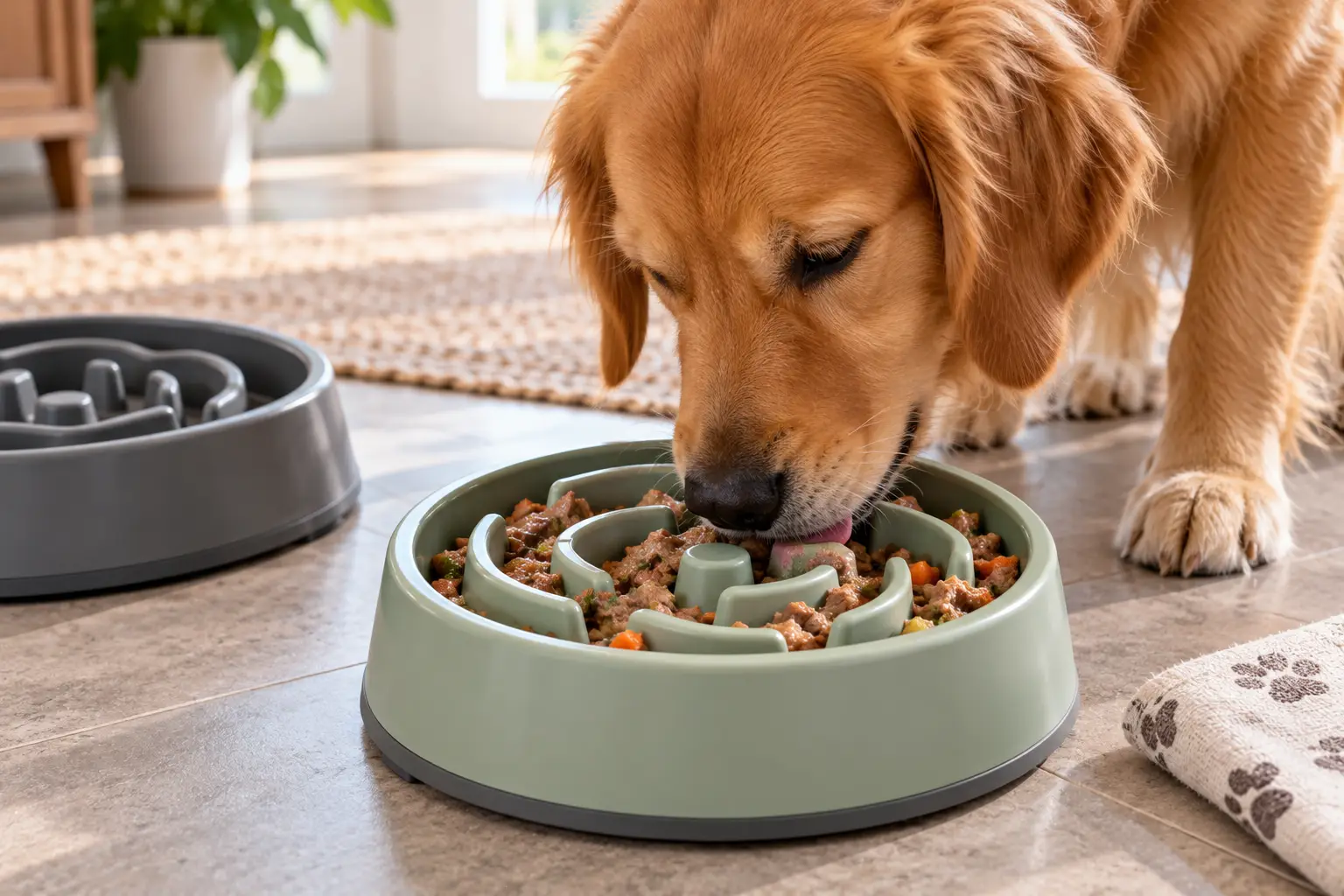
The best slow feeder dog bowl for wet food is a bowl with shallow, wide, smooth-edged obstacles that spread soft food thin, force your dog to lick and work around ridges, and still rinse clean in seconds. Deep, narrow mazes slow kibble well but trap pâté, so wet-food feeders need a different design.
That last sentence is the whole story in miniature. Most slow feeder roundups are written with dry kibble in mind, and kibble behaves politely: it rolls, it bounces, it falls out when you tip the bowl over the sink. Wet food does the opposite. It smears, it packs into corners, and if it sits in a narrow groove overnight it turns into something closer to drywall compound. 😬
So if your dog treats a can of beef stew like a speed-eating contest, you need more than “any slow feeder.” You need one that matches the texture of what you actually serve, the shape of your dog’s face, and how much scrubbing you’re willing to do twice a day.
Why bother at all? Dogs that gulp swallow a lot of air along with their food, which can mean vomiting, gas, and discomfort. Fast eating has also been studied as one of several risk factors for gastric dilatation-volvulus (GDV), the life-threatening condition often called bloat, especially in large, deep-chested breeds. A slow feeder is not a medical guarantee, but it’s one of the simplest, cheapest habits you can change.
In this guide, we compare seven real bowls available on amazon.com, built from different materials — food-safe plastic, natural rubber, TPE, ceramic, and stainless steel. You’ll get honest analysis based on spec sheets and aggregated customer feedback (no invented “tests”), plus practical how-to sections Amazon listings never cover: cleaning wet food out of a maze, transitioning a stubborn eater, and choosing a bowl for flat-faced breeds.
Slow Feeder Dog Bowls for Wet Food at a Glance
| Bowl | Material | Capacity | Wet Food Fit | Best for |
|---|---|---|---|---|
| Neater Pet Brands Neater Slow Feeder | Plastic | 2.5 or 6 cups | Excellent (wide, shallow grooves) | Neater Pet Brands Neater Slow Feeder — daily wet meals, flat-faced dogs |
| LickiMat Wobble | Natural rubber | Small-to-medium meals | Excellent for pâté | LickiMat Wobble — smooth pâté, anxious dogs |
| SodaPup Honeycomb eBowl | TPE | About 4 cups | Very good (separate cells) | SodaPup Honeycomb eBowl — mixed wet + dry meals |
| Dogit Go Slow Anti-Gulping Dog Bowl | Plastic | About 10 or 20 fl oz | Very good (open design) | Dogit Go Slow Anti-Gulping Dog Bowl — budget, easy cleanup |
| LE TAUCI Ceramic Slow Feeder Dog Bowl | Ceramic | 1.5 or 3 cups | Good | LE TAUCI Ceramic Slow Feeder Dog Bowl — plastic-free homes |
| Neater Pet Brands Stainless Steel Slow Feed Bowl | Stainless steel | 3 cups | Good | Neater Pet Brands Stainless Steel Slow Feed Bowl — raised-feeder users |
| Outward Hound Fun Feeder Slo Bowl | Food-safe plastic | ¾, 2, or 4 cups | Fair (deep maze traps pâté) | Outward Hound Fun Feeder Slo Bowl — extreme gulpers |
Reading the table top to bottom, a pattern jumps out: the bowls that handle wet food best are the ones with the least aggressive maze. The Neater Pet Brands Neater Slow Feeder and the Dogit Go Slow Anti-Gulping Dog Bowl win on cleanup, while the Outward Hound Fun Feeder Slo Bowl wins on raw slowing power but asks for more scrubbing in return.
If you feed smooth pâté, the LickiMat Wobble is a genuinely different tool — your dog licks rather than bites, which naturally caps eating speed. If you split meals between canned food and kibble, the cell layout of the SodaPup Honeycomb eBowl lets you portion each one separately, which is something a single open maze can’t do.
💬 One click helps other shoppers make an informed choice too! 😊
Top 7 Slow Feeder Bowls for Wet Food: Expert Analysis
1. Neater Pet Brands Neater Slow Feeder — wide grooves that rinse clean fast
Of every design here, this is the one whose geometry most naturally suits wet food: long, wide, shallow channels instead of tight twists.
The 2.5-cup version measures about 12.5 x 8.2 x 2 inches, and a 6-cup size covers bigger dogs. Listings state it holds dry or wet food, has non-slip feet, is dishwasher safe, and is designed to work even for flat-faced pets. In practice, that roughly 2-inch profile means a Pug or Frenchie isn’t jamming its nose against tall walls, while the elongated oval spreads a can of pâté thin enough that your dog has to lick instead of inhale. Neater also sells a raised version with adjustable legs, and the slow feeder top lifts off the base.
Based on comparing the specs, this is the bowl to beat if you serve wet food every day and wash by hand. It’s moderately challenging rather than brutal, which suits most dogs and avoids the frustration that makes some pups walk away.
Reviews consistently report that it slows eating without upsetting dogs and is easy to clean; a recurring wish is for taller leg options on the raised model, while owners of older, stiff-jointed dogs tend to appreciate the elevated setup.
Pros:
- ✅ Shallow, wide channels release wet food easily
- ✅ Friendly to flat-faced breeds and short muzzles
- ✅ Dishwasher safe with non-slip feet
Cons:
- ❌ Too easy for the most determined gulpers
- ❌ Large footprint takes up floor space
Expect to pay around $20 to $40 depending on size and the raised option — strong value for a daily-use wet food bowl (check the current price).
2. LickiMat Wobble — turns pâté into a lick-and-chase game
This is less a “bowl with a maze” and more a lick mat shaped like a bowl, and that difference is exactly why it works so well with smooth wet food.
The interior is covered in textured nubs, and the rounded base rocks as your dog eats. It’s made from food-grade natural rubber, and retailers list it as dishwasher safe (some specify the lower rack), freezer friendly, and microwave friendly. What that means at mealtime: pâté pressed into the nubs can only come out by licking, and the wobble adds a little “chase” that stretches the meal further. Freeze it, and a quick meal becomes a long enrichment session — handy on hot summer afternoons or during fireworks.
It shines for small and medium dogs on pâté-style food, dogs who get anxious at mealtime, and owners who want enrichment baked into dinner. It’s weaker with chunky stews, where big pieces just sit on top of the nubs, and rubber means heavy chewers need supervision.
On reviews, honesty matters: retailer listings and lick-mat roundups consistently position the LickiMat Wobble as a wet and raw food slow feeder, but we found less detailed, verifiable US review data for it than for the other picks. What feedback exists emphasizes longer meals and calmer dogs.
Pros:
- ✅ Textured nubs make pâté physically slow to eat
- ✅ Freezer friendly for extended enrichment
- ✅ Doubles as a calming activity tool
Cons:
- ❌ Chunky wet food doesn’t grip the nubs well
- ❌ Rubber isn’t for unsupervised power chewers
Price lands around $18 to $25 — good value if you feed pâté, less so if you feed chunks.
3. SodaPup Honeycomb eBowl — deep cells for mixed wet-and-dry meals
Instead of one continuous maze, this bowl uses individual hexagonal chambers, which changes how you can serve wet food.
SodaPup makes it in Boulder, Colorado, from FDA-compliant TPE. It measures roughly 8 x 8 x 2 inches, holds about 4 cups, and the maker lists it as top-rack dishwasher safe, freezer safe, and microwave safe. The practical upshot: you can drop a spoonful of wet food into each cell, top kibble with stew, or fill the cells with broth-thinned food and freeze it. Because each chamber is separate, your dog has to work cell by cell rather than shoveling in one direction.
This is a smart fit for medium and large dogs who gulp hard and for owners who mix canned and dry food. It is not the right pick for flat-faced breeds, though — deep, narrow cells are tough on short muzzles.
Reviews consistently describe sturdy, non-flimsy inner walls and a real challenge for fast eaters. A few owners note the material feels firmer than expected for “rubber,” and one common observation is that microwaving heats food unevenly — so stir before serving.
Pros:
- ✅ Separate cells make mixed feeding simple
- ✅ Made in the USA from FDA-compliant TPE
- ✅ Freezer, microwave, and top-rack dishwasher safe
Cons:
- ❌ Deep cells are hard on flat-faced breeds
- ❌ Corners of each cell need a brush for pâté
Price is typically around $20, a fair value for a USA-made, multi-use enrichment bowl.
4. Dogit Go Slow Anti-Gulping Dog Bowl — the easiest wet food bowl to scrub
Sometimes the smartest design is the simplest one: an open dish with a few raised obstacles that slow your dog without creating hiding spots for gravy.
The small size holds about 10 fl oz (300 ml) and the medium about 20 fl oz (600 ml), roughly 2.5 cups. Dogit lists it as suitable for wet or dry food, usable as a food or water dish, and dishwasher safe. Here’s what that means at the sink: there are no narrow channels, so a sponge reaches every surface in one pass. The trade-off is that the challenge is mild — it slows a moderate gulper, not a canine vacuum cleaner.
It’s ideal for budget-conscious owners, small and medium dogs, puppies learning their first slow feeder, and dogs that give up when a puzzle is too hard. Owners who loathe scrubbing will love it.
Detailed verified US reviews were thinner than for the bigger names, but buying guides that compared it consistently rate it as durable and good value, and at least one wet-food-focused guide singles it out as a strong choice for mixed diets precisely because it cleans easily.
Pros:
- ✅ Open layout cleans in seconds
- ✅ Works as a food or water dish
- ✅ Very affordable entry point
Cons:
- ❌ Mild challenge for very fast eaters
- ❌ Lightweight plastic can slide on smooth floors
You’ll usually find it under $15 — the best pure value in this lineup.
5. LE TAUCI Ceramic Slow Feeder Dog Bowl — heavy ceramic that stays put
If you want to avoid plastic entirely, ceramic is the classic alternative, and this bowl brings a slow-feeding maze to that material.
It comes in an 8-inch, 1.5-cup size and a 9.5-inch, 3-cup size, with several colors. Listings state it’s dishwasher safe and microwave safe, with a non-slip base. In real-world terms, a glazed ceramic surface doesn’t pick up the knife-like scratches plastic develops over time, so there are fewer micro-grooves for wet food residue to hide in. The weight also means your dog can’t bulldoze it across the kitchen, and the microwave rating lets you take the chill off refrigerated leftovers.
This is a strong pick for plastic-free households, small-to-medium dogs, and owners whose vet has suggested non-plastic bowls for a dog prone to chin acne. Larger dogs should look at the 3-cup size.
Reviews consistently report that the bowl is heavy enough to stay put and stretches meals from seconds into minutes. On the downside, some reviewers saw chips or cracks and switched to hand washing, and a few note that 1.5 cups of food piles high — so wet food portions are the sweet spot.
Pros:
- ✅ Heavy ceramic resists pushing and tipping
- ✅ Glazed surface resists scratches that trap residue
- ✅ Microwave safe for warming chilled leftovers
Cons:
- ❌ Can chip or crack if dropped
- ❌ Smaller size fills up quickly
Prices run around $20 to $35, reasonable for a long-lasting, plastic-free bowl.
6. Neater Pet Brands Stainless Steel Slow Feed Bowl — stainless steel for raised feeders
Stainless steel is the material many owners trust most for hygiene, and this insert delivers it in slow-feeder form.
It holds up to 3 cups of wet or dry food, measures 8.25 inches across and 2.75 inches high, and is designed to fit the Neater Feeder Deluxe Large and Express Medium to Large, plus other raised feeders with a 7.25- to 8-inch opening. What that means in practice: stainless doesn’t absorb odors from fishy wet food and shrugs off endless dishwasher cycles. The catch is the channel shape — one reviewer measured channels around 1.5 inches wide and 3 inches deep, which means pâté can settle in the bottom corners and benefits from a quick swipe with a bottle brush.
It’s best for households already using an elevated feeder and owners who refuse plastic. If your dog is a large, deep-chested breed, read our safety section on raised bowls before going elevated.
Reviews consistently praise it as a slow feeder that actually works and isn’t plastic. One reviewer noted that about 2 cups is the practical limit before food stacks above the channels and loses its slowing effect.
Pros:
- ✅ Stainless steel resists odors and stains
- ✅ Fits most raised feeders with standard openings
- ✅ Dishwasher-friendly for years of daily use
Cons:
- ❌ Deep channels hold pâté in corners
- ❌ Designed as an insert, not a floor bowl
Expect a price under $25 — excellent value if you already own a compatible stand.
7. Outward Hound Fun Feeder Slo Bowl — the toughest maze for extreme gulpers
This is the slow feeder most people picture, and its deep, twisting maze is built for one job: stopping dogs who empty a bowl in seconds.
It comes in sizes from ¾ cup up to 2 cups and 4 cups, uses BPA-, PVC-, and phthalate-free food-safe plastic, has a non-slip base, and is top-rack dishwasher safe. Outward Hound claims it can slow eating up to 10 times, and the brand says it works with dry, wet, or raw food. For wet food, though, that depth cuts both ways: it delivers maximum slowing, but smooth pâté packs into narrow channels. Chunks in gravy, or wet food mixed with kibble, behave much better.
Choose it for serious gulpers — the dog that vomits after dinner — and when slowing matters more than cleanup convenience.
Reviews widely credit it with dramatically slowing fast eaters, and many owners find top-rack dishwasher cleaning sufficient. Several buying guides, however, warn that wet or raw food makes cleanup frustrating, and a few reviewers felt real capacity ran smaller than expected once food is level with the ridges.
Pros:
- ✅ Most challenging maze in this lineup
- ✅ Wide size range from tiny to large dogs
- ✅ Budget-friendly and widely available
Cons:
- ❌ Smooth pâté sticks in narrow channels
- ❌ Plastic should be replaced once chewed
It typically sells around $8 to $20 depending on size — great value for gulpers, provided you have a good brush.
✨ Don’t miss these mealtime upgrades!
🔍 Take your dog’s wet food routine to the next level with this carefully curated lineup. Click a highlighted bowl to check current pricing and availability. These picks will help you get calmer, slower, mess-free meals the whole family will enjoy! 🐶
How to Get Started: Your First 30 Days With a Wet Food Slow Feeder
A new bowl is a new puzzle, and how you introduce it decides whether your dog loves it or boycotts it.
Week 1 — make it easy. Serve half the meal in the slow feeder and half in the old bowl, or spread wet food thinly so it’s obvious where the food is. For the LickiMat Wobble, start with a smooth pâté smeared lightly over the nubs rather than packed in.
Week 2 — raise the challenge. Move the full meal into the slow feeder. For maze bowls like the Outward Hound Fun Feeder Slo Bowl, press wet food into the channels instead of dumping it on top; food sitting above the ridges is food your dog can still gulp.
Week 3 — add variety. Try freezing a meal in the SodaPup Honeycomb eBowl or the LickiMat Wobble, or mix a spoonful of wet food into soaked kibble. Time a few meals; if your dog eats noticeably slower without walking away, you’ve found the right level.
Week 4 — lock in the cleaning habit. This is the step most owners skip. The FDA’s safe-handling tips for pet food recommend washing pet food bowls with soap and hot water after each use and promptly refrigerating or discarding leftover canned or pouched food. With wet food in a textured bowl, “after each use” really matters.
Common first-month mistakes:
- Leaving uneaten wet food in the bowl for hours
- Choosing a maze so hard your dog gives up
- Letting dried residue sit until the next meal
- Skipping supervision with rubber or plastic bowls
Give it the full 30 days. Most dogs adapt within a week or two, and the payoff is a calmer, slower mealtime you’ll notice every single day.
Problem → Solution: Fixing Common Wet Food Slow Feeder Headaches
Even a great bowl creates new problems. Here are the five we see most often, with practical fixes.
1. “Pâté is cemented into the grooves.” Soak the bowl in warm, soapy water for 10 to 15 minutes right after the meal, then use a bottle brush or old toothbrush along the channels. Long term, a shallow design like the Neater Pet Brands Neater Slow Feeder or the Dogit Go Slow Anti-Gulping Dog Bowl avoids the problem almost entirely.
2. “My dog just licks the top and walks away.” The puzzle is too hard. Thin the wet food with a little warm water, fill the channels less, or step down to an easier design. Frustration defeats the purpose.
3. “The bowl skates across the kitchen floor.” Lightweight plastic bowls move. Place a rubber feeding mat underneath, or switch to the heavy LE TAUCI Ceramic Slow Feeder Dog Bowl.
4. “My flat-faced dog can’t reach the food.” Deep cells and tall ridges don’t suit short muzzles. Look for low, wide obstacles — the Neater Pet Brands Neater Slow Feeder is designed with flat-faced pets in mind — or use the LickiMat Wobble with a thin layer of pâté.
5. “My dog chews the bowl instead of eating.” Remove it immediately if pieces come off. Supervise meals, and consider the Neater Pet Brands Stainless Steel Slow Feed Bowl or a ceramic option for dogs who see rubber as a chew toy.
Each fix costs little or nothing, and most problems disappear once the bowl difficulty, the food texture, and your cleaning routine are in sync.
Real-World Scenarios: Matching Dogs to the Right Bowl
Specs are abstract. Here’s how the lineup maps onto real households.
🐾 Scenario 1: The apartment Frenchie on canned food. A French Bulldog eating a can of pâté twice a day, in a small kitchen, with an owner who washes by hand. Budget: around $20 to $30. Best match: the Neater Pet Brands Neater Slow Feeder in the 2.5-cup size. The shallow, wide grooves work with a short muzzle, and hand washing takes a minute. Add the LickiMat Wobble for the occasional frozen weekend treat.
🐾 Scenario 2: The Lab who mixes wet food with kibble. A 70-pound Labrador who finishes dinner in under a minute and occasionally vomits it back up. The owner tops kibble with stew. Budget: around $20. Best match: the SodaPup Honeycomb eBowl. Separate cells let you spoon stew over kibble in each chamber, and the deeper structure gives a strong eater a genuine challenge. If vomiting persists, the Outward Hound Fun Feeder Slo Bowl in the 4-cup size is the step-up option.
🐾 Scenario 3: The senior Shepherd mix on a raised feeder. An older dog with stiff joints already eating from an elevated stand, with an owner who wants no plastic. Budget: under $25. The Neater Pet Brands Stainless Steel Slow Feed Bowl drops into compatible stands. Because German Shepherds are among breeds with elevated bloat risk, though, this owner should first ask their veterinarian whether a raised feeder is right — see the safety section below.
The common thread: start with food texture and face shape, then layer on budget and cleaning preferences.
How to Choose a Slow Feeder for Wet Dog Food
Use these steps in order — each one narrows the field.
- Match the bowl to your food’s texture. Smooth pâté loves textured lick surfaces and shallow grooves; chunks in gravy need wider channels; mixed diets benefit from separate cells.
- Check your dog’s face shape. Flat-faced breeds need low, wide obstacles. Deep cells and tall ridges frustrate short muzzles.
- Size for the real portion. Measure what your dog actually eats. Food piled above the ridges defeats the slowing effect, so choose a bowl rated larger than the portion.
- Prioritize cleanability. For wet food, “dishwasher safe” plus open, smooth-sided channels beats a dramatic maze you can’t scrub.
- Pick the material for your household. Plastic is light and cheap; rubber and TPE add enrichment and freezer use; ceramic and stainless steel are heavier and plastic-free.
- Match difficulty to your dog’s temperament. The American Kennel Club notes that slow-feeder bowls, food puzzles, and even hand feeding can all slow a fast eater — the right tool is the one your dog will actually use.
- Consider freezer and microwave use. Freezing extends enrichment; microwave-safe bowls help warm refrigerated leftovers.
Run your shortlist through these seven steps and the “best” bowl usually becomes obvious. For most wet-food households, that’s a shallow design with smooth edges and a non-slip base.
Slow Feeder Bowl vs. Lick Mat vs. Regular Bowl
| Option | How It Slows Eating | Wet Food Cleanup | Best for |
|---|---|---|---|
| Maze slow feeder (e.g., Outward Hound Fun Feeder Slo Bowl) | Ridges force dogs to work around barriers | Harder — narrow channels trap pâté | Extreme gulpers, chunky wet food |
| Shallow slow feeder (e.g., Neater Pet Brands Neater Slow Feeder) | Wide grooves spread food thin | Easy | Daily wet meals, flat-faced dogs |
| Lick bowl (e.g., LickiMat Wobble) | Licking replaces biting | Moderate — nubs need a brush | Pâté, anxious dogs, enrichment |
| Regular bowl | Doesn’t slow eating | Easiest | Calm, slow eaters only |
The table shows that “slow feeder” is really three tools. A maze bowl like the Outward Hound Fun Feeder Slo Bowl slows hardest but costs cleanup time, while a shallow tray like the Neater Pet Brands Neater Slow Feeder trades a bit of challenge for convenience. Lick bowls such as the LickiMat Wobble work on a different mechanism — licking is naturally slower than biting — which is why they pair so well with smooth wet food.
A regular bowl is still perfectly fine for dogs that eat calmly. The point isn’t that every dog needs a slow feeder; it’s that dogs who gulp wet food benefit from a design matched to that texture. Many owners end up with two: a daily slow feeder and a lick bowl for frozen treats or stressful days.
Features That Actually Matter (and Ones That Don’t)
Marketing copy for slow feeders loves big claims. Here’s how to separate useful features from noise.
✅ Features that matter for wet food:
- Channel width and depth. This is the single biggest factor. Wide, shallow channels release wet food; narrow, deep ones trap it.
- Rounded inner corners. Sharp 90-degree corners collect pâté; curves let a sponge sweep through.
- Dishwasher safety and real heat tolerance. Top-rack ratings are common for plastic; stainless steel and ceramic tolerate more.
- A stable, non-slip base or real weight. A sliding bowl spills gravy everywhere.
- Freezer safety. Frozen wet food in the SodaPup Honeycomb eBowl or the LickiMat Wobble turns a meal into extended enrichment.
❌ Features that matter less than you think:
- “Slows eating up to 10x” claims. These are manufacturer estimates, and your dog’s results depend on food texture and how you fill the bowl.
- Fancy maze shapes. Flowers, bones, and spirals look great in photos, but complexity often means more scrubbing with wet food.
- “Vet recommended” labels. Slow feeders are widely suggested by veterinarians in general, but a label doesn’t tell you whether that design suits your dog.
- Color options. Fun, but irrelevant to function.
Spend your money on geometry and cleanability, and you’ll be happier with almost any bowl in this guide.
Common Mistakes to Avoid When Buying a Slow Feeder for Wet Food
These are the pitfalls that lead to returned bowls and frustrated dogs.
Mistake 1: Buying a kibble bowl for a wet food diet. Most bestselling slow feeders were designed around dry food. Deep mazes work brilliantly for kibble and poorly for pâté. Always check channel width before buying.
Mistake 2: Trusting the capacity number blindly. Capacity ratings usually describe the bowl filled to the brim. Reviewers of both the LE TAUCI Ceramic Slow Feeder Dog Bowl and the Neater Pet Brands Stainless Steel Slow Feed Bowl note that food piled above the obstacles loses its slowing effect. Buy one size up.
Mistake 3: Ignoring your dog’s muzzle. A Boxer, Pug, or Shih Tzu faces real difficulty with deep cells. If your dog has a short face, rule out deep honeycomb and tall-maze designs.
Mistake 4: Choosing the hardest puzzle available. A dog that gives up on dinner isn’t eating “slowly” — it’s not eating. Start moderate and increase difficulty only if needed.
Mistake 5: Forgetting about cleaning time. Twice-daily wet meals mean 14 bowl washes a week. A bowl that takes five minutes to scrub costs you over an hour weekly.
Mistake 6: Treating a slow feeder as bloat prevention. Slowing eating is helpful, but bloat has many risk factors. A slow feeder is one habit, not a substitute for veterinary advice — especially for high-risk breeds.
Avoid these six mistakes and your first slow feeder purchase is very likely to be your last for a long while.
Slow Feeders for Flat-Faced Dogs, Seniors, and Puppies
Different dogs need different designs. Here’s tailored advice for three groups.
Flat-faced (brachycephalic) breeds
Bulldogs, Pugs, Boston Terriers, and Shih Tzus have short muzzles and often struggle to reach food in deep cells. Choose low, wide obstacles and shallow channels. The Neater Pet Brands Neater Slow Feeder is specifically marketed as working for flat-faced pets, and the LickiMat Wobble with a thin pâté layer is another good option. Avoid deep honeycomb designs like the SodaPup Honeycomb eBowl for these breeds.
Senior dogs
Older dogs may have dental wear, stiff joints, or reduced appetite. A softer challenge matters more than a hard maze — you want a slower pace, not a skipped meal. Wet food is often easier on aging teeth, so a shallow tray or the Dogit Go Slow Anti-Gulping Dog Bowl makes sense. If your senior uses a raised feeder for comfort, talk with your vet about whether elevation is appropriate for its breed and size.
Puppies
Puppies learning to eat solid food benefit from simple, forgiving designs. Start with an easy bowl such as the Dogit Go Slow Anti-Gulping Dog Bowl or the smallest Outward Hound Fun Feeder Slo Bowl, and supervise every meal — puppies chew everything, bowls included. Replace any bowl the moment you see bite damage.
Across all three groups, the principle is the same: match difficulty to ability, and watch the first few meals closely.
Long-Term Cost, Cleaning, and Maintenance
The sticker price is only part of the cost. Here’s how the picks compare over the long run.
| Bowl | Price Range | Expected Lifespan | Cleaning Effort With Wet Food | Best for |
|---|---|---|---|---|
| Dogit Go Slow Anti-Gulping Dog Bowl | Under $15 | Replace if scratched or chewed | Very low | Dogit Go Slow Anti-Gulping Dog Bowl — tight budgets |
| Outward Hound Fun Feeder Slo Bowl | Around $8–$20 | Replace when chewed or worn | High | Outward Hound Fun Feeder Slo Bowl — gulpers |
| SodaPup Honeycomb eBowl | Around $20 | Long, if not chewed | Moderate | SodaPup Honeycomb eBowl — mixed feeders |
| LE TAUCI Ceramic Slow Feeder Dog Bowl | Around $20–$35 | Years, unless chipped | Low to moderate | LE TAUCI Ceramic Slow Feeder Dog Bowl — plastic-free homes |
| Neater Pet Brands Stainless Steel Slow Feed Bowl | Under $25 | Many years | Moderate | Neater Pet Brands Stainless Steel Slow Feed Bowl — longevity |
Looking at total cost of ownership, the cheapest bowl isn’t always the cheapest choice. Plastic bowls like the Outward Hound Fun Feeder Slo Bowl may need replacing once scratched or chewed, while the Neater Pet Brands Stainless Steel Slow Feed Bowl can last many years. The Dogit Go Slow Anti-Gulping Dog Bowl stays the value leader thanks to its low price and minimal cleaning time.
Maintenance routine that keeps any bowl fresh:
- Rinse immediately after every wet meal, before residue dries.
- Wash with soap and hot water, or run it through the dishwasher if rated.
- Use a bottle brush or toothbrush on channels once a day.
- Inspect weekly for cracks, chips, or bite marks.
- Replace plastic bowls once deep scratches appear.
Safety, Materials, and the Raised-Bowl Question
Material safety and feeding posture matter as much as maze design.
Materials. Look for bowls labeled BPA-free, PVC-free, and phthalate-free. The Outward Hound Fun Feeder Slo Bowl makes these claims, and SodaPup describes the SodaPup Honeycomb eBowl as made from FDA-compliant TPE. Stainless steel and glazed ceramic avoid plastic entirely, though ceramic can chip. Rubber and TPE bowls are not chew toys — supervise and remove them if damaged.
The raised-bowl question. Elevated feeders are popular for comfort, but a large Purdue-led study published in the Journal of the American Veterinary Medical Association found raised food bowls were associated with a higher risk of GDV in large and giant breed dogs. That’s an association, not proof of cause, and it applies most to high-risk breeds. Still, if you own a Great Dane, Weimaraner, Saint Bernard, German Shepherd, or another deep-chested breed, talk to your vet before using a raised slow feeder like the Neater Pet Brands Stainless Steel Slow Feed Bowl in an elevated stand.
Wet food handling. Wet food spoils faster than kibble. A widely used rule of thumb is to pick up uneaten wet food within a couple of hours — sooner in hot weather — and always follow your food’s label. Refrigerate leftovers in a covered container.
Know the warning signs. Restlessness, a swollen belly, drooling, or retching without bringing anything up can signal bloat. That’s a veterinary emergency — call your vet or an emergency clinic immediately.
FAQ About Slow Feeder Dog Bowls for Wet Food
❓ Can you put wet food in a slow feeder dog bowl?
❓ Which slow feeder is easiest to clean with wet food?
❓ Is a lick mat better than a slow feeder for wet dog food?
❓ What size slow feeder bowl should I buy for my dog?
❓ Are ceramic or stainless steel slow feeders better for wet food?
Conclusion: Finding the Best Slow Feeder Dog Bowl for Wet Food
Choosing the best slow feeder dog bowl for wet food comes down to one idea: match the bowl’s geometry to your food’s texture and your dog’s face. Wet food rewards shallow, wide, smooth-edged designs, while deep mazes that excel with kibble often turn into cleanup chores.
Here’s the quick recap. For most wet-food households, the Neater Pet Brands Neater Slow Feeder offers the best balance of slowing power, flat-face friendliness, and easy cleaning. If you feed smooth pâté or want built-in enrichment, the LickiMat Wobble is a standout. Mixed feeders will appreciate the cell layout of the SodaPup Honeycomb eBowl, and budget buyers can’t beat the Dogit Go Slow Anti-Gulping Dog Bowl.
Want to skip plastic? The LE TAUCI Ceramic Slow Feeder Dog Bowl and the Neater Pet Brands Stainless Steel Slow Feed Bowl both deliver. And if your dog is a true canine vacuum, the Outward Hound Fun Feeder Slo Bowl still offers the toughest maze — just keep a good brush nearby.
Whichever you choose, introduce it gradually, wash it after every meal, and talk to your vet if your dog belongs to a high-risk breed for bloat. A slower dinner is a small change that can make mealtimes calmer, cleaner, and more enjoyable for both of you. 🐕
🛒 Ready to slow down mealtime the smart way?
🔍 Pick the bowl that fits your dog’s food, face, and appetite. Click a highlighted product to check current pricing and availability on Amazon — and turn every wet food meal into a calmer, healthier experience your pup will love! ✨
Recommended for You
- Outdoor Dog Water: 7 Best Waterers That Actually Work in 2026
- Best Raised Dog Bowls 2026: 7 Smart Picks & 1 Crucial Warning
- Chip reader cat feeder 2026: 7 Proven Picks to End Food Theft
Disclaimer: This post contains affiliate links. As an Amazon Associate, I earn from qualifying purchases made through these links, at no additional cost to you.
✨ Found this article helpful? Share it with someone who needs it! 💬🤗