In This Article
Introduction: Why Mealtime Turns Into a Heist
If you live with more than one cat, you already know the routine. You set down two bowls, turn around for ten seconds, and the bold one has finished their own dinner and is halfway through their sibling’s. Multiply that by two meals a day, and you have a slow-motion problem: one cat gaining weight, one cat going hungry, and a prescription diet that ends up in the wrong stomach.
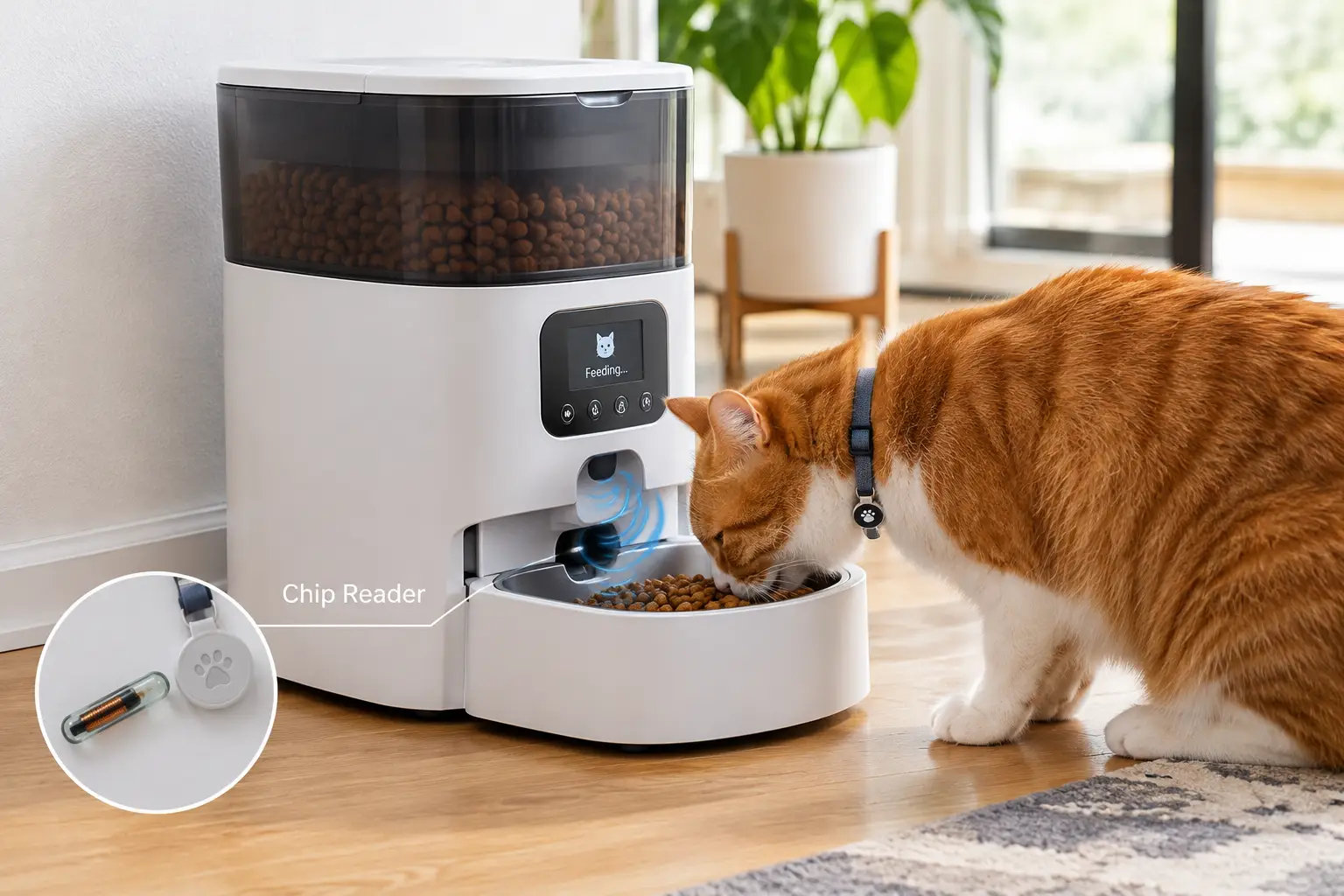
A chip reader cat feeder solves this in the most direct way possible. It reads your cat’s implanted ID microchip (or a small collar tag) and only opens the lid for the cat it recognizes. Everyone else gets a closed door. No yelling, no separate rooms, no standing guard at 6 a.m.
But here’s what most buyers overlook: not every chip reader cat feeder reads every chip. US pets carry a mix of 125 kHz, 128 kHz, and 134.2 kHz microchips, and several popular feeders only read the ISO 15-digit kind. Some “RFID feeders” don’t read implanted chips at all — they only work with their own collar tag. Others are simple sealed bowls, while a few combine chip recognition with a timed hopper that dispenses meals automatically.
This guide cuts through that confusion. Below, you’ll find seven real feeders available to US shoppers, with honest analysis built from manufacturer spec sheets and aggregated owner feedback — not invented test stories. You’ll also get a 30-day setup plan, household scenarios, a troubleshooting guide, and a long-term cost breakdown, so you can pick a feeder that actually works with your cats and your chips.
What Is a chip reader cat feeder?
A chip reader cat feeder is a selective pet feeder with a built-in RFID scanner that identifies a cat by its implanted ID microchip or a paired collar tag, then unlocks the food bowl only for registered cats. It prevents food stealing, protects prescription or weight-loss diets, and keeps food sealed between visits.
The technology is the same passive radio-frequency identification your vet uses: a pet microchip has no battery, and the feeder’s reader briefly powers it with an electromagnetic field to read its ID number. Because the chip usually sits between the shoulder blades, the reader sits inside the feeder’s tunnel, catching the signal as your cat’s head and neck move in to eat.
There are three broad designs worth knowing:
- ✅ Sealed-bowl feeders (like the SureFeed and MiBowl): you fill the bowl manually; the lid opens on recognition. Ideal for wet food and grazers.
- ✅ Automatic dispensers with a chip lock: a hopper releases scheduled portions, and the tray is guarded by the reader. Best for dry food and busy schedules.
- ✅ Tag-only RFID feeders: they read a proprietary collar tag, not the implanted chip. Simpler, but your cat must keep wearing the collar.
Quick Comparison: The 7 Best Chip Reader Feeders at a Glance
| Feeder | Reads implanted chip? | Food type | Pets per feeder | Price range | Best for |
|---|---|---|---|---|---|
| SureFeed Microchip Pet Feeder | Yes (FDX-B, FDX-A, Avid Secure) + tag | Wet & dry | Up to 32 | ~$150–$200 | SureFeed Microchip Pet Feeder: best overall reliability |
| SureFeed Microchip Pet Feeder Connect | Yes + tag | Wet & dry | Up to 32 | Premium (hub extra) | SureFeed Microchip Pet Feeder Connect: diet tracking |
| Closer Pets MiBowl CP500 | Yes (ISO, AVID 15-digit) + tag | Wet & dry | Up to 10 | ~$150–$200 | Closer Pets MiBowl CP500: pushy food thieves |
| PawsPik Automatic Microchip RFID Cat Feeder | Yes (ISO 15-digit only) + tag | Dry | 1 | Around $250 | PawsPik Automatic Microchip RFID Cat Feeder: long absences |
| PETLIBRO One RFID Feeder | No (collar tag only) | Dry | 1 tag | ~$120–$150 | PETLIBRO One RFID Feeder: scheduled kibble on a budget |
| ePawDen Microchip Pet Feeder | Yes + tag | Wet & dry | Multiple | Mid-range | ePawDen Microchip Pet Feeder: cord-free placement |
| Anifam Microchip RFID Cat Feeder | Yes (ISO) | Dry | Varies by setup | Mid-range | Anifam Microchip RFID Cat Feeder: dog-proof feeding |
Looking at the table, the split is clear: if your cats eat wet food, your realistic options are the sealed-bowl designs — the SureFeed Microchip Pet Feeder, the Closer Pets MiBowl CP500, and the ePawDen Microchip Pet Feeder. If you need automatic scheduled meals while you’re away, the PawsPik Automatic Microchip RFID Cat Feeder is the only pick here that combines a large hopper with true implanted-chip reading, while the PETLIBRO One RFID Feeder trades chip reading for a lower price and polished app. Chip compatibility, not features, should be your first filter.
💬 One click helps other shoppers make an informed choice too! 😊
Top 7 chip reader cat feeder Picks for 2026: Expert Analysis
1. SureFeed Microchip Pet Feeder — the benchmark for reliable selective feeding
The SureFeed Microchip Pet Feeder (model MPF001) is the feeder most other brands are measured against, and its long track record is the reason.
It reads 9-digit Avid Secure, 10-digit FDX-A, and 15-digit FDX-B microchips, plus Sure Petcare’s RFID collar tag (one included), and stores up to 32 pet identities in memory. In practice, that broad chip support matters more in the US than anywhere else, because older 125 kHz chips are still common here. The 400 ml sealed bowl (about 1.6 cups) handles wet or dry food, and four C batteries run it for roughly six months.
Based on the specs, this is the safest choice for households with mixed or unknown chip types, and for anyone feeding wet food to a cat on a prescription diet. The training mode, which introduces lid movement gradually, is genuinely useful for nervous cats.
Owner feedback consistently praises its dependability for separating diets. The most common complaint is that a determined cat can push in from behind while another eats — which is why Sure Petcare-compatible rear covers are sold separately.
Pros:
- ✅ Reads nearly every common US microchip type
- ✅ Handles wet food with a sealed, fly-proof bowl
- ✅ Three-year warranty and up to 32 registered pets
Cons:
- ❌ No scheduling, scale, or app connectivity
- ❌ Persistent cats may need a rear cover accessory
Usually in the $150–$200 range at the time of writing — strong value given its compatibility and warranty.
2. SureFeed Microchip Pet Feeder Connect — best for tracking every bite
The SureFeed Microchip Pet Feeder Connect takes the proven lid mechanism and adds data, which turns a feeder into a health-monitoring tool.
Its integrated scale weighs food to within about 1 gram, and LEDs guide you as you fill the bowl to a portion you set in the Sure Petcare app. The app logs when each cat visits and how much it eats. For a diabetic cat or a weight-loss plan, that log can reveal appetite changes days before you’d notice them at the bowl. It still reads microchips and RFID tags and stores up to 32 pets.
The catch: it requires the separately sold Sure Petcare Hub, which connects to your router and supports up to 10 Connect devices. Reviews note the hub needs to sit within roughly 30 feet of the feeder, which can force awkward placement.
Aggregated owner feedback is split: the feeding data is widely appreciated, while recurring complaints mention app connectivity hiccups and the lack of scheduled lid control. On paper, this is the pick for owners who will actually read the data — otherwise, the standard SureFeed Microchip Pet Feeder does the core job for less.
Pros:
- ✅ Built-in scale portions food to about one gram
- ✅ App logs visits and intake per cat
- ✅ One hub can run up to ten devices
Cons:
- ❌ Hub sold separately and must stay in range
- ❌ Some owners report app connectivity glitches
A premium buy once you add the hub — check the current price, and only pay for it if you’ll use the data.
3. Closer Pets MiBowl CP500 — built to stop pushy food thieves
The Closer Pets MiBowl CP500 focuses on one weakness of open-tunnel feeders: cats that muscle in from the side or rear.
Its fully enclosed design blocks access from the back and sides while your cat eats, and removable portion-protecting clips add a shield for kittens and small cats. It reads ISO and AVID 15-digit microchips, includes an electronic ID collar tag for unchipped pets, and can be paired with up to 10 pets. The bowl is BPA-free and dishwasher-safe, which saves real time compared with hand-wash-only bowls.
Here’s what to weigh: the enclosed shape and lid-stall detection make it a strong choice for homes with a confident food bully and a timid eater. The feeding position also lets cats keep their paws on the floor, which some cats accept faster than a deep tunnel.
The spec sheet doesn’t say this, but the manual’s advice to place it against a wall and space multiple feeders about 3 feet apart hints that very hungry cats may try to shove it. US-specific review volume is still limited, so treat long-term durability as less proven than SureFeed’s.
Pros:
- ✅ Enclosed design blocks side and rear stealing
- ✅ Dishwasher-safe, BPA-free bowl
- ✅ Pairs with up to ten pets
Cons:
- ❌ Smaller US review base than SureFeed
- ❌ Lighter units may need wall placement
Typically in the $150–$200 range at the time of writing — fair value if food bullying is your main problem.
4. PawsPik Automatic Microchip RFID Cat Feeder — the long-absence workhorse
The PawsPik Automatic Microchip RFID Cat Feeder is the rare model that pairs genuine implanted-chip reading with a large scheduled-dispensing hopper.
Its 16-cup capacity means fewer refills, and backup batteries (not included) keep meals on schedule during power outages. It reads ISO-compliant 15-digit microchips and ships with a PawsPik RFID tag for cats without a compatible chip. App control and portion scheduling let you set meals remotely. Practically, this is the only feeder on this list that can cover a long weekend for a chipped cat on a controlled kibble diet.
Two modes add flexibility: Closed Mode opens only for the assigned pet, while Open Mode stays open unless an unauthorized tagged or chipped pet approaches. However, each feeder pairs with only one pet, so a three-cat home needs three units.
Aggregated reviews highlight quieter, more dependable operation than older prescription feeders and responsive product support. Critically, the brand warns that non-ISO chips will not register, so check your cat’s chip number first.
Pros:
- ✅ 16-cup hopper suits long workdays and weekends
- ✅ Reads ISO chips and includes a backup tag
- ✅ Battery backup protects scheduled meals
Cons:
- ❌ One feeder per pet raises total cost
- ❌ Won’t read 125 kHz US chips
Around $250 at the time of writing — expensive per cat, but excellent value if it replaces a pet sitter.
5. PETLIBRO One RFID Feeder — most polished scheduled feeding on a budget
The PETLIBRO One RFID Feeder (model PLAF301) is the most app-friendly option here, with one honest limitation: it reads its own collar tag, not your cat’s microchip.
The 3-liter hopper holds about 13 cups of kibble (2–15 mm pieces), schedules up to 10 meals a day, and connects over both 2.4 GHz and 5 GHz Wi-Fi — a real advantage because many feeders fail on 5 GHz-only mesh networks. Feeding logs show who ate and when, and three D batteries provide emergency backup. The 4.2-gram tag is lightweight and needs no charging.
Based on comparing the specs, this is ideal for dry-food households that want automated meals and don’t mind a collar. It’s not suitable for wet food, and Petlibro advises spacing multiple units at least 10 inches apart to avoid interference.
Owner sentiment is generally positive about the app and scheduling. The recurring caveat in reviews is the collar dependency: if the tag falls off, your cat can’t eat, so a spare tag is a smart purchase.
Pros:
- ✅ Dual-band Wi-Fi and detailed feeding logs
- ✅ Up to ten scheduled meals per day
- ✅ 24-month warranty from the manufacturer
Cons:
- ❌ Doesn’t read implanted microchips at all
- ❌ Dry food only
Usually $120–$150 at the time of writing — the best value if a collar tag works for your cat.
6. ePawDen Microchip Pet Feeder — cord-free and quiet for flexible placement
The ePawDen Microchip Pet Feeder stands out for a simple reason: it runs on a rechargeable lithium battery instead of disposable cells.
It recognizes microchips or RFID collar tags and stays shut for unregistered pets. The rechargeable design matters more than it sounds: C-battery feeders cost money every few months, and a cordless unit can go in a bedroom, closet, or quiet corner where your shy cat actually feels safe eating. The brand also emphasizes silent operation, which helps cats who startle at lid motors.
Here’s what to weigh: this is a sealed-bowl design without scheduled dispensing, so it competes with the SureFeed Microchip Pet Feeder rather than the automatic models. It makes the most sense for owners who hate battery swaps or need portability.
We couldn’t verify a large, consistent body of US customer reviews for this model, so its long-term reliability is less documented than the SureFeed’s. Check the listing’s chip-compatibility notes and recent reviews before buying.
Pros:
- ✅ Rechargeable battery eliminates disposable cells
- ✅ Quiet operation suits nervous cats
- ✅ Reads microchips and collar tags
Cons:
- ❌ Limited verified long-term review data
- ❌ No scheduling or app tracking
Mid-range pricing at the time of writing — check the current price; worth it if cord-free placement matters.
7. Anifam Microchip RFID Cat Feeder — a dog-proof option for mixed-pet homes
The Anifam Microchip RFID Cat Feeder is aimed at homes where the thief isn’t another cat — it’s the family dog.
It uses RFID and microchip recognition to restrict access, and its design is marketed as dog-proof, with stainless steel bowls that are durable and easy to sanitize. Stainless steel is a practical upgrade: it resists scratches where bacteria hide, which matters if your cat is prone to chin acne. Pairing involves holding the chip close to the front sensor until the tray rotates to confirm.
Based on the specs, this suits owners who want scheduled dry feeding with a physical barrier against a larger pet. Confirm ISO chip support on the current listing, since budget feeders in this category often skip AVID chips.
Aggregated review summaries describe solid build quality and consistent dispensing, while a minority of owners report occasional chip-recognition or connectivity glitches and say setup takes some patience.
Pros:
- ✅ Stainless steel bowls are hygienic and durable
- ✅ Design targets dog-and-cat households
- ✅ Consistent dispensing per review summaries
Cons:
- ❌ Some owners report recognition glitches
- ❌ Setup may need extra troubleshooting time
Mid-range pricing at the time of writing — reasonable value for mixed-species homes; check current availability.
✨ Don’t miss these smart feeding upgrades!
🔍 Take your multi-cat mealtime from chaos to calm with this carefully curated lineup. Click a highlighted feeder to check current pricing and availability. These picks will help you get peaceful, theft-free meals the whole family will enjoy! 🐾
Side-by-Side Specs: How the 7 Feeders Really Compare
| Feeder | Capacity | Power | Scheduling | App | Best for |
|---|---|---|---|---|---|
| SureFeed Microchip Pet Feeder | 400 ml bowl | 4 × C batteries (~6 months) | No | No | SureFeed Microchip Pet Feeder: wet food, mixed chips |
| SureFeed Microchip Pet Feeder Connect | 400 ml bowl + scale | Batteries + hub | No (portion guidance) | Yes | SureFeed Microchip Pet Feeder Connect: medical monitoring |
| Closer Pets MiBowl CP500 | Single bowl | Batteries | No | No | Closer Pets MiBowl CP500: bully-proof design |
| PawsPik Automatic Microchip RFID Cat Feeder | 16 cups | AC + battery backup | Yes | Yes | PawsPik Automatic Microchip RFID Cat Feeder: travel |
| PETLIBRO One RFID Feeder | ~13 cups | AC + 3 × D backup | Up to 10 meals | Yes | PETLIBRO One RFID Feeder: app lovers |
| ePawDen Microchip Pet Feeder | Single bowl | Rechargeable lithium | No | No | ePawDen Microchip Pet Feeder: cord-free spots |
| Anifam Microchip RFID Cat Feeder | Hopper | AC (check listing) | Yes | Varies | Anifam Microchip RFID Cat Feeder: dogs in the house |
The pattern here is a trade-off between flexibility and automation. The sealed-bowl group (SureFeed Microchip Pet Feeder, Closer Pets MiBowl CP500, ePawDen Microchip Pet Feeder) handles wet food and multiple cats per unit, but you fill every meal. The automatic group (PawsPik Automatic Microchip RFID Cat Feeder, PETLIBRO One RFID Feeder, Anifam Microchip RFID Cat Feeder) frees your schedule but locks you into kibble and, usually, one cat per unit.
Getting Started: Your First 30 Days With a chip reader cat feeder
Most “this feeder doesn’t work” reviews trace back to rushed introductions, not faulty hardware. Cats are suspicious of things that move and make noise near their face. Here’s a practical rollout.
Days 1–3: Let it be furniture
Place the feeder where your cat already eats, unplugged or in an open/training mode, with food inside. The goal is simple familiarity. If your feeder has a training mode — the SureFeed Microchip Pet Feeder does — start at the most gradual setting.
Days 4–10: Register and go slow
Register each cat’s chip or tag following the manual. Then introduce lid movement in stages. Reward calm approaches with a high-value treat placed at the bowl’s edge. If your cat backs away, drop back one stage for a day.
Days 11–20: Switch to full selective mode
Now the lid only opens for registered cats. Watch the first few meals. A cat that hesitates may be reacting to the sound; a cat that can’t trigger the lid may have a chip that sits too far back on the neck (more on that in the troubleshooting section).
Days 21–30: Fine-tune portions and placement
Adjust portions with your vet’s guidance, and move feeders apart if cats crowd each other. Check that a dominant cat isn’t waiting nearby to push in.
Common first-month mistakes:
- ❌ Removing all other food sources on day one, which creates panic
- ❌ Placing feeders side by side, which invites interference and bullying
- ❌ Skipping the chip-compatibility check before registration
Real-World Scenarios: Matching the Right Feeder to Your Household
Specs only matter in context, so let’s map them to three common situations.
Scenario 1: The prescription-diet household
Two cats, one on a veterinary renal wet food, one on regular food. Budget around $300–$400. You’re home most evenings. Recommendation: two SureFeed Microchip Pet Feeder units, one programmed per cat. Wet-food compatibility and broad chip reading make this the low-risk choice. If the renal cat’s appetite needs close tracking, upgrade that one unit to the SureFeed Microchip Pet Feeder Connect.
Scenario 2: The weight-loss project
One overweight cat who steals from a lean, older sibling. According to Cornell Feline Health Center’s review of feline weight-management research, roughly 30–40% of cats carry too much weight, and owner underestimation is a major risk factor. Recommendation: a Closer Pets MiBowl CP500 for the senior cat, so the heavier cat physically can’t access the richer food, combined with measured meals for the dieter.
Scenario 3: The frequent traveler
A single professional with two chipped cats who’s away for 12-hour shifts and occasional weekends. Budget $500 or so. Recommendation: two PawsPik Automatic Microchip RFID Cat Feeder units, assuming both cats have ISO chips. If one cat has an older 125 kHz chip, pair the PawsPik with its included tag for that cat, or consider two PETLIBRO One RFID Feeder units with collars.
Troubleshooting: 5 Common Problems and How to Fix Them
1. The lid won’t open for the right cat. The most frequent cause is chip placement. Microchips can sit low or migrate slightly, putting them outside the reader’s range. Solution: register a collar tag as a backup — owners of the SureFeed Microchip Pet Feeder report this fixes stubborn cases.
2. Another cat steals from behind. Open-tunnel feeders leave the back exposed. Solution: push the feeder against a wall, add a rear cover, or switch to the enclosed Closer Pets MiBowl CP500.
3. Your cat is scared of the lid. Solution: return to training mode and pair lid sounds with treats. Never force a cat’s head into the tunnel.
4. The feeder won’t register the chip at all. Usually a format mismatch: ISO-only feeders like the PawsPik Automatic Microchip RFID Cat Feeder ignore 125 kHz chips. Solution: use the included tag or choose a broader-compatibility feeder.
5. Two feeders interfere with each other. Readers can cross-talk when placed too close. Solution: follow spacing guidance — Petlibro recommends at least 10 inches between PETLIBRO One RFID Feeder units, and Closer Pets suggests about 3 feet between MiBowls.
How to Choose a chip reader cat feeder
- Confirm your cat’s chip type first. Ask your vet for the chip number; digit count and frequency decide compatibility.
- Decide wet vs. dry. Wet food requires a sealed-bowl feeder; hoppers are dry-only.
- Count your cats. Some feeders store 10–32 pets; others pair with exactly one.
- Map your schedule. Long absences favor automatic dispensing with battery backup.
- Check physical security. Bold thieves need enclosed sides or a rear cover.
- Consider power. Batteries offer placement freedom; AC power suits hoppers.
- Decide whether you need data. App tracking helps medical cases but adds cost and complexity.
Each step removes a category of mistakes. Get step one wrong, and nothing else on the list matters — a feeder that can’t read the chip is just an expensive bowl with a locked lid.
Microchip Cat Feeder vs RFID Cat Feeder: Which Recognition Type Fits Your Home?
These terms are often used interchangeably, but they describe different buying decisions. A microchip cat feeder reads the chip already implanted under your cat’s skin. An RFID cat feeder, in the narrower sense shoppers use, reads a tag on a collar. Both are technically RFID; the difference is where the ID lives.
The case for a microchip cat feeder is convenience and reliability: there’s nothing to lose. Cats slip collars, and breakaway collars are designed to release. With an implanted chip, recognition works whether your cat is wearing anything or not.
The complication is US chip diversity. As the AVMA’s microchipping FAQ explains, pet chips here can operate at 125 kHz, 128 kHz, or the ISO-standard 134.2 kHz, and scanners don’t always read every type. Feeders inherit the same problem. That’s why the SureFeed Microchip Pet Feeder‘s support for 9-, 10-, and 15-digit chips carries real weight, while ISO-only readers can leave older chips unread.
The case for an RFID cat feeder with collar tags is simplicity: tags are always within range, there’s no chip-placement guesswork, and models like the PETLIBRO One RFID Feeder are often cheaper.
Bottom line: if your cats are chipped with compatible chips, a microchip cat feeder is the more robust long-term choice. If they’re unchipped or have incompatible chips, a well-fitted breakaway collar with a tag works fine — just keep spare tags on hand.
Selective Cat Feeder vs Timed Feeders and Free-Feeding
A selective cat feeder decides who eats. A timed feeder decides when food appears. Free-feeding decides neither. That distinction explains why so many multi-cat homes struggle with standard automatic feeders: they deliver food on time, then let the fastest cat eat it.
| Approach | Stops food theft? | Protects prescription diets? | Portion control | Best for |
|---|---|---|---|---|
| Selective cat feeder (chip/tag) | Yes | Yes | Good | Multi-cat homes with different diets |
| Timed automatic feeder | No | No | Excellent (per meal) | Single-cat homes |
| Free-feeding bowl | No | No | Poor | Rarely recommended for indoor cats |
| Separate rooms at mealtime | Mostly | Mostly | Good | Owners home for every meal |
The table shows why selective feeding fills a gap the other methods can’t. Timed feeders control portions beautifully but only work when there’s one cat; separate rooms work but chain you to the clock. A selective cat feeder like the SureFeed Microchip Pet Feeder or the scheduled PawsPik Automatic Microchip RFID Cat Feeder is the only approach that enforces both diet separation and independence from your schedule.
Microchip Pet Feeder for Multiple Cats: A Setup Strategy That Works
Buying a microchip pet feeder for multiple cats raises a question the product pages rarely answer: how many feeders do you actually need?
The rule of thumb is one feeder per cat whose diet must be protected. A cat on a prescription diet needs its own locked feeder. Cats eating the same food can sometimes share a feeder programmed with both of their IDs — the SureFeed Microchip Pet Feeder stores up to 32, and the Closer Pets MiBowl CP500 up to 10 — while the restricted cat gets a separate unit.
Placement matters as much as quantity. Keep feeders out of each other’s line of sight where possible, because a dominant cat that can watch another cat eat is more likely to wait and push in. Spread feeders across rooms or at least several feet apart, respecting the manufacturer’s spacing guidance to avoid reader interference.
Next, consider timing. With sealed bowls, cats can graze through the day. With automatic hoppers, schedule meals at the same times for every cat so no one learns to camp out at a neighbor’s feeder.
Finally, plan for exceptions. A visiting foster cat or new kitten can be added in minutes on multi-pet models, but single-pet models like the PawsPik Automatic Microchip RFID Cat Feeder require another unit. Factor that into your budget if your household changes often.
Features That Actually Matter (and Ones That Don’t)
Features that matter:
- ✅ Chip compatibility. Everything else is secondary. A feeder that can’t read the chip delivers zero value.
- ✅ Sealed lids. A gasketed lid keeps wet food fresher and keeps flies out, which matters in warm US summers.
- ✅ Training mode. Gradual lid introduction dramatically lowers the odds of a frightened cat refusing the feeder.
- ✅ Battery backup on automatic models. A power blip shouldn’t cancel dinner.
- ✅ Dishwasher-safe bowls. Daily cleaning is non-negotiable, so easy cleaning becomes a long-term quality-of-life feature.
Features that matter less than marketing suggests:
- ❌ Camera integration. Fun, but it doesn’t stop theft. Feeding logs give you the useful data without video.
- ❌ Voice recorders. Many cats ignore them, and some find them startling.
- ❌ Huge hoppers for wet-food cats. Capacity is irrelevant if the feeder can’t hold wet food safely.
The honest test for any feature: does it help the right cat eat the right food? If not, it’s a nice-to-have, not a reason to pay more.
Common Mistakes to Avoid When Buying
Buying before checking the chip. This is the single most expensive mistake. Ask your vet clinic for your cat’s chip number and the number of digits before you add anything to your cart.
Assuming “RFID” means “reads microchips.” Several popular feeders, including the PETLIBRO One RFID Feeder, state clearly that they read only their own tag. That’s fine if you expected it — frustrating if you didn’t.
Buying one feeder for a household that needs two. If one cat is on a restricted diet and the others aren’t, a single shared feeder can’t separate them. Budget for at least one locked feeder per protected diet.
Ignoring your cat’s size. Large breeds like Maine Coons can find narrow tunnels uncomfortable. Compare the eating-area dimensions — the SureFeed Microchip Pet Feeder lists an opening about 8¼ inches wide — against your cat’s head and shoulders.
Choosing a hopper for a wet-food cat. Automatic dispensers in this guide are dry-food only. A wet-food diet points you straight to sealed-bowl feeders.
Underestimating the training period. Expect one to three weeks. Returning a feeder after two days usually means the cat wasn’t given time, not that the product failed.
Long-Term Cost and Maintenance
The sticker price is only part of the story. Over three years, batteries, accessories, and replacement tags add up.
| Feeder | Ongoing costs | Maintenance load | Long-term value | Best for |
|---|---|---|---|---|
| SureFeed Microchip Pet Feeder | C batteries roughly twice a year | Low | High (3-year warranty) | SureFeed Microchip Pet Feeder: lowest-risk ownership |
| SureFeed Microchip Pet Feeder Connect | Batteries + hub (one-time) | Low–medium | High if data is used | SureFeed Microchip Pet Feeder Connect: medical cases |
| PawsPik Automatic Microchip RFID Cat Feeder | Desiccant, backup batteries | Medium | High for travelers | PawsPik Automatic Microchip RFID Cat Feeder: replacing pet sitters |
| PETLIBRO One RFID Feeder | Spare tags, desiccant, optional subscription | Medium | Good | PETLIBRO One RFID Feeder: budget automation |
Reading the table, battery-only sealed feeders have the lowest running costs, while automatic models add small recurring expenses like desiccant packs. The biggest hidden variable is replacement tags: cats lose collars, so tag-dependent setups should budget for spares. Against that, a reliable feeder can reduce prescription-food waste — which often costs significantly more than regular food — and may help avoid vet bills tied to weight gain.
Maintenance routine: wash bowls daily, wipe the tunnel and reader area weekly, check batteries monthly, and inspect seals and gaskets quarterly. For hoppers, empty and dry the reservoir between refills to prevent stale kibble and oil buildup.
Safety, Standards, and Microchip Compatibility in the US
Pet feeders aren’t regulated like medical devices, so the burden of checking safety falls on you. Here’s what to look for.
Microchip standards. ISO 11784 and 11785 define the 134.2 kHz chip format used across much of the world. Many US pets, however, still carry 125 kHz chips. A feeder’s compatibility list should name specific formats (FDX-B, FDX-A, AVID) rather than just saying “works with microchips.”
Electrical safety. For AC-powered feeders, look for a UL or ETL listing on the power adapter, which indicates independent safety testing. Wireless models sold in the US should also carry FCC compliance markings.
Food-safe materials. Prefer BPA-free plastic or stainless steel bowls. Stainless steel resists scratches where bacteria can collect.
Collar safety. If you use RFID tags, choose a breakaway collar so your cat can’t get snagged. Petlibro’s tag is splash-proof, not waterproof, so keep it out of water bowls.
Lid pinch risk. Quality feeders detect obstruction and stop the lid — the Closer Pets MiBowl CP500 lists lid-stall detection specifically. Supervise kittens during their first sessions with any lidded feeder.
Registration matters too. A feeder reading your cat’s chip doesn’t mean the chip is registered with your contact details. Confirm registration with the chip manufacturer’s database so the chip still does its main job if your cat gets lost.
FAQs
❓ What's the best chip reader cat feeder for wet food?
❓ Do microchip cat feeders work with HomeAgain or AVID chips?
❓ Can one chip reader cat feeder be used by two cats?
❓ Are automatic microchip feeders worth it for travel?
❓ How long does it take a cat to learn a selective feeder?
Conclusion: Bring Peace Back to Mealtime
A chip reader cat feeder is one of those rare pet products that solves a daily problem completely when you choose correctly. The key is matching the feeder to your situation, not the other way around.
For most households, the SureFeed Microchip Pet Feeder remains the safest starting point: it reads the widest range of chips, handles wet food, and carries a three-year warranty. Upgrade to the SureFeed Microchip Pet Feeder Connect if you’re managing a medical condition and want intake data. Choose the Closer Pets MiBowl CP500 when a determined food bully keeps winning. Go with the PawsPik Automatic Microchip RFID Cat Feeder if you’re often away and your cats carry ISO chips. The PETLIBRO One RFID Feeder is the smart budget pick when a collar tag is acceptable, while the ePawDen Microchip Pet Feeder and Anifam Microchip RFID Cat Feeder fill specific niches — cordless placement and dog-proof feeding.
Whatever you choose, remember that the feeder is a tool, not a diet plan. If weight loss is the goal, work with your veterinarian on gradual targets; Cornell’s Purrfect Weight feeding-plan app is a helpful, vet-school-built companion for tracking progress safely. Check your chip type, give your cats time to adjust, and enjoy quieter, fairer mealtimes.
🛒 Ready to end the food wars for good?
🐱 Pick the feeder that fits your cats, your chips, and your schedule. Click any highlighted product to check current pricing and availability — and give every cat in your home the meal that’s truly theirs! ✨
Recommended for You
- Dog Feeder Metal: 7 Best Picks That Actually Last (2026 Guide)
- French Bulldog Food Bowl: 7 Best Picks That Actually Work (2026)
- Flat Face Dog Bowl: 7 Best Picks That Actually Help in 2026
Disclaimer: This post contains affiliate links. As an Amazon Associate, I earn from qualifying purchases made through these links, at no additional cost to you.
✨ Found this article helpful? Share it with someone who needs it! 💬🤗